Monday, January 1, 2024
Congratulations!!! You have made it to the final installment of what was supposed to be a very quick New Year’s Trek. I went out with the intention of only capturing a few photos at best because I just wanted to get something in the bag to start the year off. My plans always have a way of changing it would seem, and this trek is no exception. Wait a minute, you say that you haven’t seen the other three parts of this blog. Well congratulations, you skipped ahead to the end of the line and have missed all the fun. I invite you to back and see how this all got started on the morning of the 1st. I started to get into the swing of things for the second part, and when we were last together, I had done quite a few firetruck inspired photos. Now that you are up to date, you know that I’m up to 20 keepers for the day, and obviously, there are still a few more new photos to add to the collection. I promise that this is the end of it. In my defense, I was at Outlawed Restorations for right at four hours which makes it the longest session of photography in quite some time now. Most of what I have been doing lately has been half that time or less. Of course, to be totally honest, it only felt like I was out here for a couple of hours because I became so emersed in what I was doing.
That is the beauty of this location, even after visiting here way more times than I can count over the years, I can still find fresh views on the subjects that he has on the property. This is a very good quality for a photo location to have because it will rarely get stale. Returning to a place over and over again can really boost your photography because you force yourself to see things differently. Now if you go and just repeat the same compositions over and over, you are kind of cheating yourself out of an opportunity for personal growth. This is part of the reason that I have chosen to up my game for the upcoming workshop that I have scheduled here for the Spring. In the past, when I have offered this workshop, I have focused more on how to photograph these old cars in locations full of distractions and how to make the best out of your full length, or overall compositions. This year, I have chosen to narrow the scope a little bit to really push the creativity. We will still look at compositions that include the entire vehicle, but we will spend much more time on how to “see” the compositions within the subject. This two-day workshop will challenge you to be creative and seek out the details that matter to you. This will also be the first workshop where there will be a second day session done virtually where we will discuss the photos that you have taken and have a chance to experience the location through everyone’s eyes and learn from each other. Make no mistakes, this workshop isn’t a guided tour, it will be an educational experience that will push you creatively no matter what level of experience you have. I can’t think of a better way to jumpstart your photography than learning to see in a different way.
The results of this trek speak for themselves, I think. I went into this day wanting to focus on capturing the abstract details on these cars which is a different mindset than I usually have going here. Sure, I’ve been able to get some really good isolations over the years, but they usually just pop up here and there. Having that be my main goal for the session, I have come away with some standout images that I have never “seen” before. It takes a little training to get the eyes accustomed to seeing the details, and that is just why I wanted to do this workshop in this manner. Even if old rusty cars don’t excite you, this workshop might still hold a lot of value for you because I’ll be giving you the tools you need to be able to spot these compositions within compositions. That will carry through many different types of photography and could change how you see the world!
OK, enough workshop promotion. I guess I should say that this blog was brought to you by Greg Kiser Photography, which it has been. These blogs are a labor of love for me, and a way to document what I do when I go out. It would be simple enough to just upload the photos to the gallery and leave it to you to find them and try to figure out how the photo came to be. By blogging about these treks, I have the opportunity to take you along with me while the photos are being created allowing you to know what my mindset was at the time, and why the different photos appealed to me. The blogs also serve as a record of the same thing for me. When it comes time to do my significant images list at the end of the year, it is very nice to be able to go right to the blog about the creation so that I can remember all the details. The same applies when you order a print from me. I will include a single page narrative of how the photo came to be which is my gift to you. With tens of thousands of photos in my collections, there is no way that I would be able to recall every single detail of every photo. These blogs are a great way to look back on a trek and be able to relive it. You get the benefit of having a greater understanding of how I work as a photographer, and who I am as a person. The blog is a win-win I think, for everyone.
Here we are coming to an end of a trek that happened four days ago. It really was a very complex day as I moved from subject to subject. Between the time and the cold weather, I ended up burning through two batteries which usually doesn’t happen on a single trek. There was a lot of time with the live view activated as the camera was in some rather strange positions and I had to use the live view to compose which I usually don’t do. The viewfinder is easier to get the composition set while live view is much better for getting the exposure values worked out since it gives access to the histogram. By using the live view so much, I was basically working the DSLR like a mirrorless and I was seeing battery life about on par with my EOS R5. Fortunately, I carry four batteries with me for each camera, so I rarely have to worry about running out of power on a trek.
Having finished up with Rusty, the rat rod firetruck, I started to look around to see what else I might want to photograph. Since I was over on that side of the property, I checked out the Olds 88 which I have photographed many times over. There wasn’t anything that really jumped out at me which I hadn’t photographed before on it which was a little disappointing since this car has so much character to it. I’m sure at some point I will get something new on that car, but this wasn’t going to be the day.
I spent some time around a tractor that was in a shed but couldn’t come up with anything there either. On the back side of the old family house which was on the side of the property there was another car stored in the sheltered part, but there was no clear view of anything to allow me to work it. On the other side was the old Chevy rat rod shell which has been on the property for a very long time. I’ve spent a lot of time with this car, and because it was just a shell, there wasn’t much left to photograph that I haven’t already. I could tell that things were starting to wind down at this point. It wasn’t that my creativity was waning, it was more a fatigue issue. I was getting tired. The cold was starting to get to me even though I had hand warmers going in my jacket pockets. I had been going for a little over three hours steadily making images when I had mentally prepared for a short session. I knew there was still meat on the bone here though, and since I was still feeling creative, I plowed through for what became another hour on the property.
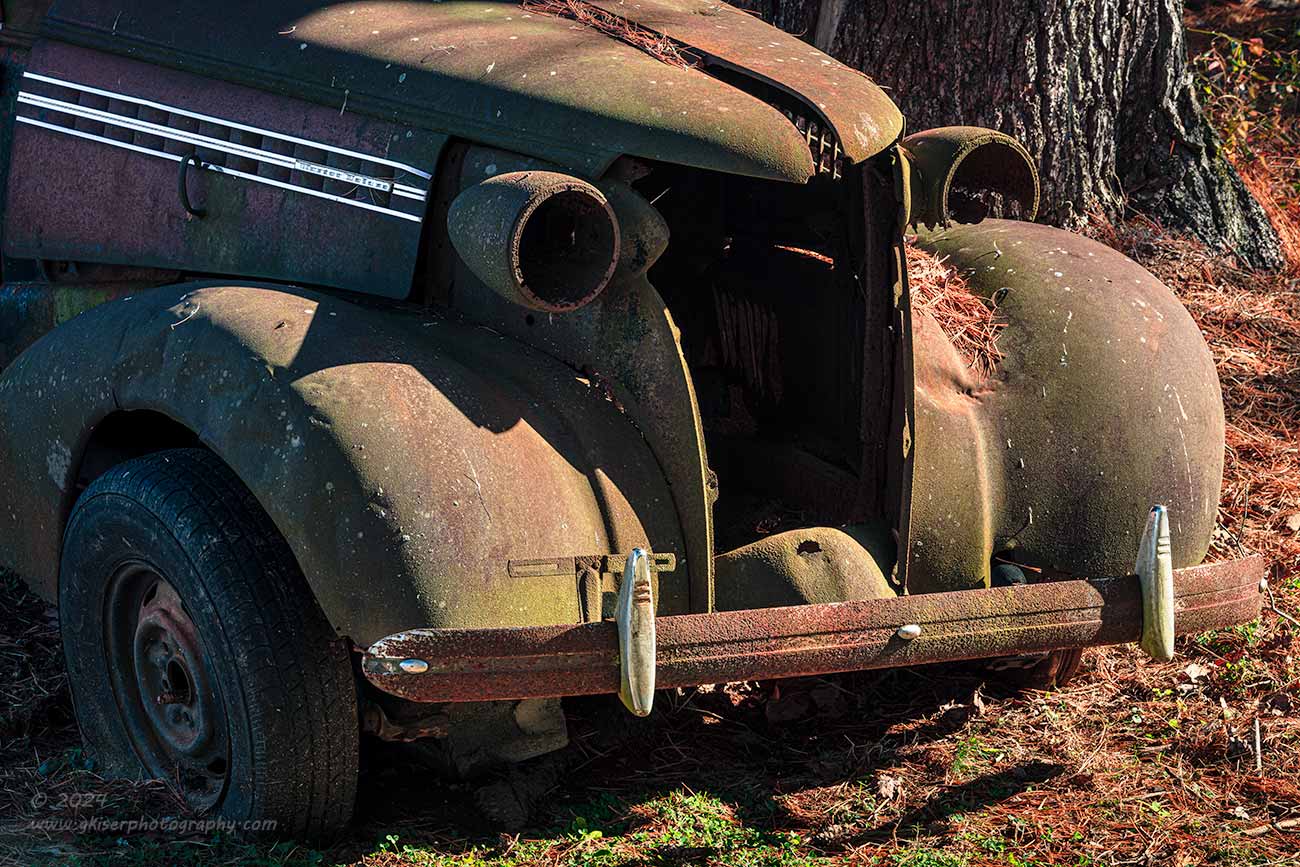
One car that is a relatively new addition to the property is an old Chevy sedan from the ’30’s that I had photographed for the first time at the end of 2022. This car wasn’t much more than a shell propped up on wheels without lug nuts. Even the rear fender had just been loosely fitted to the body clips and has since fallen from the body. The grill and radiator were gone as were the headlights, although the buckets still remained. The interior was largely gone with the seat springs remaining inside. Even the driver’s door would swing in the wind while hinged at the top with a screw. It was a beautiful old car though, and I am still getting used to it and learning how it wants to be photographed.
I walked around that care for several minutes looking inside and outside trying to find something that excited me. I liked the whole car, but the lighting was terrible for that kind of composition. That same lighting did provide a nice highlight to the front of the car which was probably the most interesting part of the car. The light was coming from the driver’s side and wrapping around the front just enough. This gave a lot of modeling to the car which added to the depth of the scene. I started to see a composition that I had shot before, but in a different way. I remembered the first time that I had photographed this car there had been a lot of fog and clouds which caused the light to be very soft and diffused. This worked well for pretty much everything that I shot, but I remember having to really focus on the structure of the front of the car because nothing was being hidden in the shadows. This time, with the sunlight hitting the car so strongly, the eyes gravitated automatically to the front of the car allowing me to include more of it. I couldn’t recall the previous composition exactly, but I knew that I had close cropped it at the wheel chopping off two sides of that front wheel and keeping things very tight on the front end. I also seemed to recall some sort of brush covering portions of the bumper. That was now cleared, and I had a great view of the front where the grill would have been.
I started to frame up a composition that included a bit more information than the last time but relying on the light to direct the eyes rather than letting the framing do it. I was really thinking that I wanted to do this one in black and white because there wasn’t much to the color palette, being largely brown and green. I was liking how it was looking in the image review with the black and white picture style applied. I made a couple of exposures here with some slight variations, but didn’t linger too much since I had already shot a similar composition.
When I got the images home and realized that this one had made it through the culling stages and into the editing portion, I went back to look at how the original attempt looked. My memory was pretty accurate with it and the crop was pretty much as I had recalled. There was a branch from the pine tree which had fallen on the bumper which was now gone. The light was the biggest difference between them, and it was enough of a difference to where I decided to carry on with the edit. I started as I had planned by making this a black and white photograph, and actually finished it as such.

“That Deluxe Trim“, Canon 5DS R, 70-200mm f/2.8L Mk2, Singh-Ray Color Combo Polarizer
The following morning, I went back to look at the edits and stopped at this one. I liked it but wasn’t seeing a huge difference with this one versus the original, so I pulled that photo back up and compared them. Yes, the light was much better in the newer version, but the essence of the photo was very similar, and I couldn’t say that the new one was really any better. I had no problem trashing the new composition, even after editing if it was no better than the first attempt from over a year ago. However, I did really like the light, and the less confining crop felt better to me overall. They were marginal differences, but enough to make me look deeper into the photograph. I realized that my initial reaction and idea to go black and white was because that worked so well on the first attempt. I hadn’t really given this much thought as a color image, but since I had shot in RAW, I still had that option, so I went back to the color profiles and looked through them until I found one that I really liked. I did a few changes to the color calibration which had been changed during the black and white conversion and tweaked a few other settings to suit the color profile that had been added. In the end, the lighting made a huge difference in the saturation of the car, and the shaded portions added another layer of color since there was a decidedly blue cast to the color in the shadows. This worked very well as a color image even though there were not that many colors involved. The sunlight had a profound impact on the colors which hadn’t been the case originally. I was now looking at a photo that was a lot better than the original rather than just a variation on the theme.
I still made the right choice on the first attempt (see above) by going black and white, but the change in lighting was shall we say….a game changer? I love how that phrase has become the new “in” thing when people talk about the latest and greatest. The game has not been changed here. The game is still all about light and how the colors affect the scene. I’ve talked about this at length before, and we are seeing exactly what I am talking about here. There are just some images that work better in one or the other presentations. The shadows introduced here by the sunlight create a natural vignette that push the eyes further to the front of the car which was why I had to crop in so tightly in the first attempt. With no natural vignetting, the eyes would have spent too much time looking at the side of the hood and then exiting the photo to the left.
I wish I had spent more time on this car because I really feel that it has more to offer in terms of abstract photos, but nothing was speaking to me at this point in the morning. I looked around a few more times to see if there was anything I had missed but couldn’t find anything at all. I returned back to the Oldsmobile and even ventured into the woods where there was an old Dodge truck nosed into the trees. There was nothing there that I wanted to capture, and I really felt that I was done for the day. This wouldn’t have been a problem because looking back on what I had shot, I probably had ten keepers out of the photos that I had captured. That was more than enough to keep me busy for the rest of the evening and possibly into Tuesday. It was certainly a lot more than I had come out intending to capture. There was just the fact that I was still feeling creative and wanted to see if there was something more to get. I knew that there were three more vehicles in front of the shop which would offer potential for more photos.
Two of the vehicles have become a fixture in the front parking area. Stitch is one of my favorites, but I had spent a lot of time working the details on that truck when I had come back in the Summer on a mentorship session. Looking at Stitch this time, I wasn’t nearly as inspired and didn’t see anything new. The other fixture that I have become used to seeing is the GMC pickup which is one that I had originally photographed in 2018. It had been sitting off on the side of the property with the other parts vehicles and future projects. Moss had started to grow on it, and that particular day there was a steady mist falling which made the patina very glossy. I loved how this old truck looked and it was in a position where I could get a nice isolated photo of it. I still really like how it turned out all these years later.
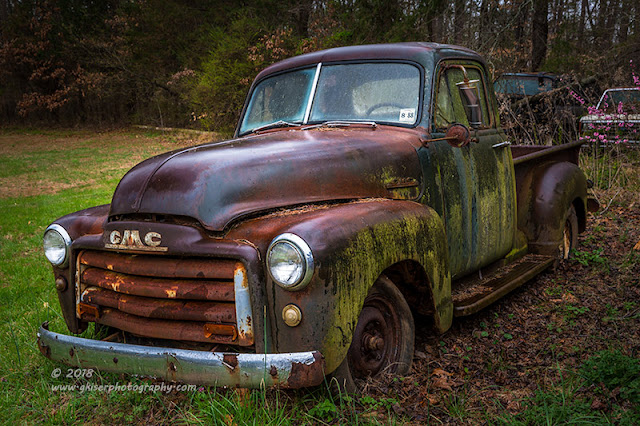
You can see in this above photo what the truck looked like back then. Oh, it was a nice one for sure and Dean hated to wash the moss off when his customer bought the truck and requested him to do that. After getting new running gear, wheels and tires, the truck was ready for anything. It came back to the shop shortly after for some more work, and I had the chance to photograph it at night using the technique of light painting. I thought that this was going to be a short-lived stay, but here we are like five years later and it still sits there. Maybe I’ll make an offer on it because it really is that cool of a truck. Can you imagine it, a custom painted bit of door art saying “Greg Kiser Photography, Landscape and Decay Photographer.” That would be wicked to roll up to a potential shoot location driving this. Hmmm, maybe I’ll ask about it next time I talk to Dean. I mean I do have a long history with this truck, and it is responsible for the number two most significant image of 2022.
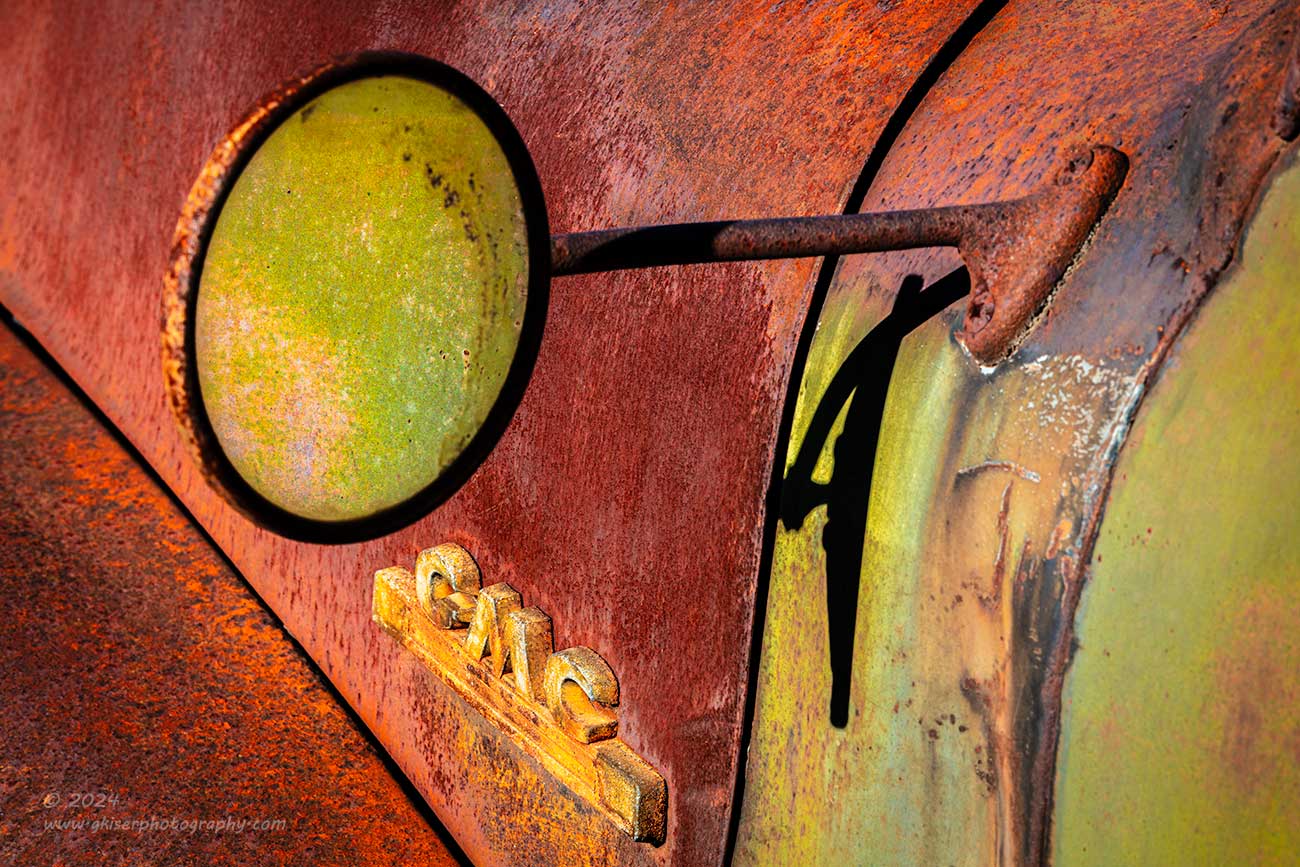
And that segue brings us back to the current trek. I bet you thought I had gone off my rocker and was just feeling nostalgic for old times. No, just wanted to really get into this next photo (actually two) because it might seem like just another photo, but there has been a lot of buildup to this one. It actually started in 2021 at the hands of one of my workshop participants. She had worked out a composition on this truck that I had never considered before, and I really loved what she had come up with. The focus was on the mirror and the reflection of the green color against the rust and how it balanced with the green section of the body on the other side of the frame. I had no intention on stealing the concept from her and made a point to not shoot this same concept for a while after the workshop. It was the following year when I returned to the property that I finally decided to give it a try. By this point, I had no clear memory of the composition and that was by design. I was going to have to work through this one on my own and figure out what made sense to me. The end result was a photo shot with my standard zoom at a very elevated angle. This created some great shapes and what I felt was a truly special image. Even to this day, I think that the photo turned out fantastic, but not without some flaws. As we live with our photos over the years, we start to see things that bother us, and even though this is still one of my strongest photos to date, there were two problems with it that bothered me.
The first problem was that the GMC emblem was at such an angle that you really couldn’t make it out unless you studied it. This pulled the attention away from the mirror which was placed right at the tip of the triangle formed by the panel lines. That bit of competing attention seemed to work against the feel of the photo for me. The other minor quibble that I had with it was the base of the mirror because it was cropped into with the composition. That was one of the compromises that I had to make for the overall impact of the photo. It was the right choice, but I don’t like having things like that cropped through on an edge. It becomes a distraction to my eyes and an exit point to the image. These were minor nits to pick, but they have caused me some stress over this photo over the years.
I saw the opportunity to make some changes to see if I liked a slightly different composition better. The light was right, and this time there was no moisture evaporating on the patina which would simplify the colors and tonality of the scene. I remembered using the standard zoom the last time but felt that I might be better served with the longer lens that was already on the camera. I was going to at least start off with that one and see what happened. Since I knew what the potential was of this subject, I really put a lot of effort into it knowing that it could very well be one of the significant images of 2024. I mean, if it was better than the 2022 version, it would be crazy for it to not be on that list.
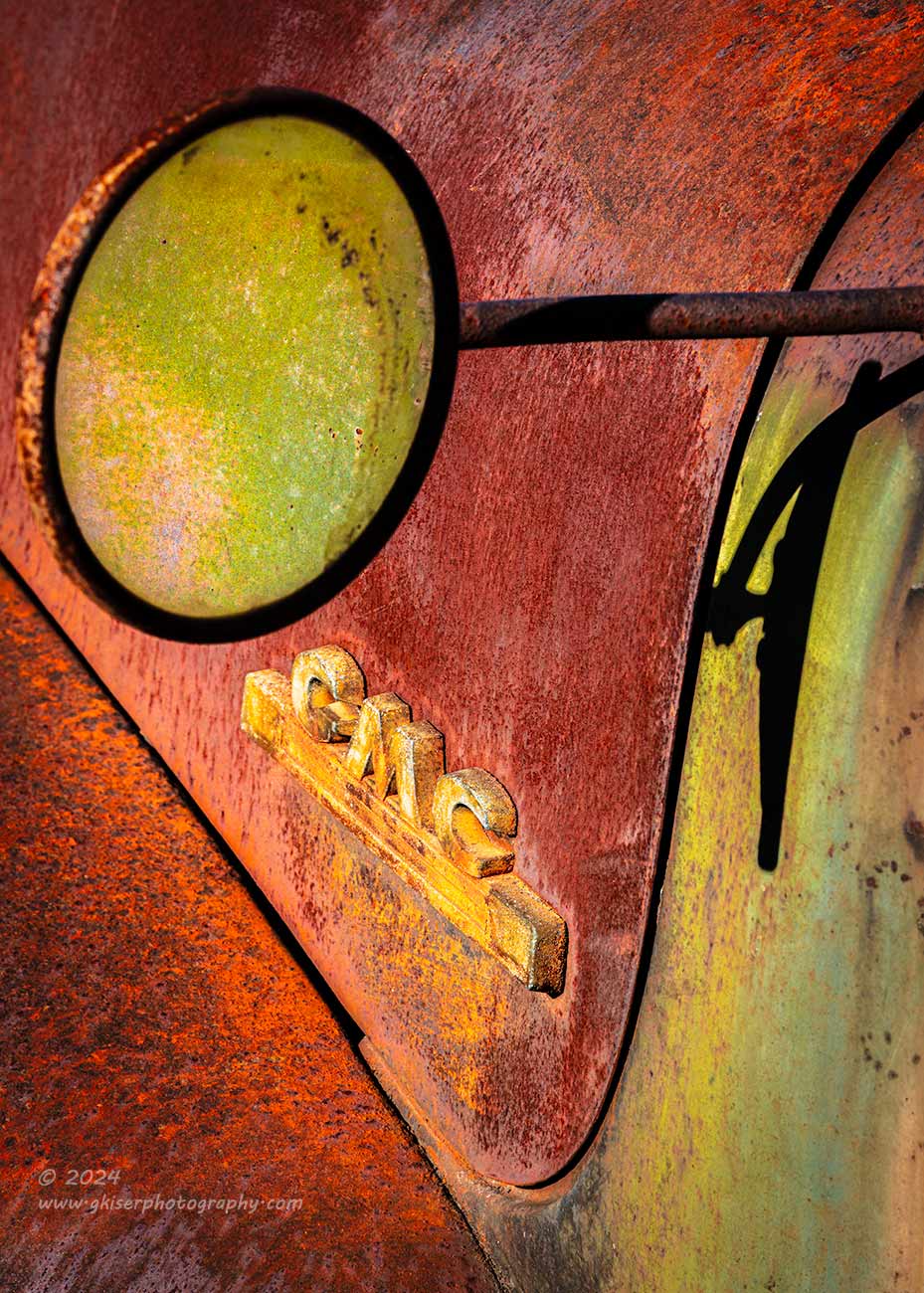
The biggest change that I made was in the camera height. I was still at roughly the same angle from the truck, but I was probably about a foot lower in altitude. This corrected the GMC emblem perspective issue and allowed it to be seen and read comfortably. The long lens also made it larger and a more important part of the photo. I was really liking that aspect. Another thing that was corrected from the different camera position was that the mounting for the mirror was now completely included in the frame (still shooting this horizontally as I had done before). My two biggest problems with the composition were handled by lowering the camera, but all was not perfect. Photography is all about compromise, and I was making one here that I didn’t like. The arm of the mirror was now horizontal and no longer made a triangle with the body lines. This was a design change to the composition, but it wasn’t a distraction as the two existing errors had been. I was willing to make that concession to the design, because there were still lots of shapes and lines in the frame which made sense, and my eyes were still able to pursue through the scene as intended.
Thanks to the sun casting a shadow of the mirror on the cowl of the truck, there was a third element that ended up in the frame that created a triangle to replace the missing one. If your eyes play connect the dots which they will do subconsciously, you will see the triangle develop between the mirror, the GMC, and the shadow of the mirror. This also fits into that rule of odds in that we are looking at three elements inside the frame. It is dynamic and pleasing to look at. The colors, textures, and body lines form another layer of interest that works well independently of the primary elements. In fact, it is the simple color palette that I love the most about this particular shot and what has haunted me since 2021.
Through the culling process, I had two of these images selected to look at further. I chose to go with the horizontal one for the edit since it included the base of the mirror. This is the one that I edited, and it turned out quite similar to the one I had shot in 2022 as far as the edit and I didn’t have a single problem with that. The biggest change was I did a local adjustment inside of the mirror for exposure and contrast. The end result looked great and compared favorably with my previous attempt. It is never a competition, but I do like to see improvement in my photographs over the year and I did see a little bit of improvement. It was just a matter of how the image stood up to the test of time at this point.
The following morning, I started the day off by reviewing the edits to make any last-minute changes before starting the blogging process. As I mentioned earlier, one change that I made was turning a black and white image back into color. The second change was in relation to this mirror shot that I have been talking about for a while now. Up to this point, I had 24 photos from the trek which had been edited, and I was kind of excited about that since my first trek of 2024 was going to have 24 new keepers. That was pretty cool, and I loved how poetic that was going to be. However, when I was looking through the photos one last time, I saw too many similarities with the mirror photos, and remembered really wishing that I had shot that composition as a vertical one. Well, as luck would have it, I had shot a few frames of this as a vertical because I loved how the bottom edge of the hood brought in another implied triangle to the scene. It was one of those verticals that had made the cut originally, but lout out to the horizontal one in the editing round.
Just for fun, I decided to do an edit on the vertical one to see how it turned out. That was a very easy task since I just copied the adjustments and masks from the horizontal composition and applied them to the vertical. A quick change in aspect ratio, a tweak to one of the local adjustment masks, and a slight adjustment to the exposure and I was done. Both compositions were strong, and they both had a different flow to them. I tried to decide which one was worth keeping, but just couldn’t do it. They both worked fantastically well and would be able to fit two very different wall spaces. because of that, I really felt that both deserved to remain in the list of keepers. As far as 24 photos for 2024, we will just call it like a birthday spanking…and one to grow on!

This GMC still wasn’t finished in front of my camera. Remember, I was out here to see things differently than before. I walked around the truck and saw all the same compositions that I would normally shoot but didn’t bother to stop at those again. I was looking for something fresh and new. When I got around to the rear of the truck, I happened to notice the broken glass. This is something that I have started to realize about myself. I love the broken glass before the age of safety glass. The way that this old glass cracks is about as interesting as the way the metal rusts and the paint gets aged. It is always unique and interesting. Because I know this about myself, I decided that I needed to photograph the scene. I had identified what excited me, and that was the first step to a good photo. I was still using my telephoto lens which had been on for most of the day at this point. This was the perfect lens to use here because I wanted to get a bit of compression to the scene to keep the steering wheel large and recognizable.
I knew that the composition was going to be horizontal because the shape of the window dictated that. I just had to figure out how to frame the composition. Photography “rules” would dictate that I use the frame of the window to frame the scene forming a frame within a frame. That felt too constrictive to me, but if I avoided the frame of the window, the cracks didn’t have a grounding to the scene. I liked having the lower part of the frame included because it would ground the cracks, add texture, and potentially color to the image. If I added the right side of the window frame, the image became very heavy on the right since that was where the main cracks were. The steering wheel, further to the left couldn’t balance out the scene. If I removed the right side of the frame the photo felt out of balance again with too much brightness on the top of the image. What I decided to do was a bit unorthodox, and I think goes against many photography rules, and even part of my edge patrol rules. Despite that, I decided to allow the top right curve of the window frame to be captured as a framing element in the upper right corner. I was careful to include enough of it to make it look like it was done on purpose, but not so much that it overpowered the composition. There was a very tedious balancing act going on, but the end result I think works very well.
The final image is well framed (how many more times can I say that word?), with the vent window closing the image in on the left side while the steering wheel and speedometer give a great sense of depth to the scene beyond the crack which is pretty much the only thing in focus. You can even see a very blurred representation of the cracks in the vent window further closing in the scene to the left. The shape of a triangle is present that points back into the composition as well, so you see how effective this framing stuff can be for a composition. Just one of those little bits of information that I will be covering during the Art of Decay workshop in the Spring. This is going to be a good time, and I hope to see you there.

When I was getting finished up with the rear window and all that framing (had to say it one more time), I heard Dean and somebody else coming out of the shop and they stopped talking when they exited the door. I could tell that they weren’t moving, so when I finished getting that last exposure made, I turned around to see what was going on. I was a little surprised to see Dean with Barry who owns two classics that I have been commissioned to shoot in the Spring. Yep, I do commissioned shoots as well, just let me know what you are wanting, and we will work that out. My mind was totally wrapped up in being creative so I was having a hard time forming words and carrying on a conversation, but we spoke for a bit, and I found out that one of the hurdles that I was having planning his shoot was solvable through both of their connections. This was very good news because there were a couple of compositions that I wanted to get of his vehicles that needed some road paint to capture the “driver” nature of his cars. Shooting old cars in the grass is great, but it tends to make them look like they might not run all that great. For two cars that have been built up to be drivers, I wanted to celebrate that aspect and have the entire photo support that concept.
When the conversation was finished, I realized just how cold I had gotten. I tend to forget about myself when I am in the zone with a camera. Having that break gave me the chance to run some self diagnostics. I was cold and I was getting hungry. It was about time to call it a day, but I wanted to look over this truck one last time before I moved on to something else. When I was looking at the truck, I found that the green and orange of the body just worked so well, and the fact that there was a clear division line between the colors was very exciting. This comes as no surprise considering how much time I spent working on the mirror abstract. I did see the opportunity to celebrate that color division once again as well as photographing another bit of cracked glass.
As I was looking at the truck, I saw the grass beyond the hood which still had a good bit of green to it. The door of the truck was of a similar tone and framed the hood and fender well which made the orange of the rust really pop. The mirror was still reflecting green and had the same effect as the abstract shot further emphasizing the orange tones of the hood. Those same tones were repeated on the top of the cab and to a lesser degree along the back side of the cab. It all worked to frame the window, which framed the steering wheel, which framed a hatching duckling on the dash. As I was looking at the scene, the photo nearly made itself, but I was going to need to get the camera in position to really make that happen first.
Setting up the shot was easy after having seen how all the elements came together. This was akin to a 3/4 length shot for a person because it was not quite an intimate portrait or isolation, and I wasn’t showing the entire truck either. It was just a section of interest. I had all the elements that I wanted in the frame and even included the door handle for a bit of bling at the bottom to keep the eyes rolling around the image. When I first saw the scene, it hit me hard, and looking at the photo that resulted, I was very happy with it. After the edit and getting the green tones to really play nicely together, I was sold on this one. It was a composition of convenience based on the way the colors were looking, but the final result was one that looks like a lot more planning had gone into it. What should have been a forgettable composition has turned into one of my favorites from the day and each time I look at it, I like it that much more. I love when that happens in photography!
I had mentioned earlier that there were three vehicles parked out front with the two I’ve been talking about being regulars so to speak. The third one is a Hudson Hornet which I had photographed back in the Summer at the previous owner’s home. Since that time, Dean has bought the car and brought it to the shop. It was finally out of the woods, and I had the chance to work some new photos of it. However, there was no trim on the car, no variation in the colors, and the slab sides were just so big that the car was just negative space. The only workable composition that Could come up with was a shot of the front clip as shot from the shaded side. I set the shot up and changed the camera to a black and white picture style and shot a few frames. One of them wasn’t terrible, and I tried to edit it, but there was just nothing there to really anchor the eyes. I ended up trashing that photo, and I found nothing else to work with on that car.
I spent a few minutes looking at the vehicles parked against the shop and found nothing to work with there, either. I think at this point, I was mentally done and needed to take a break. I had been out here for a bit over four hours at this point. I had shot 119 photos and figured that I had about a dozen to edit when I got home. I kept reminding myself that I had just wanted to get a couple of photos to start off the year. I wasn’t even able to work the location that I had driven out to visit because of permission issues. Where I ended up was my plan B which has always been a productive location, but this turned out to be insane. When the edits were all done, I had a total of 25 keepers from the day. It took me about six hours to get the edits all done and tweaked. I’ve since been typing blogs one after another all week long. If this trek is any indication of how the year is going to go, I am going to be on busy photographer. I’m not complaining, and I welcome the pace after what has been kind of a slow year. My only hope is that if I’m going to be this busy, that it not all be my personal work which I do in the hopes that I might sell a print. I really need to focus on bumping up my income through photography which will be mainly through client work and educational experiences like workshops and mentorships. Of course, print sales do help out and really show me that folks are enjoying my work.
Thank you all for joining me on this trek and I hope that you have enjoyed the photos. I had hoped to get out again during this process and photograph the two vehicles that I had started this trek wanting to capture. That didn’t work out because the sky went from clear blue to densely overcast which wasn’t right for the look I was after. I’m really hoping for some morning light and partly cloudy skies for how I expect the photo to look. I’m going to try again this week, but the weather is getting a little spastic and unpredictable at this point. I do know that eventually I will be able to get out there, and I also have another lead on a location further South in Yadkin County that might provide quite a few new subjects to work.
Until then….