Monday, January 1, 2024
Welcome back for the next installment of this rather involved quick New Year’s trek. Yes, we are still talking about what I did three days ago, and still adding photos to the collection. If you missed how this all started, you can get caught up by checking out part 1 and part 2. When I was starting this blog out, I was pretty sure that I didn’t want to cover it all in a single entry because as you have seen, there are already 13 new images which have been added to the collection which would have been a lot to talk about in a single entry. I’ve done it before, but even I get tired of looking through that many new photos at a time. I had to figure out how to break it down into more manageable pieces so that the entries would remain somewhat readable without turning into a photographic War and Peace. The first section was kind of arbitrary and I ended up cutting it after I was finished with my second subject for the day. It made for a nice package dealing with only the two subjects. The following entry, I covered a bit more subject matter over a larger portion of the property and stopped when I saw I had several related images coming up. That leads us into today’s post which I have already teased that it will certainly appeal to those that enjoy things related to the fire department.
As I’m sure you know, I was a police officer for 20 years (to the day) before I creatively retired from the department. You may or may not know that there is a certain rivalry between the police and fire personnel. It wasn’t something that I spent a lot of time thinking about, I fully respect the squirts, I mean the fire guys. They are undoubtedly the bravest of the first responders as they will be the first into a burning building after they have staged for the police to tell them it is safe to go in. I probably couldn’t have made it through the fire academy because I just don’t have the endurance to wash a big fire truck and then mow the lawn before cooking a dinner for the entire house. I do envy the rate at which they promote the ranks. There was a time when I thought that the t-shirts that were the uniform of the day were sold in the gift shop because everyone that I saw was a Captain. Of course, I kid, nobody can block up an 8-lane highway like the fire department dealing with a crash that is off on the shoulder of the road out of all the travel lanes.
In all seriousness though, Fire fighters are all really great. In my 20 years as a first responder, I’ve found that we both have screws loose to do what we do, they are just different screws. There is no way I would run into a burning building armed with only water, and I doubt that they would be willing to go head to head with somebody intent on hurting you. Like I said, different screws. It is worth noting that Dean who runs the shop that I have been photographing at for this trek is very involved with the fire department and has a lot of ties with them. It will come as no surprise that he has a few bits of fire equipment on the property as well. In fact, it was a large fire truck that was parked beside the barn which first grabbed my attention back in 2018. Of course, it would be very hard to miss this white behemoth sitting between the shop and a barn on a dreary day.
After having a chance to meet Dean and talk about the different vehicles that he had on the property, I eventually learned that this large firetruck was on the list to become a really cool rat rod with big wheels and a lowered stance thanks to an air bag suspension. I’ve seen the concept rendering and it is going to be a bad ass ride when it is done. The timeline for this project keeps changing, and there was a time in 2020 when I was thinking that it was imminent that it was going to go under the knife. The new frame had been sourced, the motor found, and the wheels and tires were ready to go. It was just a matter of making room in the shop for the project to begin. Here we are, some three years later and every time I visit the shop, I am surprised to see the fire truck still there. I feel like I have photographed this truck in all kinds of ways and have gotten some really great images including one from the middle of the night. By design, I have not left much on the bone with this truck because I have been expecting it to be gone at any time.

While I have been expecting it to be gone, I have also come to be familiar with the waiting game that keeps getting played with this one. It came as no surprise that the truck was still on the property right where I had left it last time. I had some ideas that I wanted to try with it centering around the ladders on the passenger side. This is something that I have helped several workshop participants compose around and felt that I wanted to give it a try myself. When I go wrapped up on the side of the property, I managed to work my way over to the big fire truck and began to look at things. I could see all the compositions that had been worked through in the past, but none of them were particularly interesting to me. The light was also working against me as I was looking at the brightest side of the truck. The resulting shadows over complicated the scene which was already pretty involved with a collapsed ladder showing overlapping rungs. I gave it a good try, but in the end, there was nothing there that I felt like shooting myself. It wasn’t that the composition or subject was bad, there just wasn’t a connection there for me to relate to the scene. When the composition first got talked about it was a participant who had been involved with the fire department and knew the historical significance of the hooks on the ladder. That aspect spoke to him in a way that it just wasn’t for me.
I took my time and walked around the truck in search of something else that did speak to me. I paused on the driver’s side where the siren and red light were positioned on the fender. That was certainly a point of interest that would tell a story. It just wasn’t a story that I felt like sharing. I couldn’t get an interesting angle on it, and there wasn’t a composition that really made sense. The search continued and I ended up looking at the switchgear on the side that controlled the pump motor. I have shot this before with a reasonable amount of success and have coached the composition during workshops as well. The problem was, there was really only one way to shoot it, and that has been done before. I kind of lost interest on that element and started to look further into the elements that I could play with.
It was the trio of hoses that were mounted to the side of the truck that caught my attention next. The rule of odds would suggest that things are better photographed in odd numbers and since there were only three hoses, that fit the bill nicely. I knew that there were some compositions here to work with and decided that since the light was on the other side, I had some good, diffused light to work with on this side. My first thought was to work this as a black and white scene. I wish there was some magical photographic process that I went through to come to this determination but there wasn’t. I was just looking at black hoses, with chrome fittings, on a white surface. There was no color to be found except for a bit of pinstriping and some rust. Color played no part, so I chose to get rid of it early on in the process.
From there, I just worked on figuring out a composition. I wanted to focus on the repeating patterns and the high contrast of the chrome fittings with the black insides leading to the black hoses. That was too simple to really work as a composition, but when I decided to include the bare metal retainers that held the hoses in the shelf, I was starting to see a photograph coming together. It felt like a vertical composition to me even though the main subject was of a horizontal nature. By going vertical, I was able to focus more on the fittings and the retainers rather than the hoses. This made for a more interesting composition in my mind and changed the story from what it could have been. I really liked how it was looking in the image review which was being revealed in black and white due to the pictures style being changed. Of course, shooting in RAW, I still had all the color information should I change my mind about the final presentation. I was pretty confident that color wasn’t going to be needed for this one, and I was right about that when I got home.
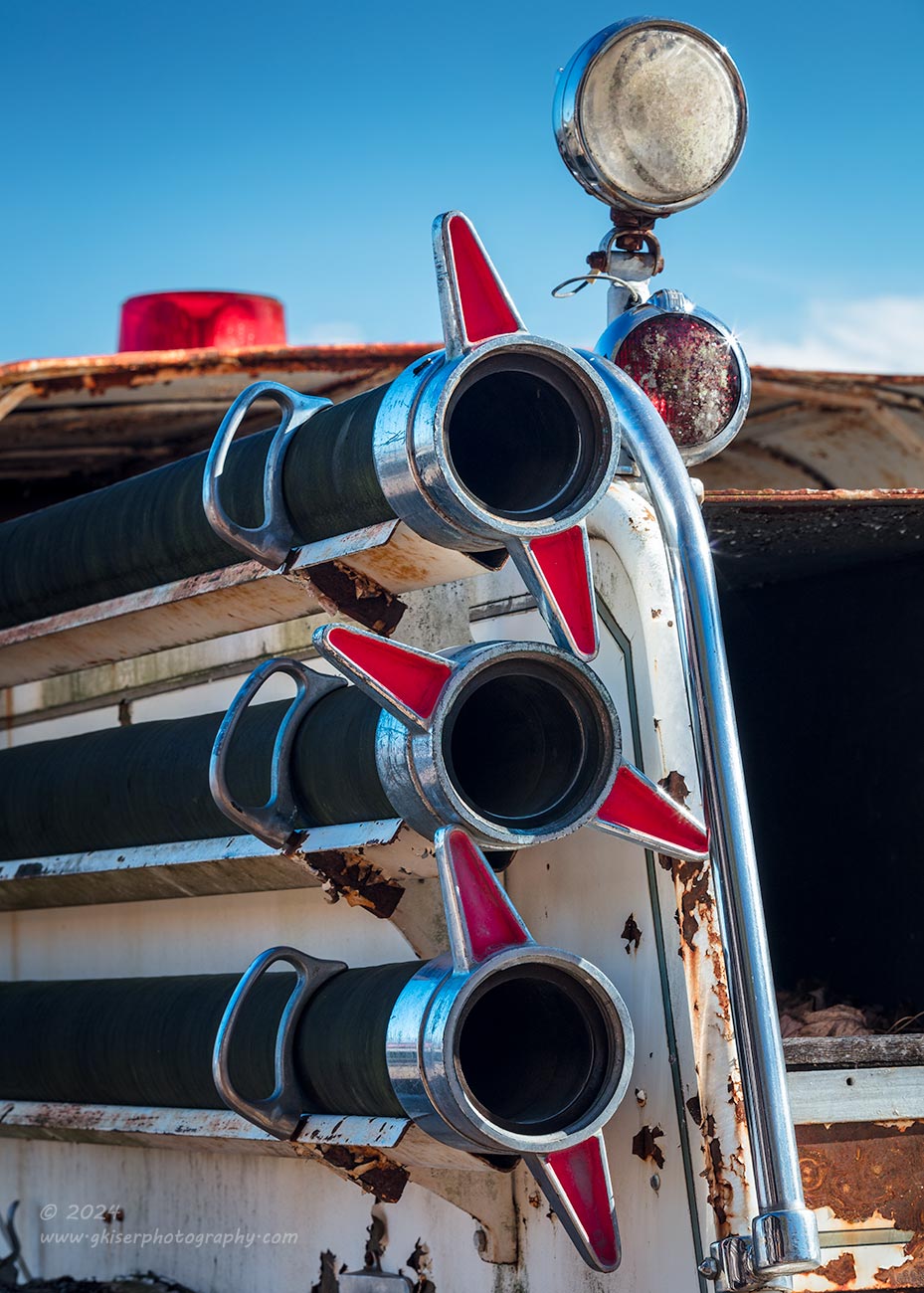
I started to look for other compositions around the hoses and ended up at the back of the truck. I had the makings of a similar composition there, but there was a very big difference on this end of the hoses. This was where the handles were placed on the female part of the hose to allow for quick and easy tightening and loosening. It was the red insets on the handles that caught my eye. They matched up nicely with the red lights that were positioned on the top of the truck and added a bit more visual interest over what I had just photographed. I also saw the need for color in this composition because of that bright red element.
It was the red that I saw which dictated a lot of the composition, however. Knowing that I wanted to make the red a big part of the photo, I had to look at the color balance through the image. The main background color was white which really didn’t factor in with the color balance, and the only other color on the truck was rust which was also warm in tone. I could have cheated the chrome to bring in more blue than was actually there to balance out the red, but I was missing the best option to provide a good color harmony. I had a clear sky above with plenty of blue which was already being reflected in the chrome. By including the sky, I could also get the red lights included in the composition and open things up to include more of the truck to show the age of the subject.
I had the basic composition figured out quite nicely at this point and started to work on the framing. Since the hoses were all lined up, I needed to get a little bit of visual tension into the frame by offsetting the red light on the roof and the two lights on the back of the truck. I had two main focal points on the hoses with the couplings and the retainers which I kept just inside of the upper elements to kind of act as a funnel for the eyes allowing the view to open up when the clear sky came into play. The spotlight was responsible for keeping the eyes in the frame and pushing them back down into the truck as opposed to taking that visual freedom and leaving the photograph. It seemed to work well, and I locked in the vertical composition to really keep the eyes focused on that path.
There was a bit of fiddling with the depth of field as I wanted some aspects to go soft, but not completely blurred out because I wanted them to be able to tell the story. I also wanted the fittings for the hoses to be the primary focus and carry the majority of the sharpness. By using the depth of field preview button, I was able to get that worked out easy enough. The exposure was actually pretty simple considering that I was shooting the shaded side of the truck as well as the part lit by the sun and the bright sky above. It wasn’t until the edit that I really saw the photo come to life. By working the reds and blues I was able to achieve that perfect color harmony through the scene and my eyes pursued just as I wanted them to within the frame. It wasn’t a shot that I had planned on making, but it really worked out well and captured a view of this old truck that I had not really paid attention to in the past. I keep saying it is worth returning to places over and over because you will find views that you have never considered before.
That was the last photo that I shot of the big firetruck, but if you will remember, I was saying that this part of the blog was going to be pretty much all fire related. Now, there isn’t another “firetruck” on the property, but there is a rat rod that has been dressed up like one. I’m sure you will recognize Ol’ Rusty from pretty much every one of my blogs from this location. This truck is a mix of parts from a Mitsubishi and Isuzu and while it might look like yard art, this thing will fire up and has been used in many a parade over the years. It is one of the first vehicles that I fell in love with on the property when I first started shooting here and I still have a very soft spot in my heart for it. It would have been a criminal offense (something a fire fighter wouldn’t know anything about ;) ) to have bypassed this vehicle while I was here. It should also be noted that I am going through these photos in the order that they were shot so it was just pure coincidence that I dealt with all the fire related subjects at the same time.
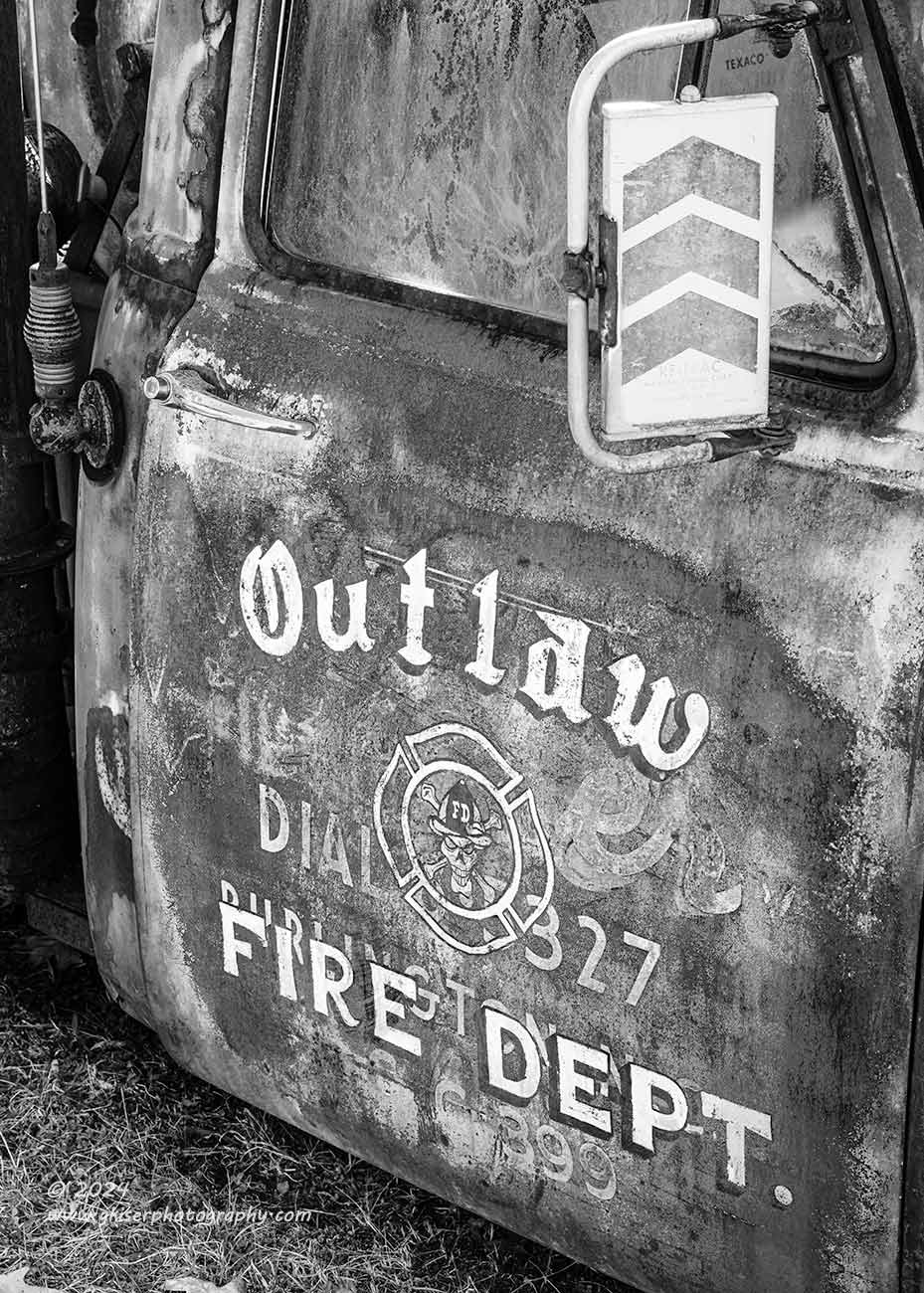
As I mentioned in my last entry when I was talking about photographing the half of a truck by the barn, I enjoy door art, and if I’m not mistaken, I have shot the door art on Ol’ Rusty before, but it kind of turns boring pretty quickly when shot from square on. Sure, you can get all the detail, but there is just no depth which a two-dimensional photo desperately needs to be interesting in most cases. I was determined to address that issue with this attempt at capturing the door art. I found the side that had the best light on it, which was also the door where there was the most detail present. I looked at things from every angle and determined that many of the tricks that I would usually use for capturing door art wouldn’t work here at all. I was thinking back to how I had captured Stitch’s doors on a previous visit which had yielded one of my most significant images of 2023 because of what I had learned about capturing elements like this. Neither of these concepts would work because there was no fender to work with, and behind the cab was just a bunch of hard angles. I was going to have to get creative here to make this work.
I decided that the best angle was going to be from the front, and I knew that I needed to include something else to add to the composition. Close by was the rear-view mirror that had some nice reflective chevrons in a group of three which worked nicely for me. There was also the base of the CB antenna which was close to the door handle. I started to play around with those elements to see how they would come together in a composition. They kind of forced my hand into doing a vertical composition which worked quite well. The mirror, antenna base, and handle made it so that I didn’t have to include the entire window because there were enough framing elements at the top to keep the eyes in the frame. At the bottom, I had to figure out how to frame things as well, but that wasn’t as difficult. I just angled myself so that there was a triangle of grass at the lower edge of the frame and to the left. That provided a visual balance for the mirror, and it also served to show how low this thing was to the ground.
My gut told me to go with this as a color image because the colors used in the door art were really interesting and visually quite appealing. However, when I got the image into Lightroom, I started to think that color was the wrong choice. I could see evidence of many different layers of previous door art coming through, and with enough local contrast adjustments, I was sure that I could really bring those out nicely. I went through some of my favorite color profiles for black and white and found one that I thought might work well. I slowly worked the edit so that the layers of door art came to life as well as all the wonderful textures of the patina. Thanks to the fact that there were a lot of different colors present on the door, I was able to really work out the tonal relationships through the conversion process.
The edit went amazingly well, and I was left with very little that had to be done locally to the photo. The biggest change that I made locally was to the chevrons on the mirror. During the conversion process, the distinction between the chevrons and the metal became very faint and what I felt was an important detail was lost. I just simply masked the chevrons and worked on the exposure there to darken them up to where they were a meaningful part of the composition once again. The only other local edit that was done was to the grass, but instead of darkening it down to close in the frame, I actually brightened it a little bit so that the textures would show through there as well. The end result is one of my favorite images from the day, and one that I think really captures the essence of this old rat rod.
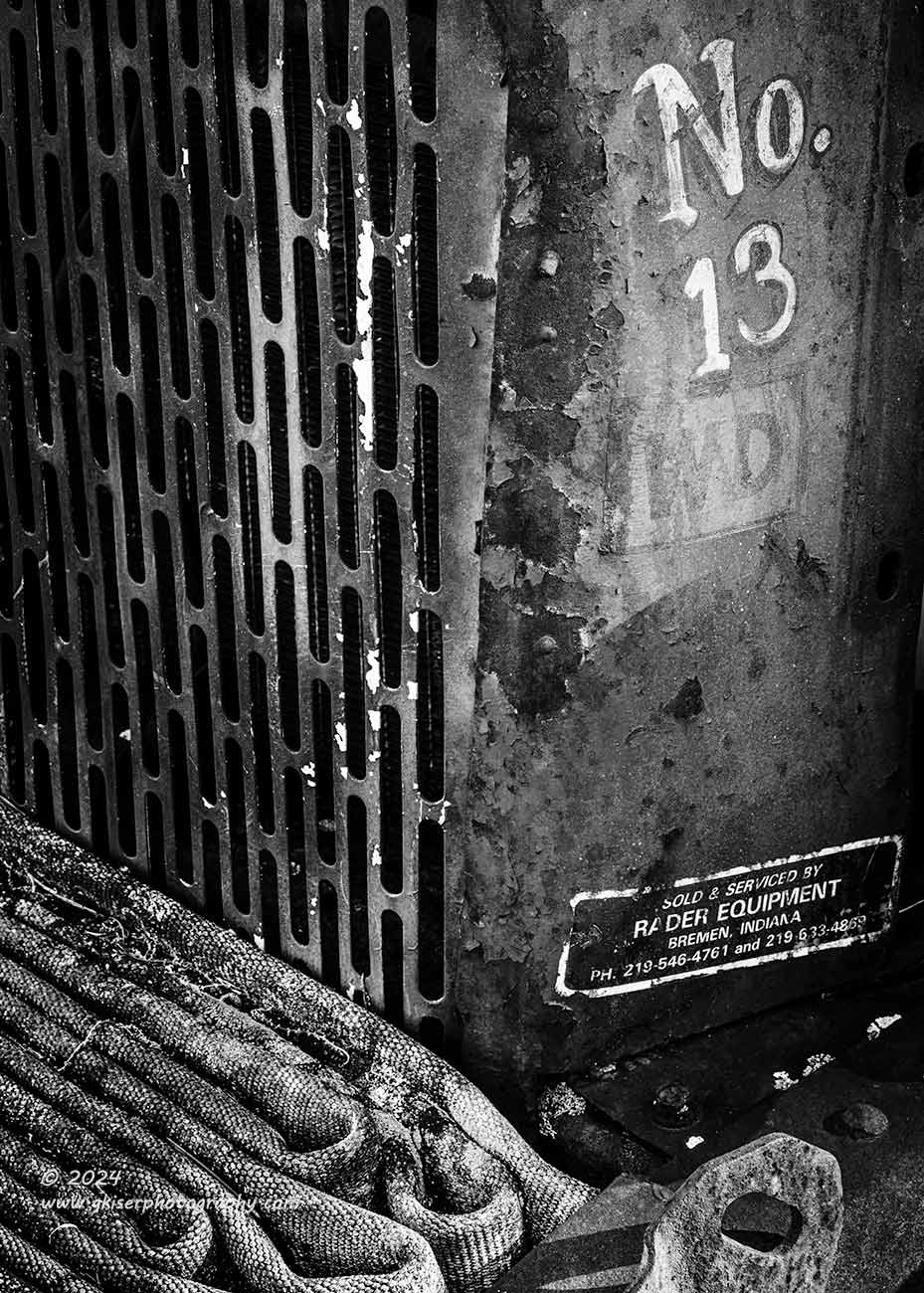
Knowing that there were lots of little things on this truck that I found visually interesting, I went back to my walking around to find more things to photograph. I knew that I was going to work this subject for a while when I first showed up, it just took me a little while to get in the right headspace to be able to see the photos. I’ve always liked the front end of this creation with the narrow grill and the stored fire hose behind the bumper. There was also a subtle “No. 13” painted on the side of the grill shell which I’ve always been a fan of. It was these elements that I wanted to capture next. I still had the long lens attached which allowed me to get lots of little details captured with ease. As you are sure to know by now, that lens is probably my favorite one to work with currently and I am still learning all that it has to offer in terms of rendering a scene.
In order to frame this image, I went with an abstract approach where I used the hose in a triangle shape at the bottom with a tow hook off to the right to firmly frame the composition. The grill takes up a little over half of the width of the frame leaving the shell to finish things out on the right. The “No. 13” is prominently displayed at the top right corner while a standard product label is at the lower end of the grill shell. I would have rather not had the text readable there, but I think that the element is needed in that space.
I wasn’t sure if this was going to be black and white or color when I was capturing it, but I shot it in color as that gave me the best ability to capture all the dynamic range of the scene. When I got it home, I looked at it and liked it in color, but when I removed the color and applied this particular profile to the image, it just came to life for me. I loved the contrasts that it had which showed off the different textures and patterns which was what this composition was all about. There were even some previous identifiers which were shining through the patina which I found to be quite interesting and not fully visible in the color versions. There was just no question as to how I wanted this photograph presented.
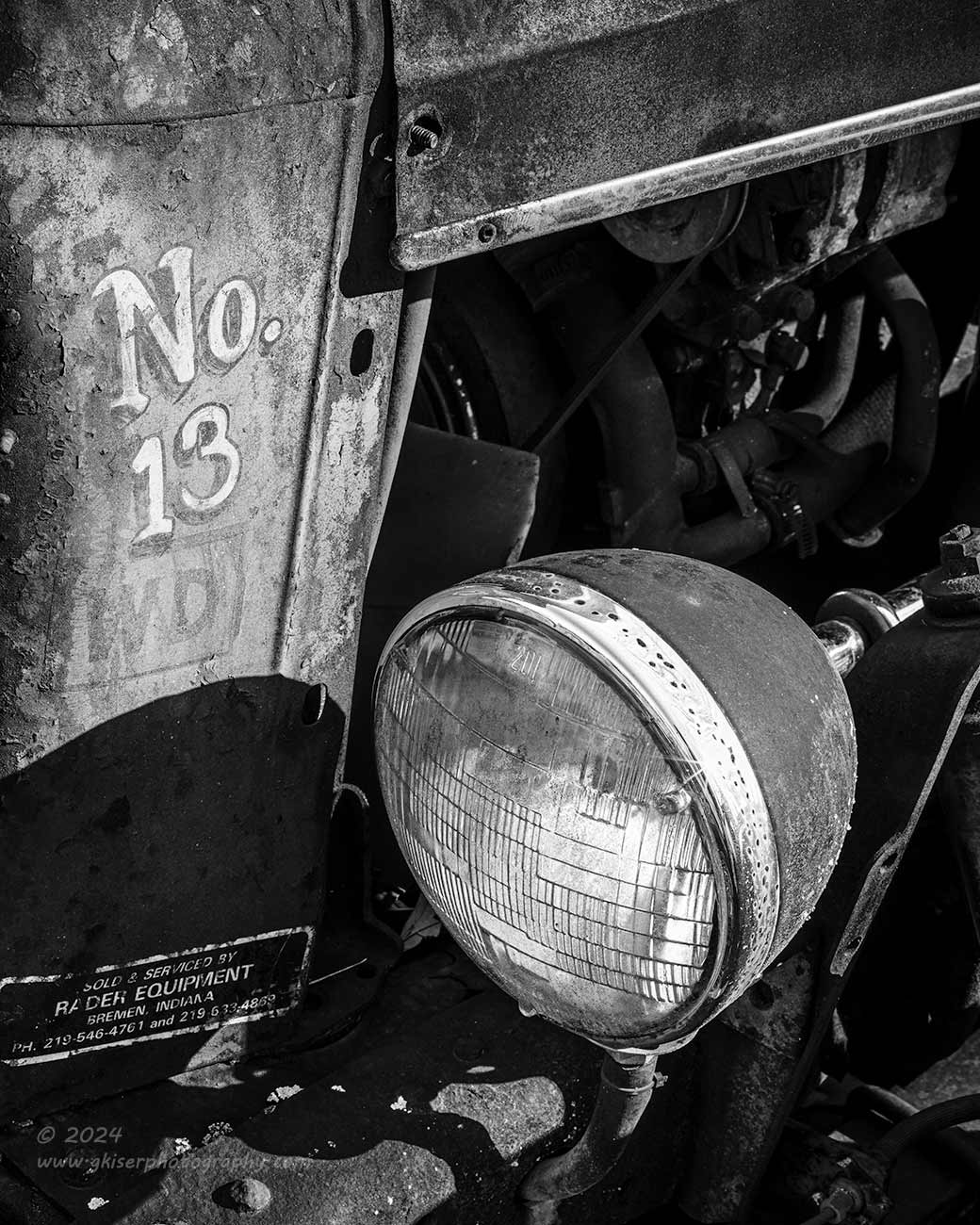
I actually copied the edit from the previous shot to this next composition that I worked on which was designed to be an alternate to the first in case it didn’t work out. I still wanted to capture the “No. 13” artwork on the shell, but I figured that adding in the headlight might tell more of the story and make a stronger photo. As with the other shot, I played with the compositional ideas with this one for a while. I again landed on a vertical composition with the light and the identifier diagonally opposed for a bit of visual tension. I included a portion of the hood which covered the engine that was in the shadows. The product label was still present in this composition although I don’t think that it was really necessary, and I would have rather it not been there. Fortunately, the sunlight helped me here as the “No. 13” and the headlight were both in the sunlight, while the engine and the label were in shadow. This helped to simplify the photo quite a bit and it left me with a very workable image.
This version turned out to be much less abstract, but it was more effective at telling a story of sorts. The two photographs went about showcasing this subject in very different ways and even though they were edited very similarly, they were miles apart in terms of appeal. because of that, I decided to include both of them in the collection of keepers. This happens occasionally when I have shot two variations on a theme, and both turn out to be successes and for different reasons. I do like when that happens because it means that I have just explored two ways of shooting the same scene which both work individually. For the longest time, when I would try this one would work, and the other clearly didn’t. Of course, occasionally neither would work at all.
I had originally thought that this vehicle was going to really be a good subject when I had the idea of coming out here to work on the artistic isolations. I knew that there were just so many unique aspects of it thanks to the design that Dean put into building it. When I had first looked at it, I wasn’t in the right mindset to really see these things as photos, but I knew that I would have to spend some time out here to allow myself to open up to the possibilities with each vehicle. The light had also not been right when I first arrived, but now that the sky was clear, the shadows were making my life a good bit easier as long as I agreed to work within those confines.

I continued to work my way around Rusty looking for other elements to photograph. This was pretty much like hunting a composition in the landscape. The easiest thing to do there is to recognize that everything is beautiful and look for something that sticks out from the entirety of the scene. That could be a tree, a mountain top, a lake, a fence, or something along those lines. In the case of looking for automotive isolations, it could be a broken axe stored on the side of the bed. I have seen this axe for a number of years, and I think that at one time it was whole. I do recall it being broken in many of my recent visits. Now that I was listening to the vehicles around me, I was able to hear how they wanted to be photographed. It was this detail of a broken axe that captured my attention and creative instincts.
Of course, to look at it initially, I saw that it was a Craftsman axe, and my first thought was to tell Dean to take it to Lowes for a warranty replacement. I mean Craftsman products have been lifetime warrantied forever and a day. I do wonder if they would honor the claim come to think about it. Anyway, I digress. I did really love how this axe looked and there was enough side light on it to show depth to the scene. There were a few minutes of figuring out a composition before I set the camera up, but once I had it figured out I put the camera into position. I framed up a strong composition where the axe was placed in the upper left third, with the edge of the bedside framing the top of the composition. The tire cut through the bottom right corner, and it all looked….to static. It was a compositional concept that I had used many times before, and that might have made it stale in my mind. It might just be that going with things perfectly straight was boring. I think it was more of the latter rather than the former, but I will say that straight compositions still do have their place, but I wanted to look at other options.
By moving to the right just a bit and elevating the camera, I was able to capture basically the same composition, only with everything at an angle. It immediately improved the composition and made it more dynamic. It went from a photo that I figured I might as well try to one that I was actually pretty excited about seeing upon completion after the edit. When I went through the culling process, my opinions were strengthened, and I quickly discarded the straight compositions and looked at the two angled ones that I had shot. I tried it as both a black and white as well as color to see which I liked better. The black and white one worked fine, but the color version had more pop. There was a good color harmony as well since the holder for the axe had a slight blue cast as did the tire in the lower right. That balanced out the warmer tones of the rust and wood well enough and it gave a sense of urgency to the photo that the monochrome couldn’t convey. The end result is a photo that I am very happy with, and one that I think tells a great story even though there are very few elements to the photo.
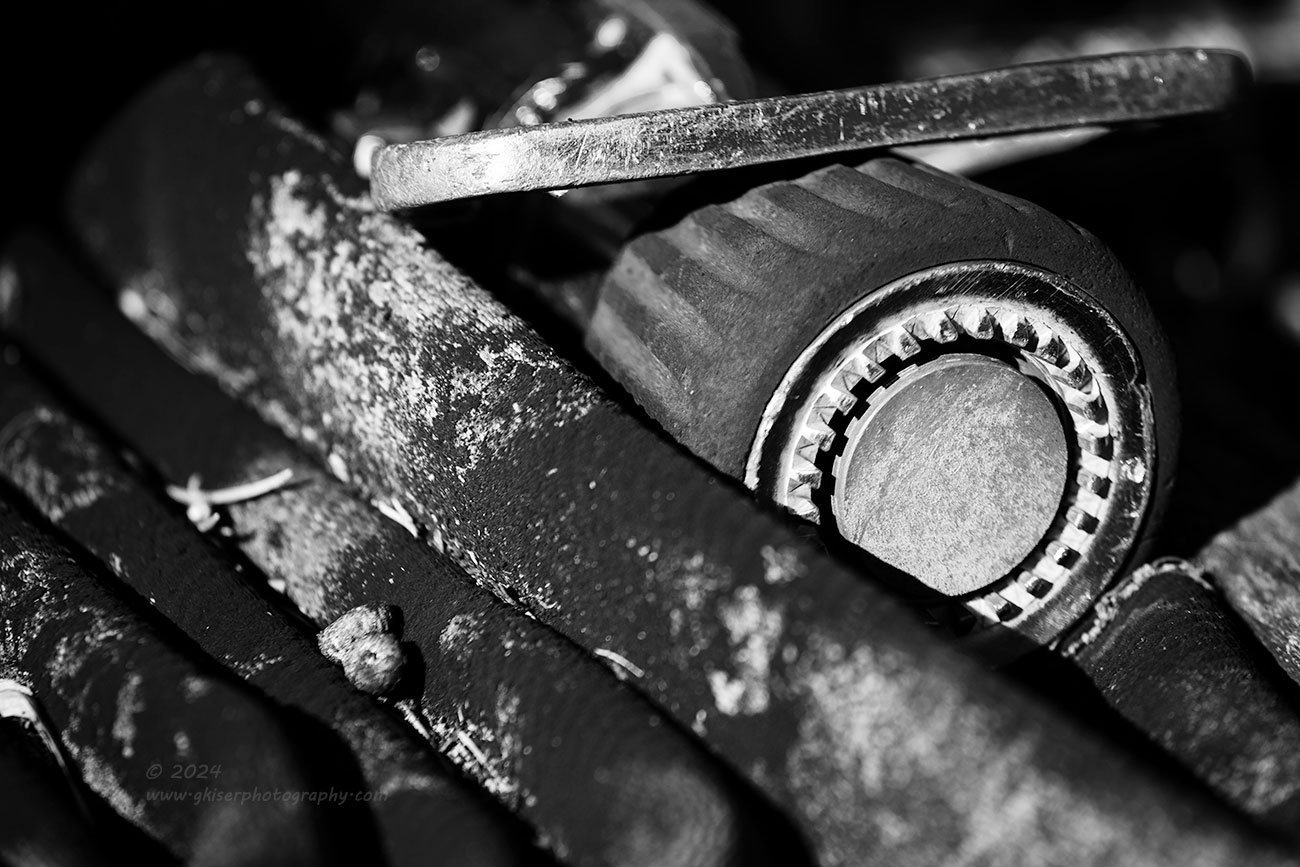
I really thought that I was all finished with Rusty at this point because I had shot so many compositions that I felt were pretty good. That didn’t stop me from going around it one more time to look for something else to photograph. I stopped at the rear of the truck which I have photographed before, and helped workshop clients compose images around, but this time, I wasn’t interested in the artwork on the back of the truck. I was looking at what appeared to be a completely dry rotted fire hose which was coiled up in the bed. This hose has made it into a number of compositions, but only as a supporting character. This time, I was really looking for those little details to make big photos out of. I saw the opportunity for that to happen with this particular detail.
I started to look around and see how I could photograph the hose the best. There was a small slit where I could frame an image below the bar that held the rear lights, and the tag that was mounted to that bar which was just to the right of the sprayer. All of these aspects kind of dictated how my composition was going to go, and I framed it up horizontally keeping everything that wasn’t the hose out of the frame. To further simplify things, I chose a very limited depth of field with the focus centered on the head of the sprayer. This allowed everything else to go blurry and just become shapes around the main subject. The handle for the sprayer was close to the head, so it was also in focus which was important because I felt that was part of the story here.
For the edit, I had no question that this was going to be monochrome. I just had to find the profile that fit the scene the best. From there, the edit was quite simple, and I don’t think I even had to do any local adjustments to it. The end result is a nice abstract photo that has a lot of interest because it asks more questions than it answers. I really like how this one turned out and I’m surprised that I never saw this before in all the times that I have shot this truck. It really goes to show you how important revisiting locations can be. You will bring different ideas with you every time, and you will see things differently depending on your attitude and emotional state.
That last little bit is very important here, and I’ll show you why. Since around Thanksgiving, there has been a lot going on and I’ve been rather overwhelmed with many aspects of life. Because I am very self-aware of how I see things photographically, I know that during these times I gravitate to detail shots. It is a way of clearing out all the noise and distracting elements of life. When I am composing and shooting an image such as this fire hose, or the door art on a rat rod, I am able to put blinders on to everything else and focus on a single detail. This makes me very happy, and it calms me greatly. Since I know this is kind of where my mind is these days, I was looking forward to finding these little details and working them as I have been. On the other hand, if I have been doing lots of projects that require paying attention to details, I know I generally prefer to back away and photograph the broader scenes which include more details because the small details tend to get lost in those situations. I enjoy seeing the larger picture when I have been focused on the little things for so long. Understanding who you are as a photographer can have a huge effect on the effectiveness of your photography depending on whether you embrace your own baggage, or if you fight against it.
Thank you for continuing to join me on this trek. We are currently at 20 keepers out of 105 frames shot on a day where I just wanted to get a photo or two. We are still not finished though. There is still one more blog to come which should be published sometime on Friday. Only then will you know the true count of the keepers and how many frames I shot. You can see already that my hit rate is really good on this trek, and that doesn’t change with the last bit of it still to go.
If you are interested in doing photography like this and have a decent understanding of your camera, consider signing up for my Spring workshop where we will look at the ins and outs of how to create images like this. There will be opportunities to shoot entire vehicles and even groups of them, but the main focus of this workshop will be teasing out the details and working through them to make some very artistic photographs that cause people to think. It will be a two-day workshop with the main portion being in the field actually making images. The next day will be an open discussion as well as a chance to share some of your images to see what can be learned. It is a different take on what I have done in the past, and an opportunity to really delve into creative photography like never before in one of my workshops. I hope to see you there!
See you back here soon for the conclusion to this “short” trek….