Wednesday, December 27, 2023
When I went to bed last night, I had a laundry list of plans for going out with the camera this morning. I was in the mood for a bit of photography and was even looking at doing a lot of black and white work because that was where my creative itch was at. I was in bed before 11pm and I had the clock set for 7am. It was too late to catch a sunrise, but I wasn’t expecting any color at all, so that was just fine. In fact, the weather was going to be very cloudy, and after a full day of rain, I was hoping for some morning fog which was where my first subject was going to come into play. Let’s go through the list of locations I planned on hitting this morning.
I was going to start out with a tree that I had seen about a year ago on the way to Planet Fitness with Toni. It had looked gorgeous in the fog with the bare branches backlit showing off the structure of the tree. I have been waiting for the conditions to be similar so that I could try and capture that scene, and it was looking like this was going to be the morning. The leaves were finally off of the tree and the weather conditions were looking favorable for it to happen. Well, when I got there, the fog wasn’t all that dense, and the clouds were keeping the sunlight from effectively backlighting the tree. I saw no potential in the composition and decided to abandon it. At least it was just about six miles from the house.
My second idea was to go and photograph an older graveyard with the hopes of the cloudy and misty morning adding just that right atmosphere to the scenes I shot. I actually had two different locations that I have been thinking about trying. The first one was only 20 minutes up the road, so I went there first. When I got there, the conditions were right for what I was wanting. The mist added some tonal variations to the headstones, and the overall lighting was very melancholy which was what I was after. I parked and got out to look for compositions before I pulled the camera out in the rain. I spent about 10 minutes walking around to see what might work. What I ran into was something that I have to deal with every time I try to photograph around a cemetery; I really start to feel like I am disturbing those who have been laid to rest there. The more I walked around, the more I felt really bad about possibly taking photographs of the stones. I looked for ways of doing it without including the names, but that just wasn’t going to work. Eventually, I decided that this was not for me. I just didn’t feel right about it and figured that I would be better off finding another subject to work.
Well, with that realization, my other possible location in Lenoir was out. If I didn’t feel right photographing headstones here, there was not much of a chance that I would change my mind in the hour or so it would take to get there. That left me with two other locations to try.
I set my course out to Yadkin County because I had been considering photographing the Shore Styers Mill Waterfall here recently and with the rains, I knew that it would be rather active. I’ve photographed it before after heavy rains and the water becomes very churned up and turns into a frothy brown flow that I think photographs a little different than a normal waterfall. It was a little bit of a drive to get out there, but I had run out of options close to home. Not quite an hour later, I was pulling into the parking area of the falls and saw the rush of water flowing over the drop. There was no detail to the cascades because of the much higher than expected waterflow. I paused there briefly and decided that there were no real points of interest to work within the cascades and since I had no interest in doing an overall photograph of the falls, I pulled back out into the road and contemplated my next destination.
The last place on my list was a follow up to my last trek into East Bend. There were still two different vehicles that I wanted to photograph out there, but the more I thought about it, the less I wanted to do it today. The light wasn’t all that great for doing automotive work, and I knew that I wanted to have an interesting sky for the pickup truck at least. The sky overhead was just a solid overcast of clouds which wouldn’t work. I was feeling a little defeated and decided that I would save those cars for a better day when the light was better. For now, I was looking at a quarter of a tank of gas and no more options. I set my course to the West and towards home.
I had been gone for about an hour and a half now and had nothing to show for it despite having like four locations in mind to shoot. I was starting to wonder if I was actually feeling as creative as I thought I was. Usually at those times, I can get out and work with no problem at all, but I was just not seeing that first photograph in my head. It was a little depressing feeling like I had the want to make photographs but couldn’t make anything at all work. The mist was still coming down, but it was getting slower. As I made my way back to Wilkes County, I kept thinking about locations close to home that might work with the existing lighting. Nothing was really coming to mind though. It wasn’t until I got into Wilkesboro that I remembered the two old Dodges on the outskirts of downtown North Wilkesboro. I’m not sure why they came into mind, but they had. It was worth a try since I had not photographed them in the winter quite like this before. I made a quick exit off of the highway and headed to the location which I was quite familiar with by now.

When I arrived, I saw the one Dodge out in the open next to the same trailer that it had always been parked near. The difference with the scene from what I was used to was that the vegetation was must less intrusive around the car. I liked the fact that the color of the car stood out more since the greenery was no longer…well, green. The color of the car was still not a favorite aspect of the scene, but I had been interested in shooting black and white so that might not matter to me once I got started. I was here, I had the place to myself, and I had nothing at all to lose by giving it a shot or two. I parked out of the way and grabbed my camera. Based on my recent success with the long lens and the fact that I have shot this car mostly with my standard zoom and even wide-angle lens, I grabbed the 70-200mm lens to get me started.
Since I still wasn’t really feeling all that motivated, I started off with the basic overall composition of the car. It was a little bit of a different way of doing it because of the lens choice. The compression to the scene did work well since the front of the car was so large anyway. I found a composition that used a tree in the background for a complimenting element. I played with the height of the camera until I liked what I was seeing. Getting down kind of low so that I was online with the car seemed to work very nicely from a perspective standpoint. I fired off a single frame horizontally and then flipped the camera to a vertical orientation to try it that way in order to bring more attention to the tree. In total, I shot three frames of this basic composition. It wasn’t much, but I had something in the bag at least.
It was the first composition that I had shot that turned into the first keeper of the day. It wasn’t necessarily an inspired composition, but I saw something in it that I really liked. For the first time ever shooting this car, it stood out on its own against the background. I chose my favorite low saturation color profile to begin the edit with because it would concentrate on the blues more than the greens which I felt would work for this shot best. I spent some time working the colors up selectively until I had a generally cool toned photo where the primary color was that of the car. I gave it a bit of a grungy final look and called the edit done. It was simple, but I really liked the way that the colors came through with the edit in comparison to the tweaking of greens that it normally took. The photographic day had finally started, and I couldn’t have been happier.
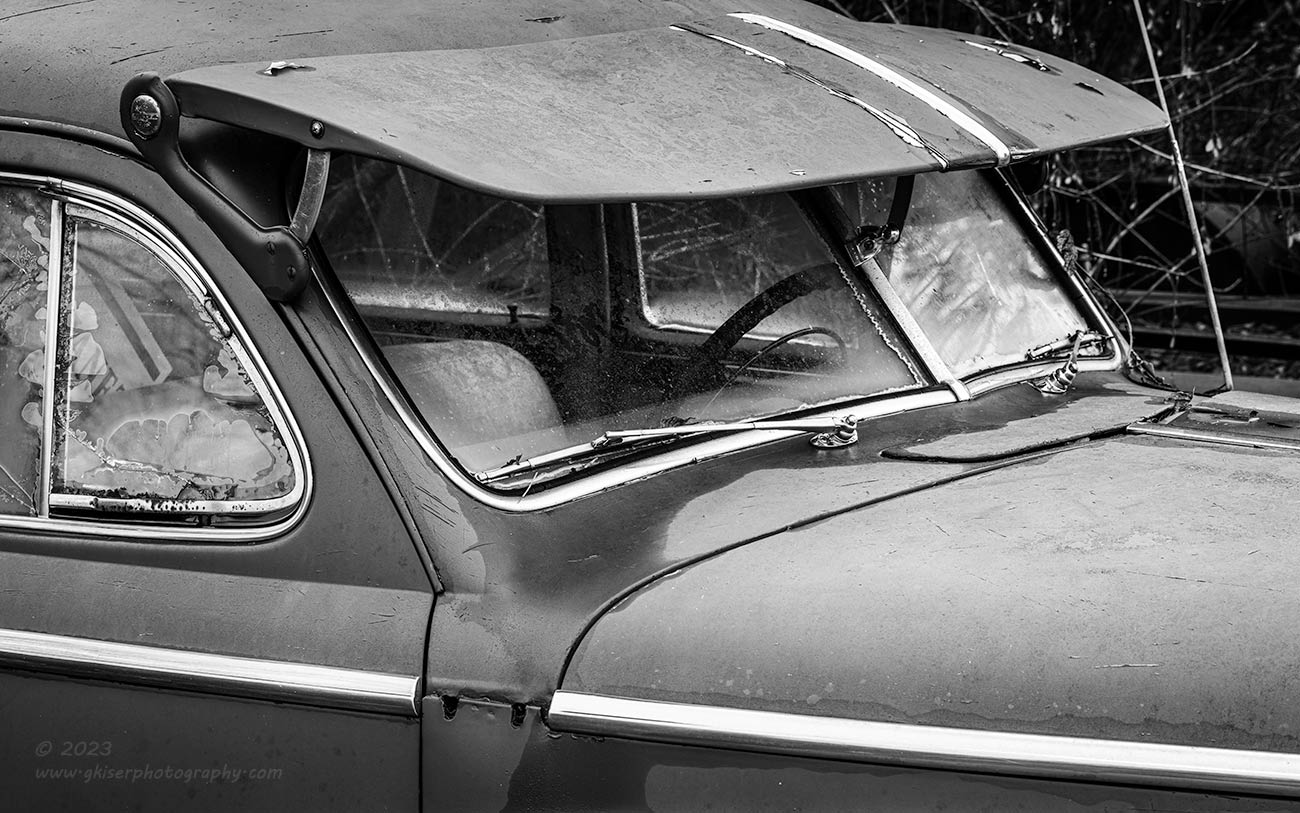
The next three frames were all about the passenger window post. I wanted to concentrate on this part of the car because I have always found the visor above the windshield to be quite interesting with this car. Part of what I had decided to do with the car today was to work on isolations and really work the angles. I’ve learned over the recent treks that I seem to get much more creative when I slow down and truly work the subject. By taking my time, I was hoping to find all of the angles and bring some new life to this old car.
The concept for this composition was to use the chrome molding as a lower framework to the photograph. The vent window would frame the left side, while the visor framed the top of the image and worked with the windshield to formulate the main focal point of the frame. This was going to have to be a black and white photo because there was a campaign sign in the rear seat that had red text and would show up way too easy in color. By losing the color, I felt confident that the sign wouldn’t be a distraction. I wanted the photo to be about the lines and design of the car since this was a unique look compared to most of the cars that I have photographed over the years.
I was pretty happy with how it was looking in the image review and had even changed over to the black and white picture style so that I could get an idea how it was looking as a black and white composition. It was the last of the three frames that made the cut. It was edited pretty much like I had seen it in the camera, but I applied a 16:10 aspect ratio crop to it in order to accentuate the lines of the car. The end result was quite nice and I’m glad that I spent some time working that angle.
The next five frames that I shot were backed away from the car and trying some different framing for an overall shot of the car, and in some cases an isolation on the front half of the car. None of these really worked, and there was only one of them that made it to the two-star rating during my culling process. In the end, these just all felt very bland and uninspired to me. I preferred the first image of the day when it came to the overall composition of the car.

That left me getting in close once again to the car in an attempt to figure out an intimate capture to show off the lines and textures of the old Dodge. I seemed to gravitate back to the same pillar that I had just finished shooting, but felt that I wanted to do a vertical composition instead this time. I worked through the composition without making an exposure until I thought that I had it just right. The way that I had it framed, I was able to see the broken window which I thought was very important to the story of the car. The bit of molding was used to frame the bottom end of the composition while the visor was there to frame the top of the composition much like it had in the horizontal version.
While this composition was shot from about the same angle as the horizontal one, it has a completely different story to it. The broken window is the focal point here and I think that aspect tells a lot about the car. I like that the visor is still featured very prominently as that is still one of the more interesting elements of this car. The cracks in the paint really show up well in this composition and again helps to establish the decay end of the photo. Black and white was chosen here because I wanted the focus to be firmly on the shapes that I had captured, and I wanted the chrome to establish those lines. By losing the color, the chrome becomes much more effective in the composition.
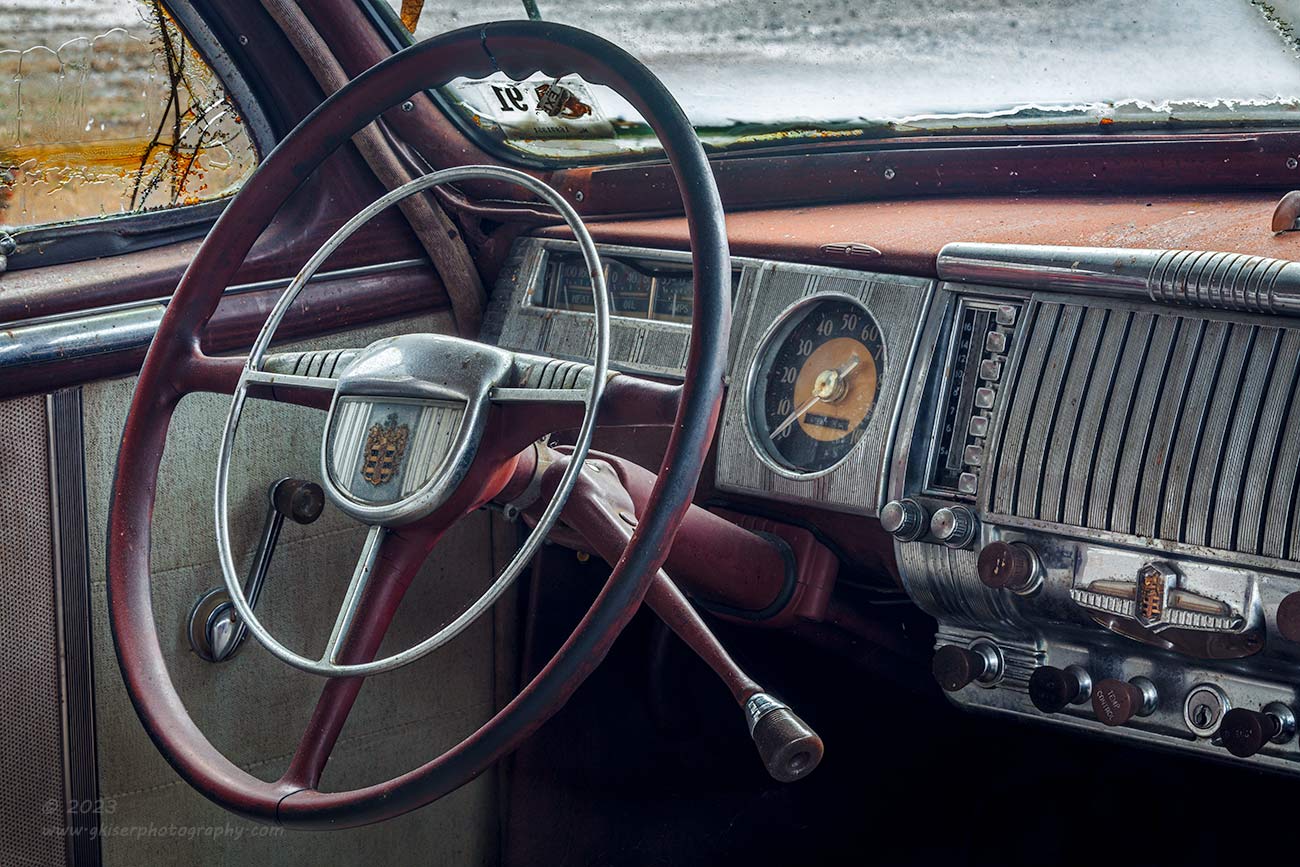
At this point, I was feeling like I was finally getting in tune with the old car. I had done all of the expected compositions I felt like and wanted to stretch my creative muscles at this point. Having worked this car several times in the past, I wasn’t really sure what to try next. I knew that I had more access to the car since the vegetation was dormant, which offered some new angles. I decided to see what I could do from those areas. I went to the back of the car and saw the trunk for the first time, but there was nothing there that I really wanted to work with. I did notice that I could see the dash clearly through the open rear window. This, of course, fed into my long-term goal of learning to photograph dashes with these cars. There is something about that part of the car that has created a bit of a challenge for me in terms of composition. Getting things to line up always poses a challenge for me.
I was seeing a great opportunity to capture the dash of this car, but I had to contend with the seatback and the frame of the window. I thought about it and realized that I had the telephoto lens attached which should make that less of an issue because I would be able to shoot with a narrower field of view. I worked out the location of the camera which turned into quite an ordeal as I moved it in all directions in increments of about a half inch. Too high, and I got the frame of the door, too low, I got the back of the seat. Too far to the left and the speedometer was covered, while too far to the right, the window crank disappeared. When I would get it close, I would then have to get closer, or further away and adjust the focal length before starting the side to side and up and down over again. When the process was finally finished, I had a composition that included all that I wanted, while it excluded all that I didn’t. The elements that were present were also organized in a way that I felt looked really good. The only thing that was left was the exposure.
This was another area where I had to consider options. The windows were fogged and were lit much better than the interior of the car. The footwells were in deep shadow, and most of the dash was in moderate shadow. Looking at the histogram, I had enough detail if I just clipped the highlights by a 1/3 of a stop which realistically, I could recover in post. I considered doing an HDR capture of this scene, but decided against it since I didn’t mind the footwell going black. As long as I could get detail in the dash, I was going to be fine. The idea was to do this in black and white which would also have more leniency in terms of tonality.
As you can see, I ended up doing this one in color instead of in black and white. That was in a large part due to the detail that was captured by the camera in the shadows. When I started the processing, I saw all that luscious color coming out of the shadows and I started to work the subtle color tones as part of the edit. In short order, I had an image that was chocked full of details in the highlights as well as in the shadows. All of this was from a single exposure, and I was absolutely thrilled with the outcome. I’m still not where I want to be with doing interior shots, but I am getting closer to that goal with every attempt that I have made. This is probably one of my favorite interior photographs to date, but I don’t know if it would qualify as a significant image from the year. Sadly, there is not enough time to live with this photograph to see how it stands up to the test of time. That is a pretty important qualification for that list, and with it being published in just two days, I can’t make a qualified decision on this one in time.
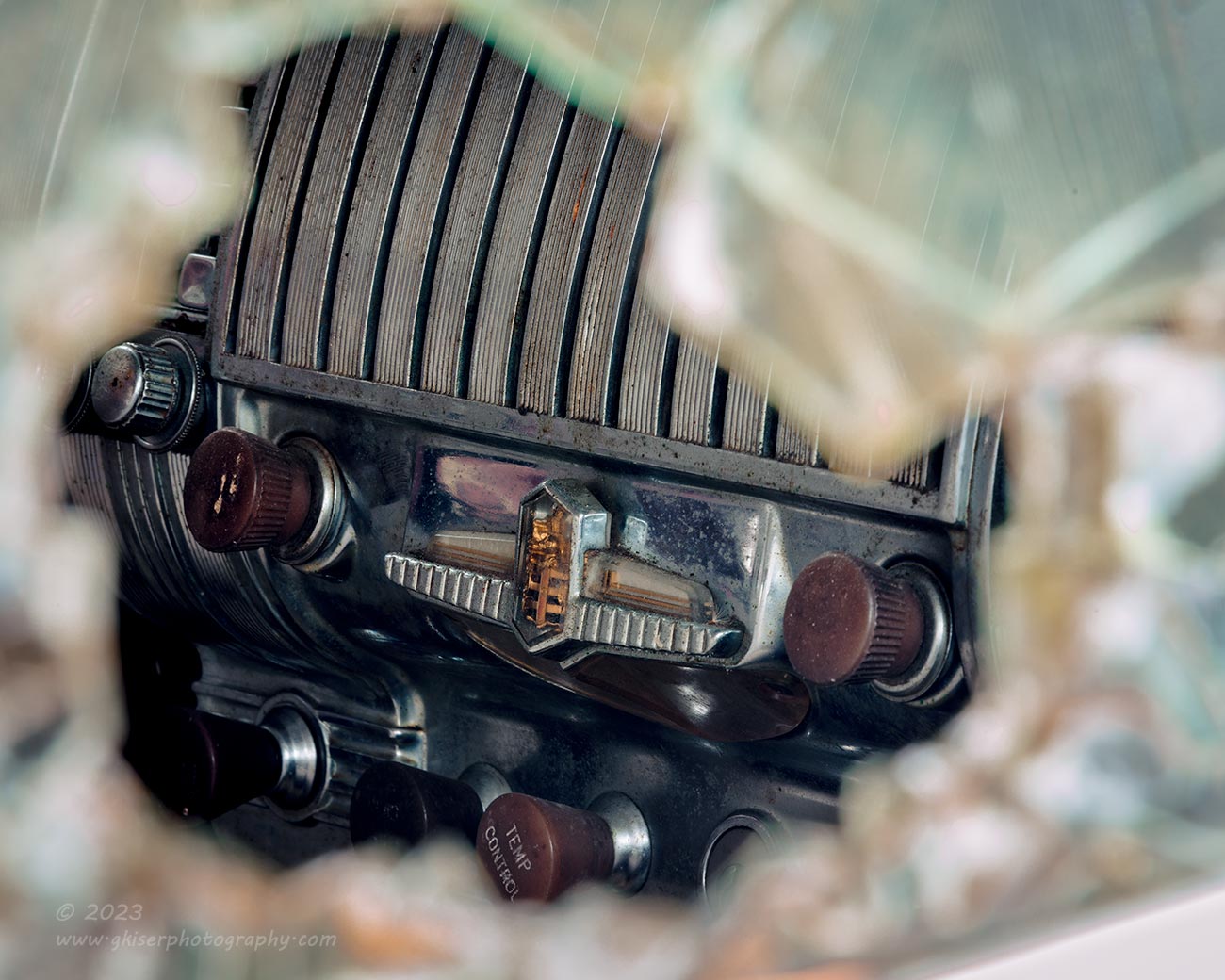
While I was working on the dash composition from the open rear window, I took notice of the hole in the side window which I had photographed before as a main element of the composition. Now, I had another idea on how to use that broken glass. I left the camera by the rear window and moved up to the hole. I just moved my head around until I found a vantage point through the hole that would work for a composition. It was the knobs that really grabbed my attention as well as what I believe was the speaker grill which took up the same room that a modern-day infotainment center would occupy. I loved the basic nature of the controls and decided that would be the focal point of the next composition.
I moved the camera up to the broken window after the four exposures had been made though the open window. I was now looking at something a bit more challenging to compose. I think that this was probably the first time I have ever had to compose using the depth of field preview button. You see, in order to get enough detail in the glass to show the broken nature, I had to really stop the lens down. I mean, I shot this at f/22. However, looking through the viewfinder, or in live view, I was seeing the composition through the lens at f/2.8. That changed the border of the glass enough to make a difference based on the blur that was seen. By using the depth of field preview button, I was able to stop the lens down to f/22 and see the scene with the right amount of foreground blur. This was how I had to get the composition set to make sure that the edges were where I wanted them.
I’ll be totally honest here. This composition was really more of a “let’s see if this works” kind of experiment rather than an honest attempt at a photograph. I made three exposures with slightly different camera positions just to see if the concept would work. When I got the images home, I picked the one that looked the most like what I had intended and decided to do a quick edit on it to see if the concept held up to an edit. In a matter of a few minutes, I went from working on a proof-of-concept photograph to editing a photo that I felt would probably become a portfolio image. There was a lot of local adjustments made to this as I had to treat the glass and dash as separate entities for most of the edit. The end result was better than I could have imagined and the detail that the glass retained, both from an exposure standpoint as well as from a detail standpoint made the photograph. There is no question how we are viewing the scene, but the foreground blur captures the attention immediately as I had hoped it would. This is one of those photographs that you can feel as well as see. Even the blurred glass causes a concern with the sharp edges while you can actually feel the knobs rotating between your fingers. The crest makes for a perfect focal point and the grill adds some much needed pattern to the composition. I’m quite proud of this photograph, and it is another one that I feel might have made the significant list had I shot it a while back so that it had time to grow on me some more. Regardless of being included on a list, I absolutely love how this one turned out, and I think it might be one of my favorites from the day.
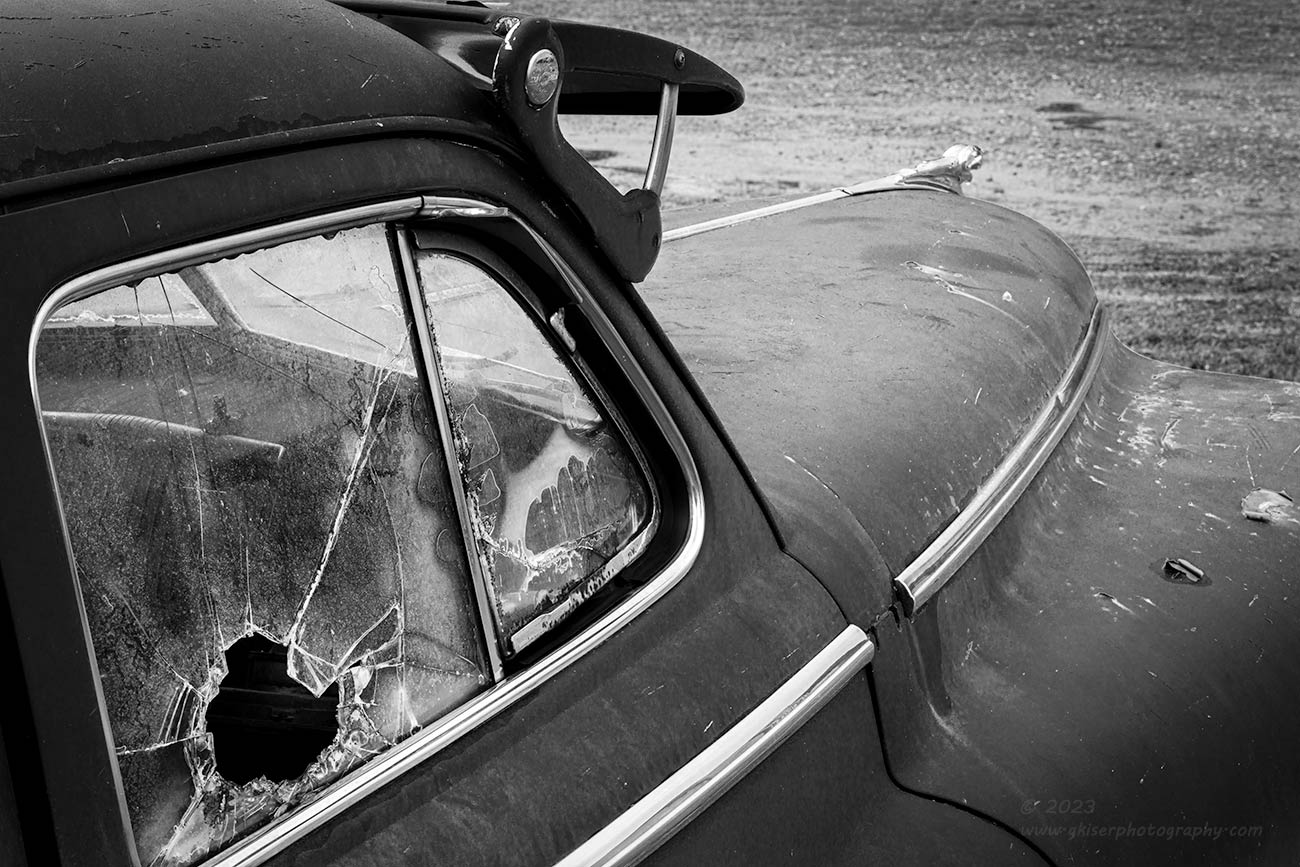
The next four images that I shot were done from the same general area that the previous two photos had come from. The difference was that I was no longer interested in shooting through windows as much I was interested in photographing the lines of the car. That same hole in the glass made for the foreground interest for this next composition, but I had the eyes going out over the front of the hood. The visor over the windshield was once again an important aspect of this composition because it helped to frame the image while showing off a unique part of this car. The molding was another very important part of this as it helped to direct the eyes to the front of the car and the hood ornament. It also kept the eyes from becoming lost on the top of the fender to the lower right. Beyond the car was just the gravel driveway which held very little interest. When matched to the green color of the car, the gravel took on even less importance which was a problem for me.
Since the entire composition brought the eyes to the front of the car, I was worried that they would just run right out of the scene since the gravel wasn’t interesting at all. There was nothing to put in that area that would garner any interest, so I had to look at the scene as it was. I decided to convert the photo to black and white so that I could have more control over the tonality of the car and the gravel. It would also allow me to focus the attention on the texture of the gravel rather than the lack of color in comparison to the rest of the photo. With some careful dodging and burning of the gravel, I would be able to use it to keep the eyes from escaping the frame, while making the hood ornament stand out a bit more than it had.
The end result of this photograph was quite successful when matched up to my intention for the composition. It is not a stellar photo, but I think that I handled the issues that I had quite well. The resulting photo takes my eyes on the route that I had wanted them to go while focusing on the design of the car. The broken window was key to the success of the image in both a foreground element as well as a valuable clue to the story I was trying to tell about this car. Without it, one could almost assume that this was a running and driving vehicle. Looking at the window, it becomes a little clearer that decay is a theme here.
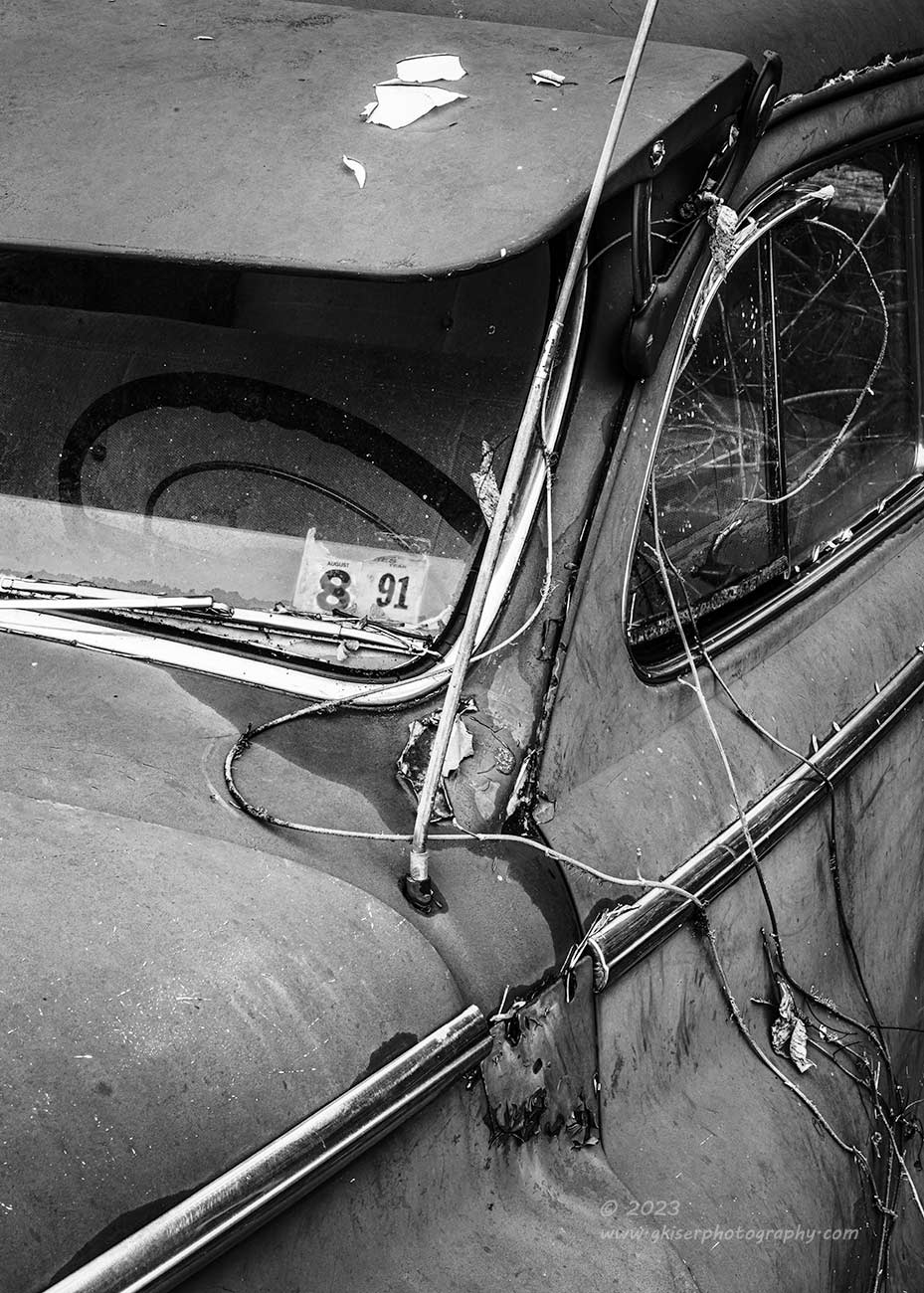
As I was trying to really hone in on the decay aspect of this car I started really looking for more clues. One of those clues was the fact that the wheels were getting overgrown by the grass. I spent the next five frames focusing on the driver’s side front wheel. The composition was harder to get than I expected, and it forced me to try both square and horizontal compositions. I thought I finally had something figured out, but when I got the photos home, none of the five made it past the second run of the culling. The photos weren’t bad, they just weren’t particularly interesting which left me feeling very little connection with them. I was fine letting them all drop off the list because it was the composition that developed from working on that wheel that I liked even better.
By the time I had gotten to the end of the five images, I was shooting a horizontal composition that had a vine framing the image on the right side. That fine turned out to be much more interesting than the grass growing over the wheel, and it was better able to tell the story of the car. The wheel was abandoned, and I started to work with the vine and how it crept up the driver’s door of the car. I found that the best composition here was a vertical one which again focused on the windshield post as well as that visor above. For the first time since I had started shooting this car, I ran into a problem using my 70-200mm lens. I had my back up to a tree and couldn’t get the framing right as I needed something wider than the 70mm I was at.
It was time for a quick break, and I retired to the truck to swap out lenses. The telephoto was traded for what used to be my workhorse lens, the 24-70mm. It almost seemed odd to have this lens back on the camera again, but I knew it would do the trick for the composition that I was working on. Once I got back into position, I was able to frame up the composition as I had imagined it at 53mm. I made three different exposures with some slightly different exposure settings. It was the last of that series that turned into the keeper that you see above. The original concept was for this one to be in color because the orange leaves really looked great against the green paint. The problem was, there wasn’t enough orange to carry the complimenting color and it got lost. Instead of trying to fight to keep the colors, it was decided to go black and white to define the shapes of the car and let the vine become a framing element as well as a director of the eyes.
From this angle, the antenna provided another hurdle to work through. Because it was bend and at an angle, I had to find a way to simplify that light because it was too closely related to the chrome windshield trim. In order to simplify it, I tried to overlap the antenna with the chrome, but that left a sliver of the vine hanging by itself to the left of the antenna. What I decided to do to correct that problem was to move the antenna just off to the left of the chrome to cover the vine, but not so far off the chrome as to create too many distinct lines. The end result was one that I can certainly live with, and I believe that it came out pretty good.
One other aspect of this composition that I liked was the inspection sticker. I’ve always enjoyed including these in my photos when possible because they will establish when the car was last on the road in many cases. Just the presence of the sticker will date a lot of the cars that I shoot because NC did away with the stickers like 15-20 years ago. Just seeing them makes me feel all nostalgic.
It was about this time that I finally felt that I had worked this car as much as I could. I made a quick walk around it with the wider lens just to see if I had missed anything. Feeling pretty good about it, I decided it was time to head down the driveway to the other Dodge that was stuck in the woods. I had only shot this car one other time and it was a hurried shoot during a foggy morning. I had more time to work with now, and decided to go into it with the same mindset as I had been using for the first part of this session. I was going to take my time and work the scene trying to come up with some new and different compositions.
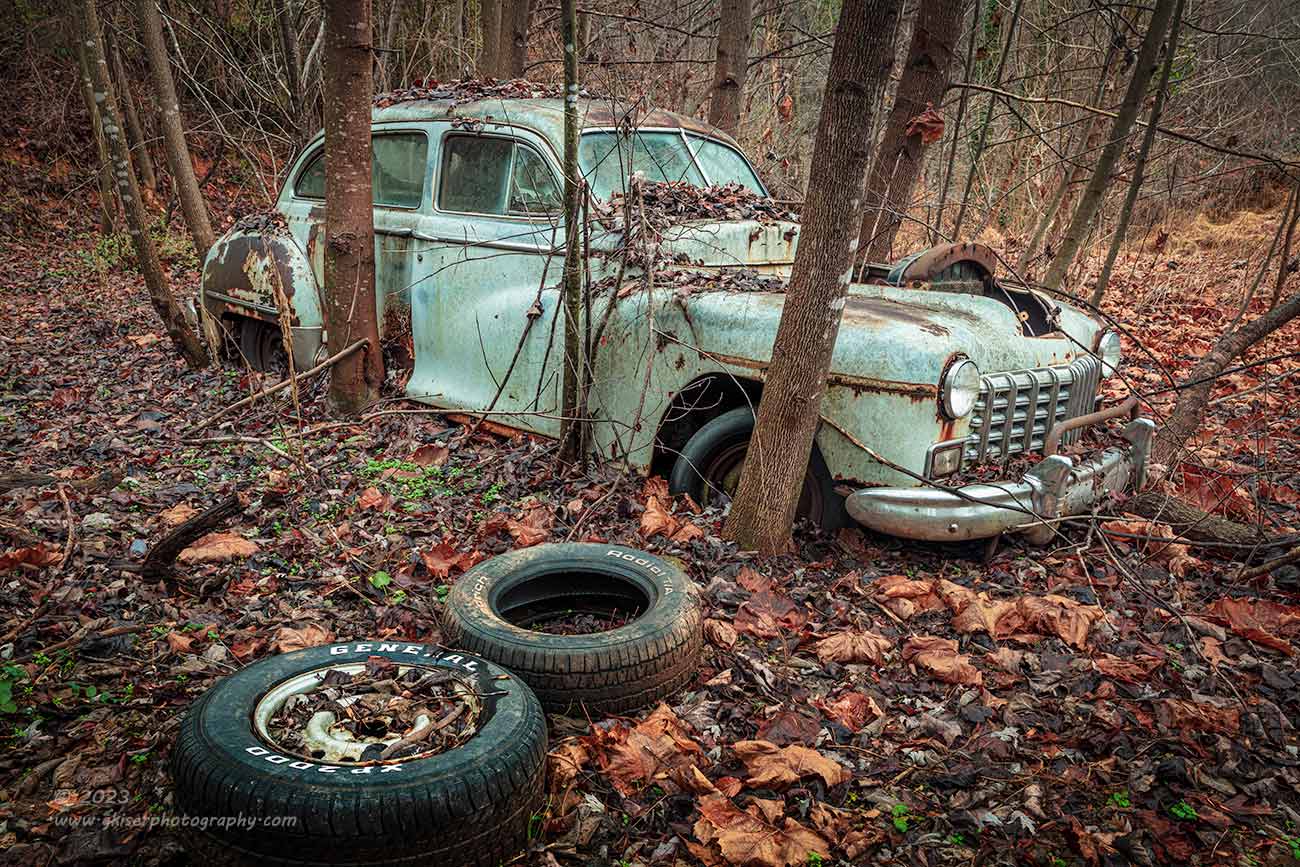
Since I hadn’t really planned for this location, I didn’t go back and look at the previous photos I had shot of this car to remind myself of what I had captured. I don’t often do this anyway, but when I saw the car, I wasn’t really sure what was different and therefore what I could do differently. I knew that I had shot an overall composition of the car as well as one with the rear wheel and rear window. The specifics of those I couldn’t remember. I seemed to remember that there was a tire bocking the front of the car, but I saw two tires on the ground leading up to the car. The tires made for a natural composition, and I just hoped that it wasn’t going to be the same one that I had shot before.
I started to frame things up and decided to go with an elevated position for the camera to show the line created by the tires which brought the eyes to the car. I moved around to the right and the left to get the rest of the scene organized. It was the trees on either side of the front of the car that dictated my position because I wanted them to overlap near the car to simplify the lines around the car. This effectively turned two trees into a single one visually which helped an already cluttered scene. I felt that this composition was very similar to what I had shot before, but it felt right to me, and I thought that all of the elements were coming together nicely.
I ended up shooting six frames mainly because I realized that there was a slight breeze, and the grasses were moving during the exposures which were lasting several seconds due to the low light. To fix this, I bumped up the ISO and sped the shutter up until I was able to freeze all motion in the frame. I shot a couple of exposures at each setting just in case I had a workable image with a very low ISO. To show you what I worked up from, I had started at ISO 100, f/16, and 2.5 seconds. The photo that you see here is exposed the same, but the settings were ISO 400, f/11, 0.4 of a second. That made all the difference in the world and allowed me to get the image that I was after.
It wasn’t until I started writing this blog and looked back at the original attempt that I was able to figure out what changes were present in the scene. There had been a tire leaning on the front of the car which really ruined the view of the face. That tire was now laying in a perfect spot on the ground to make the other tire really make sense in the scene. The lack of a tire blocking the front allowed me to compose from a more side angle which placed the trees in better locations around the car. The composition turned out to be much stronger here. The edit was also treated a good bit differently as well. You will notice that while they are both the same car, I have pushed the color in this new version quite a bit. In the original one, I had desaturated the car to make it look whiter which is probably more accurate to the real thing. However, with the amount of orange that was in the scene, I decided to pull more of the teal undertones out and create a better color harmony. I really like how those color work together and think that it makes for a more pleasing photograph that is easier to look at for extended periods of time.
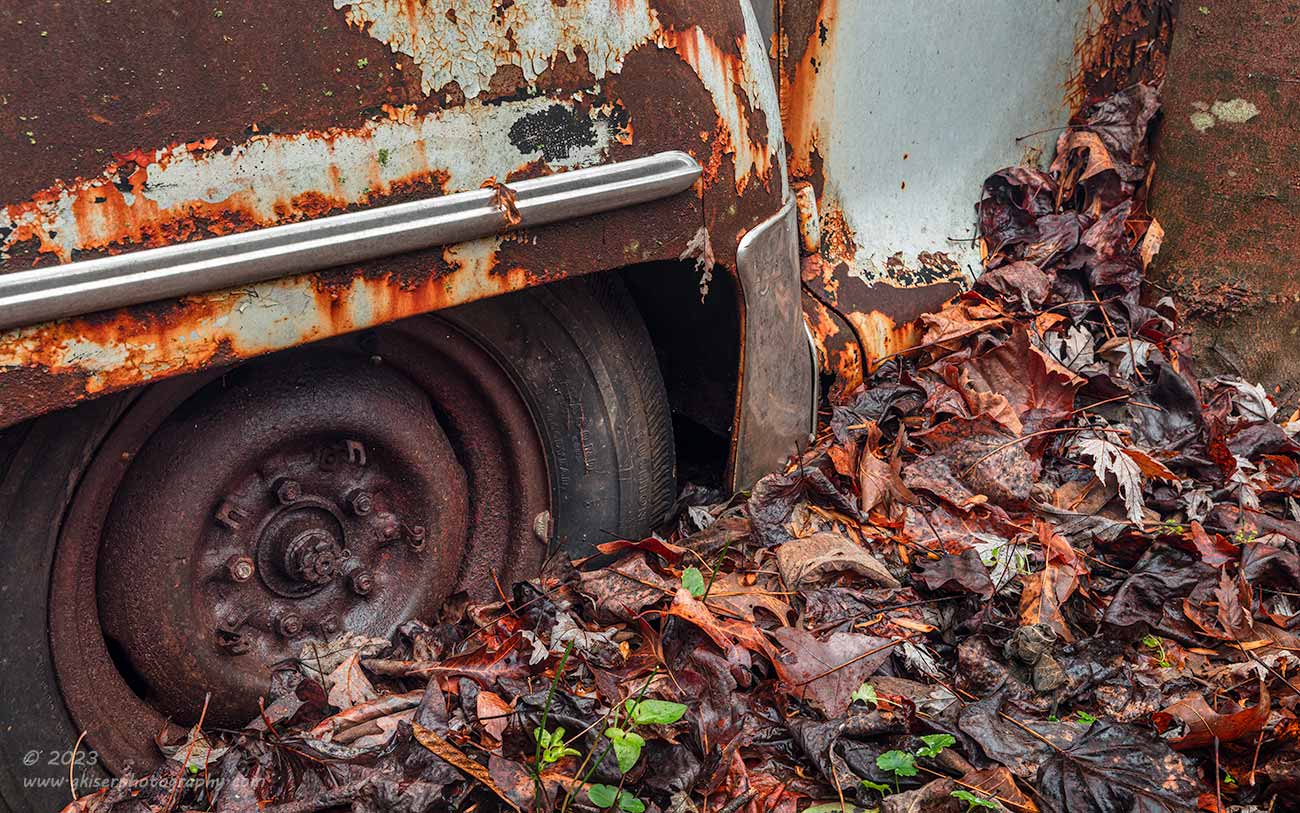
Now that I had the obvious composition figured out, it was time to move to the creative compositions which I was wanting to do. I remember how difficult this car was to work with before since it was surrounded by trees. It was just very hard to get isolations on it, but I knew that there were more than I had shot before. The easiest place to start was around that rear wheel on the passenger’s side. This was arguably the most interesting area of the car thanks to the rust, trim, and the shape of the quarter panel. I didn’t want to reshoot the same composition that I had done before, so I slowed down and looked around to see what might work. The part that I found to be the most interesting was the fact that there was a tree growing right next to the door, and probably touching a portion of the car. There were fallen leaves that had wedged themselves between the tree and the car which added to that interest. I also thought that this quality made for a great framing element as it helped to contain the eyes.
The wheel was still interesting to me because it was sinking into the sea of leaves. It was more captivating than the front wheel on the other Dodge which I had tried to photograph earlier in the day. The two bits of chrome helped to define the shape and I liked how they looked in the composition. I worked around and found the angle that I felt was going to work the best and did two frames of the composition with a slightly different depth of field for each one. Since this was a fairly simple composition, there wasn’t much need in tweaking things any further than I already had which meant that I was good to go with just those two frames.
I wasn’t sure if this was going to be a black and white image or a color one when I shot it. I did like the colors because of the warm tones that the leaves and rust brought in. The question was going to be whether or not I could balance that warmth with some cool tones. That balance came from the paint and allowed me to do this as a color photograph which I think tells more of the story than a black and white would have.
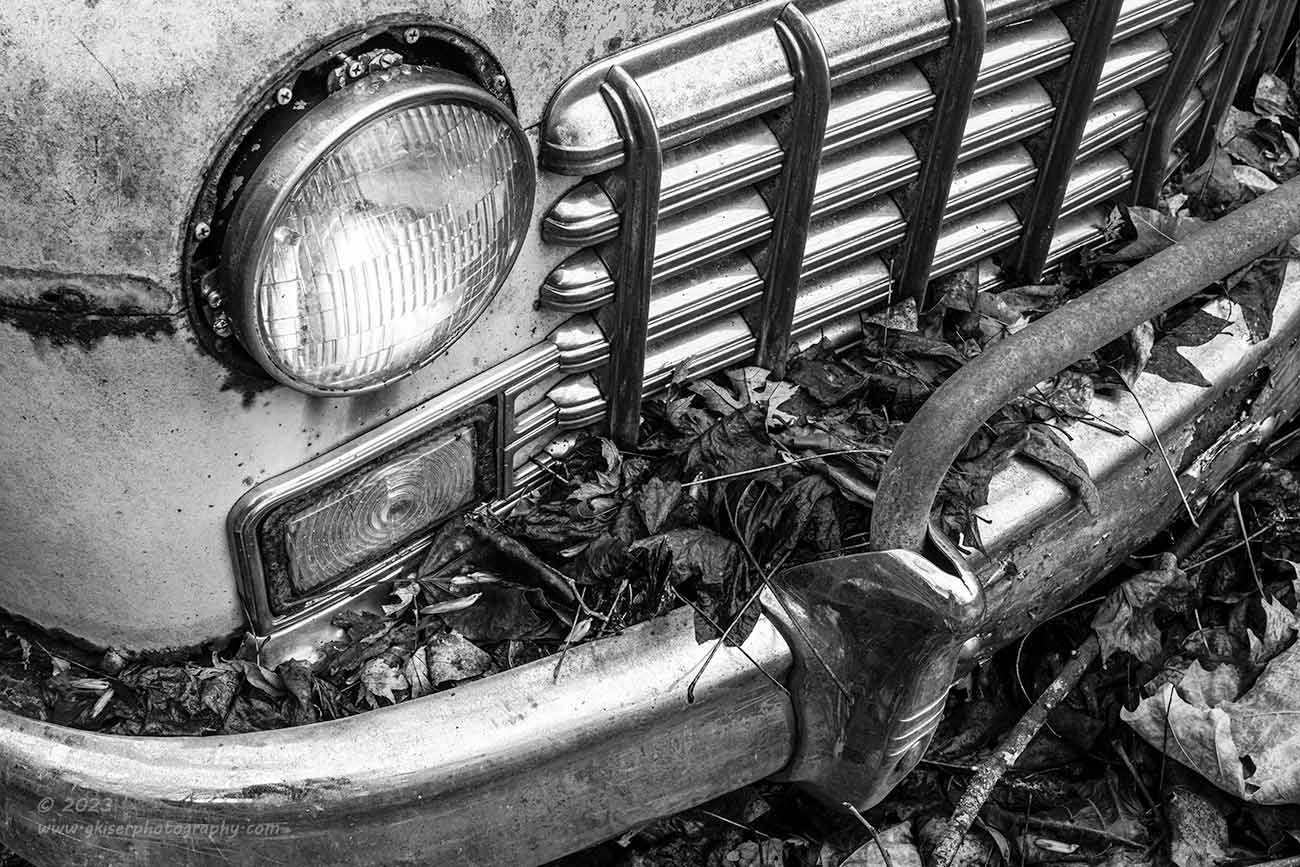
The next nine frames came from the front of the car which I didn’t recall working with before. Looking back, this was because there was a tire blocking the view of the car at the time. Now that the front was opened for viewing, I was able to work with the grill and bumper. I’ve really started to enjoy working the fronts of these old cars in ways that I hadn’t ever really done before. I looked over the scene and took the camera off the tripod to see how things were looking through the lens. Nothing was really jumping out at me to start with, but I really liked how the leaves were piled up on the bumper which made me stick with it for a while longer. After a minute or two, I landed on a composition from the corner, up high that I really liked. It focused mostly on the leaves from the angle that I was at, and the bumper became a diagonal line through the frame. The headlight was included in the upper left third which I liked, and the grill introduced another diagonal element.
I held the camera roughly where I was for that composition as I moved the tripod over and connected it to the camera. The legs were dropped, and I worked to find the composition once again. This took a while, and after I found it, I kept fine tuning it so that all the angles were right with it. I ended up shooting nine frames here with the keeper being frame number two. Sometimes you just get it right early on and all the effort you make trying to improve on it doesn’t do anything for the photo. I’m glad that I shot the number of exposures here that I did because I was really thinking that the best ones were there towards the end of the run. The first few didn’t look quite right in the image review which had prompted me to tweak the composition. Had I not shot those early ones, I would have missed out on this photo which is one of my favorites from the day.
Since I made mention that the leaves were a favorite part for me, you might be wondering why I chose to do this one in black and white rather than color. I looked at it both ways, and determined that in color, the leaves were a stronger part of the photo and overshadowed the elements of the car since they were largely without color in comparison. By removing the color, I was left with a tonal variation between light and dark which established the elements. This put more attention on the body of the car and the bumper for the structure of the photo. The leaves exist in two different locations divided by a diagonal line which brings more interest to them as a texture. This photo is quite simple to look at, but the simplicity is due to a lot of different elements coming together as a cohesive group.
I had spent a lot of time on this composition and with good reason. It was one of the stronger photos that I had made from the day. When I was finally satisfied that I had what I was going to need in order to ensure a keeper, I started looking around the car once again to see if there was anything that I had missed. I didn’t see anything else that I felt justified a photograph, so I gathered my things and went back to the parking lot.
As I passed the green Dodge, I couldn’t help myself and stopped to get another series of photos showing the entire car. Using the 24-70mm, I went vertical with the composition to showcase more of the tree. There were an additional six photos shot for a total of 54 for the day. One of these made it through the second round of culling to be cut finally because it wasn’t as good as the first frame that I had shot for the day. The vertical compositions seemed to fail this car for some reason when doing overall photos. It was just hard to beat that first composition of the day which is surprising. I obviously didn’t have much faith in it at the time since I only shot a single frame before switching to a vertical composition. I guess I’m thankful that I got that one shot in the bag since it turned out to be the strongest overall composition.
If you are reading this and wondering how I come up with my isolations and how you could see similar compositions in your own photography, consider joining me for The Art of Decay workshop in April. This will be a two-day workshop designed to hone your ability to see these types of compositions and to learn how to effectively capture them. In years past, I have spent most of the time looking at shooting the entire car and going for the postcard shots. I’m now ready to take it to the next level and really get into the art of photographing these rusted old cars. Get signed up and we will work through the process, and you will be pushed to create images that you didn’t know you were able to make. I hope to see you there!
Thank you for joining me on this very long trek, as long as you count all the hours spent driving around, the 118 miles driven, just so I can spend two hours at a location about 7 miles from the house. It just goes like that sometimes. I had a plan, in fact I had lots of plans, but nothing worked out because the conditions weren’t right, my headspace was right, and I couldn’t get in tune with the location. In spite of that, I kept trying and ended up stopping at this location where I have been before only to create a batch of new photographs that prove that with every time I pick the camera up I improve. There is a really high probability that this will be the last trek of 2023, and I can’t think of a better one to go out on.
I hope to see you back here in a couple of days when I publish my list of 12 most significant images for 2023. That will be on Friday morning, with my year-end review scheduled for Monday morning at 8am. I’ve been working on both of these pieces for nearly two months now, so I hope that you enjoy them. May you all have a very happy new year, and I look forward to sharing more adventures with you!
Until next time….