Wednesday, November 16, 2022
There are two things that can get my creative juices flowing. The first is finding new subjects to photograph. The second is conducting workshops, or mentorships. When both of these things come together, it creates a drive to create like no other. That was the case with this trek, and I’ll go ahead and warn you that this will be a long one with two parts. When I get done with the second part, I’ll add a link to the bottom of this blog so you can continue on reading.
If you paid attention to the title of this entry, you will hopefully get the reference to the “do-over” aspect of this trek. It all started last Saturday when I did my Fall Decay Workshop. There were five participants in attendance as I had a late cancellation the morning of the workshop. As I like to do, I arrived about 45 minutes before the workshop began so that I could scout out the property to see what has changed. This is not something that I worry too much about because the general lay of the land has been the same since I first photographed here in 2017. However, I don’t like to be caught off guard for a workshop so I like to get here early just to check things out.
When I arrived, there was a lot of fog that had rolled into the Yadkin Valley overnight and the lighting was absolutely gorgeous. I was wanting to get my gear out and start getting some photos, but I didn’t want to be involved with that when the first participants started to show up. I did get out of the truck and start walking around though. Almost immediately, I noticed that there were some new vehicles out here which I was not familiar with. There was a Plymouth under a tree right by the White Firetruck that was the first subject that caught my eye here nearly six years ago. There was another Plymouth on the side of the property that was new, and I could see some other trucks that hadn’t been here before. As I continued my walk, I noticed that the silver Volkswagon Cabrio was gone from behind one of the rat rods which had always been a difficult element to work around. Most of my favorite subjects were still here and there was more than enough to work a workshop around.
I went back to the truck and contemplated getting the camera out once again. I voted that idea down because it would just not be the professional thing to do. I was here for the attendees, not for my own photographs. I just grabbed the questionnaires and started to refresh my memory on things that I was going to need to cover through the day. Shortly after 7:30, the first participant pulled in, and then another one. By 8am, all but one was there, and I was getting started with the introduction portion as I knew that the last participant was going to be a few minutes late.
The workshop went wonderfully. The weather was amazing through the entire day. My goal was to use the last bit of sunlight to get some shots of the new subjects on the property, knowing that most of the time this workshop starts winding down around 3:30-4pm when folks get worn out. All through the day, I kept seeing new compositions that I wanted to try, and I also worked with some of the clients on compositions of theirs that I really liked. I was taking notes on different aspects of their compositions that I liked and put them in my toolbox as I helped them work though the fine-tuning process of the composition. The more I helped, the more I saw potential in the new subjects and saw fresh angles on subjects that I had worked before.
I was really getting excited about shooting here at the end of the day. I hadn’t been this kind of excited about this location in quite a while now. Last year, I had come out prior to the workshops to get a few compositions figured out so that I could help more efficiently, but this year I didn’t bother with it since I was so familiar with the location. It had kind of become old hat to me. With several new cars on the property, I was experiencing that creative energy that I had been missing previously. Dean, the property owner even moved a neon green generator which was parked next to one of the Plymouths which opened up a bunch of new compositional possibilities. The more I talked through the compositions that were available, the more I started to think about new possibilities. This actually made the workshop even better because I was genuinely excited about the compositions and my mind was going a hundred miles an hour as I worked through my own ideas, assisted with the participant’s concepts, and in many cases blended the two adding compositions that I had started to see with my clients’ concepts. This gave me the ability to put into practice some of my ideas to see if they would work while teaching the process to the participants.
This was the first time that I’ve done this workshop where a couple of the participants worked through most of lunch, so the time that I usually would have to rest and answer questions, I was still working through the photo process in the field. Lunch went quickly and we were back to it for the second half of the day. This half usually goes pretty quick, and we start to wrap things up well before 5pm, although I always plan on staying until sunset. It just doesn’t happen that way.
Well, this time it was completely different. For the first time ever on a workshop, we ran out of light before we ran out of interest to work. I was beyond pleased that the workshop had maintained steam through 10 full hours of the day. However, that meant that I was out of time to get my own photographs. I had been out here for roughly 11 hours and had not shot a single photograph for myself. It really was bittersweet since the workshop had gone so well. I left tired with nothing to show for my time around all that great rusted goodness during the most excellent lighting conditions I could have asked for. It was quite a bit better than last year when we got cut short due to torrential rains. I knew I was going to have to come back again soon to take advantage of this creative high that I was on.

Fortunately, I didn’t have to wait long at all for a similar morning to line up according to the weather forecast. I was looking for clouds and hopefully fog which was what we had for the workshop. Tuesday, brought heavy rains through the day, much like Friday had done. Wednesday’s forecast was showing clouds in the morning, and I was hoping for some fog as well. The closer it got to Wednesday, the less clouds were showing in the forecast. What had been high and low-level clouds turned into sporadic high-level clouds which wasn’t quite the same thing that we had seen on Saturday. I still wanted to go out there since there were no other cloudy days in the forecast for the near future. It was going to be a gamble, but with the time of year and the recent rains, I was figuring that fog would be a pretty high possibility for the morning.
I got up with Toni around 5:00 since she was going to clinicals for the day. I checked the weather, and it wasn’t looking all that great, but it was still better than a clear day. If I was lucky, I would have until shortly after lunch to get the photos done before the sky cleared off and the sun would become a problem. I got ready to roll out and did my morning routine down in the studio before heading back to East Bend for the second time in a week. Just as I had hoped, there was pretty dense fog down US 421, and it didn’t clear off when I entered Yadkin County. There was even a bit of mist to contend with which was perfect for what I was hoping to achieve. I arrived at the location around 7am and was thrilled to see that the fog was just as thick here as it was for the majority of my journey. I got out and grabbed the camera and tripod so I could get to work. I wasn’t sure how long this was going to last, but I knew that I didn’t have much time to waste.
I decided to get a quick shot of the firetruck that is supposed to be getting moved into the shop for a full rebuild. I love this subject, and every time I’m here now, I think it is the last time I’ll get to see it. Since I didn’t have a photograph of it in the fog, I figured that this was going to be a great chance to get something different. To amplify the fog, I wanted to stay away from the truck which meant that I wanted to use a long lens this time. I fitted my telephoto and a polarizer before mounting the camera to the tripod. I knew pretty much how I wanted the composition to look, but this was the first time in a very long time that I had been shooting it from this distance. It only took three exposures before I was sure that I had what I wanted with both vertical and horizontal orientations.
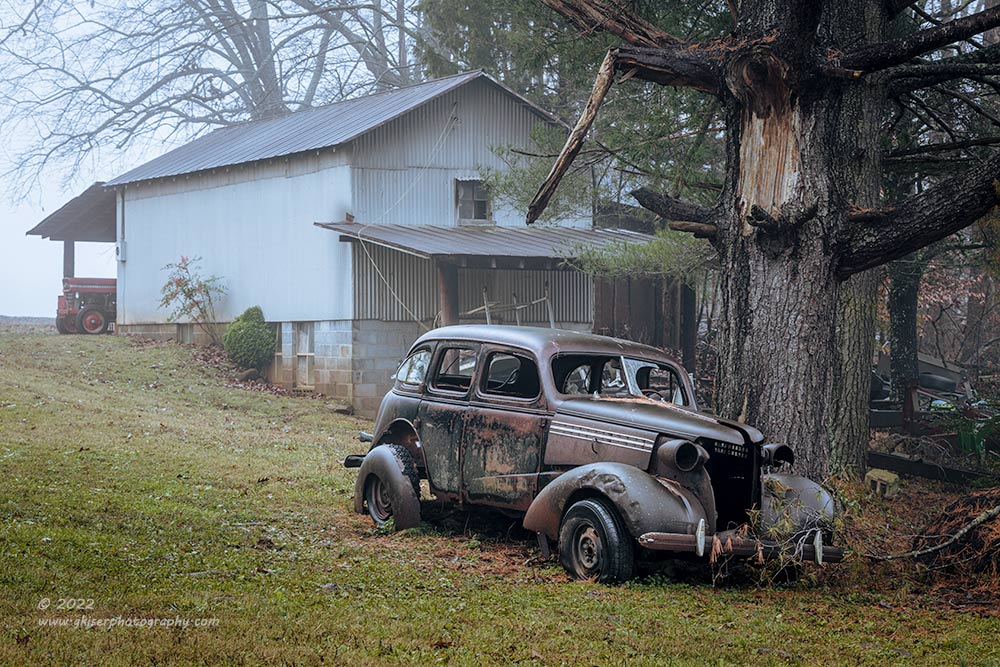
Once I had the fire truck captured, I moved on to the Plymouth that had captured my heart a few days before. I had worked compositions from both the front and the back on this car as well as isolations, so I was already ahead of the game with how I wanted to capture the car. Since there was a good deal of fog in the background, I decided to get the front end captured while the sun was not nearly as strong in that direction. Usually, I would want to give the car plenty of nose room, but this time I just didn’t have a clear shot of scenery in front of the car to do that. I would have also had to deal with the barn behind it, so I just decided to add some visual tension and place the nose near the lower right corner of the frame while the barn and the tractor filled up the background and brought you to the fog. It was a simple composition, and one that really didn’t take long at all to put together.
I did notice that the rear fender had become detached from the body which was different from how it was on Saturday. I thought about reattaching it but decided against it since it helped to mask the wheel a bit and added a bit more of a disheveled appearance. Later on, I would actually reattach it to streamline the composition, but I’m glad that I left it alone for this one. There is just something interesting about the lines of the car with the fender dropped to the ground like this. I still liked the broken branch above that pointed to the car and made sure that my composition included that aspect.
As with the fire truck, I didn’t spend more than a few minutes on this car. It was another handful of exposures, and I was done here for now. The fog was already starting to lift, and I didn’t want to lose the light before I had a chance to capture some of the new subjects and compositions that I wanted to try. I fought the urge to go over and work the rat rod and the old shell of a hot rod which I had shot many times in the past. Instead, I decided to go over to the other side of the property where the other Plymouth was parked.
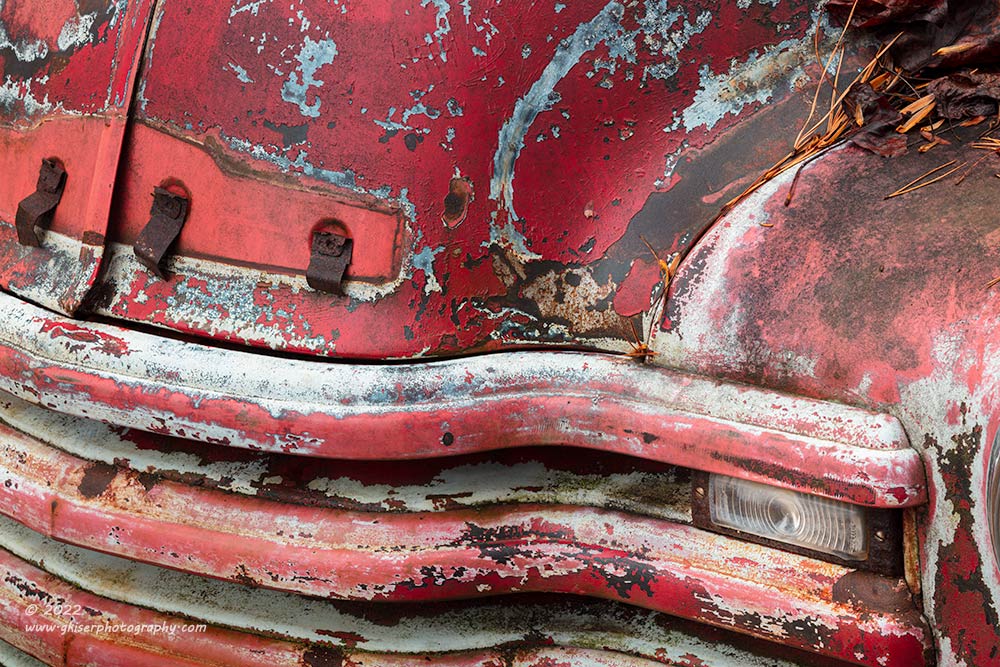
When I go over there, I decided that I wanted to try a new composition on the front of the old Chevy pickup which was wearing the Clemmons Fire Department front clip. I had only shot this truck once before, and when I did, it was part of a trio of subjects. I wanted to get an isolation of the front of this truck which I had seen while helping to compose a bit broader of a shot on Saturday. I still had the long lens attached, and I figured that it would work out just fine for what I wanted to accomplish. I started to line up the shot and resisted the urge to include the headlights like I would normally do. This shot was not about the headlights, and I didn’t want to include the side of truck either. I just wanted to get the colors and the grill along with part of the hood ornament mounting hardware.
I framed up the shot and worked the camera to a level that got the right perspective. I chose to include a small sliver of the headlight bezel on the right side of the frame to keep the white portions of the paint from pulling the eyes out of the frame. The sliver of chrome was darker than the white and closed that section in quite well with the red taking the majority of the focus away from the color shift at the edge. I used the turn signal to anchor the image and worked the rule of odds into the image with three slats of the grill matched up to the three mounting brackets. I didn’t spend long with this composition at all before turning my attention to the other Plymouth.

One of the compositions that I had seen being worked on Saturday, was a shot that included the Plymouth along with the other two trucks. That composition had been done with a wider angle lens and caused the Plymouth to be a bit larger thanks to the perspective distortion. I liked the effect, but I wanted a different relationship between the elements for my composition. Also, with the sky pretty much a featureless white, I didn’t want to include that much of the sky in the shot which meant that I needed to look at a longer lens which was what I already had attached.
I started to get the shot framed up and realized that there was a really cool tree that snaked along the right side of the frame and made an excellent framing element for the photo. I worked out the position so that the Plymouth was completely separated from the cab of the Chevy truck while the Chevy and the older brother were a bit more overlapped, but still showing enough to give both their own place in the composition. It felt strange shooting this from so far away, but I was really liking how it was looking on the LCD. There wasn’t much need in making multiple exposures here and I wrapped up this composition pretty quickly as I had the others.
It was starting to dawn on me that I was going at a running pace through the compositions that I had planned out. I wasn’t spending long at all on any of them, and I was getting a much higher than 10% hit rate I was certain. I just didn’t know how this pace was going to last. I had only shot 22 frames by this point, and I was feeling really good about all of them. I had done all of this in just 30 minutes from getting the camera turned on.

Another composition that I wanted to try was on the nose of the Plymouth. It was a composition that I had done back in 2014 and was reminded of during the workshop. I was hoping that this car was going to allow me to do a variation on the composition, but the amount of rust was greatly reduced from what I had shot years ago. I also didn’t remember the exact composition but knew that I was focusing on the shape of the nose with the grill fins to make the shapes. I chose to stay with the long lens as that had a better chance of getting the isolation shot that I was after. I started to play with the lines and try to figure out where I wanted things to go. I knew that I just wanted to concentrate on the side of the nose this time and avoid the background distraction. The hood was not quite lined up with the nose so that ruined the lines for what I really wanted to do. Instead, I worked on a narrower approach centered around the letter “Z” which is a form of an S-curve. I battled with the Plymouth emblem and how to incorporate that without it being a distraction. I ended up placing it close to the corner just as I had done with the chrome vents down in the opposite corner. My hope was that it would all balance out and not look awkward.
After two different variations on the composition, I decided to cut my losses and move on to something that I had seen while another photographer was working on this car. I had never seen an intact hood ornament on a Plymouth like this. The sailing ship was just too cool to pass up and I knew that I wanted to do something with this bit of automotive jewelry. I had been running through different options in my mind and had come to the conclusion that I was probably going to be better off getting low and isolating it from the rest of the car in some way.
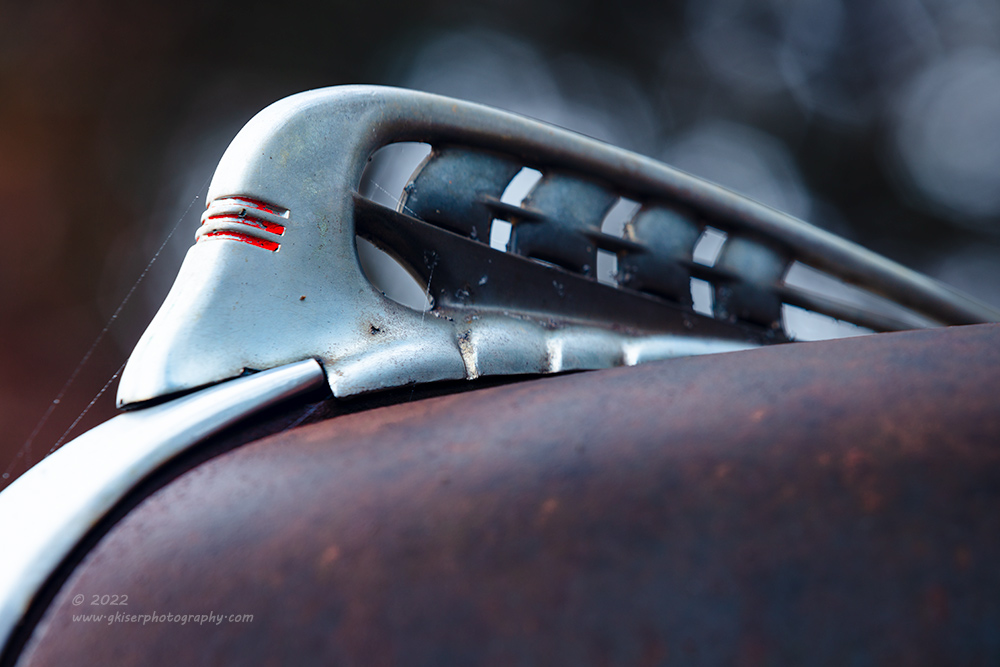
I looked at how the light was falling and decided that I needed to work from the driver’s side to get the best light and background. I dropped the camera pretty low and aimed it up towards the hood ornament. There were some spider webs attached that I could see dressed in the morning dew which I though added to the image. I worked on getting the framing right and while I was doing that I was taking note of the heavily blurred background due to the wide-open lens. It was a lot more blurred than I would have wanted, so I knew I was not going to shoot this at f/2.8 even though I did envision the background going blurry.
Once I got the framing set up, I started to dial in my aperture. The easiest way for me to do that was to focus on the front of the ornament and press the depth of field preview button as I increased the aperture. I was quite surprised to find that the blue that I wanted came at f/10 which was a pretty narrow aperture, but at 200mm and this close, there was just no depth of field to work with. This was perfect though as I had little bokeh balls in the background of the ornament which set it off in the frame quite nicely. Just to be sure, I shot a total of four different frames here with slightly different shutter speeds while making sure that I had the camera absolutely still before each exposure. The exposure was kind of difficult with the sun hitting the leading edge of the brightwork while I still had to worry about the detail of the hood. There was just a small amount of bracketing involved to make sure that I had the most workable exposure possible.
When I was satisfied with this composition, I moved my attention to the hood ornament of a Ford Truck that was new to the property. I had worked out a composition with another one of the participants which was similar to one that I had shot before on another Ford. I framed this one up and made sure that the camera was square to the hood before making several exposures as I played with the highlights. Despite spending several minutes on this simple composition, I ended up not using it since I had one that was better in my collection already.
Hang on…..Let me check on that fact.
Nope, the other one that I have isn’t better than this one. I have a Chevy hood ornament that is better, but the Ford one is not nearly this dynamic. Let me go and do a quick edit and get this image uploaded

OK, a few minutes later and I’m back with the new image. The part that I really liked about this one is that the cool and warm tones are very well balanced here with the blue of the sky reflecting in the top of the emblem against the very red tones of the rust beneath the emblem. The composition was quite simple and when I was working with my client on getting the composition put together, I explained the benefits of having the camera squared up with the subject so that there was no distortion to the shape of the emblem. She got it captured and I offered another tweak to it by going with a 16:9 aspect ratio in the camera. This followed the rough dimensions of the emblem and caused the subject to fill the frame perfectly. I did the exact same formula for this image and now that I look back on my older images, I have to say that this is a better image than the last one of these Ford emblems that I shot.
This just goes to show that the first run through the images isn’t always the most accurate in deciding what is good and what isn’t. I’ll usually keep my throwaway images for a few days and determine after some time has lapsed that I have all that I want from them before I delete the files. I’m glad that this one got rescued because I might have been upset to realize that the image that I was thinking about was actually a Chevy emblem and I didn’t have anything quite like this in my collection.
After shooting those frames of the emblem, I moved my attention to a favorite subject on this side of the property. There is a blue Chevy truck that I always use to illustrate my concept of storytelling during these workshops. I had seen a potential composition down at the wheel that I wanted to try. I worked with that for a little while and got what I thought was a pretty good shot. However, when I got home and went through the images, it just didn’t feel like one of my images, so I chose not to let it move to the next round of culling.
Hang on, let me double check that one.
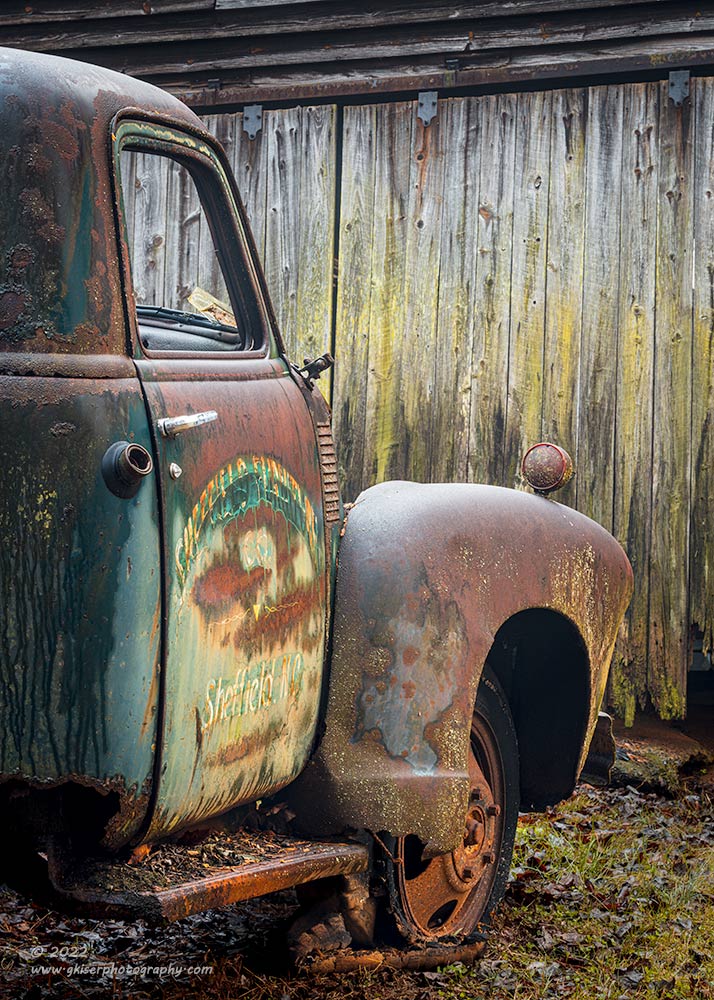
Yep, that composition didn’t really hold water for me. It was too cluttered and I too many things didn’t hold true to my style. I’m officially trashing those two exposures. However, while I was back here, there was a half truck that I had photographed a couple of years ago in a light painting exercise that I had worked with another participant on for a composition. It got me thinking about how I had matched the truck with the barn door within the frame and how well it had worked. Of course, now that there was light, things were completely different. Having worked through some variations on a composition here during the workshop, I was excited to try it out during the day.
I was still shooting with the long lens, and I felt that this lens suited the composition that I wanted this time. I didn’t need the background to spread out any and wanted to keep it all compressed within the shot. It was just a matter of getting a little further away from the truck than I had last time, or for the workshop. While I had done this before as a horizontal shot, I decided that I wanted it to be a vertical one this time because the biggest point of interest for me was the door art and the fender. The fact that the cab was propped up on logs was not important to the story here.
I ended up shooting just three frames with slightly different framings and focus points to make sure that I had the image that I wanted. I looked at my watch and realized that I had been here only an hour at this point. I had shot 35 frames thus far and was feeling really good about how the day was going. As we look back, those 35 initial images had yielded seven…no, check that, EIGHT new images that were keepers from the day. It is a rare occasion that I have this many keepers from only an hour’s work outside of portraiture. I was really pumped, and I could tell that the work I had done during the workshop figuring out compositions was paying dividends at this point. Maybe I should start doing dry runs with compositions before my actual trek next time because it sure does make me efficient once I start working.
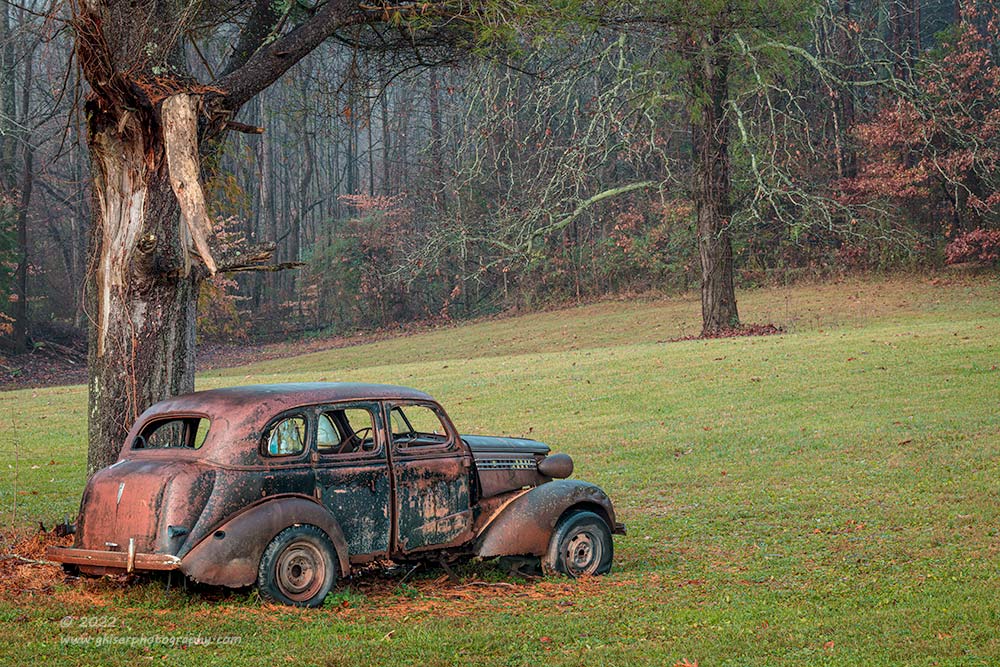
I was starting to slow down a little at this point and I was beginning to contemplate the next steps. I went back to the Plymouth that was closer to the main building and started to look at compositions with it. The fog had dissipated for the most part and I was able to look at another composition which a couple of the participants had landed on as an alteration to a compositional suggestion that I had given. One of the photographers coined the title “The Joust” as he placed both Plymouths in opposition within the frame. I had worked with him on that composition in order to adjust the relative scale of the two cars by using a longer focal length. This worked well, and I liked the idea of the shot. In fact, I liked it well enough to try it myself.
As I started to figure out the position that I needed to be, I realized that I wasn’t liking the composition as much as I wanted to. I fiddled with it for about 10 minutes before I decided that I preferred the tree in the distance to be a counter element in the frame. I moved to the right slightly and aimed the camera slightly to the left of where it had been. I ended up with two dominating trees and the car which fell into the rule of odds and seemed to work well as a composition. I tried several different variations on this and even included a few vertical compositions just in case those suited the car better.
Even though I had lost most of the fog by this point, the light was excellent. It was very soft and diffused thanks to the clouds and remaining fog. I didn’t have to worry about deep shadows, or the direction of the light nearly as much as I had on Saturday. When we were working on this particular view, the sun had come out and there was a bit more dynamic range to the scene. I wasn’t sad to see that part fade away and the overall impact of the scene was just what I was hoping for as I was viewing it in my LCD.
When I was relatively sure that I had the photographs that I wanted of the Plymouth, I moved back to the far side where I hadn’t really spent any time as of yet. There was an Olds 88 that I love photographing that was situated back there. it was another subject that I started to see with fresh eyes during the workshop and I wanted to get a few new compositions worked out with the car while I was here, and the light was good. I contemplated doing an overall view of the car, but I have shot that so many times that I didn’t think that I would be able to improve on it. Instead, I started to work with isolations using the telephoto lens which was a choice that I usually didn’t make with this car.
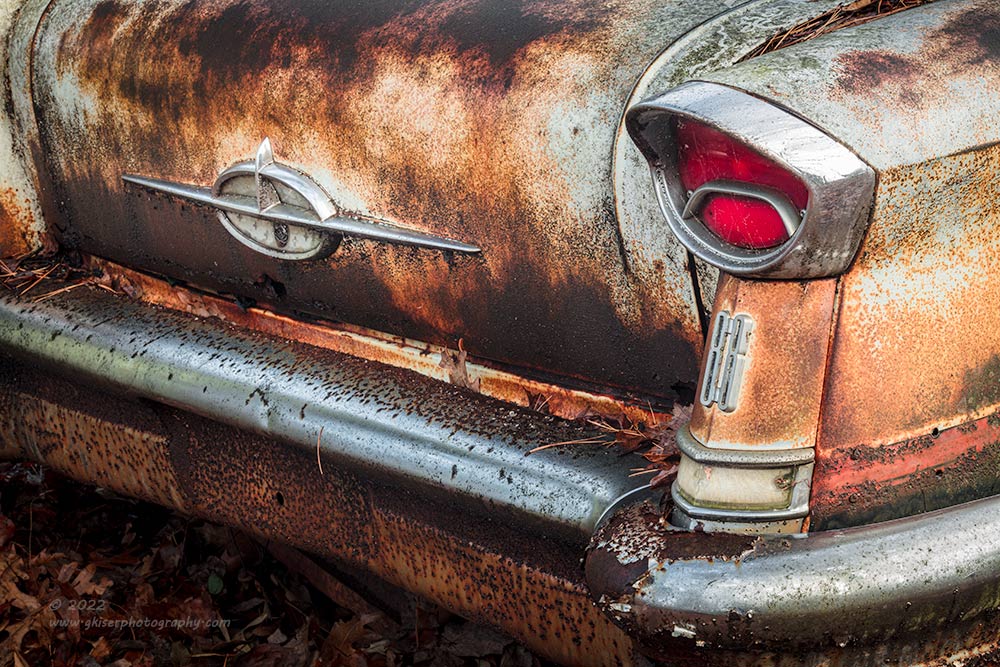
It was the taillights that really interested me with this car. Because of that, I started out on the rear part of the car trying to figure out new and interesting compositions including the those lights as well as the “88” emblems below them. The first one that I came up with was a quarter shot that included the large center Oldsmobile (or Oldsmobubble as my Grandfather called them) emblem. It was unlike anything that I had shot with a car like this and I kind of liked how it was turning out. there were enough clues here to identify the car without a problem for those that like to play that game. There was also plenty of evidence about the state of decay that the car was in.

While working on the taillights, I started to really pay attention to the back window. I had noticed that this car had a three-piece rear window years ago, but never really thought to capture it as part of the composition. Since I was in the mood to try new and different things, I decided to make a composition formed completely around the rear window design. It would have been boring to just include a broad shot of the entire rear window so I opted to go for just a side of it which would represent the entire design. For simplicity, I went with a horizontal composition and added some of the fallen leaves for a bit of visual tension and added interest to the scene.
The resulting composition had a nice strong triangle off to the right side of the frame which was the visual anchor to the scene. The leaves provided the much-needed texture to the scene as well as a complimenting color to go along with the patina of the car. The film and condensation on the windows added yet another dimension of texture to the scene while staying with the analogous colors that were present. The image was really very simple, and I was hoping that it would be equally as effective. I had my doubts though.
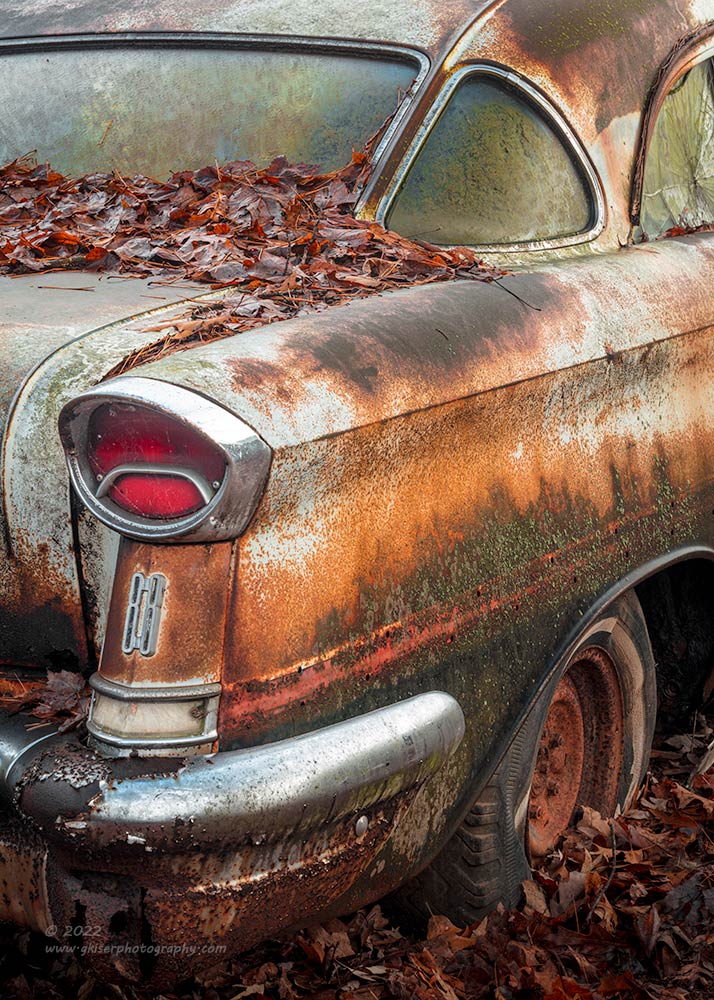
Since I wasn’t quite sure if the simple composition of the rear window was going to work, I decided to add some more visual interest to the frame and build a more complex composition. I flipped the camera vertical and went back to the taillight and added the rear wheel as well. There were a lot more lines to this composition as well as more textures and shapes. I was also able to include the “88” which is very unique to this car and I’m assuming the window design. It all came together to tell the story of this car.
From here, I went on to capture more images of just the taillight. I went from the sides to straight on. These added a few more frames to my frame count, but none of them really turned out all that special. I was pretty satisfied with what I had captured from the rear of this Oldsmobile already and I was ready to move on. To this point, I had shot 51 exposures in an hour and a half. If you are keeping count, I have a total of 11, no…make that 12 keepers from that first 51 frames. My hit rate was entirely amazing as was the rate that I was getting them. On a good day, I would be expecting to edit through about five images with this many exposures. With the number of keepers more than double that I was on cloud nine!
It was the number of keepers from this trek that has forced me to do this as a two-part entry here in the blog. I didn’t want to load you up with two dozen new images all in the same blog entry as that would be just too much to read, and quite frankly, too much to type in one sitting. I’ll come back to this tomorrow after I finish up with a virtual mentoring session and start working on part two of this adventure. Then I have about a dozen or so images to critique from the workshop from one of the participants. I think it is safe to say that I will be down here with the computer pretty much all day tomorrow.
Don’t let that keep you from ordering prints though. I can get prints knocked out quick and have them ready to ship out Friday morning; so, if you would like to have a print of any of these images, please let me know. You can order stock sizes directly from the website, or you can get larger prints and have them on different media by contacting me to discuss options. There really is just nothing quite like holding a photographic print in your hands to really understand how the photographer wanted you to see and appreciate their work.
I’ll see you again at some point tomorrow afternoon when I get finished writing the next part to this lengthy trek.
Until then….

Remember to use the code KISER10 to get 10% off your purchase