Thursday, December 15, 2022
OK, so I last spoke with you six and a half hours ago (as I start typing this entry) as I was finishing up with my trek from yesterday. You might remember that towards the end of that trek I had stumbled across an interesting barn in the Jonesville area. The conditions hadn’t been all that great when I saw it, so I just made a mental note about it and decided to return at a later date. Knowing that John (doing advanced mentorship with me) wanted to work on doing barns that were out in the open like this, I figured that I would find a day when he could come out too and we would make it a tandem shoot so he could figure it out as I was figuring it out. I had no idea that it would be the following day when things would come together.
Well, I spent most of Wednesday night sitting in front of the computer editing the 15 images from the day and left the blog entry for this morning. That took about four hours or so to type out, but before I started it, I was looking at the weather because I was going to have to wash the 4Runner and Toni’s Accord before they looked worse than the cars I normally photographed. I saw that the rain was moving out of the area shortly before sunset and the clouds were going to be clearing right around that time. It was the ideal setup for weather as I was hoping to get the setting sun to shine on the barn as the clouds to the East were still dark…you know magic light. Before I started typing I didn’t think I was going to have any problem at all finishing it up before time to go out. I got in contact with John to see if he wanted to head out with me to try the barn. He was game but had to be on the way home by 5 which worked out fine for the light. There was very little chance that we were going to get good light after that point. We decided on meeting between 3 and 3:30 to get started. That way we wouldn’t miss the light.
Of course, I don’t like to be the last one to show up, so I planned on getting there early. I wanted to leave around 2 just so I could get a little bit of a head start in figuring out the compositions available. As 12:30 rolled around, I realized that I still had a lot of typing left to do and I started to worry that I wasn’t going to get finished in time to leave. I sped up my fingers as best I could and tried to finish up what turned into a very long blog entry before time to go. I somehow managed to get finished shortly before 2 and was able to get everything wrapped up before hopping in the truck to head back out to Yadkin County once again.
It was raining when I left, but that was to be expected based on the weather. If I figured it right, by the time I got there, the rain would be stopping, and the clouds would be clearing off within the next hour. Upon my arrival, the first part of that assumption paid off. When I parked, there was still mist coming down. While I went over to the side of the road where the barn was, it was still misting. When I got back to the truck to get the camera it was still misting. Because of that, I opted to forego the filters and use a lens hood to keep the lens clear. While I wasn’t positive, I figured that my best lens choice was going to be the 70-200mm because of the distance involved. That lens also had the best hood which I keep in the truck at all times now. By the time I got back over to the other side of the road, the rain stopped, and it was just cold and damp at this point.

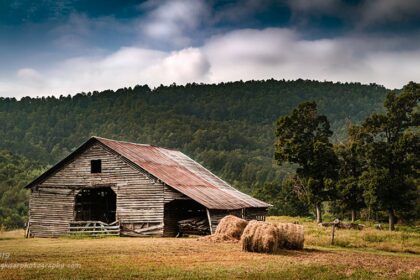
I had already figured out the composition that I was interested in capturing. Since the clouds were very low, there was a foggy atmosphere going on which I wanted to capture. The fog was enveloping the hill behind the barn which caused it to fade into the sky. This was a perfect way to include a featureless sky, so I wanted to get it shot before the clouds faded. John wasn’t there yet, but this gave me the chance to work out the compositions beforehand. I found that there were some things that had to be addressed dealing with the composition. There were a lot of power lines cutting through the scene diagonally from the right. They were just about too deep in the property to undershoot which wasn’t a good thing. You see, while power lines are easy to clone out, John is not doing any post processing at this point, so I needed to make sure that the composition could be shot without the need for post processing and cloning. I also had to work around there being very few elements in the scene that could be used to balance the composition. I found ways to overcome both issues and started to shoot some exposures.
I started off with what would be referred to as the postcard shot where the barn was pretty much front and center in the frame. It was direct and left no question about what the most important thing in the frame was. The fog was rolling along the top of the hill rapidly, so I wanted to get a lot of exposures to make sure that I got the best balance of fog and texture. By 3:00, I had shot 18 exposures with slight variations on the framing which had brought me to the best composition for what was being offered.
When John came over to the side of the road, we talked about the considerations that would have to be dealt with and he rattled them off like a pro. I love seeing this kind of progress with photographers. Just a few months ago, it wouldn’t have been this easy for him to recite compositional concerns, and also offer how to deal with them. He got set up and started to make exposures going with roughly the same composition that I had been shooting previously. The fog was still hanging on but wasn’t quite as predominant now. I quizzed him on the picture style that he was using, and he explained very correctly why he was using the “Landscape” setting on his camera. I was really starting to feel unneeded because he was taking charge of the scene.
As we progressed, the fog started to clear which was a good sign for the clouds to lift, but the sky was still very much overcast. This was a great teaching moment as the illustration was right there as to why you can shoot an overcast sky in the fog with success, but when the fog leaves, the sky becomes a distraction. It all comes down to how people “see” a photograph. Their eyes will go to the brightest area of the scene, then to the area of highest contrast, and then to the area of saturation. When the fog is present, the tones gradually change to bright which eliminates the contrast of the tree tops in the scene. Since the barn had lighter colored wood and some bright tin on the roof, I knew that the barn would be at least an equal point of sight in the composition, but with the contrast of the light to dark areas on the barn, and the saturated roof, this would easily overpower the sky which just had brightness in terms of visual weight. With the fog gone, the sky not only had brightness, but also heavy contrast at the horizon which left the barn fighting for attention within the scene. I had John shoot both versions and then go back and forth between them to visualize the difference and the impact that the fog had on the scene.
With the fog gone and the composition rendered ineffective, we discussed other ways of photographing this scene. One of which was by filling the frame with the barn and eliminating the sky completely. This is a good trick when nothing else will work. The composition isn’t all that dynamic, but it can follow the same rules as the one that we had started with. John was quick to point out that the barn was largely centered which he knows is not usually the best idea. We talked about how you can dissect a subject into different elements when you are filling the frame with a single subject. In the case of this barn, we made sure that the stack of three openings in the front of the barn were in line along the right third. The lower third followed the division point of the roof and the siding on the side of the barn. This was how we applied the rule of thirds to this frame and doing it that way allowed us to maintain balance in the scene since there was no foreground to introduce it, and no other elements that we could effectively include with the barn. Sometimes simple is the best solution.
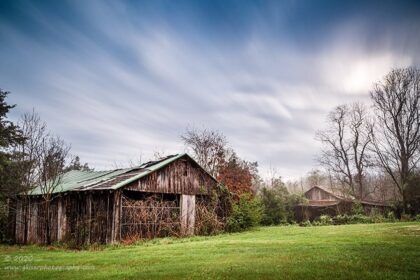
One of the alternatives that we talked about was what we could do in the event of a good sky developing. Having interest in the sky can be another element to the scene, and it will certainly allow you to include more of it as compared to an overcast sky. The power lines again came into the conversation which limited where John could work. We did identify some other points of interest which were now visible like the lone tree at the top of the hill which seemed to stand out near the apex. One of the things that we have spoken about many times is the use of nose room and the direction of implied movement. This was going to be one of those times when we broke that suggestion, but for good reason. in order to bring a bit of drama to the scene, the dip in the hill behind the barn became a very good element to include which was to the left. In the direction of implied motion of the barn, we only had a pretty straight horizon to work with. In order to have the whole composition make sense and be visually attractive, it seemed appropriate to have the barn facing out of the frame but giving it enough breathing room so that the eyes didn’t jump out of the frame. Exceptions to rules or suggestions are always welcomed if there is a reason for doing it. This time we gained visual tension, and balance within the scene at the expense of having the barn facing out of the frame.

We got our compositions set up and I let John get the ideal spot which placed him at a point where the power lines wouldn’t bother him. I, on the other hand, went a bit further to the right which forced the power lines to cut slightly through the top right of the frame. To minimize this, I shot through the fence pretty low to the ground. I was able to eliminate all but one of the lines. That last one took about 20 seconds to make disappear in Lightroom. From here we watched the sky change from overcast to having some slight texture. To the West, the sky was breaking up nicely and I was hoping to get the sun to shine through a hole in the clouds to make the scene come to life. The longer we waited, the more textures came into the sky which started to look pretty good. It was at this point that John asked about using an ND Grad. This was not one of those obvious times you would want to use one because of exposure issues, but creatively it was a very valid choice. He grabbed a 3-stop soft ND Grad and fit that to his lens to get a slightly darker and more saturated sky.
I chose not to use one because the exposure was fine, and I was already planning on how I was going to deal with the sky in post. Remember, John is shooting his photos in JPEG and we are working on getting them as strong as possible in camera with no need for any post processing. I’m a huge proponent of shooting a scene for how you plan on editing it. We were both doing exactly that, and we had similar views of how the image should look at the end, but a completely different workflow to get there. There is no absolute right way to do any of this, and I would be a terrible teacher if I thought that there was only one way to accomplish a task.
The sun kept trying to poke out and there were times I could just feel it about to happen. The photo that I have included above was one of those times. Obviously, there wasn’t much sunlight on the scene, but there was a difference compared to the others that I shot in this series. As the sun started to play a part on the scene, the clouds above started to pick up some color. It was this beautiful faint warm and cool toned sky with blues and ambers depending on the altitude of the clouds. This was what I was wanting in the sky, but I was really wanting to see the barn light up for John. That didn’t happen unfortunately and by about 4:45 the light show was over. The sun had become buried within the clouds to the West once again. The colors faded in the sky overhead, and we were left with a very flat scene.
It was time to pack it in and head home. Over the previous couple of hours, we had seen some very different conditions above this barn. It was a great learning opportunity where we not only discussed compositional considerations, but also how to read the light and the weather conditions. I think that we both ended up with a couple of very good images from this experience. I had shot a total of 43 frames which is not uncommon for a setting with changing light like this was. The edits went rather quickly and here I am four hours later getting ready to submit the blog entry.
I do hope that you enjoyed the trek as well as the photos. If you are a photographer yourself and would like to learn more about what I do, let me know. I do offer mentorships and chances are I can work something out to fit your needs and budget. While I am looking to be booked for a while on advanced mentorships, I still have plenty of hourly slots available.
I’m going to get this all wrapped up tonight and I’m going to take a day off tomorrow while I start the process of getting the vehicles cleaned up. Also, keep Toni in your thoughts as she will be in her final exam for the semester in the morning which will dictate whether she continues with nursing school or not. I know she will do well, but she is stressing it. I’m sure she will be glad when it’s over, and I’ll be happy to see her take a break from studying for a little while.
Until next time….