Saturday, September 27, 2025
OK, that was a clickbait title if I ever heard one. I’m going to clear something up really quick before Toni finds me and kills me. There were no hookers at all, I was referring to Hooker Falls which we bypassed and went to visit Triple Falls instead. They are all in the same area and share a parking lot I believe. Now that that is all cleared up, I can get back to the business at hand talking about this next phase in the adventure that started out with Eastatoe Falls.
As I last left you, Bill and I were leaving Eastatoe and we were both still feeling rather energized even if we were a little tired after the two-hour session with that impressive waterfall. I had left things in Bill’s hands as to where we would go next. We were in his truck, and he knew the area which meant that no matter what he decided to do, it would be better than me just aimlessly milling about trying to find something to shoot. He had a couple of ideas including Key Falls which wasn’t too far from where we were at. With the waterflow that we were seeing at Eastatoe, it seemed reasonable that there would be a similar flow at Key Falls. Spoiler alert, there was no such luck, and the falls were but a trickle. There was only one small section that I could see that held any visual interest for me. Bill was likewise unimpressed. No worries though, the weather was still looking good and the rain that was supposed to be arriving about now didn’t seem like much of a possibility at all. He still had other ideas for us to visit.
The next stop went to another waterfall that was an easy hike from the parking lot, but the parking lot appeared to be rather full. We didn’t stop there, and I don’t recall the name of that waterfall at all. Not discouraged in the least, Bill continued on with Hooker and Triple Falls as our next destination. I remember making the joke as we pulled in that Toni would not be happy to learn that we visited a hooker during our stay in Brevard. I guess Bill agreed because we didn’t go to Hooker Falls but instead went to Triple Falls which was off of the same parking lot. It might have had less to do with Toni’s reaction and more to do with the fact that Hooker Falls is a bit less impressive than Triple Falls with only a 12-foot drop with very little to interrupt the flow during that drop.
The parking lot was crowded, and there were two different lots with both nearly full. It was enough that I would have turned around and found somewhere else to go, but Bill parked his truck, and we got out. I had no idea how big the area was, but if it was the size of what I was used to, we would be elbow to elbow with everyone there. I’ll be honest here, I wasn’t all that excited to be around that many people while trying to get photos, so I spent time looking at the trail as we walked towards the falls. Bill hadn’t decided if we were going to go to the main overlook to see all three of the Falls from one vantage point, or if we were going to go to the base of the falls. I had no opinion because I didn’t know what either looked like. I did, however, notice a tree stump that stood out because of the reddish color of the wood. I got Bill’s attention, and we made a quick pitstop while I worked the scene and Bill took my lead and worked on his own composition.
This little sidebar took just a few minutes, and I shot a few frames with slightly different compositions. I was actually feeling pretty good about it when I was done and Bill was saying that he had an idea for his composition, but it was going to need a lot of Photoshop to make it work. Now that I’ve been through my photos, I’m really wondering how well his idea turned out. I can say that my idea turned out bad. Not just a little bad, but like epic failure bad. Before you ask, yes, I did go back into Lightroom to give it another look. I looked at it in color and black and white. It was just not good on any level, and there was nothing I could do to make it good. I think it was just a product of wanting to shoot where nobody was. At any rate the tree stump only took a few minutes out of the day, and we were back on the hunt for our next waterfall.
When the time came, Bill saw that there were a lot of people at the lower section and figured that it would be better to go to the overlook. However, we started walking to the lower section instead of further down the trail. If I didn’t know any better, I would say that Bill’s conscious mind was saying go further to avoid the crowds, but his unconscious mind was saying that the better photos would be had in the lower section. Whatever the case, I just followed Bill and let him decide where the good photos would come from.
The area that made up the lower section was a very large area with a lot of space for everyone to spread out. There were a lot of people, but it didn’t feel crowded. The same number of people at the Upper Cascades of Linville Falls would have had somebody falling over the railing into the water. That wasn’t the case here and there was room to breathe which I liked. We were walking along a stream that reminded me of Big Creek without the tall embankments. I wasn’t seeing a waterfall just yet, but there was a long line of cascading water a short way up the stream that caught my eye. We stopped as I worked this area to try and find the best way of capturing it. I had to use the extender once again to get the reach, but I finally got the right focal length.
While I was working that area, Bill just went up to the next level and began working on some views up there. I was stubborn and stuck with my idea for longer than I should have. I fired off 12 different exposures that all shared the same issue. They were boring with just layered elements in the frame. I needed some different angles to make this more interesting, but the fact that there was nothing down here that would make it better couldn’t be avoided. I went up to the next level that also showed the same area of the stream with a different angle on the embankment. It was the embankment that offered the element that I needed to make this concept work. Maybe Bill knew this when I stopped which was why he kept going. It is possible that he wanted to allow me to work the scene and come to my own conclusions, but he was right in walking by this area when I stopped.
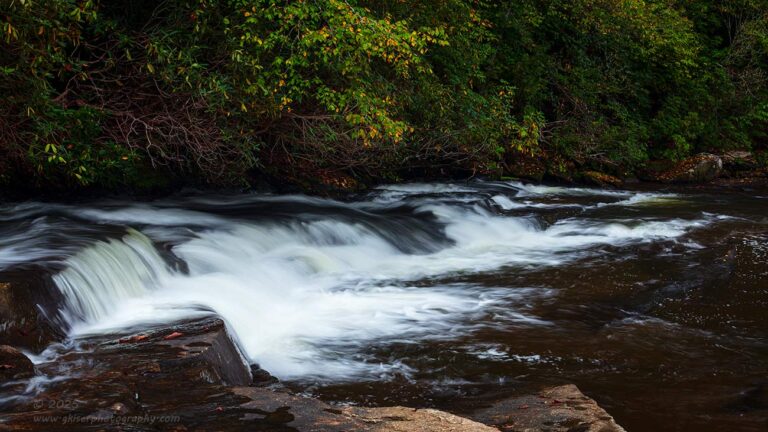
Now that I was up on the higher level, I had a much different view of the white water and liked this much better. I had bits of the rocky shoreline pointing to the disrupted water as well as cradling the larger portion of it. It all added to the interest and gave the image much more dynamism. It wasn’t a great photograph, but it was much better than what I had started out working with.
I was still trying to dial in the right shutter speed to capture this scene because the nature of the water was very different to what I had been dealing with at Eastatoe. I needed a faster shutter speed to provide detail in the white water, but that shutter speed froze all the little bubbles in the rest of the water. It became a game of compromise to get a shutter speed that did what I needed it to do in both areas. Again, this was not a great image, and looking back on how the day went, this was a rather disappointing one compared to the collection of amazing photos I had captured at Eastatoe. It was going to take me a little while to learn the personality of this waterfall and the associated rapids so that I could photograph it well.
I didn’t linger too long down here because Bill had already moved on ahead of me for shots that he was wanting to get. The time that I was spending was mainly to prove to myself that I was right stopping for a moment. I’m not sure I proved my point here, but things were going to look up soon enough.
Speaking of looking up, the clouds were thinning at this point and there was a lot more light on the landscape than what we would have wanted ideally. It was coming and going with the passing clouds, but even that was going to make things a bit more difficult as the exposure will change rapidly between frames. The only thing that we could do was make do with the weather and be thankful that we had such great conditions at Eastatoe earlier. It also could have very well been raining based on the forecast, so we were thankful for that as well.
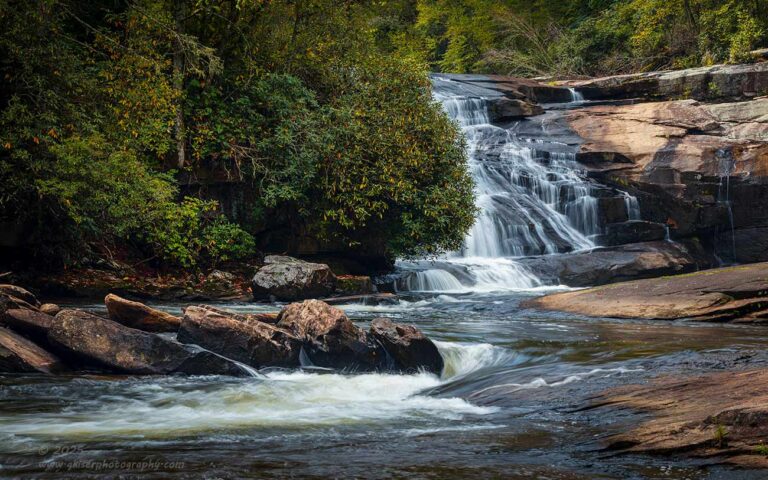
As I moved up along the stream a bit more, I was finally greeted by the lower section of Triple Falls. It was actually pretty impressive in size and the character along the right side was pretty phenomenal. It was this introductory view that caught my attention because of how it flowed downstream to a grove of boulders that created a nice little cascade and subsequent rapids. Because of how this scene hit me initially, I decided that I would stop and get a photo of it. This was something new for me in the realm of waterfalls though, because I was getting essentially a grand view of this waterfall, but half or more of it was obscured by trees. It felt kind of odd to be composing a photo of a waterfall that couldn’t fully be seen.
I still had the camera built with the telephoto lens from my earlier attempt at photographic greatness. There was no doubt that this was the right lens for the job because I needed to have the background waterfall looking as large as possible in the frame. This meant avoiding wide-angle and normal focal lengths which would comparatively shrink the falls in the background. From where I was standing, I was able to get the composition that I wanted at 95mm which I felt was a good compromise to keep the depth of field where I wanted it at the aperture that I needed in order to get the shutter speed that was required. The scaling of the elements appeared to be just about perfect as were the colors that were filling the frame. Considering how many people were walking around, I was very fortunate to have this scene to myself without anyone standing or walking through.
There were a total of four frames that I captured of this scene as the light changed up. Ironically, it was the first exposure of the bunch that made it through the culling stage. The latter three didn’t even make it through the first round which is telling of the light since I cull from the last image to the first. The first of the four was easily the best in terms of overall lighting, but even that wasn’t enough to save it for the next round of culling. That was the round that this image fell out of favor and was eliminated. I didn’t give it another thought until I was done editing the 26 or so images that made it through the last stage of the cull. I had called it a night after that and figured I would do the final tweaks on the images the following morning.
As the saying goes, I slept on it through the night and considered the keepers that I knew I had from the waterfall, and I realized that there were no establishing photographs showing the falls in the setting. While that is not mandatory, I knew that I had shot one before the lighting had gotten rough and wondered why I hadn’t kept it around to see how it looked after a bit of processing. When I got downstairs and started looking at the edits from the previous night, I went back to the first-round survivors of the culling to see if I had dismissed any too quickly. This image of the lower falls at Triple Falls came up in the viewer on Lightroom and I found myself looking at it with fresh eyes. It wasn’t my typical waterfall photograph, but it wasn’t bad by any stretch. In fact, I could see what I was thinking at the time, and that same sense of awe was back.
With the RAW photo hitting me a little differently than it had during the cull, I brought it back into the develop module and started to work out the processing phase. It really didn’t take long before I was really happy with how it was looking. There was no doubt that this was going to be a keeper after all. Going back through the discarded images one more time after the first round of processing is done is something that I have done for a long time just for this reason. Especially on treks where there are a lot of strong images, there are always really good photos that get overlooked. In this case it was because the composition was something that I hadn’t really tried before and it struck me as odd, but in that oddness is a certain quality of uniqueness that I think carries the image quite well.
The following seven frames didn’t turn out well at all. I had moved my attention to the rocks creating that bit of rapids which had been in the foreground. I liked the concept, but the sun was a bit too harsh for this to work out. The scene just had too much contrast and there wasn’t enough detail in the water regardless of what shutter speed I had used. None of those even made it through the first round of culling, but it wasn’t for lack of trying in the field.
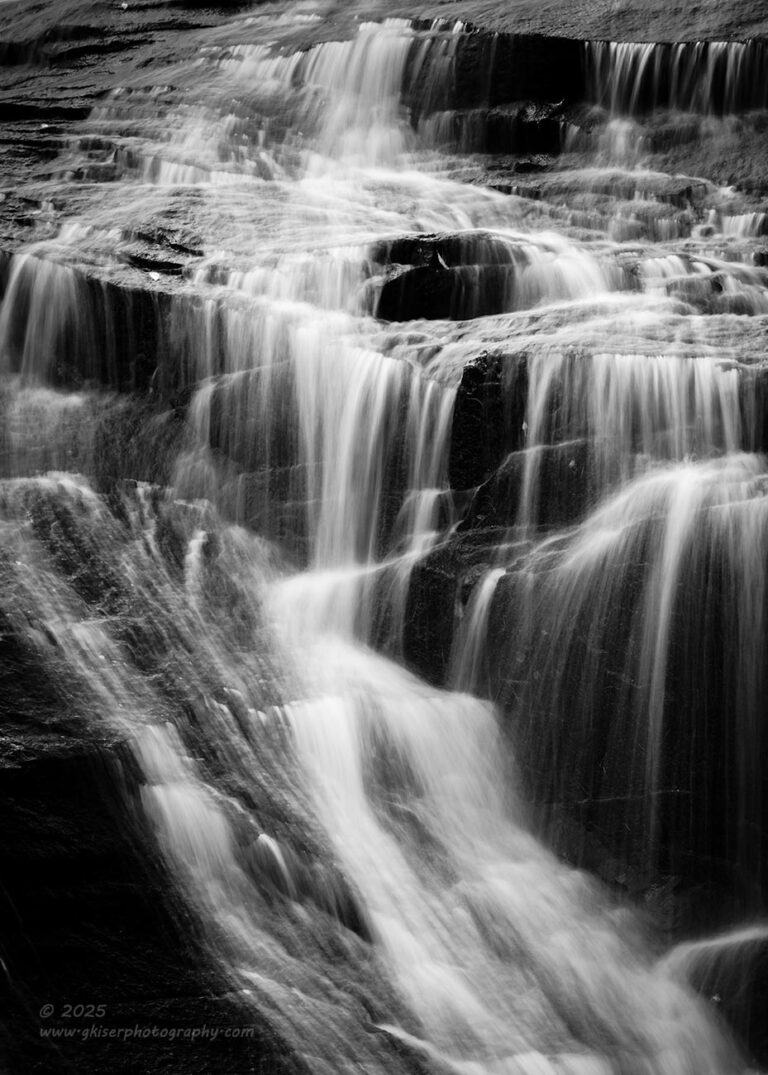
I could see Bill working up close to the lower falls and decided that I had better catch up to him because there was no doubt that he knew things that I didn’t about the area. I had been struggling up to this point to find something that truly excited me where I knew I had something wonderful in the camera. It was a little disheartening to find that the sunlight was getting stronger, even from behind the clouds. This was creating some very contrasty scenes when it came to trying to capture the waterfall.
When I got up to Bill, I wasn’t really sure what he was working on, and I didn’t want to snipe his ideas and compositions, so I just looked at the waterfall to take it in. I would love to say that I examined the entire waterfall critically and found this and that which prevented me from photographing the whole thing. I can’t say that. In fact, I don’t remember exactly what the entire scene looked like. I think it was a matter of knowing that I had the long lens attached to the camera and had already seen areas in the falls which excited me. The strong sunlight was creating a high contrast situation with the water and rocks which would likely make this a tough waterfall to photograph in its entirety. That same situation made it possible to work with black and white which I had kind of learned how to do well with Eastatoe falls just a couple of hours before.
Now it isn’t like I had never shot black and white, or done it in a high contrast way before because I had. I had spent a good portion of 2024 working on different ways of doing black and white photography as a matter of fact. The thing is, I had not done too much with waterfalls in black and white, mainly because I have not shot that many of them in the recent years. Eastatoe seemed to lend itself quite well to black and white and I found that the high contrast look worked very well with the water, especially in isolations. I was thinking that this waterfall would be another great opportunity to make the same choices.
There was no reason to switch the camera over to black and white because what I was going to be putting in front of the camera really had no color at all. The plan was to pick out interesting segments of the water flowing over the dark rocks which even in full color was black and white with a tint of blue from the sky above. By leaving the camera in my custom picture mode, I was able to maximize my dynamic range for the RAW images which was going to be needed to make sure that I maintained detail in the water.
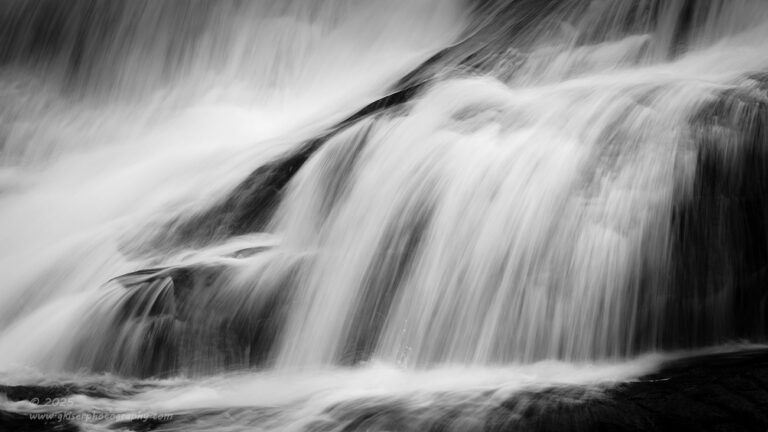
What started at this point was thirty minutes of water abstract photography with right at 50 frames captured. There was no rhyme or reason to what I shot other than I just worked the interesting areas of the falls. I had started out with the area on the extreme right of the falls which I had seen coming around the bend in the stream. I tried it horizontally and vertically with several exposures each to try and work through the lighting while keeping the motion in the water. The images in the review were looking really good straight out of camera without any extra contrast added thanks to the existing light.
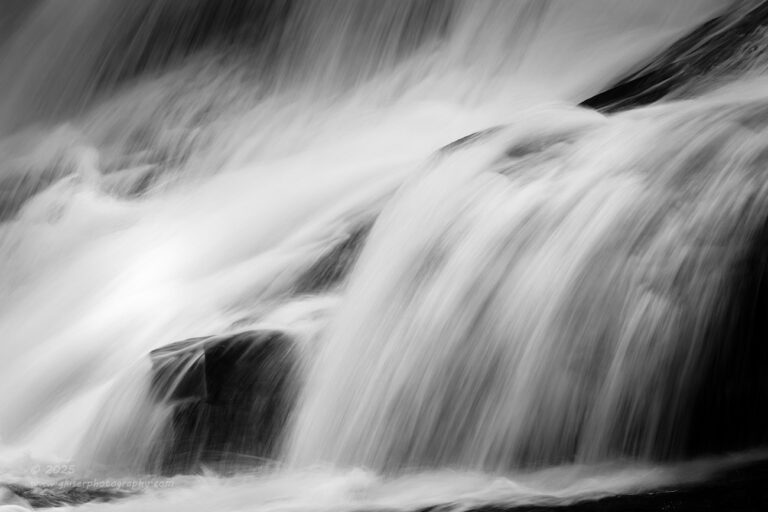
Eventually, I started to target a boulder that was jutting out from a broad cascade creating its own detail within the frame. This became the visual anchor for many of my images through this period. Unlike with Eastatoe where I pretty much kept the shutter speed the same through most of the exposures, I was moving the shutter dial a good bit, usually with the light as a chance of getting different looks with each exposure. There wasn’t anything directly planned out with this series of photograph. They weren’t really considered compositions with purposeful exposure choices. These were more like breathing than photography. I didn’t think through much at all and worked on pure instinct.
I had listened to this waterfall and found that this was how it wanted to be photographed. There was no postcard shot of the entire scene, no establishing view to show what the entire waterfall looked like. The fact that I don’t really remember what it looked like tells me that it wasn’t important. What was important was the small details that spoke for the grander subject. The world around me disappeared and I started forming Haikus with my camera.
I’m not going to insult you by subjecting you to a Haiku….wait a minute, why not?
Liquid lace flows by
A hard edge causes a tear
Remains unbroken
That is probably the first time that I have written a Haiku since elementary school when I learned what one was. Now, I never claimed to be a poet, and barely identify as a writer, so I ask that you not grade me on that attempt. However, it does serve to illustrate the point. A Haiku is short and sweet with a twist usually. It never says exactly what it means, but it creates a frame of mind that paints a picture. Why is this important? Well, thanks to Dave Russo who sent me a video that explained Haiku and the concept of Synecdoche and how they both can apply to photography. One of the concepts that I really latched onto was the concept of Synecdoche which simply put is allowing a part to speak for the whole. I ended up doing a whole workshop with this concept in mind back in the Spring which you can read about here.
Synecdoche didn’t really change my photography any, but it explained why I enjoy certain compositions the way that I do. In fact, after going through the video in all of its parts I had a new appreciation for how I like to do photography. More and more I have been concentrating on isolations when photographing old cars. This started off as a practical way of getting around terrible locations when I wasn’t able to get an overall photo of a really cool car. It became its own thing over time and something that I sought out even when the subject was in a beautifully picturesque location. The details seemed to be more impactful in many situations, and I had seen the same thing happen in landscape and waterfall photography over the years as well. I see more in the terms of detail than I do in terms of a grand scene. In essence I was allowing a part to speak for the whole. I was creating a response to the image that allowed the viewer to appreciate the scene for what was beyond the portion that I had captured.
It was something that I had never really considered before, but I totally agreed that photography and Haiku are very much linked. A Haiku is designed to be a short series of words in rhythm that create an emotional reaction and speak for something much broader than what was written. Once read, it is done, leaving you to have a response to what you have read. My photos are essentially that. It takes but a moment to see the photo. It doesn’t do anything, they aren’t videos, there is no dialog that goes along with them unless you are reading the blog here. They are short and sweet snippets of time that represent an emotion or a reaction.
Then there is the scope of the photo which can only be so broad. Even a grand landscape can speak for an entire region, but that is kind of a stretch. Where I have used the concept of Synecdoche most often is with old vehicles. An isolated headlight with a portion of a grill will speak for the entire car while concentrating on a reaction. Now, here I was photographing a relatively large waterfall located in Transylvania County which has been referred to as the land of 100 waterfalls. I wasn’t photographing the entire waterfall, and not even a recognizable section of it. I was picking things out like boulders that jut out from the smoother embankment causing the flow of water to be disturbed creating visual interest and structure. That flow of water then returns to its original flow as if nothing had happened. That is the photo that I have captured.
The Haiku that was written by that photograph goes like this…
Liquid lace flows by
A hard edge causes a tear
Remains unbroken
Can you see the relationship now? The photograph and the poem serve the same end and create (ideally) the same reaction. Neither is clear as to what is being said or represented, but the response given is similar. This is all done by just capturing a section of something larger. That section has a bit of tension to it, a twist if you will.

The twist in these photographs comes in the form of contrast between light and dark. That is where the high contrast black and white comes into play. That contrast defines the shapes and the direction of the flow. The next form of tension comes from finding an object in that flow that is stable and unmoving. In the scope of moving water, rocks are a great anchor for stability. There is that element that is steadfast when everything around it is moving. This defines the movement, and it is that dichotomy that forms the twist to the Haiku.
OK, enough of the English lesson for today. There will be a pop quiz at the end of the week, so be sure and study your notes. The point that I was trying to get across is that I was looking at this great big waterfall and I was choosing to let the details speak for it. I was going by pure instinct identifying the areas that had that twist, that dichotomy, and letting the camera become an extension of my eye. While I had been struggling leading up to the waterfall, I was now hearing how it wanted to be photographed, and everything was happening just as fluid as the water was flowing.
It is these times that I love being a photographer because it feels just as natural as breathing. I’m not aware of time, weather conditions, people, or even the fact that my feet were still wet from two hours in ankle deep water. I am just a vehicle for the camera, and the photos come quick and fast when I am in this kind of mode. There are no long strings of the same image as I try to get them technically perfect. I get the composition and get the shot. If it looks good, I move on. If there is a glaring problem, I fix it and then move on. I don’t stay in any one place for long, but I will use the same element many times over, but in different contexts with different compositions surrounding that element.

The routine would usually go something like this. I would frame up the shot, take the shot, alter the composition, get the next one, and look around to see if anything had changed to draw more attention. I would then point the camera to that area and start things over. As I had mentioned, the light was changing quickly, and the sun was out stronger than I normally would like when photographing waterfalls. I wasn’t really paying much attention to it on a conscious level, but when I was looking around for how the different sections were appearing, the light played a large part. I just wasn’t caught up on the technical side of it and thinking about how the highlights affected the shadows. I had largely disregarded the shadows in the scenes in favor of getting the highlights to be exposed properly. The shadows meant nothing to me in terms of detail, I just needed them there for the twist to the Haiku.
I do remember this one section of the falls which drew my attention, and it was only because of the harsh light. As I was looking for contrasts, I could see that the sun was hitting a flatter portion of the falls which had a thin layer of water running along the surface while there was a thicker cascade flowing behind it. That thicker water was in more of the shade, so there was even a high contrast between the water in this view. I trained my camera right to that area and found that there were two rows of rocks that just pulled my eyes into the frame. None of this was a conscious choice, it was my reaction to how I had composed the image by instinct. It just worked and I was amazed at how quickly I was able to react to the scene.

After I had realized just how effective the rows of rocks were to lead your eyes into the scene, I rotated the camera to show this scene off vertically. That opened up the smoother flow of water in the background, and I saw a completely different image even though it was of the same portion of the waterfall. I actually love both of the images way more than I should because of how much I am against direct sunlight when it comes to photographing water. It just worked here, and the rocks were nearly black, but there is still some detail left in them if you look closely.
I could have brought that detail out and had an image that had all the zones represented from light to dark, but instead I really embraced the high contrast look and pulled the shadows down a good bit to really amplify the contrast. It was the dark sections that defined the brighter water and gave the entire image structure. This is just not a technique that I have used a lot over the years, and to be honest the times that I have tried it, I’ve overdone it through post processing rather than having a scene that just worked in that kind of presentation.
Just like with the images from Eastatoe, there really wasn’t that much editing involved. Waterfalls in general don’t require as much post processing as other subject might. Even still, I will do a good bit of processing of those images in most cases. For this adventure, I wasn’t willing to push the processing like I would have normally. There was very little done locally, which was pretty much a vignette added, a bit of a highlight for a focal point, and dodge and burn masks occasionally added in along with a linear gradient for some brighter areas. That was pretty much it for local adjustments and the global adjustments were mostly setting white and black points with a curves adjustment. The color images had a bit of tweaking with the hue, saturation, and luminance values, but that is about it. I really kept these simple and I’m really proud of how close to the final images I was able to get just in the camera with the lighting.
At some point around this time, I became aware that Bill was pointing his camera towards me. I didn’t want to be in his shot, so I asked if I needed to move. He informed me that I was his shot, and he commenced to photograph the photographer. As I was starting to wrap up what I was capturing, I moved over to the side and got a few shots of him. It seemed easy enough since I had a solid portrait lens attached to the camera already. I just opened the aperture and got a few shots of him doing his thing. If nothing else, that reminded me that I do have a lot of people photography sessions coming up very soon and I need to get focused on those. With well over 100 images already on the memory cards, I was thinking that I might have a hard time getting all of these processed and uploaded before I was needing to change gears and worry about expressions and lighting. For now, that was going to have to wait because I was fully involved in this trek and was going to see it through until the last image had found its way into the portfolio.
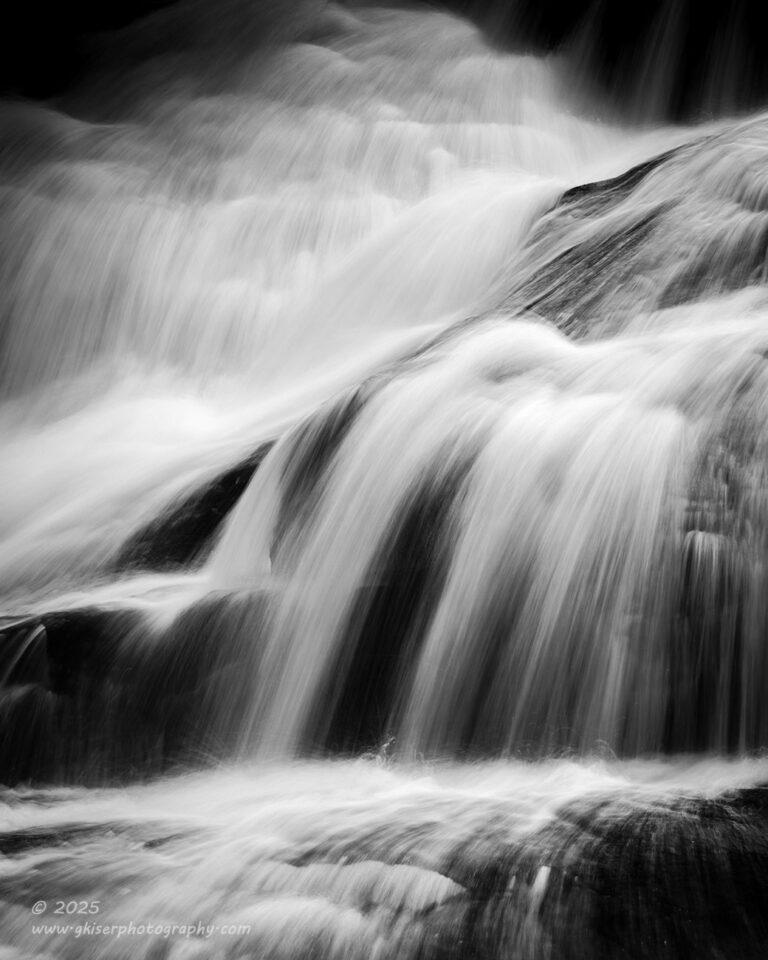
The last image that I shot from Triple Falls still wasn’t an overall composition, but rather another detail shot. I was still focused on the area that had that one rock that jutted out from the main slope which created so many compositions earlier. Now, I had shifted my focus away from that aspect and was focused on how the light was hitting the water above and beyond that rock. In fact, the rock just provided a bit of negative space in the lower left to help and define the path of the water flowing over the gentle curve.
The gentle fingers
Caressing the smooth surface
Crash down suddenly
And there we go, a bonus Haiku describing the same thing that the photo is describing. See the connection yet? As Mom would say, “I’m a poet and just don’t know it….and my feet are Longfellows too.”
By this point, the sun was getting very bright and neither Bill nor I felt like going deeper into this location. We had been here for about an hour and a half and I had shot 90 frames during that time. Despite the slow start, I finished out the time rather strongly and came away with nine keepers. Considering the lighting difficulties and the many discarded frames that I started with, I’m quite happy with the results of the day. I’m really surprised at how many of the keepers turned out as black and white. After those initial two in color, the rest just demanded to be black and white. I even went back through to see if I could do any in color for a bit of variety, but none of them would have worked in color at all.
If you were paying attention to the titles of the images, you probably have noticed that I titled one of them Like Drawn Butter. If you know what this phrase means, let me know. I’ll talk about it more tomorrow and where I got the idea. I will say that one of these blog entries was about to have that same name. It all started with what we did next.
Bill and I were both seeing the sunshine as an end to the day. It was still better than the storms that were supposed to roll through the area by now, so we weren’t complaining. He wanted to get lunch at one of his favorite restaurants which sounded good to me. After getting back to his truck, we headed out to the Cedar Mountain Cafe for a bit of lunch. Now, I don’t usually eat lunch, so this was odd for me, especially after having a big breakfast. I was rather hungry at this point though, and I suppose that was due to fact that we had been rolling since about 7:30. I was looking forward to sitting and having a bite to eat which was what came next.
The question is, was there more photography to be had after lunch, or did the rain come in and put an end to the day? What did Bill order? Was my Cuban sandwich good? All these questions and more will be addressed soon enough. So will the meaning of “drawn butter.”
Until I return, how about reviewing all of the photos from this trek and see if any speak to you. I would love to start making some prints of these images. It has been far too long since I’ve seen one of my waterfall photos in print form. I’ll leave a list of links at the bottom so that you can access all of the blogs easily and will add the next one after I am finished with it. When you order a print, you are not only showing that you like a certain photo, you are also supporting my art in a very meaningful way which allows me to take trips like this to capture scenes that are a bit further from home than normal. The very best way of enjoying one of my photos is in print form, especially when it comes to waterfalls. Just about every computer monitor that I have seen is too bright and that will cause the water to lose texture and appear like milk when you are viewing it. When I make prints of the files, they are matched to my calibrated monitor so that the detail that I want you to see in the water is actually there. The tonality and colors are also true to what my intentions were as an artist. I wish there was a way to control the viewing environment that you are looking at my photos in, but there is just no way at all to make that happen. What you are seeing is but a hint of what the print would look like. A photographic print is something to behold if you are used to looking at all the photos on a digital viewer. Order a print and experience the difference!
Until next time….