Saturday, May 17, 2025
OK, let me go ahead and clear up the title before I get started. Synecdoche is a new word for me, and one that I am still having a hard time pronouncing, so however you are saying it is probably better than my version. This word essentially refers to a situation where a part of a something represents the whole, or vice versa. I’ve come to interpret it the in the same way that I define isolations in photography. You know, when I pick a small detail to represent the greater subject. I’ve been doing this for quite some time now and have happily called it isolation, or intimate capture. This will likely continue being how I refer to it because let’s face it, I’m not great with complex words like Synecdoche.
So, when did I get the word of the day calendar and start putting it to use? Well, I haven’t got one, and this word kind of happened in an off-handed way. Allow me to backtrack for a moment. As I’m sure you know, I have been planning a decay workshop at Outlawed Restorations in East Bend since the beginning of the year. I usually go out there at least once a year for workshop and then several other times for my personal portfolio images and an occasional mentoring session. Anyway, shortly after I announced this year’s workshop, I received notification from one of my clients and a friend, Dave, that he had signed up for the workshop. I’m always excited to have folks sign up for my workshops, but this would be the second time that Dave had attended a workshop at this location. That make it even better. As the months went on, I got notification from two other veterans from my previous decay workshops as well as other workshops. Bill and Bob were onboard for this newest variation of the workshop and that gave me three participants that have been through different versions of this workshop before which meant that I was going to be able to really get into some interesting topics for instruction. I was really looking forward to it.
As we got closer to the workshop date, I started sending out information about how the day was going to go as well as providing several handouts that I have put together over the years which detail a lot of how I work as a photographer. There is no sense keeping that information to myself and I’m happy to share what I know with others. Anyway, during the exchange of emails, Dave let me know that he was undergoing a procedure at the beginning of the week that the workshop was happening. This was a great opportunity for him to address an ongoing issue that he has dealt with which is all I’m going to say about that. He felt that he was still going to be able to attend the workshop and even sent me an online workshop that he had found recently that he thought I might enjoy. Now, when I tell you about this workshop, you will probably give me a blank look and have no idea why this is pertinent. Just bare with me on this one folks.
The workshop was about the similarities between Haiku and photography. Yes, I am talking about the Japanese poetry with alternating syllable counts on each line. My only experience with this form of poetry was in elementary school where we had to write several Haikus. I won’t share what I wrote because I don’t remember after blocking out the horrific end result. This was followed up recently with a presentation for the North Carolina Haiku Society talking about self-awareness through photography. That is pretty much my understanding of Haiku. Photography, on the other hand, is something I’m reasonably well-versed in. I was intrigued at a direct comparison between the two arts and sat through all 75 minutes of the workshop that morning that I got the link. It is free, and I encourage those of you who are interested to check it out.
The further I got into the workshop, the more I could see the connection that he was making between the two. Not only that, but he was also talking about how I liked to do photography. It was quite interesting and enlightening because on some level it validated much of what I have thought about photography over the years, specifically when it came to my isolations. This is where that word came into play. I vowed to remember the word, but it continually escapes me, and I have to refer to my notes. Nevertheless, synecdoche was going to have a part to play in my own upcoming workshop as I coached the participants through working the details of the subjects. I was excited that Dave was going to be with us, so he could talk about it with probably a little better clarity than I would be able to leaving me to help with the execution of the concept.
That was the plan, but by Thursday, I received an email from Dave that he wasn’t going to be able to make it to the workshop because the recovery was a little shakier than expected. Of course, I wanted him to recover and be safe doing it, so I totally understood him deciding to skip out on the workshop. That ended up leaving Bill and Bob which was going to make for a fun workshop as they are both very well-versed photographers and a lot of fun to work with. Dave was missed though, and especially because I had planned on picking his brain for a lot of the concepts I wanted to go through.
That was the first hurdle for the workshop. The second one was one that is always an issue with workshops that are planned months in advance. That is the weather. Contrary to everyone’s assumption, I have no control over the weather or the lighting and am just at the mercy of the day as everyone else is. When planning a workshop all I can do is pick the time of the year and try to avoid holidays. I’ve been very lucky for the most part with weather conditions, but looking at this one in the extended forecast, I was seeing what amounted to a very rainy day with the 10-day forecast. As we got closer, that changed to some morning rain with afternoon clouds, and then eventually a sunny day. Even the day before it was looking like mostly sunny conditions which is far from my idea conditions, but it was better than rain all day long.
When I went to bed, I had the alarm set for 4:30 to give me time to get ready to head out at 6 as I wanted to get there early to get a few of my own images before Bill and Bob arrived. At 4:15 or so, I remember waking up to the sound of heavy thunder outside and there was a flash of lighting as well. I was irritated enough at being woken up, but to be woken up with just minutes to go before having to get up was no fun at all. Then it hit me that it was probably raining with all that noise. A quick check of the phone showed some pretty large storm cells moving over the area and the hourly was showing very high chances of rain through 9am which would be an hour into the workshop. It could have been worse, but I really didn’t want to start out dealing with the rain. There wasn’t much to do except for go and deal with it because this is a workshop and out of respect for those that traveled to get here, I wasn’t going to cancel or reschedule.
I arrived at the location just before 7am with a solid drizzle falling. I got out of the truck and started to walk around to see if there were any good spots where we could stay out of the rain at the beginning until the system passed and we were under just cloudy skies. There were a couple of places which we could work with and that left me with checking out the spots that I wanted to shoot. The main thing that I had wanted to work with was the Chevy wagon that was sitting under a shelter in the back part of the property. I had just recently discovered this when I was out here last month doing some light painting. When I saw it, the light wasn’t all that much different from what I had seen at twilight, and I decided that it wasn’t worth shooting again just yet. I had gotten my camera though and had looked for something that might work in the existing conditions. I do enjoy the rain for the saturation that it gives to the rusty cars and hoped to be able to harness that aspect with a few subjects before the workshop got started. The rain was causing some issues though because it was falling faster and faster as I was walking around.
At one point, I just tucked the camera bag under the shelter with the Chevy truck to keep it out of the rain as I walked around and started to really think how I was going to salvage the day. The hourly was still showing heavy rain until 9am which was going to take the first full hour of the workshop and from there, it was cloudy, and I wasn’t sure if the rain would really stop. I needed to have some plans in motion in the event that it stayed rainy for the whole morning.
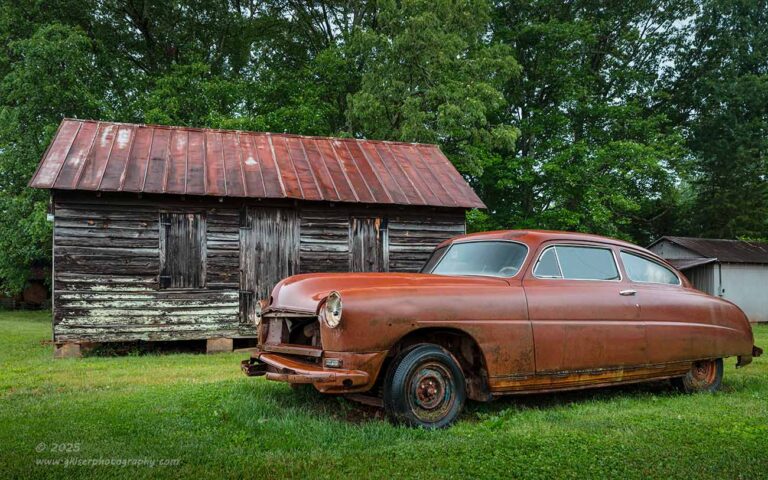
As I was walking around considering what would work and what wouldn’t, I saw how the Hudson Hornet was looking in the rain. This is one of those subjects that has been problematic to photograph in the several different locations that it has been parked. Currently, it was sitting in front of the original family home which honestly makes for the best composition that I have seen with the car. The car is still a very large slab of metal that is pretty much uniformly covered in rust which makes it a difficult subject to keep visual interest. However, the rain on it added a nice sheen that increased the visual interest on the car for me. The composition that I had shot before was going to work out with it once again, so I decided to brave the rain and went to get the camera bag.
Before pulling out the camera, I mounted the umbrella to the holder which fixed it to the tripod and allowed it to cover the camera. It is far from perfect, but it does do a decent job at keeping the lens and filter dry and free from spots. I then got the camera built with the 24-70mm lens and a polarizer before framing up the shot. Of course, I kept knocking the umbrella over because I was wearing my Boonie hat. Once that came off, I was able to work under the umbrella much easier at the altitude that the camera needed to be.

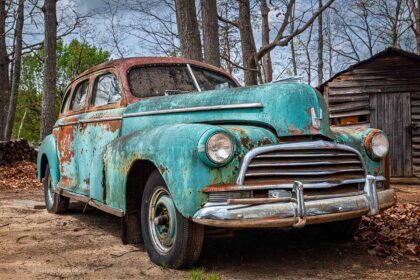
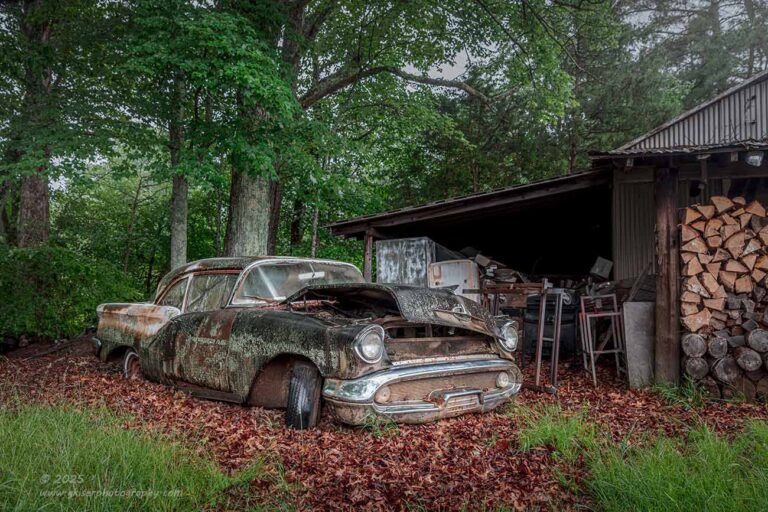
Before long, I had my first few images in the can and was feeling better about the rain. I knew that there was another car that has benefitted from the rain before, and that is the Olds that is over on the side of the property. I’ve shot this car more times that I can count and have figured out several different compositions with it along the way. This time, I wanted to try something a little different. I included a lot more of the barn and gave the scene a more open feeling. The lighting was creating a lot less contrast than I normally deal with and the refrigerator that is positioned behind the car was much less obtrusive in the composition this time. In fact, I used it to frame the hood ornament on the car, so it had a reason to be in the photo. It actually worked better than I imagined and I had what I assumed was my second decent image captured. While I was working on that subject, Bob showed up and came over to where I was working.
Bob had already asked me if it was ok to show up early since I had said that I was going to be getting there early to work on my own photos before they got there. This was not just for portfolio images, or even for my own purposes, it was in the sense of fair play. You see, part of the workshop experience is that we do a follow-up image review virtually after everyone has a chance to process their images. I ask that each of the participants submits three to four images for group discussion. I would feel a little awkward putting everyone’s work on display like that if I wasn’t willing to take part in it as well. I also realize that it wouldn’t be fair to choose images from this location from any one of the previous times that I had been here under better conditions. I wanted my submissions to be from the same conditions that everyone else was shooting it, but I also didn’t want my photography to get in the way of hosting the workshop. I pride myself in making my workshops an educational experience, not just a paid photo tour. What’s the fun in that…for either of us? I knew that I would have some more chances to do some photography later on because both Bill and Bob have said that they learn from watching me work as well, so I wanted that to be an option if I needed it later on to demonstrate a technique or something.
After Bob and I caught up for a bit, we went back to the front of the business and found that Bill had just got there. He was a few minutes early, but that was perfect as we were ready to get rolling. I did wait for a few minutes to see if maybe Dave had changed his mind and was feeling up to joining us. Sadly, there was no sign of Dave, and we got started with the workshop.
In the interest of keeping everyone’s camera gear in the dry as much as possible (keep in mind that my gear was tucked under a shelter, but still outside), I decided to start the workshop off with a bit of roll playing to go through the finer points of asking for permission to photograph on somebody’s property. This is something that I started doing on the workshop last year and I thought that it went very well which is why it is now a regular feature of this workshop. It doesn’t take too long to do, but I was really hoping that by some miracle when we finished the roll playing, the rain would have stopped.

Well long story short, it didn’t. I really wanted to get us rolling with the day because I had promised a lot of photography since both of these guys knew the basics of decay. We went ahead and did a quick walk-through of the property to get an idea of what they wanted to shoot. This walk compiled a list of something like four scenes that they were interested in shooting. We all got our gear together and came back to the little 1960 Winchester taxi which had been imported from Britain. This was a new member to the collection on the property and was something that I hadn’t photographed yet. Bill and Bob started working out their compositions and I noticed something interesting. Bob had started out noticing a reflection of a tree in the wet paint on the rear of the car and I had shown him that the reflection was the same down by the taillights for a bit of added visual interest. This is that power of “and” that I have been talking about. Bill and I both saw the potential in the reflection, and we seemed pretty excited about capturing it. The odd thing was I was looking at both Bill and Bob framing up the full car from opposite sides, not the isolation that we had talked about.
I’m all for letting the participants exercise their own creative voices, so I assisted with both of their current endeavors. Something that we determined around this time was that it is always a good idea to bring charged batteries to a workshop. I’m not going to name names here, but essentially, there was a primary battery that was left on a charger at home, leaving three other batteries with no charger in the bag. To make matters worse, two of these batteries were partially drained and none of them held a charge for very long. With no charger present and very little battery power, there was a good chance that the workshop was going to end early for one of the guys.
As we got into the swing of creativity, I started to kind of push them into the details of the car which happened to be a lot easier to work with than the entire car based on the surroundings. I was really wishing that Dave had been here so we could go into synecdoche and how a small part can represent the whole. I ended up putting it in my own words and we started to look at some isolations that would capture the essence of the car. I don’t think that anyone actually worked the tree reflection on the back, but Bob worked several different areas around the car and kind of landed on the area of the front right wheel where he spent the majority of his time. Bill spotted the Winchester logo on the top of the grill and framed up a shot of that. This was an interesting concept and after he had some time to try and work through the composition with limited success, I went over and helped him arrive at a different variation that introduced some diagonals. As I was working through that composition, I started to have my own ideas of a composition and hoped that I would have the time to come back and get a few shots of it myself. For now, it was cumbersome enough for both of them to work in the rain with rain sleeves on their cameras which was stressful enough for them without having to deal with me trying to get a photograph.

We eventually moved over to the far side of the property where Bill worked with two trucks that were partially in the trees while Bob worked a Plymouth that was parked nearby. The rain decided to finally wrap up during this portion and it was something like 9:30 or so. The rain had lasted longer than expected, but it was finally slacking off and we were able to get busy with things in earnest. Bob and Bill kind of started doing their own things at this point which had me running back and forth between them checking to see if there were any questions or if there were any pointers I could give. This kind of continued on through the morning and I didn’t really get any chances to get any photos. The light was really good for a while, and I was happy for them both.
I remember that at one point, Bill stopped at one of my favorite trucks that I always use when I talk about telling a story with a photo and finding human qualities in these inanimate objects. Bill had found a composition that he liked on the top of the fender, and we were talking about that for a little while, but I couldn’t help but notice the wheel below. Now, I’ve photographed this wheel many times because it looks really cool. However, this time the steel belts grabbed my attention because they were the same green as the vegetation on the ground. I also noticed that there was new growth in the dirt that had collected in the fold of the flat tire. This scene was hitting me differently than it had before, and I really wanted to capture it. Having explained the concept to Bill, I let him shoot it first while I built my camera for the first time since the workshop had technically begun.
It took me a few tries to nail the composition, or more specifically the placement of the camera. The composition was a lot tighter than I had done before because normally when I shoot this wheel, I will include the fender for the color. This time, I wasn’t including the entire tire, or even wheel, or hubcap. It was a very tight crop that forced the attention on the green belts in the tire along with the general decay of the rubber. I couldn’t help but think about the online workshop that I had watched about Haiku and photography, especially the part about synecdoche. This tightly cropped photograph was essentially telling the story of the entire truck, and I think that it was doing it very well.
We continued to move around and talk about different concepts with the different subjects. Bob had been spending time on the Ford sedan that was bought new by Dean’s father in the ’50’s. We covered a lot of ground talking about the direction of light and the impact it had on a scene. We also spent time looking at isolations on the car and how to effectively capture those. You all know that I am drawn to the front of these old cars for the most part. Bob was taking a different route and deciding to focus on the rear of the car where he found the most visual interest. I helped him work through the compositions as I was increasingly impressed with how he was seeing the scene. This is an area that he has been really improving on over the last few years and with this being his third experience at Outlawed Restorations, I can really see how he has progressed and is starting to find his own voice which is my ultimate goal with these experiences.

At around 11:30 we broke for a quick lunch and a magic show. Yep, I run a full-service workshop experience. While resting and getting a bit of nutrients in us, Dean’s son and his two boys came by to say hi. As it turns out, Bill is a very capable magician and he did a short show for the kids which amazed not only them, but Bob and me as well. I’m still wondering where that dime went to, and how he was able to bite the quarter in half. The best part of the show was when he promised to tell how he learned to do the tricks. He went over to whisper in the older boy’s ear that he had learned magic by going to the library and reading a book. There is no doubt that Bill is a great teacher after that statement because even I wanted to go to the library and check out a book or two after that.
With lunch over, the clouds were pretty much gone, and the sun was beating down on us. What had started off as a very rainy morning had turned into a scorcher of a day. Nothing like working in every imaginable lighting condition in just a few hours, but here we were. Both Bill and Bob were starting to think about calling it a day. One because they were down to their last battery with only a partial charge and one because their back was starting to hurt making getting into the positions rather difficult. I think that it was Bob that made the great suggestion to go over to the shaded area of the property where the light would be a little better to work with. I was all for it and had actually already decided that was where I would try and direct them. He just beat me to it, but we were all in agreement.
Both Bill and Bob got started on the subjects that they were most interested in, and I provided help and guidance where I could. Eventually, I let them know that I had a very interesting abstract composition that I had found recently that I wanted to show them. Bob got wrapped up first and I took him over to the side of the barn where I had seen the stack of fenders to see if he might be drawn to the same scene. He was, and got excited about how the stack looked. He grabbed his camera and maneuvered into position for the shot while I went over to help Bill with his exposure issues due to a very wide exposure latitude.
During this portion, Bob came over and let us know that he was done for the day. He was needing to rest his back and get comfortable. We have both determined that growing old isn’t for the faint of heart. I got everyone together for a quick wrap-up and took care of any last-minute questions or concerns. With that Bob was on his way. That left Bill and I to work on a few other things. Just as he was wrapping up the compositions that he had been working on, he was told in no uncertain terms that his day was finished as well. Unfortunately, this was when I was able to tell him about the stacked fenders. I showed him the composition, but there wasn’t anything that he could do with it due to equipment issues. We got things all wrapped up and he was on his way home.
That left me to my own devices. The only other time that this workshop had ended this early was when it got rained out several years ago, and I don’t think that that one ended this early. At any rate, I had some time to play, and I still had energy which is rare after a workshop. I wished that the light was better, but at least the rain had stopped. The first place that I went was back to those fenders because while explaining the concept to Bob, I showed it on my phone which happened to be in full color. The last time I had shot this scene I processed the photo in black and white for a more abstract appearance. It had made the list for my most significant images of 2024 in that form, but I was seeing a different side of it this time, and I was really liking the colors.
I worked out the right spot for the camera and framed up the composition roughly how I had shown Bob earlier. I knew that it was different than what I had framed up last time, but I really had no idea what I was doing differently. I just went with what felt right this time. The end result was a photo that I absolutely love and think that it is probably the strongest one that I shot during this workshop. The colors tell such an interesting story after living with a similar composition in black and white for a year now. I don’t know if this photo will make the significant list this year, but I do think that it is an improvement over what I shot last year.
Since I was back over by the Oldsmobile once again, I decided that I wanted to work with the broken glass again. I’ve shot these windows (with a camera!) many times and have always found the compositions interesting, but after having explained the concept, I wanted to shoot it again. I was torn on how to frame up the shot and whether I wanted to look from the front or the rear for the composition. There were arguments for both options, and I liked the compositions from both angles. Since I wasn’t in any real hurry, I just shot them both and went with a little different angle than I had in the past. Even the processing was done differently and hopefully it is better than what I have done before. I’m going to have to live with these a bit longer to really know if they are better, the same, or a swing and a miss compared to earlier attempts. No matter what happens, I am very happy that I took the time to capture these images because that Olds is just too cool and it won’t be there forever.
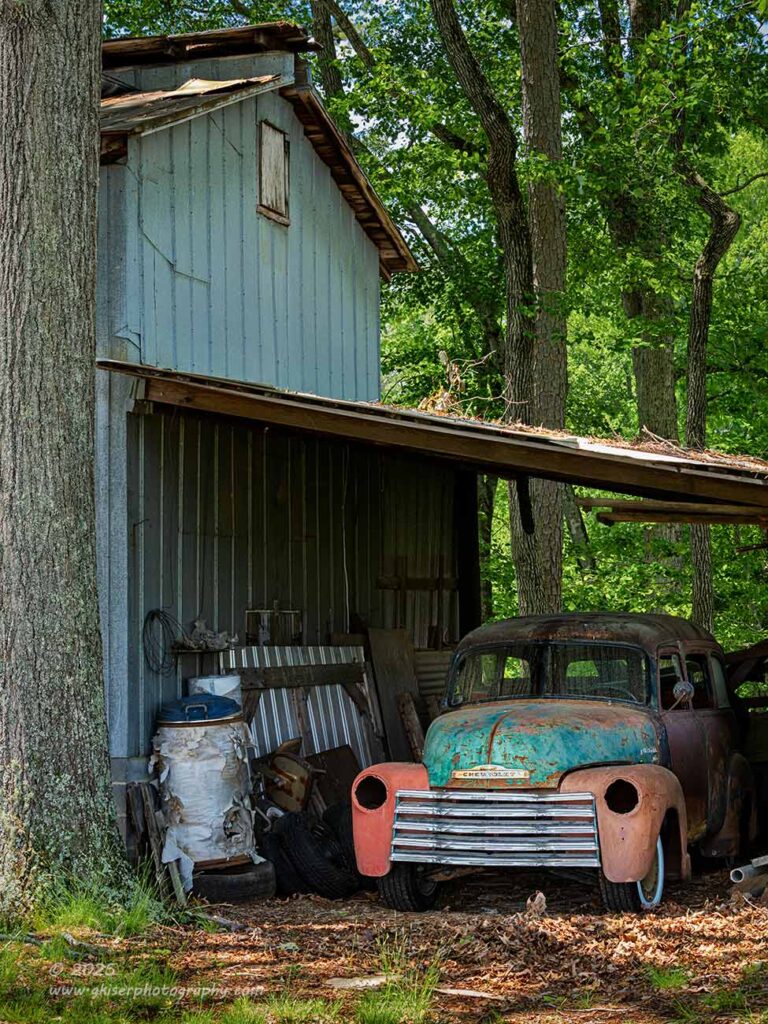
One other subject that I wanted to photograph was the Chevy parked in the barn that I had seen last month. The light had been flat and uninteresting when it was raining earlier, so now that the sun was out, I was hoping that things would be different. When Bob had been photographing it, there was sun on the very front of the truck which gave the wrong contrast for what I had in mind. Now that sun had moved off of the nose and was just showing up on the ground in dappled lighting which I thought worked well. The truck was all in shadow now which kind of defeated the purpose I had in doing a repeat shot on this truck. I had picked out a different composition, and it was still a strong composition which I figured I would give a try.
The lighting actually turned out pretty good for this composition as there was enough sunlight to really saturate the colors on the front of the truck, but not enough light to make the clutter around it a distraction. This time I included the tree to the left for just a bit of added depth to the scene but still had to crop in close on the driver’s side because of how the side was filled with more distractions that didn’t really seem to work with the truck. This composition feels more natural and shows the barn in a better way than what I had captured last time. The colors all worked together and with the trees being fuller, there were less points of distraction in the background with the elimination of large pockets of sky. I do still like how the grill has the horizontal slats and the tin panels as well as the wall itself are all vertical in orientation. That juxtaposition makes for a very interesting look to the details of the frame. It wasn’t quite what I had in mind when I started out the day, but I did get a nice image of this with better natural light than I had seen it in the first time around.
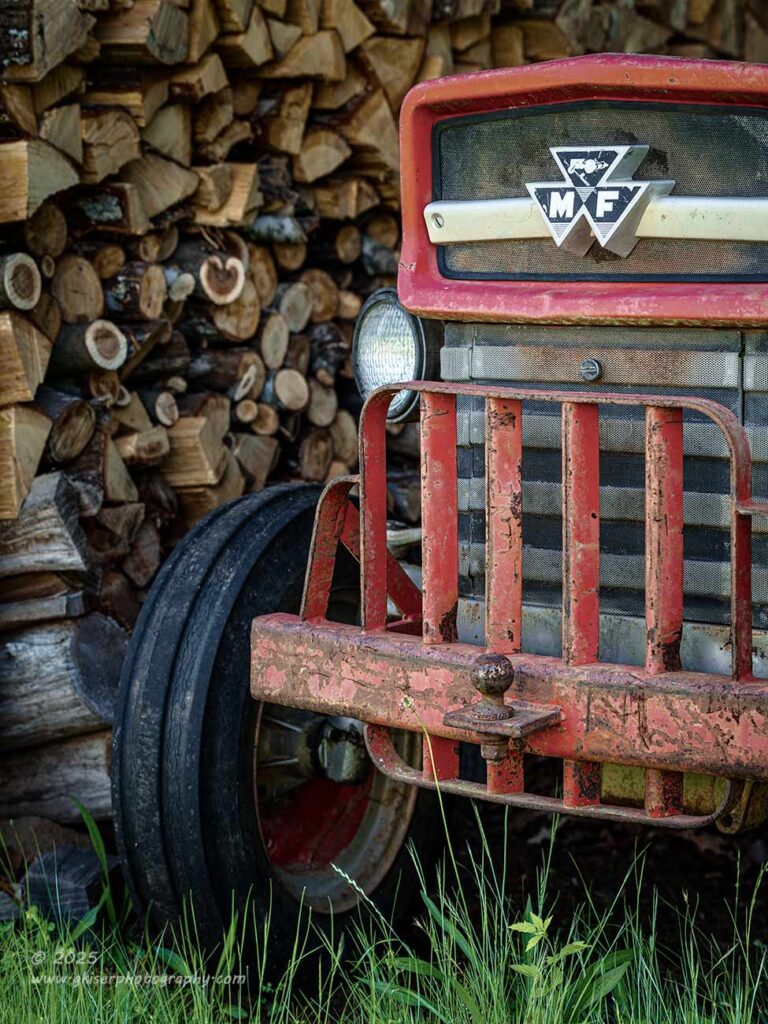
Not far from this truck, and just on the other side of the Olds, was a red Massey Fergusson tractor that has been sitting here for many years. I had shot a close up of the hood ornament that quickly became one of Toni’s favorite photos. Something about MF this and MF that made her laugh. This time, I still wanted to focus on that ornament just because I wanted to hear her giggle at it again, but this time, I wanted to include more of the tractor. I didn’t want the entire thing because that would be just too much for the frame and it would be too obvious. The thing with Haiku is that it is all about feeling and another phrase which I have learned, Kireji. This is the part of the Haiku that essentially redirects the reader and makes them feel something a little different than what would be expected. I wanted to incorporate that concept into this photo by taking two unrelated things and having them work together to make you feel a certain way. There was a wood pile stacked up next to the tractor which was great as it gave me a nice and simple backdrop. But I couldn’t help but notice that one of the pieces of wood was shaped like a heart. What better way to describe a feeling than a visual of a heart hidden in plain view in a woodpile, next to a tractor that has obviously been well used over the years.
This was one of those opportunities to do a creative crop on the tractor. Rather than just focusing on the front end, or on a headlight, or even just on the emblem, I decided to take a good portion of the front end, but only including a single wheel. Normally, I don’t like doing this because it makes the subject appear to float oddly in the air. Because the grass was tall enough to come into contact with the tractor, it felt much more natural. Now, I know that not a single person out there believes that the grass is supporting the tractor, I’m not that stupid. What I do expect you to believe is that Bill is doing another one of his magic tricks and the tractor is levitating on its own. See, perfectly realistic explanation there. No… actually, there is no magic but there is a slight connection the ground, and we all know what is just out of frame to the right because we are used to seeing such machinery. it does pus the focus more to the bull bar on the front which happens to point up to the MF emblem (I don’t know why Toni just laughed reading that). Of course, the eyes will then jump over to the wood pile, and because of a very simple radial filter applied, you will find that heart shaped log which is the Kireji in this particular Haiku.
I’m starting to really subscribe to this school of thought, and I can’t thank Dave enough for sharing the workshop with me as it has opened up some other doors for me in terms of creative compositions. I’m never going to stop learning different ways to communicate visually, and this is something that could potentially have the same effect as the book by Harold Davis that introduced me to the concept of Wabi-sabi all those years ago. By reading that, I was essentially given permission to enjoy photographing decay subjects. Now, I have an articulable reason to enjoy finding juxtaposed elements to put in the frame, or something that adds a bit of a contextual twist. I’m excited about where this will take me in the future.
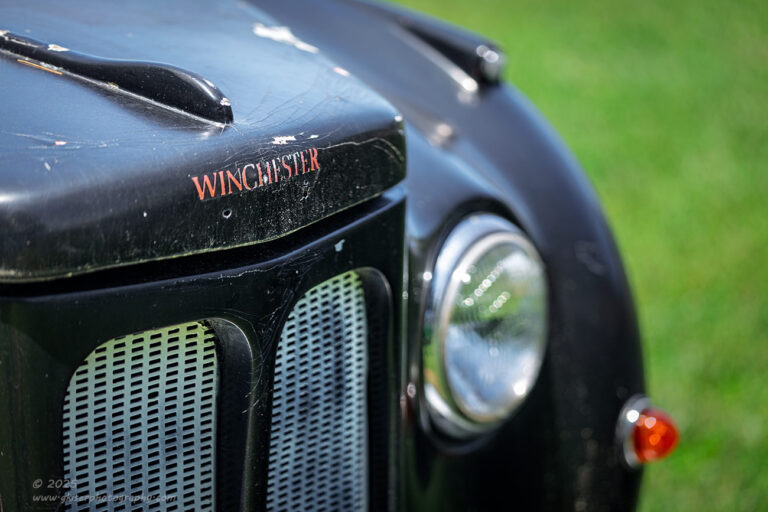
It was getting hard to work in the direct sunlight, and it was still going to be hours before the sun got low enough to start producing soft light. That isn’t to say that the light that I had was bad, because there is really no such thing as bad light, only bad ways of using it. As long as I made conscious decisions on how to compose with consideration to the sunlight, I would be able to get decent images in this midday sun. I still wanted to try working the Winchester cab which I had yet to photograph. I had a composition in mind that I had spotted earlier, but it needed a more interesting sky. When the sky got interesting, I didn’t have time to shoot it. Now that I had the time, the sky was boring in a different way than it had been before. I wasn’t going to be able to do my overall composition, but I wasn’t really all that heartbroken about it. This was because I had worked with Bill for a while to get the composition that I had loosely worked out before they arrived. There were a lot of problems with the composition, and I wasn’t sure that I would be able to solve them to my satisfaction. I did know of a composition that would work based on helping him with an isolation that he had come up with.
What had started out as a straight on shot for him had transitioned into an angled shot when we started working on the composition together. I had really liked where this concept was going and decided that the light was good enough for that composition to work. I got the camera in position and worked out the little details to make everything in the frame work together. Once I had it figured out, I made a few exposures with slightly different depths of field so that I would be sure to get it all right in the final image. I was pretty happy with that and decided to see if I could make the composition work with the taillights as we had talked about earlier.
I knew going back there that I wouldn’t have the reflections of the trees which actually made the image quite interesting in concept. Bob was right on spotting that element reflected in the rain-soaked paint. Now that the sun was out, the water was long gone as well as the reflections. I still liked the taillights and the contrasting Ford emblem, so I still thought that it could work. I found the composition that worked and fired off two frames with slightly different exposures thinking that I had it figured out. What didn’t show up in the image review was just how badly the black paint sucked out every detail of the surface of the car. There just wasn’t enough visual interest because of the black paint to support the photo. I ended up tossing those two images which happened to be the last of the day.
I had shot just 44 frames during the entire day on the property. While that doesn’t seem like many, the vast majority of the day I wasn’t working my own camera. I was helping Bill and Bob with their images which took precedence over getting my own photos. I wouldn’t have even brought the camera except for the fact that I wanted to get some photos to submit for the image review as I had mentioned. I had plenty to select from with nine keepers having been added to my collection. It was a successful day for both the workshop and for my own work.
I would like to take a moment to thank Bill and Bob for being understanding about the weather and for working very hard through the day. These workshops are only as good as those who participate in them. They have always come ready to work and learn which makes me very happy. I know that Dave would have fit in very well with this group and I really hate that he wasn’t able to join us. He had more of an impact on the day than he probably imagined and he has provided information that will keep me thinking for a very long time to come.
Thank you all for joining us on this trek and workshop. I do hope that you have enjoyed the adventure as well as the photos. If you are interested in attending a workshop with me, keep your eyes open as I don’t have any more scheduled as of right now. I am considering transitioning to a more mentorship-based experience so that I can tailor an experience to fit what you are wanting to learn while working with you one-on-one. It will allow for a more efficient use of time, and we can be much more flexible with schedules as well as weather. I think that this is a better way of doing things and I’m looking forward to taking on more mentorship clients in the future. Get in touch if you would like to discuss options with me and see if I would be a good fit for you and your journey in photography.
Until next time…