Saturday, September 27, 2025
Welcome back! For you, this is a day after you have read about the first hour that Bill and I spent at Eastatoe Falls in Rosman, NC. For me, it is about 20 minutes later that I am starting to type this out. I considered doing this as one long entry, but I figured that you would appreciate the intermission after what turned out to be a very long blog entry. If you missed it, head on over to check it out and see the first seven images that I captured from this gorgeous waterfall. I’ll wait. While you are at it, there was also an unofficial introduction part to this series that took place on the evening that I arrived in Brevard. There wasn’t any waterfall photography on that day, but I used the time to find my connection with the area and start the creative process.
OK, now that we are all caught up, I had just finished doing the AT&T shot where I reached out and captured a photo at 400mm which is the limit of what I am able to capture with my current lens choices. With a waterfall this large, you wouldn’t think that a long lens would be a good choice, let alone a long lens with an extender attached. While I was working with the long lens I couldn’t help but remember how that lens had transitioned into my workhorse lens for so much of what I shot over 2024. I hadn’t been using it nearly as much this year but knew better how to utilize it after spending so much time with it. I wanted to explore this waterfall with that lens and see what I could end up with. Of course, I didn’t need the extender on any longer, so I removed it and went to put it in the bag.

I then used the lens set to about 100mm and started to work my way around the waterfall, looking for details that I could shoot specifically with that lens. I was surprised that I wasn’t able to really find anything that I liked. The waterfall was so large that the details were still rather large in comparison. I did find myself hovering quite a bit around that same lower right section that had been one of my favorite aspects of this waterfall before I even saw it in person. I started to work out a composition around that section and found that the emphasis was more on the steps than the previous version of this composition that included the moss to the left. In essence, this composition blended the vertical and horizontal compositions that I had already shot like a Venn Diagram. The edges took the smallest dimensions of each version to form the framing for this photo. It was direct and quite impactful.
In the field, I was drawn to the speckled orange leaves that littered the dark areas of the rocks, but when I got home and looked at it, the part that really screamed at me was the contrasts between the water and the dark rocks. With that in mind, I made this a black and white image and then really worked the tonal contrast in a way that would undoubtedly irritate Ansel Adams because I really wasn’t worried about having tonal values across all of the zones that he had made so famous. This was all about the contrast of the scene, not the tonal range.
The interesting thing that I was starting to find out about myself on this trek is just how much I am liking the high contrast black and white images. I’ve shot them before, but as I was working through the processing of the images, I was getting more and more daring with the edits. I was pushing the contrasts further than I have in the past, especially for landscape work. I was ignoring the shadow detail which I would normally have tried to pull out and make meaningful. While I liked the textures in the darker areas, that was not the reason behind the photos I was capturing. It really was the way that the water was flowing, and that prompted me to push the dark areas further into the shadows.
When it comes to my list of significant images each year, I will look for those images that opened up my creative abilities and allowed me to see things differently. There are also those images that I’ve worked at capturing for a very long time and finally found the right combination of conditions and opportunity to create what I had in mind. This is one of the first times that I can remember where the significance of a trek, or experience actually trumps the individual photos. I would love to say that one of these black and white images would make the list at the end of the year, and one of them might. However, I think that the time spent at Eastatoe might actually be the significance that matters.
I’ve already talked about my renewed connection with nature that hit me like a sledgehammer while the water was flowing into my boots, and I was wiping the spray off of my filter. None of that mattered because that was how Eastatoe was talking to me. I was being directed as to how it wanted to be photographed. This same connection continued through the editing process, and I found myself doing less local adjustments than I normally would have. In fact, I was doing very minimal editing to these photos compared to what I normally do. It was how I dealt with the black and white conversions that really struck me though. Not only was there very little processing involved, but it also all seemed to be intuitive even though I was doing a very different processing than I normally have.
The significance of this experience has to include how I chose to process the black and white photos. I guess it is a natural progression from last year when I concentrated a lot on my black and white photography. I learned how to spread out the tonal values across the Adams’ Zone System. I learned what works as a black and white, and I learned how that fits into my visual language. Now, here I was with all that knowledge in my head and having photographed a waterfall that is no longer easy to get to, or a place where I can choose the weather conditions I want to go in. The logical thing to do would be to stay on the safe side of things both with the compositions that I captured as well as the way that I processed them. This wasn’t the time to experiment…or was it?

There was something about this waterfall that seemed to control my choices both at the time of capture and during the editing. I didn’t overthink anything, I just let instinct drive me. When it came to those black and white conversions, my instinct led me down a much different path than I was used to. It didn’t feel odd at the time, and it all felt rather natural. The photos were looking very unlike anything that I had done before and hadn’t required much in the way of converting the color image to black and white. It kind of felt like I was cheating if I’m being honest. No, I wasn’t using the adaptive B&W color profile that introduces AI into the interpretation of colors. No, I was using one of the older numbered B&W profiles that I haven’t used in some time. It was all just too easy, but I didn’t linger and try to overcomplicate things. Eastatoe had spoken, and I had listened.
Looking back through the images, especially the black and white photos, I am really shocked at how good they turned out. While I don’t want to ruin the surprise, there are still two more installments of this blog series after we are done with Eastatoe, and the next one is like a graduate course in high contrast black and white photography. It all started with Eastatoe and how I chose to render the black and white images. By the time it was all said and done, I had 13 black and white images in my collection, and they are all of waterfalls which is something that I don’t typically do as black and white unless I am going for something very specific. This was the first time that I think that I was able to capture the essence of a waterfall without adding the color to the scene. I did it more than once, and with more than just one subject. For me, that makes this entire day significant to my photography, so even if none of these photos make it onto that list, just know that this is a day that taught me so much about photography, nature, and myself. I’m still processing all that I have learned if you haven’t gathered that by reading my drivel here in the blog. I do appreciate you for sticking with me as I fill these digital pages up with more and more words.
Now that we have a good understanding of the significance of this trek in the grand scheme of things, I’ll get us back on track with the story of the day. I found that using the long lens was a bit of a challenge with this waterfall. The scope of it was just so large that the long lens seemed to downplay the character of this waterfall. That was counterproductive to what I was trying to accomplish which made this lens choice a bad idea for this location. Even though I still love that telephoto and find it to be very versatile now that I’ve spent a lot of quality time with it, this was just not the location to use it at. That being said, the standard lens was also not really the right choice in many respects because it didn’t capture what I was really after here. It was the wide-angle zoom that seemed to be the right choice and was the lens that I went to next.
I was really happy that I hadn’t pulled off the filter mount rings in favor of using the lens hoods which would have meant only being able to use the screw-on 82mm polarizer. That adds a lot of steps to lens changing, and now all I had to do was unclip the holder from the ring, swap lenses and clip the holder to the new lens on the ring that just stays screwed on. It makes things very quick, and if you have been keeping track, I’ve been using every one of my lenses with the exception of my 14mm prime. The only reason that I didn’t pull that one out was because there was no way to add a polarizer to that lens.
Now that I had the wide-angle zoom attached, I started to look for foreground interest once again. I found myself drawn to those moss-covered rocks in the center of the pool. I had used these to get started with the compositions of the day but had gone with a vertical orientation which had been my first previsualized idea before we even got here. Now, I was wanting to go with a horizontal orientation which shrunk the waterfall in the frame but included so much of the environment that surrounded it. This was the storytelling composition and the one that I think really captured the waterfall and just how beautiful it was nestled in that craggy section of hill.
I spent some time playing around with this by moving the camera to change the perspective as well as changing the framing to a square crop for a few frames. I even did a bit broader of a vertical composition based on the same concept. Those turned out to be too similar to the initial shot that I made of the falls and kind of failed at telling the story of the environment. It came down to the horizontal and the square crops as to what the keeper was going to be.
In the end, it was the subtle balance afforded by the full horizontal frame that had the rocks slightly offset to the left while the waterfall was slightly offset to the right that won out. This subtle diagonal relationship gave just that right amount of visual tension while keeping the image very calm in overall appearance. It checked all the boxes for how I was thinking that Eastatoe was wanting to be captured. Under many circumstances there would have been a lot of negative space to the left of the frame, but with the very soft lighting and the moisture induced saturation on the moss, there was so much interest that I had to give the photo a slight vignette to tone the textures down just a tad for visual balance.
This was not the shot that I had in mind when I was thinking about the overall capture of the falls, and doing this kind of framing didn’t seem logical when I was thinking about how I wanted to photograph this location, but after spending some time with it, I realized that even though this was a huge waterfall, it was just a part in the larger scope of nature. This was yet another indication that I was arriving at a better understanding of my own connection with nature and could recognize a similar relationship on a larger scale. I think Bob is reading this right now and having that moment that I have with him when he shows growth in his own photography. I know that this realization that I am going through is partly due to things that has said over the years.

Now that I was armed with the wide angle zoom, I was much more able to look for interesting foregrounds to put in front of the waterfall. One element that I had noticed upon arriving was the line of rocks that were near the edge of the pool before the drop to the lower section. These rocks had become leaf catchers from all the rains that had been happening over the last few days. These leaves were not the dead brown leaves that I’m used to seeing, and they weren’t the green of a premature falling from the tree. These were orange and yellow leaves which were very much Autumnal in color. The area is still several weeks away from getting the full Fall treatment, and most of the leaf color is due to the dry conditions over the previous month. However, these leaves were here and the warmth that they offered the scene couldn’t be ignored.
It was around this time that I was looking for a place to capture this very aspect and found Bill picking up two yellow leaves and carrying them to the rocky boundary. I knew what he was doing, and I don’t blame him at all. I did make a comment about manipulating a scene more because it is such a hot button topic, but also because I personally like to shoot things as I find them. I have found that when you start to change a scene, it is just not the same and no matter how carefully we place something it never looks natural in a photo unless it is just there naturally. I paid no attention to where he placed the leaves and went on with my quest to find the perfect location that was already there.
That location was found back on the side where I had started my photography here. It was right at the drop, so I had to be really careful to choose my footing carefully so as not to fall off the ledge and end up colliding with my first composition of the day. Not only was I standing in a precarious location, but I also required the camera to get down very low to the water. This was to get the leaves to be a dominant feature in the scene while keeping the waterfall and the rocks in the midground close enough to link all of the elements together in the frame. In order to get the camera this low I spread out the legs which were collapsed. This submerged about a third of the legs’ lengths in the water. This is not a problem for the tripod, but I do have neoprene covers on the legs which were now submerged in the water. Not only were my boots flooded, and my filter in constant need of wiping from the mist, I now had a soaked tripod from being well in the water. I took all of this in stride though because it was totally worth it for the experience that I was having here with Eastatoe.
When I finally got the composition that I was after, I did a total of three exposures with slightly different shutter speeds more to smooth the pond and the reflection than the cascades which I had found photograph about the same across several different shutter speeds. I was pretty sure that I had what I wanted at that point and to avoid getting careless and falling off the ledge, I stood up and started to look for the next composition.

I had been so happy with how the colors had looked with the warm leaves in the foreground, I decided to follow the rocky barrier and see if there was another section that would work out for me. The barrier wall of sorts stretched from one side of the pool to the other which gave a lot of different options. The one that I stopped at happened to be a section where there were two leaves that looked strategically placed on the rocks that were pointing at the waterfall. It was almost too good to be true, and it allowed me to be true to my belief of not manipulating a scene. I started to get the camera placed to capture the scene, but as I was moving around the water shifted and one of the leaves came floating by my foot. The remaining leaf wasn’t effective on its own and actually turned into a distraction. I regretted not acting quicker and possibly smoother to avoid losing the leaf. I even made mention of my misfortune to Bill who was close by.
It didn’t occur to me until minutes later where those leaves had come from. I told you I paid no attention to where Bill had placed those leaves when I saw him move them. In fact, I had forgotten all about it. I try not to pay too much attention to what other photographers are doing when I am working my own compositions because I don’t want to unconsciously copy their ideas. My goal is to always create unique images that are my very own and shot in a way that is true to my own vision. Of course, I will give credit where credit is due. Bill’s idea for the leaves on that barrier was solid, and he did it in a way that looked pretty natural. The composition that resulted would have been solid based on what I was seeing as I was setting up. After realizing that these were his leaves, I was very happy that the one washed away before I could get a shot. Having seen his interpretation of the scene on his Facebook page, I can say that his would have been a better photo, and mine would have just come across as an attempt to copy his. This was not my intention, and I was now very happy that the shot had disappeared right before my eyes before I could get the camera set up. Things happen for a reason and I’m so glad that Bill gets to keep that scene just for him since he kind of created it based on his vision.
It did put me in a position to where I saw another composition that was kind of related in form if not color. To the left of where I had been finding my frequent foreground of rocks, there was a small rock with a little patch of grass growing in the moss which caught my eye. This rock had been creatively cropped out of the frame as a distraction in several of my earlier compositions. Now, Eastatoe was wanting me to include it as a dominant foreground anchor for the scene. It was very small which meant that I was going to have to get in very close to it with the wider focal length.
I opened the lens up to 19mm which is about the limit of what I can do while using a polarizer and having the lens stopped down for depth of field. I worked the position of the camera so that the relative scaling between the waterfall and the foreground seemed right. I didn’t want to make the rock overbearing in the composition, and there was also the aspect of how close to keep the two elements together. The tripod was pretty much submerged again, but I ended up bringing it up slightly so that I could use the neighboring rock as a midground and creating a triangular relationship between foreground, midground, and background. This became even more important than visually increasing the size of the foreground rock. I had plenty of detail in the blades of grass with this composition, and that was what I was after. The rest of the frame came together with the height adjustment of the camera.
The final detail to deal with was the sky at the top of the frame. I’ve never really been one to like that blast of brightness at the top of the frame and I will try to avoid it when I can. Based on the angle I was shooting, there was a very pronounced diagonal aspect to the top of the ridge. This made the perspective look odd to me, so when I was changing the aspect ratio of the frame to balance the proportions out a bit better, I cropped through a section of the top of the waterfall. This eliminated most of the sky but left enough of the trees in the background to define the top of the waterfall and provide context for the fallen tree that was the subject of an extreme isolation earlier in the morning. The closeness of the waterfall at the top of the frame was only aesthetically possible because I kept the foreground so close to the lower edge of the frame. There are so many considerations when it comes to how things are framed. Being able to work through them all comes with practice, and having clarity of thought in both capture and in the processing of an image, to include the framing and aspect ratio chosen. I’ll have more on that in a couple of days in my upcoming Behind the Camera.
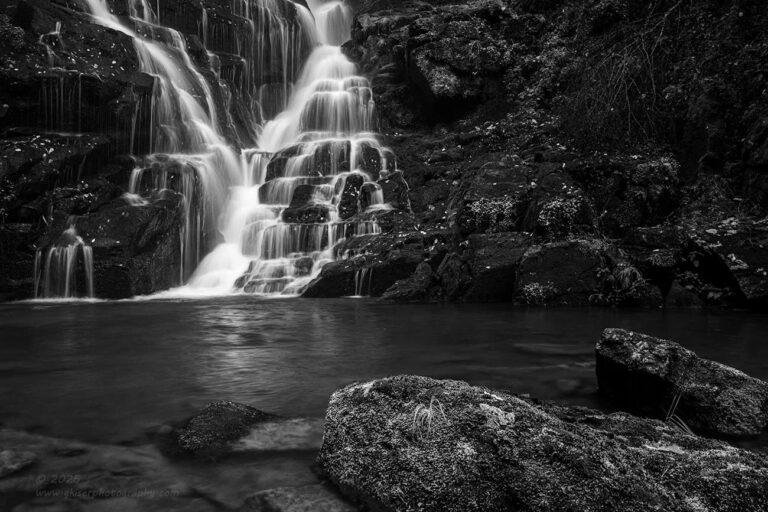
While I was working on the vertical composition with the grassy rock in the foreground, I was also taking note of the larger rocks to the right that I had used earlier as foreground interest. From this angle, they were pointing diagonally at the falls and looked completely different than what I had seen from them before. The angle made them look longer as well which I thought might become an interesting feature as a foreground at this angle.
I moved the camera around slightly and found a location that gave me the right relationship between the rocks and the falls. I was going to make this a horizontal composition which included the entire waterfall as well as the rocks in their entirety. As I looked at the composition, it seemed too optimistic, and it included just too much information. The rocks, even though they were coming in from the side were just too dominant in the scene and the waterfall, while large seemed to carry very little visual interest in this angle. I still liked the concept and started to think through what I liked about it. It was the diagonal of the rocks that caught my eye first, and when it came to the waterfall, I found that it was that lower right once again that held my interest. Essentially what was in the middle of the frame was what I found interesting. In order to make sure that the viewer saw what I did, I got in a bit closer and zoomed the lens in tighter. I cropped out a good chunk of the rocks keeping their scale down within the scene while retaining their diagonal contribution to the overall composition. As far as the waterfall goes, I cropped into the body of it retaining just the top of the lower right portion that really interested me. For balance, I kept a small secondary cascade in the frame to the left as a framing element under another diagonal stream of water that also pointed at the tiered cascades.
The composition was solid, and I liked the scaling of the elements, but the rocks were still a bit dominant in the scene with the colors that they introduced. To change that relationship, chose to convert this one to black and white which put much more emphasis on the waterfall as it was the brightest element in the frame. This one saw the high contrast treatment applied as well and I found that it was just as effective as it had been on other photos. The rocks were much darker now but still played their role as a foreground element pushing the eyes into the scene. The darkness helped with that as I had noticed in the color image that the rocks wanted to pull my eyes out of the scene thanks to the color and texture. Without the color and having much less luminance on them, they actually forced my eyes back into the scene which made this much more successful of an image.
Now that I was on this side of the waterfall, I started to look at other angles that might work out. While I hadn’t been paying much attention to the other photographers and where they were shooting from, I had realized that there were quite a few that were sticking to that side more than the side that I had been shooting. I wanted to work the entire scene, so I was going to need to get over there and see what all the fuss was about. If I had really thought about it, I would have grabbed my bag which was still on the rock that I had set it on at the beginning of my time here. It was safe and out of the way which made me not really think about getting it. However, I was moving in closer to the waterfall on the left side and all I had was my wide angle zoom. I figured that if I needed anything else, I would just run back over and get it, but for now, I was already back across the pool and on dry ground for the first time in over an hour.

I wasn’t really all that thrilled with the view that the falls offered from this side of the pool but felt that if I climbed up on the rocks to the left that the extreme angle might provide some more visual interest. I slowly worked my way to that point as I watched the falls to see how they behaved as the angle changed. It wasn’t until I got up on that rock that I was able to really see something that I liked. I now had the mossy wall leading me into the falls with the attention fully on the section that I loved. I was no longer seeing the other half of the waterfall which really concentrated the attention on the aspect that I loved. This was going to work out well.
I started to get my camera positioned to get the framing that I wanted. I started out with a horizontal frame that worked well leaving the moss to introduce the composition and the waterfall in the right half of the frame. The light was still grand, but we were starting to get moments of sunlight over the landscape which in some situations helped, but in others kind of messed up the tonality of the scene. For this, I definitely wanted to get nice even lighting because I wanted to keep the scene really calm and relaxed.
Even though this was a pretty simple scene to capture, I ended up shooting several variations of the composition and eventually switched to a vertical composition to include more of the falls, but that seemed strangely tall to me even though I was planning on changing the aspect ratio when I started to process them. Just in case, I did select a square crop on the camera and dialed in a nice square composition to round out the last two frames.
I ended up shooting a total of seven frames from this large boulder with a mix of orientations. I felt that the horizontal one was a bit stronger than the vertical but had a feeling that I would end up liking the square one the best. This is where things got interesting. During the initial culling, I ended up liking the last of the horizontal images, none of the vertical, and the first of the square ones. None of the vertical ones made it past the first round of culling. During the second round, I tossed the square crop because it was just too in-your-face and filled too much of the frame. There wasn’t enough visual information to keep the scene interesting in my opinion. That left me with the horizontal composition which you see above. Now, I had been patting myself on the back for not coming across any additional photos to process during this blog entry. I honestly had more than I had expected and was happy with the number of keepers that I had from Eastatoe. It was seeming like during the two days that I spent processing that I had done a perfect job at getting everything processed that I wanted to keep. Well, as I was talking about the vantage point that I was in at this point, got to thinking about the ones that didn’t make the cut. The square crop still seemed like a good option for this view, and I wanted to see why I didn’t like that option during the culling phase.
I went back into Lightroom and looked at the square ones. There was no doubt about it, I had cropped in way too close to the falls and made it a postcard shot which lacked character and my signature on it. I was right to ditch that. However, I had been looking at the horizontal framed image when I was thinking about the option for a square crop and decided to look at one of my earlier horizontal photos. I cropped it and found that I liked it as a square almost as much as I had a horizontal one. Without the moss playing an important part, I thought that this was another great opportunity to do a black and white conversion.
I did my thing with that crop and found that it was quite effective as a black and white image with that square crop. The more I looked at it, the more I wished that I had just a little more information at the top though. There was a detail that I was really liking and wished that I had noticed while I was there. If I had, it would have been a great photo done with the telephoto lens. Not wanting to crop into a photo that deeply and destroy the resolution, I was happy to have it show up as an element in the greater scene, but it was being cut out with this horizontal frame and the square crop just accentuated that problem. The photo that I had done as a square initially had been shot horizontally initially which locked in the upper boundary and cut through that element that I wanted in. I really thought that this was an opportunity lost at this point.
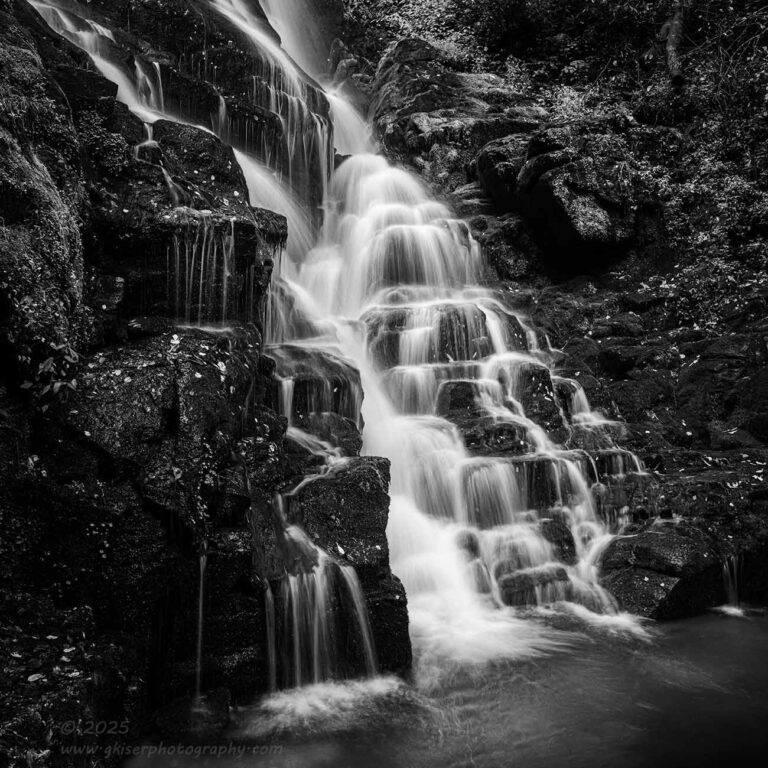
Remember those vertical compositions that I had discarded after the first round of culling? Well, they had the element that I wanted to include in the square crop, I just had to see if the square would work with the way that I shot that scene. I opened up one of them which had the right shutter speed and applied the square crop. It actually included everything that I wanted with just a slight tweak on the left to bring it in a bit closer. It was almost as if I had shot it correctly to start with. I applied the same processing choices from the first attempt to this one and it looked fantastic. I had the element that I was wanting to include, and there was appropriate breathing room all around the scene now. It was perfect and I was glad that I went back and started to find the image that would do what I needed it to do.
I’ve said it many times here recently that I’m glad that I still do these blog entries even though the popular format is video. If I were talking through this process at a normal speed and concentrating on the video aspect, I wouldn’t be going through the experience as slowly as I do while typing. This gives me the chance to relive the adventure and reconsider the images that I have discarded from the day. It has paid great dividends here recently with several of my treks providing some of my favorite images from the day. This is one of those cases because I had really stopped to think about this vantage point that I was shooting from, as well as how I had started to really love the black and white presentations. As you will see in my next blog, I really started to come into my own with black and white with our next subject. But I don’t want to spoil the surprise, so I’ll just leave it at that.
I wasn’t quite done with Eastatoe Falls though (insert bookmark here). As I was working my way back to my bag on the other side of the pool, I stopped to look at where I had found Bill’s extra leaves on the barrier wall. I still wanted to do something with this, and now that the sun was kind of peeking through the clouds there was a bit of warmth that was on the scene which was looking good from this angle. I worked out a composition that I liked and ended up shooting thirteen frames as the light changed over the scene. The composition was the same each time, and I shot it in the native 3:2 aspect ratio which was kind of a mistake.
During the culling stage, I looked at the frames and found that they were too skinny and tall as shot which I expected because of the aspect ratio. When I started to work this down into something a little more pleasing to my eyes the composition didn’t really hold up for the visual weight. I still liked the overall idea of it, but it just didn’t quite land the way that I wanted it to. It was the last of those images which was also the last of the day making my total frame count 82 for my time at Eastatoe Falls that made two rounds of culling. When it came time to process the images, I just didn’t feel that it was good enough, especially compared with the other one with the orange leaves in the foreground. That one had more presence and impact, so I went with that one instead.
OK, remember that bookmark I asked you to place a couple of paragraphs above? It was at that moment that I went back through Lightroom to see how many photos I had shot during my time at Eastatoe and I saw the thirteen frames that I had committed to with that last composition. Obviously, I had felt strongly about it at the time and saw great potential with it. Now that I was coming to the end of this blog, I decided that I would flesh it out and see what I could come up with for that last frame of the day. Fifteen minutes later, I was uploading yet another keeper from the day.

I don’t think that this is as strong of an image as the other one featuring the leaves, but at the same time, this is not a location that I can go to any time I want, so I’m happy to have as many keepers as possible from the experience. If I can go back to Hanging Rock time and time again and photograph the same waterfalls over and over for my portfolio, there is no reason I can’t add a few additional compositions from this one day.
That being said, there are some things that I wished that I had done differently with this one. I feel that I missed a good opportunity to get in closer to the leaves and make them larger in the frame. I’m not sure why I didn’t other than the fact that I was getting quite tired after two hours of shooting this magnificent scene. The thought of getting down low again was probably not all that appealing to me at this point. Yeah, I was getting lazy, and the water sloshing in my boots was starting to get on my nerves for the first time. It had been an excellent experience, but the time was coming to a close. I checked with Bill to see when we were supposed to rotate out for the next group. He confirmed that it was a two-hour block. It was not 9:57 which meant that our time was up. I went over to my bag and packed away my camera as Bill did the same thing. We triumphantly worked our way back out on the short trail to where we had parked. After more than a year of planning, I had captured over 80 frames of this waterfall, and those RAW images turned into 15 keepers which far surpasses my goal for five or six photographs. Yeah, I kept more than I probably should have, but as I said, I won’t be going back to this waterfall many times over like I can with others.
I would really like to extend a heartfelt thanks to the Waterfall Keepers of NC as well as Kevin Adams, and, of course, Bill for making sure that I didn’t miss out on this opportunity. I would also like to mention that Bob’s voice was in my head through much of this adventure much like he says my voice is in his when he is behind the camera. All of these pieces came together to provide the opportunity and the right mindset to photograph this beautiful waterfall. I can see why the current owners are so hesitant to allow folks access as the previous owners had. I’ve seen the effects of constant foot traffic at waterfalls as well as the trash that is left behind. It was refreshing to see one in this kind of shape with very little evidence of human visitation. The impact of humans is greatly limited with the way that they are doing things, and I’m actually thankful that they are even though it makes it very difficult to access. I can say that the juice is worth the squeeze in this case.
Bill and I were both tired after the past two hours, but we were also quite energized. Looking at the sky, the rain that was supposed to show up had been replaced with partly cloudy skies that included more blue sky than clouds at this point. I think he was excited to show me around the waterfalls of Brevard, especially since I am just really not that familiar with them. I was kind of hoping that he would want to do that, and when he suggested that we go and check out a few of the easier to get to falls, I was totally onboard with the idea.
I just left the destinations up to Bill’s discretion because I knew that he would pick great spots to go. If there was more photography to be had, all the better. I mean, we had driven all the way out here and it would be a shame to stop with a single waterfall. I’ll get into more about what was to come in the subsequent blogs. I’ll just leave it at this for now. We are about halfway through the journey that developed through the day. Stay tuned because tomorrow there will be another installment with an entirely different waterfall location and even more emphasis on black and white photos.
Stay tuned….