Welcome back to my monthly Behind the Camera series where I pick a topic to discuss that I don’t really have the time to get into when I am doing my regular blogs. I’m happy to take suggestions each month about the topics that folks want me to cover, but most of the time I am left to my own devices on the topics to delve into. This month I had already planned on doing this particular topic but after hosting my Art of Decay Workshop in East Bend at the beginning of the month, I felt convinced that I needed to dive into this one sooner rather than later.
What I have decided to cover this month is a concept that I started to subscribe to many years ago when I was photographing waterfalls. Put quite simply, in order to get the best photos from a subject we have to first listen to the landscape. The more we listen, the more we understand, and the more we understand, the more we fall in love with what is going to be in front of our camera. The end result of that process is that we will ultimately be able to find the essence of the subject rather than just snapping a photo that shows we were there.

As I mentioned, this concept started when I was photographing waterfalls, dating back to 2006 possibly. So, what was it that was happening back then that sparked this change in methodology? Well, I had been going out and finding waterfalls where I would then apply compositional rules as well as working through the exposure options from a very technical point of view. Essentially, I was checking boxes based on what I had learned about photography. Was I following the rule of thirds? Is my aperture showing sufficient depth of field? How about my shutter speed, is it a “long exposure”? As long as those types of questions were sufficiently answered I would press the button on the camera and make the photo happen. The problem with that approach was that the photos would often look awkward and very sterile. I wasn’t seeing the essence, or personality of the waterfall coming through. I was just taking photos which documented the fact that I was there, but not why I was there.
You are probably saying that the “why” was that I was there to photograph a waterfall. You would be correct in that assumption, but that was only the why in me being there, not the why behind the reason the photo was being shot. I felt that the missing part of the puzzle was accurately answering the why behind the actual photograph, in order to show the essence of the subject. I wasn’t quite sure how to figure out the essence of a scene at this stage in my photography because I had just been doing it seriously for a year or so at this point. Of course, I thought I knew it all when it came to how to do photography which made it frustrating when I wasn’t able to get the types of photos that I was wanting to capture. Part of that problem was that I wasn’t nearly as well versed on photographic technique as I thought I was, but there was a much larger problem that had nothing at all to do with technique.
As I started to really think about what was missing in my photos, I realized that I wasn’t making a connection with the subject. Sure, I loved waterfalls and had dreams of photographing all of them in NC. I even referred to it as answering the call of the waterfall. I just wasn’t really connecting with these natural wonders on any level other than I was there with a camera and there was a waterfall in front of me. In order to take my waterfall photography to the next level, I had to connect with the falls on a deeper level and truly understand them. I had to experience them and then create a photograph that captured that understanding. In short, I had to stop and listen to fully comprehend what was special about each particular waterfall.
The concept was referred to as listening to the landscape, but it goes much deeper than that. I found that the best way to get to know a subject is to spend time in its presence. As humans, we are blessed with five senses, six if you are my wife. Starting out in photography, I concentrated only on the sense of sight and paid no attention to the rest of them when I was working a scene. That did a huge disservice to me and my photography because I was eliminating my own experience from the photo as well as what it felt like to be there. I realized that I had to take the time with the subject to hear what was going on, smell the different odors that were wafting through the air, feel the moisture and spray from the waterfall hitting me in the face. I even took into account the taste of the sweat on my lips from the hike out to the falls. This took a bit of time, but as I was enveloping myself further and further into the scene, I started to appreciate the waterfall in a different way. This appreciation allowed me to frame an image that was influenced by all five senses, but resulted in a two-dimensional visual representation that allowed the viewer to experience the scene with me.
Over the years I built on that concept to where it applied to every type of photography that I engage in. Whether it be a waterfall, landscape, rusted car, old house, or even a person, I have to get to know what I am photographing to understand it fully. Only after I understand it on more than a level of sight, can I hope to capture the essence in a photograph. I recall watching a YouTube video years ago by Nigel Danson where he talked about just this concept, but he referred to it as taking time to eat an apple before pulling the camera out. This was years after I started to “listen to the landscape”, but he was explaining exactly what I was doing. Let’s take a second and check that video out and you will see what I am saying.
I have even started to incorporate this concept into my workshops and mentorships. I’ll start the time with a walk through of the area to give time to pick out areas that are interesting before we get the camera out to start taking photos. There might be a time when a photo is missed, sorry about that Mike, but the overall benefit will likely outweigh that negative. The thing to remember is that the time that you spend getting to know your subject will allow you to capture photos of it that others will miss. You will pick up on details that you can include in your photos because you truly understand the scene in front of you. This kind of thing just can’t be done with the grab shot on first sight.
I keep going back to the workshop at the beginning of April, but there were several occurrences there with myself and the participants that really brought this concept home for me. Keep in mind that for this workshop, we were dealing with old rusty cars and old barns. That is a far cry from waterfalls, but the concepts that I started to work with while photographing waterfalls were still very much applicable to me. I had to experience the subject before I knew how it wanted to be photographed. Yes, you read that correctly, I had to find out how the subject wanted to be photographed, and the subject was no more capable of talking to me than a waterfall had been. I’m going to take you on a quick journey with me from that workshop to show you the power of this concept.
For probably the last year or so, I have been focused more on getting detail shots of my decay subjects because quite frankly, I have run out of good subjects where I can make compositions that include the full vehicle because of the environments that they are usually found in. Being able to shoot the details has opened up the door for so many more photographs that allow me to capture the essence of the vehicles. There is that word again, essence. I’ve had a lot of practice with these types of photographs, and you would think that I could just jump in and get the shots and move on. That would be great if it were possible, but it just doesn’t work like that. I had arrived early for the workshop and was walking around to get a feeling for the location even though I have been here more times than I can count. Most of the landscape was unchanged as far as where the vehicles were positioned, but one of them had moved from the parking lot to the yard near a large firetruck. With Old Stitch being moved, there were some aspects of it that excited me because of the change of location, but I couldn’t figure out a composition that really told the story. I didn’t have the camera in my hand yet, and I was still focused on preparing for the workshop ahead, so I didn’t linger on thinking through that potential composition. Instead, I continued my walk around the property.
By the time the participants arrived, I was actually feeling like I had nothing creative to share with them. I had walked around to see what there was to work with, but I was doing it more on sight than anything else. I wasn’t looking for inspiration for me, I was just looking for potential compositions that I could point out. There was no experiencing the day or the location in my walk. I wasn’t really present in the moment; I was focusing too much on the future. The result was that I was totally uninspired by what I had seen despite this being one of my favorite locations to shoot, and one where I probably have more experience than any other spot. It really worried me for the first hour or so of the morning because I just wasn’t seeing anything that struck me as a photograph.

As the morning went on, I was forced to start living in the moment because I had participants to focus on and teach. As I slowly let go of the planning phase, and fully accepted that we were here and it was now a creative space, that inspiration started to come in. The longer we were there, the more things that I saw which excited me, and the more I felt as though I understood the location once again. The part that had made the difference was forgetting about everything else, other than that moment that I was in and enjoying being there with two other photographers who were passionate about their craft. All of my senses were now engaged, and I understood the location and the subjects so much better than I had during my initial walk around.
As the day started to come to a close, there was an opportunity for me to get my camera out and work some scenes for myself, which I would then use during the image review, so it wasn’t just the participants putting their images on display for all to comment on. The first scene that I went to was Old Stitch because of the grass coming through the running boards. Now that I had been on the property for about eight hours, I was intimately familiar with how things wanted to be photographed on this particular day. It took only a few minutes to get a composition put together that led me to what you see above. There was no reason that I couldn’t have thought of that earlier other than the fact that I wasn’t fully living in the moment and listening to the landscape at the time. Now that I was enveloped in that moment, the composition came to me quickly and established the essence of the subject.

To really put an undeniable emphasis on what I am talking about, I had specifically told myself that there was not an overall, establishing composition to be had with this truck because there were distractions in every direction. That was true, and nothing at all had moved. However, the last frame of the day for me was this single attempt to get an overall shot where I minimized as much as I could of the background. It didn’t come quickly to me, but there was a driving force at work causing me to go through the motions of getting this photograph. I had to deal with the barn and house in the background as well as one of the other vehicles which was located between the two buildings and was slightly elevated in relation to Stitch. Not only were there compositional problems, but the exposure was another sticking point for the shot as the sun was still rather bright. This was causing some very deep shadows on the passenger side which were amplified because the truck was a dark color to begin with. I could have waited a while longer because the sun would have dipped behind the trees, but that would have put the whole truck in shadows, and it was the light on the front that I was liking. I was also exhausted and didn’t want to wait out the sun for something that I didn’t think was going to improve the photo.
I had the shot set up and could tell that the histogram was pushed too far for my tastes which was showing a much too contrasty scene in front of the camera. I can’t think of a time when I had looked at a composition like this with an exposure as bad as I was seeing where I just took the photo anyway. This is one of those times when I would usually scratch the entire process and find another composition or try to play with filters to reduce the exposure in different areas. There wasn’t another composition, and no other filters would have made a difference in the exposure here. I pressed the button anyway figuring that it was going to be a trashed photo in the first round of culling. I was surprised that the captured photo showed very little overexposure warnings and the shadows looked to be just in the realm of being able to be dealt with. It was good enough, and I didn’t feel it warranted any tweaks. It was going to be trashed anyway.
Well, you see the photo above, and I can only credit the fact that I was listening to the landscape for its success. Everything that I thought about this photo along the way turned out to be wrong. The composition worked very well, and the exposure wasn’t nearly as bad as I had thought. In fact, as a black and white, the contrast worked tremendously well for the photo. Looking at the image, there is nothing that needed to be changed which would have warranted an additional frame. I had been convinced that there was no photo here, and even while framing the photo up I was not enthusiastic about it. There was, however, a force that was making me press on. As everyone else was gone, and I was the only soul left on the property, that force had to be the landscape that I was listening to. Having been out here for over nine hours at this point had put me in a creative place where the experience was overpowering my technical thoughts and opinions. I thought of no rules while making this work, I just went with the urges from my subconscious. I couldn’t tell you anything in relation to the decisions that I made with the exposure without looking at the exif data, and I really don’t recall all the steps that I went through to get the composition figured out. It was just really a form of possession where I was taken over by this truck in order to get the photo. Looking back on it, I can point out all the great things that were done compositionally, and even with the exposure, but I feel silly taking credit for those attributes because I don’t recall them being conscious choices at the time.
By listening to the landscape, I had allowed myself to become one with the scene and it was Old Stitch that directed me and my hands to create this photograph. It sounds like something off of a horror or thriller movie, but it is an experience that I have felt many times as a photographer. It seems to happen in those situations where I keep saying to myself that there isn’t a photo there, but still keep pushing forward despite those misgivings.
Along the same lines to reacting to what is there, by listening to the landscape, you can also start to perceive some subtleties that you may have missed otherwise. A great example of this happened last Spring while I was at Doughton Park off of the Blue Ridge Parkway. I had gone out in search of what I had hoped would be a really good sunset, only to find that the conditions were not as colorful as I had hoped. The problem was there was a cloud that blocked the sun as it got close enough to the horizon to cause the light to change in the clouds. The time that I was out there was around an hour, maybe more, and in that time I had gotten to know the landscape that I was looking at. I had time to listen to it, experience it through all of my senses. The beauty that was there, wasn’t really showing through to my eyes, which of course translated to the camera. However, by incorporating the other senses into the photo, I was able to pull the essence out of the scene. Let’s see how that actually took place.

Here we see a cell phone shot of what I was set up to capture. Of course, I had picked out the composition that I was wanting which turned out to be a long panoramic image covering a wide swath of the fence and sky. Everything had been dialed in and I was just waiting on the color to happen. You can see just the faintest hint of that color in the sky, but it was going to be a bit longer before any real color would hit. As I waited for the minutes to tick by, I could tell what the sky was trying to do, and I could see what the landscape was trying to give me. I began to have an idea of what the end result was going to look like, and it was going to be epic. There was this collaboration of sorts between myself and my subject, although there was only one side of that capable of actually speaking. I’m not really crazy, and I don’t hear the landscape talking, but I do recognize the language that it possesses. It was through that language that I knew how it wanted to be captured on this particular day. The only question was whether or not the conditions would allow it to happen.

As I mentioned, there was a deep cloud to the right of the scene where the sun was going to dip behind at some point. As it got lower, I started making sweeps with the camera capturing the light as it changed knowing that it was going to abruptly turn off at any moment. Not only was I wanting the sky to erupt in color, I also wanted the fence to have just a glimmer of the light. It was what I felt was the right way to represent this scene. Remember, there had been a lot of conversation going on up to this point and I knew what I needed to capture to do right by this scene.
The sun continued to drop, and I continued to shoot several series of images to stitch together later on. The thing with panoramas is that you never really know what you are going to get because you can only look at the 8-11 individual frames that usually have no composition at all. It is just a collection of parts that you can only check for exposure. I was operating on faith at this point since I had no idea how this was going to turn out, or even if it was going to turn out at all.
Just like that, when the sky started to catch some color, the sun dipped behind that cloud to the right as I had been worried it would. The fence went dark, and the sky went gray. The light was over for the evening and even though I remained for another period of time just to make sure, it just got darker with no interest at all in the sky. I took a collection of panorama ingredients home and started to stitch the ones together that I thought had promise. None of them looked remotely like what I had felt at the time. It was a little disappointing to say the least. I whittled the collection down to one that I wanted to edit because it had the most color in the sky, while still retaining that bit of light on the fence. That RAW capture appears above and shows what the camera recorded. It does not show what my heart had recorded after listening to the landscape though.

I wasn’t prepared to toss the image and I thought that it would be a good time to practice some new techniques thanks to a very recent update to Lightroom. As I started to work through the image, I started to see the colors develop that I had been waiting for. It was subtle at first, and then they started to build up. Before long, the photo that I was seeing was what I truly felt that the landscape was wanting, and it was spot on with what I had experienced from the evening. It is still rooted in reality because all of the ingredients were provided by nature, I just changed how the colors were handled. There was no sky replacement and no AI trickery going on. It was an honest representation of how the scene made me feel, and that feeling was hopefully translated into the visual form.
This story was just to illustrate that listening to the landscape counts for so much more than just a visual aspect. When we listen to the landscape, we start to fall in love with the scene and we begin to look for ways to photograph the subject in a way that represents that love. If we are successful in this quest, then the resulting photo starts to have a soul all to itself. Anyone can press a shutter button and create a photograph, but those photos lack a lot when you start to really look at them. Usually, you will never really look at the photo in those situations. You just see it and acknowledge what you have seen. To really look into a photo and examine it, you have to have a reaction to it. That reaction, whether you know it or not is because the photographer has managed to bring in more senses than just the visual. As the viewer if drawn into the photo to examine it, and really look deeper into it, they are ultimately experiencing the photograph as if they were there. It can even bring back a flood of memories that cause them to exist in your photo through their own experiences. This experience brings about an emotion which will hopefully be similar to what the photographer felt at the time, but it doesn’t necessarily have to be the same. The key is to create that emotional attachment to the scene, whatever that emotion might be. The viewer is now invested in that scene as much as the photographer, and there is no better response than that.

There are also times when you are listening to the landscape when things happen right in front of your lens that you would have never expected. Take for instance this final day on the coast from my latest trek to the Outer Banks. I had just about left a day early because of lousy weather but decided to stay one last morning. The morning turned out to be much more than I had ever hoped for, but there was this one photo that I would have never thought about capturing. I had gone out early in the morning while it was still dark. I was paying attention to the fact that the clouds were thick and there wasn’t going to be a lot of light. There was a time when I thought about going back to the room and calling it quits, but I stuck around and listened to the landscape for a while as the sun started to bring light to the sky. Eventually I pulled the camera out and started to make some images which actually turned into fantastic photos. I credit taking that time to get the vibe of the beach to understand what was going on and to be ready to capture the scenes.
As the light came up, I was getting shots one after another. I was also moving around quickly almost as if possessed. I was looking in all directions and reacting quickly to what I saw as I found those small points of interest. It wasn’t as much about thinking through complex shots, it was more about releasing myself to doing the bidding of the beach. I went where I was taken without thought to future compositions, or what might happen. I just moved around and shot the scenes that fit with how I was feeling at the moment, as I was totally in that moment.
Where this photo comes in, was near the end of the morning. I was shooting simple fence compositions and had this one framed up. After one test frame to check things in detail, I noticed that there was a rainbow developing behind it. It was just a segment, and I was able to only get a portion of that segment because I was using my telephoto lens at the time. However, the beach was telling me to get this shot, so I backed up a little bit and framed a vertical around the fence that I had just shot to get this frame. The whole thing lasted maybe a minute and it was gone. Had I not been listening to the landscape and had been stuck photographing something else, I would have missed this atmospheric event altogether. Thankfully, I was in a place that the beach wanted me to be in, and already looking in that direction when this fleeting light happened.
Listening to the landscape isn’t always about slowing down, it is about working at the same rate that the landscape is changing. Sometimes the light changes slowly and it becomes all about the subtle changes in composition to perfect the shot. Other times, it is all about moving quickly to adapt to the changing light and sky. If you are truly listening to the landscape, you can match the energy of your subject and get the shots that you were meant to get. It can feel exhilarating, and it can feel boring, but if you and your subject are on the same sheet of music, the outcome will be spectacular.
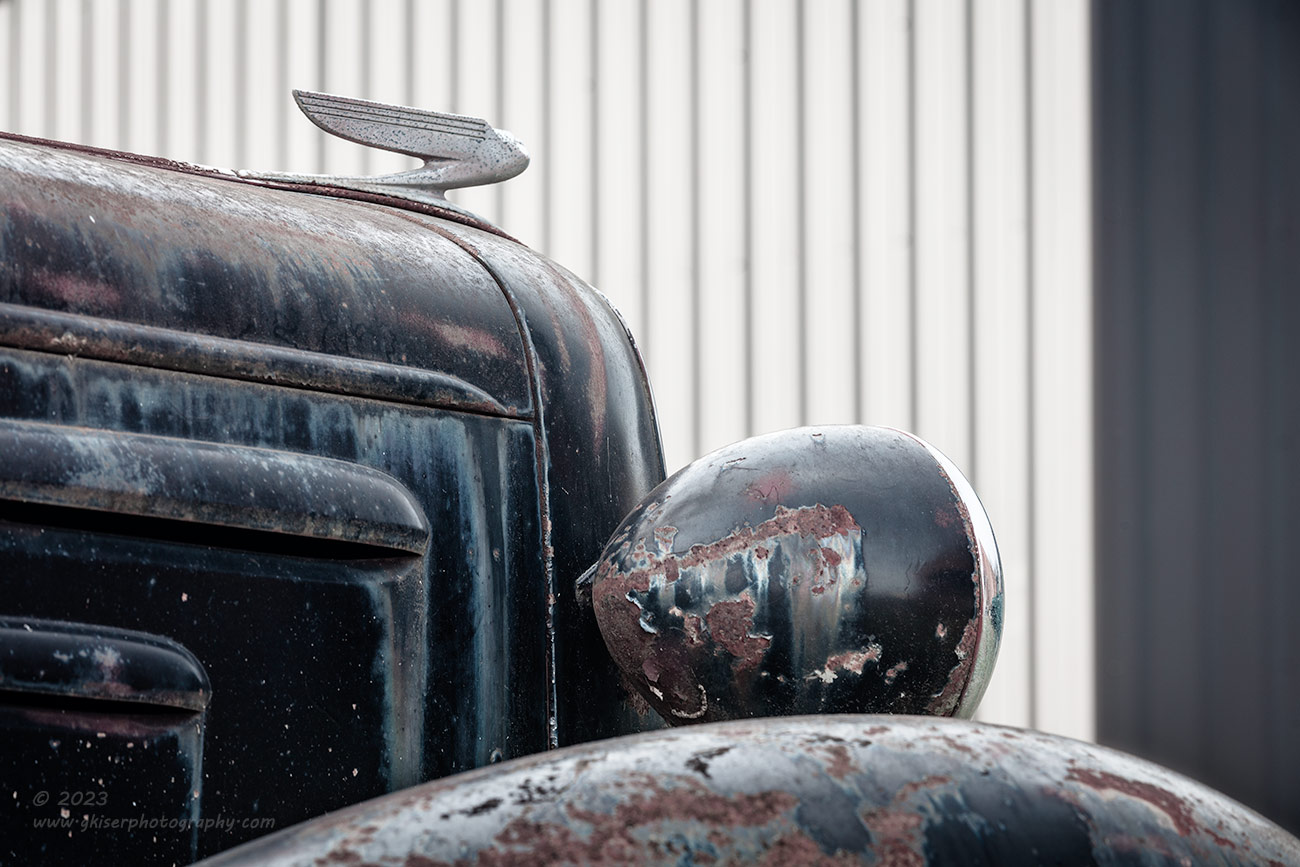
Other than starting out on this entry with a decay subject, I have been focused a lot more on the actual landscape in terms of listening to your subject. The concept works well for the landscape as I have shown, but it also works very well for any type of subject. The Chevy above was shot late last year and was part of a very quick trek with only a handful of exposures made. I had found it kind of hard to work the subjects here because of how the surroundings looked. I spent most of my time figuring out compositional tricks to avoid the background and to simplify the images. That was the photographer in me working, but I wasn’t really listening to the landscape around me. It wasn’t until the very end that I happened to look at the nose of the Chevy with the metal building behind it. The building wasn’t rusted and didn’t really provide any visual clues to a suitable environment. It went against everything that I had been working towards for the time out there. However, there was something about it.
I slowed down for a moment and started to listen. I had been out here for a half hour or so, maybe longer by this point so I was really just getting familiar with the setting. Here I was looking at the metal building as a geometrical background with a strong vertical feel to it. The front of the Chevy that I had been so interested in capturing had a more horizontal feel to it and introduced more round shapes. For how I was feeling about the subject, the concept of a geometrical presentation made a lot of sense and felt right for capturing all of the senses I was experiencing. There was a stark quality that was developing, and the emphasis was put on the textures of metal in different forms. I could almost feel the cool of the day looking at the scene and knew that I would edit it using the cooler tones as well. As I started to put the scene together in a composition, I found that the shadowed side of the building made for a great frame to keep the eyes in the photograph, so I incorporated that shadow as well. The end result is one of the most memorable photographs from the time out there and that is because I was really listening to the landscape at this time. It was captured in this way not so much out of conscious thought, but out of a reaction to the scene as a whole. The feeling came through in the edit, and everything works so well together in this final photograph.
I think that the biggest takeaway from this Behind the Camera is that the truly successful photos are not based on technical choices, or even what kind of gear you are working with. Those photos that stand out from the rest are the ones where you have taken the time to match energy with your subject and listen to how it wants to be photographed. Only then can you photograph an emotion, or capture a tactile feeling, maybe a smell, a taste, and even the sound of a tin roof clanking in the breeze. Those photos will capture the attention of the viewer and keep them engaged with your image much longer than if you shot a perfectly executed photo of a flower blooming on a spring day.
As they say, beauty is only skin deep, and that applies to your photos as well. If all your energy is spent creating a beautiful photograph, it will only be just that. If you can capture the beauty and emotion of a scene, then you have gone beyond a simple photograph and have captured the essence of what you are photographing. That is next level photography and something that will never be able to be created by Artificial Intelligence.
Now get out there and listen to the landscape, then photograph how it made you feel.
Until next time…