Sunday, February 2, 2025
Thanks for coming back for the next installment of this trek. If you haven’t already read how this all got started, I’ll wait while you catch up. As I mentioned in that blog, this was a trek that actually took several days to happen. I kept getting foiled by the weather and lighting conditions. When I finally got a day that I could work with, I wasn’t able to get in touch with the property owner at the location that I was wanting to shoot at. Things were just not going well for me at all. I did manage to get a couple of locations to kind of work out for me and I had two photos to show for the morning up to this point.
While that was going to be enough for me since I am really liking these shorter treks with fewer photos to deal with, I was still looking for just one more spot to pull the camera out. I had run into dogs which caused me some problems, and was now rolling down the driveway of a house that I have visited half a dozen times or so over the past probably five years. The location has actually been on my radar since around 2017 if memory serves. I remember going to Stone Mountain from Winston Salem one morning and had opted to go a different way. I had passed by this shop that had a driveway with a good many old rusted cars lining it. There were several signs indicating “No Trespassing”, so I left a business card on the door of the shop before continuing on to Stone Mountain. I never heard back from anyone.
I remember dropping by there a few more times over the years until sometime in probably 2021 when I dropped by and saw that the shop was open. I spoke with the shop owner and he advised me that he didn’t own the property, but that it would be fine for me to photograph the cars right there by his shop. I spent the next few hours working the vehicles there, but I really wanted to get further down the driveway to get to what I felt was an even better selection of rusted gold. I did ask about the owner and he let me know that she lived in one of the houses down that long driveway. By the time I had finished up with the cars that I was able to photograph, I was out of light and time, so I didn’t bother going to ask permission to continue with the day.
That trek started a mission of sorts because I started coming out here regularly and checking to see if anyone was ever home. I finally started to see life in one of the houses right off the road, so I pulled in and spoke to the lady that lived there. She didn’t own the property behind the house, but pointed out which house I needed to go to. That was the first day that I went and rang the doorbell. There was no answer, but there were dogs that came to the window so I knew I had the right place, or at least that somebody currently lived there.
Each time I came through the area and the weather was good, I would stop and ring the bell. There was never an answer, but the dogs would always greet me. I was understandably starting to lose faith that I was going to get to talk with someone. I had left at least one business card on my visits, but hadn’t gotten a call back. It was just really looking like a lost cause. Here we are close to eight years later and after a rather disappointing morning I was on my way back out here once again. I already knew that I wasn’t going to be staying long which meant that I was going to get back home in plenty of time to get everything finished up before Toni got home from work. It was her birthday after all, and I wanted to be here with her for a few minutes before she went to sleep.
There I was standing at the door after ringing the bell. The same dogs were at the window greeting me. I think they recognized me after all the times I had been here. I knew that there was a car that I wasn’t used to seeing by the house which gave me hope. I then heard somebody walking to the door, and the doorknob started to turn. Was it actually going to happen? Was I finally going to be able to ask the much needed permission to photograph a good many cars that stretched through roughly three properties worth of driveway? I introduced myself and explained quickly the reason for me being there so as not to freak her out. Without even having to further my explanation, she allowed me permission to access the property. She even told me that another photographer had been by there a few years ago and shot some photos which she had viewed on Facebook. Of course, I left a card and let her know that if any of the photos turned out good and she wanted a print, I would bring one out her way.
I was excited beyond words at this point because I had built up in my mind all the things that I wanted to photograph out here. The only problem was I wasn’t able to really pull those memories up since they had been filed away so many years ago. It was like a fresh find and I just allowed myself to go explore what there was out there. It was really the first time I had looked at the cars in depth. I had seen them from a distance, but never been able to walk among them like I was doing now.
I recognized most of the Fords that were on the property, but there were a lot of Dodges that I wasn’t familiar with. There were a couple of Plymouth Barracudas which I don’t think that I have seen up until this point in person. For the most part the cars were all packed in together which was going to prove hard to work with when it came to getting overall compositions. This was what I was really interested in doing because I have been doing a lot of isolations and abstracts with old cars since most of what I have been finding have not been in great locations for a more landscape type of shot. I started to pick out cars that were situated away from the masses and ones where I might be able to get a creative composition figured out which would cover the other cars, or minimize them enough to where the shot would work.
There wasn’t a lot of time to plan things out because I needed to get working. I remember when I was first looking at this property, I was wanting to be able to spend a full day out here in order to get everything. I already had a late start to the morning and wasn’t really planning on being out all day. There was really nothing left to do but pull the camera out and get to work. Of course, I had two little helpers with me. The property owner had warned me that there were a couple of cats that loved to be underfoot. I didn’t know how accurate that statement was until I started to pull the camera out for the first shot which was a very low position on the big Dodge.
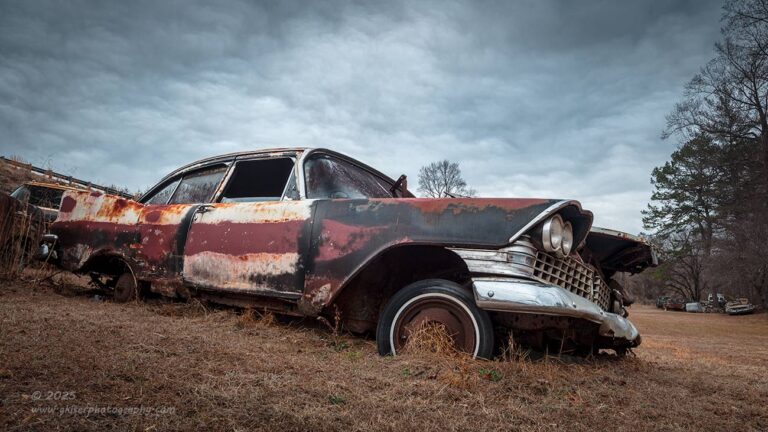
In order to get the car to cover a building, and a box truck, I needed to get down very low and wide with the camera. With the lens maybe 10 inches off the ground, I found myself having to be on cat duty to keep the nose prints off of the filters. I also had to keep them from rubbing against the legs of the tripod to keep the camera steady. It was a full time job monitoring the cats, but at least they were cute. Eventually, they both got sidetracked with the strings hanging off of my hoodie and coat. While not ideal, it was preferable to them attacking the camera and tripod.
As you can tell, I had a lot going on and was trying to get a rather complicated composition worked out. This involved moving forward and backwards until the right perspective was gained and then moving left and right to push the envelope of the angles in order to get the right look to the photo. Once all that was determined, I had to get the filters rotated and slid into position for the best look to the image. Once that was done, I had to get the exposure right, time the shot between traffic on the road which was visible behind the car. I’m really not sure how I managed to get this one done, but I did. The end result is one that I really like quite a bit because it shows off the bold styling of the car and I was able to take advantage of the clouds in the sky which happened to be full of texture at the moment.
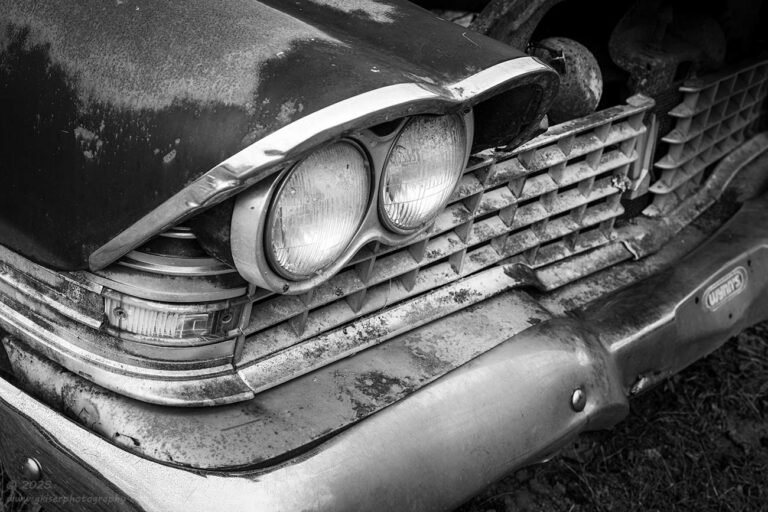
Not wanting to abandon the Dodge after getting the low shot, I was happy to work on a few isolations with my camera bag on my back and the camera back up to a level where the cats couldn’t get to it. I found that the headlights were some of my favorite elements to the car. I know that is a shock coming from me, but there was something about the housings that the lights were positioned in. I also liked the grill which had a very bold look, just like the rest of the car.
One thing that I found while working on the composition was that there was a lot of brightwork up front which caused the balance of the photo to be far from pleasing when shot in color. I figured that the best thing to do would be to make this one a black and white image so that I could focus on the design of the car more than anything else. It was easy enough to visualize as a black and white since I wasn’t seeing much in the way of color when composing it. I was quite happy with the final outcome once I got it home and processed it as I had suspected that I would.
I was starting to get in the swing of things again. It was nice to be able to work in close to my subjects, especially after having just shot both of the scenes prior to this from a distance. I really like being able to get up close and personal with my decay subjects when I am able to. I can do so much with the textures when I am close like this, and it really is my element. With that in mind, I walked around to see if there were any other isolations that I could shoot of this Dodge. I wasn’t seeing anything offhand, but I did spot a potential photo with a neighboring Ford truck. By neighboring, I mean, this truck was parked right behind the Dodge which was going to provide some difficulties in how to isolate this truck. You will actually see later on, in part 2, exactly how close these vehicles were.
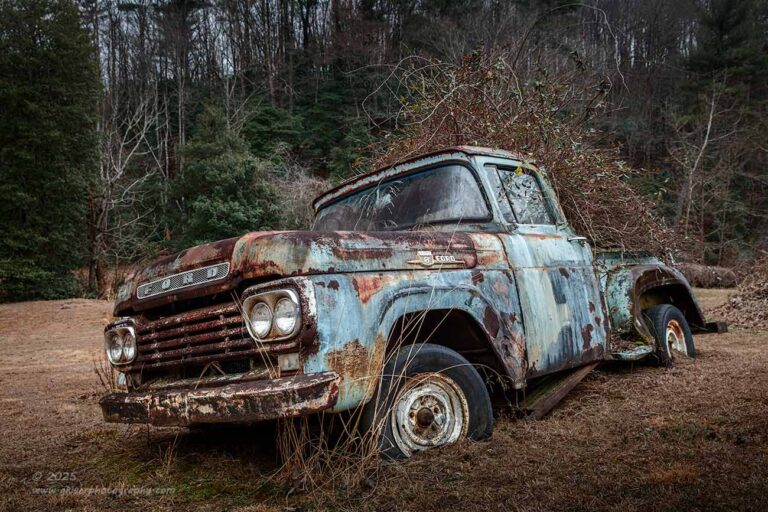
At first, I wanted to photograph the truck from a vantage point that I could include a large 70’s sedan in the foreground. Because of the area around the cars, I was going to have to crop into the truck a good bit and only get the front section. My other option would be to include the Dodge that I had just shot which would have made this much too complicated. There was a lot of overlap between the truck and the sedan which caused me some issue. More importantly though was the shed that had to be positioned between the two vehicles. While I shot a few frames trying to get things to look right, it just never really came together as a successful composition. I really wanted to photograph the truck though, and I was sad that this was likely the best angle to get a photograph of the cab as a whole.
As I walked around the Ford truck looking for a different alternative, I found another potential angle from the front driver’s quarter. This put the Dodge behind the truck, but in order to make it disappear, I was going to have to do pretty much the same thing that I had done with the big car. I was going to have to get the camera down really low to the ground once more. Fortunately, this time I didn’t have to drop it nearly as far. There was still the same old dance that had to be done in order to get the right perspective, right angle, and right elevation of the camera. This is the only dancing that I am any good at, and I can dance with the best of them when it comes to moving that tripod around. One thing that I did really like about this vantage point was that I wasn’t including the large sedan that I had started out photographing with the truck, and the shed was also not an issue from this angle. It was really just the Dodge and a section of cars beyond that which were causing me issues. These issues all went away thanks to the creative composing of the scene using the focal length to my advantage.
When I finally got the position right, I was able to start making exposures. There were only three shots that I made of this truck with this composition. The light was steady, and I had worked through all the issues before I started pressing the button. This was the last of the three exposures, and this represented only the eleventh frame that I had shot here at the property. I was moving fast, but I was thinking through everything that I was doing because as we know, I much prefer to spend my time in the field rather than sitting at the computer fixing the photos in post. If I kept going at this rate, I was going to have a very low frame count for the day, but it was looking like I was going to have a ton of keepers. It is nice to feel this kind of confident early on during a session. Things were certainly getting started on a high note after a rather lackluster morning.
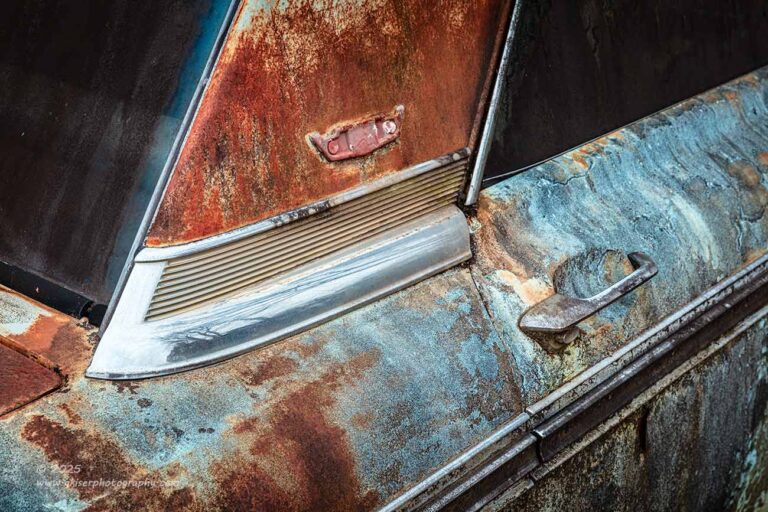
Just like a kid in a candy store, I didn’t want to stay at one shelf for too long as I wanted to sample everything that was there. I took this opportunity to move over to the section of cars that I had just masked with the looming Ford truck in the last composition. There were a lot of really interesting cars from Challengers, to Camaros, to Fairlanes, and even a Toyota MR2 thrown in for good measure. These cars were largely packed in very tightly which made overall compositions nearly impossible, or at least not aesthetically pleasing. This was the time to work the isolations and look for shapes and angles. having worked with plenty of Fairlanes, I picked on that had the most interesting patina on it and went to the rear pillar. I’ve found that this section works great for the lines and angles, especially with a 4-door car as the handle gives just that extra bit of interest to the composition.
I wasn’t able to get the side that really worked for the composition because of the proximity to the cars next to it, but something was interesting about the side that was available to me. The badge that usually sits right over the trim was missing, but the mounting plate was still there. Looking everything over, I could see nothing that would indicate which side I was actually shooting, so I decided that this was going to be one that I would flip horizontally so that it read better from left to right.
This concept is something that I talk about from time to time, but I knew that it was needed for this composition because of the angles involved. Everything flows in this direction left to right and from bottom to top which I really feel is the best way to view a landscape type image rather than from top to bottom which works better in portraiture. If the image had remained in the direction that I shot it, the main feature of the pillar would have stopped the eyes from pursuing through the scene making the composition about the door handle. By flipping the frame, the eyes spot the pillar first and then are able to follow the molding to the right where they run into the handle which then pushes the eyes back to that missing emblem and then back around for another trip through the image. That simple trick made this photo much more pleasing to look at and I knew that was going to be the case after shooting several cars like this and doing both sides.

Because I enjoyed the patina on that car so much, I started to look around for other views that might offer a different composition. As I started to look at the front, I noticed that the headlights were covered with a black film from age and the environment. There was still a Ford tag on the front bumper and the grill emblem was still looking really nice as was the hood and fender ornaments. The patina was amazing, but the colors were less interesting on the front. The headlights were also a little boring since they were complete and kind of dark. I didn’t really want to take the shot, but there was just something about how this front end presented that made me think that it was worth the effort.
I started working out some compositions that I liked on other similar cars. I started out with the headlights and the wheel which was turned just right. It didn’t work as well as I thought so I opened up the frame and started adding other elements. Eventually, I found a concept that included the grill emblem and front tag, along with the tall grass as the left side of the frame. The right side was cut just after the wheel. By elevating the camera a good bit, I was able to get the neighboring car to move out of the frame while the left side only included the hood of the Ford. The ground formed a “V” below the front of the car and that was the composition that I ended up with. I shot two frames hoping to get the grass frozen without any breeze.
During the culling of the images, this one made it through to the processing stage, but it was one of the last ones that I decided to work. I wasn’t sold on the image as a composition. It seemed kind of plain to me and I didn’t want to keep photos like that. I started processing it in color which looked fine, but the I thought that the one from the pillar was much more effective in showing off the colors. The darkness of the headlights was also something that I wasn’t used to dealing with as I usually brighten the lenses in post to give life to the car. These appeared to be dead despite being pretty much complete. That darkness with the deep and dark film that was on the car started to give me the idea of doing this as a black and white. The darkness of the car was what was different, and that was what I wanted to focus my energy on. To do it in color would have forced me to keep it brighter in order to show off the colors. Black and white, on the other hand, would allow me to be able to really make this a dark photo which would set the mood I felt the car deserved. In the end, the photo exceeded my expectations and proved that the composition was actually strong, but the appearance was lacking. Once I brought in some ambiance to the scene, it all came together beautifully.
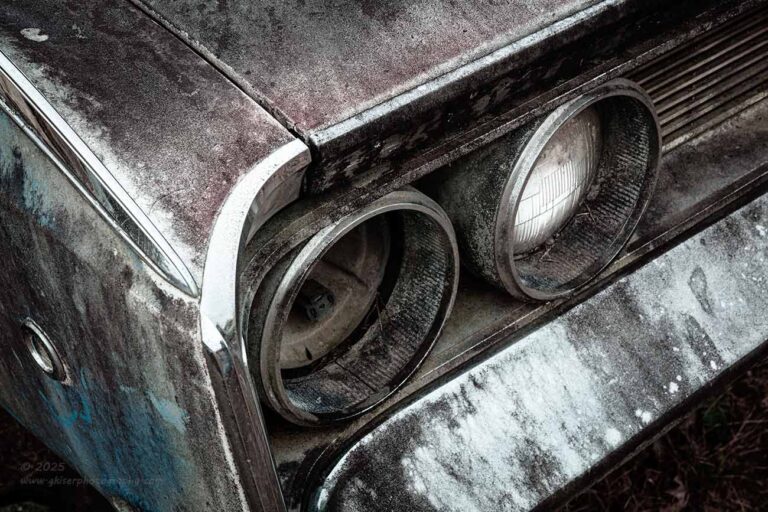
There was another old Dodge in the area that caught my eye. It was kind of a large car for my tastes, but I did like the way that the front end looked, especially around the headlights. I was drawn to the passenger side in particular because the outer headlight was missing leaving a beautiful trim ring in its stead. The bumper had a lot of accumulated dirt as did the paint. While I would have loved to capture more of this car, it was jammed in with many others around it which made a workable composition impossible.
Something that I have learned about myself over the years is that I don’t like cluttered scenes, and while my compositions aren’t all considered minimal, I do like to reduce the amount of visual information to really establish the “why” behind the photograph. If I shoot a large portion of a car, or the whole thing and you can see bits and pieces of cars all around it the point of the photo is watered down in my opinion. I like to be very direct with my photos and that has become one of the main factors in my “style” over the years. While I saw lots to like about this Dodge, I could only see one way of getting a photo that captured its essence. That was an isolation on the front end, focusing on the part that I really liked while the overall patina would be used to frame the rest of the photo.
Something interesting about this shot was the fact that I did it almost as a CYA shot. I only made one exposure of the composition, but it was after a few minutes of working the scene to get the look and balance correct. When I finally did press the shutter, I didn’t really see any way of improving it, and also didn’t see a strong case of making this a keeper at the time. I could see it as a color image and as a black and white, but neither option really got me excited.
It did make it through three rounds of culling though which brought it to the processing stage of the day. I really liked the composition and thought that it had a really nice graphical quality as well as a nice grunge effect due to the patina and brighter areas of the chrome. The color seemed to be too overbearing for the scene that included so much chrome, and black and white would just be underwhelming to say the least. Without putting too much thought into it, I picked one of my favorite color profiles and started editing a low saturation image. This really seemed to work well, and it is a profile that I have used a lot on photos that include blue tones which this one had some faint ones down along the side of the fender. The magentas along the top of the fender started to stand out with this profile as well. The bright chrome made more sense with this profile and the photo started to come together quite nicely.
What had been a single throw-away shot of this Dodge became one of my unexpected favorites from the day just due to the processing choices that I had made. Because I spent the time in the field to get a strong composition worked out that showcased what excited me about the car, the edit and processing went very quick based on the way that the image struck me. I can’t say it enough, work through everything that you can in the field because the one thing that can’t be changed in post is the position of the camera. This is the exact composition that I shot, so I knew that it worked while I was actually pressing the button. There would be no need for cropping in post which might show where I made an error in camera placement. All that I had to do was decide a mood to go with the story.

By this point in the day, I was starting to look at the cars that might not directly appeal to me, but something about their location or something unique about them was drawing me in. One of those cars was a Dodge Monaco that was sitting nearby. It was a rather large car that didn’t really work for an overall composition, but there was a feature that I really liked about it and wanted to photograph. The taillights almost looked broken because they were done at an angle as they flared out to the bumper corner. I thought that was a very unique design, but I needed to figure out a way to photograph them to show off the angle they were at. As it turned out, there was a bit of tall grass that had grown up past the rear bumper right at the taillight that I liked and there was the model name on the trunk lid. The dormant grass shared a color tone with the bits of rust on the trunk, and the red of the taillights contrasted nicely with the green of the paint. The colors all worked together here, and I felt there was a composition to be had.
Since one of the main features was going to be the burnt yellow grass, I chose to go with a vertical orientation for this shot. I elevated the camera so that I could see the angle of the lenses and set up right at the corner of the car for a bit of diagonal element to the scene. I experimented with how far up to place the camera and decided that I wanted the taillight to be clear of the grass, but close enough to be associated with it. I needed to make the tallest blade to the side of the badge, but again, close enough to be related to the composition as a whole. This took some trial and error because I was working with really close tolerances and a slight breeze that was moving a key part of the composition around.
I ended up shooting five frames as I tried to get things in the right position and I did alter the angle slightly after the third frame. As luck would have it, the second of the series turned out to be the one that got processed. It checked the most boxes for what I was wanting to capture and I felt that it told the story the best out of all of the frames that I had shot. It was a simple composition and one that I have shot many times over with various cars. It was that natural element that added the bit of interest and because of where it was at, the viewer is forced to look at the taillights and see that there is something different about them. Everything that I needed for this story came together with the composition and I’m really glad that I stuck with the idea until I had some photos of it. This is another one that I consider one of the top images of the day for how sneaky it became effective as a photograph.
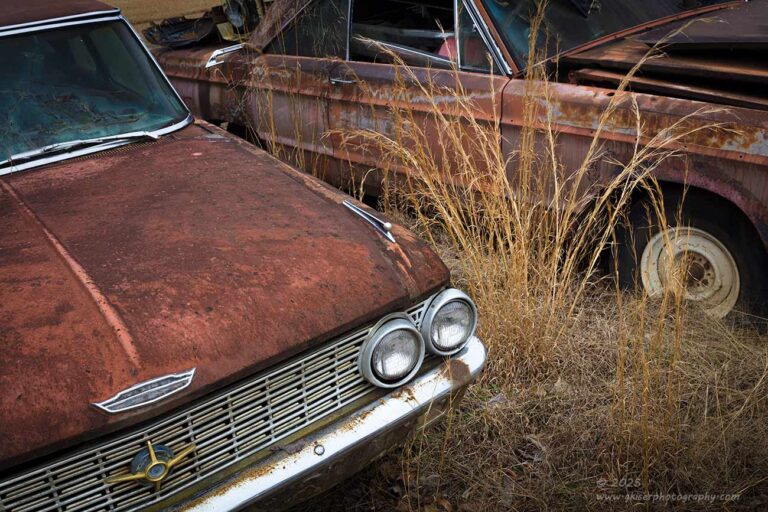
I was having so much fun with the tall grass I started looking around for other examples that I could use. Most of it happened to be in places that I really couldn’t compose an image around, but there was one tuft of it that was sitting between two Fords. There was a lot going on around the cars so I was kind of confused about how I wanted to approach this shot. There was really nothing that I had shot in the past that I could draw on with the exception of a trek that I took nearly two years ago when I had a lot of tall grass and weeds to work around while capturing cars that were packed in pretty close together. I remember doing some serious cropping on the subjects to simplify the scenes while using the natural elements to enhance the frame. That is what I was going to have to do with these two Fords.
In order to know what to include and what to omit, I started to inventory both cars as to what I liked and didn’t like about them. The nearest car was the easiest and it was the one that was most photogenic to start with. As with the black and white photo that I shared earlier, I liked the hood ornament and grill badge with this car as well as the fender ornament. The headlights were intact and kind of dull to look at, but they were close to the tall grass. I liked the body of the other car better, but it was in shambles with stuff piled on top of it which made for an overly complex look to the scene. There was a white wheel mounted on the passenger front which was a bit of contrast and a possible visual focal point. I worked this scene for a while and decided that by elevating the camera to well above my eye level, I was able to push the roof of the older car out of the frame which left me with just the stuff on the trunk. By cropping in to the front of the car I was able to keep the wheel, but keep the visual weight of the car down. You could still see the body lines which I liked, but with a good portion of the car out of the frame, the car seemed less important. It became the backdrop for the grass, and the white wheel became the beacon for the eyes to move from the nearest car to the rear one to make sure that the eyes found the grass between the cars.
Yeah, I know this was a bit of a stretch as far as a composition. I’m still not sure I like it, but I was very proud of myself for coming up with this solution considering all the visual problems that the scene brought to the table. The safest bet would have been to give up, but in order to teach difficult compositions, I have to be willing to give them a try and see them through to completion. Do you think that it works? It was good enough to become a keeper in my mind, but I really don’t think that it will ever be in my portfolio. This is OK by me as I make plenty of bad photos, but it is usually through branching out that I start to find different ways of shooting the same types of subjects which makes me a much more able photographer.

Things were starting to slow down at this point and I was finally working my way around the side of the building which had been completely obscured by the large Dodge that I opened with earlier. On the back side of the building was another Ford Falcon, a Dodge, and a Plymouth Barracuda sitting by the tire shelter. While none of these cars were in a position to have a photo take of them as the star of the frame, there was something about the overall scene that spoke to me. I would be lying if I said that I didn’t notice the green tones being shared by both the building and the Dodge. The colors just really came together for me. The green, white, and rusty brown/orange that was present on the ground, door, and the cars. I needed to photograph this color palette, and I was pretty sure that I could make a story out of the scene.
As I like to do, I started to reduce the scene down to the elements that I knew it needed while eliminating everything that didn’t fit. It was the two cars parked by the front of the building that I liked, but I had to be careful not to include the car that was parked just out of the frame to the left. I had to do something with the shelter where the tires were stored as that brought in a large trailer as well as another car which just added more complexity. I decided to use a tire as a crop point for that shelter which allowed just enough nose room for the Dodge while the Falcon became my visual anchor under the front door overhang.
For this one, there would be no sky, and the building would essentially be a flat backdrop. By including the bit of the tire shelter, I had the depth needed to keep the image from looking flat. I just needed to work my angles so that I didn’t introduce any real perspective distortion into the image. Yeah, I could have corrected for that in post, but I knew that the just how much I would have to crop would be a guess at best and I was playing with inches within the frame to make sure that I had all the right elements in place. had I overshot the scene and cropped after correcting the perspective distortion, I might have lost something that I needed. This way, I could deal with a slightly off vertical line due to perspective, but the overall scene would be exactly as intended. My only regret was that I wasn’t able to use a wider angle focal length which would have made the Ford a little more prominent in the scene. As it was, the scaling was pretty compressed which wasn’t a bad thing, just a missed opportunity for some visual excitement.

It was while I was working out the last composition that I started to think about including the sky above as there was some more nice texture showing up. By going out to 24mm I could get a bit of the sky, but there were so many other distractions that I didn’t like to the scene. However, once I was satisfied that I had what I wanted of the two cars out front, I backed up and looked at a slightly wider angle view of the shop. By doing this, I was able to include the Barracuda which I was really happy with, but the scene was becoming very complex at this point. I had the entire building which took up a very large chunk of the scene and there was a lot of clutter in the tire shelter along with the bright white trailer parked behind the building. In short, I was looking at a scene that had a lot to unpack, but I did see some great potential here.
I stuck with it and found that by adjusting my position and the focal length, I was able to get a tree along the side of the road positioned in the upper right corner which kept the eyes in the frame. This put the Barracuda right at the edge looking back inside the frame. While an important element, this car was also a wonderful framing element for the rest of the photo. I still had the same issues on the left side of the frame which meant that I didn’t want to include the large car just outside of the frame to the left. I really wanted to keep with the rule of odds for the number of main elements in the scene which I had with the three cars. Keeping the perspective was easier at this distance, so I didn’t have to worry about converging verticals, or anything like that. Everything was coming together nicely, but the scene was still very complex to my eyes. There were no other ways to simplify it though short of removing the color which had worked so well in the previous photo. I checked to see how that would look by changing the picture style on the camera.
The second I moved to black and white, I was very happy with how things were looking. The areas that had been a distraction like the green building and the trailer seemed to blend in much better now. The three cars had the most contrast as well as some of the brighter tones which pulled the eyes to them much more effectively. The sky was looking great with enough texture to keep it interesting and to allow me to close in the scene from the top without it looking odd. When I got this one home to do the processing, I took a great deal of effort to find the right black and white profile that worked with it and allowed me a head start on the actual processing of the image. This one was all about contrast.
By this stage of the day, I had shot a total of 32 frames in about 50 minutes. Yeah, I had been rolling through these compositions. I knew that the clouds were going to be fading during the afternoon, and I still wanted to get home to start the processing. I had lost count of how many keepers I was expecting by this point, but knew that I was well over three or four. I honestly had no idea that I was sitting on ten keepers at this point, and if I had known, I probably would have stopped right there and gone home. I had more to work with than I had wanted to deal with taking into account the time that I had available to me to work through the photos. However, I was really having a good time and didn’t want to stop just yet. I had basically just done a cursory walk through the property and shot the low hanging fruit. It was now time to buckle down and start working those hard to get compositions.
I won’t subject you to that portion of the day just yet. You already have ten new images to explore in addition to the two from earlier in the morning. I’ll be back hopefully tomorrow with the remaining photos from the day. I’ve still got some strong ones, so stay tuned for the next one. I will try and remember to come back here and link to the new blog, but if I don’t, you can just advance to the next blog by the buttons at the bottom of this page.
Don’t forget that I do offer prints of the photos that I shoot, so if any of these new ones have moved you, please let me know. I’ll be more than happy to help match you up with one of my photos to hang on your wall. That is the ultimate goal of my photography. While I know that most of what I shoot is destined to live online, or saved to a device, everything that I capture with a camera is intended to be a piece of wall art for all to enjoy. This is the best way to enjoy any photography, not just mine. A print removes all of the variables like the calibration of the monitor or device that you are viewing these images on. I have no control over how bright your screen is, or if red is indeed red. I can only control my editing monitor which I know is calibrated to industry standards allowing me to make prints that perfectly match what my monitor is showing me. If you love a photo, you deserve to be able to enjoy that photo exactly how it was created.
If you are a photographer, keep in mind that when Spring rolls around, I will be returning to East Bend for my every popular Decay Workshop. I’ve lost count of how many times I have done this workshop, but I do know that each time I offer it, it is better than the last. It usually gets sold out which is always a good sign. This year, I already have two signed up for it, and they have both done this workshop previously which indicates how much of a value that it offers. Go ahead and get signed up today to ensure your spot. There is also a lot of material that I will be providing before the workshop so that everyone is prepared and ready to roll when we arrive.
Workshops are not always everyone’s cup of tea though, and I get that. It is hard from a teaching perspective to make sure that everyone in attendance has enough one-on-one attention so that they get everything that they can out of the experience. I think I do a better job than most in this regard, and it usually wears me out by the end of the day. However, I do understand that you might not want to spend an entire day getting bits of my attention along the way. That is why I also offer mentorships which allows that dedicated one-on-one time where I am there completely for you. We will structure a session around what you want to learn and I will do my best at sharing what I can to answer your questions. My time isn’t shared by anyone else, unless you have opted to do this as part of a group of your choosing. Either way, you are in control of how the day goes, I am just there to facilitate the learning of different skills. Give me a call or send me an email for a free, no commitment consultation to determine if we would be a good fit and whether or not I actually know the material that you are needing help with. If I don’t, I’ll do my best to direct you in the right direction to get your answers.
I’ll be back soon, so hang tight…..


