Saturday, April 5, 2025
I guess that this counts as a slow start to the month of April after the fast-paced months of treks that I’ve been experiencing so far this year. I’m not complaining at all, and for those of you who read through these blog entries, you are probably happier not having books upon books to read about my photography. I’ve been a little distracted through the first week of the month as I have been getting the yard in shape here at the house as well as taking care of two vehicles and preparing for Toni’s new car to arrive. You might remember that in the first week of February, she had a little run-in with a deer on the way to work. Well, after nearly two months, we finally came to terms with just how badly the car was hurt and what the repairs were going to look like. The only thing that made sense was to get Toni a new car which we did about a week ago. Of course, we had to wait to take delivery of it until the damaged one was repaired which finally happened Friday. With that phase of the year over, I was able to turn my attention to the first workshop of 2025 which was a photo walk in downtown N. Wilkesboro.
This is one of those workshops that I think has an odd response with folks. I have tried to do it several times over the past four years or so. Most of the time, there is no interest in it whatsoever which I think is a real shame because this workshop more than any other that I teach focuses on seeing a photograph in places that we usually dismiss as being boring or mundane. Last year was the first year that the workshop actually happened, and I had a group of three for the day. It went off without a hitch and I think went better than expected. The response from it seemed very positive as well which I was excited about.
With the workshop finally getting some traction, I decided to offer it again this year with a few little twists. I expected it to do as well, or better than it did last year, but I found it to be very slow in gaining attention. There were no inquiries made about it, and I wasn’t seeing much traffic on the website either. It was a very slow start for sure. As I was talking with one of my mentorship clients, the topic of workshops came up because all of my advanced mentorship clients get access to any of my workshops that aren’t sold out as part of their mentorship. For those that weren’t aware of that little fact, it is a great benefit to this already strong program. Anyway, he had missed out on the workshop the previous year and wanted to do it this year. I now had one person signed up for it and it was officially going to happen which is always exciting news for me.
There was still very little interest in it from most folks though, although I did hear from one of my workshop veterans and one of the three that attended last year that he might want to attend this one if he turned out to be free for the weekend. I had no problem holding that spot for him and allowed him to make the decision on attending at any time leading up to the workshop. There was another participant that was possibly going to make it, so things were looking up.
The closer we got to the date of the workshop; I started to get a little discouraged at the lack of interest. So far, it was only John that was going to attend, and I hadn’t heard back from Bill as of yet. It was about two weeks before the workshop that I finally got word from Bill that he was free and wanted to join in on the workshop once again. Of course, I was happy to have him along, but even more exciting was the fact that he had done this workshop already and felt that there was enough merit to it to justify attending once again. This was in addition to I think three or four other workshops that he has attended since I started hosting them. I have to admit, I am always humbled and thankful for the ones that attend multiple workshops with me. Generally, it is easy to get new participants to get signed up, but to have folks return more than once, and in some cases four and five times, is not something that happens easily. I think that it really shows that there is value to what I am offering which keeps me motivated to continue the workshops.
As we got within a week of the workshop, I started to take the weather forecast a bit more seriously. It had been looking like rain for Sunday which was when this was originally scheduled. That hadn’t really waivered, and the percentages were showing to be in the 80-95% range. The smart money was on us slogging through downtown in the rain which I didn’t much care for. I also didn’t want to put my two participants through that unnecessarily. I always put that disclaimer up on the description that the workshop will go on no matter the weather unless it is dangerous, or just impossible to work in. With a small group, and one that I am very familiar with, I decided to reach out to them a few days ahead of time to see if they would mind shifting the day of the workshop.
I had set it for Sunday originally because downtown can be a little busy on a Saturday starting at an early time during the morning. Sunday is a much calmer day with less traffic around. This is a big consideration that I have to take into account when potentially working with as many as six participants. The last thing that I want to do is have my group in the way of other foot traffic or causing businesses problems. Since there were only two joining me, I felt that we could make it through on a Saturday without being too much in the way. Saturday was also looking like partly cloudy, dry, and warmer. All of this seemed like a great trade-off for making the switch.
With that in mind, I reached out to Bill and John to get their opinion on moving the workshop. John was all for staying dry and was fine moving it to Saturday. Bill had to check his other commitments but felt that it would probably work for him as well. By that evening, Bill was also fine with staying dry for the day and gave me his blessing to switch days. I couldn’t ask for any better and officially made the switch in days. In those final days leading up to the workshop, the weather forecast really didn’t change at all and I was happy with the decision that we had made.
As I always try to do, I got to the location early and managed to beat everyone there. I like doing this so that I can greet the participants instead of getting there to find them looking for me to confirm they are in the right place. With about 20 minutes to kill, I got my gear and started to look around. Normally, I would have done a dry run of the area one of these weekends leading up to the workshop, but the weather has been so good over the weekends lately that I have been concentrating on other subject matter. Fortunately, not that much changes in North Wilkesboro and I felt confident that I had enough knowledge of the area to get to the right places to cover what both John and Bill wanted to cover.
John had told me a few days before that he wanted to work on isolations and figuring out how to create meaningful compositions of small details. This is harder than it might appear, so it was a very good goal to have for this workshop. Bill wanted to challenge everyone to shoot the same subjects in their own way to compare during the online follow-up meeting that will happen soon afterwards. I thought that was a wonderful idea and would force me to bring my gear and do some photography when I normally would just leave the camera at home to focus on answering the participant’s questions. I also knew that Bill had an unexpected talent at capturing abstracts and would likely want to work on those during the day. Abstracts and isolations can go hand in hand in this type of photography which meant that I was going to be looking for interesting details to fill the day.
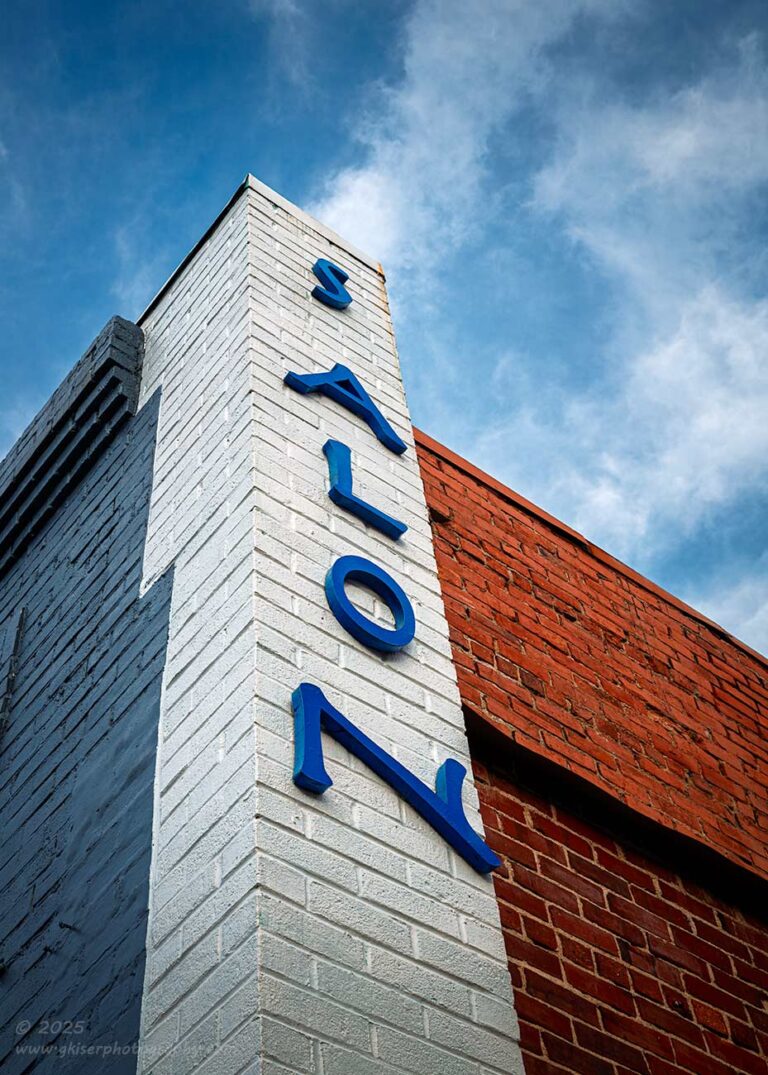
The first detail that kind of drew my attention was the corner of a building near where our meeting point was. This was a salon which I think had been painted recently as I didn’t recall seeing the colors that were there before. The side of the building was still the brick facade of most of the buildings downtown, but the front of the store had been painted a blueish gray and the corner had been painted white. On the side of that corner piece was the word “Salon” in different font letters of different sizes. It was very interesting to me how the letters looked, and the way that the paint colors transitioned made for even more interest. With a bit of blue in the sky I saw a color balance there that really sparked my creativity. Since I had a few more minutes before anyone would show up, I decided to walk over there and compose a shot.
There wasn’t really that much to it, but getting the angles right took a little planning. Once I had things set up, I mounted the polarizer on the lens and fired off my first frame. This was when everyone started to show up. I used what I was doing as the intro to the workshop. We talked through why I picked this subject and why I chose to shoot it the way that I did. As I was talking about it, the sky changed up and became even bluer. I cranked off another couple of frames as we talked through the options that were available.
After a short amount of time, I figured that I had done enough demonstrating, so I turned it over to Bill and John to see if they wanted to try their hand at this building before we moved on. They both were happy to give it a try and got their respective cameras built and ready. They spread out to different angles and different subjects on the building to do their own thing which made me happy. Since both of them had done workshops with me before, I had a pretty good understanding of what they might need from me and tried to give them the space to stretch their own wings. I did check in them very often and provided any help that I could with the choices that they were making.
After a while, both of them had come up with some really great compositions and were ready to move onto the next subject. I had some ideas of places to go but wanted to see if either of them had anything in mind that they wanted to shoot. John was a local here and knew the area well and Bill had done a workshop here a year ago so they both were familiar with the area. John was the first one to offer a suggestion that we go over to the old hardware building a block up from where we were. I knew it but had never shot there before. John was interested in the awning and the windows which was good enough for me and Bill was happy to go check it out. Just like that, we had our next location.
When we arrived, we started to look around to see what might make for a good photograph. This made for a very interesting conversation about what to look for, and then how to turn that into a photograph. In no time at all, I had both of them working on their own compositions and working through the issues that we all face when deciding how to frame up a subject. I’ll have to hand it to John here. I have been by here many times before but never really found anything that I wanted to photograph. Even while working through their compositions, it wasn’t really resonating with me. However, there was no doubt that there were a lot of nice details to work of the store. The more and more we worked it, the more I saw that John had hit a home run with this suggestion. When Bill started to work on a door that had a yellow chain going across it, the challenge was made for us all to shoot the door as we had done with the Salon sign earlier. By this point, I was really feeling the store and felt that this was a good challenge to accept.
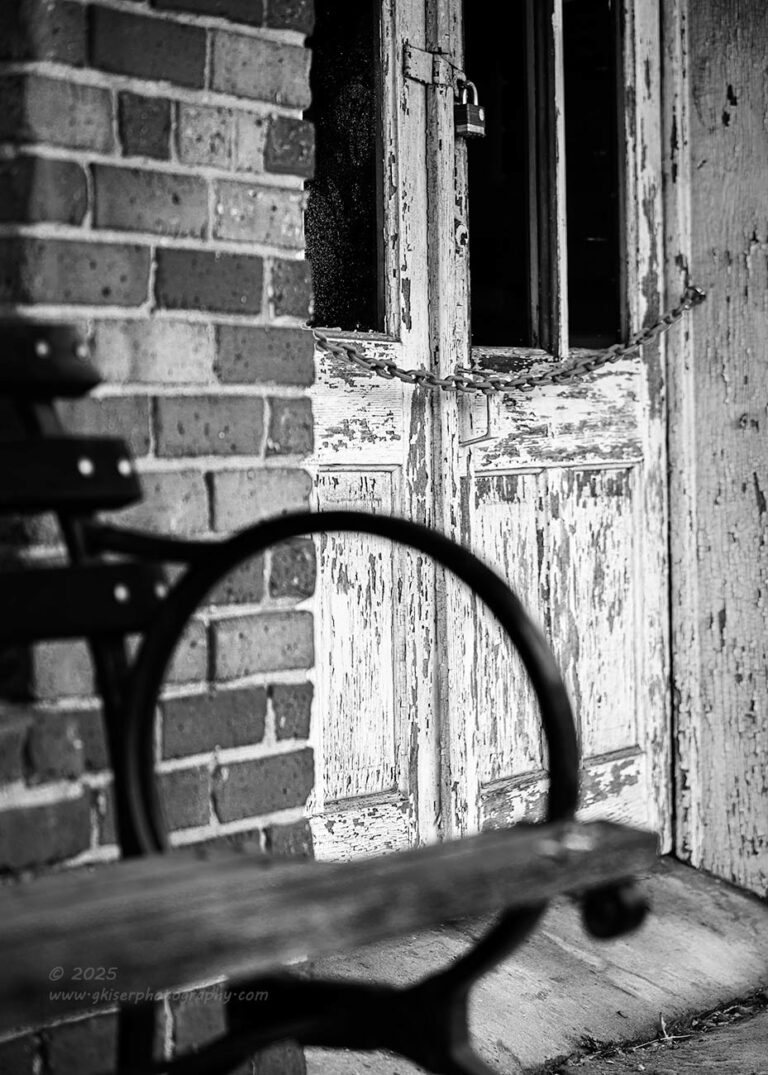
I brought out my camera one more time and started to work through the composition the way that I saw it. I didn’t want to get in their way, so I stayed kind of low and positioned between them to start working things out. As they got their shots, I began to work my way to the left and then to the right to see how I wanted to get the scene. It wasn’t coming together quite as easily as I had thought it would which tells me that Bill had a great idea for a challenge with this subject. Needing to clear my visual palette, I decided to back away from the door and use the bench near the door as a foreground. It had some great little details and shapes that I thought would add interest to the frame.
I put the composition together and then figured out the right settings to use that would give me a narrow depth of field to show the depth while still focusing on the textures of the door and the chain. I liked this better than what I had been shooting and committed to it for a while as I worked through all the little details to make the image work the way that I wanted it to. In just a little bit of time, I had a shot that I liked, but I had no idea that I would be presenting it in black and white until I got home and looked at it. Having the color present was just too much and made for too complex a composition. The black and white really suited it and I thought made the photo quite effective for what I wanted to showcase in the scene.
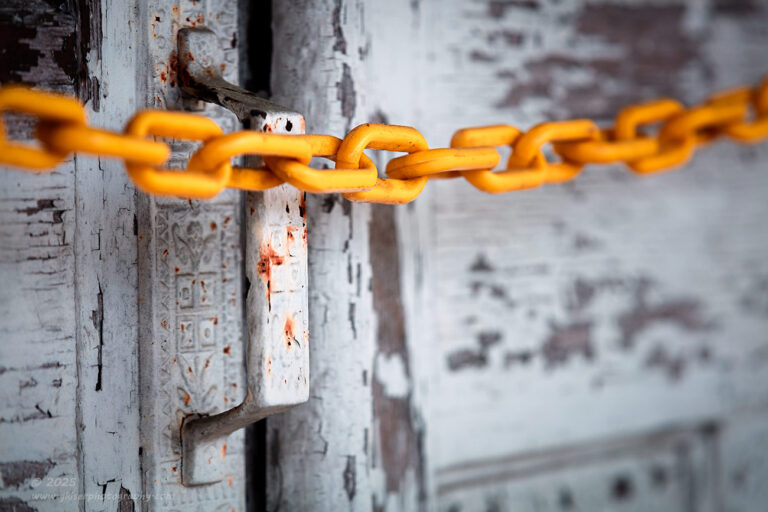
Now that Bill had shifted position, I went to the side of the door where he had been shooting and started to frame up a composition of the handle and chain from that side. My initial idea was to do this as a vertical frame, but that seemed too basic and expected. To address that, I flipped the camera horizontal to follow the chain and went with a kind of extreme angle. The photo still didn’t quite do it for me, so I opened up the aperture and allowed myself a very narrow depth of field to concentrate the attention on the handle. The last little bit of the puzzle came later when I got home and flipped the image horizontally to allow it to read better left to right.
With the chain being a primary feature of this composition, I really wanted to leave the photo in color. A side benefit of that was the fact that the rust really jumped out from the metal surfaces and helped to balance the color of the chain. The white door was left with a slight cyan tint to it but very much desaturated since it took up so much of the frame. The result is a subtle color harmony that makes the chain pop off the background. The blur adds interest while keeping the eyes firmly on the main area of interest. This will probably be my choice for the discussion group since it is most comparable to what everyone was working, although I do like the more pulled back shot with the bench in it better.
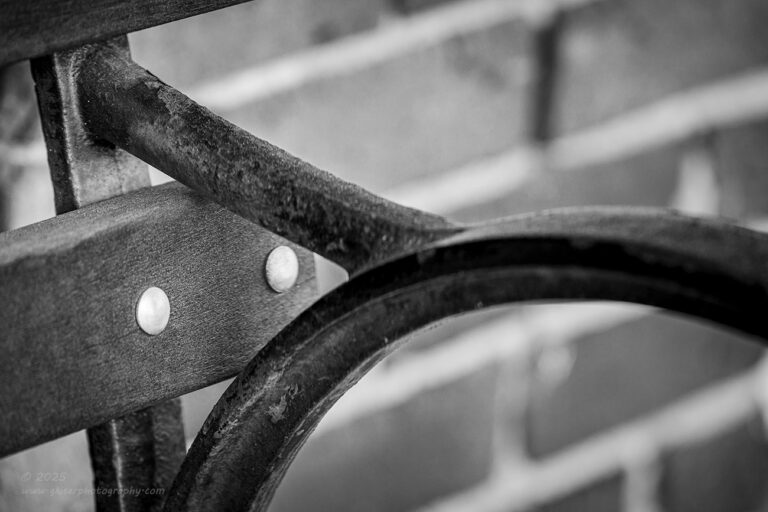
Speaking of the bench, there were some things that I really liked about the bench. Since John was wanting to work on isolations and more intimate captures, I decided I would feel this subject out to see if there were any workable compositions with it. I did my standard batch of questions about what I liked about the scene and what I didn’t like about it. That helped me form the composition which focused on the curves of the framework as it held the back slats. It took a little doing to figure out how to capture this concept, but in the end, I worked out two variations of the composition with one being horizontal and one being vertical.
There wasn’t much in terms of color with the scene, so I was pretty sure that black and white was going to be the right choice for the presentation. My only real issue to work out was my depth of field. I thought that the scene was much too busy with everything in focus, so I started to open up the lens to see where I liked it the best. Ultimately, I ended up settling on a very wide aperture so that the bricks in the background blurred out significantly. Both compositions got treated slightly different in this regard though. The horizontal one was shot at f/5.6 because of the angle that I was capturing the bench frame. I wanted to keep most of that significantly sharp which meant a bit wider of a depth of field. With the vertical one, there was less need for that much depth of field, so I opened the lens up to f/2.8 for that composition. This kept the bench in enough focus for my needs and just about obliterated the background which was what I wanted for separation.
Both of these images turned out well enough to make it through two rounds of culling. When it came time to look at processing the photos I liked them both for different reasons and how much of the shapes had been captured. I worked the vertical one first as that was my favorite, and Toni’s as well. I did go with the black and white as I suspected that I would. I went through the entire post processing routine and found that I really liked how it turned out. I liked it so much, in fact, I just copied the settings and applied them to the horizontal composition.
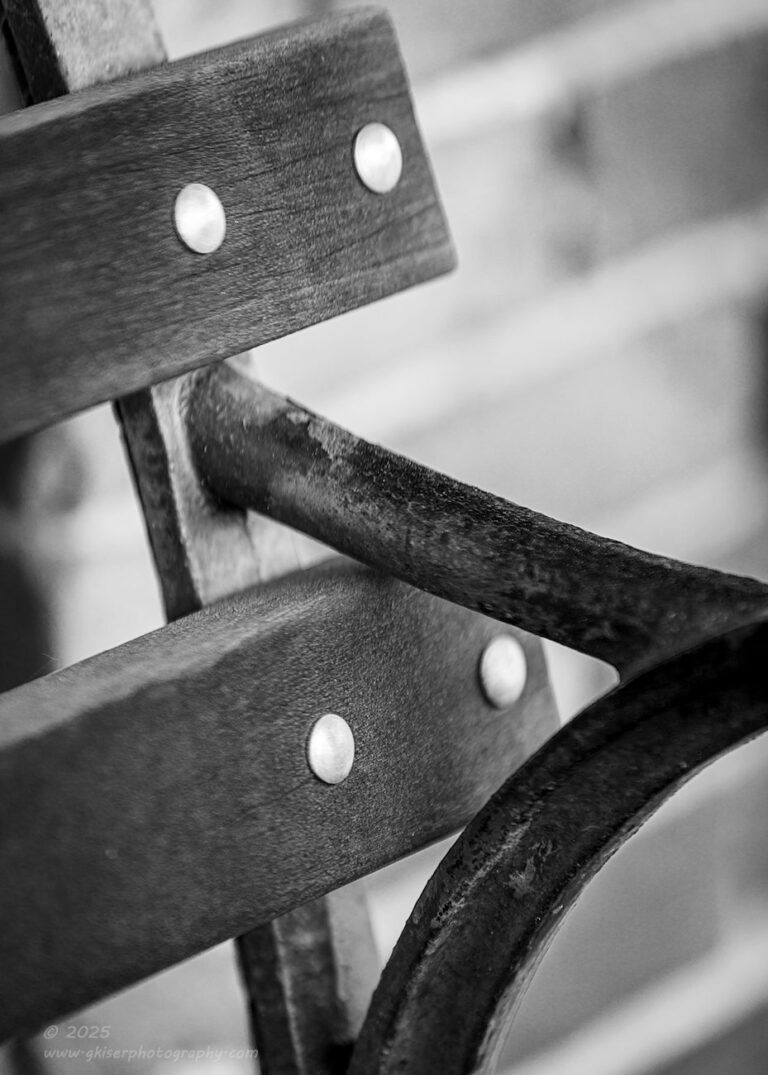
What I found was that I liked both of them about equally with the black and white treatment applied. I went ahead and made some tweaks to the horizontal one because of some specific concerns in comparison to the other composition. It got even better after doing that, and I decided that I would just keep them both in the collection. The whole purpose of shooting it in the first place was to demonstrate what I saw and how I decided to capture it. No sense keeping the images to myself if they are meant for a training aid.
This turned out to be a very good location and I’m glad that John brought it up. It was time to move on though because this was just a half-day workshop which meant that we really couldn’t afford to stay in one place for too long. Since there were no other suggestions about where we should go, I decided to hit an alley that I had shot years before and had already looked into shortly after I arrived at the location. It was a quick walk over and I took them down a less than hospitable alley, but it was full of interesting subject matter in my opinion. At first, I wasn’t sure that they would find it as interesting as I did, but slowly they started to warm up to it.
Before long, John and Bill both started finding subjects and compositions that they liked. I helped them work through any issues that they were having as they went. It was a challenging spot for both of them, but that was kind of why I wanted to work this area. As I was helping them, I was also looking for other compositions that they might enjoy trying. They each moved around to different points in the alley and eventually, the sun came out. This started to bring shadows into play, and it was a good time to demonstrate how these shadows could be made into subjects of their very own. It is kind of neat to photograph something that wouldn’t exist at all without a harsh light source. Added to that the fact that the light source is constantly moving which changes how the shadows look by the minute.
Since both Bill and John were focusing on their own ideas, I decided to break the camera out again and began working the composition that I had seen developing underneath some scaffolding. I really liked the abstract shape of it all but wasn’t quite sure how I wanted to treat the scene. I had first captured a frame with my photo to see if there was any merit to it at all. I liked what I was seeing in that photograph, and that was enough for me to try and work something out with the real camera.
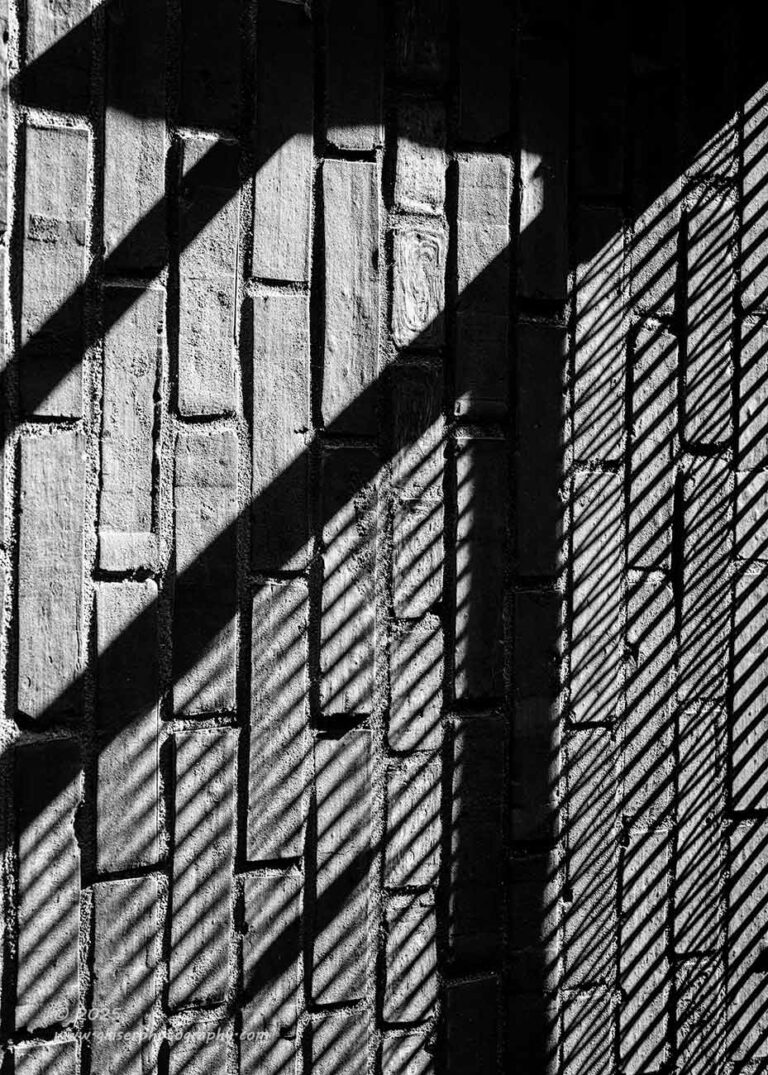
I framed up a shot that was similar to what I had done with the phone and fine tuned it through framing. Once I had something that I liked, I dialed in the exposure that I thought would work well. I knew that I wanted the shadows to go nearly black and I only wanted detail in the bricks that were lit by the sunlight. I was pretty sure that this was going to be done as a black and white image because it was pretty much of a brick wall with a shadow over it. Color really played no part in the frame at all. I set the camera to black and white and made a few exposures with slightly different approaches because I wanted to be able to show what I had seen.
It wasn’t until I got home that the composition didn’t really feel right to me. I really liked the shadow working across the bricks, but the composition had very little flow to it. I knew that this was more of an abstract shot, so that gave me some leniency as to how to proceed. To strengthen the composition, I started to rotate and flip the image. Eventually, I landed on a vertical composition as opposed to the original horizontal. This made the shadow much more pleasing to the eye and gave a better flow to the composition. The issue was that the bricks which we are all used to seeing as horizontal structures were now vertical. I didn’t really like that aspect, but the bricks were not the subject of the shot. I decided to give precedence to the shadow rather than the bricks. It was an abstract, so I was comfortable changing the orientation of the bricks to make the main subject have a better appeal.
I think that the image works, although it isn’t as strong as I had hoped. I’m including it here because it was an experiment in the field, and I want to share what I did. This is a workshop after all, and that means that it is time to do things you wouldn’t normally do in order to grow. Just because I’m teaching the workshop doesn’t mean that I can’t learn and grow as well. That is part of the fun of doing these workshops if I’m being totally honest. I’ll never know everything in photography, and doubtfully will I ever know as much as I think I know. Only by pushing my own envelope can I see what I am capable of, and photo walks are a great way to achieve just that. It is a purely reactive form of photography and one where you find yourself looking at subjects that you might not otherwise consider shooting. Might as well embrace it and shoot crazy things because the law of averages suggests that you will nail at least a portion of these shots.
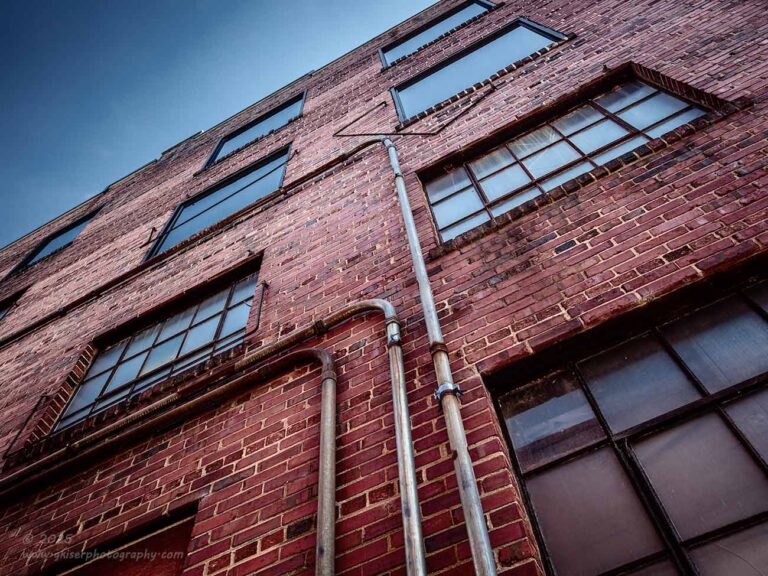
Once I was happy with the shadow, I moved out of the way in case John and Bill wanted to shoot it. Since I had the camera out, I moved over to an area that I had spotted during my scouting walk before they got here. This was a section of the building that had three conduit pipes going up the wall. I liked the shapes and the leading lines that they created, not to mention the frosted windows with the grungy bricks. I realized very quickly that the telephoto lens wasn’t going to cut it here and swapped out with my standard zoom once more. The angle that I wanted was nearly straight up which was getting difficult with the sun so high in the sky.
I did manage to get the right angle, and the composition came together pretty well. Initially, I was wanting some clouds to fill the negative space of the sky, but there were only a few small clouds that really didn’t add much to the scene. Ideally, I would have had enough to do a long exposure, but I could tell that wasn’t going to happen at all. In time, I decided to go with black and white for a “fine art feel” and even switched the camera over to that mode. This looked really good with the blue sky and allowed me to kick up the exposure a bit more than I had with the color version.
I ended up firing off several frames here as the clouds kind of came through but in the end, it was the fourth frame which happened to be the first black and white one that I ended up selecting to process. Ironically, I didn’t like it in black and white when I looked at it on the computer. No matter what color profile I used, it lacked something important. Conversely, when I went through some of my color options, it was just too colorful and cheery looking. The mood wasn’t right at all. The black and white captured the mood that I was after, but the image lost presence. The presence gained by the color eliminated the mood. What was I to do to solve this because I really did like the idea of the photo.
Well, I ended up using that one color profile that I love for those situations where the choice lands between color and black and white. This desaturates the colors, adds contrast, and emphasizes the blues in the frame while muting the reds. I thought that this photo had the right ingredients to make that a good choice. Once I selected that profile, I was pretty sure I was on the right track. I went through the entire processing routine with this one and worked it both globally and locally until I had the grungy feeling that I was after and a really nice color balance with the blue sky. This one actually turned out better than I had anticipated which made me rather happy indeed.
Since the camera had been set up there for a while, I needed to clean the filter off for all the pollen that had fallen on it. I also figured it was time to move on to the next spot before the end of the workshop. We all packed it up and decided to move over to another alleyway that I have enjoyed since I started coming out here. Bill had spent time here in the past and remembered it well. It was the first time that John had photographed here, so it was a good choice to end up the workshop.
I didn’t bring out my camera in the interest of time and to make sure that everyone got all their final questions answered. Shortly after noon, John called it a day. Having been recovering from an injury for over a year now he had done very well to be on his feet for this long. Bill decided to stick around for a bit longer and wanted to follow me as I looked for another subject to shoot. I had to think about this for a bit in order to make it a stop that was worth our while. I knew that there was a spot that looked good this time of day by the Police Department, and there was also a fire hydrant that I had seen recently that had benefited from a wall repaint behind it that made it more photogenic than it was the last time I had shot it. I was interested in photographing that hydrant again, and if the area at the Police Department didn’t pan out, we would head up that way.

Well, there were too many cars parked in the PD parking lot, so we didn’t even go down there to check out the wall that I was interested in. We did go up a block to find the fire hydrant. I know that it seems strange to look for something so simple as a hydrant and I honestly felt kind of odd telling Bill that was what I was looking for. I mean, I’m the guy who finds all these great old cars to shoot almost at the drop of a hat. How could I be excited about a simple fire hydrant?
Well, it is not so much the hydrant as it is the wall behind it. The bricks are stepped down to the right of the hydrant with a stucco wall to the side offering a different color and texture. While there had been a lot of red and salmon colors around the (then) pink hydrant, the bricks behind had been painted a clay color and the wall lightened up to a taupe of sorts. The hydrant was also wearing a fresh coat of red paint the last time I saw it and I really liked the color contrasts compared to how it appeared the last time forcing me to shoot it in black and white.
When we did get there, I was really happy to see that the colors were still as I remembered and there were no cars blocking the view. Bill and I discussed how we each would shoot this subject, and he was all in for giving it a try. Since I had plenty of time, I let him go first in case we ended up shooting it from the same angle. He picked his spot pretty quickly and it was nowhere near where I wanted to capture it from. With him 12 feet away, I decided to set up where I wanted to shoot from. We were both shooting with our telephoto zooms which kept us across the street from the hydrant and well out of each other’s ways.
I chose to do things a lot different from the last time, while keeping roughly the same angle. The last time I had shot it, I had used a wide-angle focal length and got in very close. This time, I really wanted to capture the yellow paint on the curb edge that framed a manhole cover. I liked the cover as a complimenting element to the hydrant and saw that the sun was creating a dark side to the wall where the edge of the sidewalk ran. There was a lot of tonal contrasts here that added so much to the visual interest and the colors all worked very well with hints of cool blues to balance out the reds and yellows of my main elements.
I carefully framed up the first composition and dialed in an equally well thought out exposure. I fired off the shot to see how it all worked out. Looking at it in the image review I decided that there was not enough room at the bottom of the frame and that this wasn’t really what I wanted to capture. I reframed and tried again. This worked better, and all I needed was the right lighting which was now changing constantly as the clouds moved over the sun quickly. There were another nine frames captured as I tried to get the light just right for this new and improved composition. By that tenth and final frame, I was happy that I had gotten a great one of the hydrant.
Ironically, when I got home and started to look through the images to cull them, there were three that passed through the first round with the first one being among them. By the end of the second round of culling it was that first one that I had dismissed through the live view that had the strongest lighting and composition. Just goes to show that you can’t always trust the image review to make the final decision on what images work the best. I’m just glad that I didn’t delete this one off the card when I decided that it wasn’t worth committing to and shifted the framing for what I thought was tremendously better all the way around.
That was the end of the workshop. I had some parting words with Bill about the experience and made sure that all of his questions had been answered. I didn’t know it yet, but I had shot a total of 37 frames through the day. This really isn’t that many for the amount of time I was out there but considering that typically on a workshop I won’t even bring a camera, this was a pretty big deal. I would like to reiterate that me making images through the day was actually requested by both participants and had either of them had an issue with me doing so, I would have skipped my photos happily. With a small group, especially one made up of veterans of my workshops, I wasn’t as worried because of the relationships that we have formed. Just know that if you decide to take part in a workshop of mine such as the upcoming decay workshop in May, my focus is on the client and not my own images.
I do think that this workshop was a success, and we all got out of it what we wanted. I would like to thank Bill and John for attending and making this workshop so great. Hopefully the next time I offer this one, more folks will attend. It seems to be a very well received workshop and one that benefits even seasoned shooters with little tips and tricks that can be “game changers.” I’m not making that up, that is a direct quote from Bill after helping him with an issue that he has had for some time now.
If this workshop experience sounds like something that would benefit you, keep an eye out for my upcoming workshops which is always a link on my front page. I’m always looking to improve the experience and expand what I can offer. There are a few other workshops in the works that hopefully will happen this year, so keep an eye out. If you would like more personalized attention, consider joining me for a mentorship experience. I do offer several tiers of mentoring to fit your needs and am happy to custom tailor an experience for you. Just give me a call for a free, no commitment consultation to make sure that we are a good fit and that I can provide the information that you are seeking.
Thank you all for joining us on this workshop trek. I do hope that you have enjoyed it as much as I have!
Until next time….