Saturday, September 27, 2025
My blog yesterday was all about the last few hours of daylight in Brevard after I arrived in town. That will kind of serve as the official “Part 1” of this blog series, although I’m going to break things up a little different than normal. After reading through that blog, you are probably well aware of my less than upbeat attitude towards the trek. I honestly wasn’t really feeling up to the task of photographing Eastatoe Falls. However, because it is on private property and there are only two days a year that it is accessible, and only after reserving a slot through the Waterfall Keepers of NC, I figured that I really had to take advantage of the opportunity. My friend Bill Neagle had signed us up the day that the slot had become available just as he had done the previous year. The whole event was cancelled last year because of Hurricane Helene and the damage that was left in the wake of that storm. If I missed it this year, it would be because of my own choice and since I have control over that, I took Toni’s advice and went ahead with the trek as planned. The weather was looking to be nearly perfect and the recent rains promised better than expected water flow after about a month of little to no rainfall.
Now that I was in Brevard, I was really trying to get into the mindset to photograph waterfalls which is a different kind of subject compared to the rusty cars that I have been spending most of my time with here lately. It helped to have Bill with me since he is really and truly a waterfall photographer. He gets energized by them and knows most of the ones in the area. I fed off of his excitement as I tried to get my mind ready to capture this elusive waterfall. I was also reading a book on landscape photography written by several prominent photographers in the genre. It wasn’t so much to learn things as I have read the book many times before, but I wanted to direct my creative energies in the right direction which started with identifying that direction.
As we turned in for the night, I checked the weather one last time and found that the rains were supposed to start after our time slot was over. There was a slight chance of a shower during our time there, but it wasn’t looking like a problem at all. I made the decision to skip converting my camera over to rain duty by changing out the filter mount system in favor of lens hoods and screw on filters. This would allow me more flexibility with my filters and make changing lenses much more efficient.
Just like every other night before an important trek, I didn’t sleep all that well. I kept rolling through what I expected of myself from the experience and tried to work through the shots that I wanted to be sure and get. This was not all that easy to do since I have never been here, and the last time I had really looked at photos of this waterfall had probably been six months or more ago. I purposely didn’t look for inspiration photos because that would influence what I would be doing while I was there. Since we only had a two-hour window, I needed to get to know the waterfall on my own terms and figure out how I wanted to photograph it rather than recreating other photos that I had seen before.
One thing that I knew about the falls was that I was going to be more interested in the lower right section than I would be the entire falls. This lower section just had so much personality from what I had seen and that was the part that really interested me about the whole thing. Don’t get me wrong, the entire waterfall is beautiful, but I needed to figure out a more direct story than just an overall capture of a pretty waterfall. I needed the photos to show off the personality of the waterfall highlighted by how it affected me. The issue here was that what I was asking myself is something like being expected to write a biography about someone that you have only read a few short stories about and have never met before. Without having direct contact and the ability to ask questions, it is really hard to know what to write about. I needed to meet the star of this story to really understand how this waterfall was going to affect me. That was going to have to wait until 8am.
The alarm rang at 5:45 and both of us were moving with a sense of purpose. The weather was looking even better than before with a slim chance of fog, partly cloudy skies, and no rain until around midday. Things were definitely looking up for us. We got ready, enjoyed a quick breakfast, and checked out of the hotel around 7:30. We were on our way and the morning light showed off a beautifully misty and foggy morning. It was perfect for waterfall photography, and we both knew it. The chances of getting conditions like this on a date that was scheduled so long ago is like winning the lottery. Nothing about the two-hour window from 8-10am on September 27th could be altered. That was when we could be at this waterfall. There were no chances to reschedule short of waiting until next year. If it had been bright and sunny, or storming, we would have had to deal with it. Instead, we had what I think would be considered universally as fantastic conditions.
You would think that this would be very exciting for both of us. I’m sure that Bill was excited, he’s always excited to photograph waterfalls, or try new things. I was excited, but also quite nervous. Bill and Eastatoe have a history together and he knows her well. I don’t, and I wasn’t sure if I would be able to do this waterfall justice on a first visit. If it had been sunny, or even raining hard, I could have put the blame on the weather for less than perfect photos. That wasn’t looking like an option because I couldn’t have asked for better conditions. If my photos failed, there would be no masking the fact that it was all on me. I was really starting to wish that I had gone out and done some more waterfall photography here recently with the rains that we had during the Summer. At least that would have put me in a better mindset for picking the exposure times that would work best to show what I wanted to share of this waterfall. There was no more time for preparation, and I was just happy that I had been out a lot this year for photography in general. This would at least make the muscle memory part easy.
We rolled onto the property just a couple of minutes before 8am and were guided to the parking area by volunteers with the Waterfall Keepers of NC. It looked like we were the second vehicle to arrive. Bill said that there would likely be about eight or so during the timeslot which wasn’t bad considering this was a one-day affair at a famous location. Bill asked if I wanted to go to the lower section of the falls first, or if I wanted to go directly to the main section. Since I honestly had no idea, I let it be his choice. I said it more than once during the day, this was his house, and I was going to leave things up to him because he knew so much more about the area than I did.
Bill chose to go with the lower section first, so I followed along with him. When we got there, my first thought was less than positive about where we were at. I could see the beautiful Eastatoe Falls above a cluster of boulders, and there was a secondary cascade below those boulders. For me, this was a very cluttered scene and I wasn’t able to figure out how to organize it to show off the main falls. While this view added some height to the falls and brought a more impactful view, it lacked flow for me. I didn’t want to discount it, so I started to look for details that might capture the essence of this area. While I was in the process of figuring out one little gorgeous cascade off to the left, Bill was setting up on a rock to get the entire waterfall system. I was sure that it was going to turn out great because he knew what he was wanting. I was just getting to know the area, so I was taking baby steps with this little cascade.
I found the angle that I liked from a boulder that was nearby which I could stand on and place a tripod. I opened up the camera bag and built the camera with the telephoto lens which was going to be necessary to capture the isolation that I was looking at. While I haven’t been doing much waterfall photography this year, I have been getting more and more proficient at working a scene through my decay photography. Picking out details on an old car is really no different than picking out small details within a landscape. I’ve always said that for me at least, landscape photography is all about creating order out of chaos. I’ll be talking more about this in my upcoming Behind the Camera, but I wanted to really have clarity of thought showing in my photos with nothing in the frame that didn’t support the story that I was trying to tell through my photos.
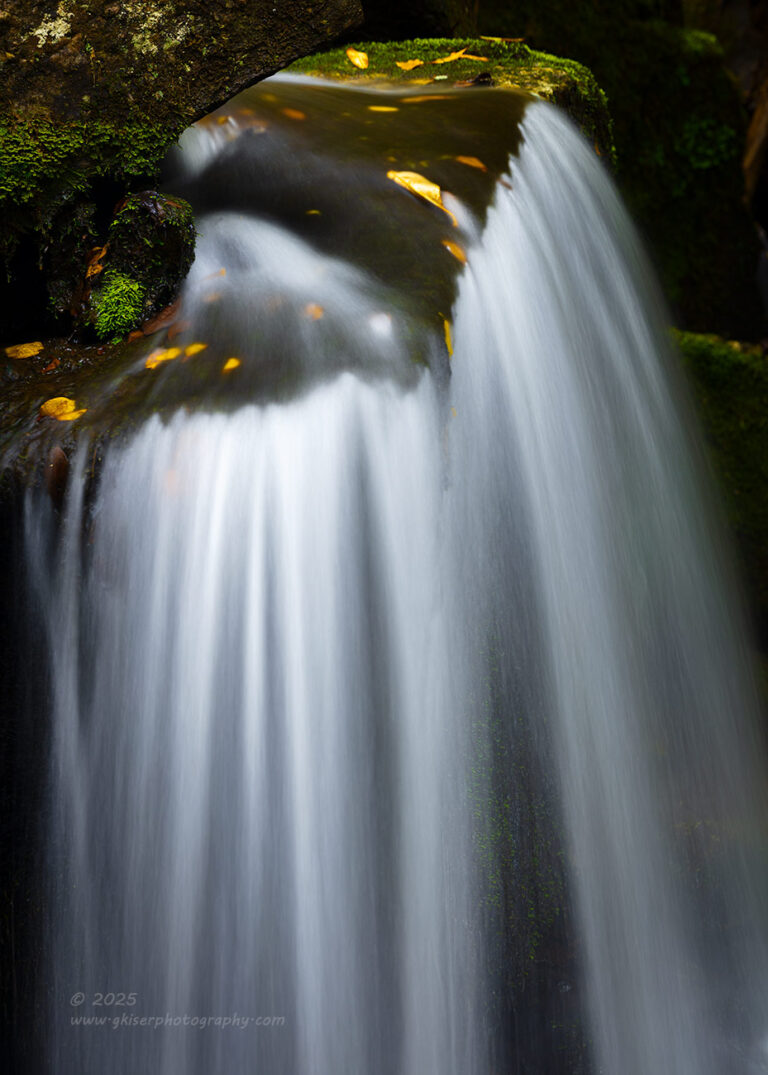
For this little cascade, I removed all the clutter, and even the main waterfall which I had yet to photograph to make a very simple, yet impactful composition. I had to think back to the connection between photography and Haiku poetry that I had been introduced to by another friend, Dave Russo back in the Spring. The concept of synecdoche was in full swing with this composition. While I was really wanting to see the waterfall in a full view, this little detail that I was looking at spoke volumes about the scene as a whole. It was my kind of photo, and something that is true to how I see a scene. To look at this scene in a photograph, there is no way of knowing what waterfall it is attached to, or for that matter, if there is an actual waterfall nearby. It is one of those scenes that baffles Toni because she is always saying that I can make this little drip look like a massive waterfall and she calls it photographic trickery. There are clues as to the sense of scale here, so that is not so much in question, but what is very apparent is the wonderful lighting on the scene and the flow of the water. These are the most important aspects of waterfall photography, and this small detail captured those elements so well.
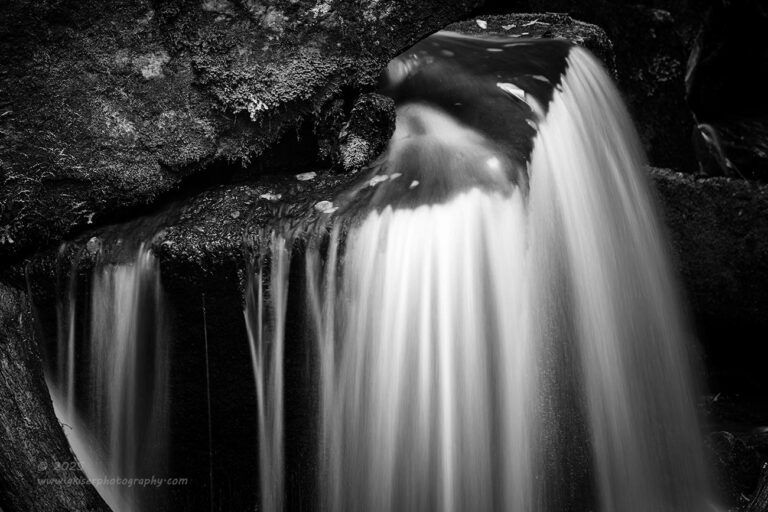
Because of the length of the drop, I went with the expected vertical composition to start with. I wasn’t at the top of my game for estimating the shutter speed that I wanted to use by sight, so I had to do a bit of experimentation to find the right one for the flow. I ended up shooting a total of three shots with this composition as I tried different speeds. It was the second of that series that seemed to work the best when I went through them on the computer later that night. I was pretty confident that out of those first three images, I had something in the can as a keeper and that made me happy. It is always that first image that is the hardest. That is also part of the reason that I had gone out the evening before and worked that cemetery. It got the photographic juices flowing and started my connection with the area even though that location had nothing to do with waterfalls. It was all about understanding the area that I was in which makes the photography much easier.
I had that first image of the day on the memory card and was starting to get excited about getting up to the main section, but Bill was still working on his composition, so I wasn’t in any rush. I looked at what I had just shot and wondered if there was a way to improve on it, or if there was something else in the area that I wanted to shoot. After looking around, I still thought that this small cascade was the best option for me at the time. I had what I thought was the strongest composition around it, but it was also the most expected composition. By expected, I meant that since the subject was taller than it was wide, that would usually dictate a vertical composition. I started to question if that was the best option, or the only option. I could do this scene with a horizontal composition which would change the visual language quite bit as the balance would shift from the textures of the water to the textures of the rock and moss around the water. It was a subtle shift, but one that I wanted to explore.
I rotated the camera and started to dial in a composition within a vertical frame. This was looking good, but I kind of felt that I wanted more water to show, but that started to lose the focus of what I was wanting to capture so I rejected the urge to open the frame up more. The more I looked at it, the more I realized that the color was throwing this off because it was putting too much emphasis on the rock and moss while the water was left almost as negative space. I decided to shift my thought process to black and white to bring more attention back to the water because it was brighter that the other areas. By removing the color contrasts, I was left with just texture in a dark space that worked exceedingly well. This was what I ended up going with and when it came time to process the photos, this was kept black and white as I had considered at the time.
It was also one of the last photos that I processed which is important because as you will see, I ended up with a lot of black and white photos from this day. Through the processing of all of them, I started to develop a visual language with the conditions and found the right way of processing the monochromatic images. High contrast seemed to be the way to go with pretty much all of these images that were converted to black and white. I’m finding that more and more, I am shifting away from the Ansel Adams zone system of exposure with my black and white images in favor of something more dramatic and contrasty. I’m really liking the deep blacks and the bright whites for that visual impact and there are no better subjects to do that with than waterfalls. By the time I came back to this horizontal shot of this little insignificant detail well below the falls, I had just about perfected how I wanted the image to look. The edit took no time at all, and it was one that worked out better than I could have thought. There was something about the unexpected horizontal framing paired with the dramatic high contrast black and white that demands attention from the viewer.
After shooting another three frames of the horizontal composition I was happy with what I had captured from this lower section. I didn’t really realize that out of the first six frames, I already had two keepers with the second and sixth exposures working out very well. I still didn’t see anything else that interested me and started to pack things up to get out of Bill’s way. He was still working on the grander composition that included the main falls. He was having to wait for another photographer to move out of the way who was situated at the top of the ridge. I could tell what he was going for, but the scene didn’t really click with me at the time. It was nothing that I wanted to spend time photographing, or at least that is what I thought.
A day later, after I had finished up doing all of my processing and the first blog, I saw on Bill’s Facebook page some of the early photos from the day. The one that he had been working on while I was working on my little detail shot ended up being posted. I’ll have to admit that it turned out quite nice and more organized than I had given the scene credit for. I think that the key was his vantage point well up on a boulder. He had the right location for the shot, and it wasn’t as disjointed as I had thought it would be. There were a few aspects of “clutter” that still turned me off from the scene, but it was certainly manageable as a composition. I did like how he was able to flatten the scene and make it look like the main falls just flowed right into the lower cascade that I had been working with. It just goes to show that how a photographer sees is much more important to the final photograph than any equipment that is used. Bill saw this scene when I wasn’t able to, and he executed a photo of it that showcased what he saw in a way that I couldn’t.
One other thing that we didn’t quite agree on was a fallen tree at the top of the main falls which caught out attention as we were looking at the light fog that was settling in at the top. Bill pointed it out and said that he wasn’t wild about the fact that the deadfall was blocking the water. Usually, I would have agreed with him on that, but for some reason I had seen that same tree and thought that it would make an interesting composition all on its own provided I could get the reach needed to photograph it properly. Stay tuned to see if I was able to make that happen.
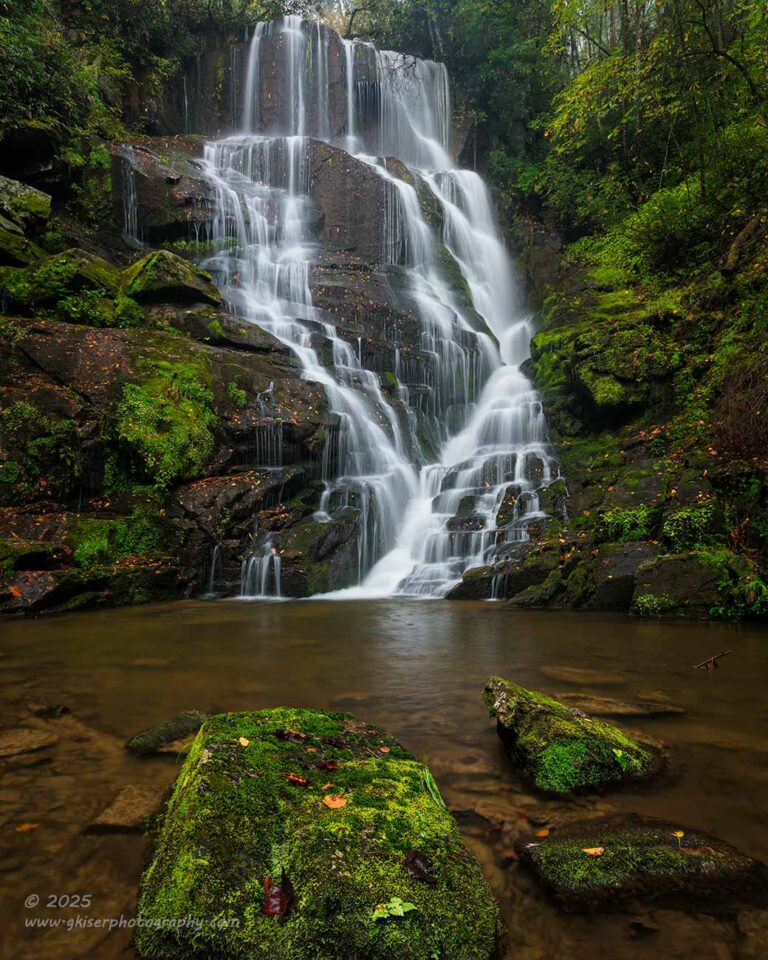
We each had our starting images for the day and decided that it was best that we get up to the main falls before more people showed up. That was going to be where our time needed to be spent anyway. We made the quick hike up the hill and down the steps to find ourselves in the pool of the main falls. It was glorious to say the least. Since this was my first time seeing this waterfall, I was struck with its beauty right off. I can certainly see why it is as popular as it is. In fact, it was the cover shot on one of the editions of Kevin Adams’ waterfall book. This was a special waterfall without a doubt, and I could feel the excitement brewing. From what I could see of it from the lower section, I was not as impressed as I thought that I would be. Now that we were right up at it, I totally got it.
We had been on location for only a short time, and I wasn’t really sure how this waterfall wanted to be photographed. I had my shot list in my head which included a full length shot in vertical format as well as an isolation on the lower right side. These were just the ideas to get me started and I was hoping that I would get more ideas as the morning progressed. For now, I needed to figure out where the best place was to place the camera.
The side that we entered on was nice and showed the lower right side in its entirety and pretty much straight on. This would be effective, but I kind of wanted more dimension to that section which meant getting a more angled approach from the side. For that, I was needing to cross the water and move closer to the other shore. I was really glad that I had my Gortex lined boots on because I was going to be walking through a good deal of water and likely standing in the water for a while. As I walked through the water to get to the other side, I realized that I was almost to the tops of the boots, but they were doing a great job at keeping my feet dry thus far.
While walking, I noticed the moss-covered rocks in the foreground and thought that they would make for a great element in the overall composition of the waterfall. There were little yellow leaves that were sprinkled about the scene which indicated the coming Fall colors though the dominant color of the scene was still very much green. I could see that this was the angle that I wanted to photograph Eastatoe from, but there was no place to set my camera bag to be able to build my camera. I was literally ankle deep in the water with nothing flat around me. A short distance behind and to my left, was the other side of the pond. There was another photographer sitting there getting his photos, but he said that it wouldn’t bother him if I set my bag next to him. I took him up on the offer and built the camera with my wide-angle lens so that I was sure to get the right perspective on the foreground rocks in the scene. I added the polarizer because that is just what you do with waterfalls and started to dial in the composition.
The hardest part was picking the right distance from the rocks and then the right height of the camera in relation to the rocks. You would think that the waterfall would have been the biggest consideration in the composition, but that just wasn’t the case at all. I knew that I wanted the entire falls in the shot, so that part was easy to frame up. All of the shifting came after I decided on the foreground so that I could get it positioned right in the frame to compliment the waterfall.
When I finally got the composition dialed in, I realized that the sky in the upper portion was really too bright for the scene as a whole and I was needing to address it somehow. I knew that I was going to be changing the aspect ratio from the native 3:2 to something a little less tall, but I wasn’t sure exactly where I was going to need to cut through the top of the frame. I knew that I was going to have a little bit of the sky included, so I wanted to make sure that I had a workable exposure. To do this, I went back to the bag and grabbed a 2-stop hard edge grad so that the transition would come on quickly and darken the sky as well as the backlit leaves of the trees. That seemed to work well, and I wasn’t able to spot the transition line in the viewfinder which gave me hope that the effect would go unnoticed. At any rate, I now had a solid exposure to work with and fired off a series of images in order to dial in the shutter speed that I wanted for this waterfall.
One of the lessons that I have learned late in my photographic tenure is the value of higher ISO settings. When I first started out in photography in 2005, high ISO was a bad thing and introduced way too much noise into an image. My first camera was fine at ISO 64, but anything above 100 had more noise than I wanted to share. My later DSLR cameras were much better, but I was still very much locked into the base ISO. When it came to waterfall photography, that worked out well because I wanted to get the longest shutter speed that I could in order to blur the water. I was happy with shutter speeds in excess of three seconds in pretty much any circumstance. It wasn’t until early in the 2020’s that I had a break from that ideal and started to see the benefit of a quicker shutter speed, though still counting as a long exposure. I was now much happier in the half second range of shutter speeds to show the motion while retaining the texture. There is no right or wrong way, but I have found that this is better for how I want to present moving water these days.
I was finding myself having to shoot at ISO values of 400-800 for many of these shots because of the heavy cloud cover causing dim lighting on the scene. This is something that six years ago, I would have never considered doing. However, I have learned my camera quite well and trust that it handles these ISO values very well and what little noise is introduced into the image is easily removed in post with very little adjustment. It does still seem strange to crank up the sensitivity this high after so long hedging the shutter speeds slower and slower with moving water. I was confident that this was the right choice and looking at the image review, the motion in the water was looking fantastic. This was going to be my baseline for all later exposures, and I found myself jogging the ISO more than any other setting for the rest of the time here to establish the correct overall exposure.

I had now figured out the base exposure that I wag going to use for this particular waterflow because the motion of the water wasn’t going to be changing at all during our time here, and for the most part, I was wanting a deep depth of field, so nothing needed to change except for reacting to the ambient light levels. Now, I was able to move onto the second composition that I had wanted to get in addition to that overall establishing shot. I moved my attention to the lower right that I thought had the most personality. I wasn’t able to get close enough to make the 16-35mm lens work, so I went back to the bag and shed the grad filter and switched the lens for my standard zoom. This was where my current filter system shined compared to my wet weather kit that included a screw on polarizer. All I had to do was unclip the filter mount from one lens and move it to the other one. There was no screwing anything onto the front of the lens, and no hassle with resetting the polarizer. Everything just moved from one lens to another in quick fashion to allow me to get back to the actual shooting of the scene.
This lens allowed me to get a much closer crop on the section that I was interested in. I kept the camera vertical because that seemed to be the way to go for this section as it was taller than it was wide. I didn’t feel like reinventing the compositional wheel this early in the day. I wanted to get the low hanging fruit to start with and then I would have time to work out the more creative compositions later on. My goal here was to capture this waterfall as only I can. Don’t get that confused with me saying that only I can capture this waterfall well because that couldn’t be further from the truth. Actually, I was pretty sure that Bill would do a better job with this waterfall than I could because he was familiar with it. What I am saying is that I had to capture the waterfall in a way that only I could do it, just like Bill was capturing it in a way that only he could. We are all individuals as photographers and we each bring our own strengths to the photos that we capture. I had to figure out how my strengths applied to this particular waterfall and I only had about an hour and a half left to do so. I wanted to get the expected shots out of the way as I was learning the personality of this location and figuring out how to form a relationship with this waterfall.
I had visualized this composition for years, so it went pretty quickly once I had the right lens attached. My first inclination was to include the same foreground rocks to show depth to the scene while still focusing the attention on the lower section of the waterfall. I fired off two frames with that concept before I realized that the visual balance was well off in the scene. There was no longer a looming waterfall in the background, only a section that was visually as large as the foreground. The two elements were in competition with each other for star of the photo and that confused the issue for me. I decided to get in closer and omit the foreground rocks and go with my first inclination of focusing just on that lower section of the falls. This seemed to have a much more impactful result in the photograph.
The sense of depth was lost without the foreground elements, but I found that depth wasn’t all that important with this angle because I was still looking at the lower side from a side view rather than straight on. There was the indication of depth in the scene without a foreground element, and the focus was all on the flow of the water over the stepping stones that created the cascades. I was really liking this view and ended up shooting three frames with slightly different settings to make sure that I had the right visual effects.
The hints of Autumn from the fallen leaves were a nice bonus here as it gave just the right bits of color to balance out with the green moss and the blue toned water. The little orange specs gave texture of a different kind compared to the water, rocks, and moss. It all blended together magically. This was the shot that really got me fired up for this waterfall. The silky water flowing over the rocks just drew me in and I started to block out all of the activity around me and was able to focus on a dialog between myself and the waterfall. This was the moment that I had been hoping would happen. I was forming a relationship with this waterfall which was starting to result in some creative ideas that I hadn’t had before. Now I was able to see the waterfall through my eyes, and I was able to forget all my preconceived ideas of what would make a good photo here. I was now fully present in the moment and I was no longer thinking about anything. There was just music playing in my head and I was taking in what I saw and forming compositions around it all.

I had just finished a total of five frames in a vertical orientation of the lower portion of the falls, but I was starting to see it as a horizontal composition with a patch of moss off to the left. The design elements of the composition kept the eyes focused on the right side of the frame, but there was enough visual interest to the left to keep some attention over there for a sense of balance in the frame. The story became less about the section that I loved so much and more about the convergence of the two flows of water with the smaller cascades off to the left beneath the moss. There was a lot of contrast in the scene both from luminance values as well as color values. I was really liking what I was seeing with this composition.
The really nice thing about this composition was that it was essentially set up the same as the vertical one, so I had the exposure dialed in the way that I liked. This made it possible to capture this composition in a single frame rather than trying lots of different variations. Looking at the image review, I didn’t see anything that needed to be changed, so I moved on to the next composition. I think it was around this time that I was noticing that my feet were starting to get cold, and I could feel the wetness seeping through my boots. It wasn’t bad, but I knew that if I stayed in the water much longer, I was going to get actual water coming into my boots. I had the conscious thought that I just didn’t care if my feet got wet. I was having a great time with this waterfall and loved the area that I was in too much to try and find dryer ground. I just embraced the water that eventually started to overpower the Gortex and the subsequent sloshing in my boots.
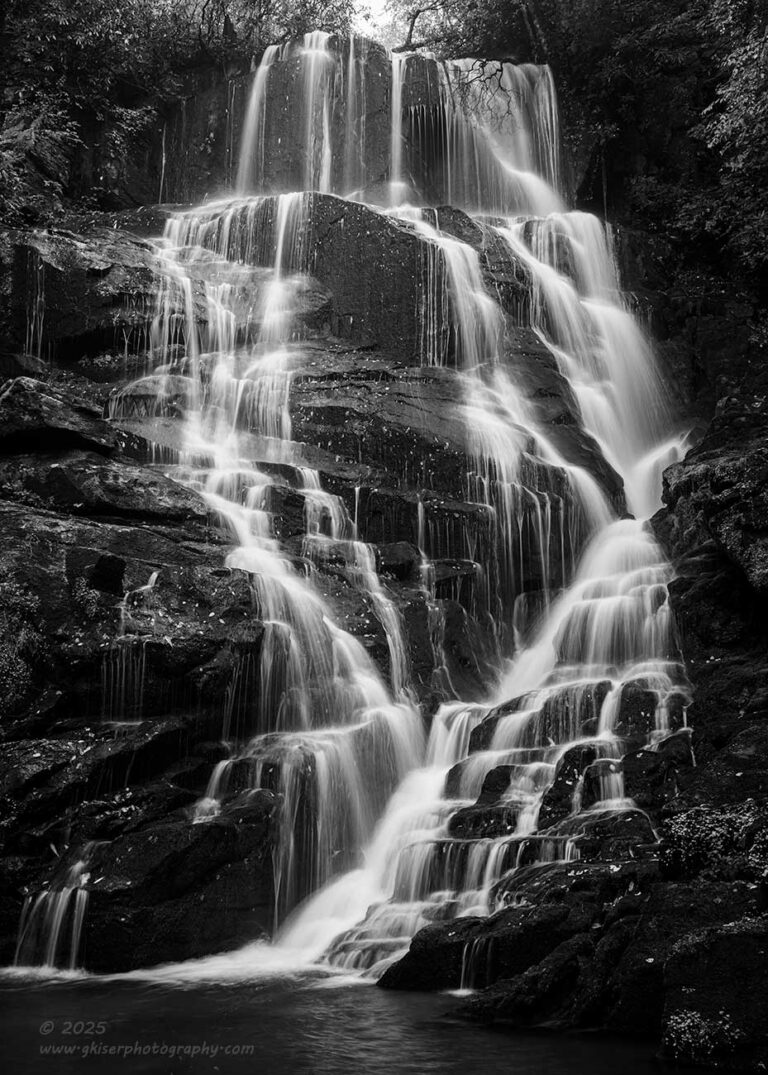
I was starting to really see things differently by this point. I was so involved with the contrasts and textures that I was seeing I started to see everything in black and white. I really think that this is a product of my experiment last year when I went out looking to shoot more black and white photos than I ever had before. The goal was to become more fluent in seeing in black and white as well as learning different ways to process the images. That experience over the course of a year was really staring to pay dividends for me here. I knew that this was going to be a great opportunity to work with some high contrast black and white images to really showcase the path that the water was taking down the embankment. I didn’t really need to switch the camera to black and white to see it since there was very little color to the overall scene. Remaining in my normal picture style was also very important to me because it was set up to provide me with a much more accurate exposure for my RAW files.
I will easily lose a stop of light in one of the black and white picture styles because of how the camera converts the colors to monochrome. With a high contrast scene like this, that means that I am giving up detail in the shadows for no good reason because there is still more exposure room at the top of the range that I can’t see. In my custom picture style, I can push the exposure all the way to the right and know exactly where the clipping is happening and give myself a good deal of extra detail in the shadows. This was more important than seeing the photo as a black and white in the camera.
With the standard lens attached and the fact that I had decided to shoot over the foreground rocks for the last couple of compositions, I considered another grand view of the waterfall from a bit closer. I rotated the camera once again to a vertical format and framed up a shot that included the entirety of the waterfall, but from a closer vantage point. This changed the perspective and gave it the towering look that I was after without making it look odd. I was still focusing my attention on the lower right corner which quickly became my visual anchor.
I shot the first frame which was a bit bright at the top, so I dialed the exposure back slightly. This worked better, but I was seeing fog at the top of the waterfall that wasn’t there in reality. A quick check of my filter and I found that it was covered in spray. I cleaned it off real quick and fired off another frame that nailed what I was looking for. It only took those three frames to get this shot. I could tell that my hit rate was pretty high, especially for a waterfall. I think that it had more to do with the fact that I was really operating on instinct at this point and just letting the waterfall tell me how it wanted to be captured. I wasn’t really thinking through much in terms of technical aspects. Those decisions seemed unimportant at this moment. I just let it all flow naturally, just like the water over the rocks.
It really was feeling great to be here at this point. My feet were now soaked, and I could feel the water flowing between my toes as I moved them. It had been a long time since my feet had been this wet in these boots, but I wasn’t concerned at all. I really thought that this whole experience was worth having cold and wet feet. I wouldn’t have changed a thing about it. Even looking back on it a couple of days later, the wet feet are still not a concern and certainly don’t impact the experience that I remember. As you are reading this, I’m sure that you have sensed a shift in my attitude compared to the previous blog, and even the beginning of this installment. That shift was real, and I was experiencing it during my time with Eastatoe. It was an almost therapeutic experience.
Speaking of which, I want to mention my friend Bob again. He loves waterfalls, and photography in general. He has primarily focused on waterfall photography and sees that as his time of relaxation and connection with nature. He talks about it often and has a new website dedicated to his nature photography. I read what he says about his connection with nature and can remember having that feeling myself when I started out with photography. I never really noticed it, but at some point, I lost that connection and just didn’t quite feel the same way about it that I once did. When I say I never noticed it, I mean that until this point at Eastatoe Falls, I had forgotten what it felt like to connect with nature and be in awe of it at the same time. It had become just about the photographs to me, and not as much about the experience. Now, standing at the base of Eastatoe, I was feeling the spray on my face, the water flowing into my boots, the slight moist chill of the morning air, and all the sounds of the crashing water. All of these aspects just furthered the experience for me. I was no longer seeing it as a challenge when I had to clean my filter off to get a clear shot. The water in my boots was making me smile more than anything. I didn’t even realize that I was chilly in my shorts and t-shirt. The sound was just the waterfall talking to me and drowning out all the other conversations around me. It was just me and Eastatoe, and I remembered what it had been like when I started landscape photography.
I’ll blame Bob for this realization because he had put the thought in my head a long time ago that I was still thinking about to this day. It has now fully clicked, and I understand more about Bob than I have in the past. I would have had this epiphany even without hearing from him the day before as I was heading out to Brevard. It might have been bad news that he was sharing, but he remained positive and upbeat about it. I know that his landscape photography will serve him well as he fights the cancer that was found in his body. There is something about nature that when you embrace it, you realize that you can be both insignificant and a very important part of the whole all at the same time. We, as humans and individuals are an integral part of the bigger picture and we get the added benefit of enjoying the nature that surrounds us. If you feel moved to help Bob out with his treatment and recovery, there has been a GoFundMe page set up for him, and it would be greatly appreciated if you could help him out.
Sorry about that little diversion from the story, but I was really thinking about Bob at this point in the day for all of those reasons. My hope is that the photos are starting to show that connection that I was now feeling with the landscape and this waterfall in particular. It was this surge of energy that had driven my photography up to this point. Now that I was settling down and starting to think about things a bit more, I remembered that fallen tree at the top of the falls that Bill and I had seen from the lower section. I turned my attention to that element and considered how I wanted to capture it. I wasn’t sure if it was going to work or not, but I felt that since I had mentioned it earlier that I needed to give it a try. In fact, I think that Eastatoe was telling me to photograph that tree at this particular time because I wasn’t even slightly prepared for it. I still had my standard lens attached which wouldn’t even get me in the ballpark of a composition at the distance that I was looking at.

I went back to the camera bag and did another lens swap which was easy since I hadn’t switched over to my wet weather filter system. I knew that I was going to need my telephoto lens, but I figured that wasn’t going to be enough all by itself. I went ahead and added my teleconverter as well for that extra bit of reach. I then moved back into the water and elevated the tripod as tall as I could make it. I rotated the camera to a vertical orientation and framed up a portrait shot of the tree. I had just enough zoom on this combination to fill the frame with the tree and have the waterfall behind it. It looked very ghostly and somehow it fit with the weather. Maybe it was the graveyard photography the night before, or possibly the Halloween season starting up, but I really liked how this was looking. It was obviously going to be a black and white image and a high contrast one at that. I just needed to figure out how to best frame it.
There were a total of four shots made around this tree with slightly different settings. It was difficult to get the right exposure settings because of the distance, and the converter. This made depth of field very finnicky and I knew that I wanted the tree sharp, but the water soft to show the depth. That was a very small difference at this distance with the focal length. It took three different exposures to get it right as seen in the camera. I did one more exposure after that with a different framing as I thought that it would work well as a square crop with a bit more room on the sides.
This was all a very slow process because I had to wait for the breeze to calm and for at least 10 seconds to pass after the last time I touched the camera. I needed to make sure that there was nothing causing any vibrations to the camera because that would cause blur. I was essentially shooting at 400mm which was the maximum reach of this combination. The lens was heavy, the balance was slightly off with the extender between the lens and camera and to get the right angle, I had the tripod neck extended to its highest point. Any vibration would be amplified and look like an earthquake was happening. Only by going through the checklist of image sharpness was I able to get sharp photos. I was happily surprised that the water that was flowing over sections of the tree weren’t introducing their own vibrations to the subject. Everything just turned out great, and I was very happy with how it was looking in the camera.
I think that this was the first time that I showed what I was shooting to Bill. I was that impressed with how it was looking, and I hoped that I was going to see a similar reaction when I got the photos home and started to process them. Sadly, my reaction was not as positive when I saw the image during the culling stage. It was showing up in color in the filmstrip because the picture style wasn’t affixed to the RAW image. That flat color image was boring and didn’t really showcase what I had seen about the tree originally. Because of how excited I had been about this shot; I kept it through all of the culling stages and eventually pulled it in to process it.
I quickly converted it to black and white and added contrast to get me closer to where I knew that this needed to be. That helped it tremendously and I was back on track for having the image that I had envisioned. It was looking great, and I started to work through the rest of the processing steps and finally arrived at this haunting image that was exactly what I had envisioned from the lower section of the falls at the very beginning. This is the kind of creative shot that I was hoping to get here because this is how I see the world these days. It is all in the little details, and I picked this detail out when most people would never even see the fallen tree at the top of the falls. If you have forgotten where it was, check out the photo right above it and look at the upper right of the falls. You will see it just there at the top.
At this point, it was just before 9am and we had been shooting for a bit over 30 minutes. I had captured 24 frames in that time which had resulted in seven keepers. If we were to have stopped right then, I would have been beyond satisfied with the trek. Remember, I was thinking that if I was lucky, I would come away with five or six keepers from the day. I was already above that estimate and still had an hour to go. You can tell from the title of this entry that there is going to be a part 2 coming up, and that should give you a clue as to how the second part of the experience went. I was just getting started and didn’t even know it yet.
I’m going to pause here for an intermission and will start out with the second part of this blog here shortly. I’ll see you back here tomorrow morning when I publish it along with whatever photos happened to become keepers from the second hour we were there. In the meantime, let’s get our boots drying out and clean the spray off of those filters.
See you tomorrow!