Saturday, January 27, 2024
As I mentioned in my last blog entry, I might just have a problem knowing when to say when. I’m currently looking for a 12-stop filter…I mean 12-step program. My goal was to shoot two buildings in Elkin and do a bit of a photo walk through town. It wasn’t going to be anything major, and I wasn’t looking for more than just a handful of photos from the day. My emphasis was going to be on capturing black and white photos since that has turned into a goal of mine for the year. I will say that I’m starting off on a very positive note with shooting monochrome. Looking back over my recent treks, I believe the black and white photos are just outnumbering the color ones, but it is not a contest by any stretch, and it isn’t about how many I shoot. This is about teaching myself to see better in black and white and be able to recognize the scenes that I might pass on because of color conflicts.
Anyway, when we last spoke, I had just left Elkin and was feeling less than enthusiastic about the photos that I had captured. I really wasn’t convinced that the images that I had in the camera were all that good and felt like I needed to salvage the day. There were 43 photos so far which really wasn’t that many for as long as I had been walking around town. Were the scenes all that good? Had I done them justice with the camera? There was a chance that I would get home and start going through the photos from the day only to erase them all as utter failures. I’ve done that before and know that it is a very real possibility. Trying to mitigate any disasters, I still thought that the light was great and wanted to find just one more subject so that I was sure to have at least one good image from the day.
I texted Toni to let her know that I was going to continue hunting and my reasons for that. Her response was simple: “You are always doubting what ya got. Hush!” She wasn’t wrong, but I still felt that I needed something really interesting to counter several photographs of broken buildings and trash in the alleyways. I hopped on 67 and went out to Yadkin County where I knew of a few places that would offer some good subjects. There wasn’t much jumping out at me along the way, and I made it to my ultimate destination pretty quickly. This was a shop that I have photographed before because they keep a collection of great old cars around.
Recently, I had been by here and there had been several great examples in the parking lot. This time, most of everything had been moved leaving just a couple of cars that I had shot before. Not seeing anything that showed promise, I decided to continue down the road. Things were not looking good for me at this point. I was sure that I was going to get home and delete all the photos and call the day a wash. I did see one old car that might offer some potential off on the side of the road, behind a house. There was a cross street that would take me to the other side of the property for a better look which I took. I slowed and looked at the car. It was less exciting than I had thought from the view of the back. There was also not a clear path to get a good composition which made me lose interest in it quickly. I saw a business on the other side of the road where I could get turned around and pulled into the parking lot. The moment I turned; I saw the white Jaguar XJ parked next to a box trailer. It was in a state of disrepair and was parked in a puddle filled with algae and fallen leaves.
The business looked closed, and the parking lot was mostly empty, so I moved around the car slowly still driving through. The car was white which is usually not that great of a color to photograph, and there wasn’t too much rust on it. In fact, the car looked in decent shape over 80% of the body. It really wasn’t decayed enough to really make good photos, but there were a couple of things that were working in its favor. First of all, this was a Jaguar which is not something that I get a chance to photograph often. Second, the car was sitting in a puddle, and third, all of the trim appeared to be there. The tires were in various states of inflation which helped with the decay aspect. After considering this subject for a couple of minutes, I decided that it was unique enough to justify some attention. If for nothing else, I wanted to capture the reflection in the puddle.
Since it was close to the box trailer, and there was a house behind the car, I wanted to use the long lens. It would reduce the amount of the background that appeared in the photo, and what did show up, could be blurred a bit better at the longer focal lengths. The first stop was the front of the car where the puddle offered the best refection. I tried to get a shot built up, but the lens was too long to get the composition that I really wanted. I changed up my plans and lowered the camera to get an overall and establishing the shot since I had the right lens to make that happen.
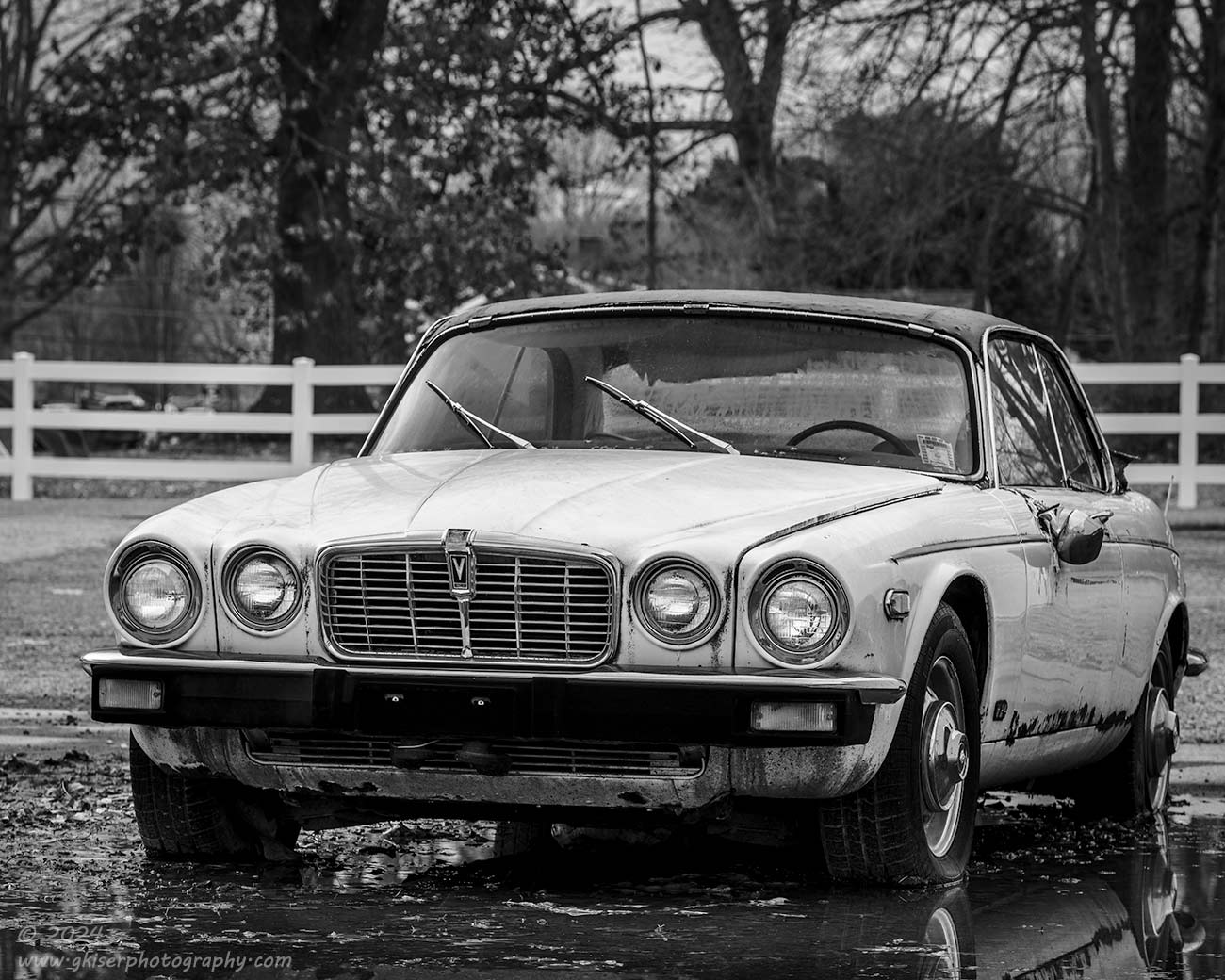
You can see from this photograph that the telephoto lens did exactly what I needed it to do. The background is blurred and there really isn’t that much of it. The car fills the frame, and the perspective gives it a sense of power and prestige which I was after. The puddle still comes into play with a bit of reflection added into the shot along with some texture that would otherwise be missing from a parking lot shot. This was that initial composition just to break the ice with the subject and start my journey towards getting to know it. I wasn’t convinced that I was going to have tons of luck here, but I felt more confident that I could pull some really good photos from this location since old cars is something I have a lot of experience with.
As it turns out, this establishing composition was the first keeper from this session. It was the only exposure I made with the camera horizontal. I followed that up with several done vertically because it showed off less of the background and more of the tall trees. I really felt that I was onto something with this composition and committed to it. I paid attention to the traffic on the road in the background and worked the exposure out exactly right. I knew that I had something that I would love from this composition.
Well, that didn’t work out quite the way I had hoped. After the culling, the vertical compositions were discarded for one simple reason. They didn’t work as a vertical at all. I found myself looking at the trees more than the car, and after I did a subtle crop to reduce the height of the frame the trees no longer made sense. What looked good in the camera, just didn’t work at all in reality. This happens from time to time because the size of an image dictates a lot of what is seen within the frame. It was a good composition in the native 3:2 aspect ratio, but like I said, at a larger size, it was the trees that dominated the frame. I hate having a 3:2 ratio vertical photo because it looks awkward to me. I much prefer cropping it shorter as a 5:7 or 4:5 ratio that seems to have a better flow to it. When I did either of these crops, the image fell apart with the trees not making a bit of sense at all, or I lost the reflection below the car.
What surprised me was that the original horizontal image survived the first rounds of culling as a strong composition. I didn’t have much of the reflection, but the car stood out in the frame which was what I wanted. I had originally envisioned this scene as a color scene because I liked how the leaves matched colors with the marker lights and helped give a bit more visual interest. I knew that I could cool the color temperature of the scene down and render the car with a cooler tone that what was actually there which would balance out the warm tones of the leaves. However, with this photo, there was a blue slide visible in the background along with some colors around the house. Even though the background was blurred at f/9, the colors were still a distraction. This forced my hand in making this one a black and white photo.
The conversion was pretty straightforward and looked really good. There was a bit of visual drama removed with the absence of color, but the attention fell squarely on the car. In an attempt to further solidify that, I changed the aspect ratio to a 4:5 horizontal which allowed me to cut off the house in the back left which added nothing to the scene. The blue slide was still there, but really couldn’t be seen thanks to the blur and loss of color. One thing that I really liked about the black and white version was that the grill and the fence behind it seemed to mirror each other. This linked the background to the foreground and formed a cohesive bond. I think that the switch to black and white made that connection a bit easier in a lot of ways.
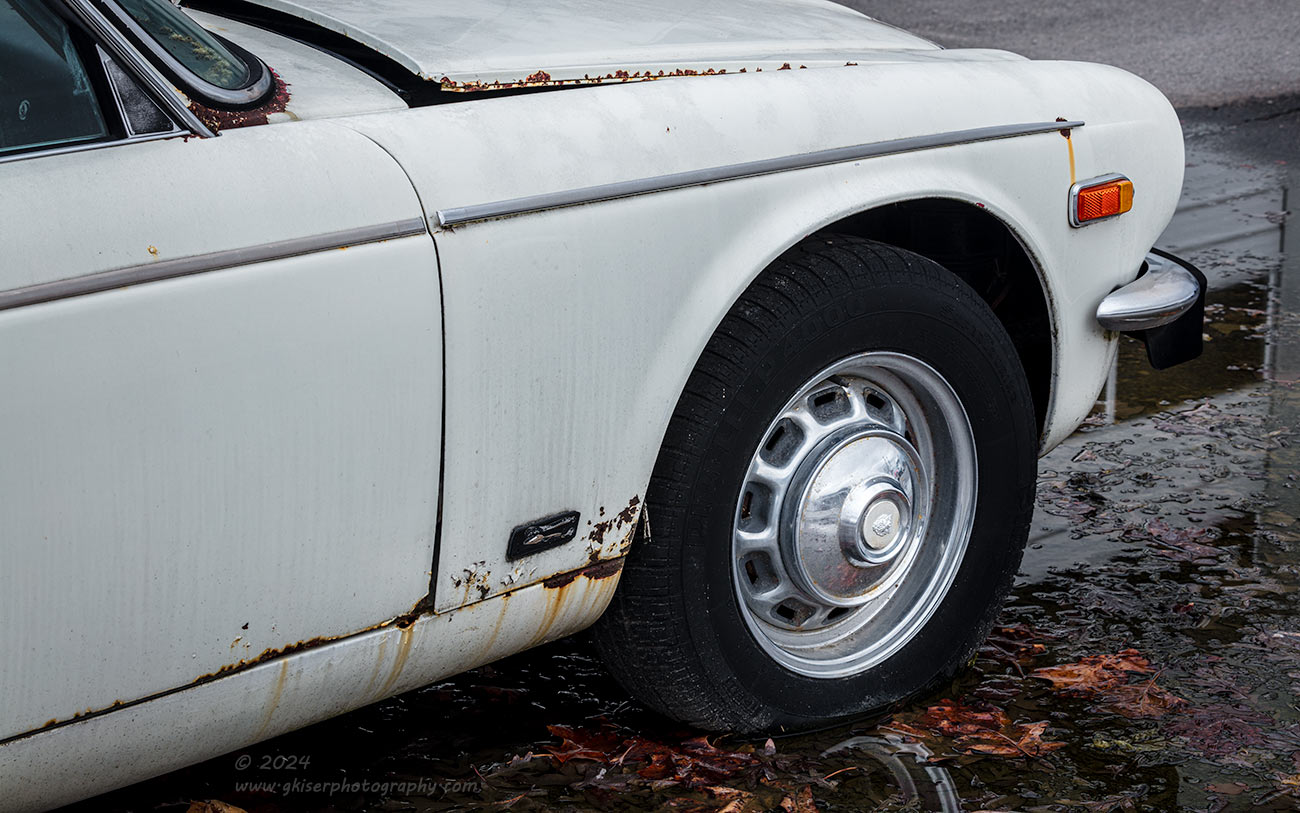
It was a kind of slow process to get started on this car because there were so many obstacles in the way of making compositions. I knew that I wanted to get a photo of the flat tire in the puddle with the leaves framing the bottom of the tire. I also found it interesting that the fender badge had been partially removed, leaving only the backing to help direct the eyes to the rust that appeared along the body line. I tried a composition from the front as well as from the rear of the tire. Things felt much better shooting forward which allowed me to get a bit of reflection of the bay door which wasn’t too far away from the car. It was a subtle element, but one that I thought helped tell the story of this car.
The story that I was trying to establish was that the car wasn’t in terrible shape, and obviously had not been left to just decay. The bay door showed that there might be a restoration in its future, or at least some love and attention. The audience doesn’t need to know that the bay door is to the shop of a truck sales business. The composition worked well, and it had a nice flow to it. Once again, I was only getting a portion of the reflection in the puddle because I found that opening up the frame to include more of the reflection caused me to have to add too much background information which turned into a distraction for the image. For now, I was going to have to settle with having a bit of the reflection included until I could figure out exactly how to get it all included while still keeping things balanced and simple.
I think at this point, I started to become aware that the employees of the neighboring store were coming out dealing with stock and trash. I waved at the first guy that I saw and decided very quickly not to engage in conversation about what I was doing. I just went on about my business like I was supposed to be there. I had seen nothing along the lines of “no trespassing” signs, and there wasn’t anything to give me the idea that I wasn’t allowed to be here. As time went on, there were three employees that cycled around behind their business. I don’t know if they were keeping an eye on me, or just doing their normal things but none of them bothered me while I was working around the car. As always, I made sure to keep my distance and make it very obvious what I was up to. That really seems to work in these situations.
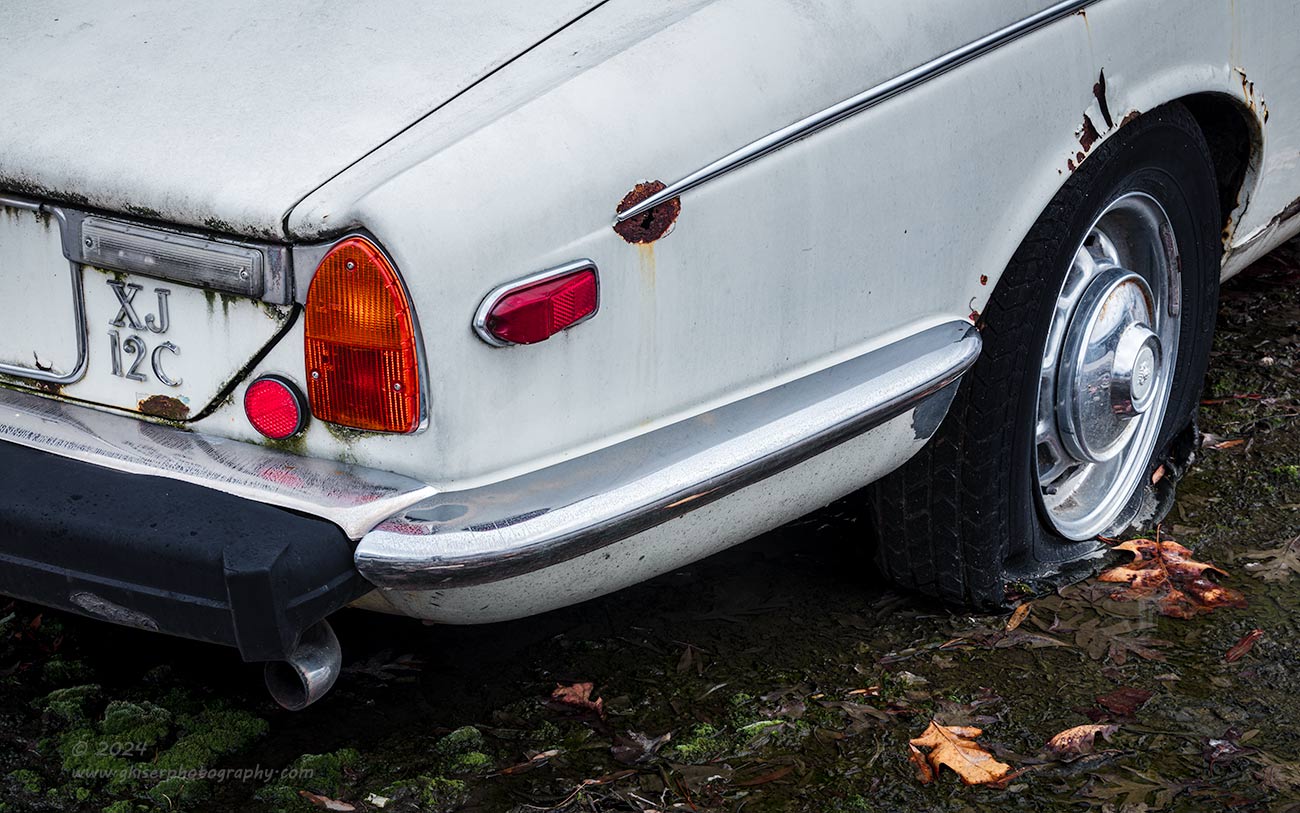
The best flat tire was at the rear of the car on the passenger’s side, but there is always less interest on this end of the car from what I’ve found. That might not be completely accurate, but it is harder to make a compelling composition because the rear quarter panels are usually much larger than the fenders and have less character to them. In this situation, I found that the algae that was in the water made for some very interesting textures, and on this particular corner, there was a tail pipe which lined up with a break in the moss below. This side of the rear finish panel held the taillights, along with the emblem depicting the model of the car. There was enough going on here to justify a composition with the submerged rear tire.
I still had the long lens attached, so I backed away from the car to give myself room to include everything. I actually wanted this lens for this shot because it allowed me to get a flatter perspective that I thought would be more flattering as well as keeping me out of the chrome. That latter part is always a concern when I’m shooting chrome that is in good shape like this. By getting further away, I shrink into nothingness in the reflections.
Finding the right degree of power on the polarizer was my next task. In order to get the reflection to show up in the puddle, I would need very little of the effect dialed in. However, that left a lot of glare on the surface of the water which kept us from being able to see the organic matter that was growing under the surface. In this situation, I decided that the reflection wasn’t nearly as important as what lay below the surface. From this angle, the car just looked old with a very small amount of rust visible. I didn’t want it to look like an old car was just parked in a puddle. For the story to really make sense, I thought that we needed to see that this puddle stays filled, and the car hasn’t moved in a long time. Those little details were paramount for the photo to really make sense, and that is how I chose to capture it.
When I began the edit, I started to realize that there was too much of the algae filled puddle and it was pulling the attention away from the car. I guess you could file this into the category of too much of a good thing is a bad thing. I liked the photo and wanted to keep it which meant that I needed to adjust the visual balance. The shape of the car helped me decide what to do here. Since it was long and narrow, I felt that a similar crop would help to draw the attention back to the car. I applied a 16:10 aspect ratio which allowed me to crop out a portion of the lower edge. This reduced the visual weight of the puddle while emphasizing the athletic shape of the rear of the car. The resulting composition was perfect and everything worked together.
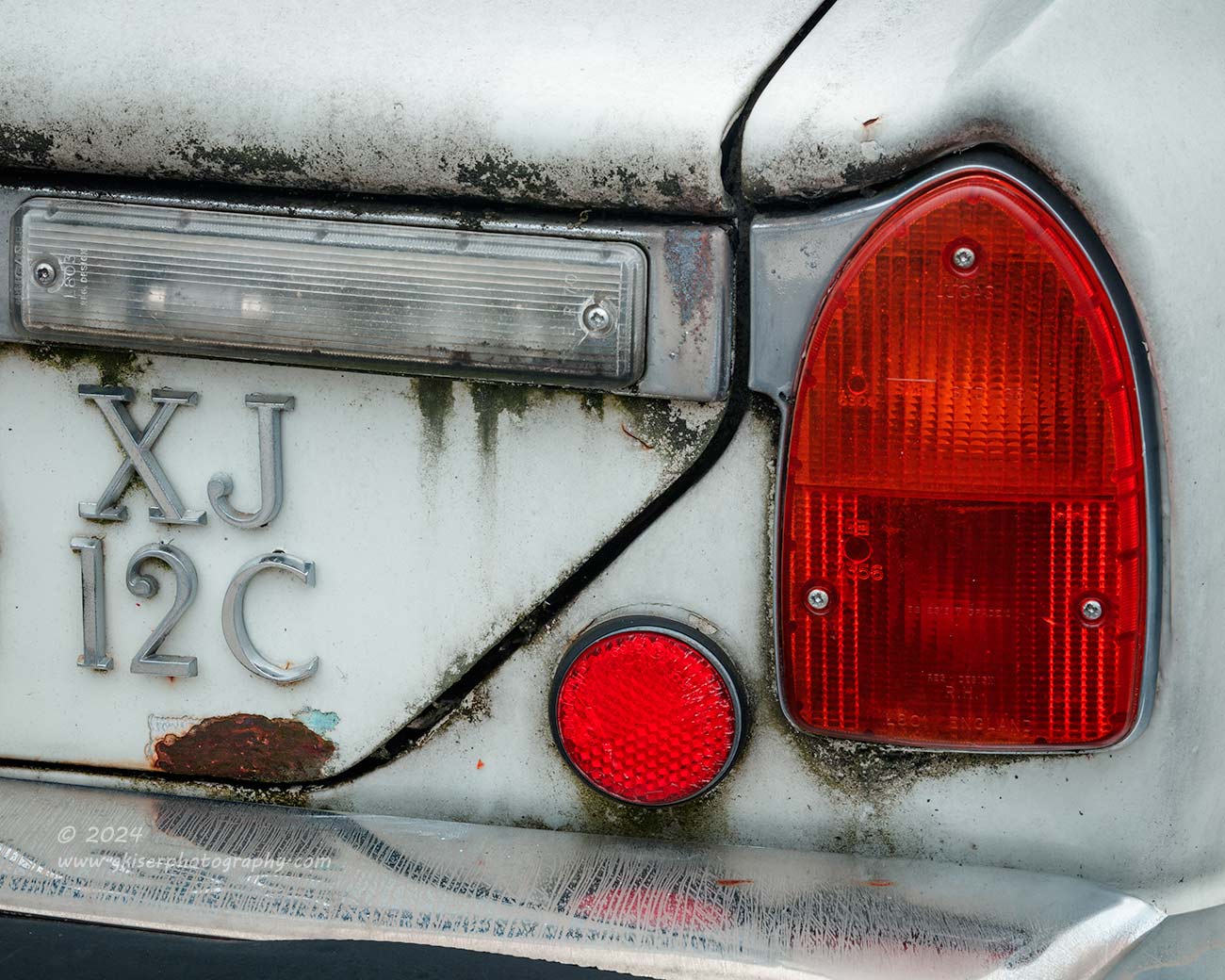
Of course, while I was at the rear of the car looking at the emblems that identified what I was photographing, I used the opportunity to capture an intimate view of that description. I really liked the way that the taillight was separate from the reflector which followed along the diagonal line from the trunk. The reverse light over the lettering had a similar appearance in relation to that diagonal. It became a simple decision of where to frame this composition on the sides because there was just a wonderful balance that was visible on either side of the diagonal line.
The top of the frame wasn’t that difficult to figure out as I just let it fall where it did while keeping the points of interest in the top third. the bottom of the frame gave me the most issue. With the chrome bumper very close to the elements that I wanted to include, I had to include it. The question was how much to include and what about the rubber bumper on the outside of it? Well, I decided to keep a diagonal element to the lower edge of the frame as well with the addition of the rubber portion in the lower left to ground the image. It faded off to the lower right while a brighter portion of the chrome formed a visual block to the eyes leaving the scene. It was this bit of chrome that dictated where the polarizer was positioned. I twisted it until there was just enough luminance on the chrome to do what I needed it to do without going overboard or fading into nothing. I don’t think that polarizers get enough credit in photography. They are so useful for so many different aspects.
When I shot this one, I really thought that it was going to be done in black and white because it was primarily about shapes more than anything else. When I started editing it, I felt that the image turned flat without the warm tones of the lenses on the right. That color provided just the right amount of visual tension and made sure that the eyes stayed in the frame on that side of the image. The red of the lights also helped draw attention to the reverse light which was linked by the chrome. This part of the journey brought you to the lettering and the patina of the paint. In short, the color became very instrumental to the photograph so I chose to leave it in place.
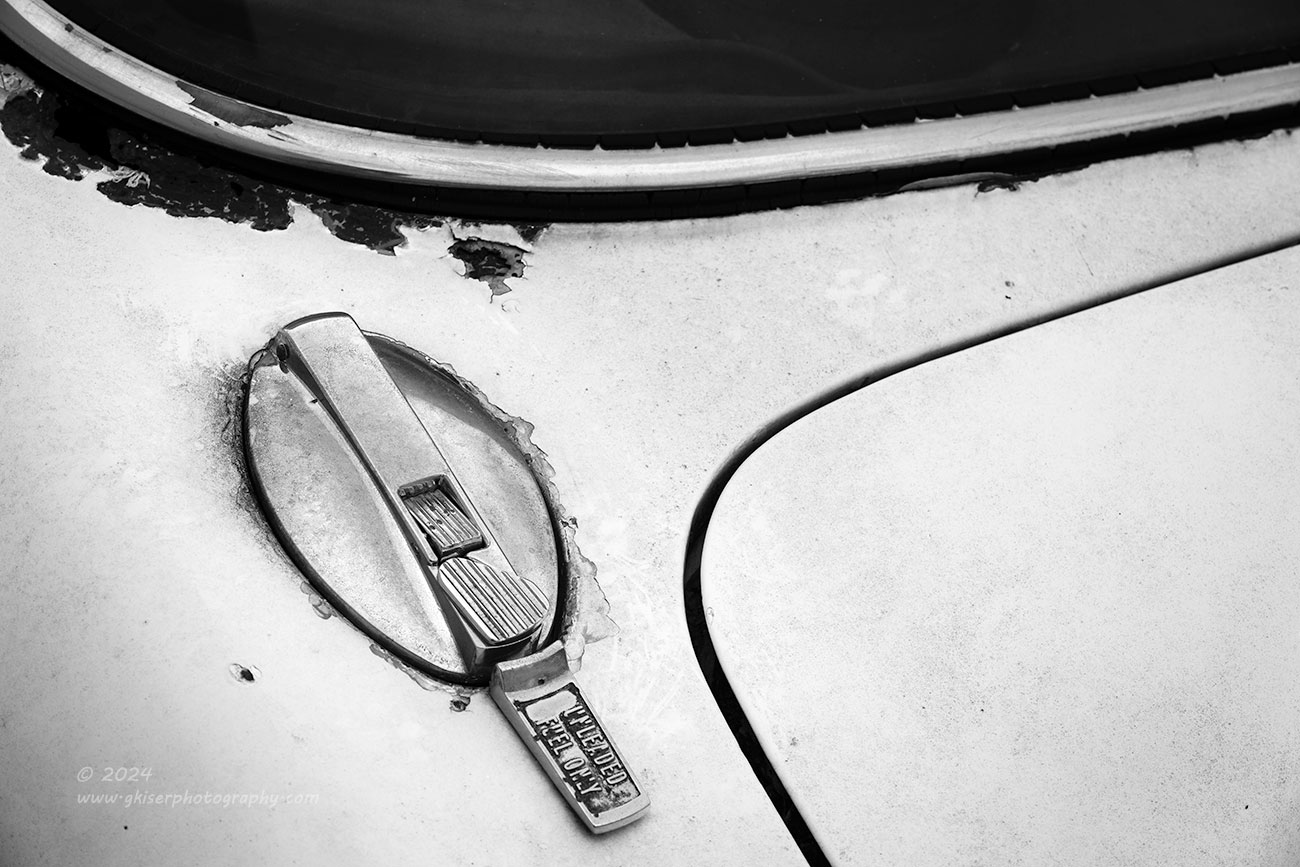
The next area of the car I started to pay attention to was the fuel filler. I started to look at the one on the passenger side, but it was caked with a black substance, and you couldn’t really make out what it was supposed to be. The one on the driver’s side was much cleaner, but also had a lot less decay around it. I opted for the cleaner appearance of the driver’s side and chose to do a very abstract composition that focused on the panel lines with the oval shape of the filler as a visual anchor.
In order to keep things at a reasonable perspective, I kept the long lens on and shot it at 85mm. It was all that I could do to get the camera up high enough for the focus to work since I was at my minimum focusing distance. To seal that point, I couldn’t get it to focus on the tab that said, “Unleaded Fuel Only,” but I could get it to focus on the button less than an inch away. My depth of field carried the focus to the nearer plane which made it all work out just fine.
There were two different compositions shot here. This was the first, the second was at a more extreme angle which I liked better in camera at the time. When I got it home, the balance was all off and the first shot was much more effective. The simpleness of the composition helped to keep the eyes right where I wanted them to be. The second composition put too much emphasis on the rear window area which became a distraction to me. Since there was no reason to have color in this photo, I went with black and white from the beginning. It was just all about shapes and lines.
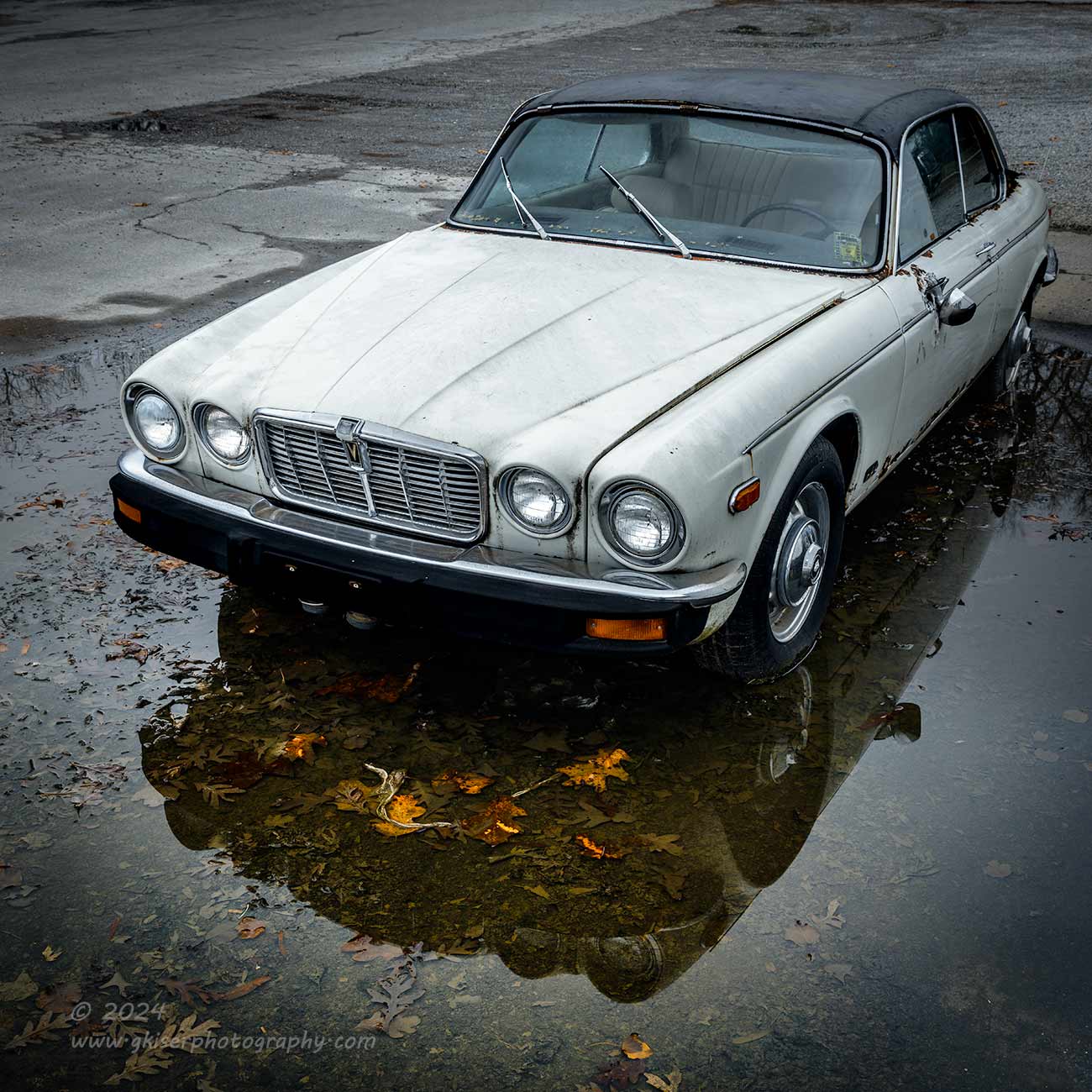
At this point, I was starting to run out of isolations that I wanted to capture. I knew from the beginning that the way to get the reflection was going to be with the wider lens. It was time to make that switch so I returned to the truck and got the standard zoom out of the bag and put that on the camera. I then went right back to the first composition that I had looked at. It was much easier with the wider focal length, but it forced me to get in closer to the car. I had to be very careful about my reflection in the chrome at this point. Much to my surprise, I couldn’t find Waldo anywhere in the chrome. I was standing there looking through the camera waving like an idiot because I could see motion before I could see a small reflection of myself. There was no movement at all, and I was liking the composition that I was seeing.
Once I got the composition dialed in, I adjusted the polarizer to show both the reflection as well as what was beneath the surface. The additional benefit was that the water seemed to start going dark around the edges which gave the photo a natural vignette which I loved. Now that I had it all figured out, I set the exposure and made the shot. One of the keys here was that I had selected a square 1:1 aspect ratio in the camera which simplified the whole image when shot from high like this. The first composition was pretty much just the front of the car, with the next two opening up to show the entire car. Thanks to that natural vignette from the polarizer, the whole car looked great in the square frame. The pavement in the background had some interesting textures and shapes thanks to the part that was gravel. It just added some dynamism to the scene that the closer crop was missing.
When I started doing the edit on this one, I really wanted to make it in black and white because there really wasn’t much in the way of color going on. The car and the pavement were pretty much devoid of color, but it was the small group of leaves that were in the puddle right below the bumper that forced me to reconsider. Now, I absolutely hate selective color photos and think that is a fad that happily fell from favor years ago. However, I have no problem with an image where there is really only a splash of color to draw the eyes. That was what I was looking at with this photo. The orange leaves gave me a great visual anchor within the reflection, and they matched the turn signals in the bumper which linked the two portions of the photo. By cooling the white balance on the rest of the photo, I was able to get a very good color balance within the scene. The more I worked the photo, the more I liked it. In the end, it became one of my favorites from this part of the trek. I still like the simplicity of the fuel filler abstract, but this one has lots of little, small details that I just really love to look at.
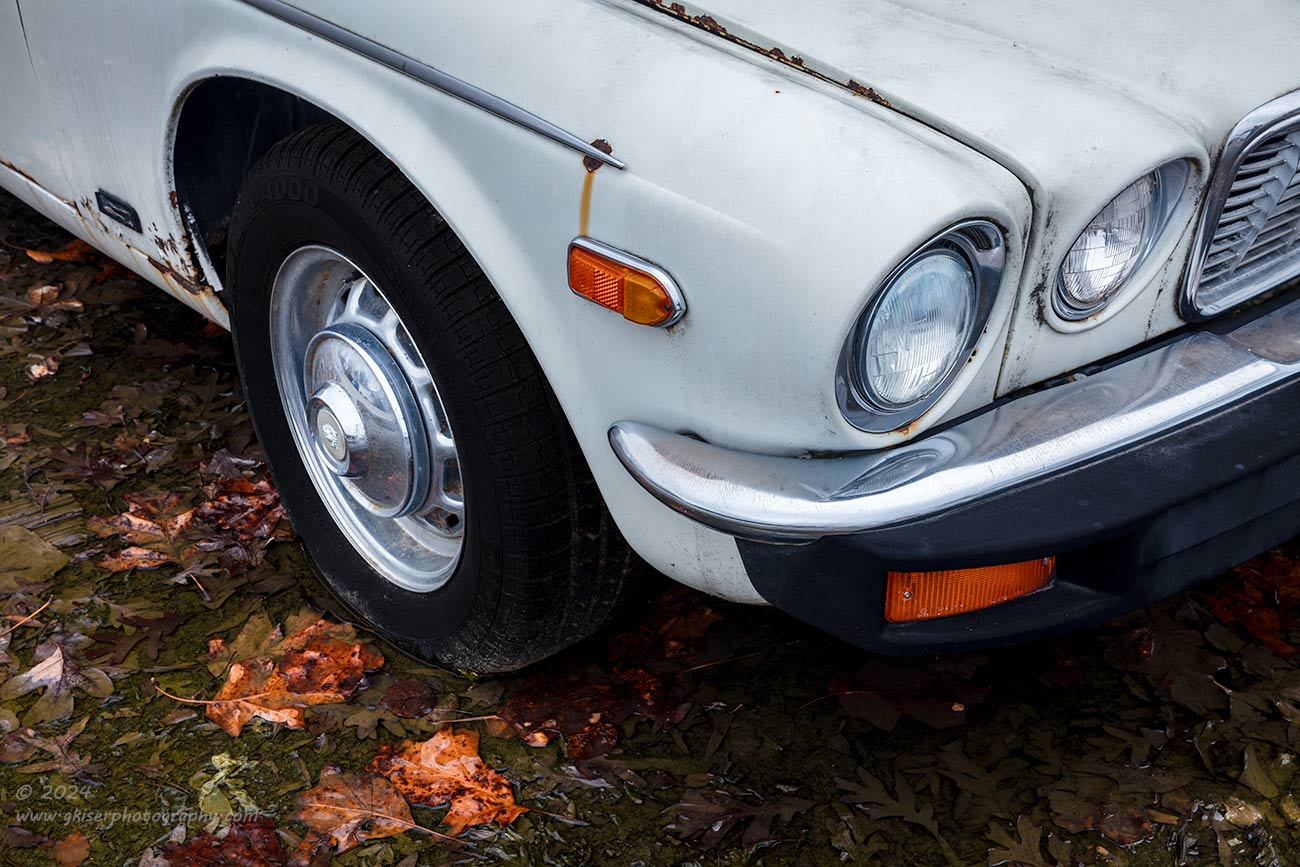
Now that I had a different lens on, I wanted to go back to that front passenger side corner and try another composition there. You will remember that I tried from both sides of the wheel and ended up liking the angle from the rear the best with the long lens. Now that I had a little wider focal length, I wanted to try the front corner again. I got things set up and began moving the camera around slightly in order to get the shot lined up like I wanted it. I went through the inner discussion of the polarizer position again and decided to have it lean towards cutting most of the glare in the water. As I got that figured out, I started to feel rain drops on my head. They were big ones which meant that I was about to get wet. I dialed in a quick exposure and started to wave wildly to see where I was reflecting. I found myself in the bumper and began to look at where could run to get out of the way when I fired off the shot. If I went to the left, I would show up in the hubcap, but if I went to the right, I would disappear from view.
The rain was starting to fall heavily now. This was a problem because I couldn’t stay and shield the filter from drops since I had to be out of the picture. I made a quick check of the filter to confirm that it was still dry and got ready to press the shutter. I needed to have a delay dialed in, but there wasn’t time to do that with the rain falling heavier. I just moved a few feet to the right and used the remote shutter release which was already plugged in to make the exposure.
Once the camera clicked, I made a quick look in the image review to make sure that there was no ghosting on the filter from the light overhead since I wasn’t there to shield the light. It looked good to me, and the exposure was right. With the rain falling heavy now, I grabbed the camera and went back to the cover of the liftgate on the back of the 4Runner. I broke the camera down and noticed only one drop of rain on the filter which had come from me walking back to the truck. I didn’t like being forced away by the rain, especially after only getting one exposure of a shot that took so long to line up. However, I felt like I had several good photos from this car, and I wasn’t looking for a lot of pictures today. For the most part, I was finished with the compositions that I had wanted to do and felt that I had finally had a good day behind the camera.
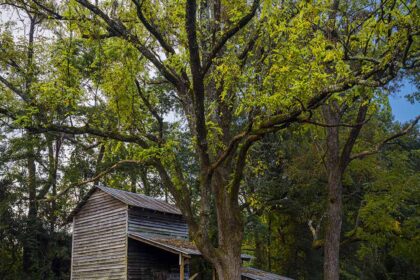
It was time to head back home by way of the store. The rain was really steady at this point but didn’t last long. Before I got out of Booneville, it stopped. As I passed a junk yard, I found the building to be rather interesting under the dramatic sky. I decided to turn around and go check it out a bit further. There was a church on the left side of the road where I pulled in to get turned around. This was where the surprise hit. I’ve been down this road more times than I can count, but I don’t recall ever seeing this little log cabin sitting off on the side of the church property. It looked really good under the sky, and I decided that I was going to stop and try for a photo or two of it before going back to the junk yard.
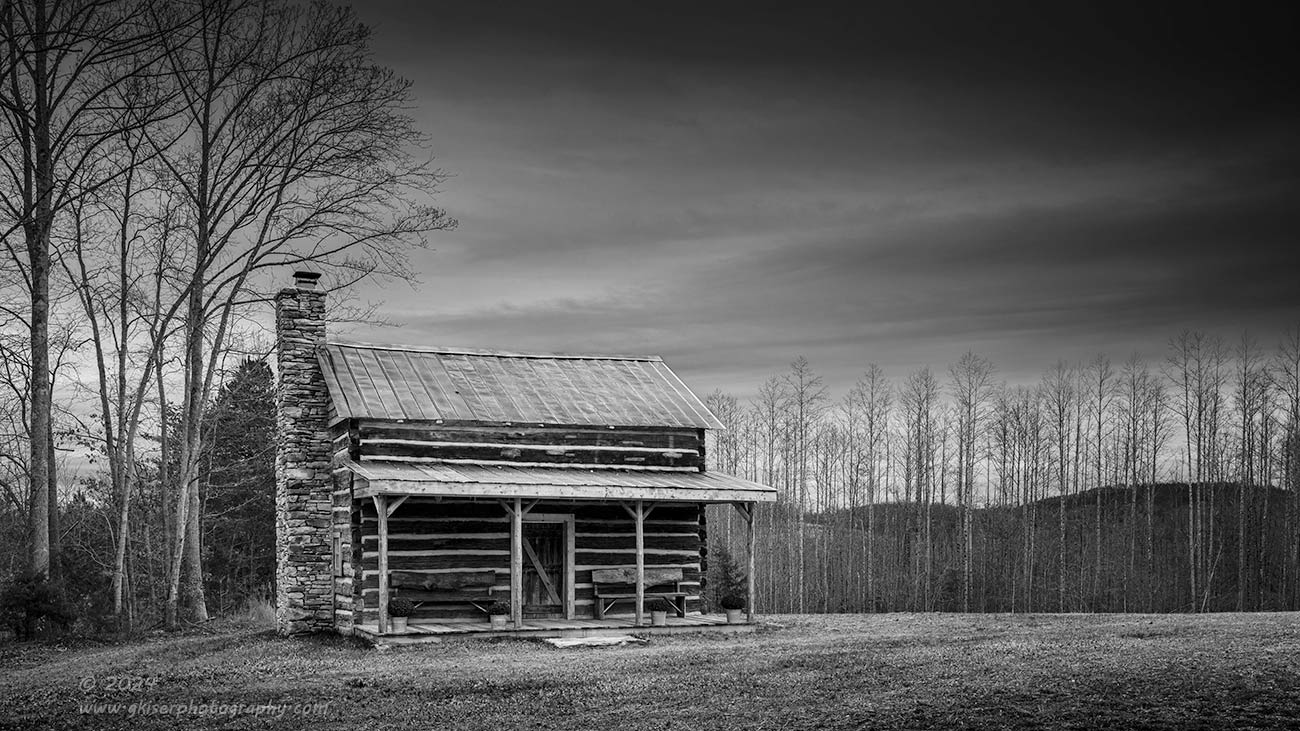
Knowing that this wasn’t going to take long, I left the truck running and grabbed the camera with the standard zoom attached. From experience, I knew that this was going to be the right lens for a scene like this. I found the right angle to work from that lined up one of the porch posts with the frame of the front door so as not to block that access point. It also served to simplify the front of the cabin visually. This gave me a nice 3/4 view of the cabin.
The hardest part of the composition was that there were some tall trees to the left which under normal circumstances would have been welcomed. In this case, with the angle on the cabin, they force me to really think about the visual balance. There was nothing to the right that I could include which would give me enough height to balance the scene, and if I put the cabin on that side, the porch pushed the eyes out of the frame more than I wanted it to. I had to play with the visual weight of the trees on the left and reduced them to just a few trees while keeping the cabin on the lower left third. I had to stretch out the right side of the frame a good bit to get a lot of the trees in the midground to balance that visual weight. It seemed to work, but I spent the next few minutes trying other compositions just in case that one didn’t work.
As it turns out, it was that first composition that landed the spot of the keeper. I chose to go with black and white here because the sky filled so much of the frame that I really felt like I needed to work it into the overall composition a bit better. By losing the color, I could do that a bit easier and let it add to the mood and atmosphere. The conversion went a little slower than I would have expected as I spent a lot of time in the color channels tweaking the tones and contrasts. Despite it being a slow process, I am really liking how it turned out in the final form. There is a foreboding overtone to the image even though the cabin is very cute and simple. The season helps set the tone with the bare trees allowing everything to tell a similar story.
Oddly enough while talking about this photograph, I started to wonder what it would look like in color. The cabin was this wonderful warm tone which established a cozy feel that the black and white didn’t allow to shine through. I knew that color wasn’t the answer with this initial composition though because the warm tones just got lost in the overall scene. However, I knew that there was a more direct composition which I had captured towards the end of my time there which would work as a color image.
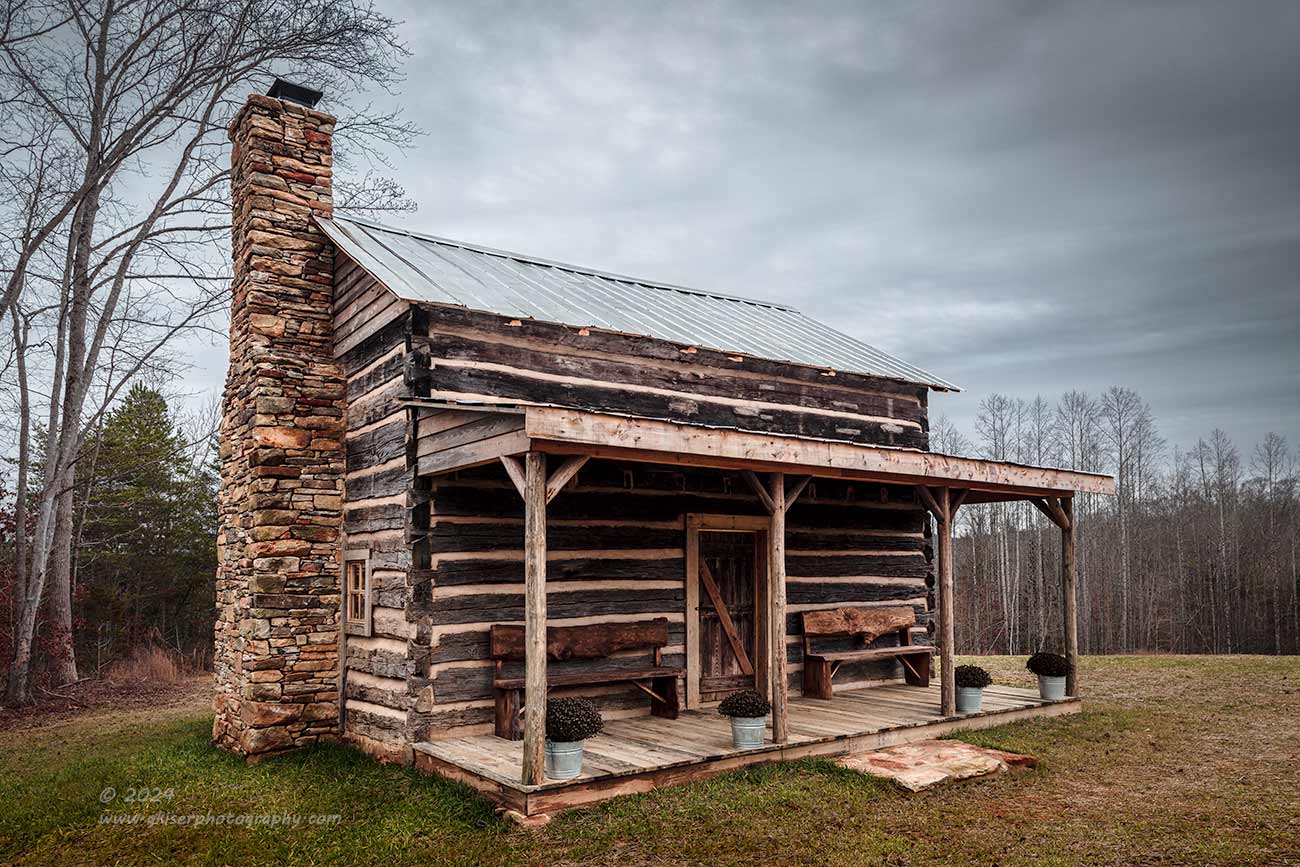
I went back into Lightroom and pulled that photo up. It was one that was shot from a lot closer to fill the frame with the cabin. It was a bit of a postcard shot with the subject being in the middle, but this was the best way to balance it out. Remember the issue I was having with the tall trees to the left? Well, this was one way that I dealt with that. I just pushed the cabin further to the right of the frame. The porch has a sense of movement as the entry is here and you can imagine activity moving to the right of the scene. This added some visual weight to the scene and helped to balance out the tall trees. The background trees still helped, but not as much with a smaller sampling of them. The sky above was also reduced in size in the frame which allowed the cabin to set the mood a bit better.
I started the process by finding a color profile that I liked. When I landed on that, I went down to the Transform tab to adjust the converging verticals as I had planned on doing. With as close as the cabin was, it felt odd to have perfectly plum verticals, so I relaxed the correction a bit and left about a quarter of the perspective distortion in place. This felt right to my eyes and made for a more pleasing composition. With those two things done, the photo was looking really promising and I continued on with the edit. After about 10 minutes, I had a final image done and saved. It made for the twentieth keeper of the day, out of a total of 73 frames.
What had started out as a trek that I almost didn’t take, turned into a question of success, and just to make sure that I had something worthwhile captured, I added to the day. The result was an astounding success with some images that I am really quite proud of. I really do need to get a handle on this need to keep digging to find more photos on these sessions. While on one hand, I really like the variety that it affords me in the photos, these treks are really starting to take a very long time to work through. It is also causing storage problems as I am filling up hard drives with high resolution master files at a very quick rate. I suppose that eventually things will calm down and I’ll have that dry spell that always seems to happen. It has been a while now since I’ve gone through one of those and I just can’t complain about that at all.
I hope that you have enjoyed this trek and the photos that I have brought back from the day. If you connect with any of these on that certain level where you would like to see the photo every day, I do offer prints which look amazing hung up on the wall. It is truly the best way to enjoy my photography, or any photography for that matter. It removes the variable of screen calibration, brightness, and so on. It is also the only way that I can share a full resolution image because the ones that I have here on the website are scaled down to fit a manageable size physically, and they are also compressed for ease of loading. Most of what you see here are images that are 19-35% of the native file size of the resized jpeg image. There is a ton of lost quality to get these images online, but when it comes to printing, every bit of the resolving power of my 5DS R can be seen and enjoyed.
If you are not in a position to buy a print, or just don’t have the room to display it, consider buying me a virtual coffee by clicking the donate button below. This is a way to show your support without having the large expenditure of a print purchase. Little things like this help to finance these treks so that you can continue seeing the new photos as they are added to the collection. Speaking of which, if you don’t want to wait to see the photos when I post them to social media, the best way to catch the new ones is to subscribe to the blog here. It costs nothing and puts you on a mailing list so that you will get notifications when a new blog is posted along with the new photos. Otherwise, if you are waiting for the social media postings of the photos, you will be waiting for a while. As I mentioned, I am 180 some photos behind for posting. They are old news by the time they hit the feed.
Be sure to join me on Tuesday for my newest installment of Tuesday’s Tips where I will post a quick video with a tip that I want to share with you. The next Behind the Camera is set to be published on Thursday morning and I hope to see you for that as well. We will be talking about getting started in photography and the steps that you can do with just your cell phone to begin the journey. I hope that it inspires many of you to pick up a camera and start capturing the scenes around you that make you happy.
Until then….