Saturday, January 11, 2025
I kind of spoiled myself with the first couple of treks of the year. I was really enjoying coming back with one or two photographs to process and talk about as it really took no time at all. If you happened to miss those, you can read about my first trek of the year and see the two photos that resulted here. The one that followed was a single black and white photo from a scene I found while exploring close to home that included an old Buick in a shelter. Those accounted for the first three images of 2025, and neither trek took that long to see through to completion. Now, things have changed for the second half of the month as I have been working on this trek for nearly a week at this point. I’m going to have to go through it in stages because there are just so many photos that came from it. To give you an idea, the final tally on the camera showed to be 297 frames shot over the course of three days. I ended up with 27 keepers which is pretty darn amazing considering some of the weather that I had to work with.
Let’s backtrack for a moment and talk about the how and why of this trek before I get too much further into it. I think I might need to clear something up about this one before I get started. It was actually an anniversary trip for Toni and me as we celebrated 14 wonderful years together. Normally, we would go to the mountains and stay in a cabin for our anniversaries, but ever since we moved to the foothills and have this wonderful house tucked away in the woods, there is less of a need to “get away” to the mountains. We have instead been going other places for our anniversaries and for just getting away since moving out here.
You might remember last year when I took a March trip to the Outer Banks all alone. It was a very fruitful trek and I came back with a bunch of new photos for my portfolio. However, I missed having Toni with me, and she told me that she wanted to go with me the next time I went out to the coast. With our anniversary coming up, we decided that a beach trip could be quite fun. Neither of us enjoys the heat of the coast, nor the swarms of people that can be found through the summer months. That makes a winter visit right up our alley, and something that we have done more than a few times over the years.
The agreement was that I was going to have plenty of time for photography as I was counting this as a business trip, but that we would spend quality time together during the day and in the evenings. We would both have time to do things that we enjoyed, and we would have dedicated time for each other. As it turned out, she had some time off from work which happened to fall around our anniversary. We scheduled the trip for the 10th through the 14th, so that we could be back in time for an appointment she had on Tuesday afternoon. The location was Carolina Beach on the Southern portion of the coast. We have visited here many times over the years, but not so much recently. It was one of the closer beaches to us, and one that I knew pretty well which made it a logical choice for a destination.
Things were all locked in, and we were looking forward to the trip. I was hoping that the weather would provide some good conditions that I could work in, though I really had no preconceived ideas of the photos that I wanted to capture. My plan was to be totally reactive to what the weather brought and just let my gut drive the compositions as well as the subjects that I put in front of the camera. This is not always the best way to go about photography, but when you are scheduling a trip outside the range of an accurate weather forecast, you are kind of throwing things up in the air and planning becomes as exercise in frustration.
Speaking of the weather, as we got closer, I was paying a lot of attention to the weather, but not for the coast. It was looking like most of NC was going to be hit by a significant snow event with anything from one to six inches of snow falling on Friday morning. This was the day that we were leaving for the beach, so I had to be prepared for a rough trip and tried to plan accordingly around potential road problems. There was also a part of me that wished that we were staying here as I don’t have many snow photos at all. Had this just been a photography trip, I would have cancelled in the hopes of getting some good snow photos, but with this being an anniversary, the photography was a secondary concern in the grand scheme of things.
By the time Thursday rolled around, the brine was being sprayed on all the roads, and it was looking like we were going to get a good bit of snow starting around noon on Friday. With check-in at 4pm, we would be leaving around that time. The snow was looking like it was going to be a part of our travels until we got almost to the coast based on the forecast maps. Shortly after we got on the brine covered roads, the flurries started to fall. The road remained dry which was a good thing. After owning a 1972 Datsun 240Z for a year, I am paranoid about rust, and I didn’t want to have brine slung up into the nooks and crannies of the truck if it was avoidable considering I wouldn’t actually be driving in the snow more than likely.
I actually thought that we had made it without having to worry about the road salt, but that hope was dashed when we hit Lumberton. The snow started to change over to sleet and freezing rain which got the roads quite wet. That brine was now kicking up all over the truck and I could hear it rusting away as we drove. There was brine and potentially road salt on the roads all the way into Carolina Beach which really surprised me, but here we were. The truck was now wearing white sides to replace what had been some mud from my previous explorations and knew that it would be a while before I could get it washed. I was also in a salt rich environment staying at a hotel that was oceanfront as well as just being in the beach air. One of the first orders of business was going to be getting the truck cleaned up when we got back home to keep the corrosive salt from causing any issues.
Our first night had nothing to do with photography as it was turning dark shortly after our arrival. We looked for a place to go eat, which for those that visit the beach in the off season, you know that isn’t always easy to do. After hearing from several folks at the hotel and a friend of Toni’s that Havana was a great place for dinner, we headed out and got gas before stopping at the restaurant. We didn’t suspect anything out of the way until we got out of the truck and went to the gate. There was a small sign that said that they were closed for renovations. Well, that was no good. Fortunately, there was another place about a ten-minute walk up the road that we figured we would try.
It was cold and little rainy, but I didn’t want to crank the truck up for a half mile trip, so we walked up the road to Bowman’s. We saw movement inside and we were ready to get inside with some heat. However, the movement was just the employees closing up shop and the door was already locked. At this point we were starving, cold, and wet. We didn’t really care where we ate at this point, so we looked for the first place that looked to be open. That turned out to be Puffy’s which was an Asian fusion restaurant. We didn’t know what to expect but went inside and made sure they were open. They were, and we ended up having a fantastic dinner and a dessert that gave us both diabetes more than likely….but it was so worth it!
After an incredible meal, we got our coats back on and walked past the hotel to get the truck. To give it a minute to warm up, I took Toni down to Ft Fisher where I was planning on doing some photography later on and wanted to see if anything had fundamentally changed there. It was dark and hard to really see anything, but I reminded myself where it was in relation to the hotel and started planning my return trip to the park. From here, it was back to the room for some rest and preparations for an early morning with the camera.
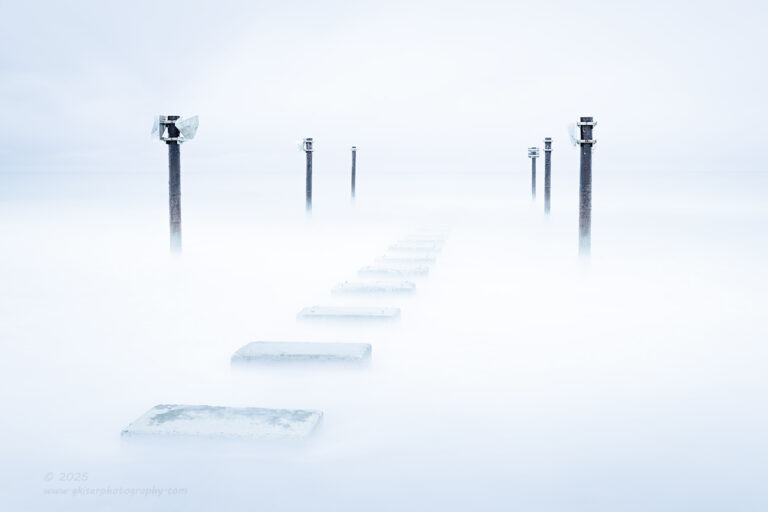
Looking at the weather, the forecast was calling for low clouds with a pretty uniform coverage. This translated to terrible conditions for a sunrise in terms of color. This wasn’t a problem though as I had ideas for things that I could do in the morning without having color in the sky. I wanted to do some minimalist photography, but for that I was needing some kind of feature going out into the water. I could use one of the piers that was on either side of us, but I wanted something smaller. I also knew that I had shot a number of piers over the many coastal trips and wanted something different. As I pulled out my trusty satellite view of the coast, I found a small feature just under two miles South of us in Kure Beach. It was kind of hard to tell what the feature was by looking top down. Toni had a great idea for using Google Earth to get a better view, and one where I could get a 3D view of the area. This view gave me the ability to see that there were elements that protruded out of the water enough to where I should be able to see them and use them in the photos. Just to confirm, I checked the tide charts and found that low tide was just a couple hours after sunrise in the morning. This meant that the water would be low enough to show anything that was in the water, and the longer I waited, the more I would see.
The hike was going to take me about 40 minutes or so, which wasn’t bad at all. I hated to crank up the truck for such a short distance, so walking made perfect sense for me. With sunrise around 7:15, I just needed to leave around 6am. That was almost a luxury considering during the summer months, I am getting up before 4am to get a sunrise at home. I was actually looking forward to the walk, but not the temperatures which were going to be in the upper 20’s when I was leaving. This meant gloves, coats, scarfs, toboggans, and all that stuff that makes it more difficult to work the camera than I am used to. I just hoped that what I found out there would be worth it all.
Ideally, I would have scouted this location beforehand, but there was no time, and with a limited number of days, I needed to pick the best option for the conditions. I had a feeling that this was going to be a great choice based on what I had seen on the maps. However, while I was starting to walk down the beach, I recalled a conversation with the front desk the previous night. They mentioned that the hotel had been there for eight years, but that Google Satellite still showed the construction phase. It was a funny little story, and one that I had already noticed earlier when planning the trip. The significance didn’t hit me until about 10 minutes into my hike. If the data that I had used to scout the morning’s location was eight years old, whatever I had seen might be gone. It had looked like the remnants of a pier, which would have been perfect for some decay photographs. However, in nearly a decade, I could see those remnants completely removed. All of a sudden, I had this sinking feeling that I was going to be met with a pretty boring scene under the clouds.
My plan B was going to have to be to continue the hike down to the Kure Beach Pier which was another mile beyond where I was planning on stopping. While I could make the walk, the timing would not be all that favorable as I would be roughly 20 minutes behind with the light. This thought haunted me as I walked quickly through the sand trying to make good time. It wasn’t easy keeping track of the time because my watch was under several layers of clothing, and my phone was under a coat and sweatshirt. The gloves would make it difficult to open up, so I didn’t bother trying to look at it.
After a while of walking, I estimated that I should be getting close to where I needed to start looking for the feature. I didn’t have my flashlight out, so I was going to need to be aware of the distance I had traveled so I would know when to start looking in the water. It was about this time that I came upon a shortened pier that didn’t go into the water at all. I didn’t recall seeing the base for the pier in the online images, but I pulled out the flashlight to look. There was nothing in the water that I could see, and my heart sank. I was sure that I was in the right place, and that the place no longer existed. Just to be sure, I wrestled to get my phone off my belt and opened up one of the fingers on my glove so I could get the phone opened. I pulled the map up and quickly realized that I wasn’t quite there yet. I had walked about a mile so far, so there was still about 3/4 of a mile left before I got there. There was a sense of relief after realizing that, and I was also pleased that I was making really good time considering I was slugging through the sand which takes a lot more effort than walking on a hard packed surface.
After another 15 minutes, I spotted the large hotel that I was using as a point of reference to start looking towards the water. I pulled out the flashlight and began sweeping the ocean in search of what I was hoping was going to be several posts standing up with some beams of some sort in the middle. It didn’t take long, and my light caught one of the posts on the beach. A quick sweep out in the water showed three other pairs of posts right where I expected them to be. There was nothing visible in the middle just yet, but I knew the tide was getting lower. It was still very dark which gave me time to scope out the scene and find some compositions.
It was pretty much what I had hoped as far as a subject for minimalistic photos. The sky was overcast and there were no breaks at the horizon indicating that there would be no color this morning. I tried to make out the signage on the posts, but most of the signs were ripped off, bent, or unreadable, especially under the bright light of my flashlight. However, the more I looked, the more started to be visible with the lowering tide. What I had thought were planks were actually cement blocks evenly spaced. Had I not seen something similar last year at the Outer Banks, I would have been at a loss as to what I was looking at. I had to laugh at myself because once again, I was looking at a drain system going out to the ocean as a photographic subject. Fortunately, I had ended up with some great photos from the last one and even went back that evening to try it again. I felt like I understood more about how to photograph these now, and this one had the addition of the tall uprights which made for even more options.
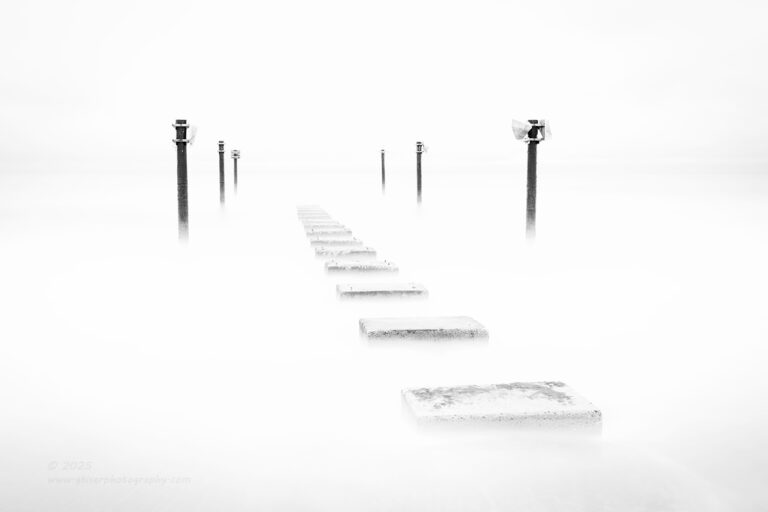
With the light still low, I fitted the telephoto lens and picked out a composition that featured four of the posts, with two of them overlapping to make three objects in the frame. There was no need for any filters because the light levels were still quite low allowing for a nice long exposure naturally. I ended up shooting two frames like this and realized that the water was dropping below the cement bits too much which was complicating the composition. It was opening up another compositional possibility though which I decided to jump on. I had to switch the lens for my standard zoom though which would allow me to get the perspective that I needed.
After getting into position, I found that my shutter speed was getting too fast, so I reached into my bag and grabbed a 5-stop ND filter which would bring my exposures back into the area that I wanted them to be. The composition was working out great and I fired off several different shots with some slightly different effects. I wanted some with some detail and others where the detail was completely blurred out. My thought was to make this composition black and white with my preference being no detail except for the features above the water. That was how I shot most of them. When I got home, those won out and I ended up with two photos that I really liked out of the first handful that I had shot. Of course, I did one as a black and white because that was my first inclination when shooting these. However, I wanted to see what this would look like in color, so I picked the other photo to process as a color image. It was largely blue in tone so, the color wasn’t all that important, but it did set the mood. To harness that, without overpowering the photo, I used a desaturated color profile to give it just a hint of coolness to establish the atmosphere that I was after. I think that it turned out as good as the black and white presentation. To go along with the moods that were set by the color choices, I also flipped the image to where the composition matched the mood of the color tones. these two shots were the same composition, shot from the same place, but the way the waves interacted with the features became the difference between the RAW files.

Having learned this lesson from the Outer Banks last year, I felt that I had enough of that one composition, and it was time to move around and try something different with the same subjects. Last year, I ended up with a bunch of photos that were roughly the same when I could have done wildly different compositions for variety. This time, I was going to do just that. I backed up and decided to include the first post in the composition which I had been shooting next to for the other compositions. This gave me a very prominent foreground and allowed me to pick out just one side of the other posts giving a group of three in the distance. I had to really play with the positioning here so I could avoid the concrete steps to the side. The main goal of these photos was all about minimalism, and I had to be careful how much extra I put in the frame.
What I really liked about this composition was the detail that I could see in that lead post. To bring as much out as possible, I popped on my polarizer in addition to the ND filter that was already mounted. This would remove the glare from the post and allow me to see the detail of the rust and barnacles. I was pretty sure that this was going to be another black and white presentation, so I purposely overexposed a bit to really get the detail in the post while obliterating the background. The long exposure made that really simple and for the most part, this photo was done in camera just this way.
Because the composition was kind of tight as I was trying to keep the steps out of the frame, I wasn’t 100% happy with it in the field which helped me look for a different composition to work on for more choices once I got the photos back home. One of the compositions that I had been thinking about during the minute long exposures that I was doing was a shot that included the Kure Beach Pier in the distance. The clouds were nice and soft, and the ocean was looking good with the 30-60 second exposures I was making which made me think that this would be another way that I could include the large post as a foreground element.
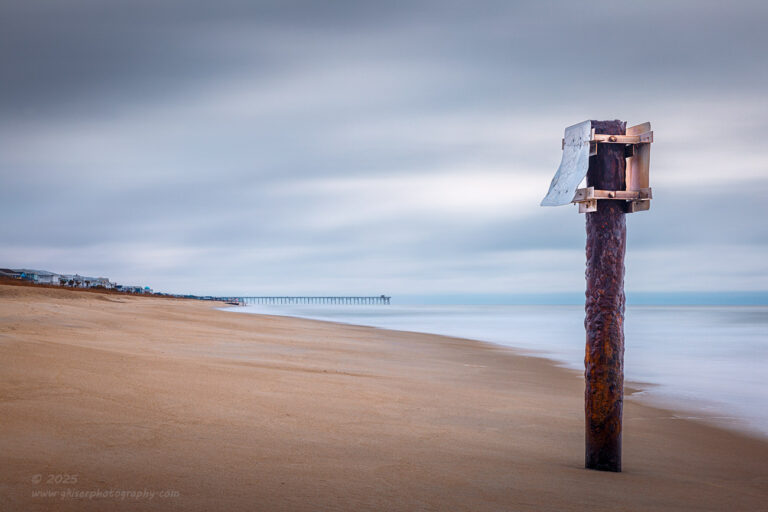
I moved over the side and found the right position for the best perspective on the scene. I dialed everything in and was happy with the composition. I fired off a single frame with this composition and decided that it wasn’t quite what I was hoping for. I was really afraid that the background was going to get lost, but I didn’t want to make it any bigger by switching to the telephoto lens because that would have pulled too much of the sky out. I was prepared to toss this image when I got home and didn’t bother working through any other alternatives. Much to my surprise, when I got home, I found this to be a very nice photo and one that came together quite well. I kind of wished that I had spent more time with it, but at least I got this one frame captured before I moved on to something else.
What I had seen as a negative while I was in the field was that the background seemed to get lost in the frame. I could have fixed that by using a longer lens, but that would have sacrificed the amount of the sky that was included which I wasn’t ok with. The soft textures and shapes of the clouds needed room to breathe, and I actually wanted more sky in the frame than I had. To include less sky to make the background bigger (compression) wasn’t a good option for me. However, with the way that the background rendered, the overlapping buildings became insignificant to the scene while the pier stood out just the right amount. Those two elements together pointed at the post with the one remaining sign attached.
Originally, this photo was flipped horizontally so that the post was on the left side. For me, this read very badly as my eyes would stop at the post and not go further. I am pretty sure that this is why I didn’t really like the photo when I shot it. The idea was solid, but the execution didn’t feel right. By flipping the image horizontally, the buildings and pier were now pointing to the post which became the visual anchor. There wasn’t any real need to explore too much further beyond the post and the frame just felt right at this point. The more I looked at this one, the more I like it and am very pleased with how it turned out. I really do love these “happy accidents” that happen with photos that I decide are not good in the field but turn out to be much stronger when I see them larger.
It is photos like this that always prompt me to talk about how important it is to view photographs in their intended way. You just can’t fully appreciate a photo when you see it on something that has a small screen. When you are looking at a photo on your cell phone, it is roughly like me looking at the photo on my 3.2″ LCD and zooming in to see details. I can get an idea of how it looks, but that is really all I can do. When I get it onto my 24″ monitor, things change quite a bit, and I see more of the photo and can appreciate the nuances. That appreciation jumps once again when I am holding a full-size print which is meant to be on a wall and viewed from a distance. Each step brings a new impact to a photograph. I really hate that the only way that I can share my photos with you online is through these low-resolution jpeg files which are saved at about 19%. It feels like such a letdown for me when I know what they will look like as a full-size print at maximum resolution. The good news is, you can purchase these high-resolution prints in a number of different media so that you can appreciate them on your walls. Not only do you get a unique piece of art to enjoy, but you are also helping to fund more treks just like this one.
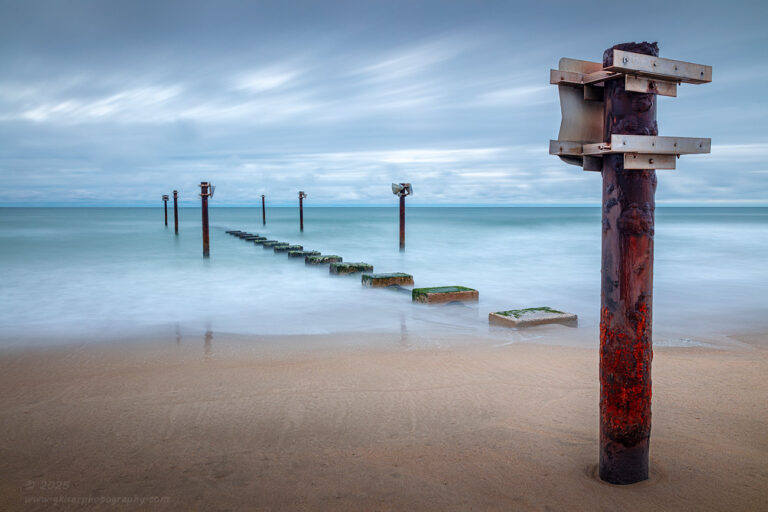
With the water levels dropping, the cement steps were much more visible now. I started to reconsider my compositions once again and landed on this one that used the nearest post as the dominant foreground. The steps were used to link it to the three pairs of posts out in the ocean for a bit of continuity. The sky was looking pretty good at this point, but it was still lacking a good deal of color so I was torn with how to do these photos. I could opt out of the long exposures and shoot at a normal shutter speed to show the waves and get the sky properly exposed. I could continue with what I was doing and overexpose everything to get a minimal look as I had been doing which was kind of what I was out here trying to do. I could also keep the long exposure but expose it more towards the “correct” interpretation of the scene and show the sky as streaking a bit while smoothing out the ocean. It was this last option that I decided to go with. By using the same filter setup that I had been for a while, I was able to get a 30 second exposure which would sufficiently smooth the ocean while keeping some detail in the sky. This seemed to work very well, and I got a couple of frames like this with the intention of making them color images should I end up processing them.
I will say that I was having a lot of fun with the ND filter, which is something that I don’t use all that often. For most of what I shoot, the tree limbs or grass become an issue with motion blur, and I usually opt out of the long exposure for that reason though I do love what it does for the clouds. Here I was with some very stable elements along with water and clouds that I could easily blur with a longer shutter speed. Unlike what I had done in the past at the coast, I used this basic setup and shot multiple compositions, different angles, and opted for more normal presentations and some fine art attempts all with the same filter combination. It was rather exhilarating.
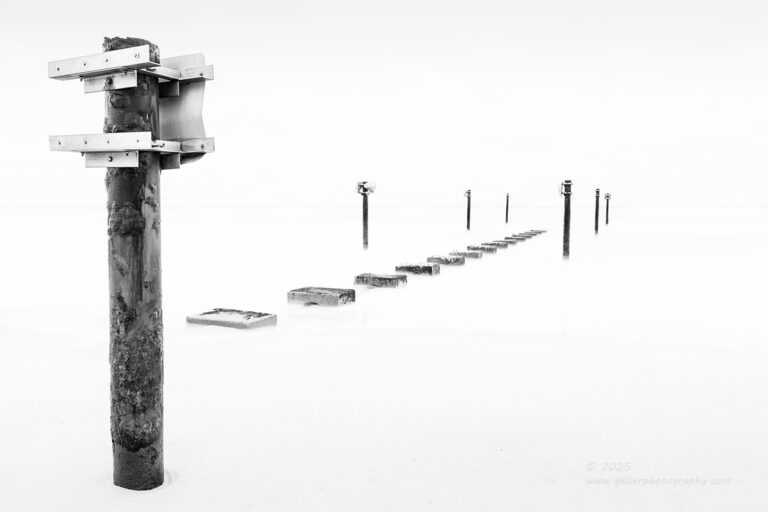
Speaking of attempting fine art with these photos, I also decided to go for the minimal black and white rendering with the long exposures and this same composition. Again, I opted to flip the frame based on the mood that I was trying to establish. You can see in these two photos just how different the overall feeling of the image is between color and high key black and white. I really love them both, but they say two completely different things. One has a traditional look while one has a very modern high contrast look to it. It all depends on what type of space the photo will be hanging in as to which one works the best. For me, I’m just thrilled that I am able to capture both types of photos during the same session without much fuss at all.
It was getting a little late in the morning at this point and I was wanting to get back to the hotel so that I could eat breakfast with Toni before they stopped serving. I made one more quick pass around to see if there were any compositions that I might have missed. I felt pretty confident that I had gotten all that I would want from here, so I started to break the camera down. Of course, my fingers were kind of numb at this point and I had a hard time freeing the polarizer from the filter holder. Not having a way of transporting it mounted in safety; I pulled out my electric hand warmers to try and get feeling back in my fingers so I could break the filter off of the mount. After a few minutes I was able to get it free and packed away. I then stuffed the warmers into the pocket of my photography gloves which made them a bit warmer for my hands. This was a trick that I used the following morning as it was even colder, but it worked quite well for me as I started my hike back to the hotel.
As I was walking, I saw a hotel that had a really nice rainbow stripe painted on both buildings. There was a green building next to them that worked nicely with the colors, but the lighting was not good here for that composition. I just filed it away in my head for later on. I was also making some mental notes of things that were nearby that I could come out and photograph later if the conditions warranted it. As I was looking, I noticed that the sky was starting to get really interesting over the ocean and I started to actively look for something that I could shoot under that sky.
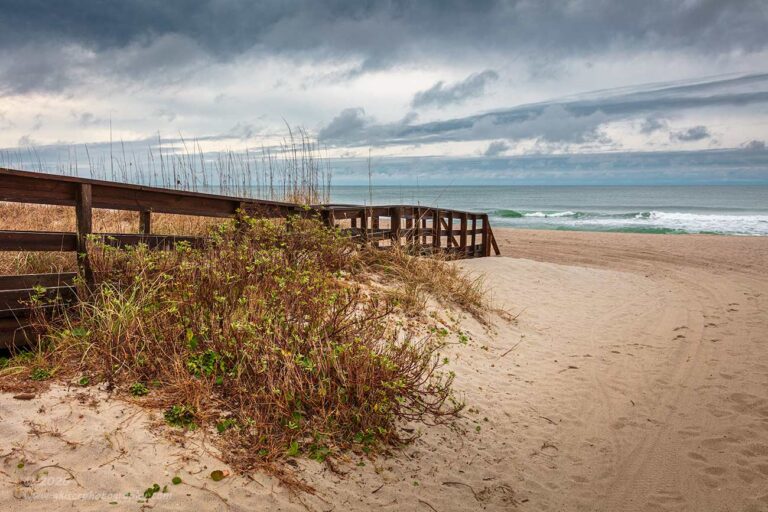
Now, one of the issues that I have always had with the NC coast is that there is precious little to use as a foreground when shooting over the ocean. We don’t have sea stacks, rocky coastlines, or little islands. We have sand, a small area of little waves, large expanses of water, and whatever sky is above it all. For me, this is just boring to look at, even when shot from an angle that gives a nice diagonal introduction to the coastline. When I am wanting to shoot over the water, I want something for the eyes to anchor to, something that stands out and tells a story that only that bit of beach can. Sometimes it is easier to find than others, though I can recall some trips to the coast where I find lots of different options with the entrances to the beach. This is usually my default because I can’t get into the dunes legally, so in order to get the sea grass and other interesting bits in the frame, I have to rely on the different entrances to the beach.
As luck would have it, I was coming up to a vehicle entry point that had a walkway right beside it. There was also a tuft of sea grass between the two almost as if it was planted for a nice foreground. I ducked into the access point and pulled the camera back out once again. I fitted the standard zoom once again because the room that I had to work with dictated that choice. I did keep thinking that I was using this lens much more these days than I have been over the last year and a half or so when the telephoto had become my workhorse lens. Oh well, I didn’t want to be bothered by which gear I was using, I just needed to use what would get the result that I needed.
Ironically, this is a realization that I have been having over the last few months. I have become much less involved with gear choices and really don’t care like I used to. I’m happy with whatever I have to work with as long as it will get me results. This is a big change from how I started out as a photographer when I used to be able to tell you the specifics of all my gear and spent a lot of time and energy in choosing what I shot with based on a collection of knowledge. These days, I am very unconcerned with that kind of stuff and feel like it really doesn’t matter. I let other things influence my decisions that can’t be put into words. I just go with a feeling and let the art guide me rather than the technique.
I was fully into that thought process for this shot because the breeze was getting a bit intrusive and with the beach grass, I was needing to freeze that motion. I didn’t do a lot of heavy thinking on that and just cranked up the ISO to allow me enough depth of field for what I was after and let it fly just like that. I didn’t even bother to look at the grass until I got back to the room later in the morning to make sure it was still. I’ll tell you what, not being concerned with the technical stuff is a rather freeing evolution to my photography. Now, don’t get me wrong and think that I am saying the technical doesn’t matter here. Quite the contrary. I’m so comfortable with the technical side of things that it has become second nature to me. It has gotten to the point where I really don’t need to actively think about it and have found that I don’t to think about because that energy is much better spent on the creative side of things. It is kind of like writing this blog. I get to concentrate more on what I am saying rather than how to spell the words and what proper form is for a paragraph. When I was in school, I had to think more about how to form the sentences than what went into those sentences. This is the same thing; I have just graduated from worrying about grammar to being able to concentrate on the story at hand.
After about a half dozen frames of the walkway going to the beach to get the waves timed just right, I packed things up and headed back towards the hotel. I took a side trip through the boardwalk area to see if any of those businesses would make for good photos with the bright colors. I wasn’t seeing anything offhand and ended up getting a text from Toni saying that she was down at breakfast and saw that I was close. I had been at this for hours at this point and decided that I could call it a morning and sit down to have breakfast with her. It was our anniversary after all. I made the quick walk back to the hotel and started coming out of my cold weather gear while she made me a waffle and filled a plate with some other things. She does take great care of me.
It was nice to be warm again and to be getting some warm food in my belly. I had walked for roughly four miles over the past three hours or so and was more tired than I realized. After breakfast we went back to the room, and I got a shower to finish warming up. We spent the rest of the day going to the Aquarium and out to eat for seafood. It was a really nice day, and we hunted for a quick scene to shoot after dinner but couldn’t find anything in the fading light. I wasn’t upset about that because I had just come off of a really good morning of photography. I was also enjoying spending the time with Toni.
When we got back to the room, she wanted to go out for walk to get a lottery ticket since the jackpot was well up there. I was down for another walk, and I took the camera in case we found something that might work for a photo. We walked around and she ended up getting a few different tickets before we ended up out by the marina. I scouted that area for photos but there was too much movement and not enough light to make anything work there. We ended up strolling around the boardwalk checking out the shops. I was really hoping that I would find something that looked good under the lighting, but nothing jumped out at me. Eventually, we ended up back at the hotel and sat down at the tiki bar.
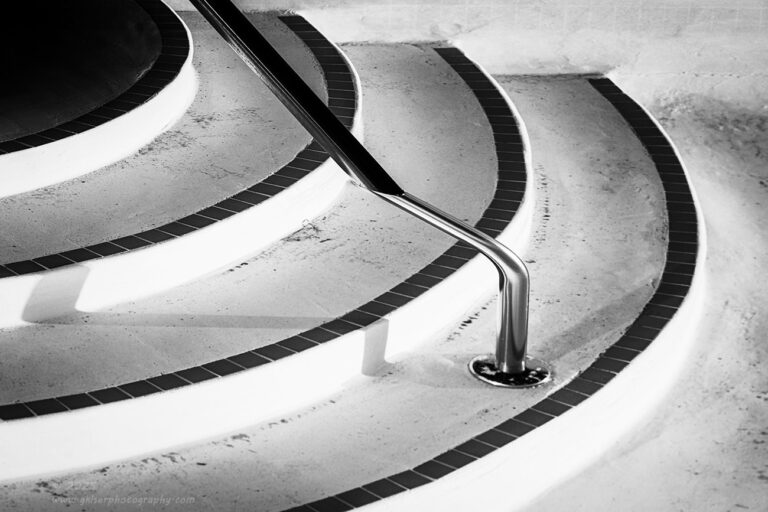
This was next to the pool that we could see from our room. Toni had pointed out that there might be some good compositions there, and I had seen some potential as well looking over the balcony. I just wasn’t sure that I could get the reach out of the camera for what I wanted to capture. Since we were right here at the pool and it was lit up, I decided to go and check it out. I walked around it for a few minutes and found that the steps looked interesting due to the repeating shapes and way the railing was bent visually where it entered the water.
Here I was in freezing conditions, in the dark, getting ready to take a photograph of the pool…at the beach. Meanwhile, there was snow on the ground at home. We really do vacations in odd ways I think. Anyway, I was here, and after some playing around with placement, I was able to land on a composition that I liked with the steps. I shot different variations with different depths of field to make sure that I had something that might work when I got home. The plan had been for this to be a black and white image because the entire scene was very blue which I didn’t really care for. By stripping the color away, I was left with the shapes to tell the story which was all that I wanted.
I would like to say that this is an abstract piece, but I think that pretty much everyone will know exactly what they are looking at when they see this image. It does fall into my wheelhouse of shooting mundane scenes in a way that hopefully will make the viewer look further into the frame and appreciate the subject that they would typically look right past. Let me know if this one succeeds in that goal. I kind of like it, at least more than I thought I would. Toni even had said upon seeing this one that she wasn’t quite sure how it would turn out when she looked at it on the image review, but she was pleasantly surprised with the outcome. I’ll admit that this one is a bit of an off the wall approach to a photograph and it might be a great one, but I’m glad that I gave it a try.

When I was pretty much sure that I was done with the pool, I packed up the camera and went back out to the fire to sit with Toni. I was also wanting to get warmed up as she was sitting by the firepit which was roaring at this point. Shortly after sitting down, she mentioned that I should photograph the fire. Hmmm, I hadn’t really thought of that before, and hadn’t really ever photographed fire before. Challenge accepted!
I pulled the camera back out with the telephoto lens again. I started to look at the compositions which were ever changing and realized that I was going to have to time the exposure just right. I made a test shot and realized that I was way off from what I thought was going to be needed in terms of a shutter speed. I was needing a sufficient depth of field which was requiring a pretty narrow aperture at the long end of the lens. The shutter speeds that I was seeing weren’t able to freeze the fire at all. I kept bumping it up and boosting the ISO to compensate. Finally, I landed on a workable shutter speed of 1/640 of a second, but that forced my ISO to 1000. Normally, I would have done anything I could to lower it, but I decided to not stress the technical end as this was more an experiment than anything else. I felt confident that I could remove any noise in the image in post should it be a problem. I was also less worried about the noise than I was about getting the structure of the flames rendered correctly.
Now speaking about noise in a photograph, this is something that I have always been aware of. When I first started out, I was using a prosumer Sony camera that had a base ISO of 64. Anything above that would present noise in the image. Each successive camera that I have purchased has been better at controlling noise, but I still did everything that I could to keep the ISO at 100. Here in the past couple of years, I have been easing up on that requirement and deciding that a crisp photo is worth a little noise. The odd thing is, I wasn’t really seeing that much noise in the images until I started to pull out the shadows.
What I have found is that ISO isn’t really the only cause of noise, or digital grain. In fact, in proper lighting with the proper exposure, digital noise is not really an issue at high ISO. However, it is less forgiving when it comes to recovering shadows in post because you are amplifying an already amplified signal. With the fire photos, I wasn’t interested in raising the shadows at all. I just wanted the flames on a black background. The flames were properly exposed to the right of the histogram and when I pulled them into post, these ISO 1000 images were just as clean as if I had shot them at ISO 100. I was shocked to say the least, but it confirmed what I had been reading lately. Keep in mind that this is on a camera that was developed in 2015 if memory serves. The new crop of mirrorless cameras handles this digital noise much better, which leaves me no doubt that I could shoot at insane levels on the R5 when called to do so.

Discussions around digital noise aside, the only real problem I had with these photos was nailing a focus point with the flames moving so fast that auto focus was useless. I ended up manually focusing on an area and waiting for the fire to blow into that portion of the frame. Once I got the focus figured out, I was making several different exposures trying to get the right combination and composition of the flames. I probably could have easily culled these down to a single photo, but I felt that since it was the first time I had attempted this type of photography, I would go ahead and include two of the best ones here in the blog. I’m not sure if either will end up in my portfolio, but I did want to share the end result of the effort.
These fire photos represented the last of the photos for the first day. There had been 71 frames shot which actually seemed like very few in hindsight. I had shot a bunch of different compositions during the early portion of the day and really felt that I would have more images than that. However, with me shooting so many long exposures, that slowed the process down quite a bit. Of those 71 frames, you are looking at ten keepers from the day ranging from minimal fine art pieces, to landscapes, to abstract interpretations of shapes, and even random flames left to chance and a shutter release. It was a day of many different types of photography which was a great thing to happen.
It is always that first day that I spend getting in tune with the area that I am working with. For getting to know the landscape and hearing how it wants to be photographed, I had managed to really start a great conversation with Carolina Beach. There was no reason that I wouldn’t be able to go even further with the photography over the next couple of days. Things had certainly started off fantastic, and I was looking forward to the next morning.
based on the weather, we were looking for a clear day with nothing but sunshine and frigid temperatures. What I had thought was cold this morning was going to be a warm one on comparison. It was looking like the temperatures were going to be below 20 degrees for my walk on Sunday. My destination was the pier in Carolina Beach because I already knew the compositions that I could shoot under a clear sky. There were also some random groins near the pier that I could make isolations of with the strong morning sunlight. The hike was going to be about the same length as what I had done this morning, so I would leave about the same time and get out there at first light.
Before going to sleep though, Toni and I watched a movie on television as we wound down from the day. It had been a great anniversary day, and one of the best ones in the recent years. I almost hated to get up early and head out the door without her in the morning. I did offer to have her come along with me, but she decided against it since it was going to be so cold, and then there would be nothing for her to do while I was working on photos. Those are the sacrifices that she makes so that I can create these photographs, and I really appreciate that she does it so willingly.
I’ll be back here tomorrow with the next day’s story. In the meantime, I hope that you enjoy this first batch of photos that have been published as well as the story behind them. Remember, I would love to match you up with a print of your own of one of these photos, but I also realize that you might not have room on your walls for a print. Maybe the prints are a little cost prohibitive for the size that you might want but you would still like to support my photography and treks like this one. If that is the case, you can click the “donate” button below and buy me a virtual coffee. This makes a lot of sense because “virtual” is the only kind of coffee that I like. Even after a cold morning hike down the beach, I have no desire to drink a cup of coffee, but by showing your support though a donation, you will help ensure that I can continue going on these treks and sharing them through the blog. For those who have donated, I really appreciate it, and it is those donations that have made treks like this a possibility. If you are on the fence, any amount will work, so you don’t have to worry about any set dollar amounts.
Look for me here again tomorrow at some point during the day with another chapter to this saga. The photos keep getting better. I’ll go ahead and give you a hint about the last morning. The sunrise was so spectacular I am thinking about doing a limited edition print which is something that I haven’t done since probably 2006. Sadly, I never did find homes for all of those limited runs. I’m almost embarrassed to say that those runs were either five or ten prints depending on the photo. I’m still a little gun-shy about doing a limited edition because with the exception of just a handful of my photographs, they are all limited editions as most will have only a single print made at some point. That just means that whether or not I offer prints as a limited edition or not, you will have essentially a one-of-a-kind piece of art to hang which brings with it a higher value in my opinion. But I digress…the point is, I have a fantastic photo to share with you here in the next couple of days, so keep your eyes out for it.
If you haven’t already subscribed to the blog, go ahead and get on the list so that you will get an email notification when I publish the next blogs with the new photos. You don’t want to miss these emails, because if you are relying on social media to see the photos, I’m looking at roughly four months of backlog images before I get to posting these. You do want to get them while they are hot right?
Part two is on the way….