Sunday, March 3, 2024
Good to see everyone back here as we move onto the third day of the Outer Banks adventure. If you have just joined us, you can catch up with the first and second days’ blogs. Don’t worry, I’ll wait right here for you to return. As a quick catch-up, the first day was largely a travel day with only a couple of hours left of sunlight upon my arrival and check-in at the hotel in Kill Devil Hills. I was able to make the most of that time by visiting the town of Manteo, and spending time around the Roanoke Marshes Lighthouse. The following day started out kind of disappointing with heavy rains falling until lunch. Fortunately, the weather broke and allowed me a full afternoon of shooting where I got some very unique conditions with fog and sunlight at the same time. There was even a really interesting sunset that developed which I was able to take advantage of before calling it a day. I ended up with something like nearly 300 photographs captured which puts this trek into the category of a pretty large endeavor.
As I mentioned at the end of my last entry, I had made plans on going to the Nags Head Pier for sunrise and possibly some blue hour photos. I wasn’t even aware of that pier until I had done some searching of the area and found it on the map. I liked the fact that it was a long and rickety looking pier which makes for some better compositional possibilities. Since the blue hour was part of my plan, I was going to have to get out there around 5:30 which was an hour before sunrise. This would give me the right kind of light that I was wanting. The hopes were that there would be lots of high clouds over the ocean and there would be opportunities for some long exposures with subtle colors in the clouds without the high contrast of sunrise.
I arrived at the location right on time but noticed that there were parking restrictions at the pier itself with towing being enforced. I imagine that I would be fine since it is the off season but didn’t want to risk having my truck towed while I was on the beach. There was also a sign that stated that there was no beach access from that parking lot which made the whole thing kind of a non-issue. It was no problem because I had seen a public parking lot with beach access just next door which is where I ended up parking.
After I got my gear and walked to the boardwalk, I noticed a sign that said there was no parking here from midnight until 6am. I was still about 30 minutes away from that window closing, but I decided to roll the dice. The worst-case scenario would be a parking ticket, but there would be no towing involved. I also doubted that the parking lot was patrolled at this time of the morning, and certainly not in the off season. After embracing my rebel-like attitude and headed out to the beach to see what I could capture on this morning.
I walked out on the beach and found the pier right where I expected it to be. Looking at it from the left side, left me feeling kind of ambivalent to the scene as there was a thick cloud bank in the background that would show no color at all. It would also cover the structure of the pier by reducing the contrast between it and the sky. By walking over to the other side of it, I found a much more pleasing view. The sky was clear beyond the pier, but I could see the clouds to the right which would frame that side of the image nicely.
There was a little bit of light already in the sky which gave me an idea of what to expect. There was not going to be anything grand about this sunrise, and the blue hour wasn’t going to be nearly as interesting as I had hoped. My plan had been to use a wide-angle lens to get in close to the pier and make it look huge in the frame while including a lot of the background for the colors. Since I was doubting that the color was going to be a big deal, I had to think about using a narrower focal length. It would include less of the sky, but it would change the visual relationship of the pier to that sky by making it a bit smaller.

With my standard zoom attached with no filters, I started to work on finding a composition that I liked. I knew where I needed the pier to end in relation to the clouds in the distance, and I knew how close I could get to the water since the tide was coming in at this point. I found the spot that I liked and started to figure out an exposure. With the meter not able to pick up anything, even at 30 seconds, I knew that I was going to need a nice long exposure. I set my first one to 5 minutes at f/8 I believe. That gave me an idea of where to go from there with my exposure. It turned out to be rather accurate too according to the image review. I made several shots in succession with decreasing exposure times until the light got to a point that I could use the light meter and stay in the area of 30 seconds.
During this early time, I found that the water was coming in rather quickly which forced me to pick up the tripod several times and retreat. Then it was a matter of working out the composition once again and starting things back up. This was becoming one of the most frustrating things about coastal photography in my book. It is even worse because every time I have to move the camera, I have to worry about getting the horizon straight once again. I have the spirit level on the camera, which is very accurate, but when I am working at an angle to the horizon, I actually have to cheat the level slightly to account for the distance to the horizon and the perspective that it causes. This takes a few seconds to adjust, and I would much rather set it and forget it.
The transition from blue hour to golden hour went largely unnoticed by me because the light just steadily increased, but the sky never really changed. The biggest change for me was the difference in shutter speeds that I could use. I shot from 5 minutes down to about a second which allowed me to capture a variety of looks under basically the same sky. The clouds didn’t even move that much during this time which was quite nice.
I would have preferred a bit more drama to the scene, and I still would have liked the idea of making the pier larger with a wider-angle lens. The issue would have been balance in the frame. Without a lot of texture in the sky opposite of the pier, that left side would have been too heavy and would have thrown the balance of the scene off greatly. Having it appear smaller kept things in the proper balance for me, and emphasized the length of the structure better than it would have otherwise.

In about 35 minutes I had shot 50 frames and realized that the light was starting to fail. With the sun approaching the horizon, what glow was there started to get more intense and less colorful. I was expecting that, and already had my eye on some scenery to the rear of the pier. I hadn’t really considered it much at the time, but the higher contrast views with less color made for a great chance for a black and white presentation of this scene. It was not until the second run of edits that I pulled this frame in and started to work on it as a black and white. I wasn’t convinced that it would work at first, but the more I worked through the processing, the more I really liked it. Who says you can’t shoot a sunrise in black and white?
There was the typical row of beach houses with the ever-popular fences along the dunes just behind where I had been shooting. This was the area that I had already scoped out as the light was failing to the East. I was hoping that the early morning light would bathe those houses in a nice warm light while the clouds overhead were still looking dark blue. This has been a recipe for success in the past and I hoped for a repeat of the performance.
I found a good composition that utilized one of the boardwalks leading your eyes to the houses, and one in particular which had windows already showing some of the warmth from the reflection to the East. The sky was still very dark behind it which I loved, and just really hoped that the sun would liven the scene up soon.

Figuring that the sun should be cracking the horizon at any moment, I turned to look at the horizon. I could now tell exactly where the sun was going to come up, and it was behind that cloud bank that had been to the right of the frame when I was working on the pier. The clouds were thick and tall which was going to block the sun for about 45 minutes at least. I had shot some test photos to check the exposure and the general look of the scene in the image review. I never did get the shot that I was after, but I was able to pull in one of the later test shots which you see above. It is not quite what I was after, but it turned out pretty decent with the warm light reflections in the windows. It was good enough to become one of the keepers from this first full day of shooting.
Knowing that I wasn’t going to get that first light on the scene, I turned my attention to some other compositions along the row of houses in an attempt to take advantage of what light I did have. It wasn’t what I had been after, but I was getting some photos and that is what mattered most. I’m writing this blog entry on Monday morning, so I still don’t know how they turned out, so as you are reading this, I have probably just finished with the edits days after writing this blog. Remember that in order to take advantage of my time being alone, I have opted to write out the blogs in the hotel room before I have even started the edits. The only thing that I have done up to this point is to run through a draft first culling by looking at the images on the back of the camera. It will at least give me an idea of what worked and what didn’t.
As I worked my way down the beach, I continued to look at the horizon to see what the sun was doing behind the clouds. It was getting closer to breaking free, but it was getting rather bright at this point which would defeat the purpose that I wanted for the houses on the other side of the dunes. I did see something else that interested me though.
About 400 feet from the pier was something in the water that reminded me of the old erosion control structure by the Hatteras Lighthouse that I had so much fun with a couple of years back. The lighting was really good on it for the moment, and I went over to it and got a closer look. There were seven beams over a pipe of sorts that had the water rushing over it. The tide was still coming in at this point so there was a lot of activity around the different sections. It was the perfect chance to get some long exposures. The question was whether or not I was going to have time to get things set up to do them.
The light levels were still kind of low thanks to the cloud cover and I had added a polarizer when working with the houses. I set the camera up and found the composition that I wanted to use. It was simple and had a little bit of interest in the sky which I liked. There was even a slightly warm tone to it which went well with the blues of the water. I wanted to find my base exposure to see if I wanted to use an ND filter for this one. What I landed on was 0.6 of a second, f/16, ISO50. That little bit of a shutter drag actually worked very well for the water at the level that it was. I figured that trying to retrieve a filter from my bag and put it on (ND filters are a pain to slide into the holder because of the gaskets) was not really worth it enough to justify the time. I just happily shot with the settings that I ended up with until the sun broke loose from the clouds. Once that happened, the quality of light changed and became much too contrasty.

I had rattled off 14 frames of this interesting object in the water and had worked it only a matter of minutes. Much like catching the light of a sunrise, working moving water will take up a lot of frames because you really don’t know what you are going to capture with each press of the shutter. The trick is to try and imagine what the water will do beyond a certain point during the length of the exposure. There is a certain skill that is involved, and a lot of luck. I wished that I had more time here because I really think that this is a very interesting scene in the water. The few photos that I shot here started to have a fine art feel to them which I wanted to work on further at a later time.
Out of those 14 frames, I had been hoping that one would work out at the very least. When culling through the photos on the computer at home, I found one where the water looked fantastic, but the sky was rather bland with only a hint of yellow from the sun which was rising to the right of the frame. That one frame made it through three rounds of culling, and I eventually started to edit it. The first step in my edits is usually to pick a color profile that I like to get started with. I looked at black and white ones, as well as color. It was a seldom used color one that I selected because it introduced pinks, magentas, and oranges into the scene in all the right areas. The water was rendered more of a cyan. It was odd to look at, but I saw the potential there, and began the processing with that profile. In short order, I had the image above which is one of my favorites from the day. While it is not necessarily indicative of the actual lighting conditions at the time, it is accurate to my previsualization of the scene and how I wanted to see things. Nothing has been replaced, and nothing has been generated by AI here. I have just worked the colors that the camera captured to arrive at this color graded image.
Now that the sun was out of the clouds, things were getting a little bright on the beach and I was thinking I would probably take a break for a while. I still hadn’t had breakfast yet and was getting hungry. I made the quick walk back by the pier and to the parking area where I had parked just a while before. As I crested the dunes I thought back to when I saw the No Parking sign and wondered if there would be a ticket on the windshield. The truck was still there which was a huge plus, and as I got closer, I could see that there were no tickets on the windshield. Total win for me!
I was back at the room a few minutes later and went to have some breakfast. When that was done, I looked outside and saw that the clouds were all but gone and the sun was really kind of bright. It was going to be a while before the clouds started to come back into the sky which would diffuse the light, so I decided to take advantage of the time by starting the blogging process on the laptop. That turned into a very big part of the time at the beach as it filled the remaining time that I was not out getting photos or sleeping. Looking back, it was the best decision that I could have made because it has saved me about 10 hours now that I have returned home. All I have to do is to go in and add bits and pieces like this tidbit which makes the story complete.
My plan was to wait until just after lunch to go out again. Depending on the clouds, I was wanting to go and find a marina of sorts to work on some isolations that I normally wouldn’t get the chance to try. There were a few out towards Manteo that I wanted to check out, and one there at the little lighthouse that I had already shot on the first day. I didn’t have much of an idea of what I would find, but I felt that it was something that I needed to try.
When the middle of the day arrived, the clouds started to come back into the sky once again. There was no rain this time, and the lighting was starting to look really good for a change. Not being one to stop photographing because it is the middle of the day, I grabbed my gear and made my way out to Manteo once again for a little photo walk. I was also planning on looking for anything along the way that might present some decent photographs.
On the way down the road, I spotted an old red pickup that was used as yard art at a store. It was still too bright to photograph that, and that is something that I can get any time at home which made me less likely to stop for that bit of old iron while at the beach. I did file it away for something to get later on if time allowed.
Just before I crossed the bridge into Manteo, I spotted an old rusted out boat hull beside of a gift shop. The rust on it was incredible. By the time I had really thought about what I had seen, I was already on the bridge and unable to turn around. That was going to have to be a stop on the way back so I could try and find a composition or two with it. It occurred to me that I might have a problem with decay subjects always catching my attention. Nah, it isn’t a problem. I can stop any time I want to.
Once I got to the other side of the bridge, I came across a marina that I had seen before and was one of the locations that I wanted to stop and check out. It was a private community, but it appeared as though anyone could drive around the marina during daylight hours. I slowly worked my way around trying to see if there were any compositions that I might like to try. Photography around boats is not something that I am very used to, so the ideas don’t really come all that quickly. I was hoping to work on that weakness while I was here.
Even knowing that limitation of my creativity, I wasn’t finding anything at all that interested me. I just felt like I was looking at other people’s money and I saw no art there. I mean it wasn’t like that old rusted out hull that I had seen on the other side of the bridge. Now that was art, but I don’t have a decay problem.
After driving around for about five minutes, I decided that there was nothing for me there. I actually felt out of place at that marina. I didn’t bring my tux, and my top hat was a green boonie hat which didn’t have crisp edges. I again set my course for the park around the Roanoke Marshes Lighthouse. At least there I felt like I could fit in.
I parked in my same place that I had the other night when I visited. I walked past the old Shad boat that was laying in the marsh which I had started this adventure off with a couple of days before. It still struck me as beautiful sitting there rotting away. I still don’t have a problem here, there is true beauty in decay as I have learned by studying the concept of wabi sabi. I can still find beauty in beautiful things which aren’t decaying. Really, I can!
I chose not to photograph the old boat once again because the lighting wasn’t all that different now than it was before. Instead, I made my way along the shore towards the marina. This marina was a bit lower rent than the one I had just visited. The boats were still nice, but I could tell that most of the owners did their own maintenance, and several of the boats were showing signs of a long winter without any care. Yeah, I was at home here, and my cargo pants weren’t frowned on one bit.
I spent some time walking around the areas that I had walked before in the failing light. The last time I was here, the whole area was in shadow and there hadn’t been any good light to work with. This time, the sun was still high, but diffused by the clouds which made for a more interesting look to things. I was still having a hard time finding anything to shoot though. It was all so orderly and modern. The backdrop was not all that pretty, and the cluster of boats had no visual rhythm to make a composition by. I started to look for isolations that would possibly make sense.
One of those scenes that I have had in my head for a long time has been the coiled rope on the dock. Of course, I was looking for an old rope with fibers sticking out of it, and lots of texture. Apparently, those ropes are no longer used and I kept finding what I figured were synthetic ropes which were smaller and smoother than the old style. I was having a rough time here finding something, but I knew if I looked close enough, I would be able to find something to shoot. Once I got that first one in the bag, the next images would be easier to find.
On one of the first row of docks at the end I saw an older green boat on the next row. I loved the color of it, and it appeared to be not that new of a vessel. It wasn’t decaying, but there were signs of age which appealed to me. I don’t have a decay problem….I promise! I quickly made my way over to the older boat but found nothing that I wanted to capture while I was looking at it. As I was about to walk away, I looked down on the dock to find a small coiled rope on the wooden floor. The rope was attached to a cleat and the composition almost made itself right there in front of my eyes. I knew I had to capture this one.

I put my bag down and set the tripod up nearly on top of the rope. I built the camera with the long lens for that tight crop without casting a shadow. There was no need for any filters, so I just framed up the composition and shot the first frame. I examined the resulting photograph in the image review and started to see tweaks that I could make to the framing. I made those changes and shot another one. Upon closer examination, I could see focus fall off due to the angle which I needed to correct. I moved the tripod in closer and aimed the camera even more vertical until I had a more even focal plane. I shot another frame and felt that it was too bright as I wanted to keep the detail in the rope at all costs. I lowered the exposure value slightly and shot another one. This one worked well, and I was happy with it. Just before I was ready to move onto the next subject, the clouds cleared, and the shadow became deeper on the side of the rope. I grabbed one more frame with the added contrast that I really liked here.
I was now in business. That all important first image was in the bag. I had to start fresh even though I had been very active during the morning. Remember, I had a long break that changed the creative energy. It was now stoked once again and that made me smile. In the distance there was someone working on their boat, and they had the greatest soundtrack playing with a mix of all my favorites from years past. It got me in a good mood, and I started feeling the creative energy flowing once again. Maybe I should start listening to music while on these treks. That might be dangerous though, because I already get so focused on what I am doing I don’t pay enough attention to my surroundings visually. If I remove the ability to hear my surroundings, that is a recipe for disaster.

Now that I was thinking creatively again, I could start looking for some more complex compositions. I still loved the green boat for the colors and started to look around it for isolations. It didn’t take long and all I had to do was follow the rope I had just shot to the boat itself. I started to see in terms of shapes and colors rather in in terms of a specific subject. I’ve found that this is a magical mental place that I am able to get into occasionally. I start to see past the subject and begin to see the art behind things that nobody will usually see. Who knows, maybe nobody will see it when I photograph it either.
Here, it was the curve of the hull with the rope coiled inside. The wooden door went well with the green color and gave a nice concrete shape to balance out a composition. I framed up a shot that I liked and started to focus on the parts that would give me the right depth of field. As I was ready to get the photo, the composition changed. I knew that the boat was moving in the water but had failed to process just how much that movement was going to affect my composition when shooting through a long lens.

I had to work faster if I was going to get the shot. I recomposed and grabbed the focus quickly and shot the frame. I had made sure that the shutter speed was fast enough to freeze the motion, and hopefully a couple of these will turn out well enough to fully edit. For the moment, I think that there are no technical problems with the photos looking through the LCD. The true test will be when I look at the photos in Lightroom on my editing monitor. If things go as I think they will, you will be seeing the photos that I shot in this blog somewhere around here.
I didn’t spend too much time working this concept because it was rather hard to get everything to come together at the right second for the exposure. I didn’t want to get bogged down and frustrated trying to make it perfect. Instead, I wanted to give the concept a try and move on to something else so I could keep the energy going. I’ve found all too often that if I fixate on a single subject, I will burn through way too many frames and steal time that I could be working with other subjects and compositions. I wasn’t even sure if the idea would work here at the stern of the green boat.
Figuring I would try something a little less moveable, I spotted a group of three wooden pilings in the water completely separate from any other object. These have always made for great subjects, and I like the way that the water levels can be seen in the different layers of the algae growth. Yeah, that is a form of decay, what about it? I don’t have a problem.

I found a simple composition that I liked which just pretty much centered the pilings in the frame. I added a polarizer to change how the water reacted within the image. I shot a few frames to dial in the composition and felt that the water was showing too much texture which was competing with the textures of the wood. I went back to the bag and pulled out my 5-stop ND filter and slid it in. This allowed me to get a shutter speed that would smooth the water out and focus the attention right where I wanted it to be.
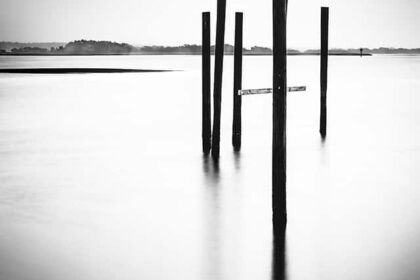
Now that the exposure was right, I wanted to make this a bit more special. Since texture was now a big part of the photo, I decided to ditch the color and change it over to black and white. Of course, the RAW image will retain all the color information in case I choose to render it in color which is a possibility. The green algae does add another dimension to the composition but seeing it in black and white on the back of the camera just screams texture to me. I like both variations, but I am currently leaning towards black and white. It will be fun to see which one makes it into the collection.
You have already seen that I was wrong at the time of the capture. When I pulled the image into Lightroom, I did do the edit in black and white first. I liked the end result, but it was missing something. I made another copy of the photo and found a color profile that worked with it better and completed the edit in color to see which I liked best. It was the color version that won out because of the way that the colors on pilings helped to tell the story. The blue reflection in the water also added so much to the overall balance of the image as it complimented the brown tones on the wood. I’m really happy that RAW files allow me to move between color and black and white both in the field and in the editing process.
I was really feeling creative at this point and was looking for more isolations and things that I liked. A few slips over from where I was, I happened to see a very red boat which caught my eye. Red has a tendency to do that which is why I like including red in my photos when the opportunity arrives. Of course, the boat was painted all over in red, so it was too much red for a photograph, but I wanted to find just a bit of it to work with the green of the water.

When I got over to the boat, I searched for an isolation that would work with the water as I had hoped. The best bet was the hard line of the bow which also had a stripe to help break up the sea of red. I liked the diagonal aspect of the bow, and the bit of texture that the water had which complimented the smooth nature of the hull. I framed up a horizontal as well as vertical composition to see which I liked the best. I’m still not sure which will win out, but I am thinking that the horizontal one will be the best option for the sake of balance between the colors. As with the color versus black and white, I am very excited to see which one wins out in this battle. There is also a chance that none of them will work because I was dealing with a moving subject which made it very hard to get the composition perfectly framed. I think that I had all that worked out well enough and overshot it a tad to allow for cropping after the fact if needed.
Unlike with the pilings before, my instincts won out with this composition. The horizontal one worked much better than the vertical one, but the edit was still an uphill battle. I had really thought that the edit would be the easy part, but the red drove me nuts with the intensity. I had to dial back the saturation, darken it, do some burning within the red just to have it not offend the eyes. The water should have been very easy as well, but I had to work the contrast there quite heavily as well as work the colors out through multiple different modules in Lightroom. The end result works graphically and within color harmonies. I’m not sure if this is my kind of photo yet, but I owed it to myself to give it a try so that if I was presented with the opportunity again, I would have an idea of how to deal with it.
I made a cursory look around the docks and decided that I had done enough here. If I had stayed much longer, I would have started forcing things just to see if I could make it work. I wanted the compositions to be more about scenes that I felt really worked artistically. I know I was probably limiting myself, but I was feeling a creative shift in my energy and wanted to listen to that and go where I was lead.
I left the camera as it was with the long lens and the polarizer attached as I entered downtown Manteo. This was more of a tourist downtown than a business one, but there were some interesting things going on which might make for a good photo or two. I just had to find it. Over the years, I have gotten very good at listening to the little hints in the wind about where to go next. This was not something that I would normally be doing, but for some reason I was being drawn to the main stretch of shops and businesses. I found myself walking by a parking deck and happened to look in the area beneath the stairs. I don’t know why I looked, but I did.
That was when I saw it. It was the proof that I indeed had a problem. Sitting there against the wall next to the lattice leading into the deck was an old silver Huffy cruiser bike. The tires were flat, and the drivetrain was solidly rusted. There was a bike lock on the frame, but not attached to anything. I figure that this bike hasn’t moved since at least last year and possibly longer. The salt air is rough on metal, and it makes it very hard to determine age.
There I was looking at a silly bicycle leaning up against a brick wall where it had been for a long time. Apparently, nobody has really taken notice of it, and it has sat there undisturbed for quite a while. Now it was talking to me and pulling my attention from all the beautiful coastal scenery that was around me. I got truly excited about this subject and started trying to figure out how to capture it. It was then that I realized beyond a shadow of a doubt that I did, in fact, have a decay problem. Looking back to even the morning at the pier, I was drawn to the pier because it was rather rickety. The fences that I liked capturing decay quickly and show the signs of age almost as soon as they are erected because the sand covers them quickly. The object in the ocean that I finished up with was very worn from the sea and had lots of evidence of decay. It was all making sense to me now. I am drawn to decay even in situations where the focus is on landscapes. I might need help with this addiction, but I truly do enjoy it.
Back to the task at hand. I was there in a very confined space trying to photograph a bicycle that was positioned close to the edge of a wall and a wall of lattice that showed the parked cars inside. There was a beam of bricks just beside the front wheel that I was trying to shoot inside of to get the bike framed by those bricks and to reduce the distractions around it. I could tell that I had the wrong lens for this because I was in too close. The idea was sound though, so I swapped out the lens for my standard zoom.
I tried again to frame the bike up between the wall and the beam, but I didn’t like how it was looking because of how the lines worked out. I moved to the side and decided that I would be better off with a side view of the bike as that would show more of the shape anyway. I started off with a horizontal composition where the bike filled the frame. It worked, but somehow lacked the punch that I wanted out of this photo. It looked too much like a product shot or a postcard. There really wasn’t much else that I could do with this subject though because of the tight quarters.
Or was there?

I took stock of the surroundings and saw some interesting shapes above the bike that seemed to compliment the style of the bike frame. To get this in the frame, I would need to shoot it vertical which made sense for the overall aesthetic I was after here. I flipped the camera and framed it that way. From the angle I was shooting, the verticals were spreading out near the top which meant that I needed to raise the camera a bit. This got the verticals under control and kept the bike and the top of the scene looking good. I overshot the framing slightly so I could make sure that the angles were right when I got it into Lightroom. Since I was shooting straight on, I needed the vertical lines to be true or it would leave the viewer feeling a bit uneasy.
With that, I was thrilled with the composition, and just needed to drop the exposure by a third of a stop to control the highlights on the whitewall tires. The way that the shadow appeared at the top of the frame made for a very natural vignette which I thought worked well. In fact, I didn’t see much that needed to be done to this in post, but I’m sure I will end up messing around with it for a while anyway.
This was really one of those oddball subjects that you can only see during a photo walk which is why I will always recommend going on a few every year. I’m even offering a workshop on this very subject in late April. There are still spaces available and I hope to see you there.
Now that I had scratched that decay itch and felt comfortable with my diagnosis, I went to look for a boat that I had tried to shoot that first night. The composition had felt a little forced at the time using a streetlight to balance out the frame as I shot up towards the bow including the (rusty) winch crank. It was that decay element that I decided to embrace and wanted to see how it would work out in the current conditions. I knew that the boat wasn’t far away, but I had to find it again since I was in the business end of town rather than the park side.

When I found it, things looked very similar to what I remembered seeing the first night, but there was light on the port side of the bow while that had been in shadow the first time. The extra light made all the difference in the world to the composition, and I felt better about it. I was still using the standard zoom with the polarizer attached which was the same gear I had the first night. I started figuring out the spot that I needed to place the tripod since that was going to be key to the composition. My goal here was to use the trees as an element to separate the white bow of the boat from the overcast sky. It was that contrast that established the shape of the boat and made sure that it didn’t get lost in the background. The streetlight was positioned in the negative space in the upper right of the frame which balanced out the image and gave a bit of interest to the composition. Boats are not usually photographed this close to streetlights, but it seemed to work with this example.
I didn’t spend too much time with this boat because the composition was simple enough and there wasn’t anything changing in the scene. There were only a couple of exposures to make sure that I had a safety in case there was a problem with the one that I started with.
Beside that boat was another boat on display inside of a boathouse. I had seen this the night before and thought about trying a shot or two of it, but decided against it because it looked too display-y for my tastes. Now that I was feeling this creative energy, I wanted to start working the details of this boat. As I was looking around, I saw the signs that identified the particular style of boat as a Shad boat which was used for fishing along the NC Coast in the 1800’s. They do have a unique design to them, and I recognized it from the derelict boat that I photographed in the reeds to start the adventure off on Friday. There were several of them around the area and apparently, they are kind of rare which I fully understand since they are about 150 years old at this point.
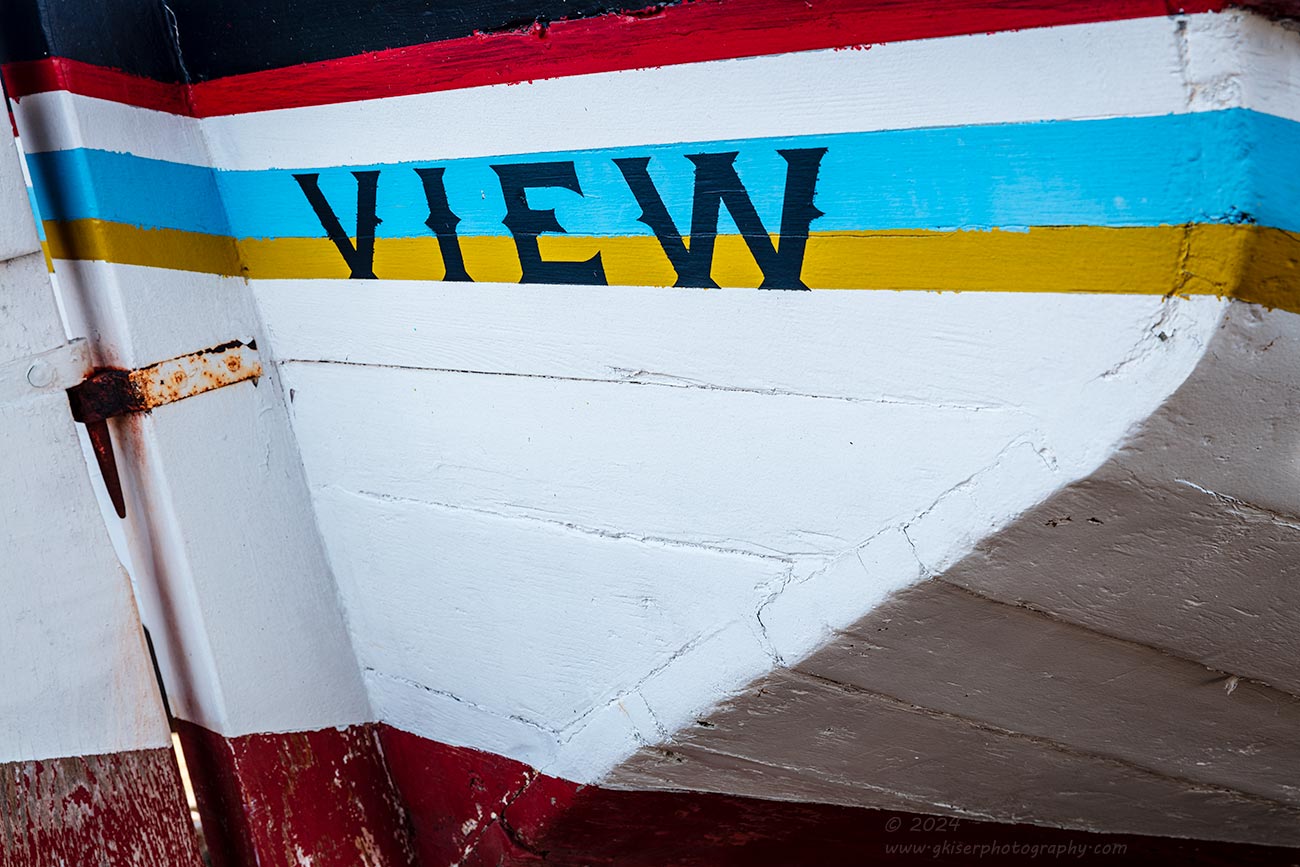
History lesson aside, I was interested in capturing some of the details of this boat because I felt that it was a unique subject to work with. The first thing that caught my attention was the stern which held the name Ella View. There were stripes painted on the hull that helped to define the shapes which I felt might make for an interesting composition. The name was split by the rudder which made a full shot very difficult to achieve. I opted to focus on the right side where “View” was the only word visible. I framed up a shot around that text that included the lines as well as some of the shapes of the boat. The idea was to establish an abstract type of view to showcase the colors and shape of the boat. As of the writing of this blog, I think that the image is a success, but I will have to wait to see it on the editing monitor to fully decide if I will be editing it.
The attempt did give me a new appreciation for this vessel, and I went to the bow looking for a different variation on the shot that I had done under the streetlight. There was no trailer arm in the way here, but there was the boathouse to content with. I looked around to see what I might be able to work with and found that the rafters under the roof had very similar angles to that of the bow. I started to develop a concept where I used those shapes to frame the shape of the bow with the focus on the ring right at the front. To do this, I was going to have to get very low to the ground and shoot almost straight up.
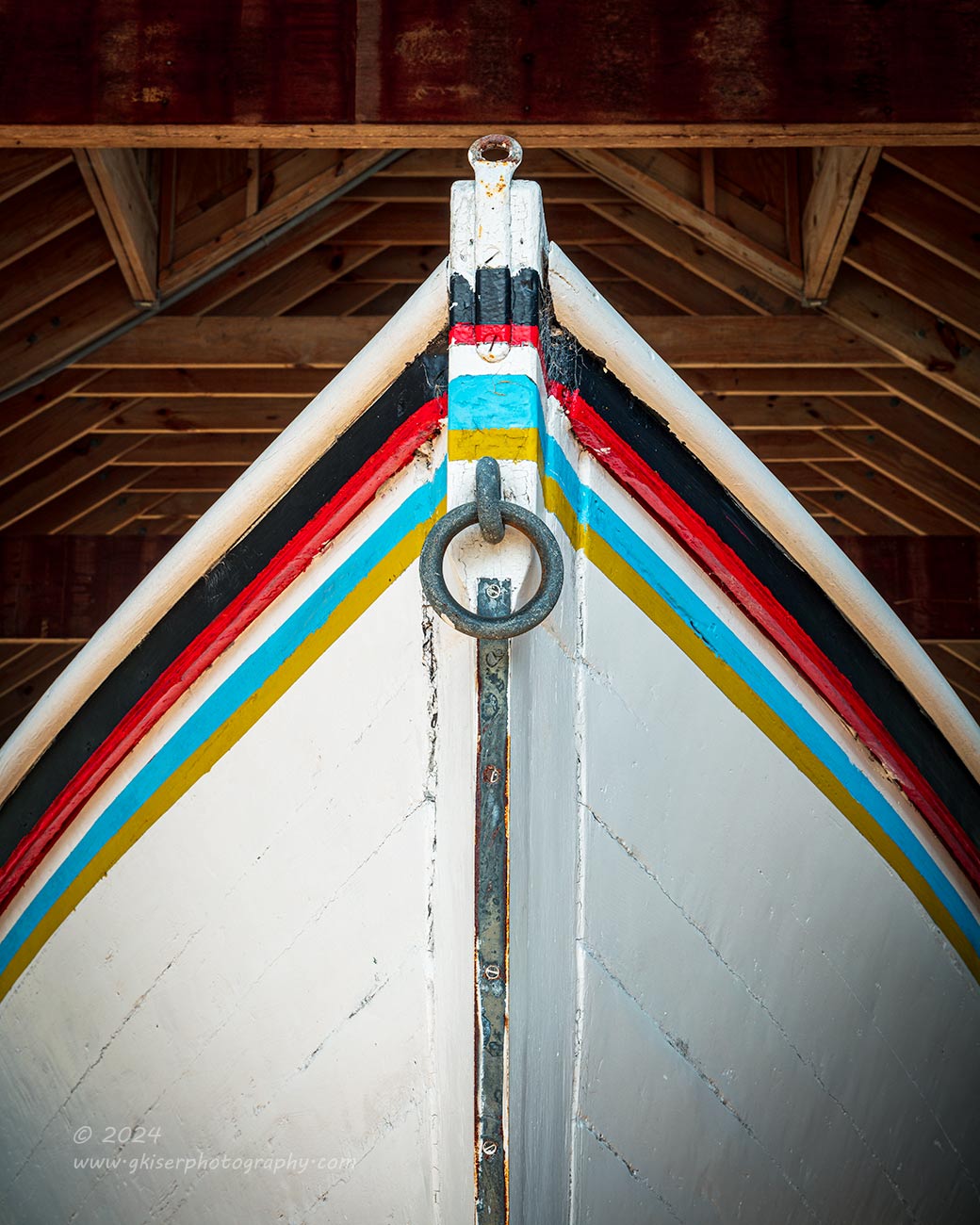
I got the tripod positioned down low and started to frame the image in a vertical fashion to start with. That seemed to make the most sense to me and created a very striking composition from what I could tell on the back of the camera. I did notice that things were not exactly centered and level which forced me to adjust the camera a bit more to get things perfectly symmetrical. When shooting scenes like this, it becomes all about the symmetry and if anything is off, it will become a huge distraction.

I had two solid frames of the front of this boat but wanted an alternative to the one that I just shot. I liked the idea of it horizontal as well based on some of the shapes of the beams above. I flipped the camera and repositioned so that the beams helped to frame the boat, but in a different way than they had before. I wasn’t sure how I would like this, but after looking at it on the back of the camera, I think that it was a solid option for a composition. I’m not sure if I will like one over the other, or if you will see both of them show up here in the blog. I do know that I completely missed the boat (dad joke, sorry, not sorry) on this concept on the first night that I was here. It might have been the lighting, but I think it was more the fact that I was new to the area and hadn’t heard how it wanted to be photographed just yet. This way of reacting to an area is always such an important part of my photography.
I was pretty much back at the start of the area that I had been photographing and felt that I had worked all the areas that I would want to. I had gotten so much more out of this visit than I did on the first one. Granted, I have one of the iconic shots from the area with the lighthouse credited to that first day, but I think that the ones from today are more my personal style and I feel very good about them. I just hope that the photos will do the subjects justice after I get to see them on the big screen and get the edits done on them.
I made the quick journey back to the truck and loaded everything up before heading back down the road. I wanted to check out that rusty boat by the gift shop I had seen coming in earlier. I was also still considering what I was going to do for sunset since there was a pretty good chance that the sky was going to come to life with the way the clouds were looking.
When I pulled out on the main road, I happened to see in one of the restaurant parking lots an old Chevy from the early ‘40’s it looked like. It had been a hot rod at some point but had been left in a state of neglect for a little while it seemed. It was interesting enough that I wanted to turn around and see if there was a composition to be had. Once I got into the parking lot, I noticed that the paint on the car was in remarkably good condition for the general state of the car. I wasn’t wild about the purple color though. It did look good with the trees and the location that it was in. It was worth a few shots, so I started to look around the parking lot for any trespassing signs since the business was closed.
Sure enough, I saw two signs that indicated that there was a no trespass order in place and the indication that violators would be prosecuted. Granted, this could just be a sign and there could be no cooperation on the part of local law enforcement, but I wasn’t going to test the waters here. I will always honor the signs when it comes to trespassing. I did look to see if anyone was inside the building since it might be opening up for dinner later. There was no such luck, so I went back on my way across the bridge to the old rusty boat I had seen on the way over.
Once I exited the bridge, I had to turn through the construction closure to get into the parking lot. Once I was there, I was able to look at the boat in more detail. I loved the patina of the boat, and I even liked the large sphere that it was attached to. I assume that it was a buoy of some sort. Whatever it was, the patina matched the boat and made for a very interesting grouping of elements. What I didn’t like about the scene was the fact that the background was filled with what are certainly multi-million-dollar homes. Those did nothing at all for the story that I was trying to tell with this subject. There were also businesses on either side of the boat and the roadway complete with orange barrels off the front of the boat. I had my work cut out for me here in terms of composition.
I got down very low to see if I could get the boat to mask any of the houses. That seemed to work, but my normal choice for this scenario would be the wider lens and that wasn’t going to work because the background would still be filled with the houses on either side of the boat. By choosing a longer focal length, I would still be able to mask the houses, but I could include less of the background along the sides which allowed me to pick an area where the open yard was a bit wider at one point. That was going to be my breathing room from the side of the boat to the edge of the frame. On the other side, I would crop in close to the buoy to make sure that I didn’t include the very large blue house that was much too nice to be in this photo.

I went to the truck and moved it out of the way since I was going to need room to use the telephoto zoom. I added a polarizer to the lens and got the tripod positioned roughly where I thought it should go. Once I had the camera mounted, I started playing the game of move around an inch at a time to see how things lined up. The last bit of the puzzle was what to do about the buoy. I was going to have to crop through it, but there was a ring that I really wanted to keep in the frame. This made the crop very tight and a choice that had a very great potential of looking accidental if I missed my point by more than a hair.
Once I was fairly happy with the composition I dialed in the proper exposure and fired off a shot. There was a slight bit of clipping on the rim of the boat and on the buoy which I adjusted for by dropping the shutter speed a third of a stop. That worked and the next exposure was right on the money. That was that. There was no other way of doing that composition because of all the background. I can safely say that the composition here was 100% the result of omitting elements that I didn’t want in the frame. Fortunately, the composition does work and allowed me to capture that great patina.
While working with the boat I was also thinking about isolations that I could do. Since there wasn’t much left of the boat except for the rusted hull, there wasn’t much there to work with in terms of isolations. However, I did see that the bow was connected to the buoy, to keep either from floating away in a flood apparently. This was a point of interest with some activity for the eyes to follow.

I moved in closer and started to frame up a shot of the details of the bow. I used a limited depth of field which at this distance still meant a fairly narrow aperture to focus the attention on the rope that went through the eyelet while blurring the background. It was a really neat composition and one that I immediately responded to. I did a little work to fine tune the balance and to make sure that the exposure was right. Once I had all of that figured out, I was very happy with the shot.

The next step was to move to the other side of that same area and see how it looked from inside the boat. The same things that drew me to the first composition drew me in here as well, but things looked different. I don’t think that it was quite as strong as the first composition, but I think that it does have merit. If it made it through the culling, you will see it here in the blog at some point around here. If I decided that it didn’t work, you will at least know that I tried something new and that I can have failures like anyone.
As it turned out, this composition made it through the three rounds of culling, but I chose not to edit it on the first day that I was editing this batch. It wasn’t until the following day when I made a second run through to see if I missed any opportunities when I took a second look at this one. I stood behind my choice that a color edit was not in the books for this composition. That had been what turned me off from it in the first place. I just didn’t look good with all the orange tones of the rust. However, with fresh eyes, I started to look at this as a black and white presentation which would focus on the shapes and textures. That really seemed to fit the composition and I found the right profile to work it in which made all the difference in the world. This might have been the fastest edit of the trek with very few adjustments made overall. The resulting photo captivates me and makes me explore it more than I did when I was looking at it in real time. I think that this will be a very successful photo once it is published in the world.

For the first time after arriving here, I moved to the rear of the boat to see what was back there to photograph. I was surprised to see another buoy, although it was much smaller, and about a quarter rusted out. The scale here was interesting to me, as was the fact that the sun was creating a bit of depth to the scene. I worked out a composition that I thought fit the scene while eliminating the construction going on in the background. It was a tight crop that focused on the textures, colors, and shapes more than the actual objects. Of course, you can tell what you are looking at, so it is not really an abstract, but it does have a leaning in that direction.
I’m telling you, there is just something magical about rust and old decaying subjects. I freely admit it after all this time, I have a decay addiction that rivals what I used to feel about waterfalls. For those of you who remember me back in the days of AOL Journals, I shot more waterfalls than anything else, and had a dream of creating a directory of all of the waterfalls in NC. Only after realizing that there are probably a thousand of them in the state and most are very difficult to get to, I started to reconsider that goal. Also seeing how many photographers have completed the same thing turned me off of that even more. Eventually, I got tired of photographing waterfall after waterfall because I would end up visiting the same ones over and over. Decay is kind of like waterfalls, but how it was in the beginning. There seems to be no shortage of decay out there, and every subject is different. I can see continuing with this for a very long time before I get bored of it. I guess I won’t be checking into decay rehab anytime soon. Would that be another term for a restoration shop? I know…another dad joke.
When I was finally finished with the old rusty boat, I hopped back in the truck and continued out to Nags Head Pier where I had started the day off. I wanted to capture that interesting structure once again, but with softer light on it. If I was lucky, the sky would start to get some color near sunset and really make things look fancy. The trip didn’t take long and when I got there, I realized that I was much too early to start shooting it. I did need to check the tide levels and how the beach looked around it. I was assuming that during the higher tides it was completely covered up, only to be revealed during low tide. Looking at the tide charts, low tide was going to be at 6:30pm which was about two hours away at this point. I had no idea how things were looking or if I would even be able to photograph it again tonight. A quick walk up to the beach access was all that I needed.
I had chosen a different location to park since I knew approximately where the feature was and saw no need in walking so far on the beach. Little did I know that the access point was right at the object. As it turns out, there was a warning sign about that object that identified what it was. This was actually a storm drain discharge pipe from the town which makes total sense. What didn’t make sense was the two large families with kids that were camped out right at the edge of the water by the pipe. I get that they were close to the access point, but the sign also said don’t swim within 200 feet of the pipe because of increased risk of water born illness.
Granted, it didn’t appear like the kids were swimming and it was a bit too cold for that anyway, but they were running around in bare feet all around where the sand was saturated with the water. Maybe it is just me, but I would have pitched my umbrella further away and let the kids run freely. For my purposes, I was wearing my old city issued boots which are amazingly waterproof, and I figured they would protect me from the nasty stuff. I mean I used to walk the streets during floods in these boots replacing manhole covers while dodging brown trout. This couldn’t be any worse.
The tide looked about right for the time, and I could see that six of the beams were visible while the seventh was starting to get the sand removed from the exiting tide. The light was good, but I wanted the tide to drop a bit more. I just stood there on the overlook waiting to see how things started to look.
I was a little concerned with the two families as I was going to be working between them. I wasn’t going to be in their space necessarily, but I didn’t want to be in their way. My hope was that as it neared mealtime that they would leave the area. So I didn’t look like a perve standing there staring in their direction, I retired to the truck to catch up on social media and other things phone related.
I sat there for about 30 minutes or so and could see that the light was getting softer. I was estimating not wanting to go longer than 30 seconds on the exposure by the time the light dropped but was needing something in the area of 2-10 seconds to get started based on how I was seeing the water at this stage of the tide.
Not wanting to fumble with building the camera right at the water’s edge in the sand with the breeze, I decided to get things put together in the parking lot. I had the benefit of knowing the composition and the lens needed to get there. It was the same one that I had shot with earlier this morning and has been my trusty workhorse lens for many years. The standard zoom seems to work out great for the beach even though I have been using the telephoto much more regularly over the past year. It is wide enough to capture a grand scene, while being able to pick out details, but not so wide as to introduce a curve to the horizon. I knew that I wanted a polarizer so I could control the contrast of the water as best I could. I didn’t expect much from the sky because I would be shooting on axis with the sun so the polarization effect would be greatly limited. The last bit of the puzzle was the 5-stop ND grad which I figured would get me what I needed now and allow me to stretch the exposure at it got less bright and the water levels dropped more.
With the camera built, I put the backpack on just so I had access to the lens cloths and extra batteries. It would also give me a place to put the ND Filter if I needed to remove it. With the camera in hand, I went up the stairs and over the dunes to get up close and personal with a drain. It then hit me…I was going out there to make fine art with a drain carrying storm water. Why not? I mean I went out and photographed a rusty bicycle leaning up against a brick wall a few hours before. I’m not your typical photographer.
When I could see the beach once again, I could see that one of the families was packing up and getting ready to leave. Great timing! I walked out there with all my gear and plopped the tripod down on the right side of the drain so that the beams would read correctly from the left to the right. I started to get the composition sorted out and found that I needed to move in closer. I was right on the edge of where the water was coming up to, but since the tide was still going out, I felt that was a safe bet. I would be able to move in closer soon enough.
The nice thing about the 5-stop filter is that I can still get things composed through the viewfinder, and the live view works great still. I can even use the histogram and light meter which makes it all so much faster to work out. All of this was going to become a very important detail as this part of the day progressed.

The first test shot that I made turned out excellent and captured the mood that I was hoping to with the ethereal water moving around the beams. The exposure was dead on accurate and I liked the composition. Just to make sure, I bumped up the exposure by a click and tried another to see if it would hold the highlights. It didn’t, so I backed it back down. I had time to make just one more exposure and I saw the water heading for the tripod, so I picked it up quickly and moved back a couple of feet.
The water was apparently not moving out as fast as I had thought so I set up shop again a bit further back to avoid the water. I managed to get maybe two more exposures done before the water again hit the tripod which causes that leg to sink quickly. This affects the horizon and potentially the whole composition which is not favorable at all.
I moved back once again and found that I was at the limit of my 70mm lens to get the framing that I wanted. There were two main aspects that drove my framing for this shot. I had to keep the bottom frame close to the first beam because I wanted to keep the flow of water in the entire frame to keep the look I was after. Sand was not something that I really wanted to showcase in this composition. The other aspect that I had to keep in mind was the amount of sky that was included. There was not a lot of great texture in the sky which wasn’t terrible, but I didn’t want a lot of negative space in the frame either. Now, if I blur the horizon line and make the water transition smoothly into the sky for a very uniform background, I can deal with it, but for the purposes that I was seeing right now, I wanted to minimize the sky. That kind of dictated the sides of the frame because I didn’t want to make this a 16:9 aspect ratio as it would negatively affect the overall composition. Framing was very important with this shot, and I needed to be closer to get the framing that I wanted.
I wasn’t able to move back any more at this point, but it was looking like I was going to have to as the water was approaching me once again. I now about 15 feet further back than where I had started. I swear that the tide was supposed to be going out at this point. I wasn’t sure why the opposite was happening. I just decided to play it safe and go back up on the beach to wait a little longer in the hopes that the tide would actually move out a bit more allowing me to get back into position.
While I was standing well out of the range of the water, I was taking notes of how the water seemed to be flowing. It was coming in higher on the right side than it was on the left. I might be able to get a stronger composition from that side as I would be able to get in closer, even though the direction of the composition would be a little off. I went back down to the pipe and set up on that left side with the composition pretty much the same as I had done on the other, just a mirror image. While I was getting things set up, the other family was packing up and getting ready to leave. I was going to have the beach all to myself while I photographed this drain in the water.

Thanks to the ease of use of the 5-stop filter, I was back in business in no time. I had settled on an exposure of about 5-6 seconds which seemed to give me the look I was after based on how the water was flowing over the structures. The waves were still overrunning them, so I had to time the exposures for when there was a lull in the waves, but after a large wave had passed by covering the foreground with frothy water. It was a process to get the exposures made.
There was also the issue that Paula Abdul was singing in my head. I kept thinking “two steps forward, and one step back” cause every time I would get into a routine, a wave would come and sink the tripod. I would move back until it looked like the waves were under control. Once I advanced just a little further than I had been before, a wave would push me back to the prior spot. I was still needing to balance the foreground with the frothy water’s reach so the closer I could get the better.
Something that I noticed on this side was that the sky was looking a bit better from this angle with a tad more detail to it. I liked that aspect and thought that it complimented the waterflow nicely. I was also seeing that the left side of the first beam was the one that was emerging the best from the sand. By shooting from this side, I was getting more detail in that area which I really liked.
Things were working decently here even though I was still having to do the occasional retreat. I was able to get things lined back up quickly when I had to move and I was back to shooting. I hated making so many frames here, but I knew that the law of averages was going to be key with this type of subject. The more I shot, the more chances I would have of getting something really interesting.

Speaking of really interesting, I kept playing with the profiles in the camera switching back and forth between color and black and white. I’m really thinking that the morning captures will be done in full color while these will be best done in black and white with a more fine art feel. I’m not quite sure how that will go just yet, and I might do one each from the two sessions depending on how I am feeling. Remember, I have not yet fully culled the photos yet, and haven’t even seen them on a screen larger than the back of the camera. It is really killing me to be recounting these shoots without knowing how the photos have turned out.
There is one benefit to this way of doing things though. I am focusing more on the process and what was going through my mind rather than a description of each photograph. I do kind of like that because I tend to get too technical when I am looking at the edited photo on the screen. Doing it this way, I am still stuck in the feeling of the photo rather than the actual image. I hope that it makes for a more interesting read. I think that it is making for a longer winded account since I am talking about every step that I made rather than doing a little creative editing for parts that I knew resulted in photos that didn’t make the cut. It will be interesting to see if as many keepers are going to turn up as I have been talking about.
My initial plan was to shoot this drain until sunset and get two different feelings with it. In hindsight, I probably should have, but the truth of the matter was I had been shooting pretty much all day long and I was tired. The thought of standing here and fighting the waves that kept coming in to disturb my composition was too taxing to deal with. I had been out here for a little over an hour and had shot 81 frames of pretty much the same thing. If I wanted to stay until sunset, that was pretty much another guaranteed 100 frames. Looking back over the beach, there were some very thick clouds below the sun which were very likely going to block any color that it was going to give off. My instinct told me that the only thing that sunset was going to bring was darker lighting over the ocean. I felt that I had what I wanted and needed from this drain.
With that in mind, I decided to pack it in and head back to the room to get ready for dinner. I was hungry and tired. The trip back to the room confirmed my thoughts about the sunset potential. The clouds were already starting to snuff out the sun and the light was looking very flat over the area. My day of photography was all done, and I was happy about it. I had shot some 200 new photos since the morning which is a lot for me. I’m thinking that there might be a dozen keepers out of that, but a quick look through the blog will either confirm or deny that estimate. I promise I will leave this paragraph alone after the images are uploaded.
Once I was back in the room, I pulled the camera out and gave it a good quick clean to get the salt air off of it. I put it all away while the battery was charging. I headed out to grab a bit to eat and had been hankering a cheeseburger from Dairy Queen which was just a half mile up the road. I was ready to sit down and eat something hot for a change.
A funny story about DQ and we will wrap this long blog up. When I got there, I had a hard time figuring out how to get into the restaurant. As it turned out, there was no dine-in area, it was all drive-thru and outside seating. Oh well, I was too tired to care. I went to the ordering window and looked at the menu. I saw no burgers and assumed that I was missing something. I asked the lady if they were still doing burgers to which she replied not at this location. I could have gone somewhere else, but I was here, so I just ordered a chicken tender platter with a drink. Looking at the soft drink machine in the background I was afraid to ask, but asked if they had sweet tea. They did, and that is what I got. As I sat in the cold eating my meal, I could feel the energy returning, and for the first time I looked up in the sky to see that the sunset was awesome. The reds and pinks were stretching through the sky from West to East. I would have done better to stay on post and capture the drain as I had imagined. I could have also done some shots just over the water. I had missed the opportunity, but I also knew that I didn’t have the energy needed to do all that. The right choice was made, and I am at peace with just enjoying the beautiful sky.
Before I left DQ, I checked out the dessert menu because it has been forever since I have had a Blizzard. I saw that they had a limited time flavor of Snickerdoodle Cookie Dough. That was something right up my alley, so I went up to ask about getting one. Half joking after the burger incident, I asked if they had one of those Blizzards for me. The response was that they were all sold out of that particular flavor. Certainly, they had to be joking. Nope, there was no joke there. I asked if they had any of the limited flavors and the reply was that they had all of them but the Snickerdoodle one since the others could be made with existing ingredients. Like my meal, I settled on one of the other flavors which turned out to be very good, but not what I was wanting. That pretty much finished out the day.
On the topic of the sunset, you might have scrolled back up in the photos to check out the next to last one that I have shared. There is obvious color in that one that would indicate it was shot during the sunset. That wasn’t really the case, and this is all due to the editing that I chose for this photo. Since I was wanting one of these with colors, I picked one and played with the colors kind of like I had done with a panorama from Doughton Park back in the Spring of last year. Just like in that case, I had in mind a certain look to the image but hadn’t been granted those conditions. With some local adjustments and a different color profile, I was able to get something very close to how I would have wanted the scene to look under the soft colors of the sunset behind me.
When I got back to the room, I started to look at the weather and saw that what had been forecasted as a cloudy morning followed by a clearing afternoon was now looking like a total washout of a day with nearly 100% chance of rain all day long. The more I looked at the different weather apps the more it was looking like the day was going to be a waste. I even thought about leaving a day early so I could get started on the edits sooner rather than later. Just in case though, I set the alarm for early in the morning with hopes that there would be no rain and favorable conditions for a sunrise.
Well, the rain falling on the A/C unit woke me up at 4am and I knew the answer before even looking at the weather. The rain was here and would likely be present until late afternoon. I never did go back to sleep and thought about what I could shoot quick in a little drizzle to salvage the last full day on the coast. The only thing that came to mind was that red truck out on the main drive. I could also hopefully do some night photography with the lights on the buildings. The main thing that kept me here until Tuesday morning was the hope for one more good sunrise before I left the coast.
We shall see how that turns out because as of right now (1:42pm on Monday) it is still raining and I’m still in the shorts that I slept in. From here on out, it will be a surprise for all of us how things turn out. I know that as of right now, I am just shy of 500 photos on the camera which is going to be a lot to work through when I get home.
Until next time…if there will be a next time on this trek.