Welcome back for another month of my Behind the Camera series. It is here that I will generally talk about things that are related to my photography, but not necessarily related to a specific trek. I’ve done things a bit different this year, in that I had a rough idea of what topics I would be covering prior to the beginning of the year. Since I was having a creative epiphany, I just wrote the topics down in an order that I thought would go along with the process of the year. The topic for July ended up being a question that I have been dealing with for a number of years now, without a clear answer. I had hoped that by this point in the year, I might have a handle on it because I had been getting closer and closer to finding an answer that kind of worked for me.
So, what is that questions you ask? On its face, it seems like a very simple question to answer, and the question itself isn’t even that complex. What is Fine Art? I think that we all have an idea of what “art” is, or at least a good working definition of it that originated in elementary school when we learned that art dealt with things like construction paper, glue, and crayons. We learned that art was not edible, or at least that was part of the curriculum that I remember. As we all grew up into adults, we came to realize that art could be found in many forms like paintings, music, and even writing. A while back I made a case that photography could also be an artform. So, if art is a term that can encompass a whole lot of different things, when you add the word “fine” to it, what does that mean to the concept? When does art become “Fine Art?”
When you put “fine” in front of dining, you get fine dining which usually means that the bill is equal to a car payment, and you get a main course that looks like a decorative crumb off the plate at the next table. When you put “fine” in front of wine, the grapes apparently transcend the norm, and you get wine that somehow changes your accent, and you have to wear evening attire to consume it. Both examples start to equate to a higher tier of quality when the word “fine” is added to something that we are already familiar with. So, going with that logic, fine art is just art that is more refined. Maybe it is the use of negative space as with fine dining when most of the plate is left empty that causes that refinement. It could be that art that is left out to age a while then becomes fine art. Maybe it is the change in quality from the really thick crayons, to colored pencils (with the finer tip) that makes fine art? I mean after all, there is detail, and then there is “fine” detail. Come to think of it, there is a .jpg setting in most digital cameras where you can set it to “fine”. Could it really be that simple? If I just select “jpeg fine” in the menu, whatever I shoot will be fine art?
A quick Google of the term brought up The Free Dictionary where fine art was defined as: “Art produced or intended primarily for beauty rather than utility.” Another variation on the definition is described as: “Fine art is any art created for its own sake, as opposed to commercial artwork.”
Well, that clears things up, I think. Essentially, any art that is meant to be beautiful, and not for a commercial purpose is fine art. Congratulations parents! You have a refrigerator door full of fine art made with fat crayons, construction paper, and glue. That can’t be right….can it? When I think of “fine art” I think about snobby folks looking at the piece and debating the merits of said work. I think about classical music playing in the background as kids tug at their parent’s sleeves in an attempt to get them to leave so they can go home and watch cartoons. Yeah, I was not brought up in an artistic family. The point is, art for the sake of beauty kind of defines art, I think. Fine art is something else, something beyond just an aesthetic.
As you know, I’ve been on a personal mission of sorts to define this elusive term for some time now, especially as it applies to photography. I feel like I owe it to myself because after all, I have been self-describing what I do as being a “fine art landscape and decay photographer”. Based on the simple definitions above, I fully fit into that purpose because I am creating my photographs for the purpose of being beautiful. Then again, my first photographs were attempts at the same thing, so were they “fine art” as well? That is the debate that I have been having with myself for a number of years now. It has been frustrating because I see “fine art” tossed around without a care just like “fine dining.” I think that for a time the Red Shoe Cafe was trying to become a fine dining experience, but a Big Mac will always be a Big Mac.

Late last year I decided I was going to go on a mission to define this concept for myself once and for all. I set out on a creative path where I was looking for subjects that might fall into the realm of “fine art” in an attempt to stumble upon a definition that I could understand. What I have discovered is there is a distinction between art (for art’s sake) and that of “fine art.” It is a subtle difference to be sure, but I think I’ll be able to describe that difference by the end of this entry. The photo I’ve added here is one that I think falls into that category of “fine art.”
While my idea of “fine art” was a bit fuzzy when I shot this one, I was going on the premise that I was looking for well-defined shapes and a certain simplicity to the look. In short, I was looking for a clean photograph with no doubt as to what I was looking to capture. This is kind of where my “fine art” concept had been falling for a while. There have always been photographs that I had seen online that were usually cityscapes, or long bridges that were done in black and white with a high contrast treatment so that the image was really reduced down to lines and shapes. Typically, black and white images are there to show texture, but I was seeing a lot more negative space, and less textures in those images that I thought were classified as “fine art.” Maybe comparing this to “fine dining” was actually on the right track. The clean negative space of the plate brought the attention to the relatively small subject within the plate. That was kind of what I was after with this photograph, and I think it worked out well. Of course, there is just enough evidence of real life with the water droplets and the blistered chrome that lends itself to my type of photography.
Would this photograph be displayed on a wall to be commented on by the society elite? Who knows the answer to that question? Is this art for the sake of beauty and not for a commercial use? Well, I didn’t make this photo for a brochure for Ford, and it is not appearing on a billboard anywhere. I created this photo because the subject excited me, and I liked how the light was playing on the hood with the polarizer attached. According to the definitions that I have found, this would certainly be “fine art.” But is it really?

It was the end of Summer last year when I really started to look at the idea of “fine art” as a specific concept and not just a way of describing what I did. I went out on a trek in search of subjects that I would view as being art. The logic was, If I captured art, as a subject, in a way that spoke to me, would the resulting image then be considered “fine art?” Well, I had a great morning on the campus of Appalachian State University putting that to the test. I found a wonderful sculpture in the middle of campus and started to work with the light of the morning in order to find the best angles to photograph the piece. I then added a new element to the idea of “fine art” photography which I had seen used by many photographers doing what I would consider “fine art.” That was the use of long exposures in the captures. By dragging the shutter, the background would be simplified, and I would have that empty plate as negative space for my main course. As the last bit of “fine art” process, the images were then processed in a way that wasn’t necessarily accurate to the colors of the morning but were accurate to the vision that I had for each of the images. They were all processed differently depending on the light and composition which added to my thought that I was creating something somehow more than just a photograph. It was an artistic representation of art and certainly that would be “fine art” at its finest. But what made this “fine art” and other photographs not?
If it was the slow shutter speed transforming the motion of the background into an element all to itself, or the more creative processing that was used, would this not mean that “fine art” photography was more about telling lies and changing the scene than about the photography? If that was the case, would photography by itself not qualify as being fine art? I couldn’t agree with that idea because I fully believe that photography can result in a fine art image all by itself. So, what makes this image feel like something that should be labeled as “fine art?”
Once, when I was up on the Blue Ridge Parkway looking for early fall colors, I saw a tractor that I wanted to photograph. There was very little in the way of colors to the leaves, but I gave it a try anyway. The tractor made for a good photograph, but I recognized that it was just a photograph. I didn’t feel that I had created fine art with that attempt, not that it was my ultimate goal, but I somehow recognized that this was just art, and not “fine” art. Maybe I should have left the photograph out to ferment for a while longer and come back to it in 2031 to see if it had aged into a “fine art” photograph. Somehow, I doubt that would happen, but I’ll see you back here in October 2031 as we look at the tractor photograph to see if it has become “fine art.”
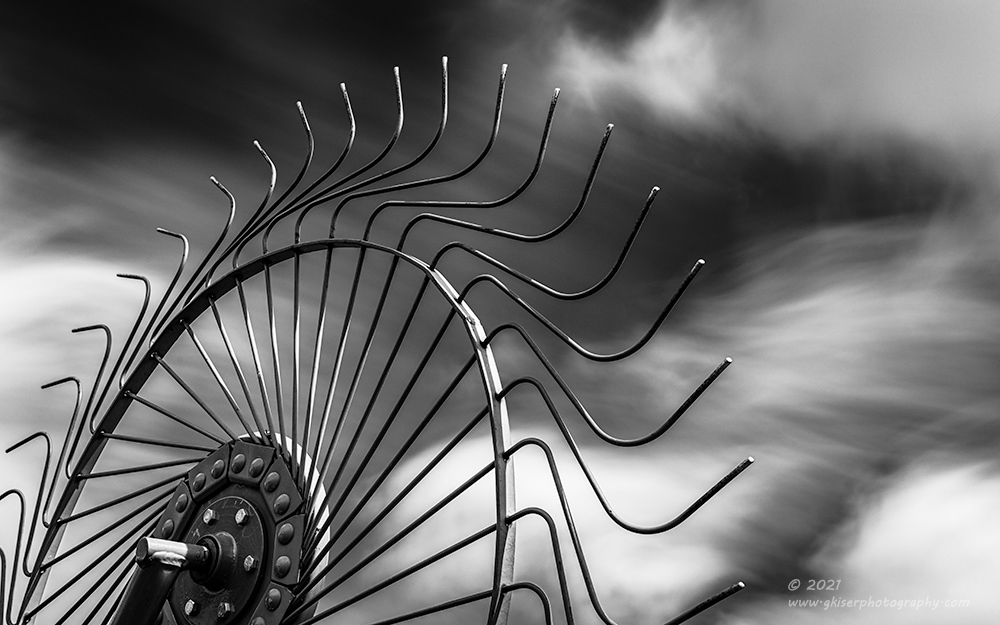
In the meantime, let’s take a look at this photograph that was made shortly after the tractor photo. It is a hay rake that was attached to the tractor and placed in the upright storage position. I’m not sure if anyone else would have seen that farm implement and said to themselves “Boy, I gotta get a photo of that spiky thing, that looks awesome!” No, I dare say that most would have moved right on past that hay rake and been satisfied with the tractor. I almost was, but it was the clouds that grabbed my attention here and I could see the direction that they were flowing which worked with the tines of the rake. It took me a few minutes to set the composition up and to figure out the right shutter speed to get the look I was after. Once I had all that dialed in, I just repeated my minute long exposures one after another as the clouds moved around until I had several images that I really liked. When I got home, I processed one as this black and white, and I did one as color.
In my own research, I had determined that “fine art” images were typically black and white. I’m not sure why that is, it might just be one of those throwbacks to film photography when a “true artist” did their own developing in a darkroom which was typically black and white. Color processing was much more difficult back in those days and a photographer would have to send the negatives off to a lab unless they had a really extensive darkroom set up. The black and white photo has almost an elitist feel to it in this day and age because it pays tribute to those pioneering photographers, but does that alone make an image “fine art?” I’ve seen plenty of black and white images, my own included, that I wouldn’t really consider “fine art.” I would certainly consider them art, but that one word just keeps sticking in my head and I feel like it should be reserved for something special.
I know I am overthinking this way too much, but these are the things that keep me awake at night and push me to make better images. I am always striving for that “fine art” look with my photographs, but until I can really define it, will I ever be able to achieve that look? So far, I’ve managed to reduce it down to some basic qualities like use of negative space, bending reality, simplification through motion, and lack of color, or creative colors. Just when I think I have it all figured out, I throw a monkey wrench into the mix by shooting an image that fits all those criteria, but somehow fails as looking like “fine art.”
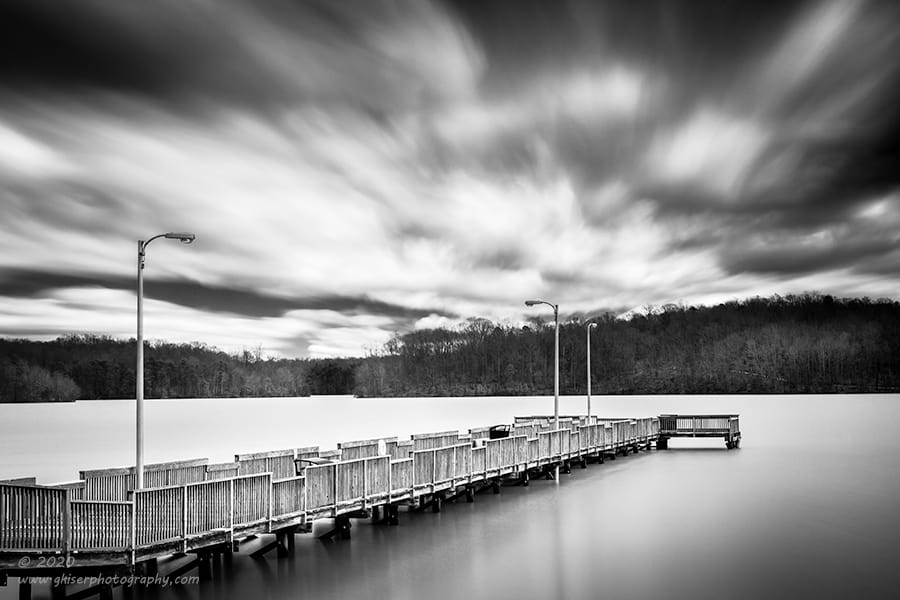
This is one of those images that hits the high points of what I have come to think about “fine art,” but yet, this is not something that I would really consider “fine art.” All the elements are there, but when you look at this, it is just a photo of a pier over a lake. I still really like the photo, but it lacks a certain quality that I think would elevate it to “fine art” status. What could that element be though? It might be the subject itself, or it might just be the scope of the scene. What I mean is this; because I have shot this as a wider view, there are a lot of visual clues as to what is being looked at. There is a visual anchor to the image that grounds the scene in logic. There is mood and atmosphere, but not a visual shock to the system. There is a certain “POW” quality that I have seen with “fine art” images that I have looked at. It does have a direct impact, but this photograph is more about a gradual understanding of what is being seen. The process between seeing and understanding is linear with an expected end point. You look at this photo, and you see a scene. You pick up on the visual clues and you can readily identify what it is that you are seeing. It might cause a memory or two, or even prompt an emotion, but that is kind of the end of it.

Just for fun, how about we take a look at this photograph for a minute. It was shot at the same pier a couple of years earlier. This one is obviously in full color which goes against my working definition of “fine art.” There were no tricks that were involved here like a long exposure, or even off the wall editing. There is negative space, but that negative space is almost the main subject. The capture was simple by just focusing on the reflection of the Autumn trees in the background of the pier. Is this “fine art?” I think that it is, but why? That is the part that I am really wanting to figure out here because the “rules” that I had established didn’t seem to be panning out in practice. “Fine art” just had a way of happening without any real thought to the process which was interesting to me.

Speaking of rules, this photograph is obviously done in black and white. There are well defined shapes, and it is a high contrast representation of the subject. There is no negative space to be had, and no long exposure showing motion. It was just a fraction of a second capture of an old Buick, yet I believe that this falls into the “fine art” category quite nicely. How could that be? Could it be the isolation aspect of the composition where I picked out a very small portion of the scene? That seemed to be the trick with the pier at the lake as well as the other images that I have included here. Maybe that is the point of “fine art,” to isolate elements and photograph them.
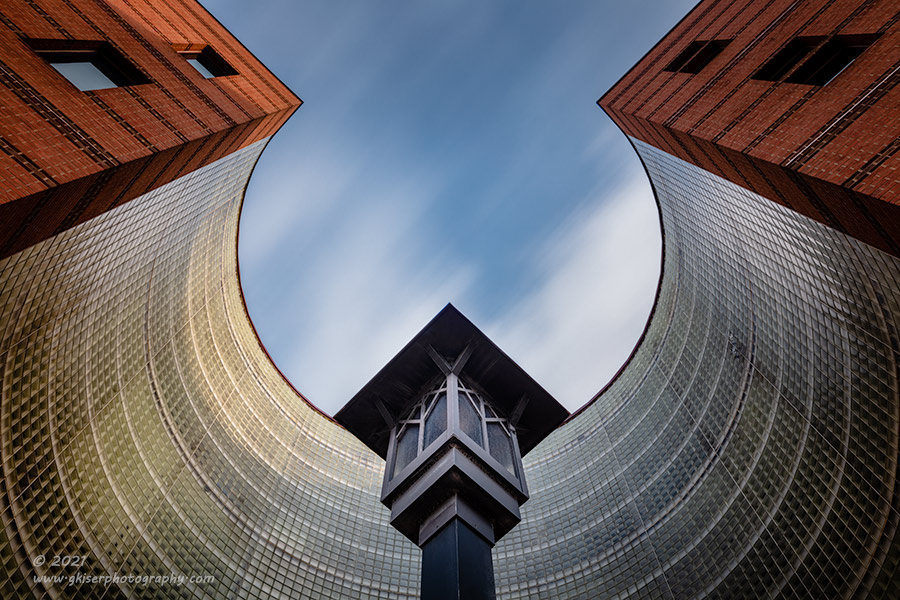
Well, that might not be the case either. Here we have a building that is at Appalachian State University. This photograph was created with my wide-angle lens and incorporates several floors worth of the building as well as a lamp post that is mounted to the ground below. This image is not in black and white, there is not much negative space, the colors are accurate to what was present that day. There is, however, a long exposure showing motion in the sky. The subject is clearly definable as well with the lamp. The building is a little more difficult to define, but as you look at the clues, you will eventually get to that destination. Is this “fine art?” I fully think that it is, and it is one of my favorite “fine art” pieces that I’ve done. In fact, this made it to the top spot in my top 12 of 2021. Yet, I still didn’t have a handle on what makes this “fine art” and other images that I have shot of buildings just “art.”

Here is another building that I had shot in Downtown Greensboro, NC. There was no long exposure here, but it was done in black and white to take advantage of the lighting and the lines. It is readily apparent what you are looking at, and while it was shot with a telephoto lens, there is a good deal of the scene in the frame. I do consider this “fine art,” but for the life of me, I have not been able to determine why that is. The concept of “fine art” is so easy to recognize, but yet so difficult to define. At least that is my reaction to it. I can recognize it in other’s photography and even my own, but when it comes down to figuring out what was done specifically to make it “fine art” I just get all confused and I’ve figured out there really isn’t a technical recipe for creating a “fine art” photograph. It has to be something completely different that I have been missing all these years.
If it is not the subject, and not the techniques in capture that make “fine art,” what is that missing element that magically transforms a photograph into “fine art?” A few months ago, I was watching a video on YouTube and the photographer said something that just stuck in my head for several days. I don’t remember the exact words that were used or even what specifically he was talking about, but the more I thought about what had been said, the more I started to understand that missing link in “fine art” photography. Essentially, the determination has nothing to do with the subject or the techniques used in the capture or processing. What made art “fine” was the message behind it. This is kind of like the story of a photograph, but slightly different. I worked on putting together a working definition of what I had figured out and it came out to be this: Fine art photography allows the viewer to imagine their own context within the image.
Essentially, I have figured out that the defining characteristic for “fine art” photography is that the photograph causes the viewer to think beyond the image and bring in their own context. Looking back on the images that I have shared here so far; I think we can see that. Starting off with the hood scoop that I led off with, there isn’t enough there visually to tell the context of what is being seen. It is up to the viewer to fill in a lot of the blanks both visually and to the story itself. The interpretation of the photograph is left completely up to the viewer.
In the next image of the sculpture, the same thing applies. There are no visual clues as to scale, or what exactly we are looking at. It is just a series of shapes with muted colors that all seem to go together in a very convenient way. As the photographer, I didn’t establish a sense of location or anchor for the image. It has been removed from context which forces the viewer to create their own context from looking at the image. In short, to understand the image, the viewer has to fill in the pieces which will bring about a different understanding depending on who is looking at the photograph.
The hay rake is very similar in that regard because again, there is no scale or setting available. I have included no context to the scene, and I’ve forced the viewer to bring their own understanding to the image. The elements that are present are organized to flow together and give a sense of movement and drama, but no clues as to what this photograph is all about, or the message behind it. That is left up to the viewer, and the purpose is purely a celebration of beauty.
In the next two examples, I showed two images of the pier at Salem Lake. In the first one, the context is clear. We have a clear setting, subject, and weather. The message is there for the viewer to see. As the photographer, I have answered all of the important questions and left only memories that might be sparked by the viewer. The reaction to the photo should be fairly similar between viewers because there is not a lot left up to interpretation. However, in the more isolated view with the Autumn colors being reflected, there isn’t much context to the scene. It is all shapes and colors. The context is brought in by the viewer, and therefore the reaction will be widely different depending on who is viewing this particular photograph.
Are you starting to understand how I am differentiating “fine art” from art? The grill from the Buick is another one that really doesn’t have context. In fact, unless you are familiar with the styling of grills from that era, you will probably not fully grasp what you are looking at. You will search through the photograph for clues and to determine what is real and what is reflection. Through all of that searching, you will introduce your own context and reason behind the image. As the photographer, I have captured 75% of the photo knowing that the viewer will bring in the remaining 25% to complete the image. I am starting to realize that “fine art” is all about including the viewer in a very instrumental way to the final image. It is that connection, and the fact that the context, which I have no control over, completes the image for an individual, that makes this such a fun way of creating art.
The photo of the lamp post encased in the building is another one that causes the viewer to become engaged in the image. The elements can all be recognized, but thanks to the perspective, the viewer is seeing this scene in a way that is not customary. It is that shock to the system that creates the shapes as being the primary focus. When I look at this piece, I see Pac Man aimed down with the diagonal lines coming in from the top. I don’t actually see the individual elements, but the shape that is created from the union of these elements. That is the context that I bring to this piece, and I figure that your context will be different. The final image greatly surpasses the sum of the individual parts to create something that causes the viewer to think.
In that last image of the building in Greensboro, it is the reflections that again make up the visual interest of the scene. While you can tell that this is a photograph of a building, there is a funhouse aspect to it where you get lost in what is reflection and what is real structure. That causes the viewer to become engaged, and the context has nothing to do with the subject, but rather what is subject and what is just reflected reality. The image becomes less about subject and more about lines and shapes within.
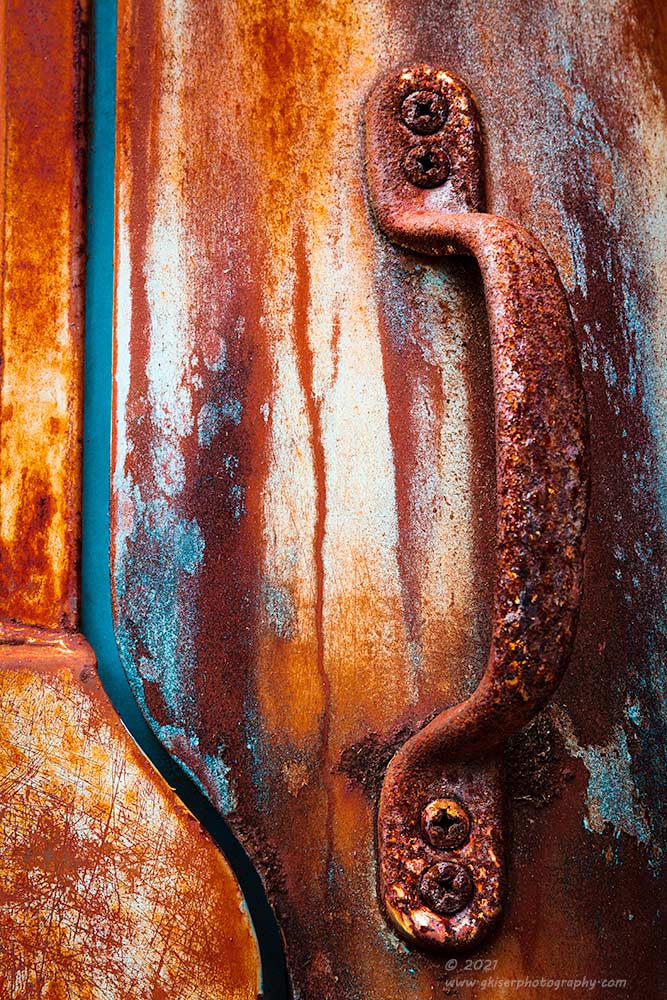
After many years, I think that I have a working understanding of “fine art” and how it applies to my photography. I’m still training myself to recognize it as I come across the scenes that might lend themselves to “fine art” captures, but now that I know what the end result should represent, I think that finding the subjects will be much simpler. The beauty of this type of photography is it can be done with an endless number of subjects. It just comes down to how the photographer sees and reacts to what they are looking at. The biggest takeaway that I have come across with this type of photography is that “fine art” comes after you have really worked a subject and are starting to run out of ideas.
What I mean is this; the normal way of approaching a photograph is to get the overall scene that attracted you in the first place. You will then try to change up the composition to improve the image. You will then start to find smaller aspects within the scene that catch your attention that you will then work. When you are completely exhausted and have no more ideas, that is when “fine art” happens. You actually look beyond the subject and begin to break it down to just shapes, textures, light, and shadow. When you remove the context of the location, and make it so the subject doesn’t matter, the resulting image will leave the viewer fully engaged to fill in those parts. When you have actively involved the viewer in your composition, you have created “fine art.” Whether you use color or black and white, or you choose to have 95% negative space in your frame. Shutter speed doesn’t matter, nor does your processing. The only thing that really matters in “fine art” is that you force the viewer to provide the context that you have removed.
The danger with fine art is you have a very short timeframe in which to capture that attention. If you remove too much context and visual interest, the viewer will look at the picture and move on without ever giving it a second thought. If you leave in too much context, the viewer will look at the photo and either enjoy it, or not. It might spark a memory or two, but that will be it. If you get the balance right, you will capture the attention of the viewer, and then you will make them an active component to the image. In a way Goldilocks and the Three Bears is not about a child breaking into a house and rummaging all through it (never thought about the criminal aspect, did you?), but it is about “fine art.” This porridge lacks too little context and is boring. This bed with the character sheets and bedrails has too much context and leaves nothing to the imagination. However, that chair in the middle of the room is interesting, it looks comfortable, but I don’t know much about it. After considering it and sitting in it, I find that it is juuuusssssst right and I know that this is a chair I can enjoy for a very long time. That is “fine art!”
Thank you for joining me for yet another exploration into my inner thoughts as a photographer. I hope that this has been enlightening to you and has given you a better grip on what “fine art” really means. Of course, this is all just the ramblings of a photographer that is becoming more and more of a hermit, so don’t take my word for it. Put it to your own test when you look at anything that you would consider “fine art.” What makes it special, and different from “regular art?” You might be surprised that this is harder to define than you thought it was.
I’ll see everyone back here next month when we look at some things to avoid in landscape photos. I don’t know how many of those things there will be yet, but it should be a fun trip down memory lane for me as I consider all of the mistakes I have made over the years. I’ll be doing this as kind of an introduction to several of my workshops that are scheduled for the Fall and early Winter. There is no sense in others making the same mistakes that I have made. If I can steer you in a different direction, then I’ve done my job as a photographer.
Until next time…

Remember to use the code KISER10 to get 10% off your purchase