Saturday, July 22, 2023
Jekyll Island (Part 1): Getting to Know the Island
Jekyll Island (Part 2): Trying it All Out
Jekyll Island (Part 3): Visiting Another World
Jekyll Island (Part 4): My Last Stand
I must have been worn slap out because I don’t remember moving at any point during the night. On the other hand, the one time I do remember waking up, I reached up for the phone to see what time it was…3:57am. A quick moment of remembering where I was and I realized that I was going to be waking up in three minutes. No sense going back to sleep at this point. I turned off the alarm and looked at the weather. The first icon that I saw on the phone was that of rain. The rain should have ended hours ago. I opened up the weather app and sure enough, there was rain for the next two-hour blocks, and the radar confirmed that there was rain overhead. It was looking like it would be finished right around sunrise, but I had an hour’s walk to get there. I opened up Clear Outside, and saw that there was no rain currently and the only rain in the forecast was going to start at around 10am. The clouds were all jumbled in the altitudes, and it was not full coverage which meant a fair chance for a good sunrise. I checked the sunrise forecaster and found that there was still a good chance to see color in the sky this morning.
My gut told me to stay in bed and just take the car to get there in order to avoid the rain, but my sense of mission wouldn’t allow me to do that. I had made a mental plan to make this journey several times during the weekend, and I had yet to walk it. The walk would do me good and give me time to become one with the area both in sight and sound. I had given up trying to become one with the area by smell because to be brutally honest, Jekyll Island could use some deodorant. I wasn’t sure how hard it was raining, and that would probably force a decision one way or the other, so I got up and went to the balcony door. I stepped outside and didn’t hear anything falling. The ground was wet, and it felt like rain, but there was no indication that anything was falling, or at least it wasn’t reaching the ground. That was good enough for me. I had an umbrella, and the rain cover was already on the camera bag.
Once I got dressed, I ate a quick breakfast in the dark and grabbed my camera and hat on the way out the door. Just to give me an idea of where I was in my journey, I keyed the destination into the GPS for quick reference during the hike. It was a straight shot and I knew what to look for when it was time to turn on the trail, so it was going to be an easy hike, just a long one. I crossed the street and started walking on the shoulder as there was no sidewalk yet. The first thing that I saw was two used condoms on the side of the road. What a way to start the day. In maybe 50 yards or so, the sidewalk started and I crossed back and continued well out of the road. The street lights were pretty decent and I didn’t need a flashlight which was nice. Those lasted for roughly 25 minutes and ended at Turtle Track Ln. After that, I was holding my little flashlight to light the way.
The GPS estimate for the trip was 54 minutes, but I made it in 50 minutes flat. There I was at the parking area for Driftwood Beach. This has been a bucket list location for me even before I knew where it was. I was now here, with a camera and ready to shoot some photos. There were no other cars to be seen which was promising for having the beach to myself. I had no idea how many folks visited here this early in the morning. My only experience had been when we drove by it in the evening and there were a ton of cars parked at the entrance. All I could do was hope that I would be all alone out here.
Shortly after I started on the trail, I came upon a sign that I was familiar with that indicated the use of red lights only during this time of the year. I was prepared for that because I had seen the same signs at the beach access points by the hotel. I had my red light ready in my pocket, so I transitioned over to that one and stowed my brighter white light on my waste belt. The red light is used just for getting the camera set up and has very limited use for navigation. It gave me just enough light to work with, so I didn’t trip over things. The trail was shorter than I had imagined, and all of a sudden the trees opened up and I saw what looked like a winter wasteland of bare trees against a black sky. It was surreal and even though this is what I imagined, to see it in person was on a whole different level. I was no longer at a coast that I was familiar with. This was something else entirely. Nothing made sense to me. The ocean had hardly any waves to it, the trees seemed to grow right out of the sand, and some of them were beyond the tide pools. There was no sign of life to the trees as there were no leaves at all, and they all just looked like skeletons. In that moment, I realized that this beach was my destiny. It was the true blending of landscape and decay.
I took a few minutes to let it all sink in. This was a place unlike anything I had ever seen and even without any light, it was living up to all the hype that I had put on this place. The average images that I had shot over the past two days dropped out of my memory and they were replaced with nothing but excitement for what the next few hours would bring. After a few minutes of thinking like this, I had to snap myself back into reality. I had to start looking for compositions so that I could be prepared for the sunrise. So far, visual overload was the main thought, but I had to start simplifying things and figuring out what parts would make good photos.
Just on a whim, I went to the right and started to check things out. I found a couple of very interesting trees along the shoreline which I thought would make for great subjects. A quick check of the sun locator app on the phone confirmed where the sun would be rising, although it was still to dark for the camera view to work on the phone to verify the compositions. It was close enough to know that I had something workable. There were actually several areas that I thought would make great compositions with an interesting sky behind them. It was still much too early to even guess as to what kind of sky would be happening though.
Just to make sure that I had plenty of options, I moved to the North side of the beach as well to find other compositions. According to the map, this area was more opened up, and I thought that there would be better options there, but that wasn’t really the case. It was too opened, and the trees that were there, didn’t have the same look as the ones I had just looked at. When I turned around, I was met with light in the sky which wasn’t from the sun. It was apparently from the mainland of Georgia and I was seeing the city lights reflected on the apparently very low clouds. There was a tree situated right below the lights which caught my eye for the structure of it. It wasn’t a sunrise, and not even in that direction, but the colors looked great to me, and I really liked the look of the tree. I knew that using a long exposure would bring out all kinds of colors and details that I couldn’t really see. It was worth a try since I was still about 20 minutes or so from really being able to start the process of photographing the sunrise.
Not knowing for sure what kind of ground was present, but feeling like it was very moist with salt water, I chose to put my camera back a bit further inland on some raised roots. It was maybe 20 feet from where I was going to be with the camera. I pulled that out and fitted my wide-angle lens because I wanted to get a lot of the sky as well as the broad look of the tree. I went over to the tree and found a composition as best I could considering there was only a bit of the scene that I could actually see. When I thought I had it framed up right, I tried to focus on the tree, but even the f/2.8 lens wasn’t able to lock focus on the tree in this very dark scene. It was going to be a matter of focusing manually through the viewfinder which was not overly accurate without the ability to zoom in, but it was all that I had.
I set the exposure for five minutes, f/8, and ISO 100 which experience had taught me would get me close to the exposure. It was too dark for the light meter to be able to work, so I was working absolutely blind and having to lean on estimates that I worked out in my head. The five minutes ticked by far too slowly, and in that time, I saw a pair of headlights in the parking area. I wasn’t going to be alone for long. I just hoped that they didn’t enter into the shot. When the shutter clicked and the red light went out, the LCD came to life and showed the image. It was very dark, but I could see the colors and the shape of the tree. By my estimates, I was two stops underexposed based on the histogram. Geez! I was already at five minutes, two stops would make it a 20-minute exposure which would be far too long for the light that was going to be changing here shortly. I decided to split that and do a stop more light with the shutter making the exposure ten minutes which was still the longest exposure I’ve ever shot. The rest of the extra light was going to come from the ISO which I raised to 200. That gave me my two stops, and after checking the focus on my test image, I fired off what was going to be a very long exposure.

During the exposure, I saw another set of headlights coming down the road and into the parking area. There was a red light coming down the trail, and all I could do was hope that they wouldn’t end up in the composition. I had no real idea what was being included in the frame since I could only see the main structure of the tree in the viewfinder. The full scene had not revealed itself to me yet. Every few minutes I would take my red light and check the counter on the top panel and do a little math since it reads out in seconds. I was used to seeing 200-300 seconds on that counter, but when it got into the 400’s and 500’s I started thinking that the camera was going to melt.
I knew that the image would not be clean by any stretch because of the long exposure along with the slightly boosted ISO, but I kept telling myself that if this worked, the end result would be worth a little noise and artifacts. The conditions I had to overcome to get this photo would be forgiven if it turned out like I was thinking it would. I just had to wait until a full 600 seconds had passed before I could see if it worked or not. The worst part was knowing that if it didn’t work, I didn’t have time for a second try. I was already noticing the light to the East which marked the time that I needed to be getting into position for sunrise. That light was also going to reduce the intensity of the city lights in the scene that I was currently shooting, so this was my only chance to make it right.
The shutter clicked (probably out of boredom from being open for a solid ten minutes. The red light remained on for a moment while the camera did some of its own long exposure image clean-up and eventually clicked off. The screen remained blank for what seemed like an eternity. Did my battery die? Did the camera shut off automatically? Did it overheat? The LCD lit up and I was met by an image that at first glance was properly exposed and full of color. I pulled it back up and confirmed that I had nailed the exposure with this one. I zoomed in and found that the focus was dead on, and it didn’t look overly noisy at all. This was a success! I pulled out my phone to capture the scene to show how dark it actually was, but all I could see was the LCD on the camera and just a hint of yellow in the distance. There was still not enough light for me to make a photo with my phone. I didn’t have time to try other things, and that picture didn’t matter. I had my first from the day and it was an epic result for the lighting that I was in. I wasn’t done yet though, I needed to get into position to get that first shot made looking East.
Speaking of looking East, I could finally see what the sky was looking like where the sun was going to be coming up. I was a little disappointed with what I saw though. It looked like there was a thick band of clouds right at the horizon that would be blocking the sun, although it cleared off on either side. I wasn’t sure that I would be getting as much color as I had hoped for, but there was still a chance for some really interesting skies because there was a ton of texture in the clouds. Since color wasn’t happening yet, I decided that my best bet was going to be working with one of the larger and more interesting trees on the beach first. The plan was another long exposure while the light levels were still quite low. This is the type of blue hour photography that I really enjoy, but it is hard to do in the mountains with the wind.
Doing long exposures with trees is tricky because the limbs tend to move and sway, which over several minutes becomes a blur inducing element where you want a steady object. The beautiful thing about Driftwood Beach is that these trees have no leaves to move, and the smaller limbs are all gone. What is left is pretty stable in the wind, and therefore a very good subject for a long exposure. With these light levels, a long exposure was all that I really had to work with, so it was a natural thing to do.
Once I found the tree I intended to shoot, I started to get the camera set up in the right position. The wide-angle lens was still attached and that was probably the best choice for this composition as well. For the first time during the morning, I was able to see the entire scene through the viewfinder, and even could get some of the detail through the live view. It was still going to be a matter of estimating the exposure time because it was still too dark to get a good reading on the light meter for a base exposure. I just looked at how it appeared with a 30 second exposure on the live view and guessed that I was about 3-4 stops off from where I wanted to be in terms of exposure. The camera was still set at ISO200, which I still needed apparently. I dialed in a five-minute exposure at f/8 and locked the focus which was finally working in the dim light. I pressed the button on the remote and hung it gently on the tripod by the Velcro patch as I waited.

Long exposures are a test of my patience. During the five minutes that the camera is making the exposure, the light is changing, and I’m potentially missing other opportunities with that changing light. I was watching the light levels increase very quickly, and after about three minutes I started to wonder if I was going to be overexposing the image based on my initial thoughts on shutter time. The exposure was seeming to take forever, and while I could look at the top panel, I wasn’t able to do the math right to see how much time I had left for the five minutes. I just knew that the camera had been recording for a very long time, and I had the passing thought that the new time didn’t get recorded and it was going for another ten-minute exposure. In a fit of panic over losing the shot, I got the shutter remote and stopped the exposure manually at 299 seconds. For those of you who are better at math than I am will know that this is 4:59 of a five-minute exposure. I had shaved off a full second in my panic. Of course, a second isn’t going to make any difference at all over the course of an exposure like this, but I was really hoping that I had stopped it at the right time to save the image that I was sure was going to be well overexposed based on the ambient light that was now present.
The camera did all of its image prep to show me an image on the review panel and it finally popped up. I immediately saw a little blinkie in the left portion of the image where the sky was cloudless. It was just barely overexposed, but I knew that since I was shooting RAW that I could recover that bit of clipping very easily. The overall histogram was dead on correct though, and I patted myself on the back for saving this image by overriding the timer. It wasn’t until I started the edit on this one that I realized I had stopped it only a second before it was going to end anyway.
The image itself was the first one that I edited when I got home because I really wanted to see how it turned out. Since the color of the sky wasn’t really interesting, I decided to go with a black and white presentation here. That fit the scene so well and allowed me to really play with the contrasts and build this image into what I had seen with my heart at the time of the capture. It has remained one of my favorites from the morning and from the whole trip. There is just something about how this old tree is situated there on the beach. As Toni said when she saw it, it looks like a bunch of dancers. There is a musical movement to this tree, and even though it looks rather complicated, there is a rhythm to the complexity that can’t be ignored.
The really amazing thing that was going on here was I had been photographing Driftwood Beach for a total of 31 minutes at this point. I had started at 5:31, and it was 6:01 after the last exposure. In that time, I had shot a total of three images of two scenes. Two of the images turned out to keepers that I was very impressed with, and it was still about a half hour before sunrise. Talk about a wonderful start to the morning. If I could just keep this momentum going, it was going to be…shall I say….EPIC!!
With the sky looking rather blah in the direction that I was shooting with this monstrous tree, I decided to move to one of my alternate subjects a bit further North. That would allow me to get an angle to be able to see the sky where the color was starting to develop. My fears were becoming a reality looking at the sky. Where the sun was supposed to be rising, the low clouds were blocking the light. The only break in the clouds near the horizon were on either side of the sun’s entrance. Adding to that, there were now maybe a dozen people on the beach with cameras and phones all trained towards the East. OK, so this is truly a destination point for folks at sunrise. I can see why, but I still didn’t like sharing the beach because I knew that it was going to make compositions much more difficult as the morning went on. I had no right to tell anyone to move, and that meant I was going to have to shoot around folks that might want to be in my shots. At least I was working with a wide angle lens that allowed me to get in closer to the trees than most of the others were.
Something else that I was starting to notice was the bugs that were present. I’ve gotten used to swatting gnats and mosquitoes away during these sunrise sessions at the beach, but this was a whole different story. I found myself swatting at everything from the brim of my hat down to the tops of my combat boots, and everything in-between. There were times that I must have looked comical as I got the camera into position and stood up quickly brush and swat myself apparently telling my subject to pitch a fastball, the first baseman to be ready to catch a pop-fly, and signal the third baseman to catch the throw from first base to complete the double play. It was a complex set of instructions for sure, and I’m not sure I really knew what I was telling anyone to do. All I knew was that I was about to be carried away by insects at any moment. The longer I stayed at an area, the more I felt like a McDonald’s drive-thru.

It took me about 10 minutes to find this next composition. There were probably two minutes of walking and looking and about eight minutes of me slapping myself like one of the Three Stooges. What I found was a trio of trees just on the other side of a tide pool. I was able to capture the color of the sky behind them, but also the lights of St Simons Island to the North. I didn’t really want the landmass in the photo, but in order to get the color, I had to accept it. I guess I could have gone with a longer lens to avoid more of the island, but that would have cut out a lot of the sky as well for the same composition which would have made the image weaker overall. I was happy with the wide-angle view and set the camera in the spot that I thought would give me the best composition. As I was getting everything dialed in, I was happy that the live view and histogram were working again. I was able to get a usable 30 second exposure in the existing light and that allowed me to use the histogram to get all the exposure values dialed in correctly.
For the composition, I was able to include some wooden remnants in the foreground which showed up very nicely against the tide pool reflection. I couldn’t help but think about the previous day when I had worked with similar tide pools. It was much more difficult with just a sliver of color in the sky, but now there was a large area of sky that was showing really nice color. It was a few minutes after six, and the official sunrise was still about 20 minutes away. It is this time before sunrise that I usually get my favorite images because the light is quite a bit softer than when the sun actually comes into view. There were no need for filters and all I had to do was watch the highlights and let the dark areas be dark showing the structure of the elements that I had chosen to put under the sky.
The exposures were looking really good, and the clouds were changing enough that each time I pressed the button, I had a different look to the sky. I could have gone for a longer exposure by adding a 5-stop ND filter, but I liked seeing a bit of texture to the ocean for this composition. It complimented the ripples in the sand there at the tide pool. With the increasing light levels, I ended up shooting at 20 seconds for this image and it was my favorite of the set because of how all the elements came together.
When the color started to fade a little bit, I decided to turn my attention to another composition because there was just so much here that I wanted to photograph, I didn’t have the luxury of just picking one composition and sticking with it. I needed to get the shots that would work with the different settings and just move around with the light. I might have missed some of the small details with the compositions, but I knew that this would give me a lot more to choose from when I got home and started to cull through the images. The last thing that I wanted was to have six different looks for the same composition because that would be boring, and I was sure that I would miss many other opportunities.
The irony here was that where the sky looked the best at this point was back at the large tree that I had just came from. The other side of the sun was starting to kick off and light up the horizon which was what I wanted to capture at this point. I moved all my gear over to the large tree and started to set things up. My intention was to get the same composition that I had shot before, but when I started looking though the viewfinder, I realized that there were a lot of people on the beach in what would have been the right edge of the frame. As small as they were, and with the intricate details that were around them, I didn’t feel like trying to do a cloning job over them, so I just altered the composition to crop them out. It was about as effective as what I had started out with, and I was happy with how it looked.
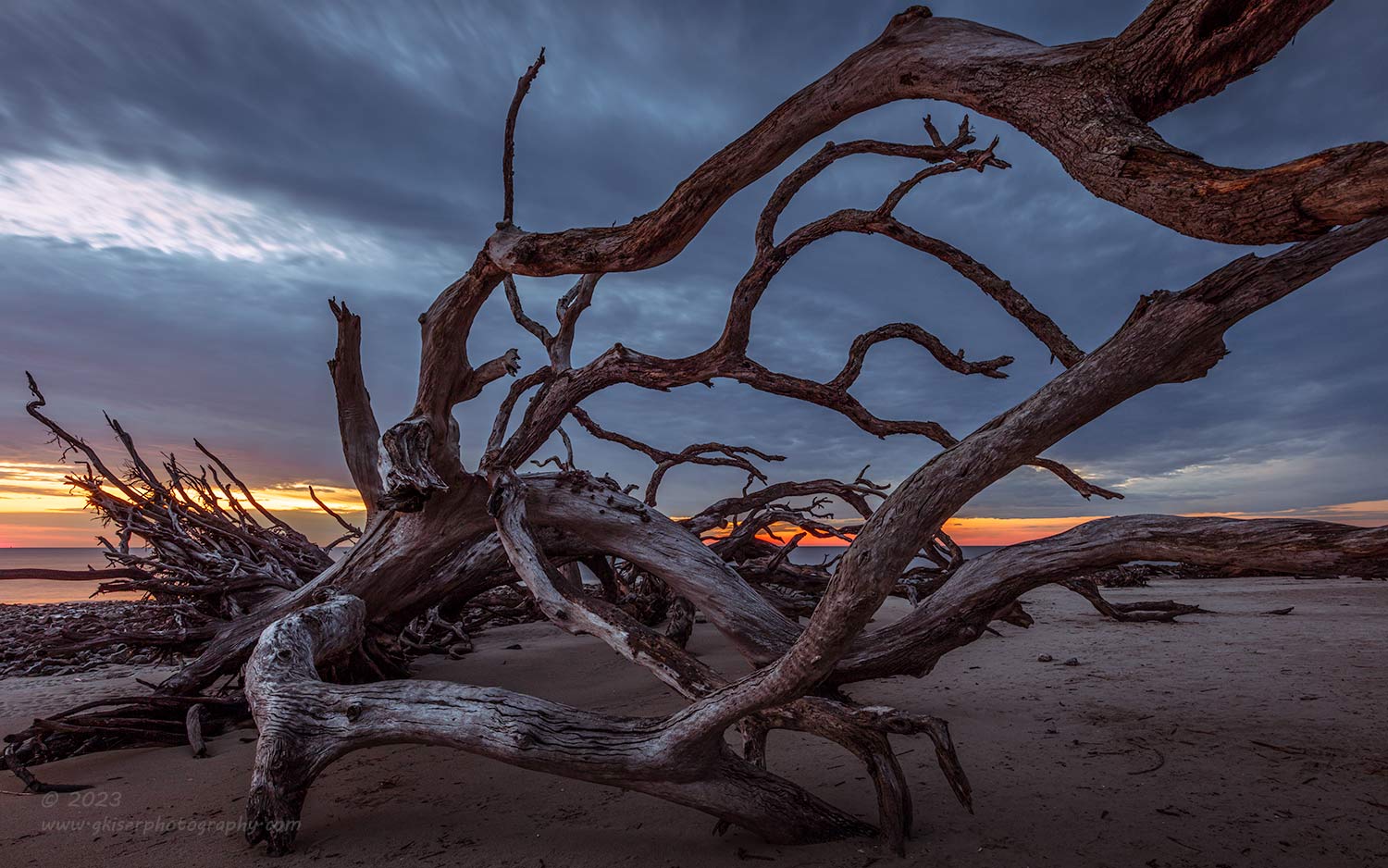
The more intimate view of this tree appealed to me in a different way than the previous composition had done. The viewer was now forced to look at the details within the tree rather than the tree itself and the sky in the background. Now, the tree was its own framing element and you could see the depth through the tree going off to the colors at the horizon. There were more textures present as well since there was now light on the tree which also helped the overall look of the image. There were a few people that were visible to the right, but I was able to block them out with one of the branches.
It was here that I found myself in close proximity to a couple of ladies who were also out getting photos. They were using their phones and I could tell that they were having a hard time with the colors. I offered a bit of advice to take advantage of the little bit of color that was present in the sky by shifting the white balance to daylight to get the contrasting blues of the clouds to really make the horizon pop. This resulted in a quick conversation with one of them who had been a photographer before having kids and now that they were grown was looking to get back into it again. She hadn’t bought a camera yet but was looking forward to making that happen in the near future. We chatted about photography for a few minutes as I was adjusting the composition between shots to change things up and avoid the people that were walking into the frame.
At some point around this time, another photographer asked if we were going to have a wildly vivid sunrise as the color was just starting to become vivid. I explained that where the sun was going to come up was blocked by clouds which would prevent the entire sky from lighting up, but there was a chance for a second blush with a break in the clouds slightly above the horizon. Once the sun got into that pocket, there was a very good chance for some pretty decent color. I was just voicing what my operational plan was for the morning, and they responded with “sounds like you’ve been doing this for a while.” That made me feel good because reading the sky is something that I have spent a long time figuring out and I guess I take for granted that understanding how the conditions affect color is just not widely understood.
All I was sure of at this point was that the most interesting part of the sky was to the South of the rising sun. The Northern view was too bright at this point, and the colors were washed out from the luminance of the sun. I was quite content staying with the moody angle on this large tree, even though I was seeing more and more people entering the frame. I had to keep readjusting to find other variations on the composition that would allow me to avoid the people. This meant getting more and more intimate with the tree. I found myself cropping into it from each side which really changed the dynamic of the scene. It became all about the tree and the shapes of the branches. The sky and even the colors in the background were just there for mood and a bit of drama. The major changes to how the story was developing from these small compositional changes really impressed me.
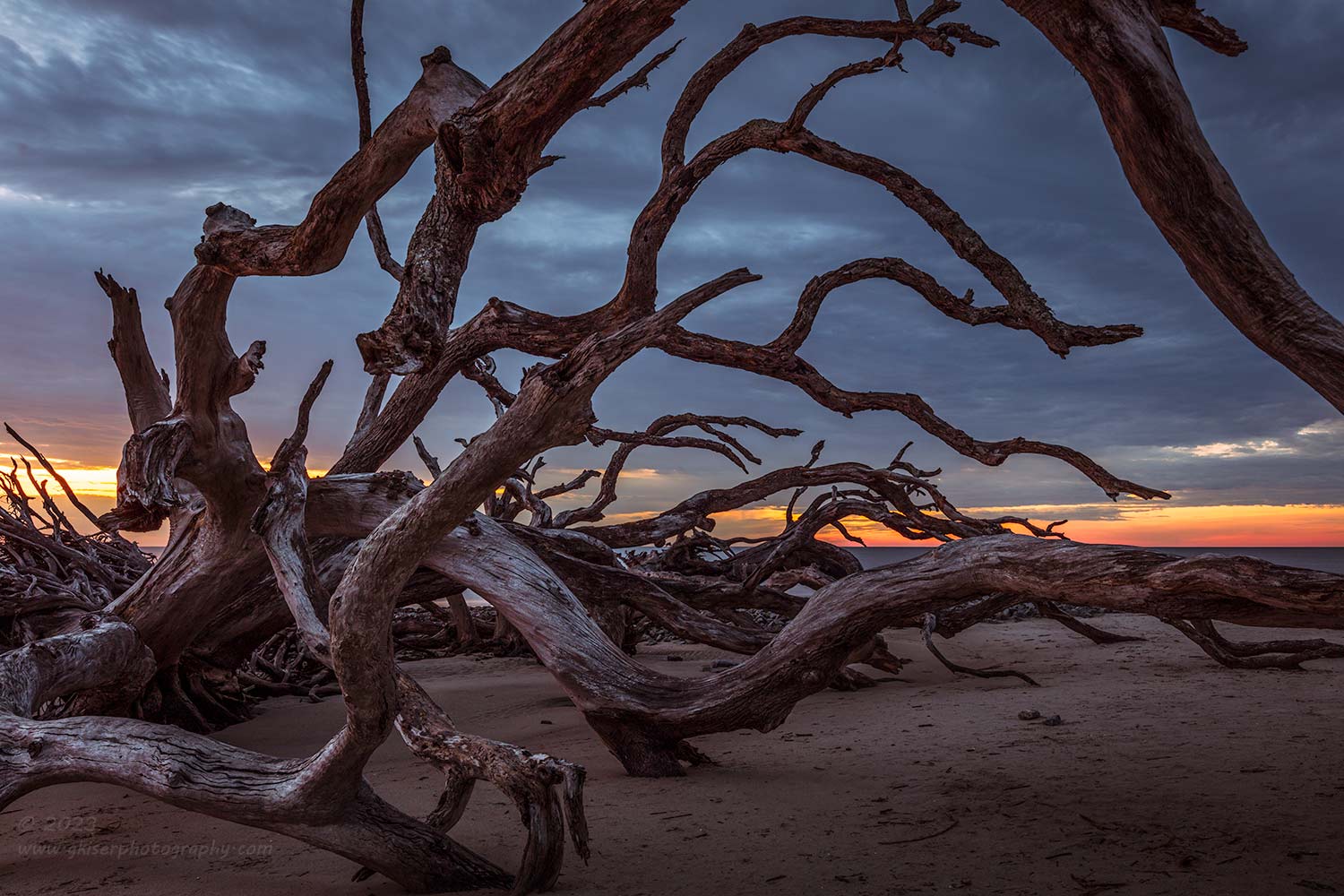
I found myself shooting many different compositions of the same subject from the same angle with essentially the same sky in the background. However, each one told a vastly different story, and created a very different aesthetic. During this specific session with the tree, I ended up shooting a total of seven frames, each with slightly different attributes. At the time, I was really thinking that one of these would end up replacing the first one that I shot (Rythm’s Movement) because the light in the sky was better. I really didn’t feel it necessary to have more than one of these photos in my collection, but when it came time to cull through the images, I saw the error of that thought. Out of the seven, numbers two and six made the first and second cuts as well as the long exposure from earlier. Seeing them on the large computer screen confirmed that they each told a different story and had a different focus. Because this location was so unique and the conditions were developing quite nicely, I had no problem keeping all three variations on the theme.
However, it was now 6:21 and the sun was going to be up in just a few minutes. Not knowing what the sky was going to do over the next 20 or so minutes, I wanted to be in position for the sunrise. I had picked out a special tree for the actual sunrise and that was where I went. This tree was a fallen one which went right along the shore. It seemed to be a hand and my thought was that I would have it holding onto the sun if it did poke out from the break in the clouds. Unlike the other scenes that I had photographed thus far, this tree was situated on large rocks. Those rocks added a much different texture to the scene and one that I wasn’t sure if I would like or not, but I did like the shape of the tree. It was also in the right place in relation to where the sun was going to come up. I confirmed that with my sun locator app and set the camera up accordingly.
I started to make exposures as the light changed, but the predominant color was still blue. There was a hint of yellow in the cloud void that was getting more intense as the sun crossed the horizon. There still wasn’t enough color to really make this work, but I kept making exposures anyway hoping to capture the best light. If I was lucky, I would be able to work some magic with Lightroom and pull out colors that were barely visible here.
One of the problems that I was seeing was that the sky was getting very bright, even though the sun wasn’t visible. That was forcing the tree to be in total shadow which I didn’t like. I went to the bag and pulled out a 3-stop ND Grad to slide in with the hopes of bringing the sky down a little bit. I couldn’t pull it down enough to cover the brightest part of the sky though because that would just darken the tree as well. The filter did help with the overall look of the image though, so I kept it on there. I did a quick three image bracket with the thoughts of making an HDR blend in post knowing that the movement of the water was going to cause some problems. That gave me plenty of information to get a well exposed image, but the lighting was still rather flat and uninteresting.
Had I been wrong when I talked to that other person about the sunrise potential? The hole was still in the sky, and the sun was still looking to come right up to it. Looking at my watch, it was 6:40, well after sunrise and the sun was still not visible. The colors were not really intensifying, just getting brighter. The upper layer of clouds were still mostly blue and I was feeling a bit sad about the whole thing. I had a pretty decent composition here, but the sky wasn’t playing nice with me. Things had been going so well up to this point and when I was needing the color to really show up in the sky, it was failing me. I only had one more morning to get that sunrise shot that I had been after all these years.
As the minutes ticked by, I was looking around for alternate views where the light was looking better. Nothing at all was really popping off for my tastes although the increasing number of people on the beach seemed to be enjoying the show. I guess I have gotten very picky about my sunrises over the years, and it takes a lot to impress me. Since I didn’t see anything else that spoke to me, I remained where I was until I was sure that the sun was past the point of that hole in the sky. I pulled out the phone and double checked the position of the sun and found that it was still a few minutes from reaching the hole in the clouds. Maybe….just maybe.

All of a sudden, that hole came alive with color, and that color spread across the upper layer of clouds. It was 6:47, like twenty minutes after sunrise and I was looking at what I had hoped would happen. The sky kicked off with brilliant oranges and yellows which contrasted beautifully with the blue clouds. The fallen tree was well exposed thanks to the grad filter and the scene just looked magical. My attitude immediately improved despite the fact that I was expecting to look down and see nothing but bones where my legs had been. I had finally given up swatting the bugs and decided to just let them chew on me so I could concentrate on what I was doing. Yeah, I’m paying for it now with welts all over my legs and arms, but it was worth it….so worth it.
I had about lost hope for this photo, and had I found something in a different direction to shoot, I would have abandoned this view minutes before this photo happened. Looking back over the stream of images, there was 30 seconds between this one and the one just before it. The difference in the quality of light was tremendous. The scene went from not bad, to HOLY CRAP! in those 30 seconds. Once that happened, my initial reaction was to wait to see if it got any better, but I thought about my reaction to the last image and realized that I had captured just what I wanted here, and there was no need to try to improve on it. Instead, my time would be much better spent capturing another composition with this sky.
I grabbed my bag and moved over to the trio of trees that I had shot during blue hour which was maybe 100 feet to the North. I had to walk by about a dozen photographers which meant that I had to go back to the tree line so as not to be in their shots. I walked past a guy sitting on a fold out chair beside a tree looking with binoculars out to the ocean. I mean this was a popular place! When I got back to the trees, the sky was still looking great, and the sun was almost fully in the hole in the sky. I usually don’t like to capture the sun like this in my photos, but I felt that this time deserved an exception. I knew the composition that I wanted thanks to the earlier photo that I had shot. I was happy to see that the lights on St Simons had faded which left just a bit of land at the horizon which I could deal with.
The composition was altered just enough to be able to include the sun in a meaningful way at the right edge. The idea here was to balance the tallest tree as a focal point in the scene rather than a framing element as it had been originally. The bits of wood in the foreground became more important here as they pointed to the sun which brought your eyes around to the large tree. The smaller trees to the left balanced the scene out and the sky above was looking really nice with the grad filter still in place over the lens. I had the composition set and now it was time to make some exposures.

Over the next minute, I shot a total of five images of this scene with a slight tweak of the composition for number four. After that minute was over, the sun was starting to re-enter the clouds and the color quickly faded. The best of the bunch was the middle photo right before the composition shift. It had everything that I wanted in the photo and required very little in the way of post processing. There were even some well-defined sunbeams at f/11 which I hadn’t really planned on but do like the effect. They would have been more pronounced at f/22, but I really didn’t have time to think about that while getting the shot set up and captured. I really do love how this one turned out, and it almost eclipsed the blue hour shot of the same composition because it turned out so good. In the end, I did like them both for different reasons, so they both stayed in my collection.
Now that the sky was starting to wash out, I knew that the sunrise was technically over for my purposes. I did notice that there were still an increasing number of folks with cameras and phones trained towards the sun. I didn’t see the draw at this point, but I knew that there were more opportunities to be had with the light that was now shining on the landscape. There were still a lot of clouds overhead and they were mostly dark still. The sun was shining through that hole in the clouds bathing the beach in that warm glow. This is what is referred to as magic light, and I love when I get the chance to photograph it. I picked up everything and started to move inland to see what compositions struck me as interesting with the light falling on the shore.
The first location I found was the side of that massive tree that I had spent so much time with before sunrise. Instead of shooting through it, I went from the side aiming to the South. The tree’s personality changed completely from this angle, and while the light was looking great on it, the actual composition wasn’t organized enough. Plus, there were several people in the frame that could be seen pretty much through the entire composition. I stayed with this for a few minutes while the light was good, but ultimately, I trashed all of them because the composition just wasn’t strong enough, and the main subject wasn’t nearly as interesting from this angle.
You might think that I am being too hard on myself here by ditching all eight photos, but I really subscribe to the success triad of photography. For a photo to be considered outstanding, you have to have an interesting subject, a strong composition, and good light. If you don’t have one of those, you will mostly likely have a very good photo, but if you are missing two of the three, the photo will be forgettable which is not what we want. The scene I had been shooting had great light for sure, but that was all that it had going for it. I needed a better subject, or a better composition. There was nothing that I could do with the composition as I had to make too many compromises as it was taking into account the amount of people all around the scene. The smartest thing for me to do was to move to another location to see if I could do something better than this.
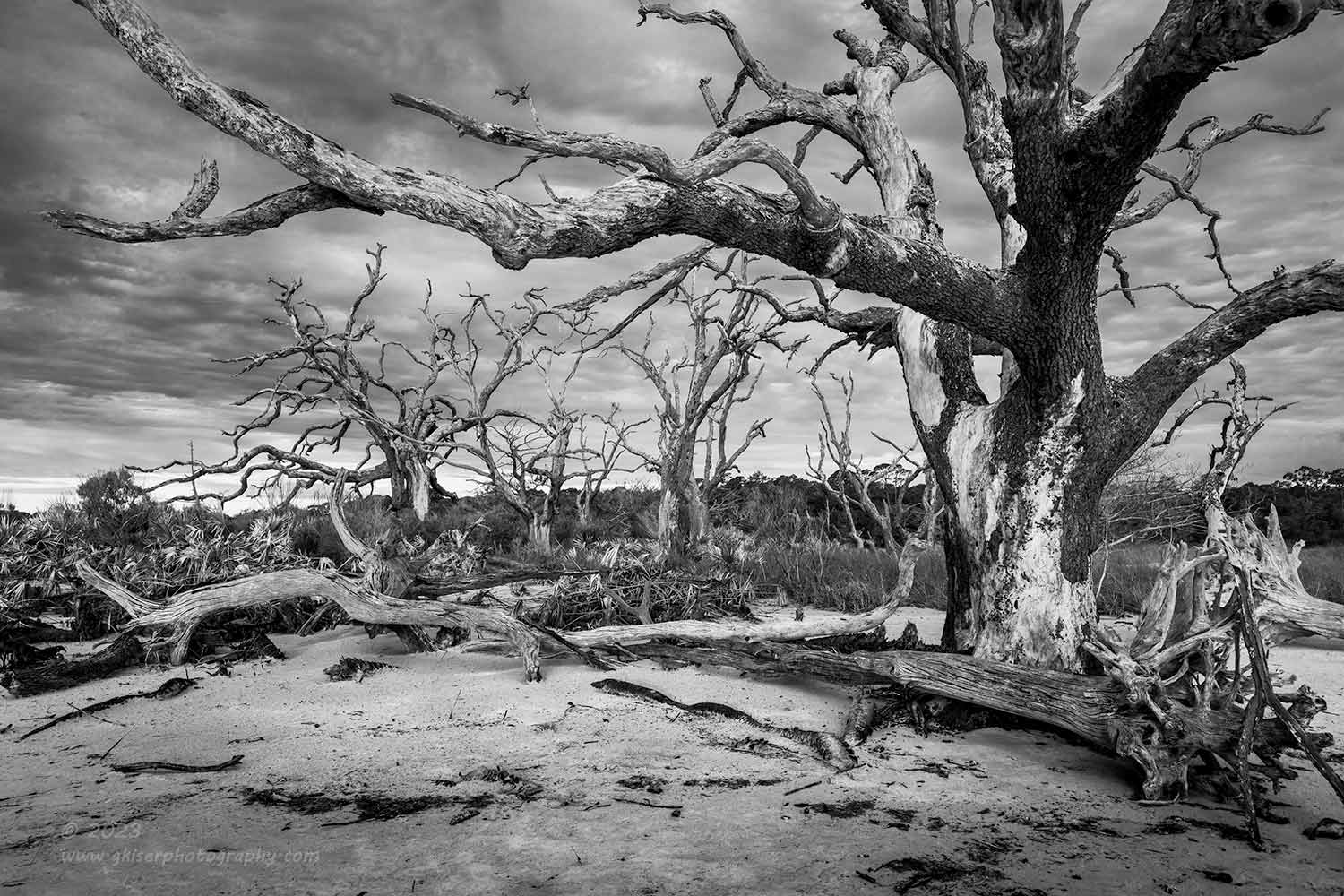
As I was walking around, found that most of the compositions that I wanted to shoot were filled with people. There had to have been 30 or more just in this area which annoyed me to no end, but I had to accept it. I just spent my energy looking inland rather than across the beach. There were protected lands just beyond the beach which meant that nobody should be there. That was a blessing for me as it gave me some opportunity to work with the trees of Driftwood Beach.
I came across one scene that had a very dominant tree with some other wicked looking bare trees just beyond it. The sky was looking fantastic above, and the light was nice and flat over the scene. There were no people in the shot, and surprisingly, not many people around this area to begin with. I got the camera set up and found the right balance over the scene. it was a very complex scene, but there were several visual anchors to allow me to isolate the elements well enough.
Going back to that concept I was just talking about; I had an interesting subject with the trees, the flat lighting was flattering to the scene, but the composition was a little scattered. I had two of the three and felt that I had landed on a pretty good photo. Since the light was soft and not quite like the warm glow of the previous scene, I figured that this was going to look pretty good as a black and white. It would allow me to bring out more contrasts to the scene and hopefully strengthen the composition visually. I even used the black and white profile with the camera to help visualize this. I ended up shooting just two variations on the composition with this being the first of the two. Since the light wasn’t changing, there was no reason to take multiple exposures of this scene. I had two options and that was enough for me.
I set out to find another scene that was a little better composed in the hopes that the good light would return. I kept walking to the North away from the masses but didn’t really find anything else of interest. Seeing less and less potential to the North, I turned back around and went back in the direction I had come from. As I was walking, I happened to see the area that I had just been in. I was much further away from it, and it struck me differently this time. I saw a different order to the scene, although it was lit very boring with the covered sun. The new version of the composition showed the large tree completely as it framed the right side of the image and then the smaller trees were all lined up to the left with the final tree being a similar shape to the larger one. The composition was better, but the light didn’t work with it, and the subject wasn’t not as defined as I would have liked. It was enough to get the camera set up and see what the light did though.
Over the next ten minutes or so, I watched as the light changed and rattled off a total of eleven images of this composition. The sun did peak back out as I had hoped, and it bathed the scene in a wonderful orange glow under the blue clouds. I knew that one of these was going to work but wasn’t sure which one it would be. I knew that I had the entire range of light from flat to full magic light, and back to nearly flat again before wrapping up this composition.
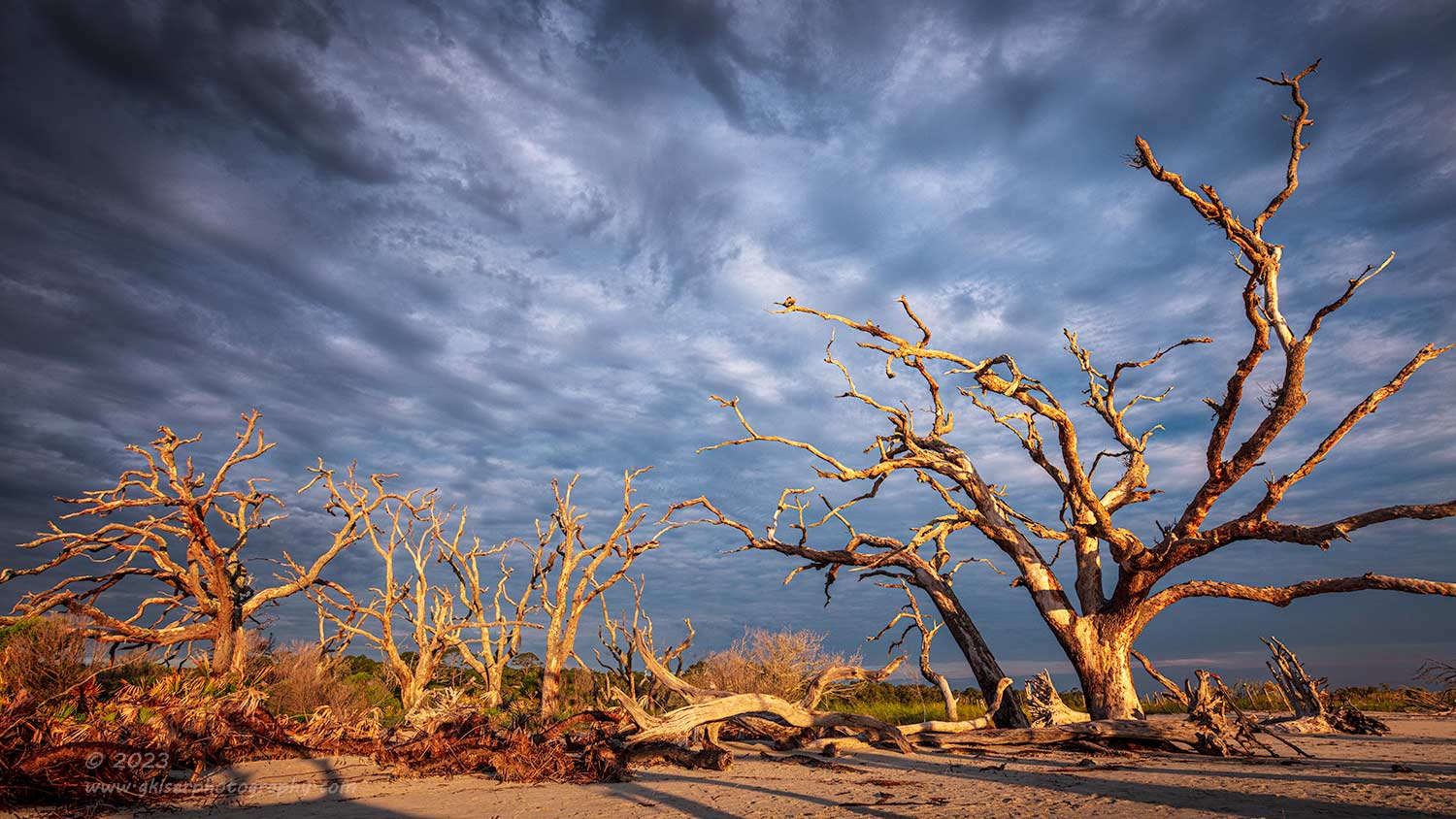
When I got home, I could tell that this was going to be something special because even the flat RAW image that popped up had some very vivid colors to it. I loved the starkness of the trees, and even looking at the thumbnail versions, I could make out the subject as being very dominant. The composition was pleasing and the light around the middle of the series was beautiful. I ended up picking number seven of the eleven to process. I started to work with this and tried to figure out what to do with my shadow which was just visible within the shadows of the trees. I had positioned myself in a way that I was in the shadows of the trees to my rear, but if you knew what to look for, you would still see me. I was fine leaving the shadow as it was, but a better solution came when I started to really look at the composition.
As I really examined how things were positioned in the frame, I realized that the 3:2 aspect ratio was actually including more than I needed to see. I chopped that down to a 16:9 ratio which eliminated most of the shadows (mine included) from the foreground and focused much more of the attention on the trees. The blue hues of the clouds balanced those warm tones so well and I fell in love with the photo immediately. There was actually very little processing done to the image to arrive at this version. The biggest thing that I did was to bring up the exposure on the large tree, while I pulled the highlights down on the trees to the left. I just wanted to balance the lighting a little better than it was previously.
The end result is one that I think really defines the location and the conditions that I was shooting in. It is one of my favorites from Driftwood Beach and I could not have asked for better light. Speaking of light, I knew that the light was going to be fading pretty quick at this point. The sun was about to go back into the clouds which would cause everything go to flat. There was also still the chance for storms later in the morning that I really would rather not be involved with having a 50-minute walk back to the room still to go. However, I still wasn’t quite ready for the morning to end. I felt that there was still another photo waiting to be shot. I just had to find it.
As I figured, the light dropped, and things got a bit uninteresting after experiencing the magic light from the last scene. I did continue walking North to see if there was anything up there that might be of interest. If I’m being totally honest though, my main reason for walking that way was to get away from the people. There were still some up this way, but most of these were here for the beach and were in the water. They should be out of my way for the most part since I was planning on shooting more inland at this point to take advantage of the slightly directional light.
I made it to the other side of the clearing just as the sun poked out for a second. I saw a grouping of trees in the distance that looked spectacular in the bit of light that was falling on the shore. I rushed over there and started to pick out a composition. What I liked about the scene was going to need a wider lens than my 16-35mm, so I swapped in my 14mm prime which I love to use, but hardly get the chance. This lens is the cheapest glass I use at just about $250.00. It is manual focus, and I have to set the aperture manually as well by a ring on the lens. It is sharp as razor and produces image quality akin to my beloved “L” lenses, but it is not built nearly as robustly which means no weather sealing.
I have noticed that even though there was a breeze here, there wasn’t much sand that got kicked up like at a NC beach. I doubt I would have felt comfortable using a non-sealed lens on the NC coast and rarely feel comfortable changing lenses on the beach there. Here, I didn’t see a problem and felt that the chances of getting sand inside the camera was slim. I still made the swap quickly and worked on finding the right composition. I hated that I didn’t have the use of a polarizer with this lens, but I wanted the perspective more than the effects of the filter, so it was a good trade.
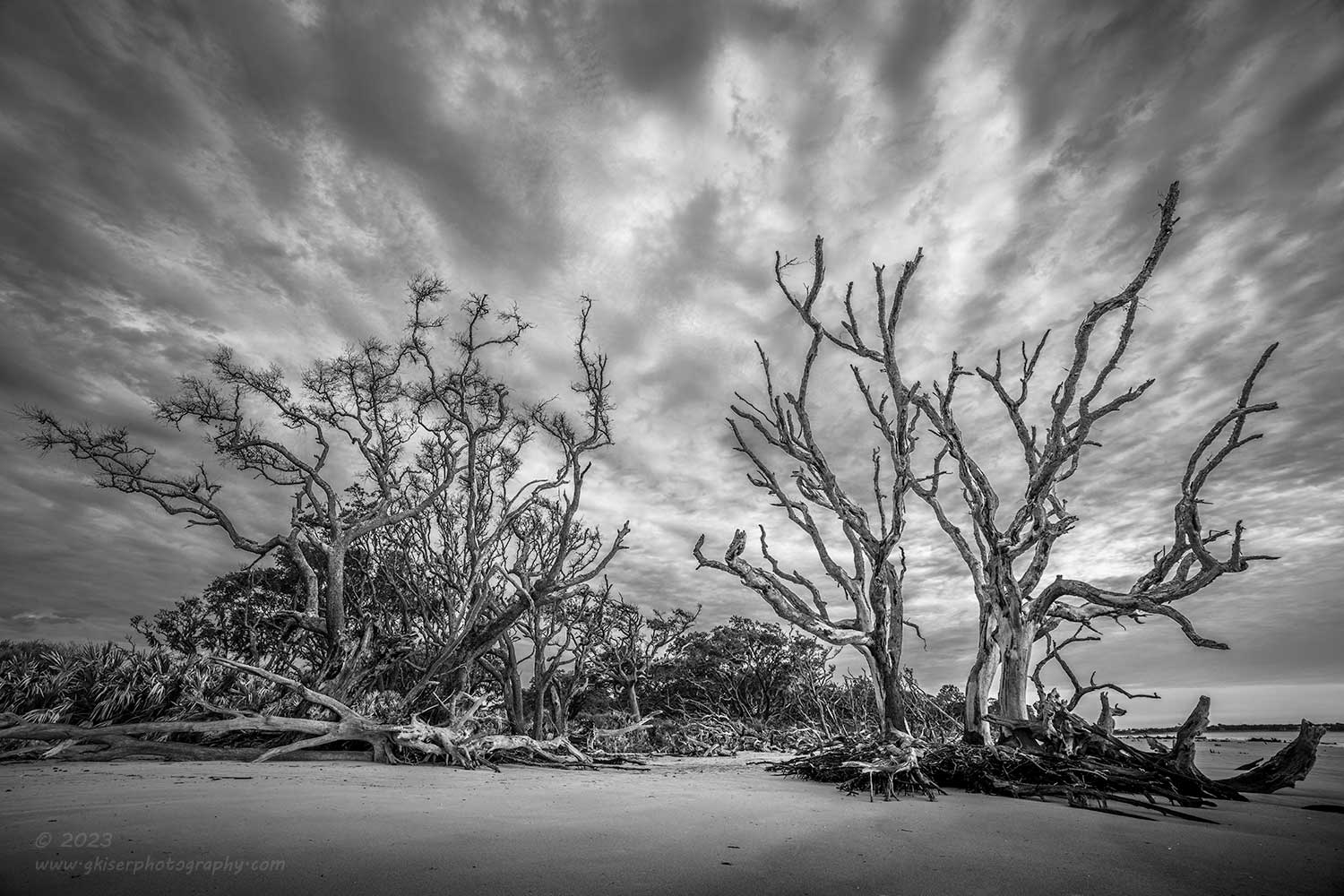
Over the next eight minutes I shot a series of 13 frames as folks walked along the beach. I tried to time them to where the breeze was minimal, and the people were where I could clone them out easily. I had to do this by looking through the viewfinder since I don’t get accurate exposure information from live view thanks to the manual aperture ring. It was a little cumbersome, but the end result was going to be worth it. I had switched the camera over to black and white for this one because I knew that I wanted to focus on the structure of the trees more than anything and I would have the side benefit of getting more detail in the clouds. With each shot, I was seeing just what I was expecting in the image review. The exposures were all looking great, it was just a matter of which one had the best cloud positioning.
I had thought about doing a long exposure as that would have erased the people walking easy enough as well as simplifying the sky so that the attention was all on the trees. The amount of movement in the trees would have been minimal, so it would have worked. However, I would have had to change my lens and go back to the 16-35mm to fit a filter on, and that would have altered the composition that I really liked. I was happy with the sky as it was because I thought it added to the atmosphere of the shot and brought just a little more mood to the scene. The smooth sand in the foreground gave enough simplicity to the surroundings.
It was lucky number seven in the series which created the best image with everything taken into account. I had to clone out about four people in the scene, but they were positioned in good places for that to happen. The clouds were great, the exposure was dead on, and I saw no motion in the background. This image had it all and was an early one that was edited because it was so striking to me. I’m always impressed with this Rokinon lens and love what it does to a scene. I really wish that I had more opportunity to use it, but at 14mm, so much care has to be taken as to what is entering into the scene and how you control the distortion it brings. When you get it right though, this lens always rewards.
At this point, it was 7:30 in the morning. I had arrived at the beach just two hours before. In that time, I had shot 86 frames which had resulted in 10 images that you see here. My total tally for the weekend was 221 frames over three days. Of course, at this point, I had no idea which images were going to work, and which weren’t, but I was pretty confident that the images that I had captured today were going to be the strongest of the time at Jekyll Island, and I was certainly not disappointed in Driftwood Beach. It had lived up to the hype and I had absolutely made the right choice about which day to photograph this location. I really felt accomplished after this group of photos and for the first time felt that the trip was worth it. I had some remarkable images from a location that can only be described as epic and otherworldly.
Seeing that the light was over for the morning, I packed up the camera and put the tripod back on the side of the bag for transport. I started walking back down the beach trying to find the access point that I had come through well before I could see it. Having been all up and down this beach, I had forgotten which section it was at, but it wasn’t nearly as hidden as I had though it would be. In the daylight, it was also not nearly as long a path as I had thought walking down it with nothing but a red light to guide me. Of course, it might have been that I had a little spring to my step now that I knew I had some amazing images in the camera.
The 50-minute walk back to the room was right pleasant even though it was getting hot. I don’t think that anything would have spoiled my mood short of accidentally formatting the memory cards or having them stolen. Even the smell wasn’t getting to me that could only be described petroleum scented ass. Keep in mind that I have a terrible sense of smell, but the smell was enough to make Toni angry for much of the day. I can’t explain it, but for the first time it didn’t bother me at all. In fact, when I got back to the room, I had walked some 14,000 steps and a bit over 6 miles according to my phone. Even that amount of exercise that early in the morning didn’t affect me. Since I hadn’t heard from Toni in a while, I sent her a text that I was tired and needed her to come and get me which she had offered to do. The plan was that I would meet her at the door as she was rushing to get the car.
I sent the text right before I started to climb the stairs to the upper floor and went to the door. I had a moment of being nice in case Aulani was still asleep and Toni would have to wake her up to come and get me. I went ahead and opened the door to surprise Toni who I found was still in the bed. She hadn’t seen my text which turned out to be a good thing. She had just had a dream that I had been hurt and had she gotten the text would have panicked for sure. I assured her that I was fine and that all was well with the trek. After we said good morning, I pulled out the camera and showed her some of my favorite shots of the morning. I couldn’t wait to get home and get them processed. More importantly though, I needed to get some water because I realized that I was very thirsty from all the activity over the previous four hours.
The rest of the morning and early afternoon was spent at the beach and in the pool with Aulani. The storms that were supposed to show up never materialized, and for the most part the skies remained clear. After we had been out long enough that I was starting to get burned as was Aulani, we headed back inside to get cleaned up and ready for dinner. The storms started to come in during this time and I again started to think about getting some more photos during the evening. This is my usual pattern at the coast, go out for sunrise, and again for sunset. However, I was absolutely exhausted after the morning’s adventures. I figured that if I went out for an evening shoot, I would be worthless in the morning, and I was really wanting to go back to Driftwood Beach for another go at it with potentially different conditions. I battled with myself right up until it got dark and realized that I hadn’t gone out for evening photos.
I don’t regret it too much as I don’t think that the light was all that great at the end of the day based on what I could see from the room facing East. Staying in the room and resting was what I needed, and I had a good time being with Toni and Aulani. I still had one more morning left, and I was setting my sights on a return to Driftwood. The alarm was set, and I passed out in the bed for one last night at Jekyll Island.
Did I get back to Dritwood Beach, or did I choose another location for sunrise? Did I even get up in time for sunrise on Sunday morning? All of these questions will be answered in the final installment of this series of blogs. Stay tuned to see what happened.
I’ll be back soon….

Remember to use the code KISER10 to get 10% off your purchase


