Sunday, January 12, 2025
Welcome back to the beach! I hope you have had a chance to read about the first day at Carolina Beach, but if you haven’t, I’ll happily wait right here for you to catch up before I get rolling with the second morning.
Now that we are back, and all caught up, you will recall that the weather forecast for Sunday morning was going to be clear which isn’t great for photos in my opinion, and it was going to be cold with temperatures in the low 20’s when I would be headed out. I don’t care who you are, walking on the beach in that kind of temperature is an odd experience considering this is the location that folks swarm to in order to lay out and sunbathe. There would be no sun hitting my body except for my face as I started my walk. I was fully bundled up and even had the hand warmers in my photography glove pockets as I learned to do the morning before. This did a pretty good job of keeping my hands tolerable as I made the roughly two mile walk up the beach to my destination.
All the way up there, I was considering my options because I have shot this pier before and knew how the lines were going to work out. I knew that I was going to be shooting well before the sun came up because I only wanted the glow on the horizon, not the full sun. Once the sun was at the horizon, I would turn my attention to some groins that were on the beach just to the other side of the pier for some isolations. It was going to be a quick shoot because there would be limited to no interest in the sky after that brief period around sunrise. I was feeling confident after my success the morning before and even though the sky wasn’t what I would have wished for, I felt there would be no issue getting a few keeper frames from the morning.
When I got a little over a half mile from the pier, I could see it in the distance, but I could also see that the beach was getting very narrow. There were rocks built up in the distance, and it looked as if I wasn’t going to be able to continue on the sand to get there. That might pose a problem, but I was close and decided to keep on going by way of the roadway. When I got to the pier, I tried to enter the beach again only to find out that there was no beach. The boulders had been built up to stop the erosion and there was nothing close by the pier that I could work from. My only option was to shoot this from the parking lot, just on the other side of the rocks.
One of the things about being a professional photographer is that you can deal with setbacks and issues as they come up. For this particular setback, I decided that the rocks would make an excellent foreground introduction to the photo. It would also make this a bit unique in my collection of pier photos from the different beaches that I have visited. I really did like the idea of the rocks as that was a feature that I have been looking for on NC beaches, so this was not too much of a stretch. I did have to be careful about the light that was coming from the overhead LED streetlights which was keeping the rocks from being lit purely naturally. I figured that with some careful composing, I could eliminate the brighter portions, and I could deal with the rest in post when I got the photos home.
There we go, things were going well for me even though there was a major change in what I was expecting. There was another problem about to happen which I didn’t foresee, and will readily admit that it was a rookie mistake. If you will recall, the night before had ended with me photographing the fire in the firepit. Part of what I had to do to make that happen was to boost the ISO up to 1000 which was absurdly high for most landscapes. It worked very well for those photos, but something that I try to always do is to restore my baseline settings back to the camera at the end of a shoot. This way, I can get up and running much quicker for the next subject. Normally, I will have that ISO set to 100 with an aperture dialed in as f/11 with the shutter speed around 1/160 of a second or so. This usually will get me in the ballpark for most shots, at least close enough that I can adjust the shutter to see the image in live view.
Well, I had been cold and completely forgot to reset those base settings in the camera, and even though I had been thinking about the previous night’s photos while walking out here, the thought did not occur to me to check the ISO. When I was getting the camera set up, I was finding the composition through the viewfinder without even turning the camera on. When I finally arrived at what I thought was going to be the best composition, I fitted the 5-stop ND filter because I knew that I wanted to smooth the water. This would probably give me about a minute to minute and a half exposure. While doing the simple task of fitting the filter, I ran into a problem that I hadn’t had with this filter in a number of years. The foam backing was getting jammed up on the filter holder and how I normally push it in wasn’t working. I think it was because my fingers were very cold and I was missing some fine motor skills which prevented me from pushing at the right points. Not wanting to miss the light that was happening at that moment, I slid the filter into the second slot which avoided the contact altogether. It wasn’t ideal because there was a chance of light leak, but I wanted to get the photo that was presenting itself at that particular moment. I turned the camera on and went to the live view. The image was brighter than I expected but didn’t really hit me as odd because the light levels were still kind of low and I was in Bulb mode.

The first frame was shot at 60 seconds and I was expecting it to be slightly underexposed based on the filter I was using, but it would give me a starting point for getting the right exposure and to see how the water looked. The massive overexposure warnings on the image review really surprised me as I had blown out the sky terribly. I couldn’t understand why this was happening and all logic would suggest that I was needing a 10-stop ND for this shot, but that couldn’t be right because the sun wasn’t even up yet. I scanned the settings again and didn’t see anything out of the ordinary because apparently ISO1000 looks a lot like ISO100 when you are in a hurry. Not wanting to go with a darker ND filter, I decided to kill another stop and a half of light by adding a polarizer which wouldn’t hurt the shot at all and might help with the saturation. With that filter, and a tweak to the aperture, I fired off another frame which was still too bright. This was just not making sense to me at all. There was no reason that the image should be this bright with all the filters that I was using. I finally started seeing photos that I liked at 30 seconds with a tight aperture, but it wasn’t feeling right. I wanted more smoothness to the water which meant that I needed a longer shutter speed.
I looked at the settings to see what else I could change and finally saw my error. That one extra “0” was making my life very difficult. I changed that quickly and started over with establishing the exposure. I had wasted eleven minutes over seven exposures as the light was changing. I had some workable images, but I knew that I would be bringing up the shadows in post which would add a lot of digital noise that I didn’t want to deal with. By getting the proper exposure, I could control that noise a lot better. Hopefully the light would continue to work with me long enough to make the simple photograph happen. I ended up doing a few exposures at 90 seconds to get things figured out and realized that there wasn’t enough texture to the water, so the next one that I did was at a full minute. That looked perfect, and I shot a few like that as the light changed. It was that first minute long exposure that turned out to be the best one. By this point, the sun was getting much too close to the horizon and the color was starting to fade away. I knew that there would be no second blush in this direction, so I looked for alternatives for compositions.
With the rocks replacing the sand here on the beach, I had recalled seeing something just beyond the pier on the satellite view earlier and walked out that way to see if I could access the beach further up. As luck would have it, I was able to get on the beach and found a tight group of groins. I’m not sure if this was another drain system, or part of an erosion prevention plan. Either way, I liked how it looked and the sky was still colorful as I looked further to the left from what I had been shooting.

I still had the same filter setup on the camera that I had been shooting with so I figured that I would see how that would look. The light levels were increasing, so the exposure time was dropped down to 30 seconds which made it easier to visualize the effect as I was now out of Bulb mode. The first shot that I went with was a pretty simple one that had the row of groins going from left to right through the frame. I really liked how the orange sky was reflecting in the water and how the shutter speed created a dreamy interaction between the wood and the water. There was no question that this was going to be a color image because of how it looked, but I knew I could do better with it.
After just a couple of exposures with that composition, I moved my rig closer and started to look at vertical compositions. In this direction the sky had very little color and I was thinking black and white once again with the long exposure. To my surprise, I had been expecting these pilings to go off straight, but there was actually a curve to them as they moved around a single groin to the left of the group. It all pointed to another small one by itself in the distance. This made for a visually interesting setup with a nice diagonal quality to it. I was liking this quite a bit more than the horizontal shot that I had begun with.

My first composition was one that was elevated quite a bit to fill the frame with the pilings. The small one in the distance was included in the shot, but I was already thinking that I would remove it in the quest for a minimal composition. I shot five frames like this and ended up picking the middle of them for the way that the waves presented around the wood. It was processed as I suspected with the small one being removed and it being done as a minimal black and white fine art style image. I must say, I am very impressed with how this one turned out and would have been happy if this was the only one that I got from the morning’s shoot. I really love the visual tension that is created with the slight veering off to the right around the single post. It just feels very put together to me.
Not wanting to give up too early though, I did change the camera position to take advantage of a second blush that was happening in the sky. By dropping it a couple of feet, I was able to get the sky in the shot as well as a nice refection of the color on the beach. The receding tide was providing that mirror like glow on the sand, and it was something that I wanted to capture. The trick was, I had to include the sky as well to make the reflection make sense to the frame. That was why I had to drop the camera down like I did. I did another series of frames with this composition and thought that it was going to turn out pretty well.

When I got the images home and started to look at this one, I liked the concept, but it almost had to be in a 3:2 aspect ratio which is not a favorite of mine when dealing with vertical photos. However, for the sky to be included with enough reflection below to have it all makes sense, that was the aspect ratio that was needed. I fully processed the image like this and got it to where the sky and the reflection matched pretty well. I thought it looked ok, but not as good as the black and white version. However, I am all about choices and a photo like this which looked good both in color and black and white I needed to provide options. I had a great one in monochrome but felt that this version was suited for color.
I did the whole shebang with the photo and got it ready to upload with the marketing watermark and everything. It even made it into this blog as I was getting the skeleton done with all the photos and links added in. It wasn’t until I was typing this blog out and was starting to see the sky coming up below the text that I didn’t feel that it worked for the photo. I kept scrolling down and the more I looked at it, the worse that it felt. The colors were too muted, and the sky was a distraction even though it worked with the reflection. As I started to look deeper into it, I could see that there was some orange tones in the water beyond the pilings that could be brought up a bit more for some color balance.
I went back into Lightroom and did a 4:5 crop on the photo which effectively eliminated the sky altogether. The composition worked better this way, but the colors were still very much off. I started doing some tweaks to those color and did some color grading in addition to everything else. The changes were all positive and I was liking the photo much better. It was a stronger composition, much like the black and white one, but this time it had color for some added excitement.
My initial reaction was to leave both versions in the blog, but when I saw them side by side, the first edit just didn’t stack up at all. I saw no other option but to remove it in favor of the fresh edit. I don’t like putting work out there that I am not proud of. I wasn’t proud of that first version, though I thought it was a decent photo to begin with. The rework just was much stronger and one that I wanted to share. It just goes to show that not everything that I shoot or even edit is as strong of an image as I would like it to be. However, if I catch it early enough, you won’t be subjected to subpar images in these pages. That is the hope, and my goal is to always put out the best quality images that I can.
I think that part of the problem was that the sky was really getting washed out with the sun above the horizon by this point. I knew that was going to be a killer for the photos from this point forward, so I decided to pack it all up and take the long walk back to the hotel. I was also hoping to stop off and get a few photos along the way as I went back, but was doubting those photos would be around the sand with the very harsh light happening.
The walk back wasn’t too bad, and the sand was no longer crunching under my feet which was an odd experience on the walk to the pier earlier. The slight warming with the sun was enough to thaw out the sand and make it feel like beach sand once again. I was looking for some of the little access paths that lead out to the beach for a quick photo but found nothing that would fit the idea that I had.
I didn’t stay on the sand long and decided to move back out to the road in search of photos. The light was better over there anyway and I just strolled along and looked for interesting compositions. Of course, I found nothing at all that excited me while walking. My last-ditch effort came from the marina by the hotel. Toni and I had been by there the night before and I had seen some interesting colors which I thought might work well under the sunlight. When I got there, the boats that I was hoping to photograph were still there, but the hulls were all in the shadows. There was also ice on the water which I hadn’t expected.
All the access points to the boats were marked with signs indicating “No Trespassing” which kept me up on the main level. It was a bit of a reach to photograph the isolations that I had in mind, so I had to get out the long lens and the teleconverter. This gave me the reach, but I wasn’t really liking the perspective. I fired off a dozen or so versions of the composition that I had in mind with hopes that one or two would turn out. I was cautiously excited about the possibilities of these, but after seeing them on the computer, they all failed for one reason or another.
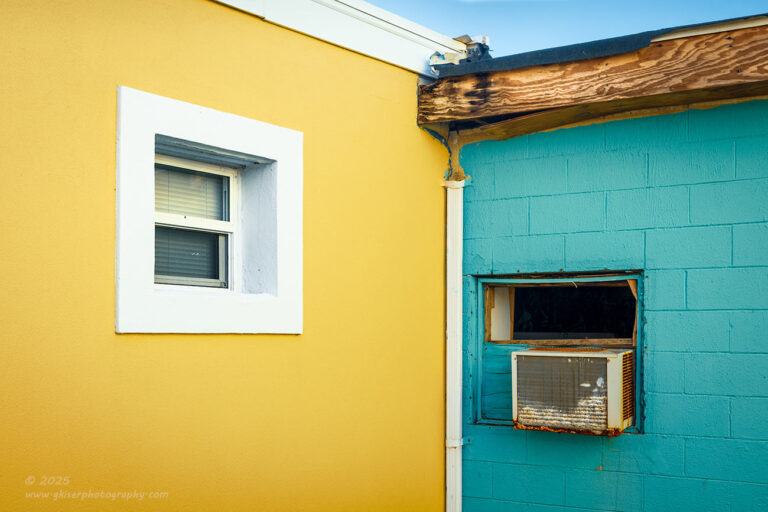
Before returning to the hotel, I stopped off at an area of the Boardwalk where there were some colorful buildings. I had been through here a few times already with nothing to show for it. This time, I was behind the buildings and spotted a section where a yellow building butted up to a teal one. The thick frame on the window of the yellow building caught my eye and I thought that would make a good minimal piece with the plain wall all around it. I also liked how the colors between the two walls worked together with the window A/C unit hanging out of the broken window.
I started off with the single window on the yellow wall. I tried a couple of different variations on the composition, but I just couldn’t get a photo that I liked. I shifted gears and went for the two buildings together. This was starting to turn out much better, but the one window was so high that it was forcing me to get the sky in the photo which I didn’t want. The more I tried, the more I saw that it was not going to be an option, and I liked the way that the composition was developing which prompted me to stick with it.
What I decided to do was to include only a small sliver of sky at the top, effectively creating a triangle to go with the four main boxier shapes. The composition was all driven by shapes and how they related to each other. It was very much an exercise in subject/ground theory which I hadn’t really consciously thought about in a while now. Once I had the shapes worked out, I was looking at the colors to make sure that they would work. The teal and yellow went well, and the orange of the wood and the rust also worked with this color palette. The white hard shapes and the blue sky helped to give structure to the entire scene. This was actually working out quite well, and the more I played with the composition and exposure, the more I was liking it.
This became the last photo of the morning because it was around 9am and I was getting hungry for some breakfast. Toni had already texted me and let me know she was down at breakfast and what they had on the menu. I was thinking about putting some warm food in my belly, so I wrapped things up with the walls and windows and headed over to the hotel. She insisted on making me a waffle while I got out of my Nanuk of the North outfit which I was happy to let her do. As I was peeling the layers, she came over with two plates, neither of which had a waffle on them. These were to tide me over till the waffle was finished. Have I mentioned that she likes to take care of me? Well, she does and while I didn’t’ really want all the food that was sitting in front of me, it sure was good and I really enjoyed it.
After breakfast we headed upstairs, and I showed her what I had gotten during the morning. Somehow the photos were less impressive than I was hoping for now that I was removed from the scenes. The only ones that really jumped out at me were the pier photos and the line of pilings going out to the ocean. The rest seemed a bit forced. As I mentioned, the boat photos were ultimately trashed and the wall photo that I was working on at the end of the morning turned out much better than I expected looking at the image review.
After my shower, we decided to head out to the Battleship North Carolina for a tour to see how it was looking these days. Short of getting lost in a maze through the lower decks, it was a great time. I had the camera with me, but there wasn’t anything that jumped out as a photo for me. The plan had been to leave there and head to Ft Fisher for sunset as I really wanted to give the trees another try since the last time that I had photographed them was when I was shooting with the old Sony point and shoot camera in 2006 or so. Toni also liked how the trees looked which meant that they really were special trees.

Even with getting a little turned around in the Battleship, we made it back to Ft Fisher with plenty of time for me to walk around and find some compositions. The areas that I had shot before were not looking good in the evening light because the sun was too far South and there were too many shadows. I ended up going across the street to the actual museum portion and spending some time in that area looking for compositions.
As I was starting to get my ideas dialed in, I saw that there was another photographer doing a photo shoot with a couple that was in the middle of the area that I was wanting to shoot. They were there first, so I had no issues with them being in my way. I just tried to stay out of their shots as I scouted for potential photos. Everything that I was seeing included the three of them which would just now work in my photos. I decided to go back across the street to see if there was anything that I had missed. The light was getting softer as well which gave me hope that there might be something interesting now. There wasn’t. The best compositions had terrible lighting, and the areas that had good lighting, had bad compositions. I started to move over to the water side to see what the ocean was looking like as a alternate. Everything was very washed out over the water, but I did spot an area that might be a good spot when the sun dropped lower.
Almost as if on cue, as I was thinking about setting up a composition, a different photographer and her clients came over and started to shoot where I was wanting to set up. I thought about holding my spot and going forward with my intended shoot, but then saw the original group from across the street join in. This meant that I had the trees available now, and that the light was probably just about right at this point. I quickly moved back across the street and started to find the right spot for my composition.
I really wanted to capitalize on the height of the trees, so a vertical composition made the most sense. It would also allow me to avoid some of the buildings in the background which were off to the sides. For this, I chose to go with the wide angle zoom and get in very close to really make the lead trees dominant as well as shrinking the background which was a little cluttered. This worked well, but the sky was a bit too washed out and needed a bit of extra color. I usually don’t use a polarizer with the 16-35mm when the sky is involved due to the strange banding that happens in the blue sky under polarization. With there just being a sliver of sky in the corner, I didn’t think it would hurt so I added that filter and that gave me the right look that I was after.

While the vertical shot seemed to capture the character of the immediate trees, I felt that the entire group of trees really should be captured to show off the way the entire scene looked. This was going to be more difficult that I would have suspected. First of all, I had buildings in the background which I had to deal with. The vertical composition had done a great job with them, but by going horizontal, they were showing up. I had to drop the camera really low to have the buildings drop below the horizon. There were also benches in the background that I wanted hidden by the trees. I was able to do all of this while still getting the framing that I thought would work out best. I still had the blue sky issue to deal with and needed some added color. However, with the polarizer, I was still getting the banding issue that I don’t like.
I had to make a choice between a white sky or a blue sky knowing that the blue sky would be rather uneven in tone from left to right. I could have done a white sky for a black and white photo, but I really wanted a gradient at the top of the photo either in color or black and white. What I decided to do was keep the polarizer on but only use it about 25% which kept the banding under control. What was left was something that I felt I could even up in post. This way I would get a genuine blue sky and some extra saturation in the colors.

I ended up shooting two variations on the composition in the failing light. After getting the first one worked out, I decided that I wanted to go wider and get more of the scene in the shot to include the lone tree over to the left of the frame. This also created a situation where more of the grass in the foreground was visible which worked due to the way that the light was falling at this point. I liked both of the compositions, but kind of favored the wider version at the time.
When I got the images home, I had one from each series that I felt were worth a closer look. The one that won me over to start with was the one that you see in color above. I loved the warm tones on the wood and the immediacy of the tighter composition. I was able to work out the sky as I had planned which went smoother than I expected. I was left with a blue sky which was what I wanted, and everything just fell into place. Well, everything except for how the scene read left to right. It felt awkward on the left side because of how the lone tree was cropped which made the composition feel off. I flipped it horizontally to see how it looked that way and it immediately felt more comfortable. The dominant trees were now taking center stage and protecting the smaller one in the background. After a few more tweaks, this one was considered finished.
It wasn’t until the next day when I looked through some of the second-string photos that didn’t quite make the cut for a full edit that I revisited the slightly wider crop of the scene. I recalled that I wanted to do these as black and white potentially and started that processing with the wider view. It actually came together quite well, and I was able to do the same tricks with the sky to get the tones to all work together. This one didn’t need to be flipped because the smaller tree was there in its entirety and kind of introduced the larger trees. It worked much better as shot than the other one had. It is also worth noting that the vertical shot that I had started off with was also added into the mix during this secondary culling. I had originally dismissed it because I thought that the horizontal image was a stronger version, but upon revisiting it, I found it to stand quite well on its own after a change in aspect ratio.

It had been a struggle, and honestly part of the struggle had been that I was just flat worn out. After the cold hike during the morning, walking around the Battleship all afternoon, I wasn’t really feeling like doing all this activity for sunset. However, I had finally worked out some photos of the trees that I have always thought were quite pretty. Now I was seeing some pinks coming into the sky to the East. Now was the time to go over and check out the shore again. If I had any luck at all, the portrait folks would be gone and shooting someplace else by now.
Sure enough, when I got over there, the beach was empty which was very fortunate. The colors were looking great with the water showing a green, almost teal which paired very well with the colors in the sky. I quickly got the camera set up in a spot that I thought would work out and loaded up the standard zoom so that I could get the whole scene in the frame without issue. I saw no need for any filters because I wanted to get the motion of the waves as opposed to the smoothed-out look of the water from my earlier photos. It is good to be able to go back and forth between techniques because it keeps things fresh.
I fired off a series of 42 frames with roughly the same settings but trying to get the waves in the right spots. I also changed up the composition a few times to adjust for people coming out on the rocks to the left. I wasn’t sure when the best light would be, so I just kept hammering away at it in hopes that each shot would be better than the last. This is the light that I love working with and I spent years not knowing that it was even a thing. The soft light opposite from the sun makes for some of the best sunrise and sunset photos in my opinion. It is also the best way of dealing with a cloudless sky at either end of the day. The blues, purples, and pinks always look great when paired with the green ocean water like I was seeing here. The rocks gave some great visual interest in the foreground while the erosion prevention devices along the edge of the shore made for some dramatic wave hits.

As I mentioned, I shot 42 frames from this spot as the light dropped. The ones that I ended up keeping because of the wave positions happened to be one near the middle, and one near the end of the run. They were all very similar, but the waves created different personalities between them all. These were the two that fit what I was looking for the most. While processing them, I really couldn’t decide which I preferred between them but felt that they both had different moods associated with them. The more I looked at them, the more I realized that the rocky shore would be better on the right side to help in reading the image. I flipped one of them and confirmed that my assumption was right. The emphasis was now on the wave out in the water which brought your eyes to the sky. It felt very relaxed when it was flipped like this.
I went to flip the other one and immediately, it didn’t feel as good. There was too much tension with the waves pulling they eyes to the right and having the eyes stop right there at the rocks. The focus of the photo became the foreground which was only there for a framing element and a bit of a visual anchor. I wanted the main focus to be on the waves which wasn’t happening. I flipped the photo back to the original direction and I considered where my eyes were going in this frame. Now, they came in at the rocks and moved to the right due to the lighter tones in the water. The direction of the curve in the wave slowed the eyes down as they progressed to the right. This kept them in the frame where they would go into the background and eventually to the sky before coming back down again to the rocks. This was a better way of looking at this photo.
Because of that, I decided to keep them both, but have one of them flipped and the other as it was shot. I could see this being a paired diptych of sorts on a wall. The overall effect of the shot is very similar in color tone and composition. The waves are different which would become the subject of both photos, and because of how the waves progress in the frame, we are allowed to read each one individually.
By the time the sun went down, I had shot 114 frames since sunrise. There were a lot more frames than the day before, but there was a lot more experimenting with conditions than the previous day. I still managed to get ten keepers out of those 114 frames which I’m really happy with. Hopefully, there are a few in this batch that you are fond of. There is certainly a variety of subjects here, not to mention overall lighting. On that topic, this was a day with little to no clouds which usually means that I stay home. Had it not been that I was in a place that I don’t get to visit often, I likely would have skipped out on the day in favor of waiting for better conditions. Ironically, the conditions were nearly perfect for the images that I came back with. I really need to consider shooting more on sunny days. I just really like the flexibility of clouds for the directions that I can shoot.
Let me know if any of these photos speak to you. I would love to get you matched up with a print of your own so that you can look at it every day on your wall. I am really excited to see some of these in print and hope that I get the chance to do that for a client soon. If I had room on the wall, I would be printing some of them out for us, but sadly, my walls are filled. That being said, those photos are available for purchase as well, so if you are interested in some of my existing framed artwork, I am willing to let them go at a discounted rate.
We are down to the last day of this coastal trek. Join me back here tomorrow as I wrap things up and get started with what might be the most awesome sunrise I have ever witnessed at the beach. It was so good, I had two other photographers shooting the same thing with me and wishing they had different equipment with them. There were other residents that were on their decks that were talking about the sunrise a half hour after it had happened. Yeah, it was that good. I just have to decide if I want to make a limited edition print of my favorite photo of the event.
Join me back here tomorrow as we reach the conclusion of this beach trek/anniversary trip.
Until then….
Quick reference index
Day 2