Thursday, September 7, 2023
So, from the title, you will probably be expecting a plot twist for this entry. I don’t think I’ll disappoint on that end. Just keep reading and I hope you enjoy this one.
I’ll be totally honest here and start out by saying that I almost did this as a two-part entry, but decided against it because I still couldn’t believe that I had so many photos from the day. I shouldn’t have had more than a couple since I was actually out on a mentorship session where I usually don’t do any photography for myself. I have my reasons which I’ll get into shortly, but this entire morning surprised me continually from the time my alarm rang until I got finished with the edits. I’m not quite sure how to go about writing about this one because regardless of how it looks, I wasn’t really all that involved with my own photography outside of just a few compositions. Most of what I would have to talk about would be from John’s perspective and what we covered as part of his continuing education as a photographer. There just isn’t that much to be said about the photos that I captured through the morning, and most of those were done so that I would have a better idea of the conditions that we were experiencing at the different phases of the day.
I guess that the best thing would be to start from the beginning, which was actually a couple of months ago. While doing another mentorship session John and I talked about the possibility of going to Price Lake on the Blue Ridge Parkway. The interest came after he read my most recent blog post from that location. I had chosen Price Lake as an early trekking destination after deciding that I was going to really work on my landscapes again after an extended period of concentrating on my decay photography. I’ve always had good luck here and I know most of the compositions that the location has to offer. When John wanted to go out there with me, I wanted there to be a specific kind of weather so that he would be able to get some good photographs considering I was planning on taking him out there for sunrise. Since we were looking at starting early, I was also fine waiting for the seasons to change a bit which would push sunrise back nearly an hour which would give us both a bit more time to sleep in considering we are both about an hour away from Price Lake.
Time passed, and the weather never really worked out for what I was envisioning, but I didn’t forget that he wanted to go there. As the weeks turned into months, I started to get the urge to return there and get some different photos which added to the want to find the right kind of day. Towards the end of August, things started to come together for the weather, but John was unable to make it. That turned out for the best because the weather flopped, and I changed my mind about going there alone. The same thing happened as September got rolling and once again, I stayed home for the morning. With the latter part of this week looking rainy and cloudy it was again looking like a good time to go out there and this time our schedules worked together. We picked Thursday morning as the best time to go.
As of Wednesday night, the weather was calling for mostly cloudy skies with clouds in the upper and middle elevations. It wasn’t looking like color was going to be much of a possibility, but with the middle level clouds, I was expecting some texture in the sky, and with the cooler mornings, I was really hoping for some fog over the lake. In fact, it was the fog that I was most interested in having John photograph, and what I wanted for my own photos as well. We confirmed out meeting time as 6am which was right at an hour before sunrise. This would allow us time to get set up and take full advantage of the blue hour which is what I expected to be the best time to work with the fog.
When the clock rang at 4am, I checked the weather expecting to see clear skies, but was actually quite impressed with what I saw. The weather showed that rain had just passed through the area which would increase the humidity quite a bit and raise the chances of fog. The clouds were also breaking up with about a 60% cloud cover spread over all three levels of the atmosphere. This meant that there was a possibility for color in the sky as well as fog. I rolled out of bed and got read to hit the road. I was actually looking forward to this and was hoping that the conditions were going to be great for John.
This is where a mentorship is so much better than a workshop. With workshops, I have to pick a date as much as six months in advance and hope that the weather is workable on that day. When I am working with a mentorship client, things are much more flexible, and we can wait until the weather is right for what we are wanting to do. That was what was happening here and that was exciting for me. There is nothing worse than trying to get someone excited about photographs that are of a scene with the wrong light, or a scene that just isn’t all that pretty. It was really looking like we were going to have a great morning, at least for the first couple of hours.

When I arrived at Price Lake, it was just before 6am and I had time to do my walk around to see what was looking good. I was a little sad to see that the fog was not developing as I had hoped it would. I could see stars in the sky above, but there were ample clouds with good texture to be seen. There was a really good chance of some color from this sunrise and that was unexpected based on the forecast I had seen before bed. It was still much too dark to do anything with the camera, so I took the time I had before John got there to walk over to the boat rental at the side of the parking lot to see what had changed over there. You may recall that I have gone over here each of the previous times that I have been to Price Lake but haven’t really seen anything that caught my eye. When I got over there, there were still the rows of blue kayaks on the concrete pier which I have passed up on several times now. There were also several red and green canoes on the floating pier which were new and I thought might work out well for some photos. Over on the side were a couple of the red and orange kayaks that I had shot a long while back. I liked these for the colors that they introduced into the landscape, but they were kind of stuffed off in the corner this time so I wasn’t sure that there would be anything worth shooting there. The canoes were interesting though, and I hoped that we would have time to get over there to work that side of the property.
I made my way back to the area where I wanted to start us out and waited for John who got there just a couple of minutes later. He grabbed his gear, and we walked down the steps to the lower shore. From here we talked about the different ways to photograph the scene and how we could include a bit of foreground interest or avoid that altogether and just focus on the shape of the distant shore. He decided to go with a strong foreground interest to begin with and set his camera up accordingly. It was still too early to know what the light was going to do, but there was a hint of red near the horizon that held promise for a vibrant sunrise. Once John was on his way getting the camera set up, I pulled my camera out of the bag and got it set up on the tripod a good bit further back from John. Since he was going for the foreground shot, I didn’t want to be in his way, so I opted to get the more direct composition that called for the telephoto lens. This combination allowed me to shoot over the top of John allowing him to get his composition without any hassle. I knew that I was going to want some filters, so I mounted the Lee100 holder and clipped on my Singh-Ray Color Combo Polarizer.
I went to the easiest composition and looked at the histogram. At ISO200, I was still about a stop short of light at 30 seconds which meant that I was going to need to go into bulb mode which I did. I brought the ISO back to 100 and dialed in a 2-minute exposure which should have given me that extra stop of light. Because the water was still quite dark, I went ahead and added a 2-stop hard edge ND Grad to bring the sky back down a smidge. By the time I did all that, the light levels were increasing just a bit, so I left the exposure where it was. I fired the camera off and let John know that I had an exposure cooking. I then moved away from the camera and went to assist him with getting his shot underway. After working with my camera, I had an idea of what the exposure values were going to be and what filters he would need. In a minute or two, I had him on his way and went back to my camera to check the previous exposure. It was looking pretty good, but it was a little dark. I added another minute to the exposure and fired off another frame before coming back to help John some more. It felt kind of odd doing long exposures and using the time to set up other compositions. I really wasn’t expecting anything to come from these exposures, but I wanted to try and capture the sunrise since I was here.
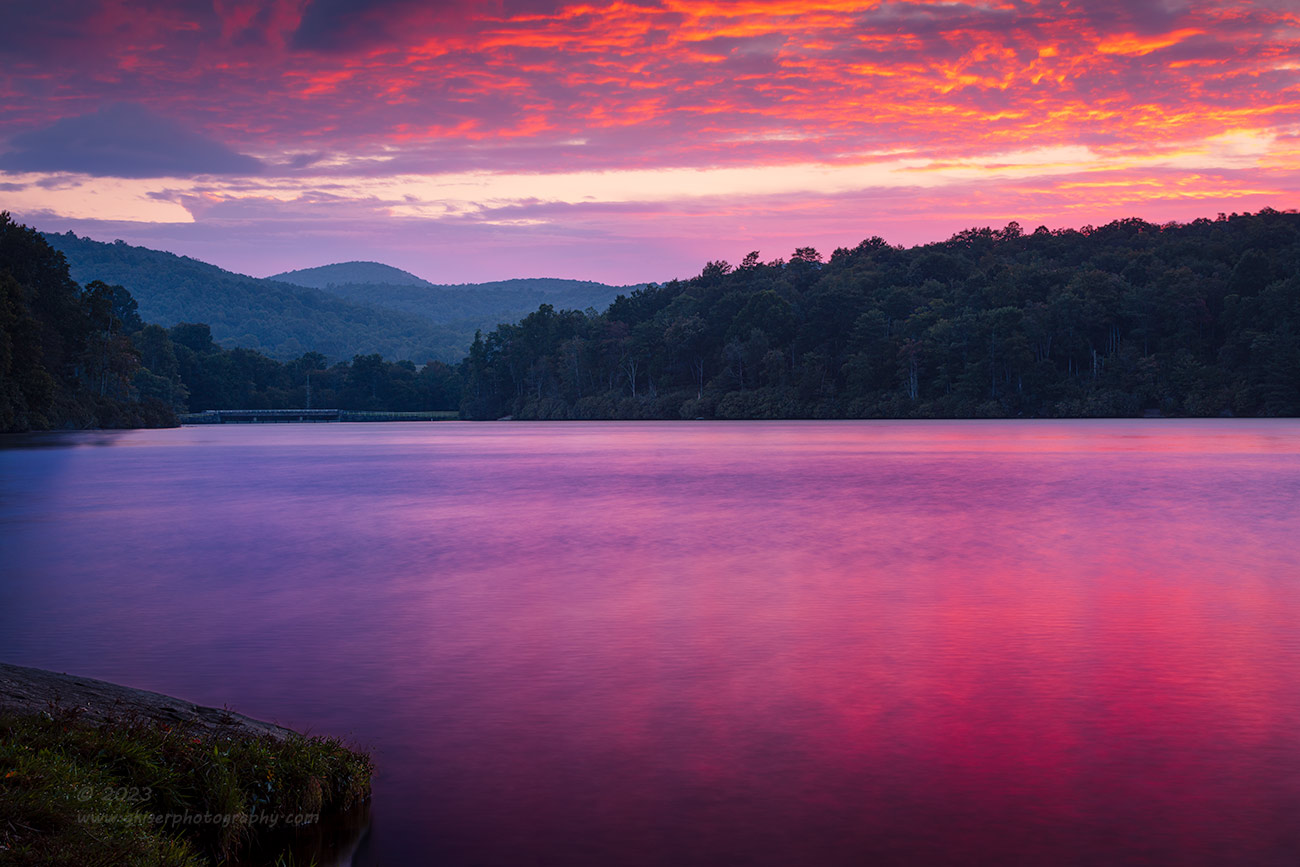
Things worked out well, and we decided that the light wasn’t right for the full composition with the foreground interest just yet. John backed up and went with a composition similar to what I had been working on which turned out much stronger than what he was working on. While he was in that spot, I moved over to the side and framed up a composition that showed the effect of focal length on the scale of the foreground and background. You might know this as compression, but I much prefer to think of it as scale relative to the foreground. As luck would have it, by the time I had that composition worked out, the light was starting to hit the rock that was the foreground. I made some exposures here as well and verified that the exposure times were settling in at less than 30 seconds making for a much easier time getting the correct exposure values. Speaking of those exposure values, the light in the sky had changed, and it caused me to go for a 3-stop soft edge ND Grad at this point. I needed more exposure taken out of the sky and because of that, I needed a softer transition so that the filter wouldn’t be noticeable in the final image.
From the two locations that I was working in, I only shot 15 frames which is nothing for a sunrise. This was actually another learning point for John as we eventually talked about sticking with a composition as the light levels changed and the cloud positions moved. There are usually just a few frames out of a bunch where everything lines up beautifully and you have a better image than what you started out with. I wasn’t giving myself that opportunity, but as I had said earlier, my priority was John’s experience and not my own photos. I really didn’t know if I had anything to show for those 16 frames, but they had served their purpose and allowed me to see how things were developing in real time without looking over John’s shoulders.
As the sky started to really kick off, I pretty much stayed with John to make sure that he was able to get the shots. We shifted around compositions a bit as he tried different things in order to capture where the interest was in the sky. I was really impressed with his ability to make adjustments on the fly to follow how the sky looked. It made me feel very good about his progress as he demonstrated that he had learned to read the scene quite well. I just let him lead the way and I was there to make any suggestions that I thought were warranted.
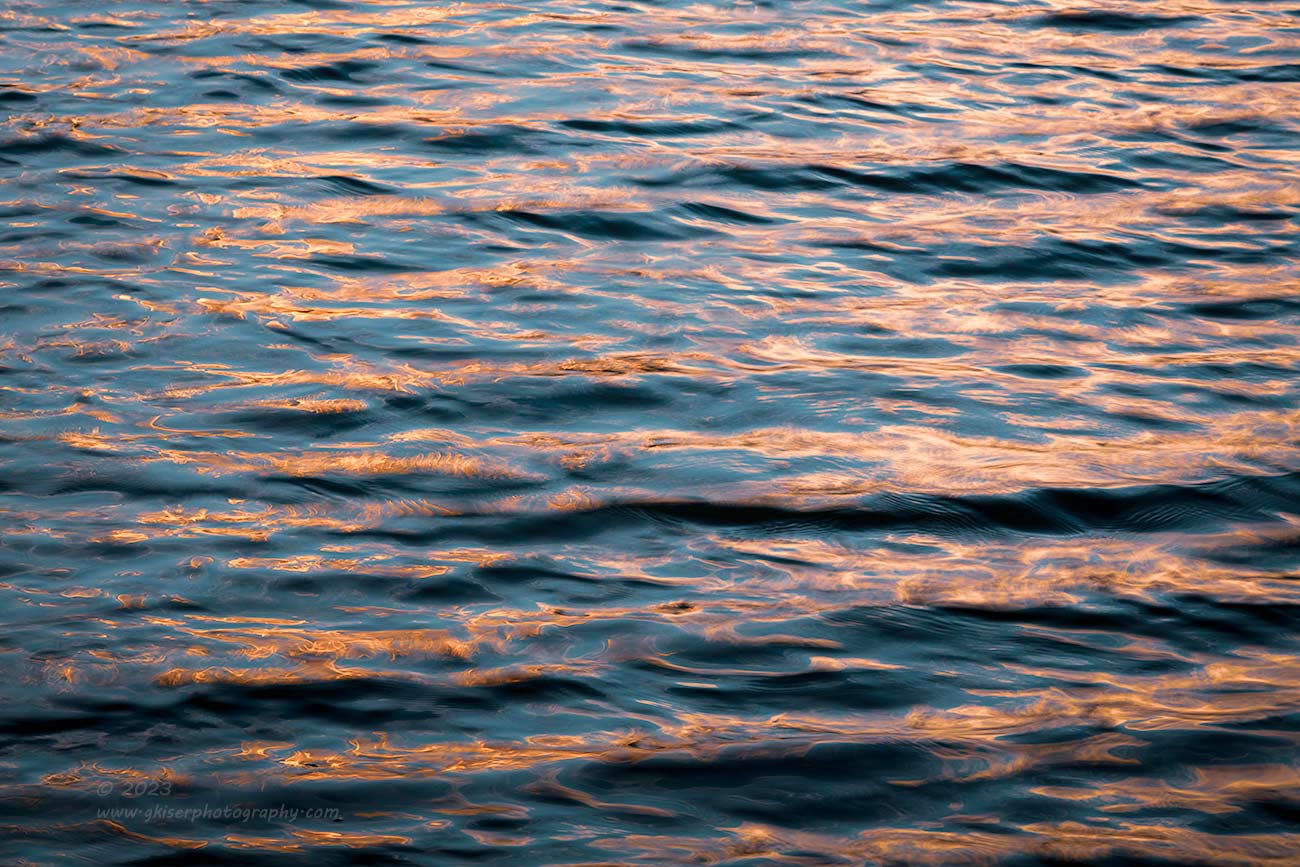
Once the sun came up over the horizon the colors in the sky washed out, but I could tell that John wasn’t quite done with sunrise capture. We talked about the different considerations that came into play at this point in the morning and how to look for alternate compositions. I was asking him what he liked about the scene, and he pointed out how the sun was kissing the slight ripples in the lake. That gave me an idea, or more accurately reminded me about a composition that I had seen recently on YouTube where it was just a basic capture of the waves without any direct subject. I explained the concept to John, and then decided to see how well it would work in this situation since I really hadn’t tried it before.
The benefit here was that I didn’t have any sky to contend with which was very bright, nor did I have to worry about the distant shoreline which had been thrown into a silhouette from the extreme backlighting. By just working the waves, I had plenty of contrast thanks to the back lighting, and a had a natural color contrast from the warm sunlight mixed in with the blue being reflected from the sky. I felt good about the idea and after four frames on my camera, I thought that it would work. John had a slightly different take on this and included the shoreline and the sky. To his credit, it turned out better than I had expected. I’m still happy that I gave this technique a try as it is certainly a valid option when photographing water. There is something calming about the random shapes of the waves and ripples which just felt right for the color combination.
For me, the show was over with the sky getting far too bright for my tastes, but John continued on with a fair amount of success with his images. I put my camera out of the way as I spent time helping him as needed. When the sky got too bright to work with, even for John, I used that opportunity to talk about alternate directions to shoot and how to look for little details that were now getting lit by the sun. As I went through some examples of things that could be photographed, I started to see things that I normally wouldn’t have seen. It really is true when I say doing these types of educational sessions benefits me as much as my clients. I pointed out a number of possibilities as well as things that might be worth photographing under slightly different conditions. When I got done with examining the scene, I pulled the camera back out of hiding and started to put my money where my mouth was.
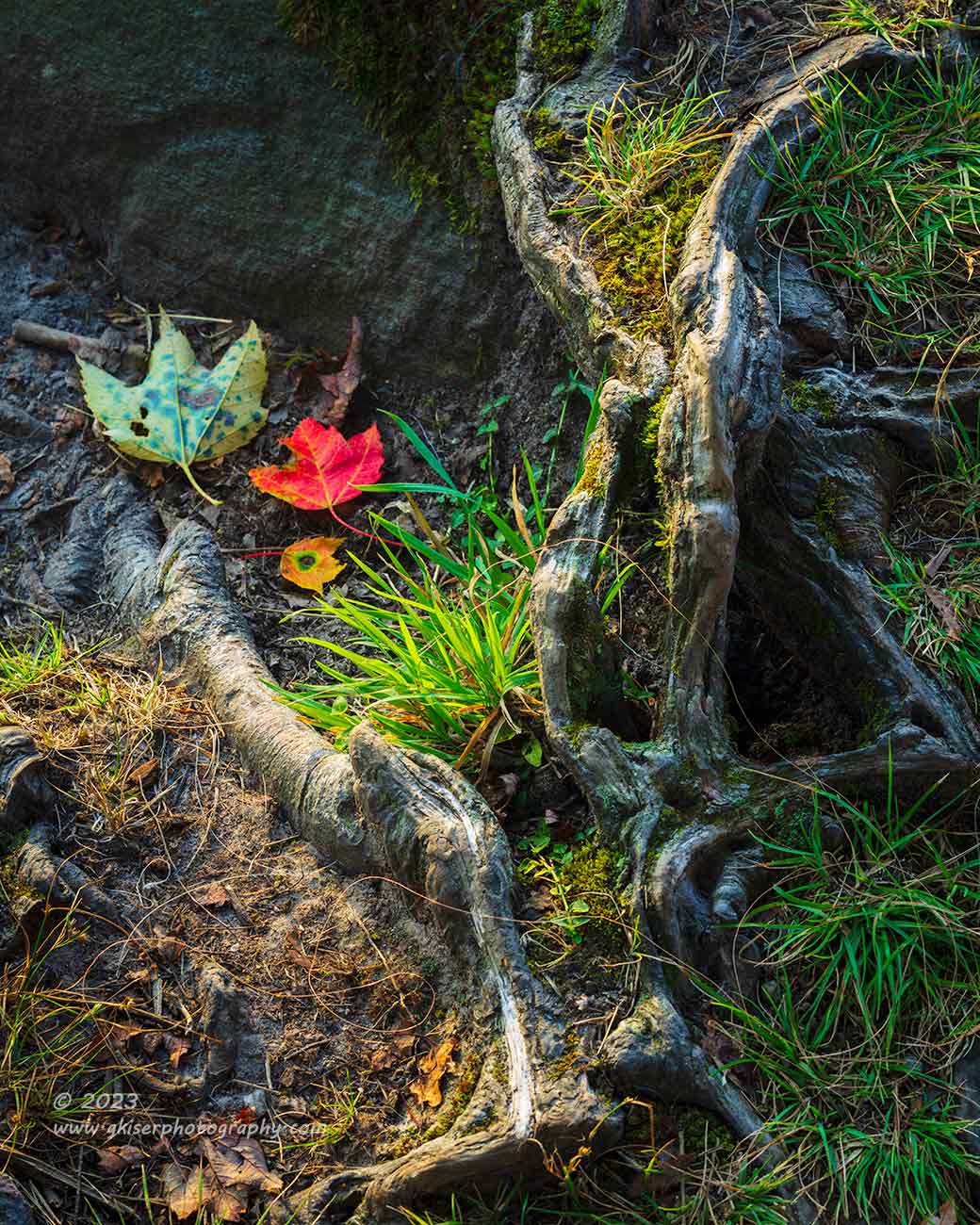
The first thing that I wanted to work with was the system of intertwined roots around a large rock at the shore which had been used as a foreground interest just minutes earlier. As I was looking for the right root system to work with, I found one that kind of stood out from the crowd. There was a couple of leaves laying within the roots that caught my eye. The problem was that the leaves didn’t really fit the scene. I made the decision to reposition the leaves that were already there so that they fit the composition a bit better. As I was moving them, I made clear my disclaimer about moving parts of the landscape for a photograph. While this was not ideal, I felt that it was justified because I wasn’t introducing anything new into the frame.
Once I had the scene set up, and the camera dialed in, I made three quick exposures with slight changes before moving onto the next subject. This composition didn’t feel quite right, and I wasn’t sure how it would turn out, but I wanted to show what I was talking about when I suggested photographing the roots under foot. I was kind of surprised when I got the photographs home when the last of the three exposures looked really good. I went ahead and edited it and felt that it had enough merit to be included in my collection as a keeper. In fact, it was the fourth image out of a total of 23 frames to make it into the keeper category and be edited. I was shocked since these photos were designed for the sole purpose of testing out ideas and showing what I was talking about.

Feeling really good about the isolations, I looked for where the light was looking the best. The sun was now shining on the shoreline a bit further to our left. I could see some of the grasses picking up the warm light of the sun and the water still reflecting the blue sky above. I moved into position with the long lens and started to figure out compositions. I started out with a vertical frame and shot six exposures as I dialed in the shutter speed that would work for the movement of the water. I didn’t want to blur the motion and level out the water. I wanted to keep the ripples intact as I had done with the above abstract. In order to get the shutter speed that fast with the aperture giving a depth of field that I wanted, I had to boost the ISO to 800 which I usually wouldn’t do. In this situation, I had really good light and I knew that the noise wouldn’t be an issue.
It was the last of the six images that made the cut, and that was right before I went back to check on John to make sure that he wasn’t having any issues. He was trucking right along with his compositions and wasn’t having any problems, so I just stayed close and waited until he was ready to move on to the next location. It was looking like that wasn’t going to be any time soon, so I went back to looking for another composition that I could do. Things really weren’t changing that much at this point which meant that I could really slow down and think about my options.

As I was considering the options, I happened to realize that the quality of light had gotten better on the grass that I had just photographed. It wasn’t like it was hard to get into position, so I moved back over to the same location I had been before getting a horizontal version of the same composition. I liked this one a bit better because it showed more of the water and the light was better on the grass. There were only four exposures made here with one of them being a vertical just in case I wanted to substitute the new light for the old light.
As it turned out, I preferred the lighting on the vertical one from the first set, but it worked better as a horizontal composition which I mainly captured in the second set. It was the last of the second group that you see here that made it into the collection. I struggled with which one to keep, but in the end I felt that it was fine to have a vertical and a horizontal composition of the scene. I’m all about options, and there are just times that you need a portrait orientated photo to fill a space, and other times, you need a horizontal one. This way, I have both covered with a subject that I usually don’t capture.
By this time, I was done with this location. I had shot everything that had interested me and directed John to things that might interest him. I was just waiting for him to arrive at the conclusion that I had after a couple of hours in the same 40 square feet of shoreline. He wasn’t far after me in coming to that conclusion, and he started to pack up his gear. Now normally, two to three hours is his limit, and he is ready for rest. I can’t complain at this because he does work very hard and is learning a great deal about photography. I was really expecting him to call it a day at this point, but I wanted to get him over to the other side of the parking lot because of those boats.
John is still figuring out what kind of photographer he is wanting to be when he grows up, and part of that exploration is to try different types of subjects. Since there is already a love for some of rural subjects that I regularly photograph, I figured that it wasn’t going to be a big jump to these boats as I really liked them and saw some great photographic potential in the boats that were present currently. I was thrilled when he was up to the challenge of working those subjects. We took the roughly minute and a half walk over to the boat launch where the rentals were parked. I took a little bit of time to introduce him to the scene and talk about different compositional possibilities. I didn’t know if he was going to jump onboard with the boats or not, but I knew that he would at least give it a try.
I actually learned something during this initial conversation as he pointed out the Old Town canoe and mentioned that this was a very popular brand of canoe. This was not something that I was aware of, but that one statement inspired me to capture the story of the Old Town canoe in some way. I was hooked talking about the different compositional possibilities but really couldn’t get a read on John as far as what he was thinking about the location. As he was pulling his camera out, I looked for a place to put my tripod which still held the camera with the same lens and polarizer attached. Since the canoe was what I was most interested in photographing, I started with that subject.

For simplicity, I set the camera up on the solid concrete portion of the dock and framed up a composition that captured the nose of the boat along with a sprig of grass that was poking through the water. I liked the concept, but the relationship between the two main elements was not quite close enough. I was also not able to get much of the boat in the frame unless I were to include the chrome railing that was on the other side of the boat. This didn’t really fit with the story that I was wanting to tell so I did everything that I could to avoid including it in the frame.
I ended up shooting three frames of the boat to show John what I was seeing. It sounded like he was happy to give it a try, so I moved out of the way to let him get set up. I wished that I had come up with a better composition, but it was something to get him started with. Since I was trying to stay out of the way, I turned my attention to the two kayaks stuck into the woods at the far end of the dock. The last time I had seen any of these here, there were a bunch of them, and they were all stacked up nice and orderly on the concrete. This time, there were only the two, and they were on their sides next to a rock. The nice part of it was that there was a really good reflection beneath them that I thought really looked great.
This reflection wasn’t just a normal reflection though as it was on the other side of a large rock which the mooring line was leading to. The rock effectively split the kayak with its reflection without causing a significant reflection on its own. The mooring line went to both versions of the boat and seemed to go right through the rock which added to the interest. Even the concrete portion of the dock worked in the scene because it introduced a cooler tone to the scene that balanced out the very warn nature of the colors on the kayaks.
I didn’t know if this was going to work or not, but I went ahead and framed up a composition that featured the boats to the best advantage. I ended up shooting just two exposures here with the only difference being a 1/3 of a stop difference in shutter speed. It was the first one that I preferred which was a slight bit darker than the second. It just made pulling the detail out of the boats a little easier while I had plenty of light in the background to make the image work. It was one of the last images that I edited because I really didn’t know if it would work out or not.
To say I was surprised would be an understatement though. Looking at the RAW image, I didn’t really see much potential in it, but after editing it for maybe five minutes and not doing much at all to it other than some global changes I really loved how it turned out. The more I looked at it, the more I liked it, and it became one of the last keepers from the day. There was just so much to enjoy looking at with this one and once again the colors really jumped out of the frame with the green leaves. I think part of the success of this image was the fact that there were a few yellow leaves on the tree behind them which helped to add a cohesive nature to the scene.
At some point during the day, I made the statement to John that it isn’t a bad idea if you have a photo in mind to go ahead and shoot it even if you don’t think it will work. I wasn’t married to the image at all when I saw it but saw a potential to it. After two presses of the shutter remote, I decided that there wasn’t enough interest there to go any further with it. Had I not made those two exposures I wouldn’t have had anything from these two kayaks which turned out to be a rather interesting composition with just a few tweaks in Lightroom. Every once in a while, I need to be reminded of how that works because all too often I will dismiss a scene that I wonder about later on. I didn’t have to wonder about it this time as I had two frames to refer to and play around with. It all worked out quite well.
John was finishing up with his composition with the front of the canoe at this point and I moved in a little further onto the floating dock to get a different angle on the boat. This was looking better almost immediately and I was able to get more of the boat in the frame while getting it closer to the grass that was growing up through the water. I was also able to get all of the mooring line in the frame which I hadn’t been able to do earlier without including the railing on the other side of the boat. It was looking much better from here, but still wasn’t coming together like I really wanted it to. I still made three exposures here to refer back should we want to explore the composition again.
While I was on the gangplank to the dock, I turned my attention to the canoes that were being stored upside down. I had been eyeing these to use as a leading line foreground to the landscape beyond them on the other side of the lake. I was still using my long lens and my bag was ashore out of reach for the moment. This was not the ideal lens for this job, but I worked from my location to try and make it work out. I failed miserably and after two frames gave up on this idea because it was looking horrible. I was going to need a wider lens for this idea.
I took the opportunity to frame up a simple landscape shot with the long lens while I was standing here. I don’t know why I pressed the shutter because the shot was horrible and had absolutely no flow to the composition. I guess that was why it only got a single press of the button. Hey, it was digital and cost me nothing to make the exposure. I didn’t even give it a second thought during the culling process, and it was dropped immediately.
Things were not going well at all at this point. The shots that I had been excited about were not panning out at all, and I had just a single composition that I wasn’t sold on either way. I was finding it hard to locate compositions that John would work on, and I felt really bad about that since this was the part that I had felt most excited about when I was doing my initial walk around. I was determined to not give up though, and I kept pressing to find good compositions here.

I worked my way to a spot on the gang plank that offered a pretty tight angle on the one boat that was nosed into the water which I had started shooting a bit earlier. From here, I wanted to figure out a way to highlight the name of the boat since the script was really neat looking and contrasted great with the red of the hull. I was having a very hard time finding a composition that I liked here but kept working at it. Eventually, I started to really narrow the scope of the elements in the scene and reduced it down to the name and one of the cross bars along with a small section of the side of the boat where the name was printed. It felt like I was missing so much, but at the same time, I had everything in the frame that I wanted. I fired off four exposures with slight variations between them and started to see that this was a winner of a composition.
It was the fourth of the series that hit all the check boxes and I was finally happy with one of the compositions from this side of the lake. This fueled me to create more, and I liked that burst of creative energy. I let John know about the composition and how it all worked out. He was still working on several ideas that he had, and I think that I went over to help him with one dealing with the bunch of blue kayaks stored on the concrete shelf by the water. This only took a minute or two to help with and it was just a matter of changing the angles he was shooting from.
I had looked at the scene before and considered a composition here but hadn’t worked it out until John gave it a try. Seeing how it looked in his camera gave me the oomph to give it a go myself. I didn’t want to get in his way, so I put that composition off for a few more minutes. While I was waiting, I went back to that red canoe to see if I could resolve that composition where I focused on the bow of the boat as it was close to the grasses. I knew that it was going come down to angles more than anything and I was starting to understand the angles that the boat was liking when it came to photographs.

I went further onto the dock than I had been previously for this composition and started to work out the framing. This was actually looking much better than the last two versions. This time, I was able to omit the railing with no problem, include the entire mooring line, and even got the seat of the canoe in the frame. There was a bit more overlap on the grasses than I had wanted, but it was infinitely more effective than having too much separation between them. This was going to work; I just knew it!
I only fired off a single frame here and when I looked at the LCD, I knew there was no reason for any other attempts. Everything about this worked well and I liked the photo for the first time. I liked it even better when I got it home and into the computer. It was another one that required very little post processing as the contrasts were already in place and perfect as they were. The dark green reflections in the water balanced out the red of the boat, and the gray interior was tinted blue to add some coolness to the scene for additional balance. The only aspect that I hadn’t really liked was the overlap with the grass, but in the end result that isn’t even a passing thought as the other aspects of the image carry it all quite handily.
At this point, I decided that I wanted to try the name again on the side of the boat, but from a different angle. This time, I would shoot it front in front of the boat at an angle that would put me on the shoreline. In order to get the composition that I needed; I was going to have to add an extender to the lens to get a bit more reach than the 200mm telephoto would allow. That only took a second and gave me an opportunity to talk about one of the big advantages of shooting on a cropped frame camera like John was using. He didn’t need an extender because his 70-200mm lens effectively became a 112-320mm which was pretty much the 400mm that I was now getting. A little extra reach for free is always a good thing.
Now that I had that extra reach, I framed up a composition that included the name, the rear seat, and one of the cross bars. I really liked how the composition came together and shot a total of four frames with slight variations. I shared the idea with John, and he liked it quite a bit. I moved offline confident that I had a good image in the camera. I helped to get him set up with the composition and I moved out of the way. I took this opportunity to work on the composition that I had just helped him with a few minutes earlier focusing on the blue kayaks.

What I liked about this scene was that the way we had worked out the capture, the boats were a repeating pattern and leading line to nothing but a reflection in the water. Well, a reflection and a jumble of branches set out a little way from the boats. There was just enough space above it to keep the actual shoreline out of the frame and leave the top of the frame as a soft reflection. I had never shot a composition like this before and was really interested in how it was going to turn out. I already liked the concept with the boats being a slightly different shade of blue than the water with a touch of green along the bottoms. The wetness from the rains and humidity added a bit of texture and some contrasting points to the boats as well. There was a bit of cloud reflected in the water which helped with the visual pathway through the image and the green trees closed the image in perfectly while giving great separation to the dead branches.
Having worked out the composition through John’s camera, I knew that I had the wrong lens combination on the camera currently with the telephoto and extender. I went back to the bag and pulled all of that off to switch with my standard zoom lens. The polarizer was transferred to the new lens and I was up and running again. I was able to set this one up pretty quickly and only needed to fire off four frames before I was sure that I had what I needed. It was that last frame that was the keeper of the bunch.
Of course, now that I had a different lens attached to the camera, I was ready to look at things with a fresh eye. I checked on John to make sure that he wasn’t having any issues with his composition and then made my way back to the floating dock side of the area. I wanted to get the composition that I had tried earlier with the trio of canoes pointing off to the distant landscape. This lens was going to make this much easier, and it reminded me of a composition that I had shot here before the dock was installed. Back then, they had just stored the canoes like the blue kayaks were. That blog entry is long gone I’m afraid as it was done back around 2010 or so. I’m surprised that I remember the composition because it was never all that fantastic and I haven’t seen it in years.

One thing that I did remember is that the photo lacked any punch at all, and the lighting did it no favors at all. I had much better lighting this time and having two red canoes rather than all green with a single red one helped to add weight to the canoes. With better lighting, I had a good start to a better photograph, but I had to get a composition that would work for the scene at hand. Originally, I had shot both horizontal and vertical which both worked at the time. The difference was there were a lot more canoes lined up, so the horizontal composition made sense, as did the vertical one. Now that I was only dealing with three primary boats, I chose to work with a vertical composition which emphasized just those three boats.
I started off with a composition that eliminated the post to the left, but that seemed to crowd the boats too much. I decided to include the post as a framing element and place it close to the left edge of the frame. This gave context to the dock which now allowed the left boat to have some much needed breathing room. On the right side, so as to keep things balanced, I included some breathing room for the rightmost red canoe by including a fourth canoe that was right side up. Since it was showing the interior, it broke the pattern and was not like the others allowing me to just include a sliver of it as a buffer to the edge. I elevated the camera so that there was enough separation between the boats and the reflection of the distant shore.
The hardest part of this shot was keeping everything still because I had a fully extended tripod on a floating dock which I was making rock with every movement I made. Once I got the composition dialed in and the exposure set, I would grab the shutter remote and shield the lens before freezing for about 10 seconds. After no movement for those 10 seconds, I would make the exposure without moving more than my finger. I would then evaluate the photo before repeating the process with any changes that needed to be made.
It was the second of three images that ended up making the cut. Everything worked together in that one photograph. It came down to the cloud position in the sky for the most part as the other changes were all very miniscule and were largely overshadowed by the 4:5 aspect ratio crop that I gave the image. I was very happy with this image and showed John how it all came together. When he got done with the composition that he was working on, he went over to give this one a try. I’ll go ahead and put this out there. He ended up with a stronger photo than I did because the clouds came into the scene in such a way that he had a beautiful S curve through the entire scene. I’m so glad that it worked out for him to get that better photo. I’m happy with mine, but I’m ecstatic about how his turned out. It is all about timing, and I proved that to myself with this next composition I did.

You might remember me talking about getting a tight composition on the side of the canoe that showed the Old Town script a while back. You didn’t see the resulting photo from that composition even though I shot four frames of. Well, when I came back to John to tell him about the last composition that I had shot and to check on his progress with that same intimate capture of the side of the canoe, I saw that the sun was now hitting the boat. Normally, I would see this as a bad thing because of the highlights and shadows that would be produced, but looking at the scene in person and in his camera made me realize that the sun did several things for this scene.
first of all, I liked how the red was looking in the full sun. It seemed to come alive, as did the white script. The seat produced a nice shadow along the floor of the boat which added to the visual interest. This was certainly one of those times where the shadows were adding elements that improved the composition. Everything else about his composition was the same as what I had shot earlier, and I knew that his version with the sun was going to be stronger than what I had shot. Not that this was a competition or anything, but I also wanted the best possible version of the image and felt that it was worth a reshoot.
I went back to the bag and grabbed the telephoto lens and the extender to replace that 24-70mm lens. Of course, I kept the polarizer attached because it was doing wonderful things with the various surfaces that were being photographed. Once I had the camera built again, I moved back into position where I had been a short time before. In that short time though, lots of things had changed because of the sunlight. All of the changes were for the better, and I was really glad that I was back at this composition.
having already worked out the composition it took no time to get things dialed in again. I did lower the camera slightly from my first attempt though as I had seen that was a better choice when helping John get his composition set up. With all the guesswork out of the way, I fired off two exposures with two different focus points to make sure that I got the right depth of field. With that, I was satisfied with the composition. In fact, I was so satisfied with this one, it was the first photo that I edited out of the bunch. You might notice that the treatment is a bit different from the other photos of the red boats and that was done on purpose. I wanted this one to stand out a little bit and look more aged. Between the name on the side of the boat and the fact that the seat was tattered, there was some obvious age to this subject, and I didn’t want the bright saturation to conflict with that message. By choosing a lower saturation color profile and then dialing it down in some specific ways I was able to keep that overall mood intact through the image.
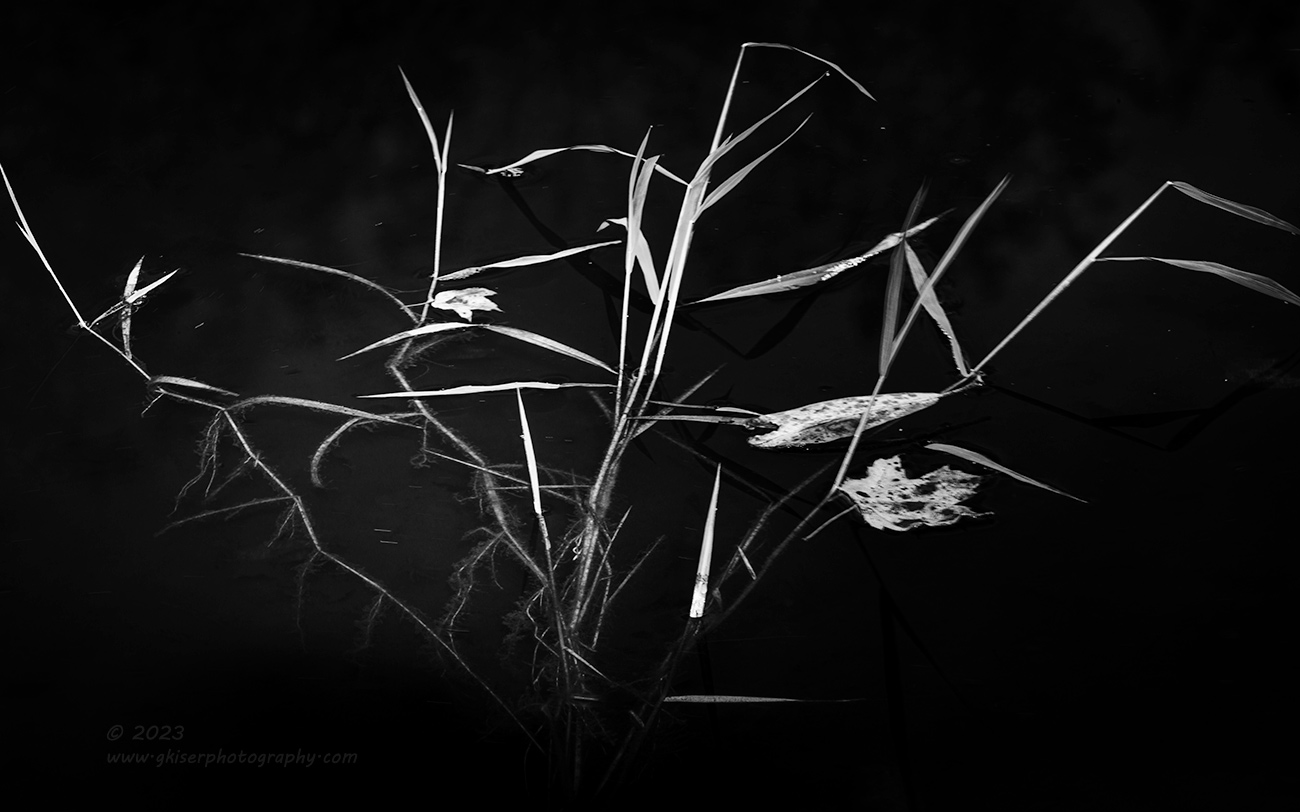
You might recall that right in front of this boat was a patch of grass that was growing out of the water. I had been very concerned with capturing it in unison with the canoe and had done several different compositions where this was an integral element within the scene. While I was standing here, I had the wild idea to make a composition just around this one element. It was going to be a little bit minimal and a little bit abstract, but mostly it was going to be an experiment in presentation.
I still had the lens with the big reach attached which allowed me to easily fill the frame with the grass. The polarizer allowed me to darken the water around the grass creating a low key approach to the scene. At the time of capture, the water was a dark brown with the grass various shades of green. I wasn’t all that happy with the colors and decided to give this a black and white treatment when I got home. There was but a single capture to work with as I didn’t spend a great deal of time on this grab shot because I needed to get back to John. I was able to find a profile that fit my vision for this piece, and I did a quick edit as it didn’t require much at all before I was happy with it.
I couldn’t help but find parallels between this new photo and my most significant image from 2022 which was also shot at Price Lake. Now, I’m not saying that these images are on the level at all, but it is interesting that one version is a high key minimalist image while this one is a low key minimalist image. One is in color which adds to the story, and one is in black in white which furthers the story much more effectively than the color did. They are both grasses that are coming out of the water. One is very simple and orderly, while this one is a bit more reckless in structure. The subjects are very similar, but the story being told is completely different. I like them both in their own rights, but this new photo can’t hold a candle to the one from 2022 in my opinion.
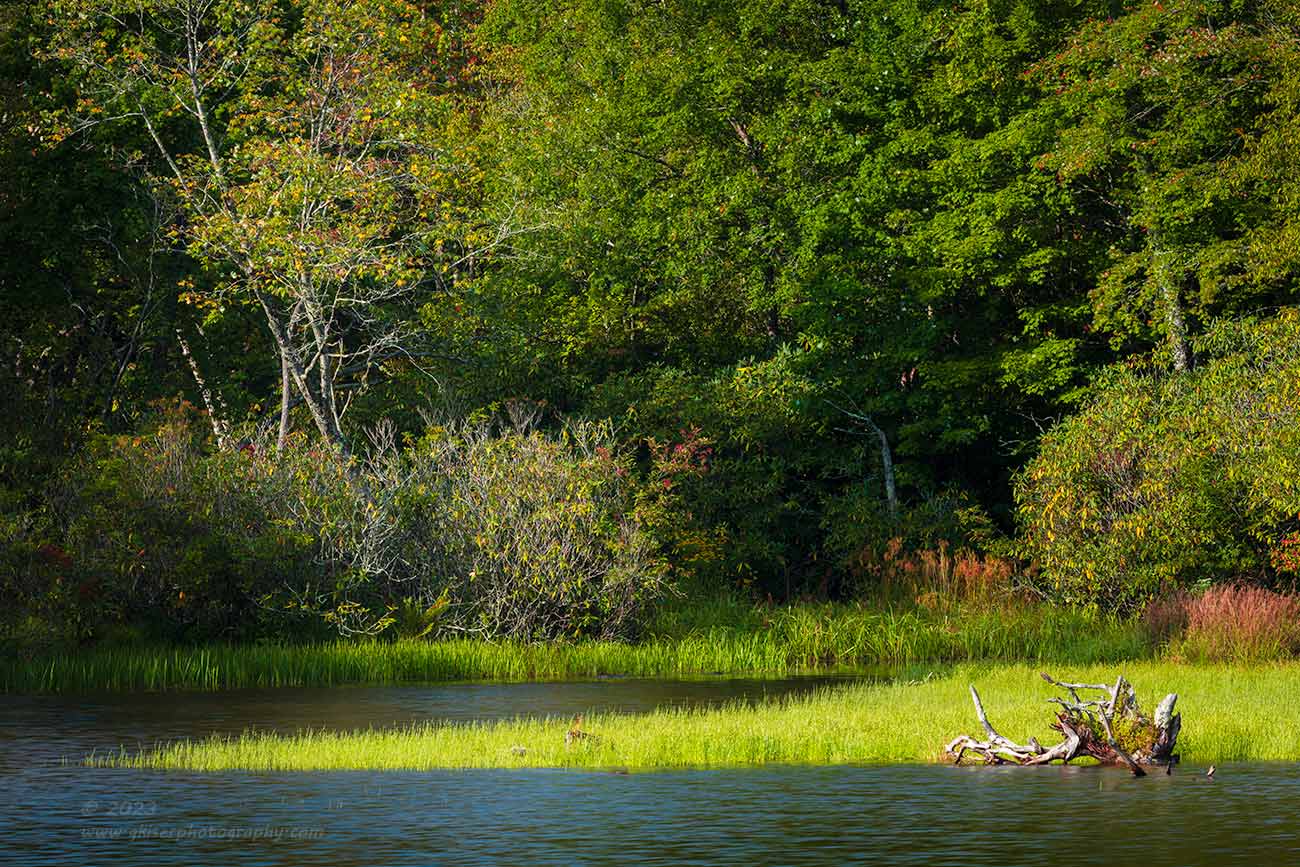
Before I exited the dock for the last time, looked off into the distance at the shoreline that I had shot earlier without success. The sunlight was now fully on it and I was seeing much more in the way of details and color. I decided to find a composition and give it one more try. What I found was a bit of dead tree that I had photographed from the trail during my first with a DSLR camera in what must have been 2008. It hadn’t changed much over the years, but it sure looks different from this direction, especially with the tall grasses growing up behind it. Those grasses caused a visual cut into the landscape with the water flowing back into the trees. This was going to be my point of interest, and I chose to use a bare tree to the left as a counter element to the tree remnants. Due to the distance, I was going to need the reach of the extra-long lens, so I was happy that the extender was still attached.
I got things framed up the best was that I could and looked for any issues that might pop up before firing off the first shot. Due to the distance, I was slowing my process down significantly to make sure that I gave the camera about 10 seconds to quit moving after any adjustments were made. I ended up making four exposures to make sure that I had one that was tack sharp as there was a lot of fine detail that I was trying to capture at 238mm. It was the last of the group, and the last frame of the day that worked out the best with the lighting and the overall sharpness of the scene. With that one, I was done for the day and had run out of creative juice.
I spent the rest of the time close by John’s side until he was satisfied that he had everything he wanted. As we were getting ready to call it a day after nearly four hours, I sprung on him my idea to import his photos into my laptop which I had brought with me. I wanted to do that in an attempt to evaluate how his photos had turned out. Unfortunately, I had a hard time getting the card ready to import the files onto the computer and had to give up on that. Instead, we both with back to his house where we looked at the photos on his computer. I’m not sure how many exposures he had made, but it seemed like maybe 60 or so captures for the morning. As with any photo session, he had some that just didn’t work, most of them were good, and with those good photos, he usually had one that was a standout from the crowd. It was probably the most successful day he has had in the field overall. He seemed very happy with the outcome of the photos which was my goal, and we had the chance to talk about most of them to wrap up the educational experience of the day.
I remember my drive home thinking about the photos that I had seen on his computer which were jpeg’s straight out of the camera as he had so far chosen to not shoot in RAW. With that in mind, I have been working with him to get to a place where he can produce high quality photos right from the camera using the internal processing power of his Canon. Looking at those files, I was really impressed and actually worried that he had shot a better collection of images than I had for the day. Again, this is not a competition, I was just that impressed with what he had done for the day. I was hoping that I wasn’t going to get home and be disappointed with the images that I had shot during the day. I didn’t even know how many I had captured. If I was lucky, I thought that there might be around four photos that I would hold onto.
I debated pulling them into Lightroom when I got home because I wasn’t really ready to deal with them just yet. However, my curiosity got the better of me and I imported 67 photographs into Lightroom. I started my culling process and was surprised to find that there were 20-something photos that I was interested in looking at further. As I culled those images down, I ended up with 14 that I was going to edit which was astounding considering for the most part, I was just shooting sample images so I would know if a composition would work. In the end, I had a total of 14 new images to add to my collection and many of them were unlike anything that I had shot before.
The edits took no time at all, and there was actually very little local editing done to these. That is a testimony to how good the light had been, and part of the reason why John’s jpegs turned out so good. When the light is right, things just fall into place much easier no matter what format you are shooting in. John had already expressed his happiness with the day, and here I am like 12 hours later saying I’m right there with him in satisfaction for the morning. I think it was a fantastic outing with a lot of great subjects and scenes to photograph. It was certainly worth the long wait to get this trek scheduled and it will likely be a standout trip to Price Lake in my memories. That is saying something since this is my most visited lake location out of every place I’ve been.
I hope that you have enjoyed this trek and the photos that resulted. As always, consider purchasing a print as those purchases do help fund these treks as well as my time writing the blogs that you read. Also, if you think that these mentorship sessions sound like fun, you can sign up for them hourly, or in a more structured and long-term arrangement. I have several options listed through my mentorship programs, but if you feel you would benefit from something that isn’t listed, feel free to give me a call to discuss your needs. I’m always happy to custom build a program that fits your own needs and helps you achieve your creative goals. The consultation is always free and there is no obligation attached to that consultation. Let’s chat and see how I can be of assistance.
Until next time….

Remember to use the code KISER10 to get 10% off your purchase