Monday, October 17, 2023
There I was minding my own business going around looking for a few simple photos to capture a couple of days before a pretty involved photo shoot here at the studio. I had one in the bag, but foolishly wanted to get another one, maybe two. Well, I ended up in Taylorsville at a place that I have been by many times in the past but ended up speaking with the property owner kind of by chance. I had kind of decided against shooting the one car that I had stopped to check out, but since he was there, and I was there…well, you know that I ended up sticking around to photograph the car. During my time there, he mentioned that there were some other cars behind the shop. I had no idea what was waiting for me back there.
Before I left, I did take a look as some of the area and saw so much great potential that I became very excited about returning to this location. I think I even said that I could get lost back there for days and not run out of things to photograph. What I didn’t know was that I was only seeing about a third of what was back there. I had run out of time, and light to explore any further and I thought that I had a good understanding of what was there. I knew that I wanted to come back on a cloudy day, and ideally when the vegetation was a little less intense. When I finished with the edits, I put the location in the back of my mind so that I could focus on the Friday the 13th shoot that has been on the schedule for a couple of months now.
The session went very well, and I hope to have a light blog entry about it coming up soon. I ended up editing photos for the entire day on Saturday and ultimately had 40 photographs to deliver to the clients. I don’t think that I’ve ever edited that many photos in a single sitting, but I somehow managed to get it all done in something like eight or nine hours. When I was done with that, I had no desire to do anything at all with a camera for a very long time. I was creatively wiped out, and my eyes were tired. Sunday was pretty much spent sitting in my recliner resting, and I would have had it no other way. By that evening my mind was starting to feel creative once again, and looking at the weather for Monday I was kind of wanting to do something with the clouds.
With it being peak season for Fall colors around the Blue Ridge Parkway, convention would dictate that I head up there. The clouds would potentially be nice, even if they were forecasted to be a bit low. I had taken advantage of some of the early color when I went up there about a week ago. Of course, that trip was filled with tourists and other photographers all trying to exist in the same place. Each year, that reality puts a sour taste in my mouth for capturing the changing leaves anywhere near the Blue Ridge Parkway. I just don’t like crowds, and I certainly hate waiting in line to take the same photograph that 20 others have just captured. My photography will always be for me first and foremost, but since I have made it a business, I recognize that I need to showcase what makes me unique rather than just adding to the noise of other photographers posting images to social media.
With that in mind, I just couldn’t bring myself to get excited about going to the mountains, even though it would be on a weekday. I knew that there would still be crowds, and the low cloud cover could potentially kill visibility which would not be what I would want this time of year. In hindsight, those clouds brought with them a bit of a snow shower that I kind of hate I missed, but I stand behind my decision. I couldn’t get the last location out of my head because there were just so many interesting vehicles out there. Even though the vegetation was a little thick, I knew that there were images to be made, and I didn’t want to risk the owner changing his mind later on. The cloud cover would be perfect for decay photography, even if the visibility was limited. I was going to keep my options open come Monday morning because the clouds were going to come in until late morning, and possibly around noon.
When I woke up on Monday, I checked the weather, and it was actually looking good for either option, so I just juggled it all back and forth in my head for a few hours. In the end, with Toni’s help, I decided to go with Taylorsville rather than the mountains because my only reason for going to the mountains was out of a sense of duty to capture the colors. I’m pretty sure that has been covered by other photographers, so they didn’t need me up there in the way. Taylorsville would almost assure quiet time in the woods photographing subjects that truly excited me. I do enjoy the leaves, but I don’t like shooting scenes just because there is color in a tree. I want the colors to help tell the story of another actual subject which I had the chance to do in Taylorsville since there were already hints of Fall color there as well.
I ended up leaving just before Toni left for work and arrived shortly after 11am. I had already called the property owner who had confirmed that I was welcome to go out and photograph the old cars. He was going to be in and out with some other things that needed attention. What I didn’t realize was this owner was actually a character in the Lewis Carroll novel, Alice’s Adventures in Wonderland. No, I have not been inhaling fumes from these old cars, and the smoke machine that was used on Friday was just regular fog juice. No, I have come to realize that the owner here shared a lot of traits with a certain rabbit which was introduced early on in the story. Of course, I didn’t recognize this fact until about halfway through the trek that I was starting on. The owner opened up a whole new world for me with the simple phrase, I have some more cars in the back. Innocently, I took his direction into the trail through the trees. Even the preliminary scouting showed that this was more than just a few cars. In fact, this was in every sense of the phrase, a rabbit hole.
I thought I had seen pretty much everything when I dipped in to scout it, but there was so much that I missed, and it seemed that at every turn, I was finding new cars and new paths. I never got the point where I thought I might get lost, but there were times I had to stop and think about which direction would lead me back to the truck. I ended up spending almost five hours on the property. During that time, I had wonderful cloud cover, bright sunny skies, and a mixture of both. I would love to take you through this adventure step by step and how I came to find each subject, but the simple fact was I was just walking around and reacting to what I saw as I saw it. Some of the time, I would come back when the light worked out better, but mostly I just shot it as I saw it. I also can’t get too detailed here because the owner wishes for the property to remain undisclosed which I fully support and respect.
What I will do with this blog entry is to keep it simple and just talk about each photo and why I chose to capture that particular scene. For the most part, I was using the same 24-70mm lens and a polarizer, so there was not much changing around of equipment, although I did bring the bag along this time. That was a good thing too because I drained one battery and used up about half of another one during the five hours I shot. I ended up with 170 photos which for the changing lighting wasn’t out of the realm of normal for me. I really thought that I was going to have 15-30 keepers based on my average hit rate. I could tell that wasn’t going to be accurate as I was culling through the images. My first cut brought me down to over 70 frames. The next had me at 50. I then had to be really cutthroat and managed to get it culled down to just 30 which I would be happy to edit and decide on. Every one of them made it into the keeper stack which makes this one of my larger single location treks when it comes to resulting photographs. Now, I’m not going to overwhelm you with 30 photos in this blog entry. I’m going to break this all up into three different chapters, and might possibly bring in a portrait shoot blog entry between the second and third installment. Settle in and get comfy. Let’s do this….
Chapter 1 — You are here
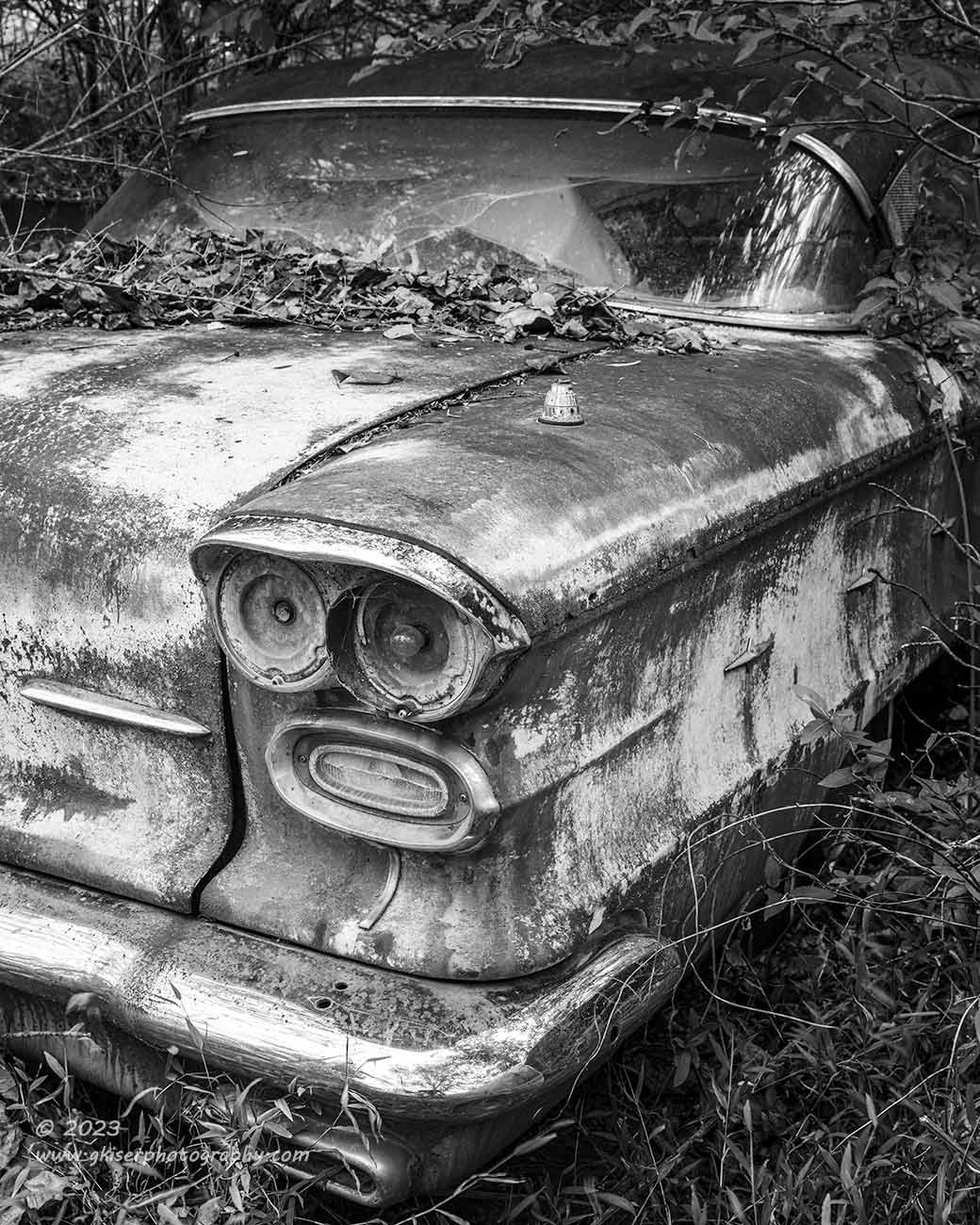
The journey along the trails started off kind of as I had the other day, but I didn’t want to spend time working cars that I had already captured. There was a Pontiac that I had seen but hadn’t done anything with which started to beg for my attention. I hadn’t taken the time to figure it out the other day because there were small sapling trees which were growing up just behind the trunk that were a distraction for the photo. Not wanting to waste time in the fading light figuring things out, I had passed on it. Now that I had time, this was something that I wanted to spend some time with to figure out. I tried horizontal and vertical shots. With the horizontal ones, I was able to get the entire rear of the car with the saplings framing the “PONTIAC” letters, but ultimately, the one very straight tree just looked like a flaw in the photo that bisected it. That was a shame, but at least I had a clear view of the rear corner with the taillights and the chrome trim along the quarter panel and trunk lid. The missing lenses were points of interest for me as well.
When it came time to edit this one, I chose to go with black and white because the colors weren’t really doing anything for me, and it was just too heavy on the rusty colors for the amount of green that was present. Removing the color simplified the photo and brought the attention to the textures and the shapes more than anything. The lighter parts of the car which still showed paint, served a purpose without color as the defined other shapes. While the image was in color, the brighter parts just grabbed the eyes and kept them from exploring the scene.

Next on my journey through wonderland, was this old Chevy truck which had also caught my eye the other night. I loved the door art which could still be seen through the patina of the paint. The orange color worked well with the greenery that was growing up beneath it. The problems that I had with it the other night was that the front end wasn’t really present and there were some major distractions there. The bed was also missing, so I wasn’t going to be able to get an entire truck. To add to the complexity, there was a lot of other vehicles and obstacles in the way to get into position for a shot. I just didn’t have the time to figure that composition out at the time.
Now that I had some time to work with, I went through the standard questions that I like to ask about what I like and don’t like about the scene. This brought me to a rough composition where I showcased the door art with the greenery below it. For depth, I came in at an angle from behind the cab and shot into the driver’s area. Through careful camera placement, I was able to position the steering wheel where I wanted it, keep the “Chevrolet” dash trim visible through the steering wheel, while hiding a blue bit of trash in the cab from view with the cab corner.
Of course, after spending all this time getting the composition right, the sun started to peak out and threw shadows all over the door. Since I had so much time invested, I just sat and waited for a cloud to cover the sun once again. I think I only waited about five minutes before that happened and the lighting was back the way I wanted it. I shot a few frames with slight adjustments here and there to make sure that I had what I wanted. I also shot a view through the window capturing just the interior. In the end, it was the entire door that caught my eye the most. That orange color and the faded lettering was just too integral to the story to omit. I still had the view of the inside though because I had chosen a depth of field that allowed even the spiderweb in the passenger side to render as sharp. This composition had it all, and with so many photos waiting to get edited, I didn’t want to have one that essentially duplicated a detail of another photo.

Not too far from the Chevy truck I had just shot was a Plymouth sedan which interested me. It was not terribly unique in appearance, but I did like how the tops of the hood and fenders were rusty while the rest of the car showed a good coating of the original paint. The problems that I had run into with it was the fact that it was surrounded by a Chevy truck, a Cadillac, a trailer, and another ’60’s model pickup to the passenger side. There was just no way to get an overall composition of this car. The best that I could do would be to shoot isolations. Because the patina was kind of uniform over most of the car, there were not many details that I wanted to capture. As I looked at all of the angles, it was the tree behind the car which really caught my attention. I liked the structure of it, and how it looked against the clouds. Sadly, the cars were all in the way of the tree, so I couldn’t make a shot of just the tree.
My wheels were turning at this point though, and I had a car that I liked and a tree that I liked. It only seemed fair that I include both in a composition. If I got low enough, I could block most of the vehicles behind the Plymouth and just focus on the car. In order to get the visual balance right within the scene, I was going to have to make the size of the car smaller in the frame which was going to be done through cropping. I started off with a horizontal frame to go with the length of the car with the bottom cropped just below the molding. This kind of worked, but the emphasis of the frame was obviously on the car which wasn’t nearly as interesting as the tree behind it. The horizontal frame didn’t include enough of the tree to make it look important, so it just looked like I had carelessly cropped the scene.
To remedy this, I flipped the camera vertically and framed up a similar composition only with the tree dominating the space in the frame. This seemed to fit better with the concept that I had, and I worked on tweaking that composition much longer than the horizontal frame that I had shot originally. Of course, the sky was causing me problems since my foreground was essentially a dark car in the shadows, so I had to do something to even out the exposure. I went to my bag and added a 2-stop ND Grad which brought the sky down just a touch while not really causing shadow problems in the tree limbs.
When it came time to edit this image, it felt a little flat when it came to color, but I didn’t like it as a black and white photo. I went through the different color profiles and landed on one that I use occasionally this time of year which changes up the yellow/green tones and pushes them more to orange. The scene came to life with the orange rust on the top surfaces matched to the newly oranged tree overhead. Yes, this is a bit of digital trickery, but I am not counting it as manipulation since it is just a matter of changing how the colors are interpreted within the scene. The colors present now told the story that I was after and gave it a seasonal flair that fit the mood I was in. I don’t want to misrepresent this photo in any way and want to be totally up front with what I have done here. The choice was for an artistic decision and that was given more importance than the reality of the scene. Other than some of the colors, this is accurate to how the scene appeared as there is no sky replacement and nothing dealing with AI inserting or removing elements.

To compare with the last image, the Plymouth found in the lower right of the frame is the same car that I used as the foreground in the above image. For this composition, I embraced the collection of vehicles in this tight area. As I mentioned, there were trailers and other vehicles close by, but when I got to the rear of the Plymouth this is what I saw. To be fair, I went back here to look for detail shots I could shoot of the Plymouth but found nothing that interested me. What I did find was a collection of cars moving in a counterclockwise direction. Almost immediately, I saw the Cadillac as the primary character with the other two balancing out the composition while providing a visual path.
I started to work out a frame around the scene had had the hardest time getting that accomplished. I had yet another vehicle blocking where I wanted to be. This forced the composition to be a bit too close for me, and I couldn’t get everything in at 24mm. My only option was to move to a wider lens, but this would have the impact of changing the perspective within the shot. Knowing that the Cadillac was the largest vehicle, shooting it with a very wide angle would make it visually even bigger in the scene. I just had to be careful with the lens and keep it from going too wide.
I had the camera set up as far back as I could go with it, and framed up the shot as tight as I could get it while keeping breathing room between the Cadillac and the edge of the frame. I also picked exactly where the other two vehicles were cropped within the frame. With the angle, I had to worry about the bumper of the Plymouth pulling the eyes out of the frame to the lower right, so I placed the little bumperette right at the corner to prevent the eyes from escaping. The truck in the background was worked out by moving the camera left and right until the right separation was achieved with the added benefit of capturing the dominant branch in the upper right.
Getting this composition put together took a lot of time, and probably represented about half of the time that I had originally explored the area a few days before. Shots like this were not able to be made under those time constraints because as you can see, there are just too many variables to have to work through. Now that I had it all figured out, I just had to wait for the breeze to stop and the light to get right which didn’t take that long at all. Things just fell into place for this one once I had done all the heavy lifting of getting the compostion set.
Editing was also very easy here and unlike the previous photo, there was no sense in doing anything major here. I had a view of a tree with some yellow leaves which provided plenty of interest in the top parts of the frame and the three cars just did their parts in adding interest. Even the fruit that had fallen from the trees added a bit to the story of this location. This one turned out to be one of my favorites from the entire day for both its simplicity as well as the complex layers of it all.

Cadillacs have long since been very expressive vehicles to photograph. Everything about them is overkill from a design standpoint. While this is not my style for something to drive, I love to photograph vehicles like this because there is just so much interest to the subject. I would have been remiss had I not spent some time shooting isolations on this big car. It was the grill more than anything that caught my eye, but the headlight bucket had to be part of it as well. You know how I like to use the headlights of these cars as the eyes of a portrait, even when they are not present.
Because of the way that the grill bulged out in the front, I had a chance to get a composition that showed off a lot of depth instead of my typical straight on shot. With the headlight bucket being used as the visual anchor, I worked out a composition that focused on the grill and used the bumperette to frame the image opposite of the headlight. For simplicity and visual impact, I let the lower part of the grill drop out of the frame to the left because that would establish the grill as the primary element. The turn signal kept the eyes from leaving the frame with the grill on the left side.
I shot this with color in mind, but when I started to edit it, the overly warm tones of the scene seemed to be a distraction from lines and shapes that I wanted to capture. By removing the color and going with a moderately contrasty black and white profile, I was able to keep the attention on the lines and shapes, while still maintaining the slight tonal variations of the rusty grill. The lack of color also put more emphasis on the leaves and other organic debris which just kind of blended in when the image was in color.
It is times like this when I know for certain that photography is an art form just as painting or drawing is. The argument has always been that a photographer just records things that are already there while an “artist” creates something from nothing. Yes, I have captured a scene that existed before I even showed up at this property, but the art has always been where to place the camera and which focal length is used to create an image on the sensor or frame of film. There is an art to photography, and you are seeing the work that goes into it right here in these images I’m sharing today. Whether we are talking the composition of an image, the exposure choices, or even the editing choices, it is all working together to present the image that I see in my head.
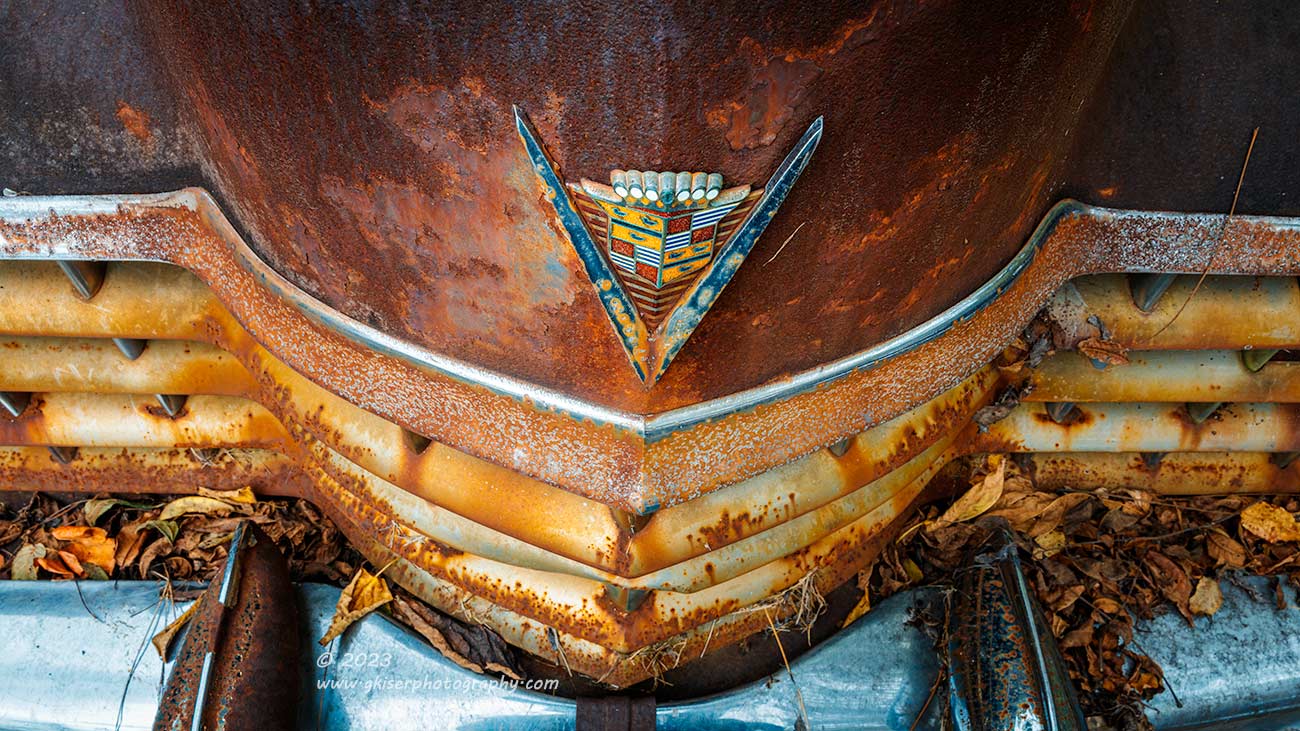
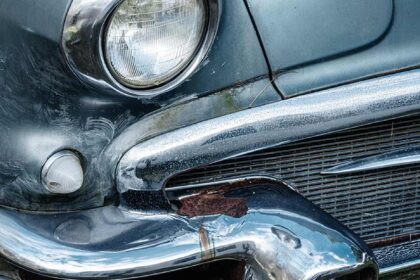
It was this view of the Cadillac that I shot next. It is closely related to the other detail shot as it focuses on the grill, but this time, I wanted the main character of the composition to be the crest on the hood. One might think that since I did the last on in black and white that this one would also be a candidate for the same treatment. The thought never actually crossed my mind because from the beginning I knew that this one was going to be in color. The same warm tones were present, but I was also including chrome which was reflecting the sky and the cooler blues that came along with it. This allowed me to achieve a color balance in the image which would add to the visual excitement. In fact, I could even cheat the cool blue to more of a teal color which would pair exceptionally well with the dominating oranges of the grille. Those same colors would be repeated in the crest at the nose of the hood.
As far as the composition went, I wanted to focus on the crest more than anything else, which meant I needed to get into a position to shoot down onto the nose of the car. The camera was set very close to the bumper of the car and aimed almost directly down towards the crest. I didn’t like how the composition was looking on the LCD because I was getting either too much above the crest, or below the bumper. If I tightened the crop with my zoom, I ended up shortening the width of the grill which made things feel very crowded. I again looked at things through an artistic eye and chose to go with a 16:9 aspect ratio to embrace the width of the grill while not adding too much extra to the top and bottom of the frame.
That aspect ratio was perfect for this composition, and I was able to get just enough of the bumper in the shot to establish the cool tones that I needed while adding the details of the bumperettes which completed a triangle of elements when linked with the crest. The shape of the grill transformed into that of a bird with outstretched wings for a bit of excitement within in the frame. The rust on the hood provided that last element of texture to contrast with the smooth chrome of the bumper while complimenting the pitted rust on the bumperettes. Photography is so much more than pointing a camera and pressing a button, but photographers rarely get the credit that they deserve for their art.
I probably could have spent the entire day on that Cadillac, but I felt that I needed to move on. I had still not even ventured beyond one of the first areas of cars that I had already come to. I knew that there was a lot more space to explore. As I went through the trails, I saw a bunch of cars that were too overgrown to photograph, but they eventually brought me to a place where I was able to move into an area that I hadn’t seen before. As it turned out, when I came out on the other side of the trees, I could see a property that I had shot around a year ago. I had stood on the other side of that fence and shot the group of cars that I was now standing among. It was a complex scene with a lot of different cars parked in close proximity, so I started to pick out points of interest. I did try an overall grouping shot of the scene, but it felt more like a snapshot than a considered photograph, so it was discarded.
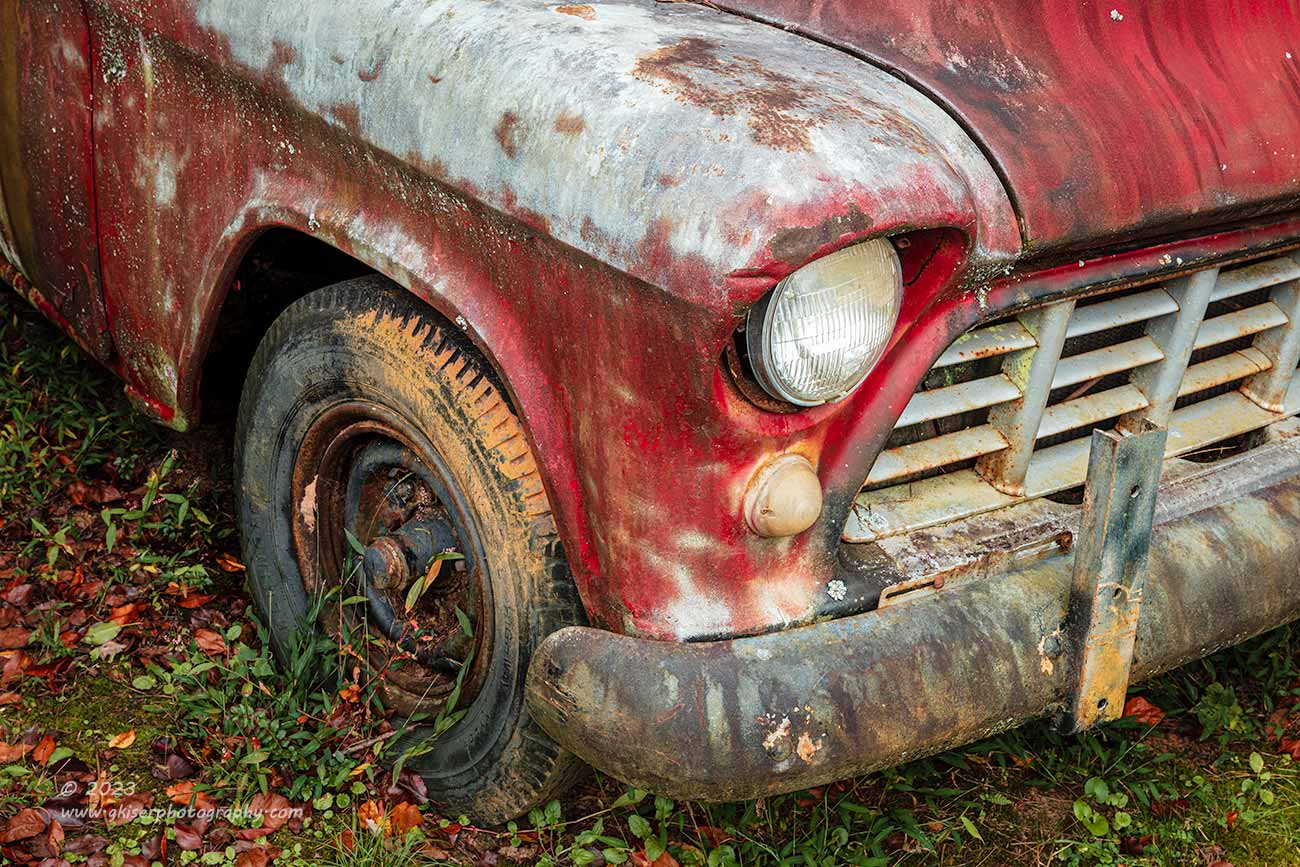
One of the first cars that caught my eye was a red truck that was parked in a row of other vehicles. The red made it stand out, and I loved the patina on it. There was no way to get an overall shot of it because there were cars on either side and in front of the truck. On the driver’s side was a minivan with a piece of plywood propped against it. Not wanting to get all of that in the frame, I went with a simple isolation composition that I have done many times in the past. It worked well here and allowed me to capture the wheel and headlight as opposing elements. There was also a welded mount on the bumper that completed a triangle of elements while I was able to capture the patina on the fender which was particularly interesting.
The composition was simple but effective and I was able to get a few frames shot in an attempt to get the grass frozen in the breeze. It was the mud on the tire that I think made the image here because it shows that this truck has moved at some point. With only a limited area in view, the viewer is left wondering if this was under its own power, or was it towed or pushed to this location. I love images that ask more questions than they answer, and that mud spot did just that for me. None of the other isolations that I tried worked out from this location.
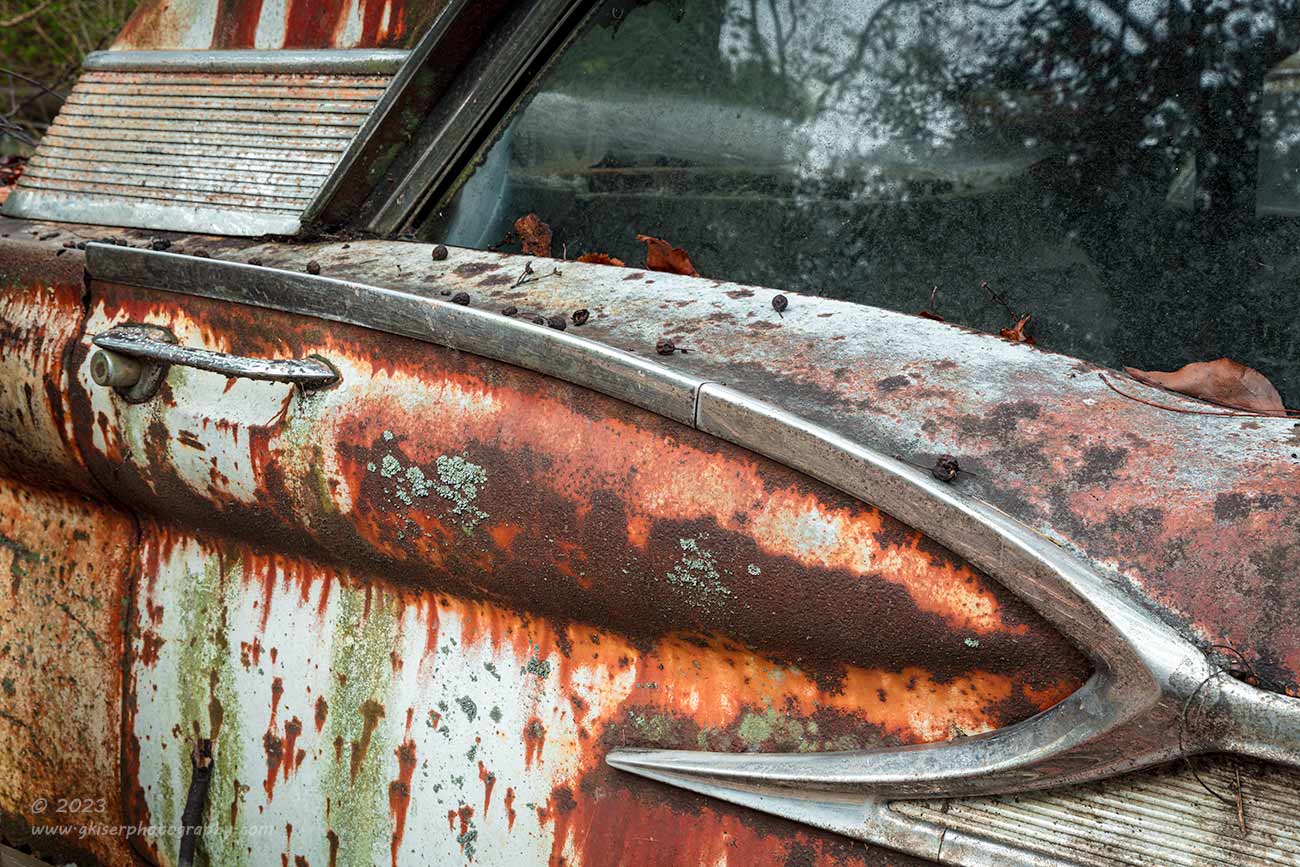
While I was trying isolations, I recalled passing by a Galaxie beside a tree. I took a minute and went back to that car. There were no overall compositions that I could shoot because of the proximity to trees and other cars, but there was a bit of detail that was very interesting to me. That was the stainless trim on the side of the car around the rear door. I had shot this shape several times on other cars and knew that a similar composition would work here. I framed that up and made the shot. Yep, it worked, and the rust made it look really good. There was just something disappointing about it though. I felt that I wasn’t doing this car justice with the simple straight on composition. I looked at my options and slowly started to formulate another composition that I thought would be better.
If I just moved to the right a tad and shot the car at about 45 degrees, I would be able to get a lot of depth and dimension to the frame as well as including more of the trim, the door handle, and even the trim on the pillar. I fiddled with the camera position for a while until I had things locked in just how I wanted them. As I was working on the needed depth of field, I saw that there was a branch which had fallen between the car and the tree which was coming into the frame quite a bit and confusing the composition. Normally, I would insist on leaving this branch here because it was how I found it. However, I could tell that this branch had fallen recently and hadn’t really played a part in the way the car had aged. It wasn’t wedged in, just lying there on the quarter panel. Since it took no effort at all to move, and there was no evidence that it had ever been there, I just simply removed the branch and tossed it behind the trunk. Now, I had an open view to the composition that I had formed.
It was worth moving the branch here because it opened up the photograph in a very meaningful way without actually damaging the scene at all. Nothing was broken, nothing bent, just a loose branch moved out of the way. I really like how this image turned out and it had so much more life than my squared-on composition that I had started with. It was so much better that I didn’t even bother editing that first version that I shot. Sadly, there were no more compositions on this car which was a real shame. The patina here was just amazing, and I loved the colors and shapes. There were just too many distractions and damage to the car to make any other photos work out.

This next composition was a little bit of walk from the last set of images and was another area that I hadn’t seen the other night. There was a huge Ford F-800 next to an International which I just had to get a photo of. It was this monstrous thing with a full face push bar and it had the most amazing patina I’ve seen in a while. The problem was, I wasn’t able to find a composition that I liked. Trying to get two very large trucks in a frame is not easily done, and the International wasn’t nearly as interesting as the Ford. No matter what I tried, nothing was feeling right, and certainly nothing was rising to the level of art in my opinion. To make matters worse, the sun was starting to come out and the lighting was getting very harsh.
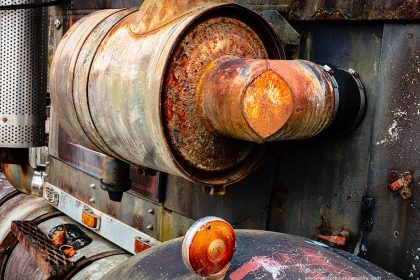
I started to look for isolations while the light was bad on the driver’s side. The passenger side was all in shadow which was nice, and that was where I was looking. The best point of interest that I could find was the hood badge that said what this big thing was. It was close to the marker light which I have found makes for a great visual anchor in other compositions. With that in mind, I started to form up a composition around that badge and the light. Of course, the patina just filled the rest of the frame which I was perfectly fine with. There was a bit of a body line on the side of the hood over the badge that I made sure to capture as it helped with the visual flow. The change in angle of the fender gave the image the depth that I needed, and the entire composition just fell into place.
Once I had the right elevation to get the separation needed between the light and the badge, I was able to make a couple of exposures with one being a safety image. I found myself getting back into that frame of thought where I would just make a couple of photos instead of shooting every stage of the composition building. I liked this as long as I was sure that what I was shooting was a workable final composition. I saw nothing that I could do to improve on this one, so I didn’t need to shoot a ton of images. I just wanted to make sure that incase a fly came into the frame I had another frame to edit.

Since the light was a bit too harsh over the big truck and I didn’t particularly like the overall composition, I settled with the one really good isolation of the most interesting truck and moved on further into the woods. The next car that caught my attention was a Pontiac convertible with a missing hood and engine. Growing up through the engine compartment was a nice and mature tree. I don’t get too many opportunities to photograph trees through cars like this, so I wanted to make that happen here. I started to look for a composition but didn’t like the one that really showed the tree in place. By elevating and establishing the framework of the engine bay, I lost the design of the car and concentrated too much on the brush that was collected in the engine compartment. My only solution was to get the camera a bit lower and capture the car primarily showing the shapes and condition. I made sure that the camera was high enough to show the far side of the opening.
The problem that I was now running into was that there was a later model car beyond the Pontiac that I didn’t like in the composition. There was no way around it, and I wasn’t able to get a good view from the passenger’s side. I was going to have to include that other car in the composition. Because I needed the Pontiac and tree to be in focus, I wasn’t able to blur out the background enough to make a difference, so I knew that I was going to have to deal with it in post processing if I was going to make the image work.
[Opens up AI editing software, types command {remove late model car from woods, replace with similar woodland elements to what is already there}] Boom! Image fixed, Pontiac all alone in the composition. Man, photography is simple!!Nope, that is now how I roll. In fact, while doing a mentorship session this morning, I was talking about the fact that I don’t even have the AI tools in Photoshop because my graphics processor can’t support them. I don’t care because I have no want to use them anyway. What I decided to do here was to convert the image to black and white which took the color impact away from the car in the background and allowed me to direct the eyes more to the Pontiac. The car in the distance now helps to tell the story that this is a place where cars go to die, and the Pontiac has been here for some time now. Having the focus on the textures and shapes seemed to be the way to go here, but I came back to this car later during the day and went with another creative direction which created an entirely different image.
I’m going to take a quick break here because I’m tired of typing and I’m sure you are tired of reading. You are reading every word aren’t you? I need for you to be paying attention in case I get lost in the rabbit hole, never to return. There were times I recall thinking to myself “I live here now” and just imagining all the of the different seasons that I could photograph these vehicles in. I could stay busy throughout the year, so stay tuned to know if I made it out and back home.
In the meantime, keep in mind that selling prints is part of what helps make treks like these possible. If you see an image that speaks to you, and you think you might like it up on your wall, let me know. We can work on getting you matched up with that perfect print in just a matter of days. There is truly no better way to enjoy a photograph than in a print form which takes out all of the variables like monitor brightness and calibration. You get to hold in your hands an example of exactly what the photographer had in mind when they shot the photo in the first place. Let’s get your order started.
Stay tuned for the next chapter, coming soon. Until then….

Remember to use the code KISER10 to get 10% off your purchase