Tuesday, August 18, 2026
Welcome back to the blog! I’m glad to have you here, and if this is your first time, I hope that you enjoy your stay and will be back again. You are welcome to subscribe to the blog here and that way you will get an email notification with each new blog. For those that aren’t signed up for these notifications might have missed my last blog series from last week. It is kind of related to this one as after stopping by the Chevy and Ford in Booneville, I had gone out East Bend to look at another location that had caught my eye a couple of days before. This location had a bunch of old rusted vehicles in the parking lot, but they were kind of crowded in with other objects and vehicles. The setting was less than ideal, and I might be so inclined to say that the surroundings were ugly, in a purely photographic point of view.
When I had first spotted this location from the Miata, it was a sunny day and there was something about it that called to me. I wasn’t sure what the main car was which was sitting mostly out in the open, but it kind of looked like a Dodge to me. There were two other pickup truck cabs close by. One of them was definitely a Chevrolet, but I wasn’t able to make out the other one that was directly in front of it. There was also a Ford tow truck sitting next to the building with several other more modern vehicles scattered around. At the time I figured that a sunny day was the wrong time to shoot this scene and would do better when the clouds were back in the sky.
The lighting was the least of the issues though. The biggest consideration that I was having to deal with was how to actually shoot these vehicles. There wasn’t a single chance at an overall and establishing composition of any of the vehicles without just including too much of the surroundings. This left me with working the details as my main source of compositions. This meant getting in close which meant that I really needed to get permission to access the property. I was going to have to figure that out at a later time because I wasn’t able to pull into the parking lot to really look at things while I was in the Miata. There are times that a little extra clearance under the rocker panels can come in handy, and this was one of those times.
When I managed to get back out here last week, I had been really quite successful in shooting those two cars in Booneville. I wasn’t really looking to do much more because I knew that I had plenty of new photos to work with from that hour long session. That probably fed into my lack of wanting to dive into this location. I did pull off the road and into the parking lot so that I could get a better idea of what I was looking at. I still wasn’t able to make out the main car, but the trucks looked like a Chevy and a Ford which were jammed together making any photos difficult with them. The car was a little bit better off in terms of location and being away from other vehicles. It was sitting next to a trailer though which was going to create problems for me if I tried to get to ambitious with the framing of the photos.
Honestly, none of the vehicles looked as good as I had remembered them from driving by in the Miata. Of course, this was probably due to the fact that I wasn’t really look critically during that drive-by. Now that I was really looking at what I had to work with, the negatives were starting to outweigh the positives for the location. The light was flat and the subjects were not all that interesting to me in the form of details and isolations. I wanted to be able to shoot them in a broader composition, but that just wasn’t possible. The end result of that stop was essentially abandoning the idea that I had to stop here and get a few photos before heading home.
That was pretty much it. I had looked at this location critically and decided that I didn’t really like what I was seeing. There was nothing at all wrong with that and I’ve written off many a location like this over the years. I didn’t give it another thought, that is until I was driving back this way on Monday headed to Winston. I was in the Miata once again and the sun was out really strong. As I got close to this location, I figured I would slow down and see if anything had changed with it since I was last out here. Yes, I know it had only been a few days, but in the world of decay photography, great subjects can come and go in the blink of an eye. That is why I wasn’t surprised when I saw that the lot was empty as I drove by. I mean totally empty like nothing that I had seen out there was still in place.
I wasn’t really upset by this, but it did give me cause to wonder if I could have done something with the vehicles that were out there when I had the chance days before. The rest of the ride into Winston, I found myself regretting that I hadn’t stopped and worked these vehicles at least a little bit just in case I might have gotten lucky. You win some and you lose some as I’ve found out over the years.
On the way back, I decided to take another look to see if I could figure out what had happened to them. I slowed and found the empty lot once again, but this time I noticed the trailer at the edge which I hadn’t seen the first time. It was on the other side of the trailer that I found everything that I had remembered sitting right where I had last seen it. Nothing had moved; I just missed the section of the parking lot as I was driving by. There was an odd sense of relief that flowed over me now that the vehicles were all present and accounted for. I don’t know why I felt that way because I had already decided that I wasn’t going to stop and photograph any of these. However, looking at them in the sunlight, I was again drawn to them in a way that I hadn’t been under the cloudy skies.
I really wanted to give these vehicles a try, and I was thinking that a sunny day was going to be the best time to do that. As it turned out, the next two days were forecasted to be sunny which normally would mean that I would be happy to stay at home. Having seen these vehicles once again in the sun had me reconsidering that notion. By the time I was headed to bed, I was already thinking that I would throw caution to the wind and head back out there in the morning, or maybe a little later in the day. If I was going to break with the cloudy, diffused light tradition that I have made for myself when it comes to decay photography, I figured that I might as well just break all the rules and go out at the brightest part of the day and plan on working right around the noon hour. If nothing else, it would have me working the subjects in the same light that I had found so interesting when viewed from the car.
The morning pretty much went like normal with me waking up when I was ready to get out of bed and then getting my morning stuff done after my breakfast. I wasn’t in a rush, and I felt no pressure to get out the door, but I was still planning on going back out to East Bend once again to look at these cars. I think it was around 10:15 or so when I headed out the door. I had a quick stop to make in Yadkinville on the way out there, so I ended up arriving at the spot around 11:40 or so. I pulled in the parking lot and turned the truck off. I wasn’t going to give myself a chance to chicken out this time. I got out and walked over to the cars to get a closer look. It was a commercial parking lot after all, and I felt comfortable enough walking through it to get a closer look.
The first thing that I noticed was that the car wasn’t a Dodge at all. It was a ’40’s DeSoto which I had not expected. I’ve only photographed a handful of DeSoto’s over the years, and I have found them rather unique and worth shooting in just about any condition. That pretty much sealed the deal for the location. I needed to get some photos here, even if it was just a handful of isolations. This meant that I was going to have to find an owner for the property or at least somebody that could give me permission to work out here.
I had done my homework with the location and found that there was a road that went behind the property that had a several different mobile homes with one of them having several vehicles parked around it that looked like it might very well belong to this property. I started to walk back to that home which happened to be the last one. There were several cars parked around it, and it looked to be lived in. This was actually the only home with cars which meant it was the best place to knock first. There was no answer at all. With many dogs barking, I knew that anyone would know that I was there, so I turned and walked away. I started to look at the other homes and began to play the game of occupied and vacant with most of them looking distinctly vacant. The ones that looked lived in showed no signs of anyone being home.
There was some construction going on next door and I wanted to see if anyone over there might be able to give me any assistance in tracking down the owner. I was lucky and found a lady talking on the phone next to the front porch of the far house. I got her attention and found out that the person that works for the property owner lives in the first mobile home on the road that I had just gone down. I thanked her and headed back to that home. There were no cars around it and all the shades were pulled. I knocked on the door and rang the smart doorbell which I don’t think actually worked. With no signs of movement inside, I turned and went back to the main parking lot. It was time to make a decision about what to do.
Now, if you have been following me for any time at all, you will know that I am a stickler for getting permission to work within a property and am always very respectful of other people’s property. This was no different, and I would have much rather made contact with someone to give me permission. However, I had exhausted my options and talked to the only other person that I could find out here. I had walked around enough to know where the “No Trespassing” signs were and those were all on the different mobile homes to the rear of the business. There were none anywhere around the parking lot that I was wanting to work in. This is where I start to lean on my training and experience as a police officer. I looked at this as a commercial property which would make the parking lot a bit more of a public feature than one with an expectation of privacy. With no signs or fences designed to keep anyone out, I felt that I could legally be there until such time that I was told to leave. Granted, this is a gray area, but it is a legal gray area and one that I am comfortable working within. I don’t routinely recommend this approach to folks that I am mentoring or during workshops because with this access to property comes the need to be able to fully articulate why you are there and be completely willing to pack up and move on if challenged. I would never suggest that somebody put themselves into that kind of situation, but I was confident that I would be able to work through it well enough.
With the truck parked right on the shoulder of the road, I was plenty visible to anyone passing by. Where I was going to be standing with the camera would also be very visible. In the best-case scenario, the property owner would show up, and I could attempt to get a full blessing to be here. If they didn’t, at least I knew that what I was doing would be visible to anyone that wanted to look and if there were cameras on the property it would be very apparent what I was doing. All of this made me feel comfortable with pulling the camera out and getting to work.
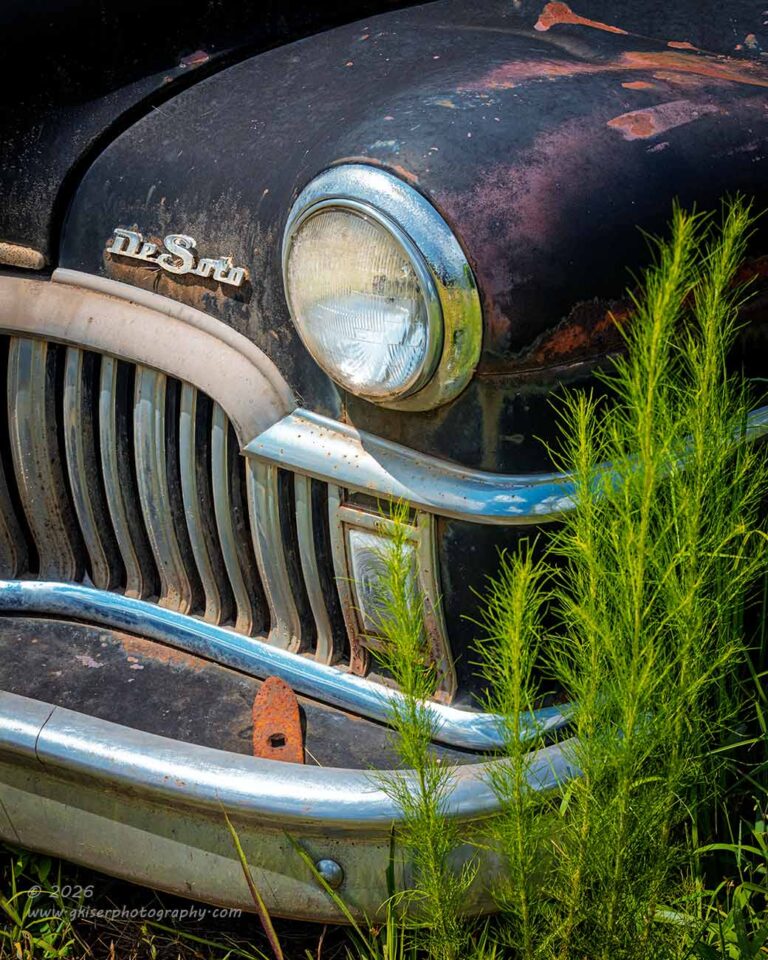
Because of the lack of permission, I wanted to get as many obvious shots as possible out of the way to start with. I knew that I wanted to work with the DeSoto more than the other vehicles because of the uniqueness of it. The light was really good on the front of the car, so that was where I started. I noticed pretty quickly that the DeSoto emblem was affixed to the front of the fender just inward of the headlight. This became an obvious place to get started with compositions because that one detail would speak volumes about the whole car. I’m thinking in terms of synecdoche more than anything else at this point. The parts of the whole that I thought did a great job of defining the entire car were that emblem, the grill, and the large fender. I found that the tall weeds also told a lot of the story of this car that the lack of rust wasn’t telling. This became the first composition for the day, and I didn’t waste a lot of time working it before moving on to the next composition.
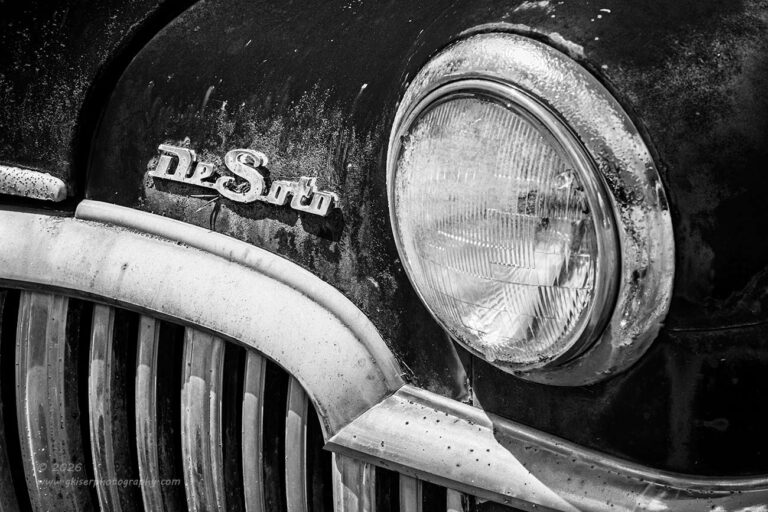
That next composition was a much tighter crop on the badge and grill with the headlight as a visual anchor. Remember, I was going for the obvious compositions here and that meant going with what I had used successfully for years. I didn’t have to think much about these compositions other than working the angles out which made them almost effortless to capture. The way that the grill curved as it went under the headlight was a detail that I really loved about this car and that was what this second composition was all about. Because it was about a shape rather than a scene, I chose to make this one black and white to really concentrate the attention on the shapes of the grill. The fact that the car was black also helped with that decision. Black cars are not a lot of fun for me to photograph, but I’ve found that I do have better luck with them during bright and sunny days which was starting to become apparent with this trek once again.
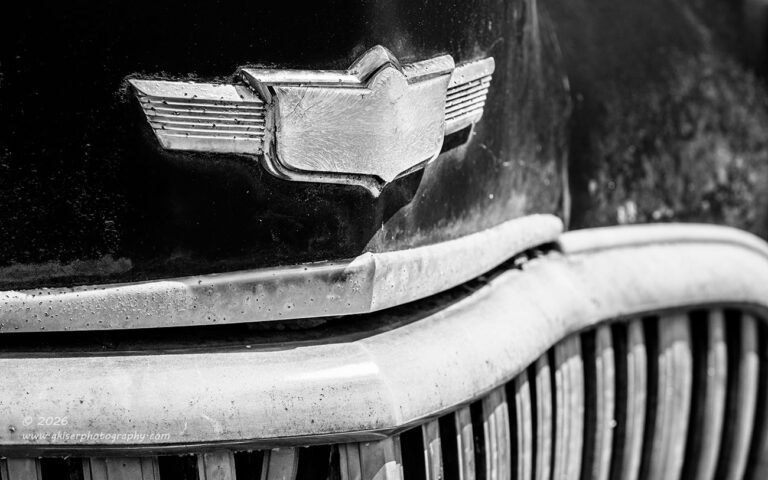
As I was working that corner shot of the grill and headlight, I started to really understand that it was the shape of the grill that I was really after. The headlight was becoming a distraction to the overall composition in that regard, though it did make for a strong composition as well. I needed to remove that headlight from the frame and concentrate on something else which would bring more attention to the grill. This element turned out to be the hood badge that was faded into a blank canvas. The wings on either side of the emblem had horizontal ribs through them which contrasted nicely with the vertical slats of the grill. The curve of the grill housing became more evident the further to the side that I placed the camera. I found that this was a great way to achieve balance in the frame as I would have the emblem placed in a portion of the frame where the grill housing dipped down while off to the right, it got larger and allowed more view of the grill slats.
I really liked this composition, though I wished that the detail was still in the badge at the front of the hood. Oh well, I can’t have it all, and this is decay photography after all. The part that I enjoyed the most was the slight irregularity that the grill slats provided to the lower portion of the frame. Had this grill been in good shape with no bends, I think that this would have been a rather boring composition. With the more casual look of the grill, the whole photograph ended up with more interest. In full disclosure though, I did flip this image horizontally which is why you can’t see the DeSoto badge on the front of the fender. That would have overly complicated the composition with this tight crop and with the natural orientation of the elements, the photo didn’t read smoothly from left to right. A simple flip of the image fixed the problem and there was nothing else in the frame that would give away what I did and create a distraction.
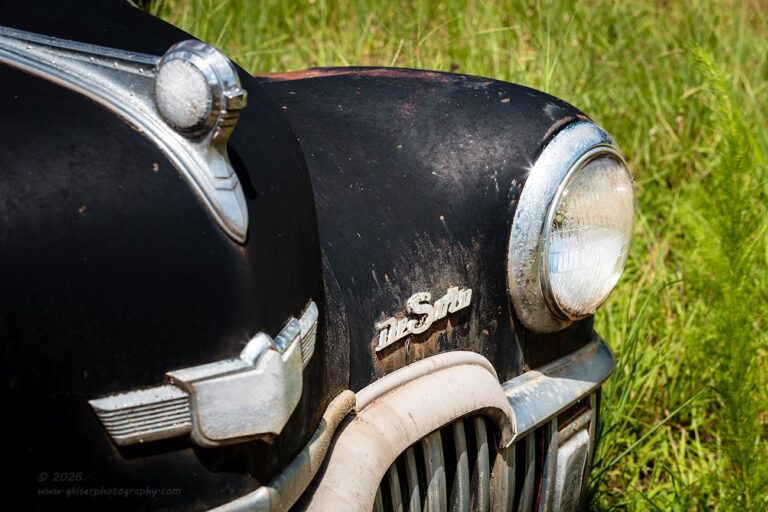
I did want to see what a composition would look like with the DeSoto emblem showing in the frame. For me to do that, I essentially started off with a composition that I had shot of the other side, but this time I wanted the emblem. I needed more breathing room to make this work, so that meant opening up the frame a bit and placing the elements in slightly different locations within that frame. This involved moving the camera around as well as raising and lowering it to achieve the overall look that I was after.
As I kept adding elements, it wasn’t long before I had the grass in the background which added another texture that balanced out the sea of smooth black which I really did like. I was also able to include the hoor ornament in this composition for a bit more of the story of this car’s styling. The grill shell was still a very important part of the puzzle so that was a mandatory inclusion to the frame in the lower right area.
A benefit to shooting with the long lens was that I could get a shallow depth of field with a pretty small aperture. This isn’t worth mentioning except for the fact that the chrome provided a couple of different areas of sparkles which turned into stars thanks to the narrow aperture of the lens. I was able to get the stars while still blurring the grass in the background for a bit of extra depth to the scene. The goal was to get the entire car in focus while the background was softer. The side benefit to all of that was an aperture that produced the stars on the specular highlights which just added that little detail to the overall story.
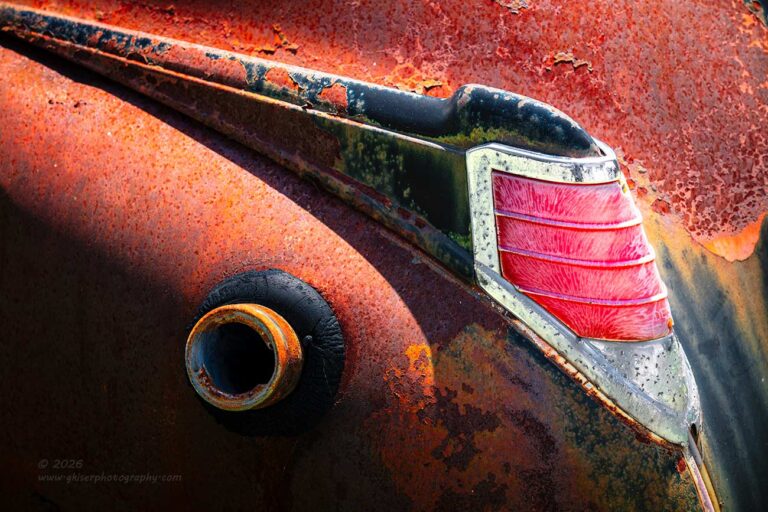
One other area that I really wanted to work with was on the rear of the car. The little taillights had interested me as well as the fins that housed the taillights. DeSoto was ahead of their time with the fins since this was a ’40’s model and the fins didn’t really become a thing until the next decade. My goal was to create something more like an abstract shot of the taillight more focused on shapes and the colors of the rust than anything else. I was actually really happy to have the sun here because it added a shadow element to the scene that wasn’t there to begin with. I knew that I was going to be working with the driver’s side which had the fuel filler neck for a bit of added detail. This neck would sit at the top of a shadow on the quarter while the shadow from the fin would curve around the opening creating a frame within a frame for the little opening into the car.
As I was framing things up, I was really enjoying the play on Chiaroscuro lighting with this one, but in addition to the alternating light and dark, I had the element of dark, rust, dark, rust playing into the frame. It was all anchored on the taillight which brought in a faded red tone as well as the chrome which set a neutral value for colors in the scene. The way that this one worked out made it one of my favorites from the day. The fact that it would not have been possible without the sun creating the shadows is not lost on me. I’m really starting to reconsider what I’m finding as good light these days. I’ll always love working on a cloudy day, but there are some distinct benefits to harsh sun as well.
I’ll just chalk it up to growing as a photographer and artist. We all go through different stages in our work when it comes to things that we find pleasing. Maybe I’m just getting into my sunlight phase after a couple of decades of not really liking the sun to be a player in my photographs. There is no denying that it has a way of helping in many different situations. I’m even taking it so far as to say that I’m liking the high midday light that most photographers can’t stand working with. I used to be one of those, so I’m not saying anything negative at all.
I had the images from the front of the DeSoto as well as the rear which meant that I could start to turn my attention to the trucks nearby. As I mentioned, they were only cabs and neither was in a position to be photographed in an establishing composition. However, I felt that there were opportunities to get some detail shots of both trucks and while I was here, I might as well give it a try. Looking at them both, I found that the Chevy had a bit more visual appeal in terms of colors to the rust and patina. The Ford was an older truck and had pretty much rusted uniformly over every body panel. The Chevy had some paint still and a bit more character which I thought would be good to start working with.
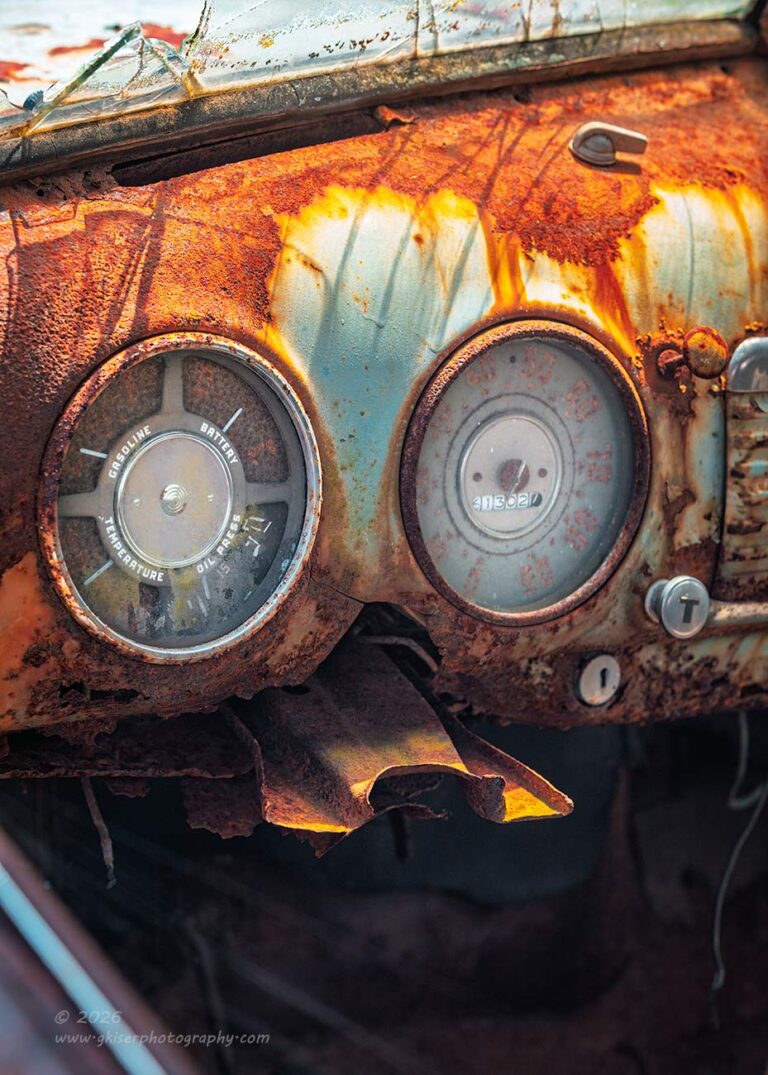
I looked around the truck and found several different areas that I felt would make for good compositions, but where I wanted to start out kind of surprised me. The dash of the truck caught my eye as I was looking around. I think that the main reason for this was the fact that the steering column was missing leaving just the gauges on the dash. Now, interior shots, and specifically dashes have long been a difficult subject for me to make a composition around. I’ve come a very long way over the last few years as I have really pushed to create meaningful images of dashes. I saw the chance to create one here even though the lighting was probably not ideal for this kind of image. More diffused light would have been better since so much of the interior was in shadows. I didn’t have the clouds, so I decided to work with what I had and see if I could make it happen.
This is where really knowing my gear comes in handy. There was a lot of tonal range in this scene from the highlights on the hood to the deep shadows in the footwell. Not that long ago, I would have seen this as a case for doing an HDR image with probably three frames shot to capture all the tonality of the scene. More recently, I have found out just how far I can push a RAW image from my aging Canon 5DS R which was introduced in 2015 if I’m not mistaken. It is not mirrorless technology and doesn’t even have the flippy screen that all the cool kids love using. It is a dedicated tool for taking still images above all else. Even after all this time, this camera body can do the work that many think is only possible with the newest flagship mirrorless cameras being introduced today.
Take a look at the lighting in this last photo and see the sun beating on the top of the dash and the hood. This is full sunlight at roughly 12:15 in the afternoon while the footwell is in total shadow with no light being bounced in. Yes, this was a very hard shot to make with the lighting, but because I know my camera, I could tell on the histogram that I had plenty of detail in the highlights as well as the shadows to make this image work out the way I saw it in my head. It actually didn’t even take that much work, and I had room to bring even more detail into both the shadows and highlights if I had wanted to. The key here was to create something that looked natural to how my eyes saw it in reality and not making it some kind of weird 2000’s HDR looking photograph.
One of my favorite aspects of this photo is the way that the shadows from the broken glass are showing up on the dash. This makes it possible for me to include that broken windshield by just including a small bit of it to establish what the lines on the dash are representing. This keeps me from having to include so much of the hood that it creates a distraction in the top of the frame with the brightness. The principles of synecdoche are applying to this aspect of the photo allowing the shadows from the broken glass to speak for the glass itself.
Of course, I am still far from done with this trek. I wasn’t here but for right at 30 minutes, and I am roughly 15 minutes into my time with these vehicles. To make these blogs a bit easier to digest, I have chosen to break this one up into a couple of parts. I’ll be back tomorrow with the next chapter and even more photos from the experience. I’m sure that you can already tell that this spot that I was happy to write off has been quite fruitful once I committed to actually getting photos. That is how it goes most of the time. I just need that one little reason to get the camera out such as the fact that this was a DeSoto, and then more and more photos start revealing themselves to me.
Check back here tomorrow to see what photos come next. If you want to be sure and not miss that publishing, be sure and subscribe to the blog now. You will get to test out the notification with the next blog being published to make sure that everything is working right. You will get a confirmation email after subscribing that you will need to accept in order for the subscription to go through. Of course, you can cancel at any time…but why would you want to do that?
I’ll see you back here soon enough…

Remember to use the code KISER10 to get 10% off your purchase