Welcome back to another installment of my monthly Behind the Camera. It is here that I will talk about different things that surround my photography, or even photography in general. Last month I took you on a tour of my studio which is a little break from the normal topics here in the blog. This month I am going to get back to a more regular type of entry and speak to those that dabble in photography or are trying to really delve into the art form. The question was asked a while back by one of my mentorship clients, and I thought that it would make a great topic for this month’s discussion. The question was quite simple and went a little something like this: “What do you do when you can’t figure out a good photograph of a subject?” For me, the answer is simple, but I can certainly see where the question comes from and would like to turn it around on you for a moment.
What would you do if you just couldn’t work out a good photograph?
OK, I’ve got a vote for snap the photo anyway.
I’ve got another for change your lens.
Yet another for fix it in post by making a composite image.
I was hoping that someone out there would say come back at another time, but that is too close to admitting defeat for most.
Yep, these are all viable options, but there are other things that you can do in this circumstance and that is what I want to talk about this month. Of course, this list is not complete by any stretch, these are just some of the alternatives that I look at when I am faced with the issue. Feel free to add to the list as you see fit.

So, here is the situation. You have arrived at the location that you are wanting to shoot. This could either be due to research and you know that you want to shoot a landscape from this particular area; or you have driven by and found that an old barn on the side of the road has caught your attention. You are all excited about the possibilities, so you get the camera out. If you are like me, you will set it up on a tripod for maximum quality (you are concerned about image quality, right?) and begin to formulate your composition. You work through the process of preparing to get the photo, but you can’t get it quite right. Your landscape is boring, it is not conveying what you like about the scene. That barn has too many distractions like the condos showing on the hill behind it. Maybe you have a very beautiful, rusted car that you have never seen before, but it is parked next to a late model SUV with chrome spinner rims on it. Maybe the location just doesn’t fit the subject. There are an endless number of problems that you can run into when trying to capture a photo. I’ve spent plenty of time dealing with these issues over the years and while I’m by no means an expert, I feel pretty confident that I can work through more problems than the average photographer.
Let’s look at the options available to us at this point. We have an interesting subject, but we just can’t seem to make a photograph that conveys what we like about that subject. There are two questions that I always ask myself at this early stage of the game. The first is the easiest to answer; “What do I like about the scene?” This is where you really look at the scene critically and determine what you like about it. It forces you to identify the specific elements that work together. These elements will dictate how much of the scene appeals to you, which should establish the scope of your composition fairly well. The follow up questions is much more difficult to work through but is the one that will dictate the overall impact of your composition. You have to ask yourself, “What do I not like about the scene?” This is where you will identify distractions and elements that don’t go with the main subject, or the story that you are trying to convey. By answering those two questions to yourself, you will be on your way to establishing a working composition. It will help to establish the scope of the photo, determining if you are wanting to get a grand scene, or something more intimate. It will help to dictate where you stand, and how tall the camera will be since camera position is the best tool for composition that you have. In many cases, these two questions will establish what focal lengths you will want to choose from in order to get perspective right, or to conceal an element, or even eliminate it from view. These two questions will take care of most of the compositional concerns that you have and will get you in a good place to work a scene, at least to start with.
If you have been honest with yourself at this point, you should have a relatively strong composition by this point, but you might still not have a photo. There are numerous issues that you might run into at this point. The most frustrating is that you can’t eliminate the elements that you don’t want in the frame. You’ve tried everything from changing lenses, to changing your position, but there are still distractions in the scene. Here you have to decide if there are ways that you can minimize those distractions. This could be with post processing which is a very handy tool as you can darken areas or remove saturation from distractions. In some cases, you can clone out small distractions. This is also the time when you can look for changes in weather or lighting that might help you out. I’ve found that fog is a great reducer of distractions in a photo, and there are times when you can put distractions in the shadows which can be just as effective but will require the sun to potentially be in a different position or intensity.
As you go through the options that are available to you at the scene, as well as those that could be available at a different time, you can see how your composition might unfold in a variety of conditions. It might be just as simple as coming back another time to get the shot. It might not be that simple though. The distractions might be too terrible to deal with. You could be looking at this beautiful landscape right in front of you. There is a high ledge waterfall that is dropping into a pond which has a snowcapped mountain in the background. You have arrived right at golden hour with soft, warm light bathing the scene and a perfect reflection of the sky in the still water. Everything is perfect, but there is a Dollar General on a set of stilts right in the middle of the pond. There is no way to fix this issue.
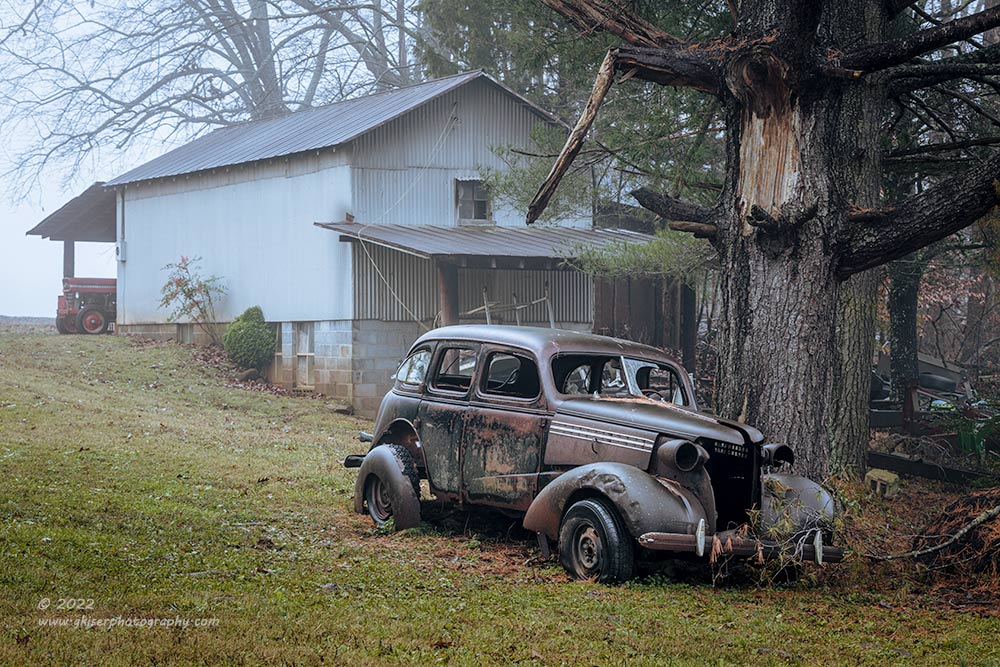
In those circumstances when you have a great subject, but the other elements are not ideal, you can always make the choice to embrace them. Take for instance this photograph above. The car was too good to pass up, but the background was very cluttered for my personal tastes. I had gone out on a day when it was foggy which was chosen to minimize the background in the different compositions I had in mind for the day, but the distance wasn’t enough to really affect the areas that I wanted here. I wasn’t wild about the metal building, nor did I want to include the various spare parts that were spread out beneath the trees to the right of the scene. The large trees that were next to the car were nice, but not something that I had to have in the photo. I could have shot some isolations to deal with the clutter, which I did later on during this session. I still wanted to get an establishing shot of the car and scene with the atmosphere that the fog had created. What I decided to do was include the surroundings which included the building and the spare parts. I knew that I would darken the area to the right of the photo slightly, which would reduce the impact of the distractions. On the left side, I kept the building because sticking out at the end, was a tractor which provided a bit of contrast to keep the eyes in the frame, and the red would cause the eyes to bounce between the car and the tractor while the building faded into the tones of the fog. Essentially, what I had done here was to embrace the entire scene and have it work together. While this doesn’t work with the Dollar General in the middle of your frame, you can create images that tell a more complete story as long as the elements can be made to work together. It all comes down to how you wish to tell the story through your image.
If you still can’t get a photograph that you like because of the distractions, you have to start thinking about things on a smaller scale. As I mentioned before, you can look at shooting isolations. This is a very powerful photographic tool, and it allows you to bypass the distractions completely. The trick here is to look at your main subject and decide what you like most about it. For a landscape, it can be a single tree in a field, next to that Dollar General, or it can be a portion of a waterfall that is more interesting than the entire waterfall. The idea is to really fine tune what you like about the scene and get brutally specific about it. You have to look at this as a compromise. You might want the overall, but the isolation will be a much stronger photograph, and at times the only workable solution. Honestly, this happens more often than not when I am photographing my decay subjects.
An example of this comes from a mentorship session that I did not too long ago. The assignment was this: go out and shoot photos and then cull them down to the best example from the day. He did this and sent me a photo of an old house he had found. It was an overall shot with heavy shadows over the front of the house, a large commercial style garage in the background, and the left side of the frame was just touching the front porch of the house. After we went through a critique of the photo, it was decided that we would go back out there to shoot the house again to see what improvements could be made on the composition as well as lighting.
During this follow-up session, we were able to determine that moving the camera position across the street and shooting with a narrower focal length was the trick to get the overall composition that he had wanted. It was not a spectacular photo, but it checked the boxes to create a pleasing composition that highlighted what he liked about the scene. As we had done the walkaround earlier, I had recalled many of the attributes that he had said that he liked about the house. I forced him to narrow those likes down even further which allowed me to redirect him a little bit in his quest for different compositions. Having got the overall shot in the bag, we started working on the isolations of the elements that he really liked. It was in those isolations where he found the photos that he liked much better than what he had shot before. This was simply a case of the details were more in line with what drew him to the scene than the actual scene. As photographers, we tend to always consider the overall scene as being the best way to tell the story. In this case, the house was up on cinder blocks after having been moved years ago. The surroundings didn’t really add to the story, but the house had a ton of character.
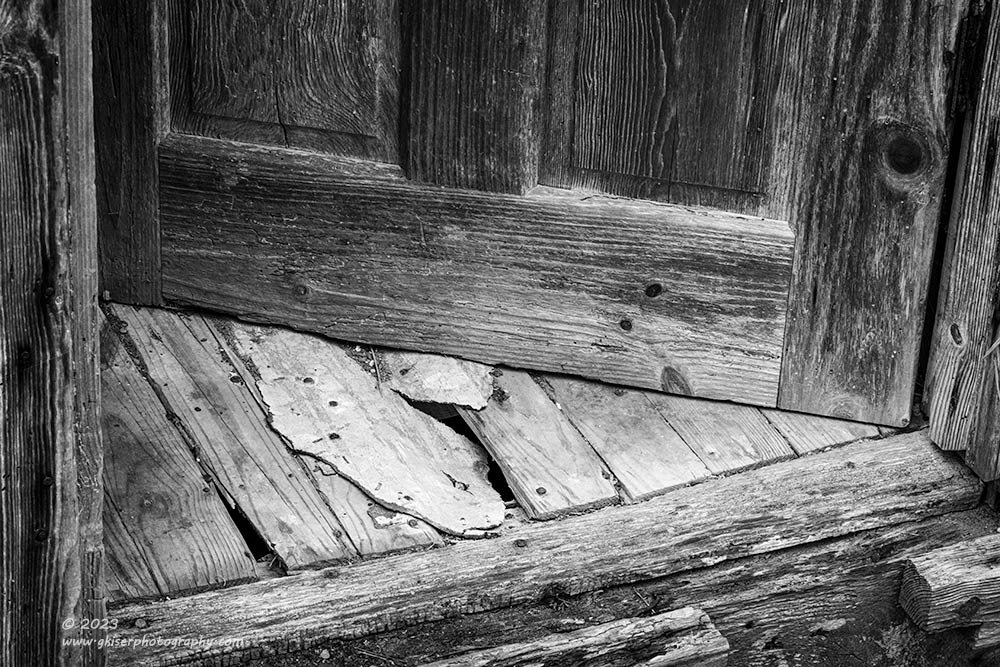
This is one of the compositions that we worked on near the end of the day, and one that I liked so much that I came back to shoot it the following day. I’m including it here because it was the only composition that I duplicated which he had shot. He had told me that he liked the back of the house and had tried to shoot it many different ways, from all different angles. None of the compositions resonated with him. The way that he was describing his compositions, he had been including either the entire rear of the house, or large sections of it. I had him really get specific about what he liked which turned out to be the open door. Knowing his shooting style, I also knew that he liked the textures of the wood, so I started to look for a composition that spoke to those two very specific attributes. In a matter of a couple of minutes I had come up with this simple composition that included everything that he had liked about the scene while eliminating a lot of extra details that had watered down his earlier attempts. This was what he had seen but just hadn’t known how to capture it.
When it comes to creating compelling compositions of a scene, we have to understand how we see, and how our brains interpret that information. It is all too easy to see a detail like this door when looking at the entire scene because our brains filter out the rest of it all. When framing a photograph, we will default to shooting what we had seen which would be using a 35-50mm lens at eye level. We capture a lot of the scene and hope that the photo showcases that detail that we found appealing. The problem is the camera captures everything that is there without the benefit of our brains to filter the information. With a photograph, you have to create a clear image of what you are intending to capture, or the photograph will look boring to not only you, but to others.
Isolations are a fantastic way of getting to the core of an element and tell a story on a smaller scale. I’ve done this for a very long time when shooting the old cars that I love so much. Too many times they are positioned in a place where there is just no way to get an overall composition of them which leaves me with only isolations to work with. There are other times that the overall works just fine, but I also see details that interest me within the subject. This happens a lot with landscapes too, and it is something to keep in mind because you can come away with several different compositions from a single location.
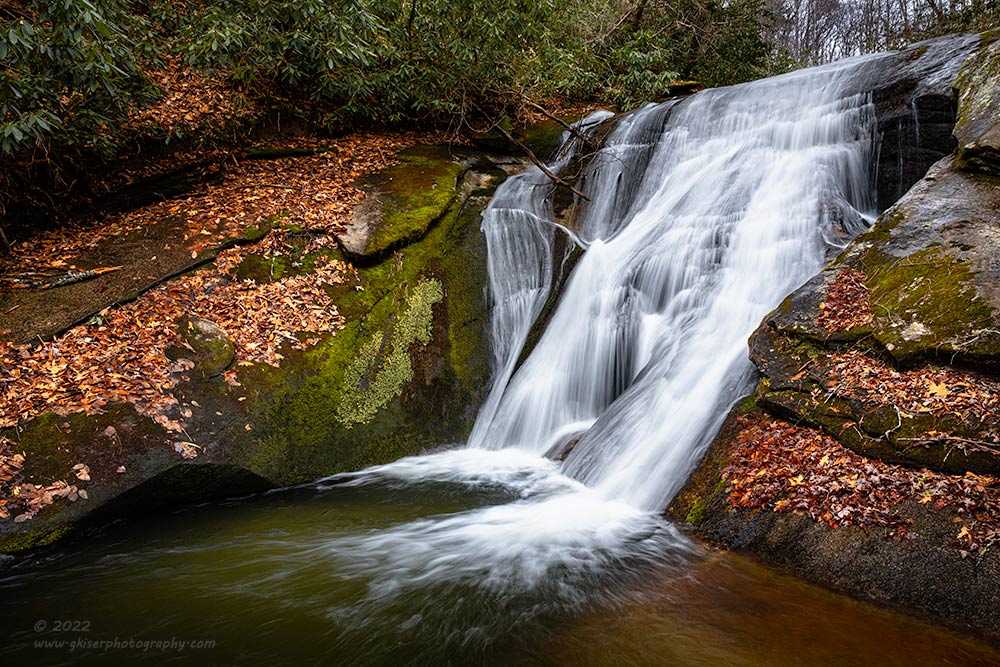
Here you can see the overall composition of a waterfall I shot a while back at Stone Mountain. There were no Dollar Generals in the area (yet), so I was able to get a very easy overall composition, but I didn’t want to stop there. The hike was like 30 seconds and the stream crossing was ankle deep with waterproof boots, so I had a lot invested in getting here. No, this is actually an easy one to get to and I’ve shot it many times. Even still, I didn’t want to just get a single shot and go home. I wanted to spend some time here and try different things. I looked into the waterfall to see if there was an isolation that jumped out at me. I looked for the different textures and shapes that the water provided. This was very easy to do with the image review because it allowed me to see the waterfall as a long exposure while I was able to zoom into portions of it. I found the area that I liked and changed up my lens to get the shot that I saw within the falls.

This is the part of the waterfall that really captured my attention. The beauty of doing this type of isolation, when I don’t have to, is that I train my eye to pick out the details within a scene. This allows me to transition into finding isolations when the Dollar General is smack dab in the middle of my scene. It is a skill worth having as a photographer and I highly recommend training yourself to see isolations even when you don’t have to. It won’t be the cure-all though because there are times when you have a great subject, but there are no isolations that interest you. What do you do then?
I’ve run into this a time or two…dozen. It is especially problematic with barns because too many times, I can’t get close enough for an isolation without having permission to be on the property. The distance alone makes it to where I have to shoot an overall if I am to shoot anything. If the overall doesn’t work, and I can’t get close enough for an isolation, I am kind of stuck. If I can’t figure out a change in weather condition, or lighting change that will make the scene work, then I’m kind of left with a “fix it in post” solution which can include heavy cloning of areas, or even compositing of images. Neither of these aspects are of much interest to me. That is partially because I am just not that good at digital manipulation, but also because I want to keep the scene true to how it appeared. Heavy manipulation just feels like cheating to me at this point in my life. A great example of this is when a bank of a dozen power lines stretch across the front of a barn. Yep, I can clone those out, but they are covering all of the important detail on the main subject which means that I will have to do an amazing job at cloning which could take hours. I’m not afraid of the work involved, but I don’t want to force myself into a situation where I sacrifice the main subject’s detail. My goal is always to have a photo that can be reproduced at a huge size without any loss of quality. Cloning on that scale will ruin a photo in my opinion.
This leaves us with the lesson for today’s Behind the Camera. What do we do when we have a subject that we want to photograph, but we can’t make a workable photograph out of it? As we have discussed thus far, there are some things that we can do in order to give us the best chance for success, but there are just times that we can’t make it work. It is a fact of life for sure. There is a long and illustrious list of subjects and locations that I have wanted to shoot over the years but just can’t see a workable photo. I don’t have any photos to share of these places because either I haven’t shot anything there, or the photos just didn’t turn out which means that I have deleted them. Therein lies my answer to this conundrum, if the photo isn’t there, I just don’t shoot it. This seems harsh I know, and it is a hard pill to swallow for many. The fact of the matter is, if I can’t create a photo that is worthwhile and one that I can picture hanging up on a wall, I would rather not waste the time with it. I might try some things out, but if they don’t work, I have no need to keep the photos beyond that.
It is those times when a scene strikes me, but there just isn’t a photo, that I just enjoy what I am seeing, and I remember it. For a normal person, you could even take a snapshot of the scene to remember it later on but know that a snapshot is all that it will be. How in the world can you look at a scene and like it on that level when there is no photo to be had? It comes down to how we view a scene with our eyes and mind. Our brains are an amazing thing because they actually filter what we are seeing. Our brains allow us to see that waterfall dropping off of the cliff, into the pond while totally dismissing the Dollar General. Our brains will allow us to miss power lines, odd lighting, and the apartment complex in the background. The camera is just not as crafty though which is why so many of our photographs fall short in what we expect out of them. Our cameras are unable to filter any of the visual information out of a scene. It just captures what is there at the moment.
Take the case of an early 50’s sedan that has been added to a yard close by as yard art. Every time I see the car, I love it. There is a cherry blossom tree that is right next to it which adds so much to the scene at this time of year. I’ve even had a friend recommend me go out there and shoot it. Toni has even seen it and said that I should shoot it. Heck, I’ve wanted to shoot it every time I have passed it by…but you don’t see any photos of that car here, do you? That car is placed on a well-manicured lawn with two houses blocking every bit of the background. It is placed on a mulched surface and the whole thing just looks like yard art (which it is). Part of the draw for me is finding cars that have been sitting in places for a while. That is where the stories come from and what I like to photograph. The car has been there for about 8 months now and it is still all cleaned up for having it placed there. While I haven’t seen a photograph there just yet, I’m convinced that in time it will start to look a bit more neglected and will then be ready for some isolations. Since this will require asking permission, I don’t want to waste the ask just yet. I want to get it at that right time, and then I hope to be able to do some work with the car, but only after the photo reveals itself to me.
If it never does materialize, I’ll do what I have done with so many scenes through the years. I’ll just enjoy it and walk away. If things change, I’ll gladly revisit it and try again, but I am under no pressure to capture a single photo unless I think that it is worthwhile to do so. This is something that I came to terms with years ago after forcing myself to photograph every scene that I came across. Even knowing that the photo wasn’t all that good, I would go through all of the motions with it and it would just sit there. It was a waste of my time and energy to capture photographs that I didn’t really like in the field, and never changed my opinion of through the entire process. I learned that if a photo doesn’t work, it just doesn’t work. There will always be other scenes that are more worthy of your time and attention and if you stay stuck on an unworkable scene, you will miss what is better around the corner.
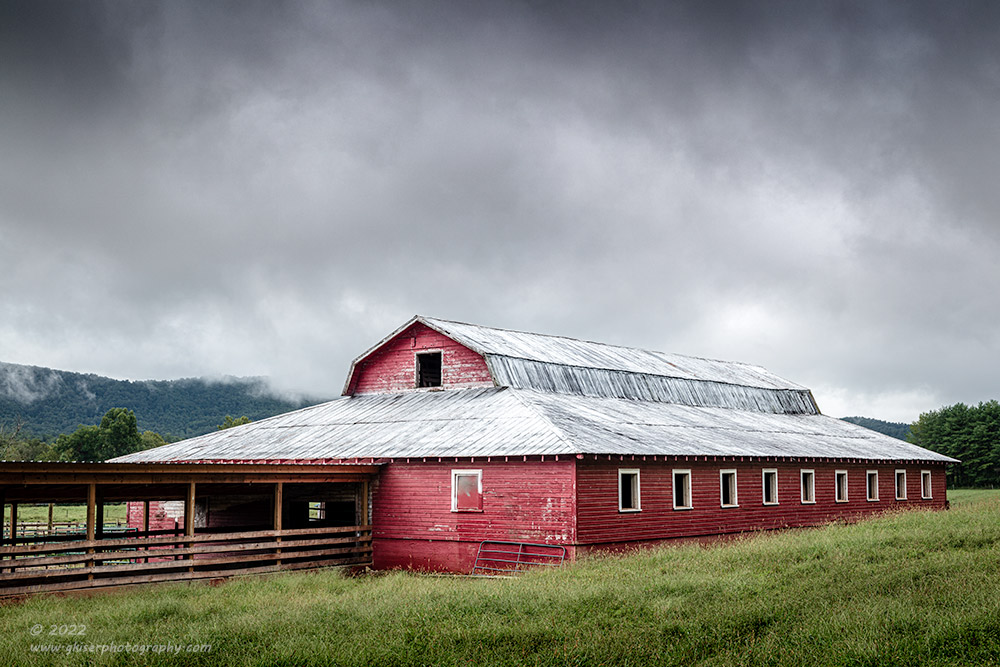
The longer you work as a photographer, the more tricks you will find to deal with these unfavorable situations, and you will be able to come back to the failed scenes and try something different. Sometimes it works, sometimes it doesn’t. This is a barn that I have gone by many times, and it has interested me each time. After about two years of passing it, I decided to try my hand at it. I did a creative crop that I had not considered before but had done recently with another subject and seen succuss. The weather conditions were also just right to put the barn in the right light. It was the crop that made the image work because there were actually two barns connected to each other. I chose to focus on the smaller barn and use the covered walkway as a leading line into the scene. The perspective gave me a more pleasant composition with a heavier weight in the lower left to balance with the midground and background to establish the overall depth of the scene.
The success of this composition was by and large due to my experience as a photographer. In the two years leading up to this attempt, I had dismissed it because I couldn’t see a way to make it work. There were a lot of power lines stretching across the scene on the other side of the bar. I didn’t spend a lot of time thinking about working the scene, I just enjoyed the barn. I thought about it often and tried to work out ways of shooting it in my head. Eventually, my talent and skillset rose to the challenge, and I was able to get not one, but two images of this barn that I really like. Just because you walk away from something doesn’t mean that you have failed, it is just an indication that you aren’t in the right mental place to shoot it. As photographers, we are always getting better at our craft, and we learn to see things differently. In this case, I was able to see a way to mask many of the power lines with a very low perspective that would also have the roof crack the horizon line. I knew that the content aware fill options in Photoshop were much better now, and I was better at using them. The new skills allowed me to make this image, along with my newfound understanding of color theory. Most of my best images are from repeat visits where I put to use new things that I have learned with other outings. Never discount your own growth as a photographer as a tool you have access to when it comes to making images out of difficult locations. This is just the tool that takes the longest to use because it is based on nothing but time and your own experience levels.

Photography in general comes down to purpose. What is your purpose behind capturing an image? I’m assuming that you are wanting to tell a story whether you know that or not. The story could be very complex, or it could just be as simple as showing off a pretty scene. You have to really work to boil down the elements in your scene to make the purpose of your image apparent to the viewer. Here you can see a photographer in a very complex environment which is rather busy, setting up a shot. From the looks of things, this is going to be a photograph with a lot of distractions because he is in the middle of downtown Wilkesboro. There are power lines, buildings, traffic, and the whole nine-yards that will have to be dealt with. However, you can see that he is shooting the scene from a very low perspective and probably didn’t just randomly choose that section of the parking lot to place the camera. If you look at the shadows, you will see where the sun is in relative position which is supported by the squinting eyes (the sun was bright). There were a lot of thoughts going through his head at this point which you can tell by the smoke emanating from his ears. This was not the right time to shoot this composition for what he was after. He had the composition, but not the mood. The decision was made to come back at a later time of day, but the location and activity was still the same. It was just a different lighting recipe.

The magic of this photograph is that it was captured with none of the distractions that were obviously all around. The lighting and colors all work together, and even how all of the elements of the building work together were orchestrated by the photographer. The photo captures the essence of the subject in a way that I wanted to present it. Even though I consider this a success, had I come back to shoot this scene and there been one detail different, I would have walked away. It had been about an hour since I was scouting this location, so in that time, a Dollar General might have been built in the background. Less likely though, there might have been a car parked in front of one of the garage doors. That one element could have changed the mood, or even disrupted the composition completely. I had to be prepared to walk away from this scene even though I was shooting this for a potential client. If the photo isn’t there, you can’t force it. Now, if a car from the ’50’s or ’60’s had happened to be parked in front of one of the garage doors, I would have been inclined to make the photo work because that would have added to the story being told. Had it been a 2023 Honda Accord, that would not have worked at all.
Could you walk away from a photograph because it wasn’t right? Could you really? Look back through your portfolio and be honest with yourself. Did you include photos that have really bad distractions? Did you include ones with lighting that wasn’t good enough, or maybe you did a strange crop because you thought that you could avoid that Dollar General to the side? Sure, we get better with experience and many of these things naturally work themselves out as we learn what makes a good photo. However, if you are still taking the picture because you are there, not because it is right, you might want to reevaluate your criteria for working a scene. It is not a race to get the photo. You control when the shutter button is pressed, or if it is pressed at all. Make those presses count and capture the scenes that make good photographs, leave the snapshots for the cellphones.
With today’s emphasis on filling our social media accounts with photos documenting everything from what we ate, to what our kids are doing, to the mess that the cat left in the living room, we are numb to photos at this point. Photographers are just as guilty of doing this as anyone else, but if you are trying to be a photographer, you have to have a purpose behind your photos. There has to be a reason behind every photo you capture as a photographer. Capturing snapshots is a different ballgame but be aware that if you do a lot of snapshots, you will get lazy and forget how to artfully craft a photograph. I am always saying that there are two important questions that a photographer needs to ask themselves before taking a photograph. If you will remember, those questions are “What do I like about the scene?” and “What do I not like about the scene?” These are great questions, but I suppose there needs to be one other asked even before you get into those two. The most important question that a photographer can ask is “Why am I trying to make a photograph of this?” If you can’t answer the why, the rest of the questions aren’t important…and your photograph probably won’t be important either.
Thank you for joining me for another installment of my monthly Behind the Camera. I hope that this one benefits your own photography and forces you to be a little more selective of what you shoot. If you aren’t a photographer, I hope that this gives you a bit more insight into how I create my images the way that I do. If you would like to learn more from me in a more structured environment, consider my many mentorship programs. They are a very efficient way to improve in your own photography and you will learn a lot about how you view the world during our time together. As you can tell, I love teaching photography and am happy to share what aspects of it I am most familiar with.
I’ll be back next month, and I plan to talk about the differences between zooms and prime lenses. It is not as clearcut a choice as it once was. Of course, if there is ever anything that you would like to see me discuss, I’m happy to entertain questions for this feature. My goal is to talk about things that actually matter to photographers and those that enjoy the photographs which are captured by photographers. There is just so much that really goes into photography, and I think that it increases our appreciation of the art to know the behind the scenes aspects of it.
Until next time….

Remember to use the code KISER10 to get 10% off your purchase