Tuesday, March 28, 2023
Welcome back, long time no see! When I last left you, I was thinking that my adventure in the local junk yard was winding down. It was starting to drizzle, and I was not finding anything else that I wanted to photograph. If you missed that part, you can catch up here. Essentially, working off of an invitation from the owner of one of the cars that is being stored on the property, I ended up finding myself in a very target rich environment for my decay photography. This isn’t like an old car destination that everyone knows about and many photographers flock to. This is a case of finding cars just as they appear in the real world where they aren’t on display. This is how I much prefer to find my subjects as I relate it to a hunt, or safari rather than going to the zoo and waiting in line to pay admission to see something that is there for the express purpose of entertainment or artistic subject matter. One might argue that going to a junk yard is very similar to going to Old Car City, but I would strongly disagree. Part of my motivation behind this type of photography is to preserve memories of subjects that might be gone tomorrow. In a protected location like Old Car City, these cars aren’t going anywhere, and their only purpose at this point is to be seen and appreciated. The subjects I am shooting on this property are still working in a manner of speaking. There are customers coming through and buying parts off of them to repair their own vehicles. Some of them might be purchased as an entire parts car. In any case, what I have captured on this day might not be here the next. That is the importance of what I am doing, and I just don’t have that sense of fulfillment going to the rust zoo.
Let’s get back on track with the trek, shall we? I had walked through the majority of the property at this point and was starting to work my way back to the truck. I was leaving behind a few interesting subjects because I couldn’t make a good composition with them, but I had gotten what I felt was a strong number of keepers for the day. My goal was to get done before the rain started in earnest and hopefully that was going to give me enough time to maybe grab a few more shots on the way out if there were any more interesting subjects to be found.
It just so happened that as I got about half way back to the truck on the top end of the property, I saw a Ford Fairlane sitting on top of a Lincoln Town Car which caught my eye. The car was interesting to look at but was in about the worst possible position for a photographer to deal with. As I mentioned, it was sitting on top of a car that about 50 years newer which didn’t add to the story that I was wanting to tell. It was also right next to a large trailer, and at another angle, it was in front of a wildly painted RV. There were power lines behind it, as well as many rows of cars going up the hill. To the opposite side were other large vehicles that messed up the background of any composition that I could think of. I could possibly do some isolations, but most of the points of interest were blocked by tree limbs. As I walked around the car and tried to figure out how best to capture it, the only element that stood out to me was the trim on the door. The design was interesting, and the rust had settled in as if to frame the main elements of the chrome.

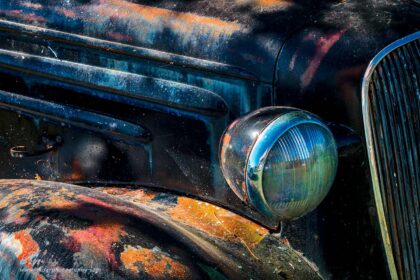
Most of the time when I shoot isolations of emblems and chrome on these old cars, I have to lower the tripod quite a bit and kneel down. That wasn’t the case here for sure. I had to extend the tripod as far as it would go which was well above my head. I then had to use the live view to compose the image and figure out the exposure. The glare from the cloudy sky above was making that difficult, but I was managing well enough. As I saw the composition coming together, I was pleasantly surprised at how good it looked. I’m usually not a big fan of shooting chrome against black because the contrast is too much to really show detail. It was the rust that really gave me hope here and I got things fine-tuned in the camera for the first exposure.
When that one came up on the image review, I worried that the black was going to be too dark with the amount of effect that the polarizer was giving the scene. I decided to get a safety frame just in case with a little less polarization in place. I dialed it back about a quarter of a turn and saw more detail in the LCD. I fired off that shot and was satisfied. As it turned out, the first image was perfect and had just the right amount of darkness added to the ribbed portion of the chrome. It all turned out remarkably well and was elevated to one of my favorite images from the day when it was all sorted out at the end.
After those quick frames, I went back to looking for a workable angle on the car itself but was just unable to find anything worthwhile. While I was working with the Ford, I happened to see the Biscayne that the owner had told me about earlier. It was a red four door which was not my preference, but it was a year that I did really like so I went over to see what I could do with it. As with so many of the other cars in the lot, there was no chance of getting an overall shot of this car because it was surrounded by other vehicles. I will say that there were two ’50’s model pickups behind the Biscayne which would have been a perfect addition to the story had they not been facing away from the sedan. There was just no way to get an all encompassing composition of this car, but since it had two extra doors, I wasn’t all that upset about the loss.

Instead of looking for a grand composition, I decided to do what I do best and look for isolations. The front of the car was in decent shape even though the hood was missing. I immediately picked up on the fact that “Chevrolet” script emblem was still in place on the grill and in good shape. Luckily, this emblem was not seriously blocked by the tall grass that surrounded the car, so I saw the opportunity to make a composition. For the second time during this trek, I was looking at the front of the car for a composition and not considering the headlights as the primary focus. The headlights were actually present this time which was nice, but they were secondary. I wanted to concentrate on that emblem which I don’t get to see all that often.
to keep the composition a little more dramatic, I decided to put things at a diagonal, instead of shooting the emblem straight on. To add to that decision, I chose a very narrow depth of field with an aperture of f/3.5 which kept the attention right on that emblem while the lights went slightly soft. I used the depth of field preview quite extensively here as I was deciding on the aperture that I needed. The extra light that was allowed to enter the camera helped to keep the shutter speed relatively high, so I didn’t have to worry about the tall grasses moving in the slight breeze that was certainly bringing in the rain sooner than later. Everything about this image came together very quick and there was no need for more than two exposures to make sure that I had what I needed.
The concept behind this photograph started to interest me because I was using the grass to frame elements and to be an element all to itself. I don’t run into this opportunity too often, but I had noticed that the car was pretty well surrounded by the straw-colored grass and I was starting to enjoy the color palette that it introduced. With that in mind, I started to work my way around the car to see if I could take advantage of this formula with any other points of the car.

It didn’t take me long to find the next point of interest thanks to the grass. On the back right quarter, I noticed that the “Biscayne” badge was largely visible through the grasses. I pondered that for a moment and decided that just shooting the emblem through the grass would be dull. I wanted to introduce some more depth to the scene and more diagonal lines. Fortunately, just around the corner were the taillights. I’m not 100% positive about this, but the dual lights were indicative of the lower end models with the Impala getting dibs on the iconic triple lights. Having the badging and the dual lights helped to really identify the car, much like the Chevelle I had photographed an hour or so before.
With these elements coming together I started to frame up a shot that I liked. There was a lot more fiddling with the angles of the camera than I would have suspected, but I eventually arrived at a composition that I really liked taking into account all of the warm tones being used. I went back and forth as to how I wanted the grass to be rendered in the photo. Not too long ago I had done a long exposure shot which was similar to the concept here with a good deal of success. I wasn’t convinced that it was going to work here because of all the warm tones and lack of texture on the surface of the car. It would have also been very difficult to get a good motion blur with the light breeze. There was just enough to soften the individual stalks if I wasn’t careful, but not enough for an animated appearance. I tried a few different shutter speeds to figure out the right threshold for what I was after. I managed to settle on 1/25 being the slowest that would work. This resulted in my ISO being 400 which was pretty high for this type of photography, but with the light being so good, I didn’t have to worry about noise at all.
I shot a handful of images during the lulls in the breeze to make sure that I had a photo that showed no motion when I got home. I also tried a few slight variations on the composition to make sure that I had the right framing without the need for cropping in post. This has always been an important aspect with my photography. I never want to throw pixels away unless I am changing the aspect ratio of a photo. That makes it very necessary to work through the composition with painstaking accuracy in the field. While it takes more time, I am rewarded with much higher resolution files at the end of the day. Generally speaking, the compositions that you see here are the ones that I have framed up in the camera while in the field.
When I was satisfied that I had what I needed from this composition, I started to make my way around the car one more time to see if there was anything else that I wanted to shoot. Nothing else really jumped out at me, but I was still really enjoying the tall grass around the car. I figured that I might come back to it if time allowed later on. I was kind of getting my second wind at this point. The rain was still holding off and I wasn’t smelling the rain in the air any more. I figured that I had some more time to play with some of the harder subjects out here at this point.

The first subject that I wanted to work with was one of the Chevy trucks that was parked behind the Biscayne. It wasn’t so much that this truck was a difficult capture because it wasn’t. There were a ton of isolations that I could shoot on it, but every one that I would shoot, I’ve done many times over the years. I didn’t see anything special about this truck that would make it stand out from the rest of the similar isolations that I had shot so there was really no need to beat that dead horse. The challenge here was the overall, and that was what I wanted to get. There was something about the missing headlights and the still shiny smile that it was wearing that I wanted to capture. I was also noting that the sky overhead was starting to really get interesting with the rains still approaching. Taking into account that this scene had the same issues as pretty much any other scene I had tried to shoot, I figured that an easy way to combat the surrounding vehicles was to get in close and very low. This would allow me to fill the frame with the truck which would then block most of the background while the low perspective would fill the rest of the frame with clouds.
I worked around with the angles until I found the right spot to place the camera. The perspective made the already large nose, extra impressive with worked perfectly for this composition since my main story was that front end. The angle also highlighted the tire that was on top of the hood that I found interesting since the truck was missing a wheel in the foreground. The tire didn’t help the lines of the truck any, but it sure did help tell the story of it so I was happy to include it in the composition.
As I was getting the exposure figured out, I noticed that the sky was looking quite bright in the frame. The histogram confirmed that the sky was pushing too much of the scene into shadows, but not by much. I went to the bag and grabbed a 2-stop soft edge Galen Rowell ND Grad to slide in behind the Color Combo Polarizer. This took just enough of the sky down so that I could bring the shadows up a hair in exposure. The histogram was looking good at this point and the image that I was seeing on the LCD looked promising. The truck was still dark, but if I had pulled the sky down any more, I would have over darkened the top of the cab which I wanted to avoid.
I ended up shooting four frames to make sure that I had the exposure as close to the right as I could while keeping the motion of the grass at bay. I wasn’t holding out much hope for this one because I really thought that it was going to be too contrasty to be effective and since the truck was largely in the shadows, I didn’t see enough of the detail coming out to make the image work right. When I got it home and started to work on the RAW file, I noticed that I had plenty of information to work with, but the colors were not all that impressive on the truck to begin with. I also had the red of the Biscayne in the background which I had to take into consideration. There was also another car just at the edge of the frame on the right which was another distraction. Looking at all of these issues and realizing that color didn’t play much of a part, it only made sense to look at this one as a black and white image. I sifted through the different profiles and found one that was a little lower contrast than the others which allowed me to build up the contrast where I wanted it.
There were several benefits that happened almost immediately with this change. The sky was able to be brought in quite a bit more threatening which I liked. The truck appeared brighter and had more variation in tones, and the surrounding cars ceased to be a problem because they just blended into the background. Chrome always looks good in black and white as well which helped to bring more attention to the front of the truck. It all just came together quite well for me with this one. In terms of visual drama, this is one of my favorites from the day which is surprising because I had all but written it off in the field. I’m very glad that I stuck with it and tried to get a decent image from this old truck.
This was the point where I was pretty sure that the day was going to come to an end. I had seen the entire property at this point and was satisfied with what I had captured. I had 63 frames on the memory cards which actually didn’t seem like much considering how many compositions I had worked on. I was sure that I had more than six photographs that would be better than average at this point. I wasn’t quite ready to quit on the day yet. I still needed to make another loop through the yard to make sure that there weren’t any other photos that I had missed. I worked my way back down to the Pontiac and spent a few minutes there but didn’t see anything else. I followed my original route along the trees and came back to the Chevelle and tried once again to figure something out, but decided I had to be happy with the one isolation that I had shot. Nearby was the Chevy next to the pond and I remembered how happy I was with that composition. I had the thought for the second time that if that was the only photo that I mamaged to capture for the day it would have been worth it all. I like days like that when I know that there is at least one image that really appeals to me and gets me excited.

As I walked up the next side of the property, I found myself looking at the early ’50’s Chevy that I had passed by earlier because I didn’t see much in the way of a composition or interest for isolations. The car was missing all of the brightwork which kind of dulled the car as a photo. The wheels were off of something much newer which I didn’t care for, and it suffered from the same issue of crowding around it. I hadn’t been able to figure out an overall composition, and without the trim or emblems to give me a visual anchor, I wasn’t seeing an isolation either. The one aspect that kept my interest was the color of the car. The tealish blue with the rust was beautiful to me, and there was a tree in the background that shared that rusty hue. Having that bold cooler tone amidst all of the warmer tones was an interesting contrast to my eyes and worth working with.
As I examined the scene, I started to really look at focal lengths and how they could affect the background. I decided to swap over to my telephoto lens for the first time during the day and I moved away from the car. The position that made the most sense was right up against another car, but that allowed me to shoot at 102mm which compressed the scene nicely. I was able to all but erase the other cars in the scene which removed the distractions. The front of the car was still a bit bland, but it was the blue that I was after anyway. For this composition I ended up shooting six frames with two variations on framing. Most of the extra frames were there to make sure that there was no motion blur being captured as the breeze was still in and out.
I wasn’t sure that this was going to be a successful image or not, but I felt accomplished for finally making one of this car which I had completely dismissed during my first round through the property. I didn’t spend any more time on this car though because I saw no isolations that interested me. I did continue down the path to the next area that I had been stumped at. You might remember from the first part of this entry that there was a Chevy truck with a slightly older car perched on top of the rear which I wanted to capture. It was surrounded by distractions and was just generally not something that I felt would make a good photo. Since I was here and had the longer lens attached, I decided to see what difference that made to the composition.

It was about like I had expected with distractions still entering from either side. I could deal with the pile of debris with the motorcycle on the right, but the red truck on the left was killing me. I could have moved to the passenger side for the more attractive side of the big truck while eliminating the red neighbor, but that would still yield two yellow support cables and a large gray van. I chose to go with the lesser of the two evils and shoot from the driver’s side to include a bit of the cab of the red truck. My intention was to shoot this as a black and white and actually changed the display to black and white to help visualize the photo as I was composing it. One last thing that I changed up was the crop of the image. I tried a square crop, but that seemed a little too crowded for me, so I went with a 4:3 crop that is kind of close to a standard 4:5 which was how I envisioned this being cropped in post. Everything seemed to make sense with the image review, and I was pretty sure that I was onto something with this approach. There wasn’t much need in making a lot of images of this because nothing was really changing, and the breeze had calmed down for the time. I just shot two frames and called it a day for this scene.
When I got the image home and started to edit it, I did it in black and white with a full edit done. I was happy with how it turned out and it all seemed to fit what I had planned for the scene to begin with. At some point during my editing session, Toni came down and I had her look at the images that I had done up to this point. When it came to this one, I told her how I had gone black and white to minimize the clutter and the distraction of the red truck to the left. I showed her the before and she said that she liked the color better but hadn’t paid any attention to the red truck until I had mentioned it. Of course, now that she knew to look for it, she couldn’t unsee it and understood why I went black and white. She still felt that it had potential as a color image. Since she is my resident tester for black and white images, I had to pay attention to the fact that she didn’t “love” it in black and white.
When I was all done with the edits, I came back to this one and took a trip through the color profiles. Of course, this was done with the existing edits done for the black and white image which altered much of what I was seeing. As is the case with black and white images at times, the processing done actually rendered the colors very nicely, and I had gone in and burned the red truck to darken it which kept it from being a distraction in full color as well. I found that the vivid profile seemed to fit the scene and the edit the best, so I switched to that one. A few fine-tuning touches on the edit and I had an image that presented with the look of color but had lost the distractions as effectively as the black and white version. I had been considering doing a fresh edit on this to see what the color would look like, but this really helped move things along and all of the original edits worked for the scene with the new profile.

If you will recall, when I left the big truck last time, I ended up finding a Fairlane in the air sitting atop a Town Car. I went back to this car because I really wanted to capture a photograph of it before I left. With the different lens, I figured that I had a decent chance of getting a new perspective on the car. I started to look at both sides again and found that my best bet was going to be shooting from the driver’s side. In doing that, I was going to have to deal with several power lines which went through thinning trees. That meant that I was going to have to be very accurate with the cloning to remove the, or I was going to make a mess of the trees. My other option was to leave them in the scene which I didn’t really want to do.
But wait, there might be a third option as well. I could use a shallow depth of field and blur the background to where the lines just faded into the sky. I just had to figure out a composition that would allow me to do just that. I started to find the angle that I liked with the car, but I could see the other junked cars in the background going up the hill as well as the power pole. I found this to be a distraction to the scene. Of course, if I included the bottom of the wheel, I was going to the top of the Town Car which would prompt me to include enough of it to make sense in the frame. At every turn, I was being forced to include more in the frame than what I really wanted to which was diluting the overall impact of the subject. I took a step back and defined what exactly I liked about this car. I was enjoying the mangled fender that was causing the headlight to droop. I liked the bent bumper with the mangled bumperette showing the undercarriage with lots of detail thanks to the reflected light from the car below. I liked the trim on the door which was the same as what I had photographed on the other side.
The decision was made to make a three-point crop on this car leaving only the top with breathing room. I wasn’t sure how this was going to work, but it was my best option. I got the camera into the perfect position and raised it just enough so that the headlight was not breaking the line of the windshield trim. I placed that light on the top left third intersection for maximum impact. I then started to play with my aperture values to determine what was going to give me the best look for the image. It turned out that f/2.8 was too blurred but stopping down to f/3.2 was perfect. The power lines disappeared into the background but you can still make out the trees. The trees give just enough texture to excuse the lack of detail in the clouds above. One other nice feature that is brought into play here is the tree that is to the right of the car that is rendered very sharp as it is on the same plane as the light that I used as a focus point. The composition is a departure from how I would normally shoot a photo, but it is these experimentations that bring growth.
At this point, I am not sure if this is one of my favorite images from the day, or I’m just so happy that I managed to get a strong composition from a very difficult location. Either way, I very pleased with this photograph and will certainly view it as a unique addition to my collection for some time to come. With this one in the bag, including 12 different frames of the same composition as the clouds moved overhead, I decided that I had finally gotten all that I could out of this Ford. I started back over to the Biscayne one last time because I was still really impressed with the color palette that it produced.

I still had the long lens attached which was what I wanted to shoot with at this point. I worked my way around the car and looked for a view that caught my attention. It didn’t take long before I zeroed in on the rear passenger quarter that I had shot before to showcase the Biscayne emblem. This time, I went from the other direction and shot the broadside of the car to really capture the tall grass. What I liked about this side was the curve of the chrome trim that followed the body line of the car with the door handle right at the top of the grasses. I framed the shot in a way where I had just enough green grass to balance the colors in the scene while including the bottom of the door window with broken glass to close in the top part of the frame. The composition is actually less about the car and mor about the tall grass. The car just provides the visual anchor and a background to give the grass structure. It is the color combination that I found most intriguing about the entire scene though.
After I grabbed a few frames for this composition, I moved back to the front of the car to shoot an alternative composition with the headlights and the Chevrolet script. That one wasn’t as effective as the first one because the tall grass ended up bisecting the main elements of the scene and that caused a major distraction. The other composition that I shot was another one of the rear of the car from the driver’s side. It was a good one, but it showcased the bumper that was pulled out on that side creating a very large area of chrome in the frame. Had I not shot the rear quarter from the other side so successfully, this would have been a fine composition, but there was just no comparison between the two. The original one was much stronger as a photograph, so that was the one that was marked as a keeper.
At this point, the rain was starting to fall kind of heavy and it didn’t look like it was going to be a passing sprinkle. I broke the camera down quickly and headed back to the truck. I had been photographing for a total of exactly three hours by this point. I had shot a total of 93 frames in those three hours. It had surpassed my expectations as I was only counting on a single subject to work with. Of those 93 frames, I ended up deeming 17 of them to be keepers which really is astounding considering how long it took me to get warmed up. In fact, as I was going through and editing the images, I was a little disappointed with the Pontiac that I had come out here to shoot. I didn’t really have any expectations of it since I had never seen it before, but I had been hoping for me. The overall photo of the Pontiac that I had started the day out with was the next to last image that I edited because I was just not all that thrilled with it. However, by the end of the edit, I liked the photograph quite a bit. It is one of my favorites from the day and is even better than the one of the window trim that I had initially been very excited about.
I hope that you have enjoyed this trek and photos as much as I have. Remember, any of the photos that appear in the blog or in the galleries here can be purchased in print form. I will do pretty much any size, and a wide assortment of media including photo paper, fine art rag, metal, or canvas. You can find my stock sizes here in the gallery store which has recently been repaired after a month or more of malfunctions. If you like them on your computer, or worse yet…your phone, you will LOVE them in print. It is the actual print that is the final step in this creative process, and you are the one that can enjoy that final step for years to come. All you need to do is get in contact with me to get your order started.
If you are wanting to learn more about photography, don’t forget that I offer mentorship programs of various lengths and involvement. These programs are a very efficient way to learn photography, or to gain skills that you might otherwise miss out on. If you think that you might be interested in signing up, give me a call to discuss your options and whether or not I could help you achieve your goals. The consultation is free and there are no commitments unless you decide it is right for you.
Be sure to join me on April 1st as we look at how to deal with the situation where you just can’t find a workable photograph to capture of a subject.
Until next time…

Remember to use the code KISER10 to get 10% off your purchase