Welcome back to another installment of my monthly Behind the Camera, where I will either take a question that has popped up during the month or will talk about something that is near and dear to my heart. This month, I want to do a follow up piece to one that I did a while back dealing with how the camera sees. That turned into one of my favorite installments of this feature because it really started to look at photography in a different way and pointed out some of the differences between how the camera sees and how our own eyes actually see when perceived by our brains. If you haven’t read through that one, or want a quick refresher, it might be a good time to pop over there and give it a look. I’ll wait for you.
Now that you are back, let’s start to look at this month’s take on things. We should all be on the same page with how the camera captures everything regardless of how we are actually viewing the scene. This month, I want to talk about how our own view of the world around us influences the types of photography that we excel at. Notice I didn’t say the type of photography that we “do”. That is an important distinction that I think needs to be made, and more importantly, understood, for a photographer to be able to produce the work that they are going to be the best at. What in the world am I talking about here? I know you are waiting for the April Fool’s joke to be made here, but I assure you that this is a very serious topic. I’ve hit on this with my workshops here lately as I have gotten to know the participants. It is also at the core of my mentorship program, but I have never heard of another photographer utilizing these concepts.
The concept is simple, at least to me. We each view the world in a unique way. Some of us concentrate on the details, while others look at the big picture (pun intended). Some take the easy path, while some prefer the road less traveled. We each have things that we see that excite us and cause us to look in a particular direction. Nothing I’ve mentioned yet has anything to with photography at all, and for these distinctions to be made, we just have to be human. These are things that are hardwired into our brains and there is nothing that we can do to fight that. However, as we age, these preferences in world views can, and often do change on their own. To be a successful photographer you have to be very self-aware of who you are as a person before you can really create an identity as a photographer.

As photographers, we typically latch onto images that we see other photographers creating which prompts us to try and go out to create the same thing. For me, it was seeing photographs of grand landscapes which excited me the most and I had dreams of creating images like the ones that I saw in books and magazines (before the era of smart phones). To this day, I enjoy looking at the photographs of these grand landscapes, but I had a very hard time teaching myself to capture these images. Why is that? Well, for one, I wasn’t being true to my own view of the world. I didn’t see the world as a grand far-reaching view, which is possibly why those images appealed to me in the first place. It was a look into another set of eyes that I didn’t possess. I met with a great deal of frustration over the years trying to recreate those grand views with my camera. My photos lacked something, but I didn’t really know what that was, and wouldn’t figure it out for quite a number of years into being a hobbyist photographer.
What I slowly learned was that while I enjoyed a certain type of photograph, it wasn’t how I viewed the world which meant that when I tried to capture those scenes it felt, and often looked forced. Conversely, when I would focus on a certain aspect of the landscape like a waterfall, barn, or old car, the photos seemed to come across much more organic. They were not the typical landscape photographs that I had come to expect by looking at other’s work, but these were the images and compositions that came more natural to me. It took a number of years for me to embrace that realization and decide that I should listen to those voices in my head about what to capture with my camera. It was the start of me breaking away from trying to be a photographer that already existed and putting my efforts into being the one and only “me” photographer.
We each have the opportunity to be that “me” photographer in whatever context it comes out as. It is what makes us all unique among a growing percentage of folks that have a camera in their hands. The trick is to fully understand how you view the world around you, and how you tackle life in general. Before I got serious with a camera, I never knew that there was a distinction in how one viewed the world. We opened our eyes and saw what was there. Some of us might have had rose colored glasses on, but that was the only difference. That assumption couldn’t have been more wrong, and those glasses actually weren’t colored at all. They were perfectly clear, but they filtered out different elements of what was seen which made things appear prettier. In some cases, they just eliminated distractions and allowed you to focus on what was most important before your eyes. I wore those glasses and never really knew it until I really considered how I was using a camera.

Now I’m pretty sure I’ve lost you, and it seems like I am talking out of an atypical orifice. Allow me to reel you in for a moment. Let’s take photography out of the equation completely and think about how we see things…I mean truly see things. How do you function at work and at home? Are you the one that overloads yourself with information and stimuli? Do you tend to focus on the details while keeping the big picture in view? Are you the type of micro manager that likes to fully commit to dealing with one issue at a time and completely forget everything else around that issue? Be honest with yourself here. I fall into the middle one most of the time where I am aware of all that is going on, but I choose to focus on bits and pieces of that puzzle where I can actually affect an outcome. There are times when I need to really focus on something specific and I can certainly do that as well, essentially putting on blinders to everything else around me. This is when I drive my wife crazy because I fully commit to whatever I am working on and nothing matters, not even time itself. There are times though, when I have to look at everything all at once like I did when my Mom died in 2018. I was working as a community resource officer where I had to be on top of every crime that had happened in my district so that I could address concerns from the community while figuring out how to address crime prevention. I had a home life with a wife and a kid still living at home which comes with all those typical concerns and tasks. Added to that was the death of my Mother which I had to handle on a personal level as well as being an executor of the will. Then there was my Grandfather who had just moved into assisted living and since Mom had been helping with that transition, that task now fell on me as well. I was also a photographer running what I was hoping would become a business at some point. It was all too much for me to deal with because I just can’t take that much information in at the same time and efficiently deal with everything. During that time, I had to break things down into smaller and more manageable pieces which I could understand and work with.
On the other end of the spectrum would be my wife, Toni. She thrives in a situation where she has a lot going on and is at ease during those times. She has said more than once that the more she has going on at a given time the better she functions. When the situations call for her to focus on a specific task, her mind will wander, and she will get off task quickly. I can’t understand it because it is so foreign to me, but it is one of those fundamental differences between us. When presented with a specific task that takes time and focus, she won’t be able to complete it in one sitting without doing a few other things at the same time. It is just her way of functioning in the world. This translates into what she sees as well. She will often times point out something that catches her eye 25 miles away, in the shadows of a hidden structure. She will ask me about it, and I won’t have even seen the structure she was looking into. It surprises her that I missed the billboard advertisement that was on the other side of the street at the same time, or the couple walking together that had matching sunglasses. I never saw any of these details, but I could tell you the exact layout of the property where that barn was located at the top of the hill. I have no idea what was around it because I didn’t care. It was that barn that caught my attention, and it was the only thing that mattered to me.
It is these two examples where I can start to come back to photography again. When you look at Toni’s way of interacting with the world, it only makes sense that she could see the grand landscapes before her. If she was a photographer, this is what she would focus on, I’m sure. As luck would have it, she does pastels and enjoys recreating my photos with chalk. What photos does she gravitate to? You guessed it, the far-reaching grand landscapes that I shoot. I can look through all of her pictures and see coastal views for miles and mountain ranges off in the distance. She picks those scenes that I have to consciously try to create because they are not my natural way of deciphering the world around me. Those are just the ones that feel natural to her.
When you look at my photography, you will see mostly scenes that include a lot of information, but there is usually a key anchor to the image. It is that anchor, or main subject that I focus on and build the composition around it to tell the story. In short, I am looking at the smaller details within the grander picture and that is what I capture, because that is what I see. This works for landscapes and rural scenes alike. It represents how I function during most of my life. However, there are times when I get overloaded, as with the events I detailed above. It is those times, that even looking at the smaller segments of the bigger picture seems overwhelming. It is at those times that I tend to gravitate towards the intimate isolations like the rusty Ford above. It is the creative equivalent of putting blinders on and focusing on a single task while letting everything else go for a time. Photography becomes my meditation and my link to sanity when the world gets too complicated.

Why is this navel gazing important to photography? Well, simply put, by understanding the concepts and applying them to your own photography, you have a chance to identify your style of seeing. I am weakest at taking grand landscapes without a particular point of interest and turning them into a photograph because I am weakest at taking a lot of input and understanding it all at the same time. My strength in viewing the world is picking out the important details in a larger scene and organizing them to where they make sense. In life, if those details get too busy and jumbled, I’ll just isolate the issues and deal with them one at a time while paying little mind to the entirety of the situation. Understanding my strengths and weaknesses in viewing the world allows me to understand where I am strongest in photography and where I have the better ability to produce the more visually appealing images.
The scenes that I shoot today have very little to do with the images that I saw which got me interested in photography. I still enjoy looking at them and it is a treat for me to see a grand landscape captured by another photographer because they have told me what in the larger scene is important to them and have eliminated the other elements. I’m left being able to focus on their vision which is restful for me. I wouldn’t have been able to define that same organization of a larger view as they have because I would have been overloaded by having a lot of elements that were equally as important. However, I will regularly see smaller compositions within those larger views which I imagine I would have captured had I been there at the same time. I understand now that it is due to my view of the world that I’m able to pick out areas of the landscape that have a particular interest to me and focus my attention on those areas. It doesn’t mean that I don’t enjoy grand landscapes, it just means that it takes a bit more effort for me to organize a composition with a lot of elements over a larger area.
As I have been teaching workshops and working with clients in a one-on-one setting for a while now, I am starting to see some very practical applications to this theory of mine. It is interesting to view how others see the world around them and how that affects how they treat their photography. More often than not, I can deduce whether a person is detail oriented or if they prefer to take it all in just by looking at a collection of their photographs. In one such example which has popped up over the last month or so, I’ve been talking with a photographer and doing some quick critiques on his work. He has a knack of picking out interesting slices of a scene that don’t even include a complete element. Essentially, he will break down shapes within a scene and that becomes the subject. During a workshop, he was trying to capture a scene that I was talking through the process of composing. The composition included a strong subject, with a supporting character above it. He had a really hard time making that work, and the images that he got from that scene just weren’t satisfying to him at all. He asked me about them and what he did wrong. After looking at the collection of images that he had shot during the day, I was able to tell him that he hadn’t done anything wrong at all. He just didn’t see that composition because that was now how his brain was used to viewing the world. There was really nothing that I could do to enable him to see the way that I did, or the way that several others had seen that day, nor would it have served him to even try to change how he viewed the world. What I chose to put my time and effort on with his images was delving into the isolations that he had shot. That was where he was the strongest, and he was able to see compositions that nobody else, including myself, had seen that day. This was where he was the strongest, and this was where we needed to focus our attention on his creative path. It really is that simple, if we embrace how we naturally see the world around us, we can create an endless number of images with a higher degree of success.
If you have ever looked at another photographer’s picture and thought that it looked great and that it would be easy enough to organize a similar composition, only to become frustrated that you couldn’t do it later, I assure you that is not your fault. We can all recognize beauty in a photograph because all of the pieces are already there. It is kind of like eating a casserole that consists of a group of recognizable ingredients. You know that it is good, you understand how it was put together and made, but when you try to do it yourself, you are left with a mess in the kitchen and some creation that isn’t fit to feed the pigs. It isn’t that the casserole was difficult to make, it is just a simple matter of making a casserole is not your cup of tea. However, you can bake a cake like nobody else can. It is all about embracing what makes you….well… you. There is nothing wrong with enjoying a good casserole even though you can’t make one. When you feel the need to create something in the kitchen, pull out the mixing bowl and create your own masterpiece. It really is that simple, and I prefer cake anyway.
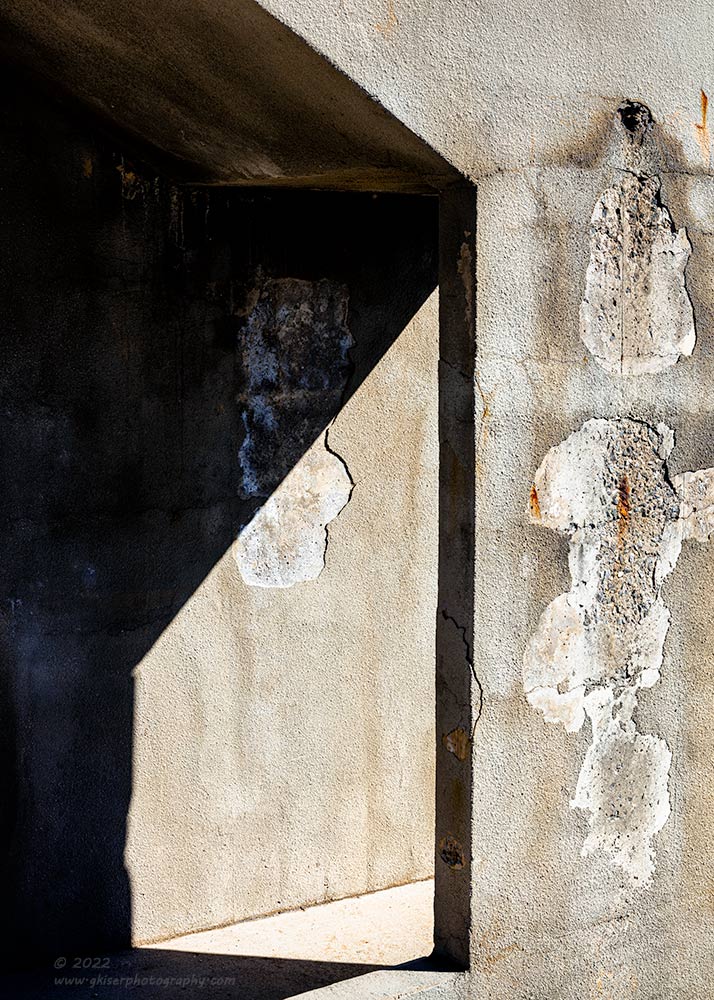
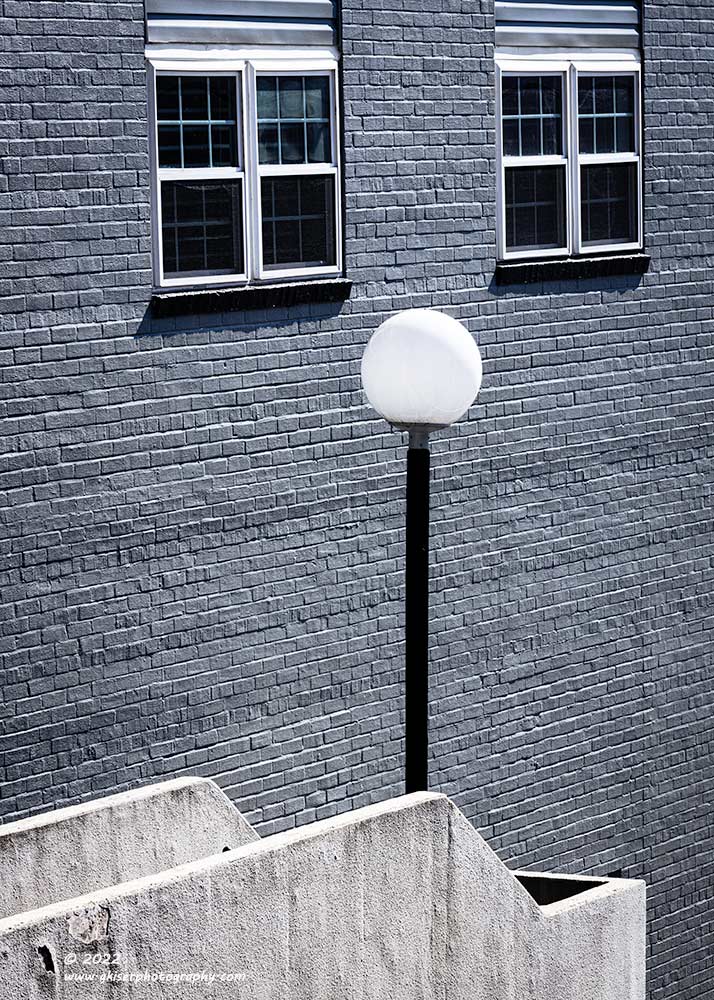
Just in case you are starting to think that reducing the subject matter in a photograph makes it easier to see, or to organize, you would be mistaken. When you start to really focus on a smaller area of a larger scene, oftentimes you are looking at much more information that has to be considered. However, all of that information is directly related to what you are capturing, so it all goes together to tell the story. Consider this photograph of a protected walkway at the base of some stairs I shot a month or so ago. The building itself was brick, painted gray. There was a concrete area where the stairs were, and a tall light post coming off the side of this particular structure. There were windows all along the exterior wall. Looking at that scene, the element that grabbed my attention was the way that the shadows were playing on the concrete section. I could have included that as the visual anchor for a study of the wall with the repeating patterns of windows as in the photograph below, but instead I wanted to make the shadows the primary focus of the image. With that decision, I chose to really concentrate on a single aspect of the scene, but that single aspect brought with it a handful of other details that were lost in the grander scene. That shadow brought with it lines, that turned into shapes. Those shapes became the elements, but if you look at the walls, there are textures to be found and areas where the surface of the concrete has been damaged with age. There is a harmony to the shapes that have been captured here, but if you pay attention, there would have been no photograph at all had it not been for the light and the shadow.
This is what I mean by focusing on a small section of a grander scene. You find the part that truly excites your eyes and focus on that aspect and that aspect alone. You will find that there are new supporting elements that come along with that visual treat which then create an even more interesting image. Had I included both portions of this building, the shadows would have been lost as would the detail of the concrete. The light post would have become an afterthought in a great sea of gray bricks. While another photographer that was more adept at including so many elements might have been able to make a compelling image from the entire side of the building, that was not how I saw things. My eyes immediately picked out portions of the building that I liked, and I ended up making two different compositions on two different days, with different lighting. They both feel completely different and say different things. I’ll even go out on a limb and say that unless I had told you that the two images were the same building, you probably wouldn’t have even considered that possibility. That is just how I see things, and how I choose to convey my visions to the viewer.
Let’s talk for a moment about using photography to get to know yourself better. That’s right, go lay down on that couch while I get my note pad out. Tell me about your childhood. No, we aren’t going to get into a psychiatry session here, but we are going to dig deep for a minute or two. Whether you are a photographer or not, you have taken pictures at some point in your life. Think about the vast majority of images that you have captured. How much detail did you include? How much of the whole scene did you capture? For you non-photographers out there, when you take pictures of friends and family, or your cat even, are the shots tight on the face, do you tend to go for something waste up, or do you get the entire person and everything behind them? If you look back on my pictures from childhood, there becomes a theme where I try to avoid getting too much background in the shot and I concentrated on faces and what the activity was they were doing. Mom, on the other hand would get a full body picture (unless she cut the head off which she was apt to do) of whoever she was photographing. That meant that there was a lot of stuff going on in the photo in the background. She saw things as big pictures, and that carried through to her life where she tried to stay on top of everything for everyone. Meanwhile, I’m left here focusing on faces and activities and being the detailed oriented person that can block out the world when I need to.
Let’s go in a different direction. I had the opportunity a few weeks ago to do another mentorship with a photographer who is just getting started. Now, it is too early in the process for me to really know how he sees the world, or how his photography will develop, but in a three-hour session I made some connections that will be played out in coming meetings. Early on, I asked what he liked to take pictures of, and how he wanted them to appear. The short answer was flowers, and he liked to fill the frame with them. Essentially, he is talking almost a macro type of photography, but at least he is wanting to focus just on the flower. He had done some tests in the kitchen trying to get the depth of field effect that he was after, and I noticed that he was looking at isolating a single subject by composition and by depth of field. During our conversation, I learned that he dealt with numbers for his career which is very detail oriented. It all started to come together for me. As we were outside doing some practical examples, we went through several different subjects, and I saw repeatedly that he liked to focus on the smallest of details within the scene. Even when I tried to get him to capture a larger scene (for the sake of learning exposure), he was focused on the small details within the grander scene.
This is what I am talking about with being your own photographer and capturing the scenes that excite you. Sure, he will be able to take a picture of a house, but it won’t be something that he will do passionately. However, he will excel getting in close to the door and capturing the detail of the wood, and design of the led crystal glass. All of his life choices have come from his view of the world around him (assuming here since I don’t know all of his life choices). He has been detail oriented since birth which allowed him to excel in math through school. That strong background in math brought him into his career in the accounting field where he continued to be more interested in the fine details of budget and expenses within the larger scope of life. This is now carrying on to his photography which is going to be his hobby after retirement. See how that just flows so nice and simple? I’m not saying that he wouldn’t be able to go out and get a fantastic photograph from an overlook on the Blue Ridge Parkway, but where he will find his true joy will be in focusing on the details of a scene and making those very details the grand scene in his photograph.
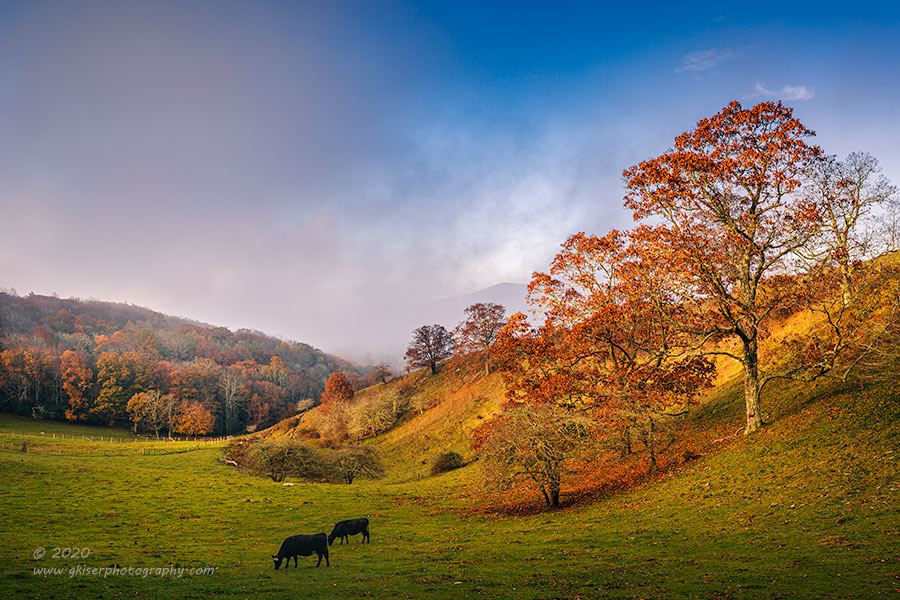
So, are we now locked into a certain type of photography because of who we are and our experiences leading up to becoming a photographer? Nope, not at all. Most everything in photography can be taught, and you can always move into different realms and photograph things differently than you would normally see them. All I’m saying is you shouldn’t try to force yourself to photograph things in ways that you think you should. Embrace what makes you unique to the world of photography. I shoot plenty of grand landscapes because I recognize that there are just certain scenes that require it like you see above. The process takes a little longer for me to work out because I am literally having to talk myself though the creative process and question myself as I go to make sure that I have the right kind of image. It is not natural for me, but over the years I’ve gotten much stronger at it which is always a good thing. The way it usually plays out is I start to see elements that I like, which in this case was the trees to the right. As I evaluated the scene, I realized that the sky was starting to look good, and I could see the mountain in the distance coming into view. That brought me to the conclusion that I needed to include the distant ridge with the Fall colors to balance out the image. Then the cows came into the scene, and I had to consider where they would work the best as they were moving around the scene rather quickly. As I looked at this scene, it was all of the elements that worked together to tell the story that I wanted to tell, but it wasn’t how I actually saw the scene in front of me. What I saw when I looked at this, was the trees to the right. That single element that excited me became just a visual anchor for the grander scene that I shot.
So, if we aren’t locked into a certain style based on how we view the world, then this whole entry is irrelevant. We can just choose to be the photographers that we want to be. In my experience, that is not really the case. Yes, we have the ability to move through different ways of seeing, but it is not quite that simple. As I have mentioned, it is a natural thing to photograph the way I see the world because I’m used to seeing it that way. If I put thought to it, I can make the camera see things in different ways which can be rather helpful at times. Back to the couch again, tell me about your relationship with your Father?
I’ve found over the years that I can get bogged down looking at details and I start to dig too deep into the subtle nuances of whatever task I am dealing with. For instance, you might recall that back in 2020 Toni and I moved to our home in Purlear, which required a complete repaint of the inside as well as lots of little, small repairs. For the better part of two months, I was focused on the details down to the edges of the moldings I was painting. I was filling and sanding screw holes in the walls, working on doorbell wires, and changing out lighting fixtures. In those two months, I was absolutely tired of looking at the details. I had missed world events, and even had no idea of things that were going on in the city I used to work in where Toni was still employed. I had to reset my brain which I was able to do through photography. I spent a lot of time shooting images much like the one above that took in much more of the scene and focused less on the details. It pulled me out of that detail prison I had put myself in and taught my brain that it was ok to look at the bigger picture again. Ultimately, I got back to my comfort zone of being aware of things, but still able to focus my attention on certain tasks at hand.

Yes, I use photography to heal myself and I’ve been doing that for a very long time. It all started when I was still a new police officer, and I needed a creative outlet to relieve some stress. As I’ve gotten more mature and a little better at reading myself, I’ve learned a lot about how and why photography helps. It wasn’t until a few months ago that I actually found that I can take control of it to change my own attitude. You see, I was in a really bad creative slump during the Fall and no matter what I tried to photograph, nothing excited me. I had a lot of things going on, and I was juggling a lot of problems with the business aspects of photography. I was overloaded and there was no room to be creative. I wanted to be, and went out a lot to try and find something to shoot, but I just kept making excuses about why the photo wouldn’t work and I wouldn’t even try it. I actually remember thinking to myself that what I photograph is dependent on how I am viewing the world. At the time, I was looking at the grand landscape and it was too much to take in. I had gotten to the point where even trying to focus on that one anchor point in the image wasn’t working for me. I would see all the extraneous details in the background and just couldn’t deal with it at all. It was a quick trek around Wilkes County that changed all of that and gave me a glimpse at what the answer was going to be. I had to stop thinking about how the website was always going down due to hacking attempts, and the fact that I had emptied out my business savings to try and get into portraiture, and the fact that the weather wasn’t working for me at all. Those were just some of the issues I was dealing with, not even taking into account my personal life at the time.
When I was driving around looking for something to shoot in Ashe County, I saw an old Bug that had interested me for some time. It was the same story though; I didn’t like the setting and there was no photo to be had here. Well, thinking back to the isolation that I had done on the old road tractor in Wilkes, I decided to look for isolations on this Bug. That was the ticket and I ended up getting a handful of images just from this one car that I hadn’t been able to see before. Just like that, I forced my photography to change my attitude and my way of looking at things. I had been spending too much time looking at too many different things and wasn’t spending enough time appreciating the details. It was the time that I spent with this little car getting these isolations that freed my mind and elevated my attitude more than anything else that I could have done. It was the first time I remember actively deciding to photograph a subject in a particular way because of what was going on in my mind. It was a real eye opener and something that I expect to delve into more over the coming years.
I’ve always been able to look at my photos and remember how I was feeling at the time, but I’ve never been able to use my photos to change how I was feeling. That is powerful, and something that I think all photographers should be aware of. Art in any form is a window into the heart and soul of the artist. It reflects what is going on with that artist and is an expression of themselves. This can be harnessed as a healing tool when one gets familiar with how they are a part of their art, and how the art is a part of them. If you can’t alter your feelings, if you alter your art, will that not affect how you feel? I don’t know, but I do know that I have been able to change my outlook on things through my photography before, and I have just recently figured out how to bring about that change to a degree, by choice. No, I won’t be curing depression or anything like that, but I have found that in some circumstances I can take the edge off for myself.
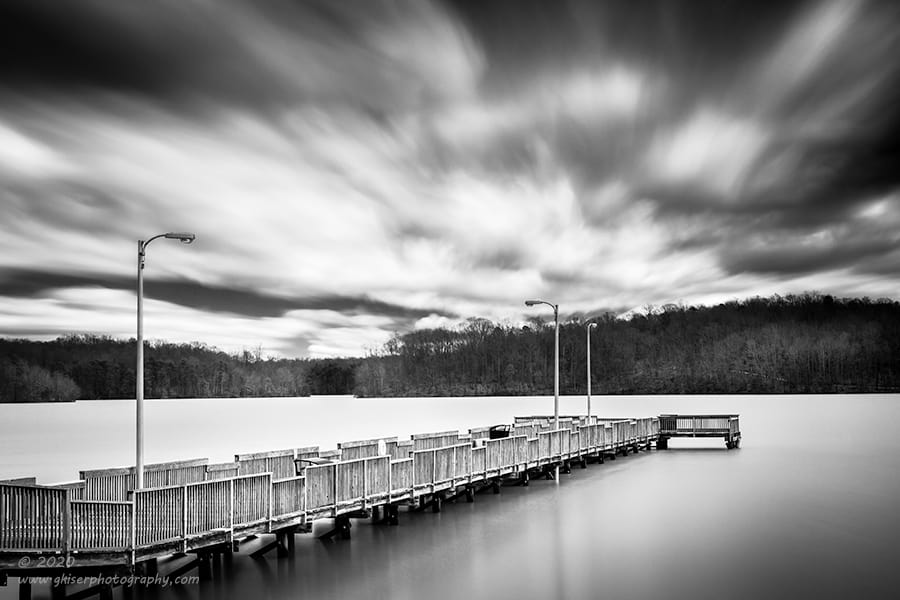
Before I had made that discovery though, I was able to look back on my photographs and determine just where I was mentally at the time. Take for instance the image of Salem Lake above. I shot it in February 2020, which is significant for several reasons. I was still dealing with the loss of my Mom as it has just been about 17 months. I had retired from working as a police officer about five months before, and I had a lot on my plate taking care of my 99 year old Grandfather who passed away just a month after this photo was taken. There had been a lot of change in my life and while I really didn’t understand the weight that was on me from just those aspects, it came out in my photograph. I had been struggling to find scenes to photograph that excited me because I was just not in a happy place, and I was feeling very isolated and alone. This scene from Salem Lake was one that I was drawn to, and I spent some time capturing it. It was a photo that I really liked and probably the only one from that period of time that resonated with my soul. I can look at this picture and I can sense the loneliness and bleakness of the world. The lack of color makes it moody, and the representation of movement over the 3:22 seconds of exposure shows how I felt the world was passing by as I was standing still. It is not a happy photograph, but it is one that I can still look at for a long time and I can remember exactly how I was feeling at the time.
This phenomenon has a very important place in this conversation because it is not just how we view the world that leads us to our most successful images (however you define success); it is how we incorporate the emotions that we have at the time. There was no way I was going to be able to create an image that was bright and cheery when I had all of that on my plate. It wasn’t representative of my view of the world at the time. No, I was almost certainly going to be drawn to moodier and more atmospheric conditions because that was where I was emotionally at the time. I will often play that game with myself and look back at the photographs that I have captured over the years and see if I can remember what I was feeling at the time. In most cases, I can remember my emotional state quicker than I can remember the location that the photo was from.
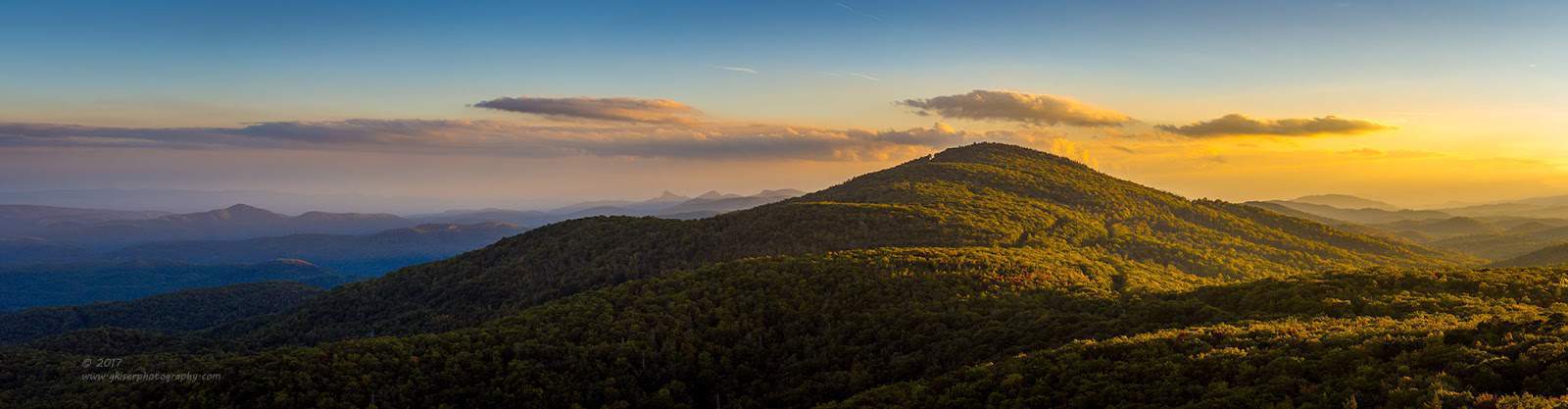
I’ve used this photograph many times over the years to illustrate this point in presentations. It is a pure representation of who I was at that moment stating at the overlook of Beacon Heights. It appears like a grand landscape in its composition, but it is essentially my way of seeing the world around me. I have included the single mountain within the context of the surroundings. There are not a lot of elements here at all, but the emotional connections are more than I can count. The situation was this. I was heading out to the Blue Ridge Parkway after working a full day. I could have spent the time with Toni and Seirra, but I had opted for a chance at getting a great photograph with the conditions that were present. They didn’t want to come along with me because it is very boring watching me get a photograph. I spent th entire trip up there hoping that I had made the right choice in goin for the picture, and that the conditions and subject would come together for something great. I was already regretting my choice during the drive up there which was a bad sign.
When I arrived at Beacon Heights, there were cars parked everywhere so I was doubtful that I was going to be able to get anything at all, but I had to try because I was going to be losing light soon. When I got out to the overlook, it was full of people, and I just didn’t like what I was seeing as far as compositions. In fact, the only way I was going to be able to capture anything here was with the long lens, shooting over the masses’ heads. I was here, so that was what I tried. There I was pulling out my tripod, and camera with the long 70-200mm lens attached. I looked every bit of the professional and in total control of what was happening. I looked across the scene and tried to pick out compositions that I could shoot without including the crowd but found nothing that really excited me. It was the last idea of shooting a panoramic view that excited me, and seeing what the sun was doing, I could see the light working for that kind of composition. As you can see, that is what I ended up shooting, and this is still one of my favorite images of all time, and it hangs proudly in our living room as a large canvass, and also can be found in Baptist Hospital in Winston as an even larger canvass.
What does this image say about my emotional self at the time? Well, look at the light and the dark parts of the scene. The brightly lit part is where our eyes go naturally. It is that warm sunlight shining on the side of the mountain which reflects the outer me. This is the part that everyone on that overlook saw when they looked at me (like they even noticed I was there). They saw the confident, obviously well-equipped professional, capturing a scene which would no doubt be one of the most sought-after images in history. Hey, what can I say, I looked the part, and was convincing in my roll. That was only about a 1/3 of the whole story, because the part that nobody really saw was that 2/3 of the scene which was in the shadows. I was not confident that I was going to be able to make an image from here at all. The pano idea was a last ditch effort to salvage a trip that I was feeling very guilty about taking in the first place. I felt like I had failed my family and was about to fail at the task before me. I wasn’t feeling anything like what I looked like on the outside. When looking at this image long after the fact, it is an interesting metaphor for what I suppose is a common thread among most humans. What others see is usually a very small part of who we are, and we keep most of ourselves shielded from public view. This simple image of a mountain at sunset says so many things about me, and about a human condition that it will always be a significant photograph in my collection. It was true to how I saw the world, and saw this scene.

Ok, time to pull it back a little bit. Maybe you aren’t all that impressed with the whole concept of how we view the world factors into how our photography will look. Maybe you are content with just capturing the scenes that interest you and you don’t want to put a lot of extra thought into that. I get it, you just want to take pictures. One of the most frequent questions that I get is what lens should I buy, or more often, what lenses should I bring for the workshop? It would seem like a simple enough question, but the types of lenses that you will get the most use out of all stems from how you choose to frame a scene, and that is a direct result of how you view the world. Here we are full circle again, right back at the beginning of this piece. To accurately answer your question, I will need to know more about who you are as a person. My uniform answer is I’ve shot successfully with everything from 14mm up to 400mm. I’m betting that a few of you have heard that answer before after you asked your question. It is an accurate response, but one that fails to really answer the question. For me, and how I view the world, a 24-70mm lens is the way to go. I see in a standard field of view, and I like to get in close to really draw the attention to the subject. I’ll also usually fill the frame with that main subject. It gives me a lot of flexibility for how I compose images. However, if I was into isolating parts of the landscape and taking them out of context, a long 70-200mm would be a better answer. If I wanted to take it all in with a dominant foreground, the 16-35mm would be the best choice. It all depends on how I am viewing the scene before me, and how I want it to be presented.
Time and time again, I will run into folks that have a collection of lenses that all cover the same basic uses. I’m here to tell you, there is no realistic difference between having a 55-200mm, a 28-200mm, and a 100-300mm in your camera bag. You are overlapping focal lengths and you essentially are duplicating your choices and making it very difficult to select the proper lens for the job. In this situation, every lens is a moderate telephoto covering 100-200mm, which I would assume is what you like to shoot most of the time. If you need the extra reach, you pull out that same range, but one that has that 200-300mm range added on. Maybe you are needing something in the standard range, so you pull out that 55-200 which gives you a little extra room on the wide end, but if that isn’t enough, you put on the 28-200mm which will get you just a bit more of a wide-angle look. You are spending money for repeat focal lengths with no regard to a particular reason to do so. When I see this, I really think that it is somebody that really doesn’t understand how they view the world, and just wants to buy glass so they can have choices. The fact that the choices are all very much the same doesn’t occur to them. The better way of looking for lenses is to understand what they do, and to get smaller zoom ranges for noticeably better optical quality as well as less overlap between ranges.
If I had only one lens in my bag, I would want it to be my 24-70mm which is my favorite walking lens. It gives me a solid standard view of the world much like my eyes actually see, but adds a mild wide end, and a mild telephoto end to the range. This is all very comfortable for how I view the world around me. My next lens would be a 70-200mm because there are times I like to pick parts of the landscape out and focus all of my attention on that. This is also a great choice for isolating close up elements as well. The last lens that I would add for the way I see the world is my 16-35mm which gives me a wonderful wide angle view of the world, but this is the zoom lens that I use the least because I don’t really see the world as a wide angle subject. What I use this lens for is emphasizing the foreground element and making it more important while giving it more context to work with. That brought me to the need for a 14mm prime because there were times when that 16mm wasn’t wide enough to get a single subject in the frame. It wasn’t because I wanted some grand landscape that covered miles and miles of the view. I would imagine that a photographer that preferred the grand landscapes that encompassed a far reaching view would lean towards wide angles more than I do, and would use them differently than I do. Somebody that saw the world in minute details, would undoubtedly go for macro lenses, and would probably go with longer focal lengths to really focus on the details.
There are other considerations when it comes to lenses, and you need to be aware of those aspects as well. There are times when the speed of the lens comes into play, or potentially the optical characteristics. That would be a reason to have duplicate focal lengths in your arsenal. For instance, I’ve added a new lens for the first time in six years or so and it happens to be a prime medium telephoto 85mm. Now, I have that focal length covered with my 70-200mm lens, but there is a difference that is important with this particular lens. My zoom is a relatively fast f/2.8 lens, but the 85mm prime is much faster at f/1.4 which allows me to shoot in lower light, and to obliterate the background for portrait work. It fits in my world view because as I mentioned before, I prefer to focus on the faces and activities of people more than full body images. The 85mm is tight enough that I can do just that, and it allows me the ability to blur out the background when I don’t want to have the visual complications. It is optically superior to the zoom lens, and lighter to carry around for portrait work. It is there for a specific purpose, and I don’t carry it in my bag normally. The choice came down to how I want to capture a particular scene and it has already worked out very well for me in a recent headshot session.
The next new lens addition to my arsenal is the 50mm f/1.2L, which was just ordered days ago. Honestly, this lens was a toss-up decision with the 35mm f/1.4L Mk2 which I had actually planned on getting. The reason I bring that up here is that I put my money where my mouth was for this decision. I preferred the compositions that were possible with the 35mm, and it would allow me to include more of the location in a portrait shoot which appealed to me. However, as I really started to dive into the nuts and bolts of how I would be using the lens, I realized that the way I would want to use it would introduce more distortion to the subject than I wanted to see. It all came back to how I viewed the world and how I see my portraiture developing. I will continue to fill the frame with my full-length shots, and I will much prefer to go in for the 3/4 length shots, or close ups which is where this lens shines above the 35mm. The 50mm focal length is boring for what I typically shoot though when it comes to landscapes and decay work, and I try to avoid that view most of the time. When it comes to people though, it makes more sense to capture them in the same proportions as we are used to seeing them, so they are recognizable to themselves and others that are looking at the photos. I suspect that most of my portrait work will be done in the normal to telephoto ranges and I have a prime lens in each of those arenas now. When paired with my 24-70mm f/2.8L Mk2 and 70-200mm f/2.8L Mk2, I think I have a workable lens kit for both studio and location sessions.
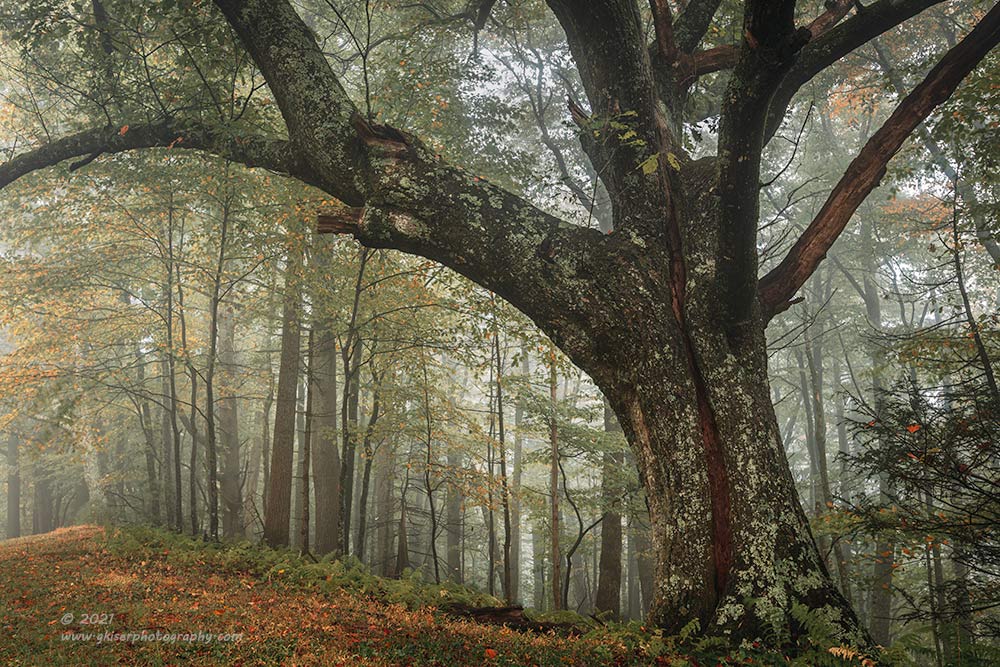
All this is to say that lens choice should be heavily rooted in understanding how you shoot, what you like to shoot, and what you are hoping to achieve with the equipment. Don’t fall for the marketing hype that says you need every superzoom that comes out. If you have no idea what you might want, just use the kit lens that comes with the camera to begin with. Get used to what those focal lengths offer in terms of composition and then start to pay attention to what focal lengths you tend to gravitate to, and then which images are your favorites. That could be two different lists in all reality. As I’ve mentioned, my favorite lens is the 24-70mm, but some of my absolute favorite images have been shot with the 16-35mm. If you just look back on my list of significant images from last year, you will see that the vast majority of the images were made with that standard lens, but the top spot, as well as the number three image were done with the wide-angle glass. Pay attention to things like that when you are selecting lenses because what you have created will tell you a lot about how you intend to capture the world.
If you find that you are constantly using the 55mm end of your 18-55mm kit lens, then chances are you don’t need to invest in the 10-22mm wide-angle because you won’t use it. However, you would probably get a lot of use out of the 55-200mm. Of course, this is all considering you are using a cropped frame camera as these are the typical lenses that would be used inexpensively with that body. If you are shooting with a full frame, the kit lens that comes with that would typically be something in the neighborhood of a 24-105mm. Again, the concept is the same. If most of your images are 24-50mm on that lens, you would do well to get the 16-35mm, or even wider options like the 14-35mm for the RF mount. That would be a logical step because you are obviously not interested in shooting much beyond that 50mm range. However, if you strive to reach beyond the 105mm end, your next lens choice should be something like a 100-400mm, or possibly a 70-200mm, but that would duplicate way too much of what the kit lens has.
These are some of the things that I will go into when talking lens choices through my mentorship program. It all comes back to how you view the world, and I really think that is an untapped consideration for photographers. If you watch YouTube enough (hey, I’m a graduate of YouTube University), you will see lots of photographers saying that this is the best lens for landscapes, and they might be talking about a 100-400mm lens. I agree that you can get some great landscape shots with that focal length, but I also know that I don’t see the landscape in quite that narrow of a view most of the time. I’ve had a 100-400mm lens, and it was great, but I rarely used it. I would much rather have the more manageable 70-200mm that pairs well with my 24-70mm and use a 2X teleconverter for those times that I need that extra umph on the long end. For me, the 100-400mm lens would not be the best landscape lens. I’m always weary of others saying that I should buy a certain lens because unless I know how they view the world, they have no idea how I would use that lens, or if I would even be able to translate my views through that particular piece of glass. As mentors, and instructors, we have to take into account the person behind the camera before we can make blanket recommendations and proclamations about what equipment is the best.
I challenge the photographers out there to really look at their photography as a whole. See what trends you can identify over the course of say the last year of shooting. Do you lean towards horizontal or vertical compositions? Do you seem to gravitate to wider angle views, or do you like a narrow view to the subject? If you shoot wide angle, do you do it in a way that still isolates a primary subject as above, or do you like to take it all in? Do you like to get in close and eliminate the actual subject in favor of a more abstract view of things? Once you get an idea of how that all pans out, consider how you view the world around you, and how you go about your day-to-day activities. Is there a connection like what I’ve proposed here, or do you go off in left field with your photography? I would be interested to know the answer because with my limited pool of experience, I’m seeing correlations in myself as well as others far too often to discount.
Thank you so much for joining me this month for another deep dive into a topic that has been rattling around in my head for some time now. I hope that I didn’t bore you with my ramblings and would be thrilled if I caused you to think about this topic beyond what I’ve mentioned here. I guess I’ve spent just long enough with photography to really start considering personal motivations behind the choices made as a photographer. I’ll see you back here in May when I go a step further and talk about my personal style as a photographer. It has changed over the years in many regards, and part of that is due to what I’ve talked about this month.

Remember to use the code KISER10 to get 10% off your purchase