Saturday, March 15, 2025
Rust is hiding everywhere…
Every good trilogy needs a tagline.
Welcome back for part two of this epic tale. If you missed the first part, you really need to read through it because it outlines exactly how this trek came to be. It was totally accidental as I had no idea that it would be this involved. There are a couple of things that come to mind after this trek which I wanted to mention before getting started here. First of all, you just never know what can be found just out of view. I’ve been to more properties than I can count where that has been the case. One of which happens to be the location of my much-anticipated decay workshop in East Bend. I originally found this property years ago when I saw an old White firetruck sitting out by a barn. There was also a shell of a hotrod on the other side of the property, but I had no idea what all was deeper in the property. I ended up talking with the owner that first day and I’ve been back more times than I can count as he has a very extensive collection of rusty cars which he lets me photograph. The vast majority of the cars aren’t visible from the street and that made for a great lesson in searching these spots out.
Something else that comes to mind is the amount of rusted cars that are out there. I remember years ago, before I really became a decay photographer, I would get excited about finding an old car in a field. It was something rare and I thought there were only a handful of those kinds of subjects left to find after government programs like “Cash for Clunkers” which purged many of the older cars. Each time I would find one, I would stop and photograph it because it was something unique. In time, I got better able to find them and started my path to becoming a decay photographer. Since that time, I have found more rusty, old cars than anyone should have been able to. I’ve worked in and around Forsyth County, and now that Toni and I live Wilkes County, I’ve been all around that area as well. I’ve probably spent an appreciable amount of time in a dozen counties looking for decay subjects.
After 15 years working from Forsyth County, and another five years out of Wilkes, I can’t help but think that I’ve started to reach the end of the list of available old cars. Sure, there will always be ones that I miss and that keeps me motivated to continue looking for them. However, the law of averages should dictate that I am reaching the end of the line. I’ve resorted to learning how to do isolations in order to allow more possibilities for the vehicles that are in settings that might not be all that great for photography. This has allowed me to shoot subjects that even a handful of years ago, I would have had to pass up. I’ve gone back and worked previous subjects many times over when they are in good areas. I will occasionally stumble on new locations that have some interesting old cars to shoot, but those are usually in rather difficult areas to deal with. For the most part, it is just dumb luck that I find these places, but I am always looking when I’m out and paying attention to the clues.
The fact that a place such as this exists that I haven’t been to yet is amazing. The fact that the last three treks that I have been on have resulted in similar types of experiences is unheard of after so many years looking for decay subjects. It really makes me wonder if I will ever run out of subjects to shoot. I mean, I’m way over my quota of good luck in finding these spots whether it be from word of mouth or just getting lost in rural areas. I just can’t begin to express how fortunate I have been as a decay photographer.
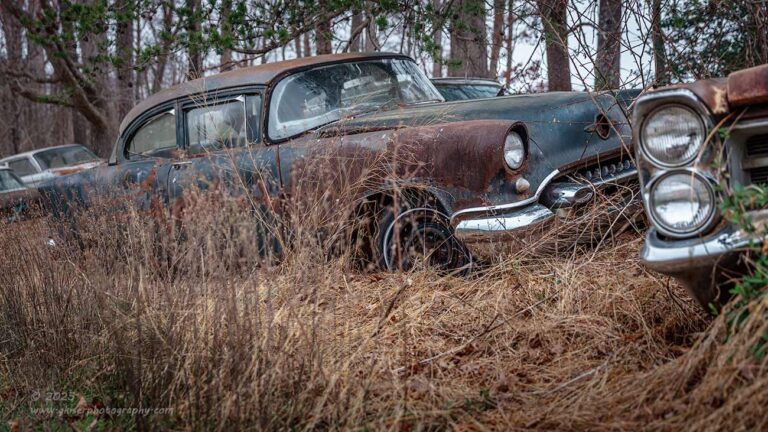
With Spring upon us now, I know that the decay photography will start to slow down because once the trees fill in and the vegetation starts to grow, it will become difficult to find these subjects and even more difficult to get in position to shoot them. I will more than likely be returning to my landscape roots before long to fill the time during the warmer months. Knowing that makes this last trek just a little sweeter. I have probably had the most luck in a single month when it comes to rusty photos right here at the close of Winter. The proof is in these last three blogs which I am now referring to as the Trilogy of Rust. It started early in the month with hail Mary shoot near Traphill, and a week later, a surprisingly fruitful trek in Hays. Here we are in the middle of another three-part blog about a visit to Alexander County, near Taylorsville.
I had started out breaking my own plan of action for the location by shooting a grand scene with two cars which didn’t really work out. I had then moved in close and shot an isolation of the Galaxie 500 which turned into my first keeper for the day. I was thinking that I had roughly two hours before the rain would start falling, and I had a lot of cars to work with. It was time to get serious, so I went down to the lower part of the property where I had seen a ’50’s Pontiac mostly by itself and partially buried in the ground. I had seen this as low hanging fruit during the tour that the property owner had given me. Now that I was looking at it closer, I was seeing some problems with the location.
The first problem was the fact that there was a car nudged right up behind the car, and there was a fence post that was right beside the door. In my haste, I didn’t notice the post until I had fired off the first frame as a test shot for the composition. You never understand how powerful the human mind is at filtering a scene until you critically look at a photo that you just shot. There were all kinds of little distractions in the shot which I hadn’t seen setting things up. This didn’t bother me though because I was completely understanding of the fact that I was working quickly. I did have to alter the composition a bit to minimize the problems. The post was a thin metal post that I just resigned myself to having to remove in post….That was not intentional, but the post thing was quite funny. I shot a couple of more frames like this and thought that I had something good with a little divot in the ground making a great leading line to the car. However, the composition just didn’t work well at all when I got home, so I’m glad that I didn’t spend too much time with it.
The key with this car was going to be in the isolations. The bumper caught my eye mostly because of how it was partially sunk in the ground. I had the 24-70mm lens on which would allow me a nice wide-angle view of the front end which I took advantage of. I captured the leading edge of the hood with the emblems and ornament, along with the partial front bumper. I liked it a lot and decided that I could cut in even tighter to eliminate the headlight buckets for a more abstract view. This didn’t work as well when I saw it on the computer though. I also did a quarter shot to showcase the bumper in a different way thinking that was going to be a winner. This is usually a very successful composition, so I did a couple of versions of that one. As it turned out, it was the first image that worked the best capturing the entire front of the car. I ended up doing it in black and white to further simplify the scene down to the shapes that I was interested in.
The driver’s door was partially opened on the car which allowed me a view into the passenger area. I composed a shot around that idea, but I had to get much too close because of how the landscape worked right there. This turned out to be an awkward composition and I didn’t spend any time with it at all. There was a Chevrolet near the Pontiac that I decided to turn my attention to. It was well in the brush, but it had a presence that the Pontiac just didn’t have. I ended up spending a bit of time to create a workable composition and shot two frames of. The latter one turned into the next keeper. It was done in black and white to reduce the complexity of the scene since there was already a lot of vines over the car. By stripping the color, I was able to concentrate on the shape of the car which was more visible now.

As I was looking at the Chevy, I happened to notice that the fenders had the portholes that I usually attribute to a Buick. There might have been some merging of makes with this car, but I did like the trim at the tops of the fenders. Since I had an opening by the passenger side, I got in close for a detail shot of the trim and the hood hinge. I tried a couple of different variations so that I had the right composition with the right balance when I got home. I actually came back to this later in the day but felt that one of the earlier ones worked out the best of all the attempts.
Not wanting to waste the trip through the briars, I turned my attention to a 40’s Pontiac that was nearby, also well in the woods. I picked out the large emblem on the trunk lid for a composition and tried to work something out with that. Experience has taught me that this should have been an easy composition to make, but the reality was I was having a hard time finding the right combination of elements to include. Everything that I did, looked boring. The one frame that I shot was the strongest of all ideas that I had, but in the end, it was eliminated after the first round of culling. I did really like the rear end on this car, so I decided to look for other options. I had room to work on the driver’s side which was where I started to work through what was available to me.
To show off the roundness of the rear (I realize how that sounds, but there was a lot of junk in that trunk), I started to formulate a composition from the rear quarter that anchored on the chrome trim under the gas lid. The more I worked on the composition, the more I liked what I was seeing. My biggest problem was dealing with the cars in the background which were partially visible through the trees. When I finally landed on the composition that I thought worked, I snapped a single frame and checked it for problems. It was just as I had hoped and there was no reason to go any further with this shot.
By this point, I was ready to get out of the woods and start looking at some of the other subjects along the wood line. I managed to claw my way out of the briars to get back to the open field. Then it was a matter of working up the hill and looking for something that was begging for a photograph to be taken. The first car that I found which fit that bill was a Bonneville which was parked close to other cars, but the front of the car was open enough for a shot.
I looked at how the front of the car was laid out and decided that I wanted to get the nameplate which was fastened into the grill on the driver’s side near the headlight. It didn’t take me long to figure out the right composition for this shot because headlights are kind of my thing. I shot three frames here to get the depth of field right along with the focus point. It was the second of those which turned out to be the winner.
That was pretty much all that I could think to do with the Bonneville, so I decided to go up the hill a little bit further. I was really looking for an overall photo of a car and where I was standing, there were no alternatives for that. It wasn’t that I disliked the isolations, but there were several cars that I thought would make great compositions if I could find backgrounds that worked for them. One such vehicle was a tow truck that was perched atop the hill. This is one that the owner told me about as we were going around looking at the cars. It had been parked out on the road for a while until it was hit by a drunk driver. The plan had been to make it into a Tow-Mater with a little artwork on it. The idea came from any kids that came by would want their photos taken while sitting on the hood. After it was hit, the truck was pulled back here to get it into safety. I actually liked the damage on the side where the hit had happened. It created a good deal of personality for this truck.
Because of how featureless the clouds were, I had to angle myself so that the trees were in the background. The problem with that was there was a bright green Bobcat sitting on the front left quarter of the truck. This forced me to use a very shallow angle off of the front so that I could leave the equipment out of the frame. This left some cars and a trailer in the background of the truck. This forced me to get very low with the composition, but I still wasn’t able to get the background below the ridge. I had to embrace some of the background clutter and did so with the use of a narrower depth of field.
There were three attempts at getting this composition right, and after all of that, I had decided that I didn’t want any of them in favor of one that I shot later in the day. When I was showing Toni the 28 photos that I had pulled to process, I came to this one and said that I had decided against finishing it. She didn’t really understand why I didn’t want to finish the photo and made some compelling arguments as to why this one, while not as strong as the later composition, had merit of its own. Before calling it a night, I had started an edit on it and found that it did work well for all the reasons that Toni had mentioned. Once again, the Photo Wench came through and saved me from making a mistake by tossing a perfectly good photo.
While working on the photos for the tow truck, I decided to move in for an isolation shot of an emblem on the hood. This emblem was framed by a fallen branch and that added a bit of interest for me. I shot two variations before moving on. Sadly, neither composition felt balanced and there was nothing that I could do in post to change the balance of the image. Had I stuck with the concept longer, I would have probably been able to work something out, however, as I have mentioned, I was working fast to stay ahead of the weather that was supposedly moving in. A quick look at my watch and I found that it was nearly 1pm, an hour away from the forecasted rainfall. Because of that, I didn’t bother working this isolation any longer.
I did notice that the clouds were starting to get a little bit of detail in them, so I changed gears and moved to the other side of the truck from what I had shot to begin with. This opened up the sky as a background and there were fewer distractions in this direction. I had to add a grad filter to the lens to bring the sky down a touch which worked well enough. This was a composition that I committed to and stuck with for a little bit of time. I ended up shooting a total of six frames as the clouds moved around. Eventually, I figured out that I had what I would want, and the sky wasn’t going to get any better. I didn’t have a lot of time to waste on any one composition anyway, so it was time to move on.
The next subject that caught my eyes was a Chevy station wagon close by. I loved the ’60’s lines of this car and figured that it would be easy to pick out a composition that showcased those lines. It was harder than I suspected largely because the chrome trim was missing, and the rust had eaten a lot of the important metal where I would need it. There was still something about the style of this car though, so I kept at it. Eventually, I found a composition that was through the driver’s window into the dash area. The chrome trim around the door and windshield made for a really nice set of curves through the frame which created a frame for the dash. The missing steering wheel made it very easy to compose around the instruments which became the focus of the composition. I only had to fire off two frames with slight changes to the depth of field. That was all that it took, and the second one turned into the keeper after a conversion to black and white.
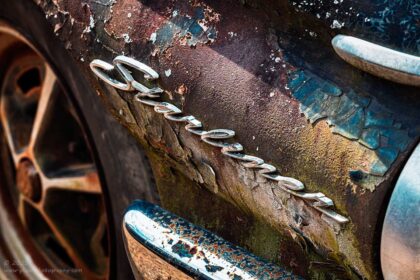
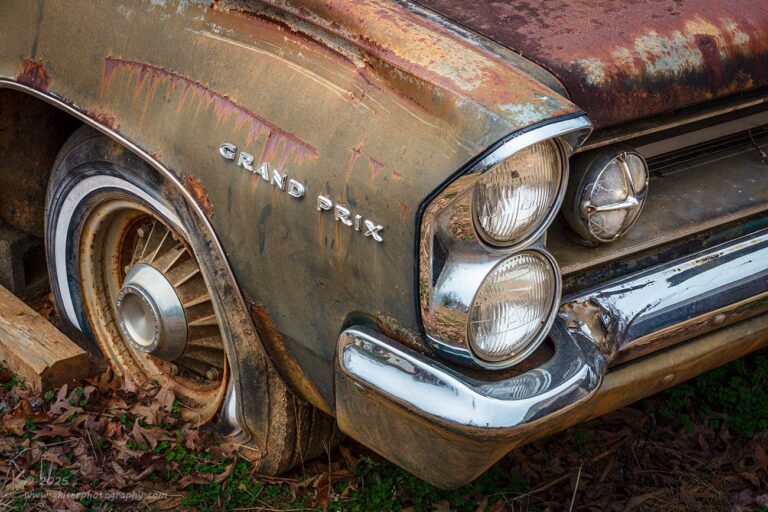
A little further up the hill from the wagon was a Pontiac Grand Prix which was slightly nosed out from the crowd. It had the iconic over/under lights that Pontiac used in the ’60s which captured my attention right away. I noticed that the fender nameplate was missing some letters which was not ideal, but it did help to establish the story of the car. There were enough letters remaining to easily identify the car, so I started to form up a composition around that corner.
One of the obstacles that I had to deal with was the tall weeds that were around the front of the car. It would have been easy enough to elevate the camera and shoot over them, but I decided to do something a little different with this subject. I dropped the camera lower and got right up on the brush. With a considered approach to the depth of field, I used the weeds as a bit of blurred foreground to help introduce the car and tell part of the story. The biggest consideration was that I didn’t have anything significantly blocking an important part of the car, which wasn’t too bad to accomplish.
Feeling rather accomplished for including the weeds in the composition with the Grand Prix, I decided to try and use that same corner element with the Oldsmobile that was parked off to the side perpendicular to the Pontiac. This felt like a very odd composition when I was setting it up. The idea was something that I had not really done before and included positioning the headlight of the Pontiac in roughly the same spot where the far headlight would be on the Oldsmobile. It was a way of linking both vehicles and having the portion of the Pontiac make sense. The reason that I was doing this was because of how closely the cars were parked to one another. In order to get a full shot of the Oldsmobile with an emphasis on the bumper and grill, I was going to have to accept how close the Pontiac was.
This was another one of those shots that I didn’t like as much as I had hoped. I had decided not to process it in favor of the next composition that I shot of the Olds. This one was a bit safter and relied on the wide end of my standard zoom to shoot past the Pontiac and capture the entire Olds all by itself. This composition was actually easier than I had suspected at first. Had I known that I would have been able to thread that needle, I probably wouldn’t have tried the overlapping headlight approach. However, when looking through the 28 potential keepers, Toni really liked the one with the Pontiac headlights in the foreground. She offered up reasons why I needed to keep that one in the collection in a similar way that she had with the tow truck shot. At the end of the processing, I pulled it in and tried a letterbox crop on it which made the composition make so much more sense. With that, I was off and running with the processing and ultimately to add one more keeper to the collection.
It was now about 1:30 and it was looking more and more like rain. The overcast had been replaced with darker clouds and while the mist had stopped some time before, I had a feeling that actual raindrops were on their way soon. Not wanting to miss out on the cars that I had originally seen closer to the road, I made an executive decision to take my gear back out there. When I had asked the owner about any of the cars that he was connected to above the others, he mentioned the big blue Pontiac at the front of the building. Sadly, it was parked next to a Nissan Sentra and a Ford Fiesta which eliminated any full-length compositions. I did want to do something with it before I left, and had already thought about doing an intimate composition around the grill badging since the motor had made it special and significant in his history with the car.
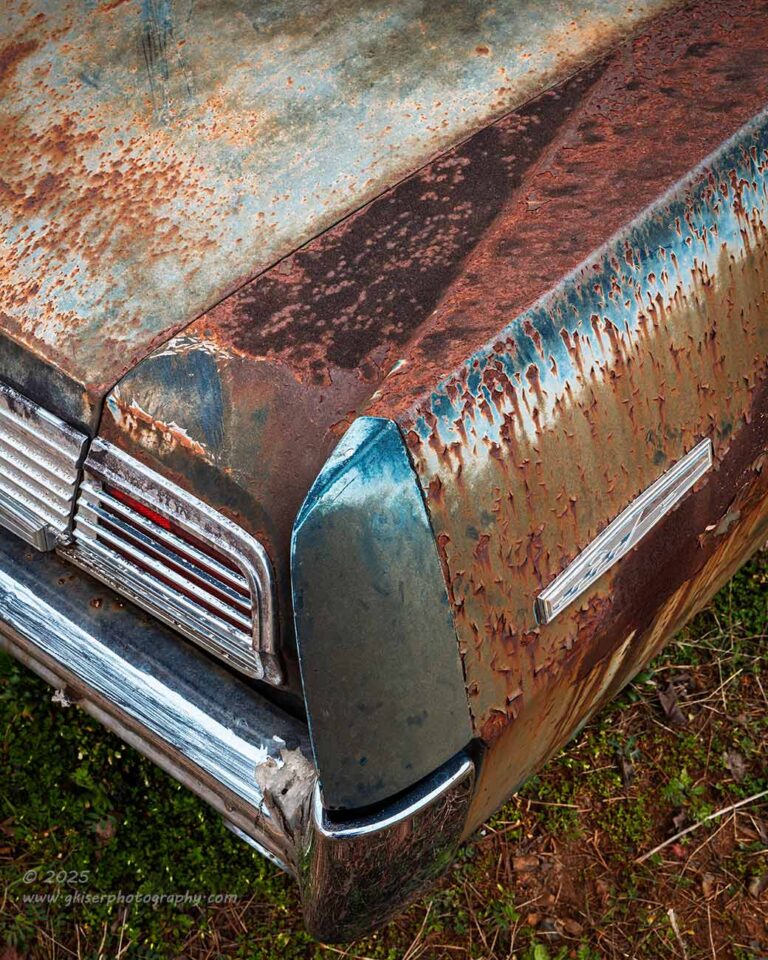
Before I got to that car though, I stopped at the one Grand Prix that was kind of off by itself from the building. I say by itself because there were no other cars around it. However, there was a boat, a tire, and a trailer nearby covering the better angles to shoot the car from. There was also a Mercedes Benz travel box on top of the car. For me, all of these clues said that I was going to need to look for isolations with this one. One of the first areas that caught my attention was the rear quarter, though it wasn’t for the shape of the taillight which is usually what draws me in. The taillight was actually encased in chrome which prevented much of it from being seen unless viewed from directly behind it. It was the patina that really caught my attention, and the more I looked, I found lines that really intrigued me. On top of the quarter panel, there was a very strong diagonal line that ran from the trunk to the subtle fin at the corner. This diagonal was the perfect design attribute for a photograph. I got the camera up really high for a top-down look at the quarter panel and the shapes that I was seeing. It took me only a little bit of time to figure out the composition and the right camera placement before I shot a single frame. There wasn’t much that could have gone wrong with this shot because nothing was moving, the light was steady, and I had fussed with the composition for several minutes at this point. The one shot was plenty for this, and I felt that it the concept was any good, this photo would nail it.
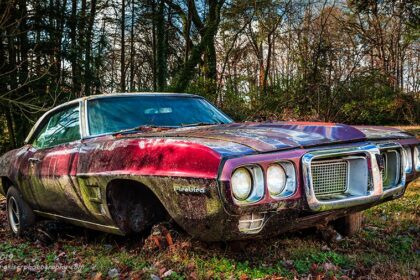
Feeling really good about the rear area of the car, I moved around to the front of the Pontiac for another one of my ideas from when I first saw the car. It was the predictable quarter shot, but I really liked the fact that the lettering was all here and the lights were there in totality. The patina on the car was perfect as well. This all added up to enough of a reason to reshoot this composition even though I have done it with tons of cars in the past. I also knew that I haven’t photographed that many Pontiacs over the years, so that makes this one a little bit of a standout just for that reason.
An interesting point about this photo, we have the Photo Wench to thank for the title of it. When she saw the processed version of the shot, she immediately said that it looked like it should be called “Scarface.” I thought that was quite fitting for this one with the long scar along the fender which looked to be dripping blood. Maybe it was the fact that it was getting late in the evening, and I had been listening to Five Finger Death Punch for around five hours straight as I was going through the photos. Whatever the case, the title stuck and I’m happy with it.
Something else worth mentioning at this point is that we are caught up with the photos. I knew that the early ones were done kind of quick which was why I just went through their details in this blog rather than overly lengthen the first entry. The breakneck pace was pretty well over at this point as I was coming to the end of the cars, and the rain was still holding off. For the remainder of this blog entry, I will be shooting the scenes that I had visualized when I had first found the location. This put me in a more relaxed state because as simple as these scenes are, they are what I had anticipated for this location. I was no longer running around like a chicken with their head cut off. I do much prefer working at this pace and being able to consider every photograph.
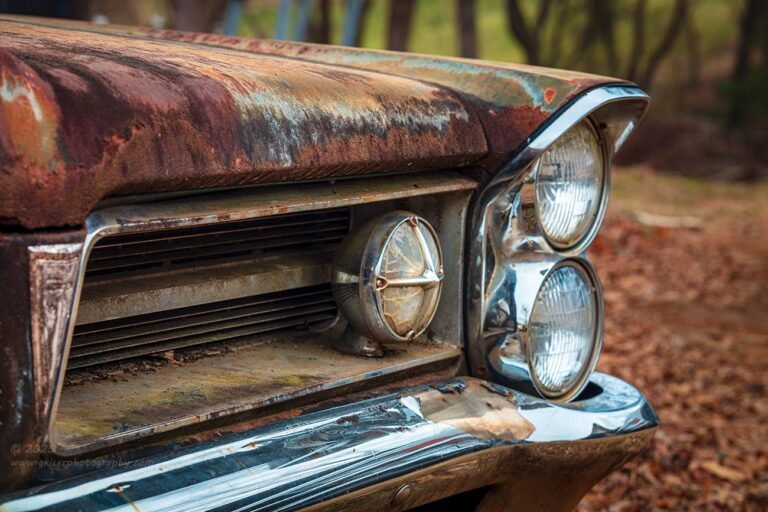
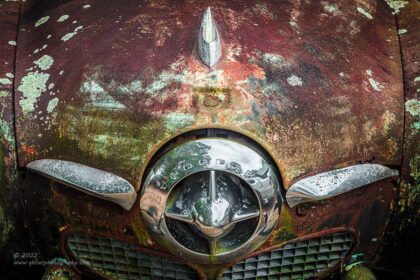
It was the patina on this Pontiac that had grabbed my attention originally, and I wanted to get some photos with that featured. I’ve found that one of the best ways to make patina pop is to include chrome in the frame. It gives a great contrasting element to the rusty tones both in the cooler blue tones as well as the smooth texture. This Grand Prix still had a good bit of chrome visible on the front of the car and that was what I wanted to use in contrast to the hood which was showing some very good patina and rust. I just didn’t want to compose the same type of image where I grabbed the corner of the car and featured the headlight. This car deserved more than that, and I set out to work a composition that made sense.
Pulling from what I had done with the Bonneville, I decided to shoot across the front end to really accentuate the dual headlights at the edge of the car, rather than in the middle of the composition. Since the grill was divided into two sections, I chose to use the center portion with the Pontiac emblem to frame the rest of the composition and provide a bit of foreground interest. Everything else would lead the eyes to the headlights which was what I wanted to be the focal point of the shot.
Because I had a lot of background beyond the car, I wanted to keep the attention on the car. The best way to do that was to limit the depth of field. This became kind of tricky with the distances involved and shooting with a telephoto lens. That lens had been swapped in for the express purpose of keeping me out of the reflections now that I was working with some very reflective chrome. It was working like a champ too with the results being no cameos in any of the photos shot during the day while using it. It did make the depth of field a little more tricky to work with though, so there was a lot of playing around with the focus point and aperture settings to get the right balance.
What ended up working the best was having an aperture of f/8 focused just inside of the marker light. This kept the lights in focus well enough, while the background went soft rather quickly. The tradeoff was that the Pontiac emblem was now a little softer than I might would have wanted it. I could have dialed in f/11 and focused in closer to me to have rendered the entire grill in focus, but the background would have been a little sharper which I didn’t want. Also, the emblem was kind of dingy which affected the details on it. Had I made that in focus, I think it would have become a distraction to the real focal point as folks spent too much time trying to make out the details. Having it soft, gave enough information as to what it was, but not so much as to demand attention. I think that this compromise worked out very well for this photo.

The other Grand Prix that was by the building was a yellow car, which I think is a year or two newer. It was parked under a shelter portion of the building next to a collection of tires. There was also some yard equipment positioned behind the car and a canoe off to the side. It was not an easy car to photograph with any intention of showing the entire car. I did think that it was worth giving it some attention and I kind of liked how it lined up with the windows on the building and the tires off to the side.
With the long lens still attached, I knew I could get some compression that might help simplify the background a bit. With that in mind, I backed away from the shelter and started to work out a composition that made sense. The most interesting bit of the car was the nose of it, and I liked the yellow color when matched with the cooler tones of the block wall. As there was no way to get the side of the car in the shot without including a bunch of extraneous elements, I chose to crop the car right behind the wheel well. This put the edge going through the side windows, but it allowed the full windshield to be in the composition. I kept a good portion of the opposite wall for that color balance and used the stairs going up to the upper level as a diagonal element cutting through the background. By limiting the depth of field, I kept the attention on the front of the car while establishing a sense of place. As a convenient element, there was a Pontiac vanity tag on the front of the car which still had some nice blue tones present. The blue of the tag helped to bring overall balance to the colors seen in the frame and drew more attention to the concrete blocks.
I actually wish that I had been able to do more with the building here. As I found out later on, this used to be a parts store with a garage on the ground level. The owner sold all kinds of parts for cars and would do the repairs onsite for the customers. It had the distinction of being the last parts house in the area that wasn’t a chain distributor like Advance Auto, or O’Reilly. I do enjoy that kind of history, but the image takes priority and if the composition isn’t there, I don’t force the shot. This was the best way to get the building captured under the current conditions.
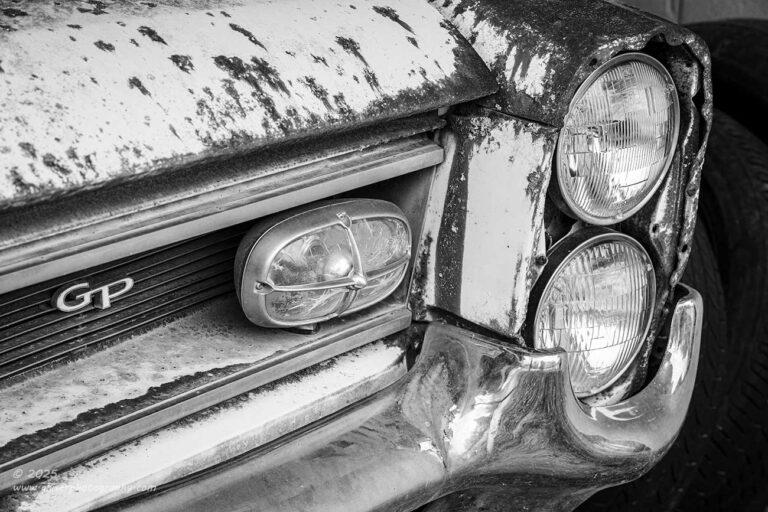
That didn’t mean that I had to capture the building with every shot I made out here. Actually, I had plans to do a lot more with the Pontiac sitting in the shelter of the building. One of the little details that I noticed while getting the last shot set up was the grill emblem on the driver’s side. It was just a simple “GP” for Grand Prix and I really liked the understated nature of the emblem. Of course, right next to that emblem was the marker light which was flanked by the over/under headlights that were so iconic for the Pontiacs of this era. With those little details, I was well on my way to capturing another composition of this yellow car.
I decided to go with something similar to what I had done with the Bonneville earlier to showcase that nameplate. Since the badge was so small in the grille, I didn’t want it to get lost by including the nose of the grill. I just cut into the scene a bit further and let the GP become the foreground. The trio of lights became the visual anchor with the rusted bits forming a bit of interest along the frame. Because the car was a pale yellow, the bright chrome didn’t really provide that much contrast to the scene, so I decided when I was photographing the car that it was probably going to be done in black and white. When I got it home and looked at it, there was no reason to second guess my earlier thoughts on this one as the balance of colors was just way off. By stripping the color, things made much more sense in the frame.
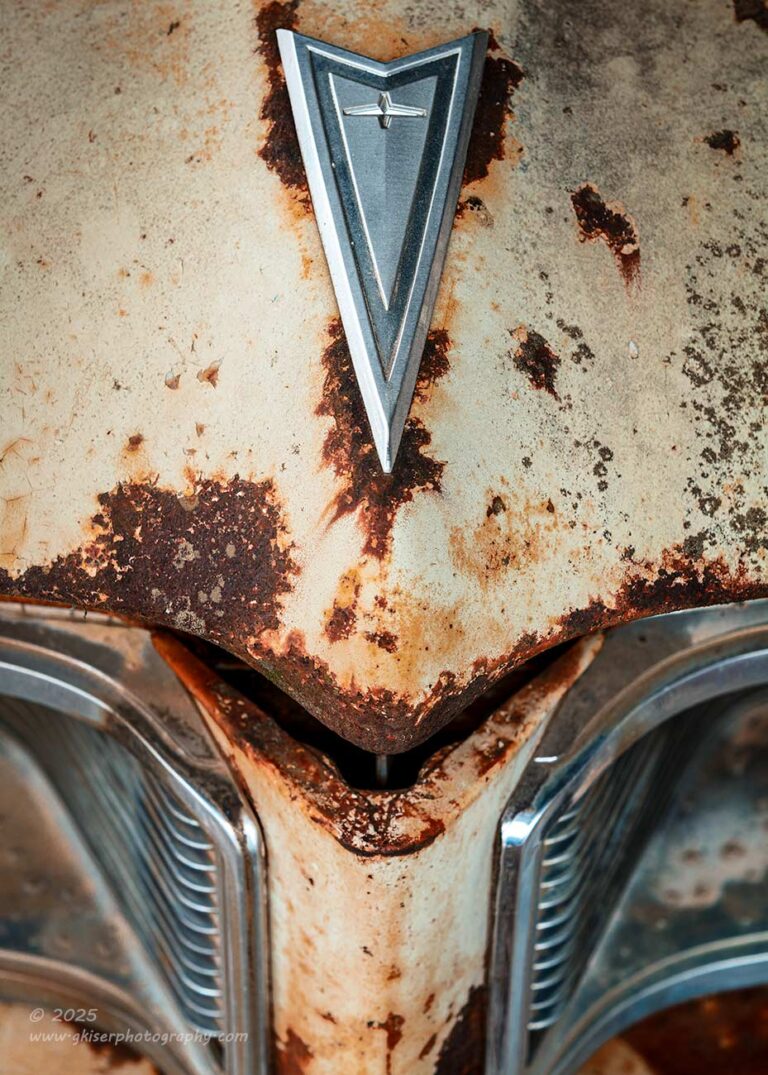
I was feeling like I needed to do something with the nose section of the grill and bumper though. The Pontiac emblem was on the hood with this car which made it slightly different than the other Grand Prix parked to the rear. This provided a different opportunity for a composition. I wanted to do something very simple with the dart but as I started to move the camera into position, I could tell that it was too close to the edge of the hood to get a simple isolation. However, by looking through the viewfinder I was getting the benefit of seeing the scene through f/2.8 on the lens. As I moved around looking for that isolation, I saw how the grill turned into nostrils below the emblem and the blur that was created due to the focus being on the emblem looked really cool. I extended the legs of the tripod and started to work out a composition that featured what I had just seen through the lens.
My first attempt was a horizontal frame which cut the Pontiac dart about in half to just leave a triangle at the top of the frame. The rest of the fame was equal sections of both sides of the grill. I liked it, but it felt strange cutting the main emblem like I was. I was going for an abstract shot, so it wasn’t really a problem to render the emblem as just a triangle shape. I did open up the field of view in an attempt to get all of the emblem in, but that started to look very boring, very quickly.
Seeing what was wrong with that framing, I flipped the camera to a vertical orientation and started to frame up another version of the composition. This time, I was able to include the entire emblem and the sides of the nose of the bumper for the shapes that I was after. This seemed to work out quite well and I liked it on the back of the camera. I just didn’t know if I would like it better than the more abstract view that I had just shot.
Here we go with another Toni sidebar for the time I was showing her the images that I was currently processing. The first one that I came to from these two which both passed muster during the culling process happened to be the horizontal shot. When I landed on it, I told her that I had decided not to process that one because the next one was better. She told me that she thought it looked cool and that I should reconsider my choice to discard it. As I’ve mentioned several times already, she has been right on the money with her objections to me tossing images, so I really considered going back to it and doing a full edit. Not wanting to keep her tied up downstairs longer than necessary to show her the photos, I moved onto the next one which happened to be this vertical composition of the car.
When she saw that one pop up on the screen, I got an immediate “OOOOH, I like that one a lot better!” Now I was able to accurately express why I had opted to toss the first attempt. Having seen both versions, she agreed with me and that sealed the fate for the horizontal composition. There is something to having a person looking behind me at the photos that I want to keep, and it is especially beneficial when that person doesn’t have the same connection to the subject matter as I do. In this household, she loves the landscapes more than I do, and I enjoy the decay photos more than she does. This doesn’t mean that she is not a good judge of a good decay photo though. Actually, it makes her a better judge because she is not interested in the actual subject, just the way the photo looks. My judgement gets clouded both with my connection with the subject and why I was drawn to photograph it, as well as my investment in time with an image. Toni gets to look at it as an individual piece of work and will judge it based on just that. I put a lot of faith in her opinions, especially when I am not convinced either way that a photo works. This is what makes her the perfect Photo Wench.
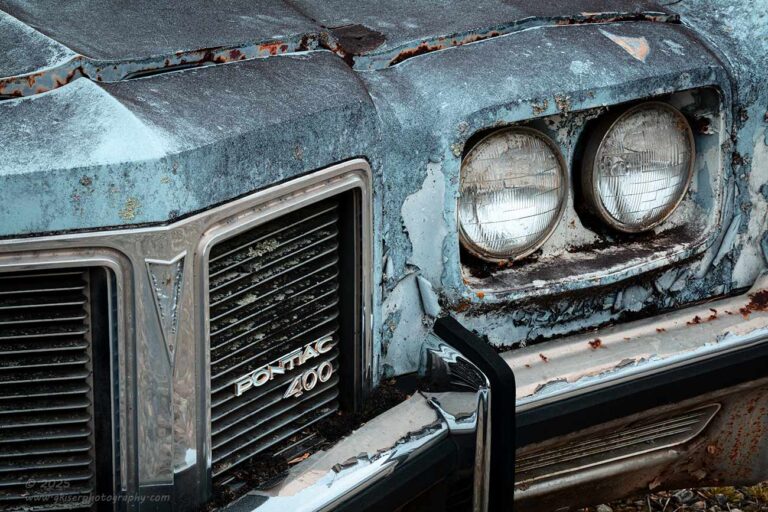
By this point in the day, I had been shooting photos for right at two hours and had been at the property for about two and a half hours. It was now time for the rain to start falling, and there was one more car that I wanted to photograph. It was the last of the Pontiacs by the building. This was the one that was special to Robbie, the owner and I wanted to get at least one photo of this car. Fortunately, he had given me a bit of the history of it, and I knew the importance of the 400 cu in motor that was under the hood and how it had a significant meaning to his memories of the car. It also fit in with a compositional idea that I had started to think of when I first saw the car.
While the car itself wasn’t a looker like the others that I usually photograph, the bold styling of the front end did interest me. It was no real loss that I wasn’t able to capture the whole car due to the Ford and Nissan parked on either side, but I did want to capture something special with it. That meant that I was going to have to look at isolations that might capture the soul of the car. I went right to that grill emblem that unapologetically identified the mill that resided behind the grill. I started to look at the way all the lines came together and found that even the missing Pontiac emblem between the grill openings left enough of a print to identify this car. The headlights had a very unique look to them as they were housed deep inside of a sculpted recess in the bumper fascia. These were the things that I wanted to capture, and I started framing up the composition to do just that.
I didn’t like the shot straight on as it was rather boring. I did find that by moving off to the passenger side, much like I had done with a couple of the other Pontiacs here, the composition got markedly better. The angle put the Pontiac emblem on a diagonal line leading up to the headlights. By having the headlights in the upper part of the frame, the little vent beneath the lights on the bumper started to fill the area under the molding which made for the perfect balancing element for the composition. It all came together very quickly at that point, and I shot a couple of frames to make sure that I had the focus and depth of field right.
I felt really good about this shot but wanted to try one more to highlight the flaking paint and moss on the fender. I just switched sides and did a standard quarter shot from outside. This worked out well and I liked the image on the back of the camera. I shot two variations of the composition and felt confident that I had it. When I got the image home, one of them made it through the first round of culling, but that was as far as it got. The composition was just too boring. I loved the textures of the fender, but that was where my interest stopped. The design of the car just wasn’t doing it any favors from this angle. The one from the opposite side worked so much better which is why you see that as the keeper here.
I kind of felt like I was done at this point. I had been all through the property and had shot a total of 69 frames (of which you have seen 17 keepers). The rain was still holding off, but I wasn’t sure for how long. I had accomplished so much more here than I had ever anticipated. There was no doubt about it, I was quite happy with how things had gone. However, I knew that I had rushed through a large portion of the day fearing getting rained out. Now that I was finished with seeing everything, I felt like another walk through would be beneficial. I would hate to miss something during my earlier rush that I had an opportunity to correct but didn’t. It wouldn’t take me long and there shouldn’t be but maybe a few photos that I would want to grab at this point.
You will have to wait for the next entry to see how that turned out. For now, my fingers are tired of typing. In full disclosure, I have finished this entry right on the tail of the first part. I’ve been typing for eight hours straight at this point. That came after a couple of hours of finalizing the edits from the night before. I need to get up and stretch a little bit and get something to eat. I might come back down and start part 3 before the night is up, but I’m happy to have this second part ready for publication first thing on Monday morning.
I’ll see you back here tomorrow with the conclusion of the day.