Sunday, March 9, 2025
I remember a while back writing a Behind the Camera entry where I talked about being a seasonal photographer. I made mention about how the winter was a time when most photographers put their gear in a closet and snuggled up under an electric blanket for a few months. I also said that winter was probably my favorite season for photography, especially when it came to my decay subjects. As you look back on the past winter season, you will see that I have been absolutely rolling with treks and photos. It all started after a pretty lengthy creative slump that only started to ease up in the fall. By the time winter happened, I was producing images at a very fast rate. In fact, as of right now, I have roughly 200 photographs in a backlog for posting to social media while during the early fall, I was down to something like 30 waiting to be posted. I only post one image a day, so I’m able to bank photos when I am shooting like I am now for those slow times like over the past summer.
I’ve also talked recently about my luck with the Northeastern part of the County around the Traphill area. I’m starting to inclue the Hays area along with that because I really don’t know the division point between them, and both communities have really shown out in terms of great decay subjects over the years. Shortly after moving into Wilkes County in 2020, I have found that once I get started working in that area, I keep getting drawn back in by tips, or little clues that I have seen. I can go out there for a single photo of a subject and end up getting leads on two other places. By the time I scout those places out, I will have seen three other subjects that I want to photograph. Each of those locations will likely result in some more tips and then the social media attention starts to come into play with even more tips about places that I haven’t been.
I started this routine recently with a visit to a location that I have been trying to get permission to shoot since Toni and I moved out this way. That was just a little over a month ago, and that trek resulted in a lead which I finally just got finished blogging about. In the meantime, I stumbled across a great little property that brought some wonderful photos to my collection. Of course, we can’t forget about finding a barn with an old Ford out front that I had shot before, but forgot where it was. I might be forgetting about a couple of locations, but you get the idea here. Once I start going out there, I am usually hot and heavy for a while until the leads turn cold, but I always end up back out there for a repeat performance.
The trek that I am going to talk about today actually started a while back when I was given a tip about a few old Tri-5 Chevys parked well off of the roadway. This tip came from a friend through Facebook who has turned me onto many great locations over the years. It was actually just about a year ago that I had gone and shot those cars, but when I was originally scouting out the location and looking to get permission to enter the property, I spotted several old cars in a makeshift junkyard of sorts. It was situated behind a house that I thought was the residence of the property owners.

Over the course of the next year with at least a half dozen visits, I would go and knock on the door to the house in hopes of finding someone at home that I could ask for permission. Each time, nobody came to the door, but I was always greeted by some pretty serious barking from inside the house. I had kind of lost hope during the summer and didn’t do much more about it until the late fall when I started again. There was never any luck at the house and each time I drove by this location I paused and tried to convince myself that it wasn’t really worth my time. The cars were kind of jumbled and most were under tarps. I could rattle off a long list of excuses, but the fact of the matter was I was trying to make it ok that I wasn’t getting the permission that I needed to get onto the property.
Now that I was back in the area again in earnest, I have been checking on the property each time I was in the area. On my last visit through, I decided to talk with the neighbor across the street. After a brief conversation, I found out that the house that I had been visiting was not the property owner’s house as I had thought. The property that I was wanting access to belonged to a gentleman that didn’t live in any of the houses nearby. She knew him and said that she would try and talk with him the next time she saw him in order to get him in touch with me. It didn’t happen that afternoon as she had hoped, and I still haven’t heard back from her.
When I saw that the clouds were going to be favorable for Sunday morning, I debated going back out there and talking with her again to see if maybe she had any more information for me. It was a longshot, and I didn’t want to rush her to talk with the owner, but it was looking like a good weather day for shooting that property. Since I had started to see some light in my hunt for permission, it was right at the front of my mind, so I needed to get something resolved with it in order to move onto something else. I also didn’t want to miss out on the winter scenery around these cars as green foliage might not look as good as what was there for the time being.

Toni and I went to sleep a little early Saturday night because we were losing an hour of sleep, and I wanted to get up in time to evaluate the weather knowing that I was probably only going to have until noon to shoot until the sun came out again. I kind of woke up shortly after she left for work at 5:45 and looked at the weather. The weather app was showing clear skies currently, but 30-50% cloud cover from 8am until noon with a slight chance of rain. My cloud app was showing 100% cloud cover through noon, and no rain chance at all. My goal was to be on the road by 8:30 so I could be there by nine and hopefully have three hours to shoot. I eventually got up around 7am and started going through my morning routine while continually checking the weather. Surprisingly there were some chances of snowfall coming into the forecast from 9-10am. This was new and only showed up on the future radar.
When 8:30 rolled around, I wasn’t convinced that the weather was going to hold. I was getting a lot of conflicting reports, but they were all showing that the sky was going to clear up around noon, which meant that I had time for one location, and I had no alternates in the area which meant that it was a one chance affair for this trek. If I didn’t get permission, I would likely run out of good light before I found anything else to shoot.
Normally, I would have just stayed at home and done some marketing and started getting ready for my next workshop in North Wilkesboro in a bit less than a month, but after making some significant headway on the location in Hays the last time I was out, I really wanted to follow up with the neighbor and hopefully get the permission that I needed. With nothing else pressing to do, I decided to throw on some shoes and load the camera up in the truck. When I rolled out of the garage, I half expected to see snow falling on my windshield, but there wasn’t anything at all falling from the sky. This was the first positive sign for the day.

The trip to the location took a little less time than I had expected for some reason, but that was good since I was a little later leaving the house than I had planned originally. The light was looking really good when I arrived, and I pulled slowly down the road to look at the landscape once again before I stopped to bother anyone. I hate to waste an ask and if for whatever reason I didn’t think that a shoot was a good idea, I would have abandoned at this point. There was no denying that the light was great, and the cars were looking pretty much like I remembered except there was a rollback blocking a couple of the cars that I had not seen before. It was not worth giving the location up though.
As I was looking at the cars, I saw movement at the house next door that I had never been able to catch anyone at home. I drove over there and pulled in the driveway to find two people and two dogs at the outbuilding. I stopped a reasonable distance away and got out of the truck not quite sure what the dogs were going to go. I introduced myself and explained why I was there, and how many times I had tried to catch someone there. I confirmed that they didn’t own the property behind them and then asked if they could get in touch with the owner. He was happy to call him and talked with him briefly and explained what I was asking. I ended up talking with the owner on the phone and really enjoyed the quick chat. The end result was I was allowed to access the property to photograph the cars which was all I had been hoping for over the past year.
Now that I had permission, I got the truck parked on the side of the lot and grabbed my camera and tripod. I started walking around the cars for the first time to really get a feeling for what I had to work with. It was both better and worse than I had thought. There were a lot more old cars here than I had imagined, and there were some really great examples of cars that I have not been able to photograph before. However, many of the cars were missing significant portions of the body, and they were packed in kind of tight in most situations. It wasn’t going to be an easy session by any stretch, but I felt really good after doing all the isolations a few days ago. It was looking like that was going to be the theme of the day here as well.
I went ahead and pulled out the camera with the telephoto lens attached figuring that would be best for the isolations. I started to look around to see what I wanted to photograph first. There was an early 60’s Impala by the wood line that was separated from the other cars enough that I might be able to get a full on shot of it. Knowing that I had the right lens for that opportunity, I started to set up the composition.
By using the telephoto, I was able to minimize the background and crop in closer to the car in order to avoid the other cars to the front and rear. I tried both vertical and horizontal compositions, but they both felt like snapshots because of the angle I was forced to photograph from. It wasn’t a great start, but I was at least starting to make exposures. I did move in closer and decided to get a front clip shot of the car because I noticed that there was a small bit of greenery that was growing out from the grill and from under the hood. It was this feature that made the car more unique and added much more character than the overall shot had captured.
This one felt much stronger in terms of composition, and I was pretty sure that I had the first one in the can for the day. Building on that concept, I moved in closer and composed an even tighter composition around the greenery. This one focused on the grill badge that identified the car and would tell the story of the rest of the subject even though only a bit of it was seen in the photo. I wasn’t quite sure which of these I was going to like the most, but I was happy with them both in the field.
When I got home and started to look at the images, I opted to edit the closest composition as the keeper of the bunch. It was only on the last run through of the RAW images that I chose to pull the front clip shot into the Develop Module and see what I could come up with. By using a different color profile, I was able to capture a different sort of mood with the colors and decided to move forward with the edit on it. By the time I was finished, I liked it just as much as the closer composition and they both turned into keepers. The overall shot of the car never made it past the second round of culling because it was just too static and lacked visual interest.
Not wanting to stay with the Impala any longer, I moved my attention to a Chevelle which I found more visually appealing anyway. From the angle that I was standing, I thought that it might just be possible to get an overall shot of the car even though there was a rollback parked really close to the side of it. I moved back to give the telephoto lens room to breathe and tried to get a composition set up. I ended up getting part of the car in front of the Chevelle because of the lens choice. It was time to swap lenses to something a bit wider.
Now that I had the standard zoom attached, I moved in closer to avoid the one car and started to frame up the Chevelle. Sadly, the car behind the Chevelle turned into a distraction that I didn’t like. I still liked the angle and the idea of getting the overall shot, but the composition was too complex like this. Since there was a tarp pulled off to the side of the car, I decided to crop into the rear and use the tarp as a framing element in the composition. This worked very well and gave me the overall look that I was after without the distraction of the car behind the Chevelle.
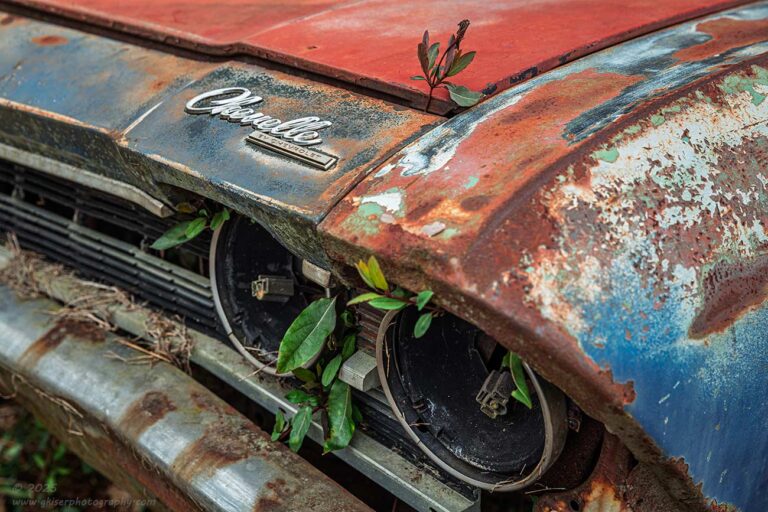
Of course, now that my attention was on the Chevelle, I was interested in getting some isolations of it. With the current light, the part that looked the best was the front corner with the Chevelle nameplate and those iconic headlights from 1969. Well, I suppose I should say the headlight sockets. What I loved best about this shot, even more than the greenery growing out from the cracks, was the different colors that could be seen in the body panels. There was a great mix of warm and cool shades that gave a perfect balance in terms of colors.

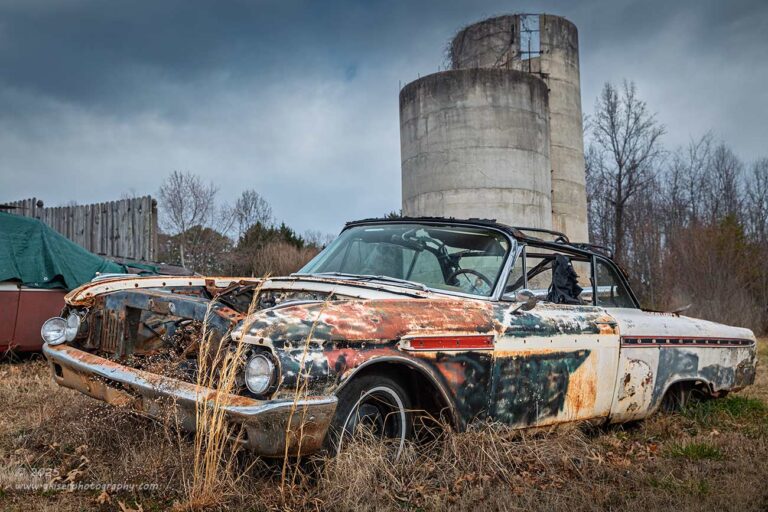
When I was finished with the Chevelle, I was feeling pretty accomplished with what I had started. I decided to move over to what I considered as the most unique subject out here, and also one of the hardest to photograph. The Ford Sunliner convertible was parked between a boat and a red car under a tarp. Behind it was the fence of the neighboring house, a shelter with an RV, the house, some cars, a basketball goal, and two silos. To the front was an open field, a gate, and fence poles without a fence. There was also a convenience store just across the street which I didn’t want in my photo. I looked at all of the angles that I could possibly shoot the car from and figured that the easiest was going to be a partial side view from the driver’s rear quarter panel.
I got the camera down very low and framed up a shot that made the car look like it was trying to take off down the road. The sky was looking good above, but there was really nothing to balance out the composition from this angle and the car was pointing towards parts of the frame that I wasn’t all that interested in. In fact, I was probably going to have to do a good bit of cloning to get the fence posts removed from the scene which I didn’t really want to do. At least I was able to avoid getting the convenience store in the shot.
Not feeling over happy with that composition, I moved in closer and got the camera higher in order to focus on the interior of the car. I had the same basic idea for the composition, but now there was no sky and no roadway in the background. I just had the great patchwork paint filling the frame with the dash and steering wheel becoming the focal point. This felt more exciting than the last composition but still felt awkward to me. I loved the car and how it looked in the camera, but the composition wasn’t translating what I wanted it to. I needed another plan.
Out of desperation, I moved to the front of the car and tried to come up with an idea to get a full shot of the car from this angle. With some careful working of the focal length on my standard zoom, I was able to eliminate a lot of the clutter to the rear of the car while using the car to cover up the house, and their vehicles. Even the basketball goal was hidden from view. The only two things that I wasn’t able to hide were the red car next to the Sunliner and the silos behind it. I actually really liked the silos and was happy to keep them. As for the red car, I decided that I could pull some saturation from the side of the car and crop most of it out to mitigate its inclusion in the frame. The idea was coming together nicely.
When I got the images home, this was actually one of my favorites from the day and certainly the best composition I did of the Sunliner. Because I spent the time in the field to get this one right, the edit took no time at all. I had added a grad filter to bring down the exposure of the sky which set the mood for what I wanted while making the car the brightest part of the scene. By positioning the camera like I did, there was not cloning involved at all in this frame even though there were a lot of distractions to be had. Everything just fell into place so well with this photo. I credit the probably 15 minutes I spent on working through the compositions with the success, because the ten minutes spent editing it was nothing in the grand scheme of things.
As I was realizing that the sky was looking really nice, I moved over to a black Impala that was parked nearby and started to look for a composition that I could include the sky with. I went to the rear of the car because that was where the iconic taillights were. I took a page out of my last trek by getting down low to isolate a portion of the car so that it became the foreground for a photo of the sky. This one came together really easily because I had not only the taillights, but the Impala emblem on the quarter panel that I wanted to include anyway for depth. There were trees in the midground that I was going to have to include in the photo, so I embraced them as part of the composition leaving just a little bit of sky above all the rest.
I kept the grad filter attached to control the sky which was more important here than with the Ford. With the Impala being black, I needed all the help that I could get to keep the exposure contrast to a minimum. Based on the histogram, I nailed it, but looking at the image review, it looked like I had white smudges and black smudges, but no detail except for in the trees. I do know my camera though and trusted the histogram to tell me what the exposure was really like. When I got this one home, it was just as I had hoped for, and the edit took no time at all.
In fact, all of the edits for the photos shot today went very quickly. There was not a lot of local adjustments that needed to be done, and even the global adjustments were to a minimum. I can’t really remember a time when I’ve had such complex photos come out so quickly in post. I’m not complaining by any stretch because I am very happy with the amount of time that I have needed to spend editing these. Of course, you can tell from the title that we aren’t done yet. We are only 39 frames into the day, and you are seeing the six keepers that have resulted from those exposures. I’m nowhere near done though, so you are just going to have to wait until tomorrow to see what comes next.
I’ll be back soon with part two of this adventure, so hang on….