Monday, September 7, 2026
As they say….Here we go again. Welcome back to another blog entry. As I’m writing this, it occurs to me that it is about a trek that happened yesterday, and you will be reading about this part tomorrow. That thought hit me in a similar fashion to the concept that Mom introduced to me as a child. Today is the tomorrow that you worried about yesterday. Maybe there is such a thing as time travel after all. All I know is that I’m having a hard time keeping what day it is straight at this point. Weeks that include holidays always throw me off even though the holiday didn’t affect me in the slightest.
At any rate, I’m happy to see you again and hope that you are all caught up on the series of blogs that I’ve been working on through the early parts of the month. When we last talked, I had just finished a trek to Elk River Falls where I did some waterfall photography and thought about how landscape photography has changed for me over the years. I have come to realize that it isn’t the same relaxing adventure that it once was. No longer am I out in nature all alone and feeling like I am actually sharing views that others aren’t seeing. these days, no matter the landscape, it seems that I’m sharing the space with hikers, influencers, and tourists. Everyone wants to be at the pretty locations now which kind of makes the photos from these spots a little less impactful and possibly even a little less important.
There was no doubt that I was feeling down about landscape photography and wondering if that ship had sailed for my photography. If you look at it in a purely matter of fact way, nobody really buys wall art anymore, and if everyone is already visiting the places that I am photographing, they can get a phone capture of what they like about the scene to post all over social media. There are mobile editing apps that allow you to do just about anything that you want to the picture and if it will never be printed, you just don’t need the resolving power of a dedicated camera. Then there is the AI aspect of things. With a few prompts, you can create a perfect landscape under perfect conditions which will capture a scene the way that you think it looks best. Absent all of these arguments, landscape photography is still a very oversaturated genre of photography which means that anything that you want to photograph has been photographed before by many other photographers. In 2026, is there still even a point to doing landscape photography for anything other than online content creation?
Content creation….oh that is another rant for me and that was even sneaking into my head on the way home from Elk River Falls. The real product these days is advertising and subscription services. These tend to all revolve around people like you and me creating content whether it be on social media, websites, video channels, or any of the blogging platforms. Part of that advertising is sponsorships, and it is all designed to reward those who put out content. What that content is really doesn’t matter anymore and there is no more pride in the craftsmanship that goes into creating something that you want others to purchase. Clout is the current currency of the world, and it is measured in likes and follows, neither of which directly pays you for what you do.
Before I get too off track here, I’m going to reel it in and get back to how things were going with me. I wasn’t really happy with how the trek to the waterfall had gone because I was seeing it as just adding to the noise of everything else online. I had shared the space with 50 or more people that were all seeing the same thing that I was seeing. Phones were capturing the pictures, and fake smiles were had by all. It cheapened the entire experience for me, and I wasn’t even really looking forward to seeing the photos that I had captured. This might actually be one of those treks where I shelf the RAW files for a day or so and come back with a clearer mind. That was probably the best thing that I could do.
However, as I was driving through the community of Foscoe which is between Banner Elk and Boone, I happened to look over at one of the auto repair shops that I’m used to seeing. Occasionally, they would have something interesting sitting in the parking lot. This time, I spotted a VW Bus that was nicely rusted. It wasn’t in a good spot for photos, and I didn’t see anything that would translate into an isolation photo either. As with most other times, I was content with driving on past the shop. However, as I was clearing the edge of the property, I caught a view of something that had an interesting shape and lots of chrome on it. It looked British and just had a lot of personality. I didn’t want to break my neck, so I got the truck turned around to drive by again. When I spotted it, I saw the unmistakable front end of a Jaguar, though I wasn’t quite sure of the year at the time. It wasn’t rusted, it wasn’t in a state of decay, at least not in the typical manner. What I saw was the tall grass growing up around it and some dulling to the paint. It was enough to interest me, and for the first time during this entire day I was actually excited about photographing something.
That was when it hit me. I might have a problem when it comes to decay subjects. I’ve been through this discussion with myself a few years ago while at the coast for the express purpose of adding coastal landscape images to my portfolio. I ended up taking several rusty tangents and found that even at the coast I was drawn to the decay subjects more than the real reason that I was even out there. Here I was once again with my mind set on doing landscapes, but this little Jaguar caught my eye and my imagination. I saw stories behind this car, and I saw character which I had not seen at the waterfall.
Something else that I saw, or rather didn’t see, was droves of people playing the tourist role. There were no selfie sticks, outfits meant to impress others, and no lines to see the main attraction. All that was there was a puddle filled parking lot with a bunch of European cars waiting for services or repairs. It was like a hidden treasure that only I had seen. Just like that, I knew what the problem was with the waterfall location. That had been a destination for many people and because it had reached destination status, it also fell into the role of a honeypot location for photography. It was expected and generally overdone. You can go online and find tons of photos, both professional and amateur of the falls. You can see photos in all conditions, day and night. There are a ton of those photos which are for sale as well, so you can have your pick of what you like the most. Did my photos from that location make a difference in the world? I dare say that they did not. Now that I was looking at this Jag in this specific location and in the specific condition that it was in, I saw something unique and something that only I had found.
It was all clicking with me at this point. This was where I was the happiest with the camera. I loved finding a spot that nobody else had paid any attention to and then photographing it in a way that captures the essence of the scene and subject. It was exciting and relaxing all at the same time. That was only where the differences started between here and the waterfall. The biggest difference was yet to come.
After I got parked, I grabbed the camera and chose to go with the telephoto lens because things were really quite tight in the parking lot and I was wanting to compress the scene as much as possible. I slipped on the polarizer to fine tune how the tones looked on the car, but I knew that it wasn’t going to help the chrome reflections at all. For that, I was going to have to pay close attention to where I ended up on those chrome surfaces. You’ve read about the funky chicken that I do to avoid my reflection as I jump and wave my arms around to see if I can spot any movement in the chrome. That was going to be happening very soon.
I Moved over to the front of the car and placed the camera at the property line looking towards the front of the car. I knew that I wasn’t going to be able to get a full shot of the car, but I had to do something with the styling of the front end. I found that just too beautiful to pass up on. While this car didn’t have the typical evidence of decay that I like to see, the setting told a lot of that story with the tall grass growing up around it. There was a layer of dirt and a dulling on the paint which added to that. These little things that I was noticing made me realize the biggest difference between this subject and the waterfall. You might remember that I had said that I don’t even remember hearing the roar of the water over the din of the other people around me. Well, here I was on the side of a road with traffic going by constantly and I couldn’t hear that traffic at all over what I was hearing from the Jag. Yep, even after being here for only a few minutes, I was already hearing how the car wanted to be photographed. I was able to understand the nuanced levels of decay and the subtleness of how it appeared.
Of course, the car wasn’t actually talking to me. That only works with Herbie and Lightning McQueen. When I say “talking” I am more referring to the connection that I am having with a subject. I wasn’t able to really form that connection with the waterfall because of all the other noise and distractions around me. Now that I was all by myself, I was able to pay closer attention to the subject and understand what made it unique and worth having a photo created. This is a form of tunnel vision that I have, and it goes right along with my flow state which I get into regularly when I am actively involved with a subject or location. I can block out everything else around me, and Toni can attest to that fact. That is probably why she never goes on treks with me anymore. I just ignore everything around me and focus all of my attention on the photographs that I am creating. That was what I was doing with this Jag and it felt natural and wonderful after the lousy experience with the waterfall earlier.

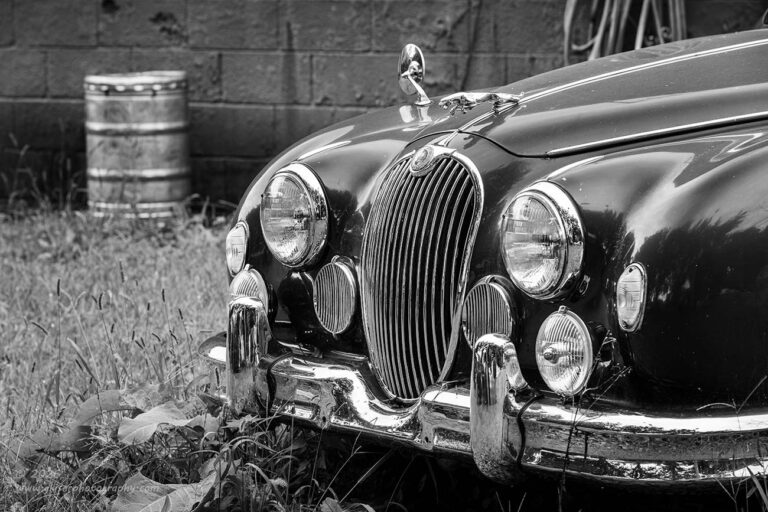
I started working on the details of the car that I was interested in. Most of this focused on the front of the car with all the chrome bits and lovely curves. For being a mid to late 50’s automobile, this car was well ahead of its time in terms of styling. The first composition that I captured paid tribute to that aspect as I just photographed the front clip of the car showcasing all the different bits of trim. Of course, I needed to find balance in the photo which came from a discarded keg on the side of the building. There was no way that I would have made a connection between those two objects had I not been vibing with the car as I was.
The hanging hose and the discarded keg on the building showed that this car was not sitting out front somewhere. The indications were that it was set off to the side and possibly behind a commercial building that had nothing to do with auto repair. The keg suggested that it was a bar of some sort and I made the connection to a British pub. Sure, it is a bit of a reach, but it was a story that I had created around this scene that was arguably rather complicated. I hadn’t been able to do that with the waterfall earlier but remembered a couple of nights before where I was able to create stories behind my images with both an old auto parts store and a rusted medium duty Ford truck. The obvious difference here was that the waterfall, or any landscape is just a pretty picture of a pretty scene. There isn’t much special about it in most circumstances. As a photographer, you just capture the scene in front of you with your main input being the composition. When it comes to decay images like the ones I’m talking about, the scene isn’t classically pretty to begin with. A photo that is captured to just record the subject will fail to be interesting. These subjects do allow a great deal of interpretation when creating images of them. To do it right, you end up photographing past the actual subject and start to capture the things that the imagination starts seeing. The photos here are ones that are created to show how I saw this Jag, not just the car itself.
Something that I love doing with these old cars is capturing images in the same way that a marketing team would have wanted when the car was new. We are all used to seeing those new car posters at dealerships and in magazines. The photographer is looking for those details that define the style of the car. The car has been meticulously detailed for the photos, and everything looks brand new. That is the way that we expect to see these photos. That is where my creative twist comes into play and I get to add a juxtaposition to the scene. This car was actually in really good shape, but it was just off enough that the photos didn’t quite fit what we were expecting. The dullness of the paint, the water spots and ever the random spider web all gave clues that this car has been around for a while and is no longer cared for on the level that would be required for a photo shoot. This is one of those curious details that I think adds so much interest to images of these old cars, and it is especially effective on ones that are at the earlier levels of decay.
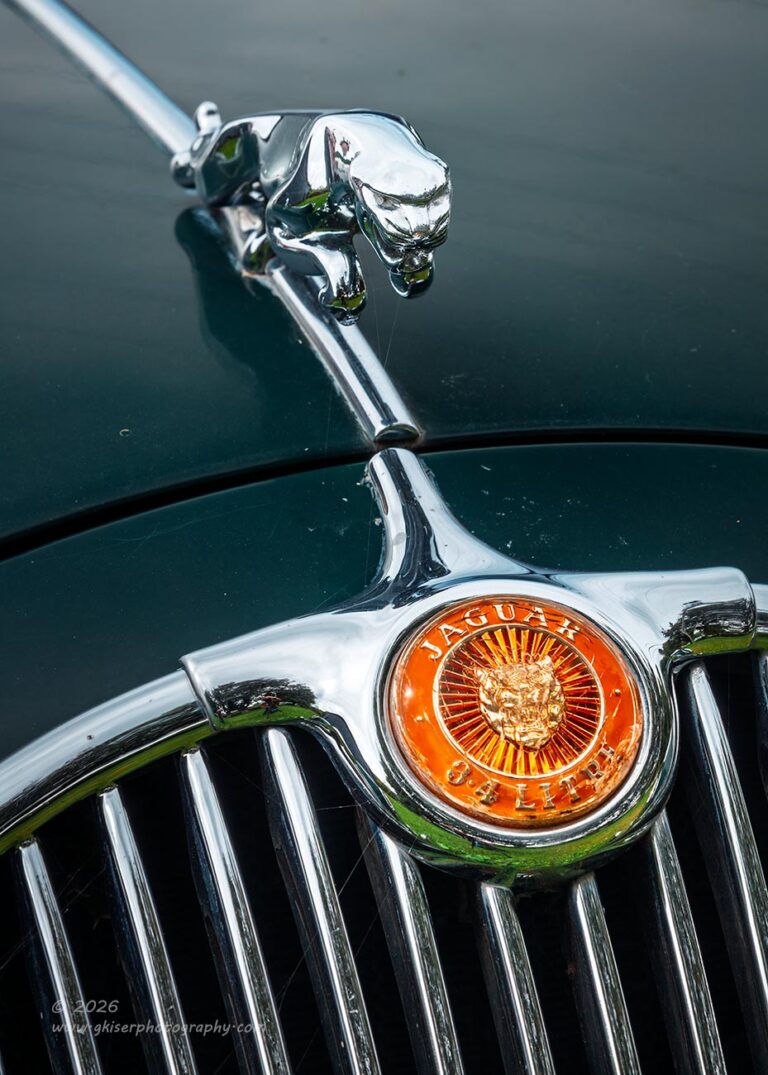
When working with the details of a car like this, there are times when the car actually becomes unimportant in the context of the details. As I worked in closer to the car, I started to arrive at that point with the hood ornament. Now, you know that I like to capture these little details, but very few of them are as expressive as the one here on the Jag. The Packard swan is another example of an expressive hood ornament, but I really do like the ones that tend to have an action to them and a little more detail. The pouncing jaguar that rides at the front of the hood was an excellent subject to photograph with all the details that were sculpted in. I loved how it was leaping off of the hood, but that wasn’t all that I liked. The blue/green of the car paired perfectly with the orange badge on the top of the grill, and the slats of the grill provided a great foreground. All of these elements together worked in the composition, but the main point of it was to show the energy of the pouncing jaguar.
All of these details just worked together so well that I’m betting you aren’t even thinking about what the rest of the car looks like. There isn’t a reason to complete the shapes because all that you need to see is right there. The connection that I hope you make with the image isn’t related to the car, but to the animal that you see and the action of jumping. I want there to be that sense of excitement which the orange and red tones of the badge hopefully help build up.
This image relies on color theory more than you might expect. I’ve done a lot of talking lately about why I choose color over black and white or vice versa. There is no way that this image would have worked as effectively as a black and white image. It relies too heavily on the colors to create the mood and reaction from the audience. It just so happens that the colors of the car are perfectly contrasting colors which are in the right proportions as well. By stripping the color, you would miss the excitement and be left with a static image of a chrome jaguar on a hood.
Of course, there is a time and place for black and white and the opening image in this blog shows a huge difference. I chose black and white for that one because the main point of the image was to show off the shapes of the front of the car and really accentuate the chrome bits. The colors were all the same as you see here on the hood of the car, but the orange badge gets lost in the expanse of the image and becomes a distraction. The balance of colors is also off in that composition to where it just makes more sense to showcase the main reason behind the photo as a black and white that leans on contrasts rather than colors. In fact, each of the images in this series have all been carefully thought out as to what makes the most sense when it comes to presentation. Nothing was left to chance and even though this car tended to blend in with the green grass, in a way that would suggest that most of the photos should be done in black and white, I found that the monochromatic look also made for a better canvas for the details to pop out. Sometimes that was the case, other times, I just needed the ability to really control the contrasts through black and white.
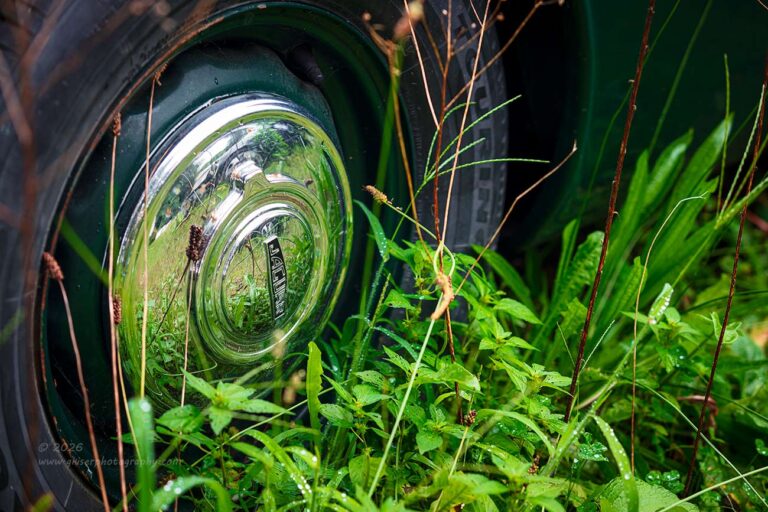
This next photo is another example of a photo that really needed the colors to tell the story even though for the most part, the colors are all analogous and don’t really represent anything overly special. What I liked about this scene was the fact that the hubcap showed the Jaguar logo and the chrome was in really good shape. From an automotive photography standpoint, the fact that it is rotated 90° clockwise is a photo foul as you typically want them level with the ground. In this case, I really liked the fact that it was straight vertical on the car because the grass and weeds around the wheel were also growing vertically. It fit the pattern, and patterns are more important than rules when it comes to photography. There was a hint of rust on the rim of the wheel which didn’t really fit the highly polished chrome. That rust also matched the color tones of the weeds around the wheel which made the rust stand out a bit more. The lush greens of the wet vegetation added to a sense of vitality in this image, but with the grass growing up around the wheel, you had a sense that the car was in a state of neglect.
All of these subtle clues played a part in making this image work in a way that it probably shouldn’t have. These were all little nuances that I was paying attention to with this car while I blocked out the world around me. I was in my happy place and was getting a lot of the same relaxation benefits that I used to get with landscape photos. These days I’m able to find Zen in the quiet around a forgotten car or structure. I still approach the scenes as I would a landscape, so my time learning landscape photography is still serving me well.
In fact, one of the concepts in landscape photography that has stuck with me from the very beginning is to not have a blank, white sky. This is usually the hallmark of an inexperienced photographer that relies on auto exposure which will expose the main subject correctly but will leave the sky blown out. For the most part, this is frowned on by landscape photographers, and I’ve internalized that exposure issue to the point that I will avoid a blown-out sky at all costs. I see all too often other photographers that photograph decay tend to not be concerned with things like the sky or having a clean composition. They are just concerned with capturing the subject that they see. For me, it goes well beyond that, and I take into account the entire frame and everything that appears in the composition. That is also how I teach decay photography because I do think it sets the photographer apart from the others in the field.
When working with chrome, I’ve found that clipping the highlights actually works to my benefit most of the time. Our eyes are used to having bright reflections in the chrome, so in order for the chrome to look realistic, there needs to be specular highlights in places. As you look in the hubcap above, the sky is actually white rather than blue. That is a distinction with this kind of photography. I’m perfectly happy with the sky being white in a chrome reflection because that is normal to see. However, in a photo of the entire car with the sky, you had better believe that you will see detail in that sky since it is not being reflected by something like chrome. As a matter of fact, to add to the contrasts between the grasses and the hubcap, I actually desaturated the hubcap quite a bit. I felt that this was more accurate than having all of the colors saturated and then the hubcap would just blend in with the surroundings. I needed the attention on that piece to show the Jaguar logo. As you can see, there was a lot of thought that went into this photo which looks pretty simple at first glance.
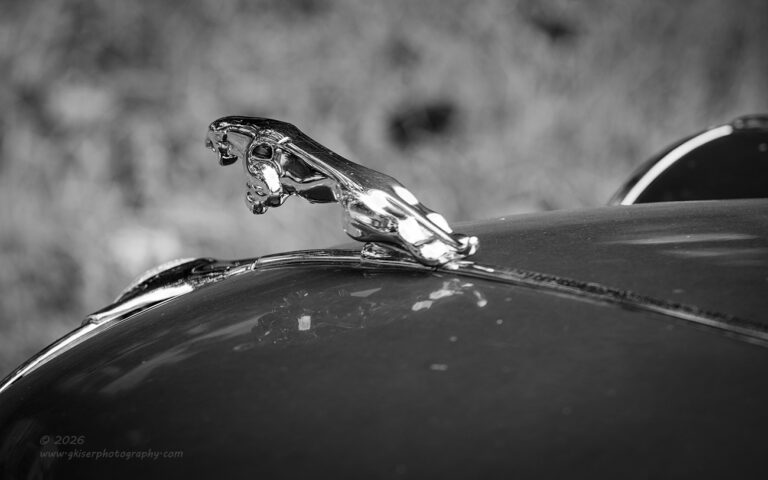
Now that I was really starting to connect with the car and was fully understanding how to make the photos work, I started to look for some odd compositions that might not have been obvious during the first walk arounds. I was still being drawn to the hood ornament but felt that I had given it enough attention from the front. I moved around to the middle of the car and looked forward at the ornament. I was seeing that same energy that I had seen before, but it was going in a different direction. It was unique and I really liked the concept of getting a photo from this angle.
I started to play with the camera position to see what worked the best. It was actually quite a bit harder to form a composition than I had thought initially. I stuck with it though. Just zooming in on the jaguar was too static and lacked interest. The badge at the edge of the hood was also a bit of a distraction as I could just see the top edge of it. It was a detail that added interest, but I needed to add context to it. As I looked around, I saw that from my angle, the light housing to the right of the jaguar seemed to have a similar shape and tone thanks to the chrome trim. By adding this into the composition, I was also bringing in another curve to the body that added a point of interest. I chose to use that element as a framing element with the hood badge on the opposite side of the frame. The hood ornament created that third element that formed an imaginary triangle within the frame. It was a shallow triangle, but it gave the eyes a path to follow. I liked the basis for the composition at this point and started to fine tune the concept.
To make the leaping jaguar stand out, I was going to need a limited depth of field, but I wanted to have most of the animal in focus which meant that I had to fine tune the aperture and point of focus to get it all right. I needed to keep the grass beyond the car blurry so as not to distract from the shape of the ornament. Of course, the hood was going to go into soft focus, but since there was no detail, I didn’t mind that at all.
The last bit of the puzzle came during the processing when I leaned into the narrow triangle aspect and cropped the image to a 16:9 aspect ratio. Since everything was monochromatic with the car being a shade of green as well as the grass, I saw no reason to keep the color in this photo. Instead, I went with a low key black and white approach which forced the attention onto the chrome elements rather than the colors or textures of the grass.
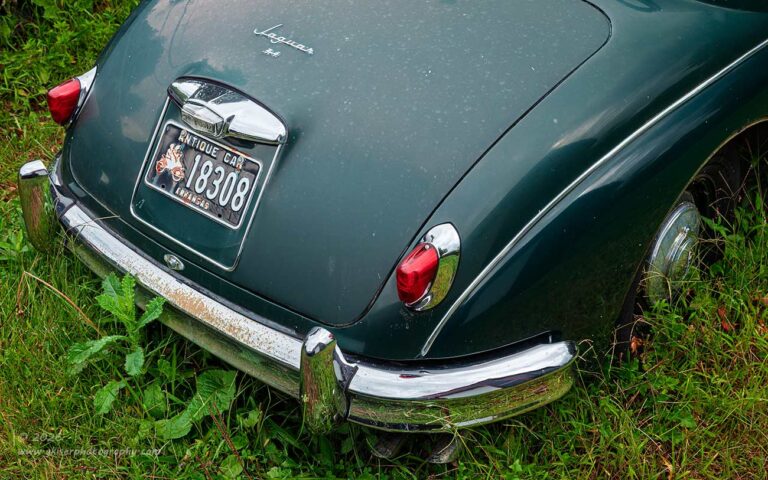
The underlying theme that I found was working for this car was that images that relied on the shapes of the chrome were better in black and white. In the ones where there was a bright color contrast, I used a color profile for the processing. The next image that I started to work on was another area of the car which had interested me, but I hadn’t quite worked out how I wanted to photograph it. It turned into a great example of when color works over black and white, but I wasn’t quite there just yet.
The rear of the car was interesting because of the antique plate that was affixed to the rear as well as the badging on the lid that indicated the engine size. I could have used the current lens and just captured an isolation of those elements, but without textures on the car, I felt that would be rather boring. As I looked at the design of the car, I found that the bumper and the chrome strip on the quarter panel framed the large rear end quite well. The hubcap on the rear wheel also added another element that was in line with the bumper giving an overlap of lines on the right side which added to the taillight for a bit of visual balance when compared to the areas that I was wanting to focus on. There was no way that I was going to be able to capture all of this with my long lens which meant that it was time to go back to the truck and swap out to the standard zoom which would easily fit this composition at the height that I could work from.
Once I got things switched out, I was back to the corner of the car. I found myself right up against another car in the parking lot as I stretched to get all the working distance that I could get so that I didn’t end up including the car that was parked beside the Jag. It was just barely enough working room, but I managed to get it all to come together. The biggest issue was appearing in the chrome trim. There were several places that I could see myself waving around and knew that the only way to deal with that was going to be a round of using the remove tool in Lightroom. I would have rather just moved out of the way while using a self timer, but with myself wedged between the camera and the car behind me, I wasn’t able to move quickly to get out of the way. The sweeping bumper also created a situation where I would end up in the shot from wherever I stood nearby. It was just easier to clone me out and that way the camera would be removed from the scene as well.
That process actually went quicker than I had anticipated, and I was ready to get started on the processing of the image. The first decision that had to be made was whether this was going to be done in color or black and white. The parts that really interested me in the frame were the chrome bits. They represented the main subjects as well as the framing elements for the frame. The tag was a black tag with white lettering, so the colors were not all that important. Based on how I had been operating so far, I would have more than likely done this as a black and white photo to concentrate on the contrasts since the car and the grass were similar colors.
I didn’t choose black and white here though. That wasn’t an accident or me being lazy. There were two small details that prompted me to do this one in color. The first detail was the red taillights. Since they were also a framing element for the tag, I liked the color contrast that they introduced. Red and green go well together and since the red was taking up a very small percentage of the frame, they didn’t really affect the overall mood or tone of the image which I appreciated. The second detail that prompted me to go with a color presentation of this image was the touch of rust on the tag and the bumper. Of course, the orange tone worked well with the green and happened to be analogous with the red of the taillights. The rust also told a part of the story that needed to be told. As I’ve mentioned, this car was in pretty good shape so to have the antique tag on it makes it look like a proper restoration. I wanted to lean into the decay aspect a little more and the rust gave that missing element that I felt was very important to the story that I was trying to tell. Therefore, I had to leave this image in color and I think that it works very well indeed.
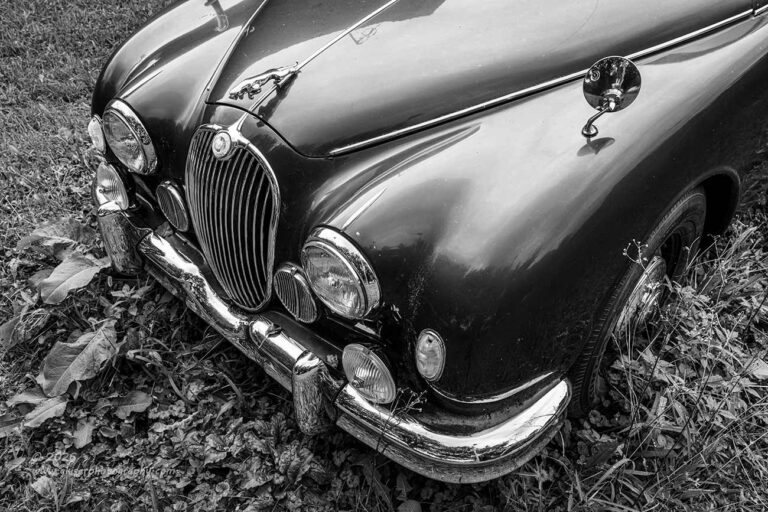
Now that I had a wider lens attached, I felt like I had some more options with how to capture this car. I went back to the front of it where I had started the session out. I still loved the shapes of all the chrome and the design of the car. I had tried to include the building in a way that made sense to a story in my head earlier on but wanted to isolate the car as much as possible. What I had done with the trunk, or boot, since this is an English car would probably work about the same up front.
I repeated the procedure that I had just done a moment before here at the front corner. Again, I saw myself waving in all kinds of places on the different bits of chrome and knew that once again, I was going to be removing myself from several places if the photo worked out. The basic design of the photo was the same with the car forming opposing diagonals through the frame. This time, the main focus was the front end which appeared in the lower left corner while the lines of the body carried the eyes through the frame to the upper right. The mirror and the wheel took on the duty of pulling the eyes back into the frame to continue exploring rather than just exiting stage right. I felt that the composition was solid and would work at least as well as the rear section had.
When I got it into post, I started to make decisions. While this was done pretty much in the same fashion as the rear of the car, there were some key differences that forced my hand in making this black and white. While the grill badge was very visible here, it was small in scale to the rest of the composition so that the orange that it brought into the scene would be largely lost. The rest of the colors were all shades of green. The visual interest all came from the contrast with the chrome and the texture contrast between the ground and the painted surfaces. All of these aspects indicated that the color was not necessary at all and would likely be a distraction to the entire frame. With that in mind, I converted the image to black and white which made this a much stronger composition.
You can learn a lot about my take on photography when you look at two compositions that were basically formed the same way around the same car, in the same light. The amount of chrome in the frame as well as the presence of things like taillights and rust all come into play as to whether or not the image will be in color or black and white. It is the simple details that drive the big decisions and the only way for me to make the right choices is to be able to listen to how the subject wants to be photographed.
Up till now, I have been really hesitant to include much of the surroundings in a photo. I’ve been relying on details and isolations in my compositions. For the most part, I think I have done very well with that too. Now that I was finishing up, I wanted to try something else. I wanted to tell the story of this car at the repair shop and explore what that narrative looked like. Fortunately, the car was parked right at the corner of the lot with the building behind it. There were other cars around the Jag, but this one was poked out a tad deeper into the yard than the others. This gave me the chance to work some angles and try to create a simple composition that included the car and the shop.

I knew that I was going to have to get down low to keep the cars right behind the Jag concealed from view. There was also the matter of the car that was parked next to the Jag which I didn’t want to have in the photos. This all left me with pretty much a single angle to shoot from right off of the front left of the car. It was similar to where I had started out, but I was much closer to the car now which allowed me to avoid the neighboring car. No matter how low I got, there were still cars visible to the rear of the Jag and everything off to the right started to be a distraction. It was all pulling my attention away from the building which I wanted to make an appearance.
My solution for that was to rotate the camera to a vertical orientation and do a creative crop through the Jag so that I only included the front half of the car. This put more emphasis on the chrome on the front of the car which I really liked. It also allowed me to get the building as well as the sky above. The clouds were looking great, and I was wishing that I had seen these conditions at the waterfall instead of the bright sun. The cloud textures were perfect, and I was glad that I was wanting to get this composition now that they were looking this good.
The composition pretty much made itself and I was only left with slight changes in location to get the different elements to have separation like the hood ornament and the discarded keg. These are the little details that I really do care about in my images even though to look at the photos they look effortless. The first exposure that I shot revealed a problem that I was worried about. The sky was clipping in several areas, and I had pretty much left the car in full shadow. This meant that I wasn’t going to have the finished exposure that I was needing. I didn’t want to do an HDR image because there was a bit of a breeze and I didn’t want there to be ghosting in the image. Instead, I took into account the glare that was happening on the building at the top and saw the opportunity to add a grad filter to control the sky. Just as I had done with the last composition of the waterfall, I dropped in a 3-stop soft grad and moved it to where it covered the sky. This gave me enough room in the shadows to recover the details of the car while not losing information in the sky. That was all that it took. From that point on, it was a matter of getting a moment with little to no breeze and no passing cars which were reflecting in the hubcap.
About halfway through the series I decided to drop the camera to the lowest that I could get it on the tripod without using the horizontal camera mount option. This changed the composition and made it a touch more dramatic. I liked this a lot more and repeated the process of getting a solid and clean image. I ended up shooting a total of 10 frames before I landed on the keeper that you see here.
In case you are wondering, it is the red trim on the building that prompted me to look at this as a color image. The grill badge kind of gets lost so that wasn’t a concern, but the red on the building helped to separate that from the car and I felt that was very important to the image. I looked at doing one of the others in black and white, but it didn’t have near the impact that I was seeing in color. Had the sky been a little blander, I might have been inclined to do one as black and white because I could massage the contrasts for a little more drama. The sky was perfect and required next to nothing from a post processing standpoint.
That was the last image of the day bringing my total from this location to 37 frames captured for a total of eight keepers. The day’s tally was 83 frames shot and 17 keepers from the two locations. It turned out to be a big day, and I couldn’t wait to get home and start processing the images from the day. That was a huge change from how I felt after leaving Elk River Falls and I was very happy about the attitude adjustment. I felt recharged and creatively spent after working with this Jaguar. It was by far a more rewarding experience, and it was the one that made me want to do more. It is funny how a location that I planned out and had looked forward to visiting turned out to be such a bummer when something that I spotted off on the side of the road turned into a fantastic experience.
I think that it is safe to say that I will remain a decay photographer for the foreseeable future. Of course, I will approach this type of photography with the same care as a landscape photographer approaches those scenes. It is just part of who I am as a photographer. If you have made it this far in this blog, I assume that you approve of my methods and enjoy my work. If that is the case, please consider purchasing a print to hang on your wall. You get a unique piece of artwork to hang, and you are also showing your support in a way that pays the bills associated with my photography. Of course, I appreciate any and all support, but I am doing this full time and rely on the money generated by my photography each month. If you don’t have room for a print, or can’t decide on one, consider selecting the Donate button below and leaving me a tip of your choice. It is a great way to say thanks for the blog and the information behind the photos.
Until next time…

Remember to use the code KISER10 to get 10% off your purchase