Saturday, March 29, 2025
It almost feels as if it has been way too long since my last trek, but that is only my perception after going out for photos a couple of times a week for so long. It has only been a week since my last outing which was a quick Sunday trek if you will remember. It was a short trek with only a single blog entry which was exactly what I was looking for, but it was such a fast turnaround that I really didn’t have time to know that I was even doing it. I had gotten into a habit of doing much more involved sessions that would result in a multiple part blog entry to cover all of the new photos that have been added. It would seem that we are back here once again, although, I am going to keep this one to only two entries in order to keep them from spilling into April, which is just around the corner.
Now, to be fair, the plan had been for me to go out and grab just a few photos and call it a day. I was supposed to be done with the blog and everything by the time I went to bed Saturday night. That didn’t happen, but the thought was there. With the weather looking like thick clouds during the day with the potential for some low-level cloud interest, I wanted to go out to Alexander County again and try to shoot the pair of barns that I had gone out before looking to shoot. I had an alternate location in the area of Newton which I have been trying to get permission to shoot for some time now. There were a handful of cars on the property, and I figured that I would be able to get a few photos there if I could gain access. The last part of the plan came from a friend giving me a tip about a car that he had found on Marketplace. This was a ’56 Chevy that was actually just a couple of miles from home, but it was down a road that looked more like a driveway than a road which was why I hadn’t been down it. Not wanting to disturb the folks that lived down this small road, I had not been out to scout the car, and had only seen the one photo that was posted for the add. My plan was to come back by this location and try to shoot the car on the way home since the clouds should be much thicker by that point.
I had a working plan for the day and figured that I would probably be done shortly after lunch because I was really not holding out any hope that I was going to get the permission needed to shoot the one property in Newton. I mean, I have been out there about ten times now with no luck, so I had no reason to think that my luck would be changing this time. In fact, I wasn’t even really counting on being able to photograph the barns because of the distance that I was going to have to work and the line of vegetation that I was going to have to shoot over in order to get a clean composition. There was also no guarantee that the Chevy was still going to be at the location close to home. There were a lot of places for me to check out, but I was well prepared to not have anything at all to show for the effort.
When I woke up shortly after sunrise, I looked at the weather and it was showing clear skies for the areas that I was wanting to shoot. The clouds were supposed to have been coming in at this point, but it was now looking like 10am for the local skies and 11am for Catawba County. This is starting to be something that I am getting used to with the overly dry air that has been over us for a month or more now. The clouds that are expected rarely come, and if they do, they are much thinner than expected. There was a good chance that the clouds would never materialize which would mean that my usable light was very limited.
A consideration that I had to make with the barn was that I really wanted to capture the spring colors in the trees which was going to mean that I needed to get out there pretty soon. It was a little early on my last trip out there, but after eating lunch with Toni at a nearby restaurant on Friday, I had seen that the trees in the background were looking really good, and the time was now right to capture the photo. There just needed to be some interest in the sky to really make it work. As of sunrise, this was certainly not the case with clear skies overhead.

I went through my morning routine and kept looking outside to see what the sky was doing. More than anything it was looking hazy which wasn’t what I wanted. The quality of light was good because of the haze though, and that got me thinking that I might as well drive out there to see how things were looking. I knew that with the barns, I was going to need a morning sun to add lighting to them as anything in the afternoon would have them backlit unless the clouds were really dense. The hazy sunlight was diffused enough that I thought I might be able to make do with it for shooting the cars should I be able to get the permission needed. I had planned on leaving early, which had me on the right schedule to be on my way before 9am which would have me in the area at the right time for the barns and to take advantage of the low sun.
After grabbing my gear, I was on the way down to Taylorsville and Hiddenite where the barns were located. The entire way down I kept thinking to myself that it was crazy to be going out on a day where I needed my sunglasses while driving. That is usually the indication that the sun is too bright to do the kind of photography that I like to do, but there was something pulling me and I knew from past experience that I shouldn’t ignore that sensation. There were some clouds popping up here and there, but the sky was predominantly hazy which I didn’t really like. I knew that the barn photo was going to have to include some sky to really make it work out as the sense of scale was very much needed due to the distance involved.
I had thought about going to the houses that were close by and figuring out which one owned the barns, but I didn’t think that the conditions were good enough to warrant that just yet. I had a composition in mind which could be shot from the street. I also knew that by getting in closer, I would lose the compression gained by using a telephoto lens and the relationship between the barns would change drastically if I got in closer. It just made sense to get the shot that I had been after for so long and then if the conditions warranted it, I would be able to ask about getting in closer afterwards.
When I got to the spot on the highway where I knew I would be situated, I pulled off the road and started to look at how things were looking. The barns looked good in the morning light and there were two trees resplendent in spring colors behind the barns. The sky above had a little bit of texture to the clouds above the hazy and probably smoke from the many wildfires in the region. It was enough to justify getting out and trying for the shot. This is something that I had worked out the details for a while now, and I knew that there was a possibility that I was going to have to shoot from the bed of the truck to give me a slight elevation over the vegetation at the fence. I estimated where that position would be on the chance that I needed the extra height and parked.
When I got out of the truck, I went over to the fence on the other side of the train tracks and started to see if I could find a place with a clear view of the barn. There was one area where the greenery was a little lower than the other places and that gave me just the right view and the angle was close enough to what I needed to work. I went back to the truck and grabbed my camera with the telephoto lens attached. I pointed it to the barns to get an idea of where I was at with the focal length. I could get the framing that I was wanting with this lens, but I was all the way at 200mm to do it. I know that the lens is not super sharp at that focal length and with the main subjects that far away, I was going to be sacrificing detail that I didn’t want to. In order to combat that, I slipped in the teleconverter which doubled the range of the lens and allowed me to use a sharper focal length while being able to get in just as close, or closer to the barns.
After adding a polarizer to the lens, I walked the whole rig over to the fence line and started to work out the camera placement. There were a couple of branches that got in the way from where I had planned to shoot the scene, so I had to move a little closer down the line to find another spot. I had the same issue with branches, so I went back to the first spot that was a slightly better angle. I placed the tripod halfway over the single line barbed wire fence and then straddled it myself to get an unobstructed view of the barns. This worked well, and I found that I liked a tighter crop than what I had seen with the 200mm which made it very good that I had the converter attached. I ended up shooting this scene at 278mm which is still in a very sweet spot for the lens itself.
The lighting was pretty consistent, and I only needed to shoot a total of four frames before I was sure that I had a shot that would work. Each of those exposures had a slightly different framing to try and get the best composition possible. As luck would have it, the first exposure of the day was the keeper. It had the best balance of sky, trees, and foreground grass with the two barns. The others weren’t bad at all, they just had more in the frame than was necessary, and two of them had the tip of a small tree that I had been shooting over which was a distraction and would need to be removed in post. That first frame had the most considered composition and the one that would require the least amount of work.
With those four exposures, I had accomplished what I set out to do for the day. I wasn’t looking for a lot of photos, and having one would have worked, but I wasn’t really all that happy with how it had turned out. It was not due to anything that I was doing as much as it was just the general conditions of the day. The sky was far from ideal for what I had been previsualizing, but it was the first time that I thought that it might be good enough to work when joined in with the spring colors. There was just a part of me that warned that this photo might end up being a trashed attempt when I got home. Just in case, I wanted to try and get something else to work with so that I had something from the trek that I would be proud of.
Once everything was back in the truck, I was back on the road again and looking for my next stop. Of course, I went down to Newton once again in hopes that I would be able to get permission to shoot that property. The entire way down there, I was looking at the sky thinking that the conditions were really too bright for me to really make a good effort there. After all the times stopping with great weather conditions with not luck finding the owner, I was thinking that there was a fair chance that with the less-than-ideal conditions he might just be there. That is how my luck goes most of the time.
When I got there, I pulled in the driveway as I had done so many times before. There were no signs of anyone on the property and I saw nothing had moved since the beginning of Winter when I was there last. I drove over to the neighbor’s house where I had contacted a man through a Ring doorbell that last time and rang it again hoping that maybe he had some new insight into whether or not I would be allowed on the property to work. There was no answer, which meant that there was nobody at all around to ask about the property. I took a moment to look around and saw that the light on the cars was actually looking pretty good despite the brighter than anticipated sunlight. There was just no way to do what I needed to do without getting permission to be here.
As with all the times in the past, I got back in the truck and left at least four good subjects behind with hopes of returning another day. I normally would have felt sad about this, but I’ve kind of gotten numb to this kind of disappointment over the years and know that good things come to those who wait. I only hoped that I would manage to get permission before these cars were removed from the property which seems to be happening more and more these days.
From here I could have headed home and tried for that ’56 Chevy, but I decided to try and make it worth the drive out here by exploring a bit. One of my best techniques for finding these subjects is just driving around and getting lost while paying attention to the clues along the way. There was no destination in mind, the truck just started driving and turning with a randomness that I actually enjoy. There is a lot of potential out this way, but nothing was jumping out at me because the light was just not great. However, from the weather forecast, the clouds should be building up pretty soon which gave me hope. I just needed to find something that would allow me to take advantage of better lighting.
At some point around 11:15, I turned on a road and spotted what looked like two early ’50’s Chevrolets in a garage. They were both in that condition that I just love to photograph and as I was looking that way, I could see a few others scattered in the yard around the different buildings. Even the neighbor’s house had a nice old Chevy wagon behind a building that might work out for a photo. It didn’t look like anyone was home at either house, but I pulled into the second house to see if anyone was home. There were no signs of movement at either house, so I pulled out the map to look around. There was a long driveway that ran the length of the property on the other side of the first house that came out at two different houses. From experience, that could very well be the owners of this property. I drove down there real quick and chose the house at the very end of the driveway to knock on. During the drive down the driveway, I spotted another dozen or more rusty vehicles along the side of the property and really became excited to shoot here. There were more subjects than I had intended to mess with today, but there appeared to be a lot of really good examples there.
There was an answer at that door, and I spoke to the owner of that house briefly. I learned that she didn’t own the other properties, but she gave me the names of the two brothers that lived in the two houses. At least now I knew that the houses were occupied, and I went back out there to knock on the doors. This time, there was absolutely no answer and no signs of movement inside. I had seen one more house just beyond the second one which looked like it was close enough that maybe they were close with the owners that I was looking for.
There was no answer at that door either, but I had seen the detached garage open around the corner of the house. I peeked my head around the corner and announced myself hoping that somebody would hear me. I heard a voice, but it was from the other side of the house which didn’t match up to where I was expecting to get a response. I turned and saw a guy walking up from the other side, so I introduced myself and said that I was hoping that he was one of the owners from the two houses. He wasn’t, but they were family and knew them. My luck was turning around.
To make a long story short, he took pity on me and called to see when they would be getting back home and if it was OK for me to do some photography. They were at a car club meeting and were going to be home in about 15 minutes. I was instructed to wait in the driveway for them to return which was fine by me. This was the same arrangement that I had ended up with when I shot the Pontiac collection a couple of weeks ago. I ended up waiting in the driveway until right about noon when the owners showed up. I had been looking at every car that had passed by wondering if it was them. When I saw the 50’s Chevy rolling down the road dressed in a beautiful rust finish, I had a suspicion that was them. Sure enough, they pulled into the driveway, and we started getting along great from the start.
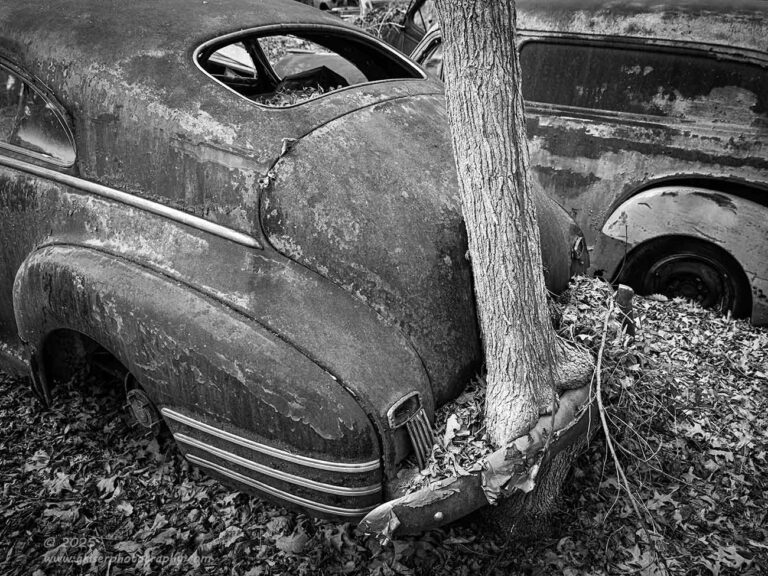
I noticed that it took a while for them to say whether or not it was OK to get some photos on the property and there was a lot of talking that took place. I knew that I was being quizzed to find out what my intentions were. I’ve been through this many times and will happily go through it many more if it can set the owners at ease about my intentions. Eventually, without even directly asking I was given permission, and he volunteered a tour of the property. I took him up on that tour and we walked around for a while as he told me about some of the unique examples that he had. For the most part, he collected Chevrolet’s from 1946 as they were unique in several respects in the postwar era. I learned quite a bit about the cars in his collection and really wish that I could have photographed all the uniqueness that was here, but I can’t just get a photo to document something without there being a compelling composition behind it. This meant that I was having to be a bit more selective about what I was going to photograph. I could tell from the tour that very few of the photographs would do this collection justice in terms of which vehicles were special.
There was one coupe that he pointed out which was parked up against a trailer that he suggested that I get a photograph of. When we rounded the corner behind the car, I spotted what he was so excited about. There was a tree growing through the rear bumper of the car which had dented in the trunk lid slightly. While I had seen things like this before, there was a composition here which I had not seen with the other cars. I wasn’t quite sure how I was going to shoot it but knew that there was something here worth capturing. The fact that the owner was invested in the scene also made it more special to me.
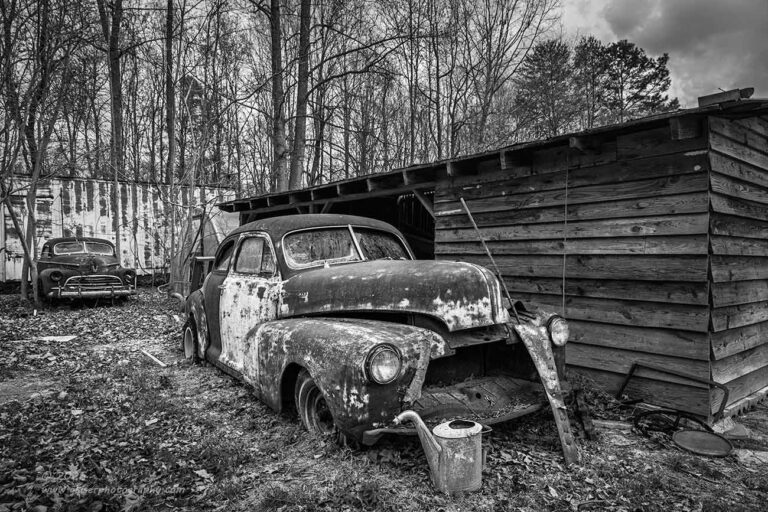
There was one particular scene that I saw during the tour that I knew that I wanted to capture more than anything else. It was a single Chevy beside a small shed with a watering can right at the front bumper…or what used to be the bumper. There were a lot of other elements around the car which made the composition a little more difficult, but the scene itself was too good to pass up. When the tour was over, and we parted ways it was around 12:30 and the clouds were just starting to come into the sky in a way that made me happy. I grabbed my gear and went back to the rear of the property where the coupe was sitting.
Since I wanted to get the sky in the shot with the clouds, I selected the standard zoom lens that would give me a moderate wide angle focal length. Of course, I added a polarizer and started to work out the composition. I had to worry about modern houses and a white Jeep Wrangler in the background. There was also traffic on the road that was visible as they passed. There were also elements that I didn’t’ want in the frame to the rear of the car, and just beyond the shed. Compromise was the name of the game, and I tried quite a few compositions to minimize the distractions because I knew that I wasn’t going to be able to omit them all.
I ended up shooting nine frames before I arrived at the one that would be my keeper. There were a few more after that, but it was this particular one which dealt with all the compromises the best. I was able to omit the background which gave me such a problem by shooting from the front. This forced my hand in having to include the straight on shot of a ’46 that was parked next to the trailer. By doing this, the greenhouse structure beside the shed was minimized to the point of not being a distraction. The composition was a bit choppy which was why I chose to simplify it by losing the color. By doing this in black and white, I was able to really focus the viewer’s attention on the main subject while leaving everything else as textures. I think that it turned out quite nicely even though it wasn’t exactly what I had in mind to begin with. It was the shot that got me started with this property. It was also the shot that let me know that there were going to be challenges here when it came to compositions. For any who have attended my workshops, you know that I thrive in these kinds of situations and have a lot of different tricks up my sleeve to simplify the compositions that I come up with.
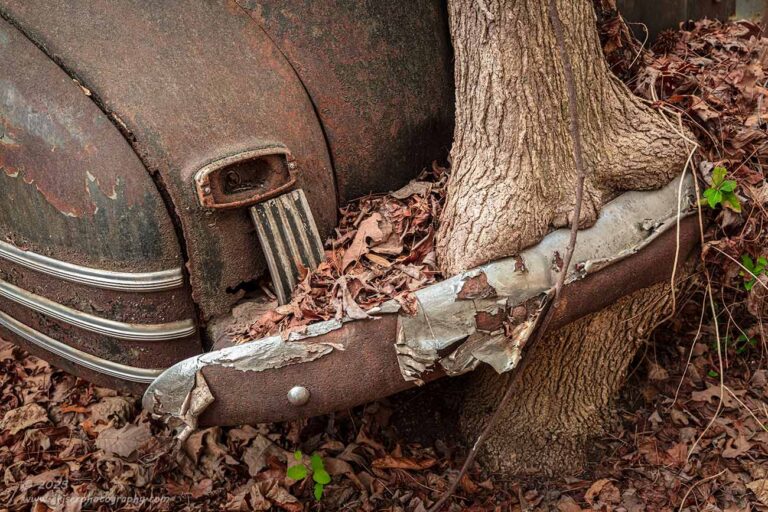
Since I was right here at the tree growing through the bumper, I went over to that car and started to look at the scene. There was no way to make it an overall establishing shot of the car, but I was more interested in an isolation. There were five variations of the stump that I shot. The first two were compositions that included the panel truck beside the coupe which provided a backdrop for the tree. It was a little complicated and required the photo to be done in black and white to really draw the attention to the tree and bumper. It was the second shot here that turned into the keeper. It did let me know that I needed to get in closer and simplify the composition though.
The next three exposures were done much closer in and really focusing on the bumper and the trim around the missing taillight. You could very easily see how the tree had started to grow over the bumper from this composition. Because it was so direct, I was able to leave the color which was largely monochromatic. However, there was enough green showing through on the body of the car to match up with the bit of greenery growing that I thought there was enough contrast in the scene to make the color a bit more interesting than black and white for this composition. It was the first version of this composition that turned out to be the keeper and I ended up doing it in color just like I had planned.
What I loved about this composition was that I took something that was manmade and something natural which had grown together. The way that they had become intertwined had an almost poetic relationship with the way the lines all flowed around the frame. I really couldn’t have designed this better had I been a painter creating something from a blank canvas. It really is special to be able to see art develop like this without any help from a person. No matter how you look at it, nature knows what it is doing and scenes like this are instrumental to how I can still view landscapes as including the hand of man.
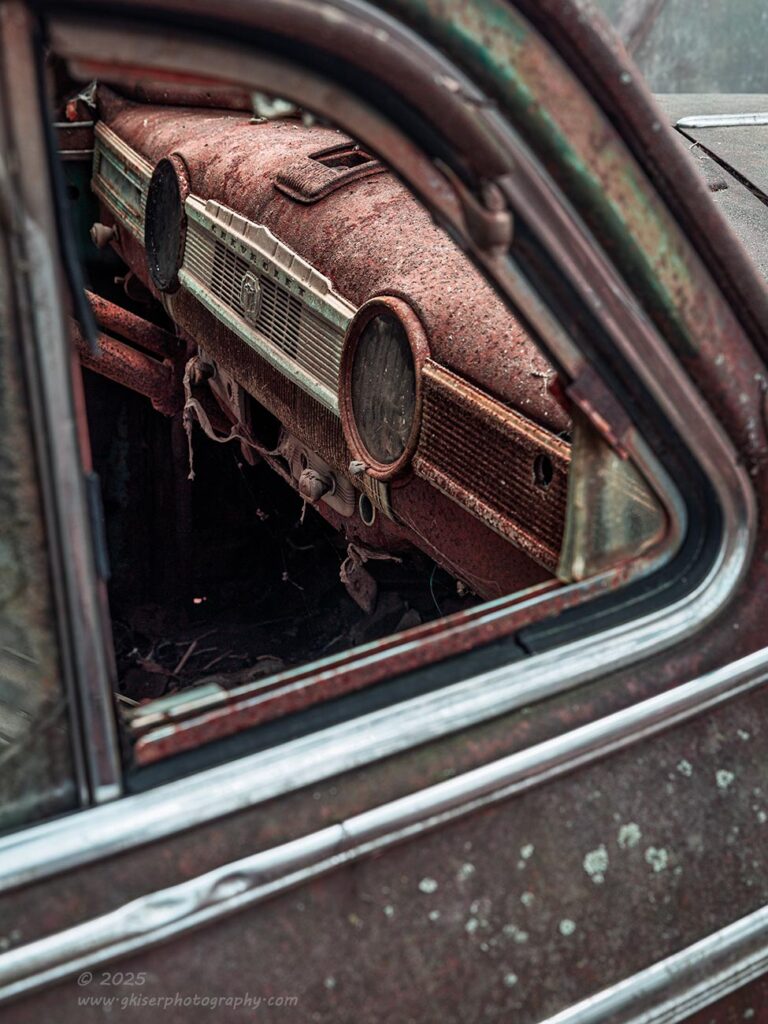
Now, I am probably going to be losing track of which car is which at this point because there were just so many of them out here that were worth photographing. I do think that this next photo comes from the same car as I was walking around and looking for other isolations that could be shot. If you have followed me for any amount of time, you know that I have a love/hate relationship with interiors of these cars. I have the hardest time getting compositions of them that work because there are always so many elements and angles going on within a car. It was just by chance that I was looking at the broken vent window on the passenger side that opened up to a view of the dash which was pretty simple. I was seeing two round displays with the chrome grill between them. The Chevrolet nameplate was present on the chrome which I thought made a very interesting subject for the photo.
There wasn’t much room to work between the two cars, but I managed to get the camera into a position with the standard zoom still attached that shot right through the vent window which contained pretty much the entire dash. It was a complex composition the way that I had it figured out originally with the windshield view included. I didn’t like the bright area pulling the eyes up, so I raised the camera to omit that part of the scene and put more emphasis on the dash. That helped a lot. I then selected a small depth of field at f/8 (at a very close distance) so that the dash was in focus, but the door was going soft. This allowed me to use the door texture and colors for a foreground without it overshadowing the dash which was the real focal point.
In post, I went one more step beyond what I had done compositionally and split the photo into two parts with the door and the dash being treated as different masks. I desaturated the door to take some of the punch out of the colors which again pushed the eyes into the frame to look more closely at the dash. The end result is one of the better interior shots that I have done, and I really like the technique that was used here. It was certainly better than I had hoped it would turn out because at the time I wasn’t convinced that it would be worth the time to shoot. I only got off three exposures as I played with the depth of field and the position of the camera. I’m glad I stuck with it as long as I did because it was the last shot that was the clear winner of the group. I can’t really think of anything else that I should have tried to make it better.
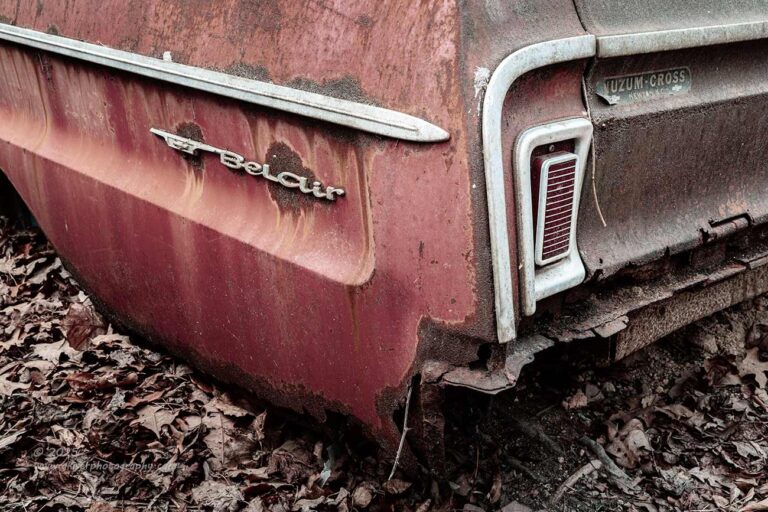
I was now starting to get in the groove of the property, and I was starting to hear how the cars were wanting to be photographed. One of the cars that had caught my eye was a red ’60’s model that was partially grounded and parked just in front of the car that I had started shooting when I got here. There was no way to get the whole car captured, but I really liked the color of it with the dead leaves. As I was looking around for different angles on the car, I found that the Belair badge was sitting in the middle of some great rust and staining on the driver’s side. With the trim right above it, I could do several different types of compositions, but I wasn’t really excited about the taillight and the rear bumper was gone which kind of made for a less interesting quarter shot. I could have done a straight on shot of the emblem with the body line framing it, but that felt kind of boring. I really wanted to include the leaves in the shot, but the emblem was too far up for that to really work from the side.
As I was looking closer and trying to figure out how to photograph this car the best, I happened to see the dealer decal on the back of the trunk which started to make a lot of sense. I wasn’t familiar with the dealership name, but I saw that it was based in Newton which was where I was standing at the moment. I’ve seen cars of this age from all over the country ending up in my back yard. It is not impressive to see something from California or Forida end up here, but it struck me as special that this car had been bought, presumably new, right here in the town of Newton. The age of the car was apparent, and it somehow seemed important to capture this story. With that sticker included in the composition, I was now thinking that I liked the quarter view shot that I had dismissed earlier.
With my newfound motivation in place, I started to frame up the shot and got everything as good as I could make it. What I found that I really liked about this composition was the fact that the rear of the car was covered in moss, rust, and dirt which started to mimic the color of the leaves. The red gave a really nice pop of color through the frame while the chrome trim added some dramatic angles to the frame. It was all working out quite well and I only needed one shot to nail what I was wanting.
In post, I decided to take the color part of the equation to a new level by using one of my favorite color profiles that really desaturates the colors and allows me to build them back up the way that I want to. By doing this, I was able to dial back the red so that it wasn’t quite so punchy and then I pulled the leaves and the rear of the trunk back quite a bit more. The resulting image has just that right amount of color to establish the different shapes and elements, but not too much as to overpower the composition. I’ve really started to appreciate this type of composition as I have progressed in photography.

At this point, I was starting to feel my inner ADHD coming out. I was just looking around for my next composition rather than fully working the car that I was standing by. I do get this way when I’m in an area with a lot of potential subjects. I don’t want to miss anything and with every new place I stand, I see the compositions differently. I was no looking at the ’46 that was originally a supporting character in the first shot I made here. There was a vine that was growing through the front of the car which was a very rich green despite the lack of rain that we have been having. It was enough of an element to kind of distract from the front of the car, but then again, the colors worked well with the rust. I thought that it was worth another look to see if there was something that I could do with it.
When I got up to the car and started to look closer, I picked out a detail that I hadn’t seen before. The Chevrolet nameplate was stamped on the bottom part of the grill, and I thought that was the coolest thing. I wanted to feature that in a photo but wasn’t quite sure how to do it. The vine was overreaching the grill where the lettering was which meant that I wasn’t going to be able to get a clear shot of that part of the car. of course, I had a knife and could easily cut the vine back, but that is just not how I want to operate. I love to shoot it as I find it and that was what I intended to do here. If I was going to include the vine, I would have to include enough of it to make sense. I started to open up the frame and eventually got a good portion of the front of the car which incorporated the vine nicely, but I had effectively lost the nameplate on the grill which was my “why” behind wanting to take the photo.
I needed to go the other way and get in closer to the main element that I wanted to include. The rust was making it hard to read, but from the passenger side, you could make out the “CHEV” at least which would then let you know what was coming. I decided to frame the shot with the grill and only a portion of the front bumper at the lower right corner for balance. I cropped in close to the nameplate at the bottom so that it would draw more attention as a framing element for the photo. The primary letters were also framed by the leaves which added some importance to that part of the frame. To balance out the composition and allow the entire nameplate to be seen, I included the arch of the grill on the driver’s side. This gave a geometrical element to the scene that I thought was quite effective for the overall look of the frame.
I liked this one but wasn’t sure if I was liking it because of all I had been through to create it. It wasn’t until I was doing the uploading of the images that Toni woke up from her nap on the couch down in the studio that I knew I had a winner. She is not all that wild about these types of photographs as she much prefers my landscapes, but occasionally she will really like one and that is usually a pretty good indication of how well the image will be received. When she woke and saw this photo, she told me it was really pretty, and she liked it. Then she went back to sleep, but for a brief moment, she told me her honest opinion of the photo and I felt that it was OK to like it as much as I wanted to. I had been working on these photos for something like five and a half hours at this point and wasn’t sure if I could trust myself to know good from a’ight. I felt that good had been achieved with this one.
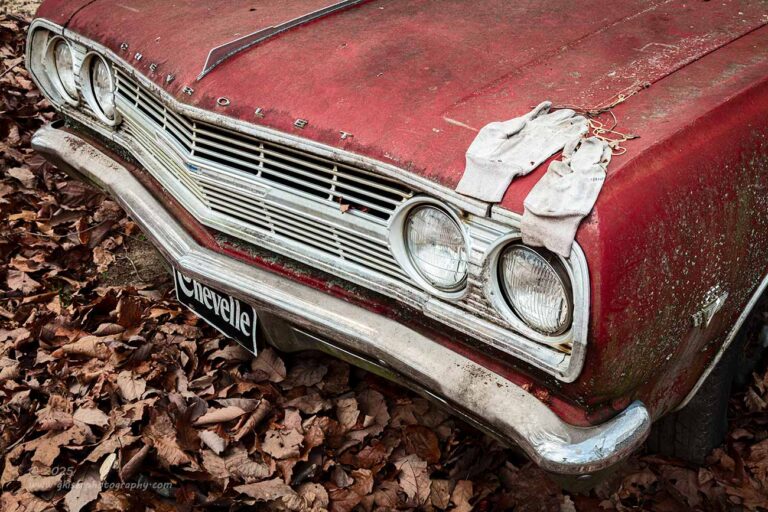
Just like spotting a shiny squirrel over to the right, my attention went back to the red Chevy that I had just photographed the rear quarter of. I knew that I liked the front-end design of the car and wanted to check it out for a compositional option. When I got to the front of the car, I noticed several different things. First of all, there were a pair of white gloves side by side on the fender. I wasn’t sure how I felt about these to be honest, but I knew that if I moved them, there would likely be a big difference in the finish underneath, and I would never be able to put them back just like this to keep that natural aging look intact. I can’t stress it enough; the minute you move something on these subjects, you have eternally messed up the scene as you can’t untouch it, and whatever you move will leave evidence that something had been there recently. The gloves were going to stay.
Other things that I noticed on the front of the car that I liked were the Chevrolet letters across the front of the hood as well as the front vanity tag that read Chevelle. There was also an emblem on the fender indicating that this car was equipped with a 283 V8. Now, I’m not really sure exactly what the car is since the quarter panel would suggest Belair and the tag would suggest Chevelle. To me, it looks more like a Belair, but for the sake of the photo, the tag was interesting and provided another visual element within the frame.
I started working out a composition which started out as a simple shot of the gloves over the headlights. I added in the fender emblem because the different angle of the fender made for a more interesting composition, however, it felt too constricted in the framing, and I was looming large in the bumper which I didn’t care for. As I tried to open the frame up, I started to include the letters on the hood which turned into a distraction since I didn’t have them all in the frame. Once again, I backed off and opened up the frame of the photo to include more and more. Eventually, I ended up with a full front end shot that also included the fender emblem. While I wanted this to me more of a direct composition, the fact that the gloves were white created a very strong focal point for the photo. They also helped to bring the attention to that little fender emblem and the long string of letters on the hood followed another bright point in the composition, so the eyes had no problem finding that element. It actually looked really good, so I fired off three frames with a slightly different angle with each of the shots. The last one was the one that ended up being the keeper.
A similar approach to the processing was used where I wanted to use a less saturated palette for the image. Instead of using the real desaturated profile, I opted for one that kept most of the original colors but reduced the contrast of the image while dulling the colors slightly. From here, I was able to work the palette to exactly where I wanted it with a more accurate depiction of the red hues on the car. The end results are quite similar in many respects, but when I was getting started, the two different color profiles fit the results that I was working towards with both photos quite specifically. In both cases, I think that the color profile chosen made getting to the final photo much more efficient which is what I like about the different profiles.

by this time, I was realizing that I was spending most of my time with just a few cars in the same area of the property. I had a lot more to go through, and didn’t want to spend all my time right here. I started working my way around all the really great examples of vehicles that were here. I had to pass by many of them because they just weren’t in a position or condition to make for a solid photograph. There were some though, which just screamed out for a chance to be photographed. One of these was an old pickup that was essentially just a cab sitting on the ground. A good portion of the grill was missing as were a number of other parts. However, I really loved how it looked. The problem was where it was parked.
Right behind the truck was a three-story building with railings and all kinds of things to distract from the truck. There were lawn mowers and other vehicles close by as well. There was really no workable direction that I could shoot the truck from which would give me a simple composition with is what I am always after. If it weren’t for the fact that I really wanted to photograph this truck, I would have moved on from it to something in a better setting. Instead, I committed to working with this one and I decided that if I just shoot the cab of the truck, I could eliminate a lot of the distractions around it and place the house in the background. For this to work, I was going to need to include enough of the house to have it make sense while keeping the framing tight on either side of the truck.
This idea worked well, but when I started framing it up, I was getting a lot of the sky above the house. The clouds were nice and would add a deal of texture so that wasn’t the problem. What I was running into was that the sky would still be the brightest part of the frame and well removed from the truck which was going to be down at the bottom of the frame. Including two layers of porch railing was also a bit of overkill and there was just too much going on with the frame which was causing the truck to get lost down at the bottom.
To rectify this problem, I decided to elevate the camera which would cause the truck to take up more room at the bottom of the frame as I would be getting the top of it, and not just the side. I also moved in closer and used a wider angle focal length which magnified the truck even more. Now I wasn’t able to capture the entire house because the camera was aimed down more than it had been. I chose to eliminate the upper story and use the second-floor railing to frame the top of the truck. This reduced the visual weight of the house and completely eliminated the bright sky above. Those two things had been in competition for the viewer’s attention. Now that they were gone, the truck was the main element in the frame thanks to the perspective distortion that a 28mm focal length will provide. When I added in the shorter 4:5 crop that made the proportions perfect.
The last part of the puzzle was to remove the colors. There weren’t that many different colors in the scene, and everything just appeared washed out when I started looking at it on the computer. I felt that the right thing to do was to switch to black and white and concentrate on the contrasts within the scene. This ended up having a side benefit which was more important than just simplifying the scene. The grill that I loved so much on the truck because of the missing slats was now mimicked in the railings with similar tonality which amplified the missing bits of the truck. With them in color, they didn’t relate to each other nearly as directly, but now that they were both similar shades of gray, you can’t help but compare the repeating patterns of one to what should be a repeating pattern of the other.
It was this image which might have been the biggest surprise of the day for me. It was an urge that had prompted me to photograph it in the first place when all logic would have dictated moving onto something else. I stuck with it and worked through all the issues until I came up with a compromise that worked out very well. The final presentation of the shot was something that I really loved and was very proud of. It just goes to show that if you listen to the landscape long enough, it will tell you exactly how to make the photograph.
I wish I had known how good that last photo was going to turn out, but I really didn’t at the time. I just went looking for something that I could do better with. I spent most of the day looking for that one photo that I could get excited about, but at every turn I wasn’t convinced that any of the photos were going to turn out as strong as what I had been shooting here recently. I have been very aware over the last few months that my creative energy has been stepped up a notch. This usually happens after an extended slump like I had all last year. I had come back much better than I was before the slump and my expectations are starting to get in line with that increase in creative vision. I don’t want to lose that, so I am constantly pushing myself to continue with the accelerated improvement.
One subject that I had seen during the tour was a tow truck parked beside of one of the buildings. One of the things that I liked about it was the blue tarp that was draped across the front. As I’ve recently learned, those blue tarps can provide some really great color contrasts to the rust. I wanted to get a photo of this truck with that tarp, but there was so much in the scene that I didn’t want to include that I was having a very hard time resolving the composition in my head. There was just no angle where I could get a clean photo of the truck, and that was what I really wanted.
In order to let things rattle around in my head for a while, I decided to look for some isolations that I could shoot easily. I walked around the truck and found only a few aspects that I really liked in terms of isolations. The grill struck me as interesting, but it wasn’t until later on talking with the owner that I realized why it was interesting to me. All the slats were horizontal on this GMC, as opposed to the main section being vertical on the Chevrolet. Sadly, I wasn’t able to get a composition that I liked to showcase that aspect of the truck.
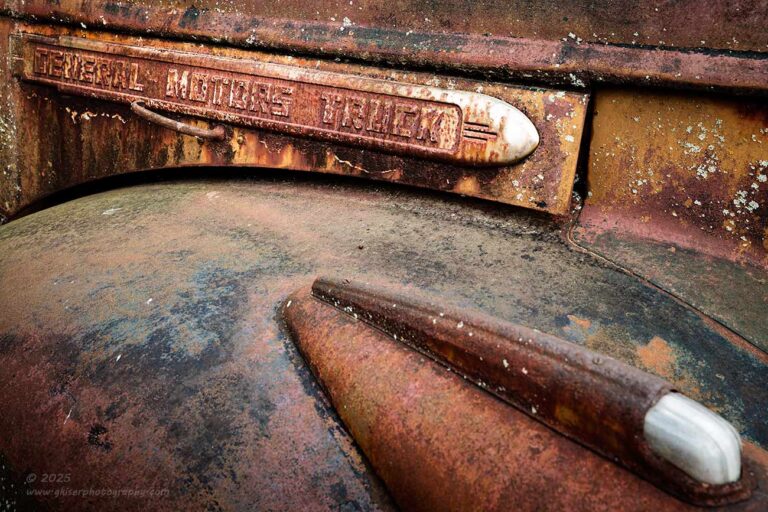
I did get a portion of the grill when I went with an old standby composition that I have used many times with this bodystyle truck. I focused on the headlight (big surprise there) which was on top of the fender which allowed me to get the edges of the grill, but the main thing that I wanted to capture was the long emblem on the side of the hood that read “General Motors Truck.” This was the first time I recalled seeing that emblem and I really wanted to capture it. The composition that I set up was effective at including that aspect of the truck, but looking at it on the back of the camera showed some issues. The primary issue was that the light was just so big in the frame that it took all the attention away from the emblem even though it stretched for about 14 inches in length.
I needed to do something about the scaling in order to get the attention to where I wanted it. I could have used the telephoto lens, but I knew that depth of field would be an issue with that lens, and I still thought that the light was going to be too large in the frame. I also had the idea to get in closer than I was and use a bit of perspective distortion to really make this an abstract looking composition. My thought was to omit the headlight and use the fairing to provide interest on the otherwise very large fender. This would all lead the viewer to the side of the hood and the emblem that I was wanting to focus on. The colors were looking really good here as well which got me excited about the composition.
As I was working through the different angles that I could shoot it from, I started to see how the marker light was affecting the composition. I had originally thought about omitting it because having something bright at the edge would typically be a distraction. However, what I was finding was that if I placed it near, but not touching the corner, it didn’t pull the eyes out of the frame. What it did do, was draw attention to the leading edge of the badge that I was photographing because of the similar bright tones. By limiting the depth of field, I could blur the light slightly which would push the eyes back to the badge which would be tack sharp. It was just a trick to get the eyes to track through the image the way that I wanted them to, and it worked so well.
In fact, this was one of those photos that I ended up loving for the design of the composition and colors that were in the frame. It checks all the boxes that I wanted from this subject and the end result is something that has the perfect visual balance throughout the frame, and tells a complete story, while keeping the actual photograph a rather abstract rendering of the subject. I really and truly love this composition and will be keeping it in mind for the next time that I run into the possibility for using it.
The question is, was I able to figure out a composition that would include all of this tow truck, or would I have to be satisfied with getting this one isolation off of it? We are going to have to wait for the next part of the blog which will be published sometime on Monday.
Thank you for joining me for this portion of the trek and for reading along to this point. I do hope that you have enjoyed the photography as much as I have enjoyed creating it. If any of these photos resonates with you, don’t forget that you can order prints which will allow you to really see the photo in all its glory. What you are seeing here is such a small and low-resolution image that you just can’t really appreciate all the detail that is here. Not only have I resized the images to a quarter of the original pixel dimensions, the compression of the jpeg images is usually around 19-30% of the uncompressed file size. That affects colors, gradients, and even detail. There is no replacement for a full resolution printed image, and I would love to match you up with your very own print.
I’ve also got an upcoming workshop dealing with this very type of subject that is happening in mid-May. You can learn more about my always popular decay workshop by clicking this link which will also let you get signed up to reserve your spot. I really hope to see you there!
Be watching tomorrow for the next part to be published. There are still a lot of really great images to come.
Until tomorrow….