Wednesday, September 17, 2025
When we last spoke, I had gone out to Yadkin County to photograph a feed mill that I had shot several times before. I mentioned that was one of the options of where to go and I had another one which was up on the Blue Ridge Parkway. That location was in Blowing Rock and was a spot that I had shot a number of times before. The odd thing was this spot wasn’t an overlook, or even a well-known place. In fact, it was a field where cattle grazed off and on through the years. There is a barbed wire fence not far from the roadway to keep the cattle in the field and to keep explorers of the Parkway out of the field. I really wanted to try a panorama there, but decided that the weather wasn’t going to support that option and I was going to have better luck with the mill in Yadkin County.
Well, if you read that blog, you will know that I blew that choice and wasn’t able to access the field where the mill was situated leaving me hunting for something to photograph through the best light of sunrise. I regretted not heading out to the mountains, but in the grand scheme of things I was fortunate to be where I was so I’m not complaining. However, this morning, I had some time to go out and get some more photos and looking at the weather, it was looking like there was going to be a potential for a colorful sunrise in the mountains. I didn’t have to think about where I wanted to go as I just knew that I wanted to go back out and try that one viewpoint again to see if I could get the shot that I had in mind.
I still remembered all the details about how early I was needing to get up and when I needed to be on the road. I just needed to get to bed at a reasonable time which would be no problem under normal circumstances. However, Toni and I had spent the day in Winston doing to doctors for her eye and we got home shortly after 7pm. The miles had reached a point on her car that I needed to do the scheduled maintenance on it before she went to work this morning. That was going to take a little bit of time, and the fact that I was doing it in less than ideal light made it take a bit more time that normal. By the time I was all wrapped up with that service, it was 9:30 which gave me time for a shower and got me in bed at 10 which was about perfect.
It would have been perfect if I could get to sleep. I didn’t give myself time to relax after doing all of the work on the car and I think that affected my ability to go to sleep. It seemed that I was up the majority of the night, but I tried to rest the best that I could knowing that I was going to be getting up at 4am to get ready to head out for sunrise. That alarm came awful early in the day, and Toni’s went off at the same time. Neither of us wanted to get up, but she had to, and I needed to. Eventually duty prevailed and we got up. Before I got my morning stuff started, I went out to adjust her tire pressure since they were still warm after I was done with the service, and I wanted them to be right for her to drive on. When that was finished, I went about my morning posting and checking of the finances before I loaded the truck and headed West at around 5:30.
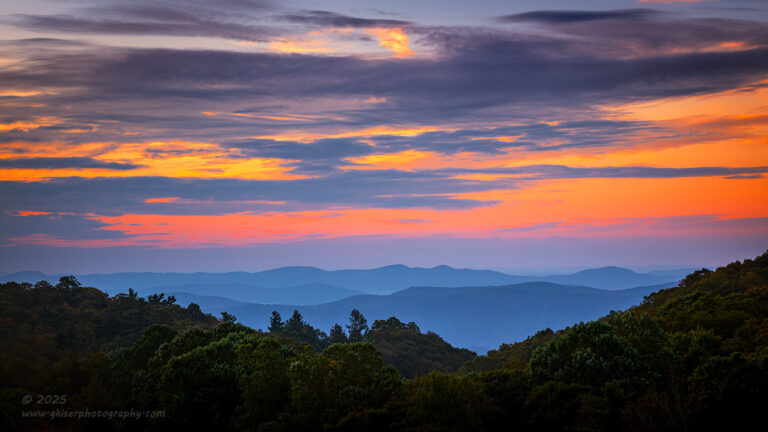
I got to my spot just under an hour before sunrise which was perfect. It would give me time to make sure that the cows weren’t going to cause me any issues as they had before. I was happy to see that they were grazing on the opposite side of the Parkway this time and I got out to look at the conditions. The moon was bright in the sky above me indicating that there were no clouds to be had overhead. Looking out in the distance, the only clouds were the ones right at the horizon and there wasn’t much depth to them at all. I was starting to doubt that color was going to be a possibility for the morning. I did see the rolling mountains in the distance which was a part of what I was wanting to see, and there was always a chance of color in the sky as long as there were some clouds. I knew that my pano wasn’t going to work because for that, I was going to need a good deal more sky involved in the light show at the start of the day. What I was looking at was going to force a very telephoto shot of the distant mountains to keep the scale of everything in balance.
While I was looking at the scene before me, I was taking note that I was shivering, and my arms were full of goosebumps. I had noticed that the thermometer in the truck was showing 48 degrees when I stopped which was about six degrees cooler than I was expecting. The temperature would have been fine had it not been for the wind which was rather lively. It was a very cold wind, and I was wishing that I had my jacket with me. Sadly, it was just too early in the year to think about taking a jacket, but here we were….cold. I’ll bring it along next time.
Since I was cold and the light was still rather dark, there was no sense in sticking around in the wind, so I climbed back in the truck to warm up. I waited for the light to improve a bit before going back out and putting the camera together. I built it with the 70-200mm lens but didn’t use the extender even though I thought I might need it because of how little of the sky the clouds were taking up. I didn’t add any filters because a shot like this benefits from the foreground being in shadows with the rolling hills taking on an ethereal quality. I didn’t need to balance the exposure and since I was basically shooting into the direction of the sun, there was no need for a polarizer either. This would help me keep a faster shutter speed which might help to freeze motion from the wind once the light picked up a little bit more.
I found a composition that I liked which included the section of the sky that was interesting as well as the mountains and the foreground trees. I was at roughly 135mm, so that was a sweet spot for the lens. The first exposure worked out to be 30 seconds which was plenty to determine what I was working with in terms of light since I wasn’t able to see much at all at this point. When the exposure was done, I could see a hint of color in the sky, but the clouds were all still very blue and not picking up any color at all. I continued to make exposures as the light built up and after eight or so frames, I was starting to feel good about this composition.
As the light changed and the clouds moved, I was able to broaden the composition a bit and change to a 16:9 aspect ratio in camera to take full advantage of the length of the misty, rolling hills in the distance. This allowed me to avoid getting the blank sky above the clouds while keeping the horizon away from dead center in the frame which would also force me to include too much of the dark foreground. It was all a balancing act, and I changed things up occasionally to take advantage of the conditions. I was looking at the clouds and trying to figure out the movement that they were going through, but there was really no direction to the movement at all, they were just fading away in places. I had hoped to be able to do a long exposure and show some blurred motion in the clouds for a bit more excitement, but they weren’t moving at a rate that would have worked for this technique sadly.
I was pretty much stuck with a standard, single frame exposure with nothing special about the shutter speed. It was a bit of a letdown for the morning, but at least I was able to get to the spot that I was hoping to photograph unlike Monday morning. I held out hope for nearly 40 minutes during which time I shot a total of 30 frames of the same basic composition as the light changed. Right about the time that the sunrise was supposed to be happening, the colors faded slightly, but I was holding out hope that when the sun came up that it might hit some of the higher clouds in the scene. It didn’t really do much in the clouds, but by underexposing the photos, I was able to get a good deal of saturation in the sky behind the clouds which gave me that balance between cool and warm tones. Of course, it was looking rather blah in the camera because of how I have it set up to ensure that I get the most accurate histogram for RAW file exposure. I was seeing a washed out scene with no contrast or saturation to speak of on my LCD which was disappointing to say the least. Occasionally, I would shift the picture style to landscape just to see what it might look like with some color in the scene. It wasn’t great, but it held some promise.
After the 30th frame, the light started to fade again, and the clouds were dissipating at a quick rate as well. I figured it was time to call it a morning and pack things up before getting the heater running in the truck. I wasn’t sure if I had anything that would be any good, but I had given it a try. It would be hours later before I got the images into the computer to see what had been recorded. You guys have the benefit of being able to take a short side trip into the future to know what worked out of the run of images. Remember, I had shot 30 frames from the first to the last of the sunrise. These exposure times ranged from 30 seconds to 1/10 of a second which shows just how much different the light levels had been. Ironically, most of the photos looked the same with the only difference being the cloud positions within the frame and the framing of the image which varied slightly through the morning. The one that seemed to be a little different was the last one when the light was getting brighter and I was able to see more of the detail on the foreground trees. While this wasn’t really the look I had been going for, I decided that I liked that bit of texture and the clouds had a more interesting pattern at this point, so this is the one that I ended up keeping. So after nearly 40 minutes and 30 frames shot, it was the very last one which I liked the best. I could have spent a whole lot less time in the cold and just popped out for that last bit of warm light. You just never know with sunrises though.
Back in real time, and on location, I was pretty sure that I had one, and maybe two images from sunrise that would work out. It wasn’t enough to satiate my creative urges for the morning though. I needed to find something else to shoot. Looking around, there seemed to be some more clouds to the South and that was where I decided to go. I ended up at Price Lake and hadn’t found anything else worth my time to photograph. The light was getting kind of harsh, so I decided to head back the way that I came and start back down the mountain. My plans were to head out to Yadkin County again and see if there were more clouds there which would let me work the barns that I had found on Monday.
After changing direction, I started to see some really beautiful beams of light coming through the trees with a slight fog around Cone Manor. I saw one area where I could get a composition, and I pulled off the road to get the camera. By the time I got out of the truck, the light had changed, and the beams were gone. There was just no way to get it captured without having the camera at the ready. I considered waiting for the next time the sun came out but decided against it. Now that I was looking at the composition critically, there were some issues with it, and I didn’t like how the flow of it all went. I just continued on down the road to see what else sparked my enthusiasm.
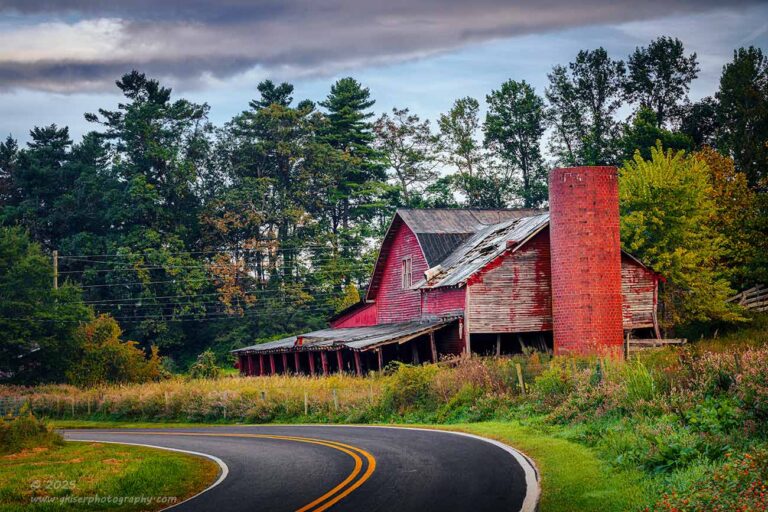
When I came up to the barricades closing off the Parkway at Old 421, I exited without finding anything else to shoot. I was pretty sure that Yadkin County was going to have better clouds and better light, so that was now my destination. However, as I was going down Old 421, I spotted an old red barn that I had shot a while back after doing a sunrise on the Blue Ridge Parkway. I knew that this wasn’t the easiest barn to photograph, but the light looked good on it, and I was now in the mood to shoot some barns. I figured I would drive by and get a closer look at it. It was very similar to how I remembered it with some machinery on the far side of it along with power lines running by that side of the scene. The barn was positioned right at the road, and I remembered what I did with the road last time was to shoot from across the street and get low enough that the road disappeared from view making it look like the barn was in a field. That also helped to mask some of the distractions that were around the barn at the time. This time, I wanted to include the road as another element to the scene. That got me excited to give it a try, so I pulled into a parking lot and grabbed the camera.
I started out with the telephoto lens to minimize the background elements in the scene as that was what I had done before. I set up on the opposite side of the road as I had done before but got the camera much higher in the sky so that the road was included in the frame. I already had the polarizer attached, and started to get the exposure settings dialed in. I realized that there was a lot of latitude to the exposure of the scene, and I didn’t see any reason to push the pixels that far to even it out. I just ran back to the truck and grabbed my 3-stop grad filter and slid it into the filter holder. Now the histogram was looking much better, and I was able to get the shot that I had set up with plenty of information in the shadows and highlights.
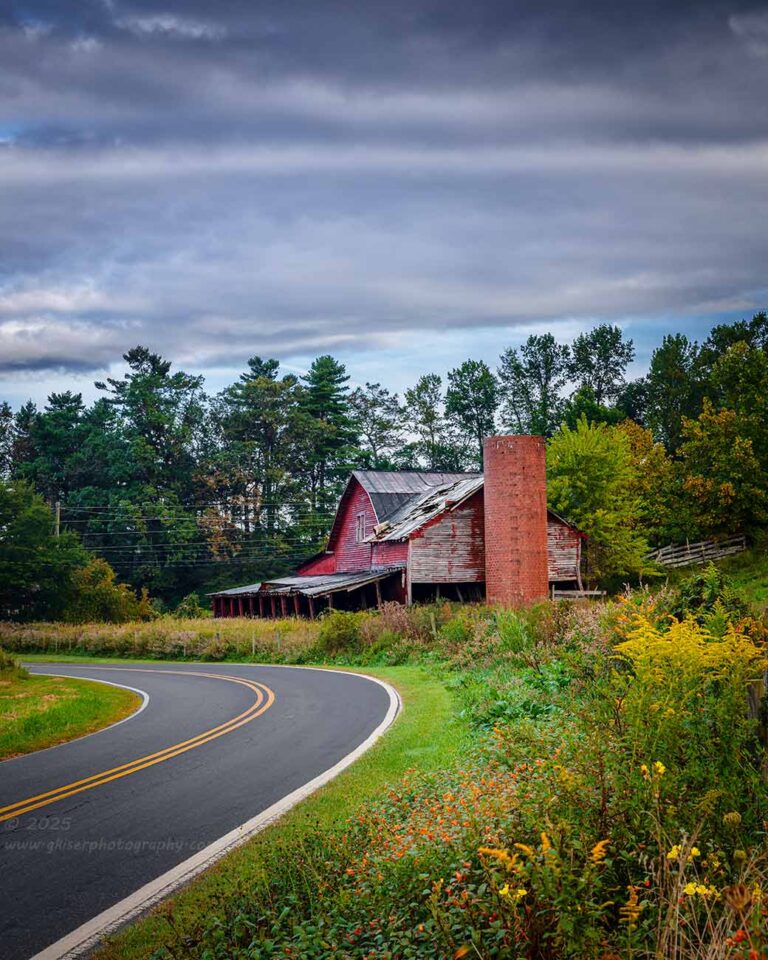
As I was looking at the image on the image review, I started to realize that there was another way of shooting this composition and that was to include the clouds above with a bit more emphasis. I flipped the camera on its side and tried to frame up a vertical shot. It was just too narrow, and I didn’t want to back away any further than what I was. I decided to go back to the truck one more time and swap lenses for my standard zoom which would give me a wider angle focal length.
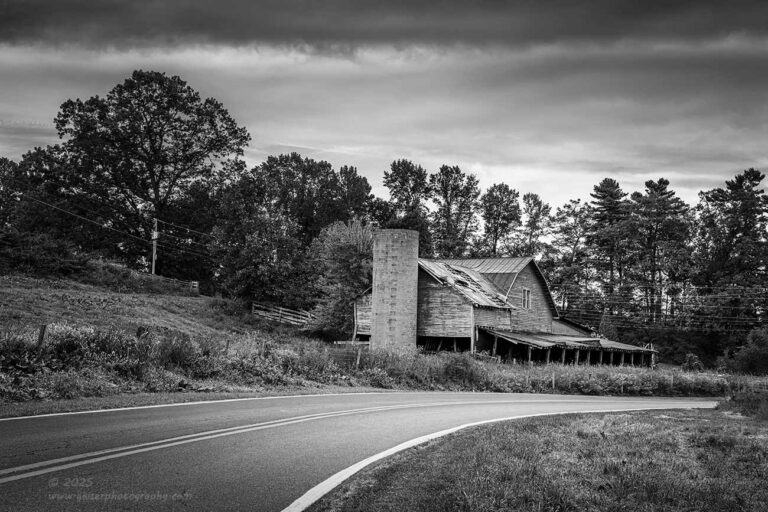
Once I swapped out the glass, I went back to where I had been and started to make exposures vertically. This was working, but I didn’t like how the image was reading with the shape of the road. I went back to the other side of the road and worked out the vertical shot with the roadway hooking in from the left and taking your eyes through the bottom of the frame to the barn. This worked out much better and I was liking how this was looking. The problem that I was having here was that the wind was blowing the vegetation along the side of the road, so I had to play with the shutter speed and ISO to get the right setting to freeze the motion. Eventually, I landed on a combination that worked, and I had a composition that was working as well.
One thing led to another, and I realized that I liked the idea of having the wider angle lens here and that it wasn’t necessarily a bad thing to include more of the setting of the barn. There wasn’t much I could do with the front of it because of another barn on the opposite side of the road, but I could include more behind the barn which wasn’t looking too bad. There were more power lines and a power pole back there, but they helped the lines that were running along the side of the barn make more sense.
Yes, I hear you saying that I could just remove them in post, but there were a lot of them and I would have to create a lot of pixels which I don’t like to do. There are always clues left after objects have been removed. They don’t tell you about that on YouTube, but I’ve seen it nearly every time I’ve removed a distraction which means that I would much rather shoot around a distraction. In this situation, I was unable to shoot around them, but since they weren’t out in the sky, they weren’t creating a highly visible distraction. They were just kind of there and I was happy to leave them there as they are less problematic being seen than they would have been had I taken them out.
Anyway, I liked how the photo was looking, but it was reading incorrectly just as I had determined a short time before with this lens from that side of the road. Looking at the scene, there was nothing which would give away the direction of the frame, so I figured I could just do a quick flipping of the image to arrive at a better direction for reading. Once I did this, the photo fell into place quite nicely, but the colors were not working in the broader scope. I decided to make this one black and white because I thought it worked better, and it would allow for some variety in the photos that I had shot of the barn.
It was during this portion of the morning that an SUV pulled up beside me and I greeted the driver with a happy “good morning.” She responded quickly and got down to the business at hand. She asked, “and what are you doing?” Now, keep in mind that I am right on the shoulder of the roadway, in full view during the daylight with a camera on a tripod. I fought the urge to respond “what does it look like I’m doing?” which honestly would only have one possible answer. But I bit my tongue and played nice answering that “I am taking pictures.” Under my breath, I thought to myself “…but I’m sure that fact is quite obvious.” She responded with a simple “oh, ok.” and she drove on. I was really expecting something more the way that she had approached me, but apparently my answer was good enough.
Odd interruptions aside, I had been out here for roughly 20 minutes at this point and had shot an additional 20 frames for the morning bringing my total up to 50 so far. My hit rate had improved a good deal now that I wasn’t trying to nail the exact right moment of light and color. The light was much more constant now and I was pretty sure that I was going to have a couple of keepers from this series of photos. It was time to move on if I was going to get to Yadkinville in time do much before the sunny part of the day came to reality around noon.
All the way down the mountain, I was watching the clouds and was really wondering if Yadkin County was seeing the cloud cover that was forecasted. When I got through Wilkesboro, I started to have serious doubts. Most of the clouds were looking like they were to the North and that wasn’t where Yadkin County was located. I started to think about heading up to Doughton Park and working some photos of the Lodge since I had been out there recently scouting it for a portrait session. That should be in the clouds, but I wasn’t quite sure just yet. I stayed on US 421 for a bit longer to make sure of where I needed to go.
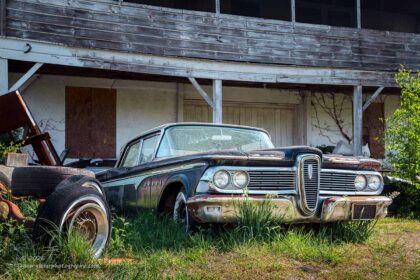
As I was approaching the Eastern side of Wilkes County, I decided to give up on Yadkin County because the clouds were few and far between in that direction and they looked better to my left. I exited on the road that I had come through after my morning in Yadkin on Monday. I had spotted a few locations that might be worth stopping at on that road. The light was good here even though the sky had more blue than I was hoping for. When I came to the first location, I could see the large brown car sitting in front of the shop that I had stopped at in probably 2020 when I was first exploring the area.
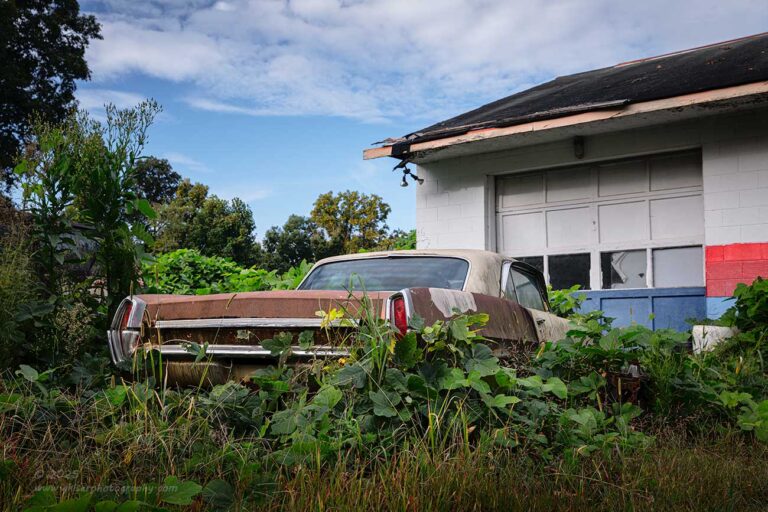
Back then, the shop was possibly still being used and there was an old Dodge on the side of the building that I ended up shooting. That Dodge was long since gone, and the parking lot had all grown up with weeds and the building was obviously no longer in use. I pulled off on the shoulder of the road in what used to be the parking lot and looked for any signs indicating that I shouldn’t be here. There were none and I decided to give the car a try. It was largely overgrown, but there was enough of it visible to provide a shape and a bit of a story. I started out with my standard zoom and a polarizer for a bit of flexibility. There wasn’t much on the car that I wanted to do isolations of because of how grown up the surroundings were, but I was happy to shoot the car in its natural habitat.
I started out nice and low, behind the car with a portion of the building giving a sense of location and to balance out the deep vegetation. It was a simple composition and one that I wasn’t quite sold on being successful since there wasn’t much of the car visible from this angle. I needed to be this low to mask the van that was parked next to the car, but I didn’t think it was working. I repositioned and found a more expected composition that was from a higher vantage point and found that I could include more of the building. The van is barely visible here as I have now hidden it behind some tall weeds between the car and the van.

As I was figuring out the boundaries of the photo, I was trying to figure out how much of the building to include. At the point in the one bay door where I was looking to cut the frame, there was a sign warning of a dog. I tried to crop the frame with it and without it. I ended up liking it better with the sign as one more point of interest on that right side which provided a framing element that added to the story of the photo. This also allowed me to include the tree that was behind the shop for a bit more framing to the image as it bookended the tree to the left which framed up the sky quite nicely.
I liked how this composition was coming along and felt that it had more potential than the lower shot. I worked with this one for a while and actually got about four frames as I dialed in depth of field and precise framing. Ironically, when it came time to cull the images, all of these were cut after the first round in favor of the lower vantage point shot which was a surprise keeper for me. It was the only frame that I had shot of that specific composition as I spent more time with the camera elevated and slightly further back.
It wasn’t until I had finished editing nine images that I went back through the discarded ones for a second look. I still liked the sign on the door, but the composition just wasn’t strong enough when viewed on the big screen. Not wanting to dismiss it so quickly this time, I started to change the aspect ratio to put more emphasis on the parts of the composition that mattered the most. When I selected a 16:9 aspect ratio, I was immediately rewarded with a much stronger image than what I had started with. I started to work an edit on this, but I didn’t want a standard edit to be done with this one. With the color tones that were present I decided to go with my desaturated color profile and build up the colors specifically as called for by the entire scene. It slowly came together and turned into a photo that I actually liked better than the one that had caused it to be discarded originally. It was another reminder of the importance of going back through the discards before deleting them from the disk.
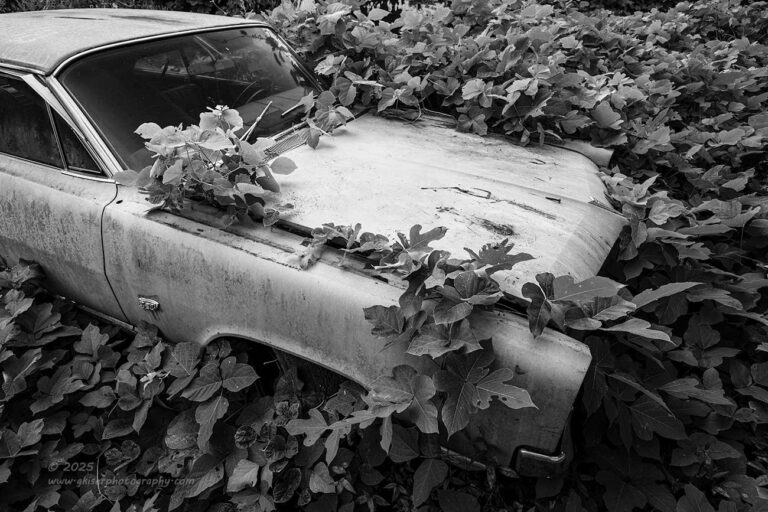
By this time I was actually quite curious about what kind of car I was photographing. There were no emblems on the rear of the car to tell me anything, and I wasn’t picking up on the styling cues from the rear to indicate anything. I started to look at the front which would give me a better idea. The first thing I saw was the 421 emblem on the fender which wasn’t a motor that I was familiar with, but when I saw the corner of the fender with the housing for a stacked headlight, I knew I was looking at a Pontiac. I then saw the arrowhead emblem on the hood which confirmed it. I’m still not sure what model this is and am not inclined to do the research on it, so if anyone knows off hand, let me know.
Now that I was up at the front, I wanted to capture a photo of the fender emblem. I got down low, but things just weren’t working out for me since so much of the interest around the emblem was vegetation. There wasn’t anything on the fender to balance the textures with and the photo looked very awkward. I did shoot it though, just in case my opinion changed when I saw it on the computer. It didn’t change, but the next thought that I had worked out nicely.
Since the car was basically buried in the vegetation, it made for an interesting composition as a whole. There was plenty of balance thanks to the overgrowth on both sides and through the open hood. The problem was the van that was parked on the driver’s side of the car and visible from this angle. I tried to work out a composition with the camera positioned as close to the building as possible and elevated to avoid the van. This lens just wasn’t wide enough to do quite what I needed it to do. There was no other choice but to go back to the truck and swap out to my wide-angle zoom which I am using more and more for this type of photography.
Once I had it swapped out, I was back to the place I had been and found that I was now able to frame the front of the car the way that I wanted to before. I didn’t get the entire car, but that wasn’t the point of this composition. The only thing that I wanted to capture was the front of the car with the windshield and the vent window. I just wanted to be able to show the way that the weeds had taken this car over. In a few months, none of this will be here and the car will be fully visible and not nearly as interesting as it was appearing at the moment.
With the car a beige color and the vegetation a yellowy hue of green, I was pretty sure that this was going to be best done as a black and white image. I even set the camera up to show me how this was going to look with a red filter applied. I liked the contrast and the juxtaposition of textures between the smooth, faded paint and the more active texture of the vegetation. There was plenty of contrast in luminance between the colors as well which added to the visual interest. The end result of this photo was better than what I had expected when I shot it.
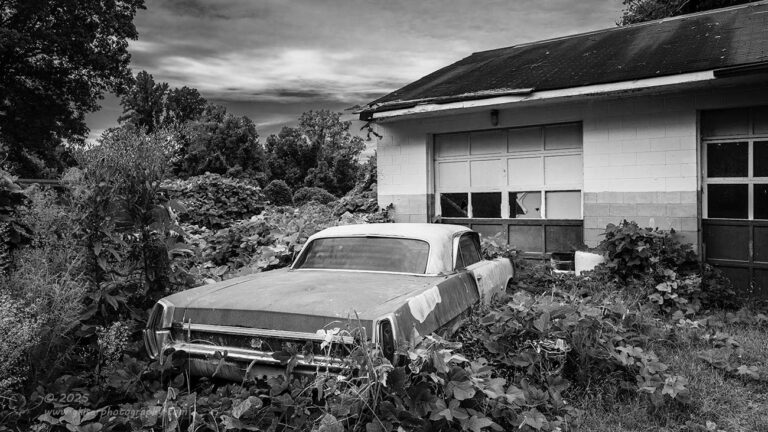
Now that I had the wide angle lens attached, I moved back to the rear of the car to see if I could go another version of the composition from that back corner. This time, I concentrated on the size of the trunk which almost looked as big as the bay door of the building thanks to the lens. I omitted the sign about the dog here because I didn’t need to include that much of the scene with this particular lens in order to get more of the sky. I liked how this one was coming together, and it looked really good on the back of the camera.
It even held up and looked good on the large monitor and became one of the first images that I edited. It started out as a color image, and I was pretty happy with it as I moved through the other edits. As I was coming to a close, I pulled in that one discarded photo that I’ve discussed and did a full treatment on it. I found out that I liked that one better than the others that I had already edited and felt that it was very similar to this last one that I had shot and had already processed. I tried figure out which I liked better and honestly thought that they were both really strong compositions, but the late addition was a bit better in terms of how the colors were represented. I knew that the scene worked in black and white, so I looked for a black and white color profile that would work with the processing that I had already done so I could just tweak it a bit more.
I was able to find a profile that worked and made the conversion before doing some final adjustments to the different modules within Lightroom. The end result was one that I actually liked better than the color image and the black and white profile made it easier to get a more interesting sky overhead. So essentially, this photo saw two different edits done to it before I landed on the version that I liked best out of them both. It also gave me a bit more variety in the processing of the images from the rear of the car.
I had spent about 20 minutes shooting here and had exposed a total of 17 frames of this scene. It was more than I had expected, and I was finally feeling like I had seen a productive day. I loaded the camera back up in the truck and started back down the road happy to head home at this point. I just followed the same route that I had taken on Monday in case something else jumped out at me. There was one more location that I thought about but couldn’t remember what I had seen. I just hoped that it would spark my memory when I saw it if it was meant to be photographed today.
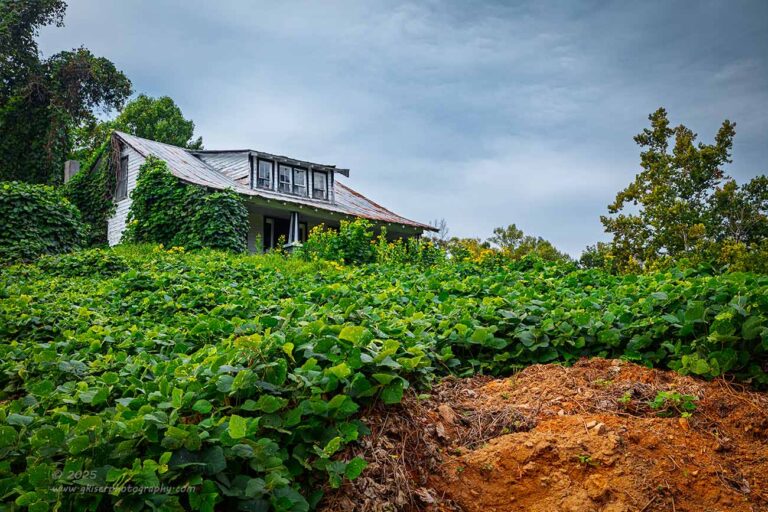
Sure enough, I spotted the house on top of a hill that was covered with vegetation very similar to the parking lot that I had been working in. The house was pretty much covered, but enough was sticking out to be visible in a photo. I pulled off the road and started to really look at the house critically for the first time. The sky was about right for what I was wanting as there was a lot of texture in the vegetation which meant that I wanted a less textured sky. It was looking pretty good for an attempt, so I got out and grabbed the camera.
For this one, I wasn’t sure whether I would need the telephoto lens, or the standard zoom. Since I was wanting to get a bit of the sky in the shot, I decided to go with the standard zoom which would give me a bit more breathing room around the house. Once I had that lens on with a polarizer, I started working my way around the base of the hill to get the right perspective on the house. I ended up getting closer to the hill than I suspected just to let the house loom larger than life above me. To break up the green, I made sure to include an area that was bare dirt which also gave me a touch of warm color tones for the scene that was largely cooler hues. This gave a much needed color balance which allowed me to do this photo in full color rather than black and white.
There wasn’t much wind, but since I had large leaves in the foreground, I wanted to make sure that nothing blurred, so I boosted the ISO once again and got a fast enough shutter to make sure that everything was frozen in the frame. I changed up my shooting location a little bit here and there to get the right visual balance with the bare dirt in the foreground. There were a total of nine frames shot here with the keeper being number seven. The last two included a bulldozer that was at the base of the hill, but I decided that it really played no part in the story of the house. The color was nice, but in the end, it was going to fail to serve a real compositional purpose.
After about 10 minutes, I was done with this scene and had brought my daily total up to 77 frames. I initially had nine keepers out of those 77 frames but then added the one with the Pontiac back in for a total of ten. As I went through them all one last time, I looked at the two sunrise images and felt that they were just too similar to one another which made me choose between them both. The earlier one was ditched in favor of the one that had a bit more detail in the foreground and some more dramatic color in the sky. That brought the total back to nine keepers which was plenty from the day. Even though my hit rate had been lousy for the first 30 images, my overall success ratio was right where I’m used to it being.
Thank you for joining me on this trek and I hope that you have enjoyed the photos from the day. There was a little bit of everything in this batch from landscapes to old barns, old houses, and even an old car in front of an old shop to round things out. I think I’ve covered everything in my landscape and decay repertoire in this one trek. If any of these images jumps out at you and speaks to you, please consider purchasing a print. Not only do you get a unique piece of wall art to enjoy for many years to come, but you are also helping me to afford these travels to get the photos that I share here in the blog. It is a great way of supporting my photography while getting something nice for yourself.
Until next time…