Tuesday, May 13, 2025
The weather this week was pretty much going to be a washout for the first three days with some heavy rainfall coming through North Carolina. With that in mind, I was all set to sit back and watch some television and wait for the yard to dry out so I could mow it later in the week. Monday was pretty much that washout with constant heavy rain through the day. The forecast beyond that was calling for more rain through Tuesday, with some breaks in the precipitation coming on Wednesday. With all the rain that had fallen, I started to think about getting some waterfall photography done. My main goal was to get out to Big Creek near the Tennessee border, but the weather that way was not looking all that great with more sun than I would have wanted once the rain stopped. There was also the issue of getting there as my navigation app was showing the route from the highway to be closed from the hurricane presumably. It was kind of a moot point after seeing the amount of sun that was expected. I needed an alternate plan.
One of my more frequently visited locations for waterfalls has always been Hanging Rock State Park and that was where I started doing waterfall photography many years ago. There are something like seven different waterfalls in the park, most of which are right there in the main section. I haven’t been out there after a heavy rainfall like what we have had and that kind of got me excited over a few of them. Looking at the weather, the clouds were going to be right for a trek out there on Wednesday morning with more rain and thunderstorms coming in the afternoon. That was certainly workable, and I would have time to get in the proper mindset to work scenes that I have done many times over in the past. It would also give me a nice relaxing day for Tuesday where I could either watch some television or try to extract a stubborn bolt out of the truck so that I could get a gas tank skid plate installed. It would be a low-key day no matter what with another day of rainfall coming.
Well, I had planned on sleeping in a bit since I didn’t need to get anything important done, and I did just that. I started to wake up around 8am and decided to check out the weather since I didn’t hear the rain falling outside. It was showing just cloudy, and that was supposed to continue through until early afternoon. Hmmmm, not quite what I was planning, but this might mean that I could go out for some photos today instead of waiting till tomorrow. I checked the forecast for Danbury which is where Hanging Rock is located. It was currently cloudy, but there were much higher possibilities of rain through the morning and afternoon. It was still looking like Wednesday was going to be the better choice for me for that location.
There was also Stone Mountain which was pretty much local and also housed another waterfall that I love to shoot. Widows Creek Falls is one of those really interesting waterfalls that looks like there is a skull behind the water. I’ve shot it with very little flow and what I would consider a normal flow of water but had never really messed with it after a heavy rain. I knew that it would lose a lot of its character with a lot of flow, but I was curious to see what I could do with it. I checked the weather for Traphill and found that it was pretty much what I was seeing for home with cloudy skies until early afternoon when the storms were supposed to start up. I could actually get out there with plenty of time to work the waterfall if I skipped my morning routine and just got dressed and ate.

It didn’t take me long to get ready to head out and I was on my way to Stone Mountain. The trip started out very promising with great clouds and wonderful lighting. However, by the time I got to my first turn, I was seeing bits of blue sky above. Within a few miles, I was seeing bright light over the landscape which is the death of waterfall photography with the bright highlights. There were still plenty of clouds above, so I was hoping that I was going to be able to get some nice, diffused light from the clouds when I needed it. I was out, so there was no reason not to continue on with the trek and see what I could do with the waterfall. It would be nice to see it again anyway since it has been a while.
It didn’t really take all that long to get to the park and to the waterfall within. The hike was even quicker. I think I timed it on a workshop one time, and it turned out to be a 30 second walk from the parking lot. Basically, in the time that a commercial takes, you can be in a position to see the waterfall. It was hardly considered a hike, but there are some sketchy areas with the wet rocks which makes it a little more than a quick walk. There were a few things that I took notice of when I got there. First of all, the water was really high, and I was not so sure that I wanted to walk across the stream to get to the other side where I am usually positioned for photos. Second, there were a few trees that had fallen, one of which was right in the middle of the waterfall. Speaking of the waterfall, there was a lot more water coming down the face than I was used to. This took out a lot of the structure and made the waterfall more of a waterslide which is not really one of my favorite types of waterfalls to photograph. All that put together might have made me turn around on another day, but I decided to stick it out and see what I could do with this one.
When I got up closer to the falls, I checked out the area that I normally cross. It was up high, and the water was flowing with some force. Knowing that on a normal day, the water is up over my ankles, I felt that I would end up getting my feet wet through my tall boots. That could have been tolerable, but the force of the water was looking like something that might cause me to lose my footing which I wasn’t prepared to deal with. My camera might be old, but I really don’t want to ruin it by dunking it in the water. I had to make a choice about where I wanted to set up and if I wanted to try an alternate crossing to get over to the other side.
The more I looked, the more I wasn’t all that concerned with getting over to the other side. There was a low branch that was blocking the angle that I would have been shooting. With the fallen tree in the waterfall, I felt that my typical angle might not be all that flattering for a photo. The side that I was on was a bit more direct and tended to flatten out the falls, but without the detail in the water, that didn’t matter as much to me. There were some other aspects that I could play with on this side which made me pretty confident that the correct decision would be to stick to this side of the water and work what I could from here.
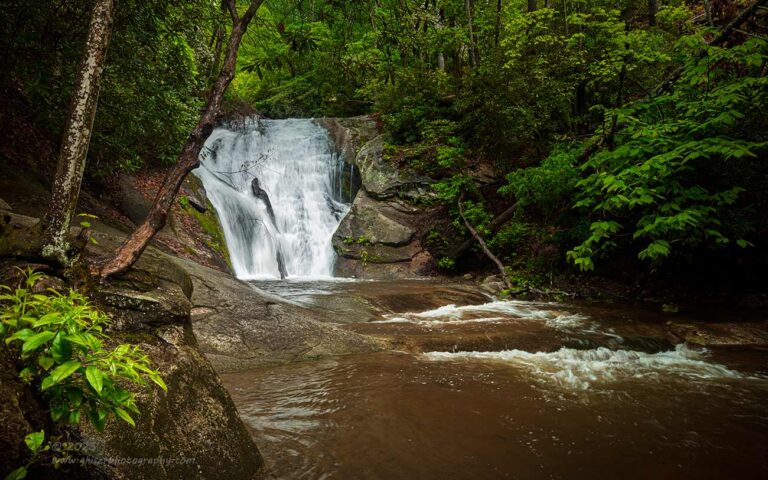
The first lens that I fitted was my telephoto because out of all that I was seeing, the part that was drawing my attention the most was the one void in the rocky face that looks like an eye socket to me. It showcased a good bit of visual interest, and I thought that it would represent the waterfall very well. I wasn’t able to get in close to it, so the telephoto was the way to go. I framed up a few different compositions at nearly the long end of the lens.
I honestly thought that I was capturing too much with that lens, so I decided to add the teleconverter to the combination to give me even more reach. That looked better in the camera and I spent some time with that setup working some isolations on the waterfall as well as some of the rapids below the falls. Ironically, my image review had led me astray in the field. The stronger images turned out to be the earlier ones without the teleconverter. The opening image for this entry is one of those and I loved the way that it looked from a compositional standpoint. I wanted to do it as a black and white image to really simplify it down to the organic shapes that I was drawn to with the textures of the water. I think that one image turned into my favorite from the day and made the entire trek worth the time and energy. The fact that it was only the fifth image of the day isn’t important.
When I got done playing with the teleconverter, I moved down off of the rocky platform that I had been standing on to see if there was a way that I could get an interesting composition of the entire waterfall with some foreground interest. There was a little bush growing on the side of the rock, beneath a pair of trees that I thought might work as a foreground interest. When I got down there, I could see some potential, so I swapped out the lens for the standard zoom and started to get a composition worked out. The problem was, even at 24mm, I wasn’t able to get both the foreground and the secondary cascades in the frame which I really wanted to have for balance. I decided to swap lenses again without even getting a shot with the standard zoom.
I was now looking through my wide-angle lens and things were looking better. I worked around to find the right place to stand that would give me the right relationship between the elements in the frame. I liked the trees to the left just touching the waterfall to link it to the foreground. This put the cascades off to the lower right for a nice balance. I was back further than I had been and was also further to the left. The result of that actually put the lens at 27mm, so I could have stuck with the standard zoom after all. It was all for the best though, because I did start using the wider angle possibility of this lens to full effect for some other compositions that I wanted to try.

I wanted to get back up on the rock where I had been situated earlier and try to get the gnarly roots of the trees be a different kind of foreground to the right of the frame. I liked the concept, but I wasn’t able to get the right separation of the cascades from the trees, and it was just not a satisfying composition when it was all said and done. I shot a number of exposures of this before I abandoned the thought. I ended up not keeping a single one of those compositions and I’m not upset about that at all. The attempt did put me in the right place to see the next composition.
This was a much simpler composition when compared to the last. There was a crack in the rock where I was standing that pointed right to the waterfall. The leaves that were trapped in the crack gave a similar color to the water and linked it like I hadn’t seen it done before. With the wide lens attached, I was able to get the cascades leading off to the lower right for balance and a bit of drama to the scene. I also liked the tree that was filling the upper right of the frame. I worked on getting the composition all put together and working on the exact camera placement that I was going to need. While I was doing this, I noticed that it was getting brighter. I looked up and saw a good deal of blue sky and that meant that the sun was going to be causing problems for me.
I really liked the composition, so I decided to stick it out and wait for the clouds to cover the sun once again. This took longer than expected and the clouds that were covering the sun were thin clouds and they didn’t really block the sun like I was wanting. I had to work the exposure down to the point where the entire scene was well underexposed to keep the waterfall from blowing out since it was fully in the light. I had found the right shutter speed for the water which meant that as the sun moved in and out, I would play with the aperture within a couple of stops of range until I lost the depth of field that I needed and would then go to the ISO to keep the shutter speed at 1/8 of a second. This created a lot of different frames as I captured all the different combinations of light as the clouds moved over the sun.
When it was all said and done, I had a collection of even exposures, some with everything but the waterfall in deep shadows, and a few with some dappled light on the landscape. It was one of the latter ones that turned into the keeper from this set. It was one that I thought was more complex than the others, but I liked how the dappled light broke up the rock in the foreground. It also lit the tree branch to the right for a bit more visual interest. The water exposed just about right for what I was wanting, and the end result turned into a surprise for me. It wasn’t my favorite of the day, but it was a close second to the intimate capture of the waterfall. It showed a different side of Widow’s Creek Falls than I have captured before and I count that as a win. I’m also really happy with the way that the sun helped to make this photo pop a little more than my expected lighting would have done.
Looking up in the sky, I could tell that the easy light was over at this point. There was more blue than clouds above me. Since I wasn’t comfortable with crossing the stream, I decided to call it a day and head back to the truck. Yeah, a full 30 second hike to get back to the parking lot. I’m glad I retained most of my energy for this strain. I had shot 102 images of the waterfall which was a lot more than I had expected. However, as I looked back over what I had done, it made sense. There was a lot of bracketing with shutter speeds to find what I liked best for each scene, and then there was the repeated shots with the changing lighting. I would shoot about 10 frames when a cloud would move over the sun, and I did this several times. That adds up quickly and it is very easy to lose track of the frames that are being shot.
I knew that I wasn’t going to have a high hit rate from this location and fully expected to have just a couple of frames that might work out. That wouldn’t take long at all to process once I got home. I would be done with the blog by dinner time which was a nice change after so many of my treks going until late at night. As I was leaving the park I was surprised at how bright the sun was getting. I guessed that the storms might not be coming in and I was wondering what the weather was going to be doing tomorrow and if I was going to be able to get out to Hanging Rock as I had planned. This was a great warmup for that trek, and I was really hoping that it would work out.
There had been a store that I had passed on the way out to Stone Mountain that I wanted to check out a little closer to see if there was a photo. That kind of kept me in the photography mindset and I found myself looking at a lot of different subjects as I drove. You will likely remember that every time I go through the area of Traphill, and even Hays, I end up finding lots more than I expect. There really is no shortage of potential subjects out there, but nothing was really jumping out at me in this light. This was the kind of light that would look good for landscape work where I captured a good area of ground which was being lit by the sun while including the sky which still had a lot of deep clouds with tons of personality. It was almost magic light all around me, and this kind of light was wasted on doing intimate scenes. It needed something broader reaching, but I wasn’t finding anything that fit that bill.
It wasn’t until I got back into the area of North Wilkesboro that I passed a farm that I had shot many years ago when there was a barn standing near two silos. Shortly after I had shot that scene, the barn was torn down and the property owner contacted me because he had seen where I had shot a photo of it. He ended up purchasing two large prints, one for him and one for a relative that had helped to tear it down. They had used some of the wood from the barn to make the frames for the prints. Since that time, the property had just seemed to miss something without the barn. The silos remained, but it just wasn’t the same.
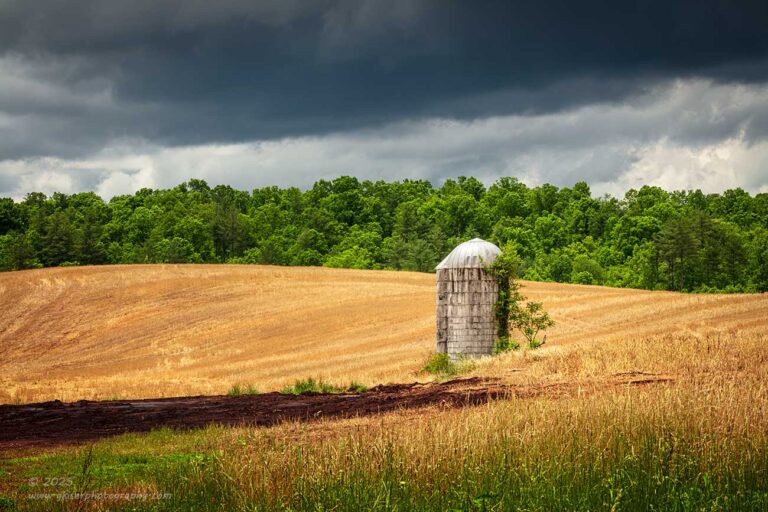
As a quick side note, I have just recently done a handout for my upcoming decay workshop where I talked about the power of “and” which describes how adding elements to a scene can really help to tell a story. When I was passing the location where the silos were still standing, I took note of the fact that the field was a beautiful yellow orange with the luscious greens of Spring surrounding the field. The silos were still there, and very lonely looking as they have been for a while. The colors in the field turned into a very important “and” while the dramatic sky above was yet another “and” which then fell into the rule of odds in a way. I had three points of interest in this scene now. What had been rather boring without the barn all of a sudden took on a different personality. The warm sunlight that was falling on the landscape also elevated the scene.
I had driven by this location for nearly five years at this point and except for that one time that I had stopped to shoot it because of the sky, I hadn’t really considered doing anything else with it. With the light and the colors of the scene, my response to it was very different. I decided that this was a good chance to get another shot of the location if for no other reason than to show that the barn was no longer there. It should be good for a single shot at least so I got turned around and pulled off on the side of the road. I remembered from the last time that I was going to need my telephoto lens for the reach needed to fill the frame the way I wanted to. I added a polarizer to reduce some of the glare off of the silo and then walked across the road to find the right position for the photo.
This took longer than I had thought. There was an area that had been dug up which left a streak of landscape that was essentially dark brown dirt. I needed to find a way to include that in the composition because it came very close to the silo base. I knew that I wanted to get the sky in the shot as well, so I started working with the elements that I liked in an attempt to make something work out. When I started framing up the composition that I wanted, I realized just how small the silos were in comparison to the barn because I remembered the barn filling most of the frame up. The silos were getting lost in the frame almost unless I zoomed well into the scene.
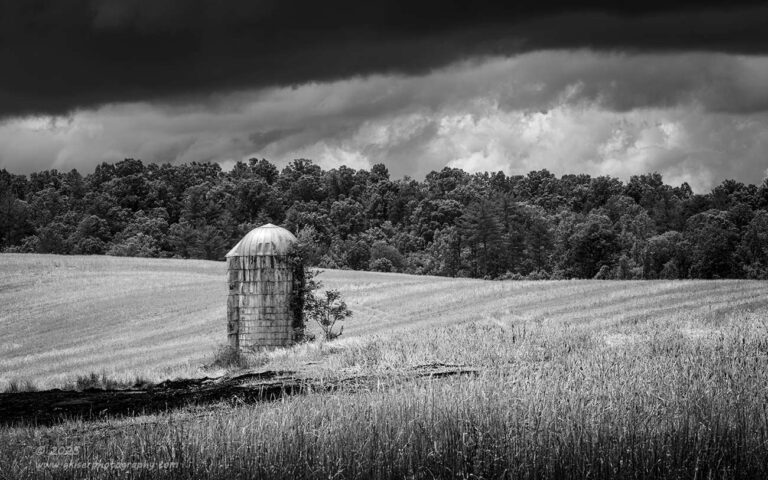
I wasn’t sure whether I wanted the silos offset to the right or to the left. I knew that I didn’t want them centered, but there really wasn’t another direct focal point to balance the silo which meant that I was having to work with the clouds above as to where the silo would be positioned. I ended up working it on both sides of the frame, and while the sun was behind the clouds, I had added a grad filter, but once the sun lit the field up again, I pulled the filter off and just used it to shade the polarizer to keep the sun off of it. I figured that I would choose the best from this and make that be the photo that I kept from this series. I mean, how much variety could I get from a pair of silos that essentially looked like a single one from the angle that I had to shoot from?
After a lot of mulling over things at home, I ended up keeping two from this series. There was one with the barn positioned to the right where the yellow field was a more dominant feature and I did that one in color to really capitalize on that aspect. For the one where the silo was positioned to the left, The colors were less of a focal point, and I needed the attention on the sky where the brighter area was the balancing element for the silo. By doing this one in black and white, I was able to achieve just that. The two photos said something very different to me, and I felt that they were both worth keeping.
I had shot a total of 24 frames of the silos with the different lighting and clouds and felt that I was pretty much done. I wasn’t really convinced that I had done the silos justice, or more accurately, the sky. There was a lot more to the sky that I hadn’t really captured. There was a rain squall coming in to the right of the scene, but if I were to have shot a photo of that, it would have been a boring Oreo composition of the field, trees, and a dark sky without context. There was an important “and” that I needed to include. The silos once again were important, but they were very far away from the squall line. The only way to get a photo of both elements would be a long panoramic shot with the top and bottom roughly framed like I had been doing with the earlier shots. I just needed to extend the scope left and right to really capture what I wanted.
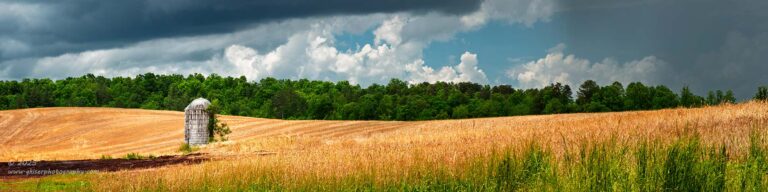
I made sure that the tripod was level which it certainly hadn’t been for the earlier photos. Once I had that taken care of, I did a dry run with the camera in portrait mode from left to right to make sure that the sweep would be totally level. It was, and now I had to figure out the crop of the scene, so I worked the zoom until I felt that I had enough foreground and sky while not shrinking the silos too much. I checked the exposure and adjusted the polarizer. I then started making sweeps from left to right. The first run was eight shots and I realized that I needed more space above and below as well as more room on either side of the silo.
I ended up shooting four more pano series and each of those was eleven frames each. They went from the trees to the left to where the trees had a slight break to the right. I included the incoming rain squall which was getting darker and darker as I went. It was the second series that turned into the keeper from this group of images. It had the best combination of lighting composition, and clouds. I had not been sure that the exposure would be even enough through the series because of how the sunlight was changing minute to minute. I wanted to have some extra attempts in case the exposure wasn’t comparable in this series. I’m really happy that it worked out as well as it did. The edit didn’t even take that long. The longest part of the whole process was removing the sensor spots from the sky which took about 45 minutes to do. Every spot was repeated eleven times, and this image is absolutely huge. It is hard to tell looking at it here online, but the full-sized file is 33,765 pixels wide which takes a very long time to go frame by frame at 100% to look for sensor spots. The rest of the processing went smoothly and there wasn’t much at all that needed to be done to it. The light was perfect, and the sky just came out wonderfully straight out of the camera.
That rain that was seen in the photo also brought some thunder with it and that was enough to make me pack it in. I had a total of 169 frames shot for the day which was a lot more than I had expected. I was interested to see what I had, but I needed to get home first to find out. Within a mile of leaving the silos, the bottom dropped, and the rain came down hard on me. I was glad that I had gotten out when I did and had captured the frames that I had. I was ready to get in the dry and start working the photos which I did as soon as I got back.
I didn’t get finished as early as I had expected, but with a whole different location added to the day, I really can’t complain at all. I’m really happy with the six keepers from the day and think that I got really lucky with the conditions over the silos on the way home. I’m sure that the next time I pass them by, they will be unimpressive as they have been up until this point. It just goes to show that the smallest of changes to a scene can make the difference between a workable image and something that you just look at driving by.
Thank you for joining me for this trek, and I hope that you have enjoyed the photos I came back with. Keep in mind that I would love to make some prints of these images for your walls. There is really no better way of enjoying photography than in the physical form with a print. This can be a regular fine art print that needs to be framed, or a ready to hang canvas or metal print. No matter what you choose, rest assured that you will be holding a photo that looks just as I intended it to unlike seeing them online where what you see is completely dependent on the calibration of your monitor or device. Not only do you get a unique piece of wall art for your space, but you will also be showing your support of my art and allowing me the opportunity to do more of these treks. Just let me know which print you are interested in and we will get the process started. For the most part, turnaround is really quick, especially for the fine art prints in stock sizes available through the website. Special order pieces are usually ready within 10 days which still isn’t bad at all.
Hopefully, I’ll be back here tomorrow with another waterfall trek and more new images. Time will tell, so I guess that leaves us at the end of this one.
Until next time….