Welcome back to another installment of my monthly Behind the Camera series where I take a little time to talk about different subjects that surround the topic of photography. This month I want to talk about a phenomenon that I have seen in several different ways over the years. This is the concept where a photographer tends to be a seasonal shooter and will only go out or be active during certain times of the year. This can take many forms, such as the photographer that only goes out during moderate temperatures, or only on sunny days. It could be that there are entire months, or even seasons that are avoided for one reason or another. It might just be that the photographer lives for just a single season each year. If you think about it, you will probably be able to identify folks you are familiar with who are just like this. I imagine that there have been times that I’ve fallen into this category as well, but for the most part, I have shot through the entire year and in all types of conditions. Of course, there are seasons that I tend to gravitate towards, and there are definitely weather conditions that I prefer, but when it comes right down to it, I can usually find photographs in any condition at any time of year. The biggest challenge is finding that creativity throughout the year.
What I hope to cover this month are the reasons why you should press forward and work in different conditions, as well as how to adapt your work to the seasonal changes. What I will suggest won’t make you a better photographer right away, and you will likely start thinking that your photos are not as good as they once were. However, if you keep up with this, I can almost guarantee that you will see an overall improvement in your photos over time. You will certainly be better at identifying and working with different types of light.

One of the trends that I have seen over the years is that of the three-season photographer. These are the ones that will go out and shoot during the Spring, Summer, and Fall with the majority of the photos being made during the Spring and Fall seasons. Once the leaves drop, the camera gets hung up in the closet and a mug of hot chocolate gets poured to sip on. There is nothing wrong with this, and there are some that just really hate being outside in the cold. I get you; I don’t care for the really hot months myself. The problem with this comes in the form of an entirely different world that you are missing out on. Whether you are a landscape photographer, a rural photographer, street photographer, or portrait photographer, if you dismiss the months of November, December, January, and February, you have missed out on some really unique aspects to be found. First of all, the days are shorter, which means that you can get up later, and be back home earlier while shooting golden hour. That golden hour is lengthened quite a bit too, since the sun stays lower in the sky during these months. The trees are full of texture and detail that shows off their structure which is completely covered during the months where the leaves are present. Those trees that don’t lose their leaves start to stick out more dominantly in a landscape as well. There is the chance for snow, although that is getting to be a rarity around my area. The sky will even look more dramatic for no reason at all during the winter months. Winter light is some of my favorite because of the low sun during the entirety of the day, and the clouds which can get very dramatic with no precipitation.
Another type of photographer is one that finds a lack of inspiration during the Summer months because it is hot, everything is a uniform green, and so much of the landscape is overgrown with vegetation. I fall into this category, but I still get out and shoot during this time. Some of the benefits of this time period between say June and September are the longer days, but for a different set of reasons than the shorter days of Winter. You can actually photograph several different locations during the day and not run out of usable light. You get a mix of broad sunlight and blue skies as well as stormy skies in the afternoons. Things happen quickly, so you have to be able to adapt to the changing conditions, but the skies can often be magical during this time of year. The times of the valuable golden hour are limited because the sun moves quickly at the edges of the day relative to the Winter months. You will see a lot more wildlife and will be able to find a lot deeper shade to work with if that is what you are after. Even I can see some the basic benefits of going out in the warmer months because you can dress lighter, not have to worry about gloves, coats, and toboggans. This leaves you more room to carry the tools of photography, or just stay lighter on your feet.
I think it is safe to say that Spring and Fall are the times that most photographers will be the most active. It stands to reason, and I don’t think that there is any dispute to the fact that it is just more comfortable to be outside at these times. This is also the time that the leaves on the trees are the most vibrant and colorful. These are the months with the most benefit and the least resistance from the environment. This is why photography always picks up during these times. I can’t argue that point, and for the most part, that is when I am most active and enjoy the photos quite a bit overall. What I’m wanting to share with you today is why you should not look at photography as a seasonal thing, but rather a year-long pursuit with opportunities to capture the same scene in many different conditions, or to create different moods in your photos. Continuing to shoot regularly is also the absolute best way to learn new things and to perfect your skills and techniques, as well as your own visual language.

I truly believe that too many photographers get into a frame of mind where they try to photograph a season and that is what drives them. They want to capture the fresh greens of Spring, or they want to capture the warm Autumnal colors. The risk here is they are not trying to photograph the scene that is in front of them, only the season they are working in. You can’t photograph a season any more than you can photograph Alaska. No matter what you are photographing, it is always going to be the elements in the frame that make up the composition which determines what you are photographing. The seasonal attributes are just an element in the frame, just as the location is. If this point is neglected, and the photographer is satisfied with trying to just shoot the season, they will end up with a very boring photo that looks like a scene shot from a car driving down the road. There is always a chance that things will fall into place in such a way that the photo will work out, but that is a slim chance. No matter what you photograph, composition and light are the hinge pins for the image. Pay attention to those first and foremost and use the season and conditions to help tell the story and add elements to the image.
In the image above, the season is obviously Spring from the vibrant greens, and pink blooms. The photo is not about the season though, but the season helps to set the mood. I wanted to capture an image that didn’t feel cold, but still had some moody atmosphere to it. The fog sets the tone, but the greens give an inviting warmth. The composition makes the scene inviting to look into. This composition would not be workable in the Winter as the foliage would be thinner, and the colors not nearly as vibrant. In the middle of Summer, things would have become more overgrown, and the greens would have all darkened to the point of looking less lush. For those that would love to see this scene in the Fall, there is a very good chance that the colors introduced would have overly complicated the scene taking away from the visual path that stands out so well. The photo is successful because of the season, but the season is not the reason for the image.
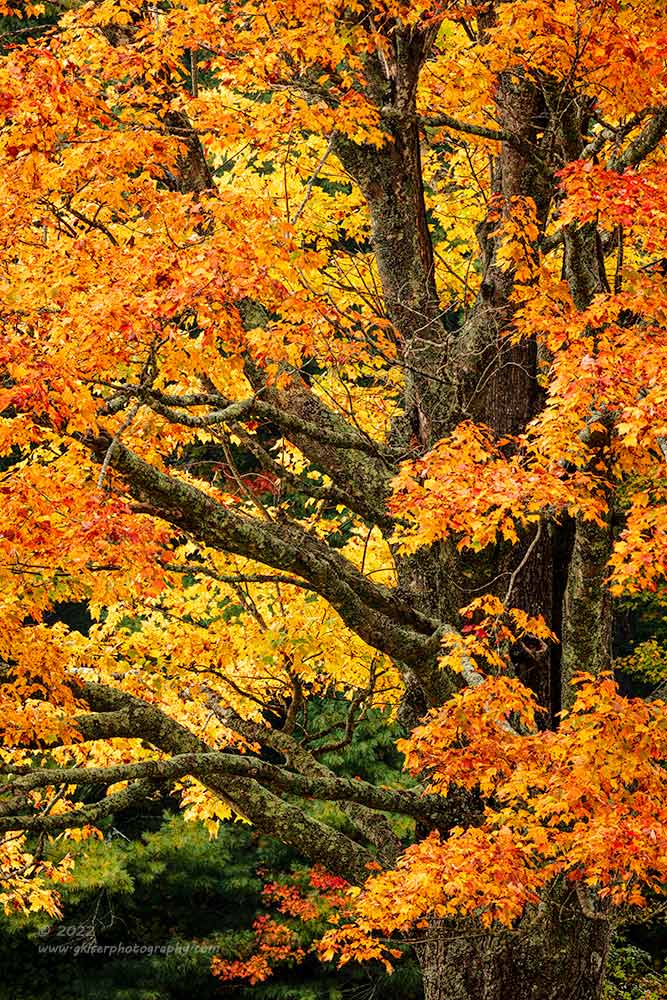
In this example, I’ve captured a photo of a tree. Some might say that I was trying to capture a season, but again, the season was just an element in the composition to help tell the story. The subject of the photo is the structure of the tree within the leaves. I really enjoy photographing the visual structure of trees, and it is one of my favorite things to do during the Winter when the trees are bare. Some trees, like this one, are not so intricate that they can maintain visual interest all on their own. That was where the brilliant oranges of the season came into play. They provided some visual excitement to the scene as well as a great color contrast to the greens and wood colors which left the scene looking flat. Yes, the season was important here, but it was just part of the story, as much as shape of the tree, and how I composed the frame.
The last two photos are great examples of photos that could be shot during the most popular seasons for photography. Yes, they could be looked at as photographing a season, but both of these photos have so much more to offer than just the time of the year they were captured. It was raining during both treks, and they had similar lighting conditions. The fog brought in a softness that helped to define the shapes in the first scene just as the bright leaves helped to frame the tree itself in the second. Both photos were much more an exercise in creating an emotional response than referring to a calendar month, but I do understand the draw to these two seasons.

Winter is one of those seasons that sees fewer photographers out and about unless there is snow. For me, Winter is one of my favorite times to get out with a camera. I can sleep much later in the morning, and I can be home by dinner time with plenty of time to edit images before needing to go to bed. With fewer people out, I have less complications to deal with in my compositions. Also, when it comes to my decay photography, having the vegetation in a dormant state and being less intrusive, allows me to find more subjects and then be able to photograph them without those distractions. Here is an example of a scene not too far from home that is rather complex to begin with, as the main subject is all about lines, angles, and textures. During the Summer, the vines are very dominant here, and the trees become a contrasting green color which adds to the visual complexity. During the Fall, the trees would be all different colors which would distract from the trestle and cross arm. The Spring would be a workable season, but the different green tones of the trees would compete with the rusted beams and set a more optimistic tone that would not work nearly as well as the Winter shot. Remember that I said that the sky can usually be much better in the Winter? Well, here is a great example of just that. There was no rain that day, if memory serves, but the sky was dramatic and provided perfect lighting on the scene for a long period of time while I put together a composition that worked. The colors of the season complimented the subject like no other season could, and the simplicity of the scene allowed the viewer to focus on the main subject with everything else falling into the background.
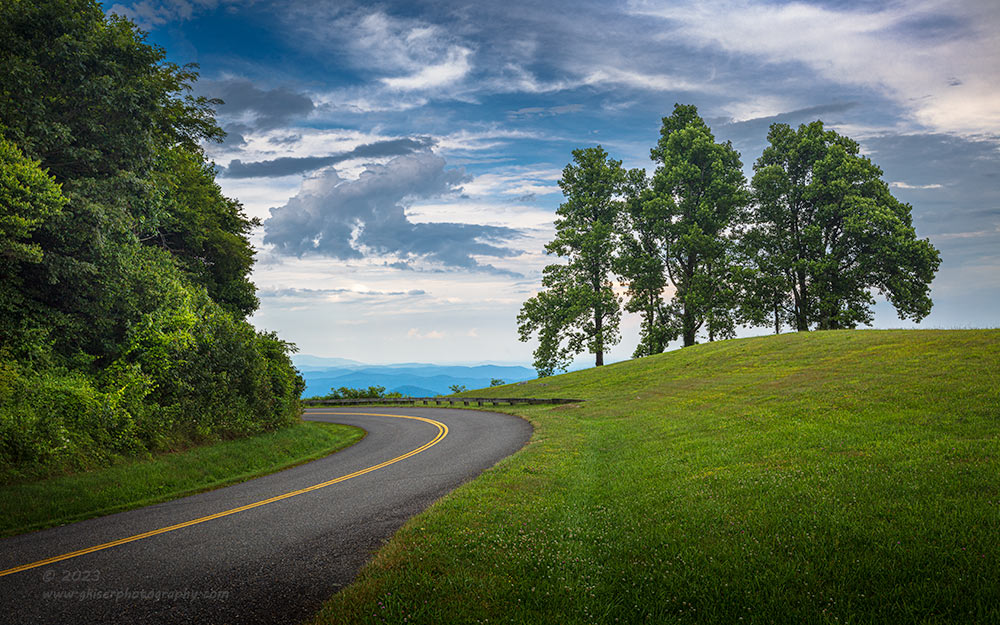
Here we can see a recent photo from my least favorite season to work in. For me, Summer is just too green, and I really don’t care for the heat of those months. There are certain things that have to be taken into consideration during this time of year to get a workable photograph. First of all, there has to be something to break up the green, and in this case, the roadway did that quite well. The sky was another concern because in order to get the visual interest in the sky, I had to wait for a storm to begin brewing as Summer months usually have hazy blue skies. Until this point, the sky had been clear and boring for most of the day. The storm brought in some dramatic clouds which truly helped the landscape photos that I shot that afternoon. The risk is you might not have very long to work before the rain hits which was just what I ended up dealing with on this particular day.
As you can see from the four examples, there are photographs to be had during all seasons of the year. The photographer has to know how to deal with things and know that the success of the photo will always be based on the composition, story, and connection to the viewer. Each season has its own benefits as well as considerations that might have to be addressed. The reward for knowing how to work in the different seasons is you will be able to create very different “looks” to your photos while still remaining true to your style. I’ve found that many of the scenes that I’ve loved during a particular season have held no interest for me in other seasons. While that sounds like an argument for only shooting during particular seasons, the converse is also true. I’ve gone through three seasons uninterested in a scene only to have it come to life during what would typically be a less than ideal time to shoot.
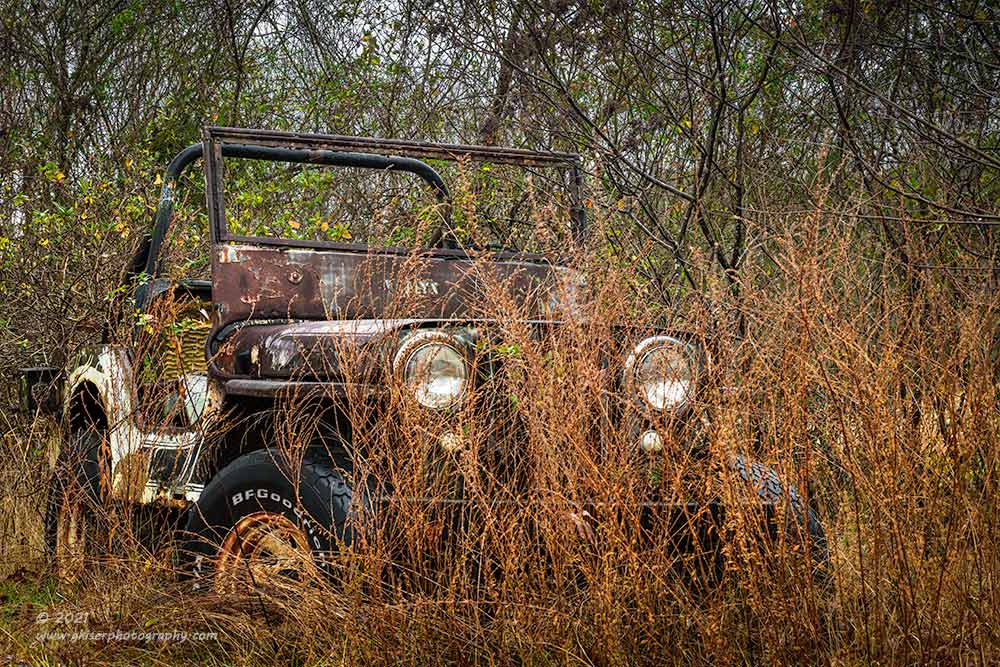
This is exactly the kind of scene that I would pass by three seasons out of the year and would never think twice about. In the Summer, I doubt I could see it at all. In the Spring and Fall, the brush would be too thick to really be able to make out the subject well enough to photograph it, but in the middle of Winter it becomes easy to make out the shape of the main subject behind the dormant vegetation. The headlights can easily be seen which helps to define the subject. Even the colors of Winter make for a pleasing palette that shapes the mood and compliments the Willys. There wouldn’t have been a photo any other time of the year, and if I were one to hang up my bag once the leaves dropped off the trees, I would have certainly missed out on this opportunity.
If you look through the examples that I have posted up to this point, you will see a common thread here, I like to photograph in roughly the same conditions. You would not be wrong in that assumption, and I make no bones about the fact that I love a nice cloudy day for photography. The lighting is even and, in many cases, only barely directional which means that I can shoot in just about any direction that I want to. It makes it easy for me and allows me to create the painterly style that I enjoy so much through my editing process. The clouds also provide visual interest for those photos that include the sky as an element. For me, this is the best time to be a photographer, and what you will see the most of in my collection of photos. However, if I were to only go out during these times, I would be limiting myself just as a seasonal photographer is limited. If you will recall the beginning of this entry, I specifically mentioned photographers that will only work in certain conditions. I feel that this is comparable to the seasonal photographer which is why I wanted to address that aspect as well.
For a photographer to be considered good at what they do, they have to be able to adapt to different conditions and make images regardless of what conditions they are faced with. Sure, anyone can go out and make a photograph in conditions they aren’t used to or aren’t comfortable with. I’m not talking about a photograph for the sake of taking a picture though, I’m talking about a well thought out photograph that embraces the conditions that are present as part of the visual storyline. To be fair, I rarely plan to go out on these less than optimal days, but there are times when the weather forecast is just plain wrong. I know, imagine that. If I find myself out during conditions that I am not expecting, do I just go home, or do I adapt and find subjects and scenes that will work with the current weather?
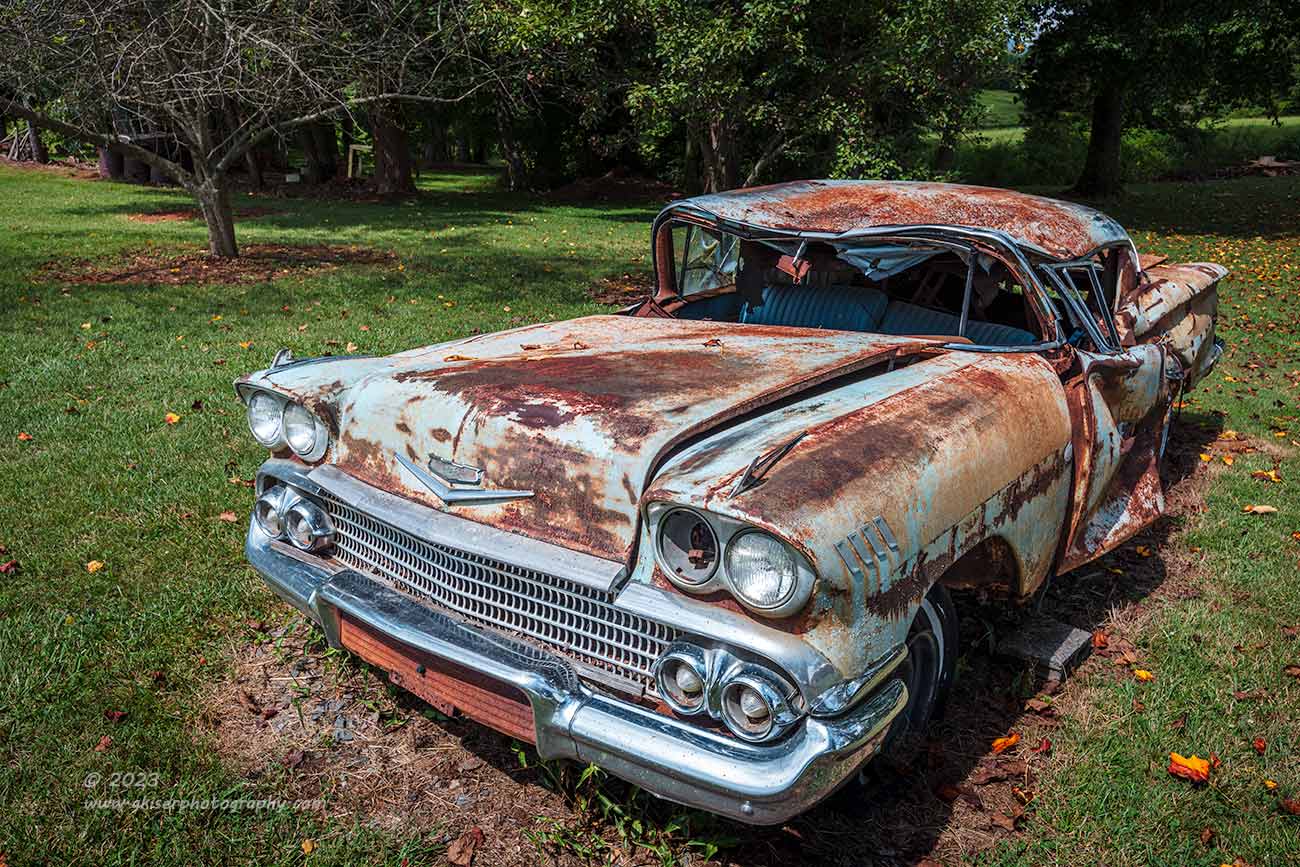
The answer of course is to go home and give up. If you believe that, we really need to talk. I’ll just drop back to plan B…or C…or even D if needed, and keep on going. Sunny days are some of my least favorite times to shoot. The light is directional, high contrast, and usually quite harsh, especially around the middle of the day. This doesn’t go along with my normal style, but even in what I would consider bad light, I can still make images. If you take a look at the trek where I shot this Impala recently, you will see that even in this less favorable lighting, I was able to create a number of really good images.
You can see here that the sunlight was hitting the car quite heavily, but the thing that I looked for most of all was that there was no dappled shading on the car from overhanging branches. Since both of the cars in the scene were out in the open, I had even light, with the only shadows being cast by the position of the sun. This is actually a pretty good setup for this kind of light, and when I saw that it was working for these subjects, I got to work on the scene. The extra saturation of the colors helped to make the images work better, and that was from the bright sunlight. There was also a lot more contrast built into the scene which made for less work for me in post as the background was much darker straight out of the camera. The downside was that I was very limited in which directions I could shoot, and one scene I really wanted had to be shot at three different times in order to get enough diffused light from passing clouds to make the shadows work.
As you look through the images up to this point, you will see an entirely different lighting scenario taking place here, but yet the photographic style is still there. Had I limited myself to only a specific shooting condition, I would have missed out what I think are some really great photographs. Experience has taught me with these types of subjects, the longer I wait to photograph them, the more likely they are to disappear and never to be seen again. I couldn’t take that risk, but if I didn’t understand how to work in conditions that I don’t normally shoot in, I would have had no choice in the matter. Knowing how to work in adverse lighting or seasons will open up all kinds of possibilities for your photography and it is worth exploring.

While we are on the topic of shooting in bright light under clear skies, I want to talk about this type of photo as well. I’ve mentioned that I try to avoid those clear sky days, and for the most part I do. However, I do understand that there are some subjects that will benefit from these kinds of days much more than my “normal” lighting preference. It would be wrong not to appreciate a nice sunny day for what it can do for photography. The exact reason that I avoid this type of lighting most of the time is the exact reason that I love it. That is the shadows. How can I spend so much time avoiding it, if I love the shadows created by the direct light? Well, over time I have learned to embrace that which I find difficult to work with because it adds an element that is beneficial to some subjects. It also creates subjects that were not there before.
In this example, I wanted to photograph hard lines and shapes which is easiest to do with architecture. Under flat lighting, which I usually like to work with, there is very little dimension that is visible to the viewer. Having the sun creating shadows, shows the depth and adds some definite tonal qualities to the shapes which would otherwise be missing. Imagine the photo of this building on a cloudy day. Even the two triangles at the top of the photo formed by the blue sky, would have rendered as white or gray and just blended into the rest of the shapes. It would be a flat image with no depth at all. The image only works because of the shadows, and the deep, uninterrupted blue of the sky.
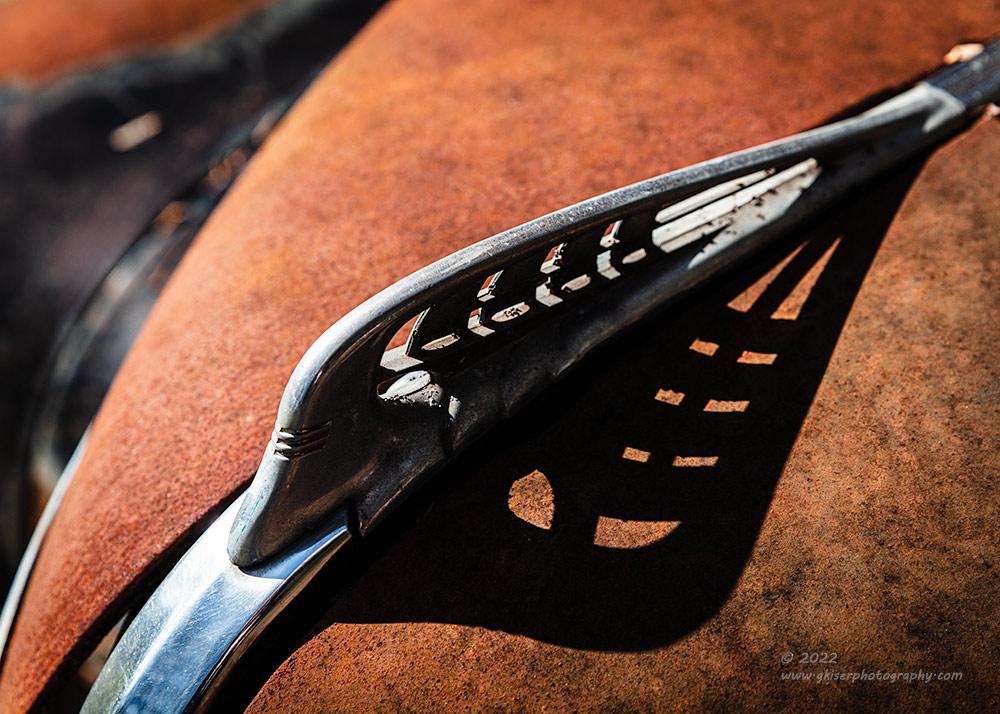
In one final example of an image that wouldn’t have existed without direct sunlight, I’ll share this photo where the subject is actually the shape that would not have existed without that sunlight. The shadow here completes the composition and defines the shape that excited me. I could have done just an image of the hood ornament which I have done many times over, but with the size of the frame here, the ornament would have been lost as only a secondary element without the benefit of the sunlight. The shadow extended the shape, and even completed it, allowing the hood ornament to reside in roughly half of the frame adding the right amount of visual weight to make it the primary focus of the image.
If I had chosen to limit myself to only shooting on cloudy days, these images would never have been made. The treks would have never taken place or would have ended much earlier than they did. Yes, it would have been a shame to have missed out on these images, but the bigger loss would have been the experience of working with different conditions. This is my main argument for shooting all year, and in a variety of conditions. You will learn so much more about photography and will allow yourself to be better able to problem solve during all of your photo sessions. If you aren’t a studio photographer where you have the control over every aspect of your shoot, you are probably going to have to work in conditions that very well might be out of your control. It could just be a situation where you find yourself wanting to go out with a camera, but there are no “proper” days in the forecast which will let you work. The more capable you are in shooting in less than favorable conditions, the better able you will be to go out and scratch that creative itch.
I realize that my idea of inclement weather for photography happens to be a beautiful sunny day which is just a horrific time to be outside. I can hear you all expressing your amazement that I would put myself into that kind of situation for the sake of a photograph. No, I’m really not that soft at all. But you do bring up a valid point. What about days when the weather is really not good? What about rain, wind, snow, and other times when most people would be happy to remain at home? Well, I think that photographers should be out during those times as well. Again, you will get a whole different look to your photos because of the extreme conditions, and you will learn how to work in those extremes.
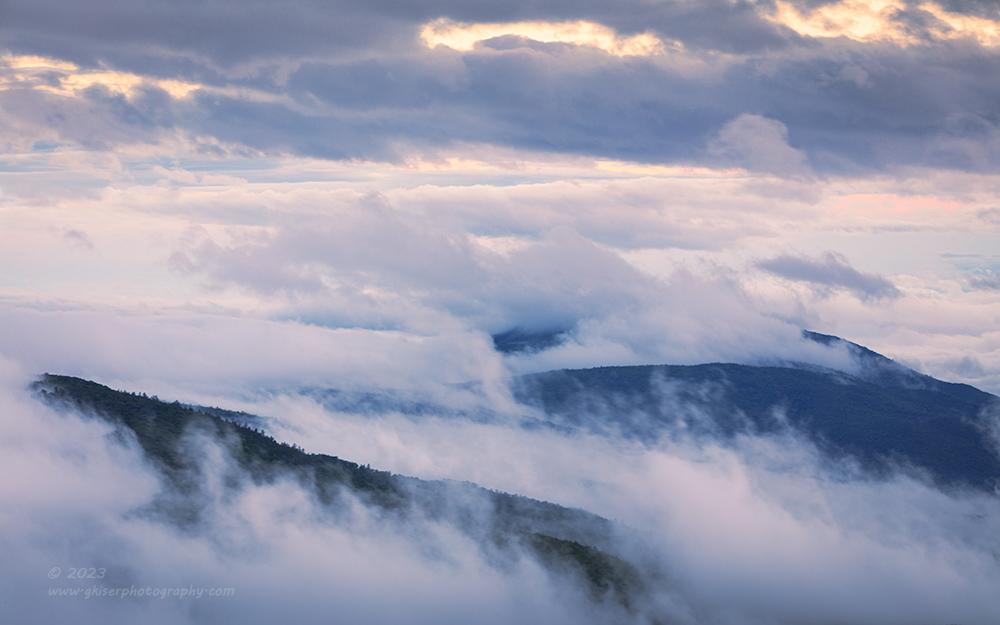
This photo is from one of my recent treks to Hawksbill Mountain. Maybe from the looks of it, you might say that this is just another one of my cloudy day shoots, but it was so much more than that. I hiked up to the summit in a pretty good rain shower. Once I arrived, the rain stopped, but the wind kicked off stronger than I had ever had to deal with before. The wind was so bad that I couldn’t let go of the tripod for fear that it would blow off the mountain. It was lifted off the ground more than once while the camera wasn’t attached. I slipped and fell on my camera bag, and almost lost my hat several times. It was a challenging morning and one of the worst set of conditions I have ever found myself in. The resulting images were spectacular though, and full of little details that I would not have been able to capture had I not put myself through that beating.
I learned a lot of valuable lessons that day about how to keep my gear safe, as well as myself. The most valuable thing that I learned was had I gone with my gut and turned around to the safety of the trail, I would have missed all of these shots. I’m not recommending that you put yourself at risk for a photo, because I certainly don’t agree with that. I took every precaution I could to maintain my safety on that mountain. I’m just saying that you can put your comfort aside for a while for the sake of some photos that you would otherwise miss out on.
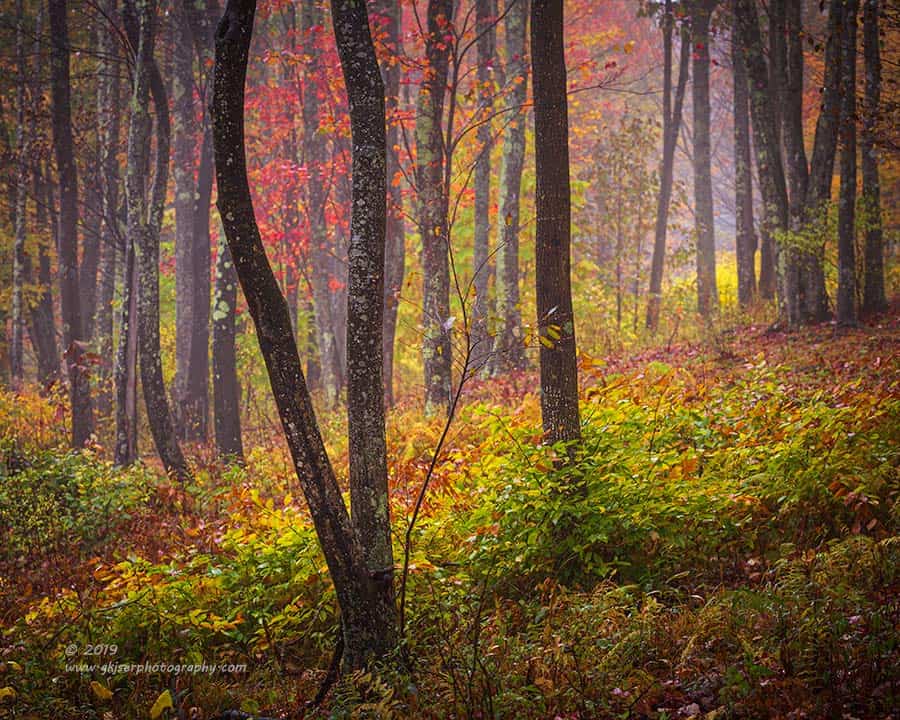
A real risk for me preferring to shoot on cloudy days is that I will get caught in rain showers from time to time. This can be a light mist, to a full-on downpour. The rain will offer several opportunities for me as a photographer though. It is one of the best ways to introduce some atmosphere into your photos, but it is one of the harder conditions to work in because you will have to worry about getting water spots on your lens resulting in blurred portions of the image. For those that are not using a weather sealed camera, you will have other issues that might cause concerns with equipment as well. There are rain covers that you can put the camera in, and I’ve found that using a lens hood (especially the deep one for a telephoto) works well to keep rain off of the front element.
The results of rainy photos can be quite good as seen in this Autumn photo from several years ago. It was a driving rain, and I had water pouring off of my camera, but the hood kept the front element dry so that the photos would come out clean. Even with the brilliant colors of the woods, this photo would not have worked without the mood and atmosphere that the rain gave it. You will notice that I used no filters here, even though I would normally recommend a polarizer because of the boost in saturation and contrast that it would have given. In reality, a polarizer would have been the wrong choice because I wanted the glare from the water on the foliage because that was a big part of the draw to the scene for me. Also, the water did a great job of increasing the saturation and contrast all on its own. While these are all very valid reasons to avoid the filter, the one that I was paying the most attention to was the fact that I had water pouring off of my hands, and if I had tried to do anything to index the filter, I would have left water dripping down the filter. The filter was also larger than the diameter of the lens which would negate my ability to use a lens hood. Hey, sometimes, I go for the path of least resistance in the face of adversity, and it works out for the best.
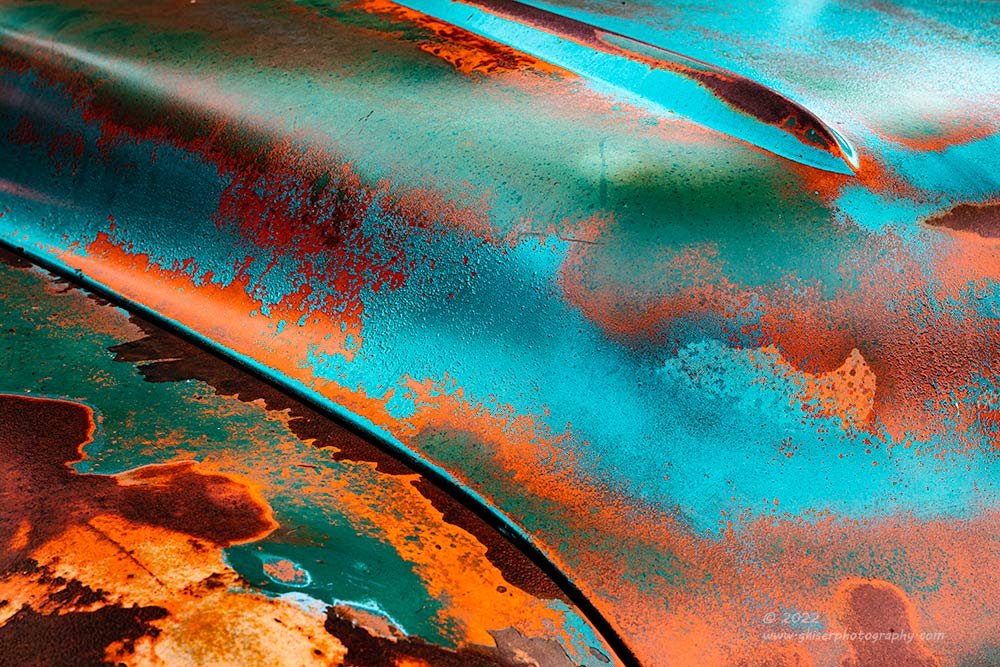
Another example of when the rain helped me out was this scene I found while coming back down the mountain from Blowing Rock a while back. The rain had chased me away from my intended trek location and I was just driving home to get dry. I passed by this truck that I had seen out front of a local store several times before but hadn’t really seen a photograph with it because of the location. Now, with the rain falling pretty good, I saw the colors of the patina saturating like I had never seen before. Just like the Autumn woodland, the wetness saturated the colors brilliantly on this old Chevy. I had to work under an umbrella to keep the water off of the front element as I was having to use a much shorter lens hood than the telephoto one that I had used in the other image. It made working very difficult, but the image that resulted would not have had the same “pop” had there not been rain actively falling on the surface of the truck.
I’ve had to use the umbrella trick many times with subjects ranging from landscapes to decay, to waterfalls. Had I not been pushed to use one while photographing a tree in a driving rain one January, I wouldn’t have seen the value in putting a small travel umbrella in my camera bag. Working adverse conditions teaches you how to create images despite those conditions which feeds into your creativity allowing you to see scenes that you would have never seen beforehand.
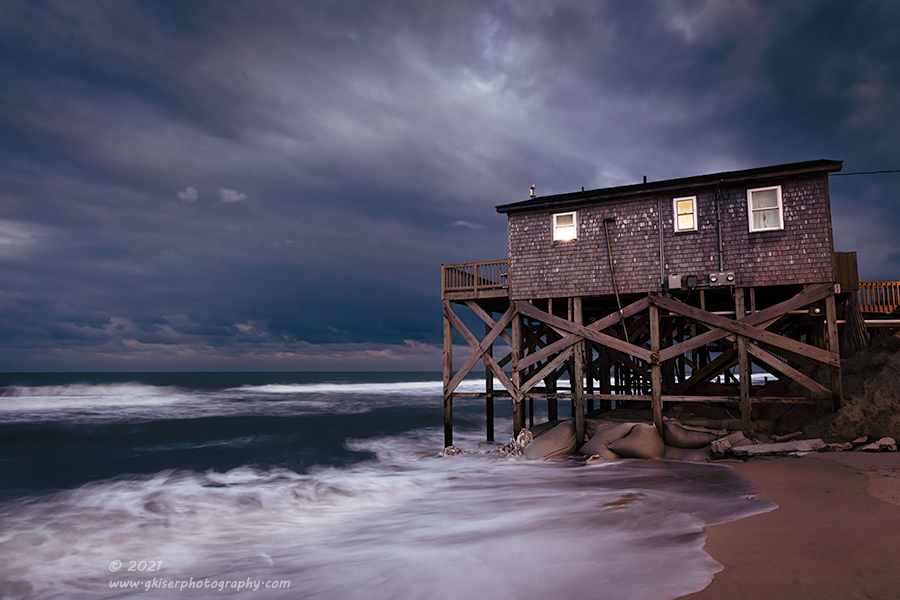
When talking about shooting in conditions that you normally don’t, I would be remiss to not talk about this photo that was shot on one of the last nights at the Outer Banks. The sky was amazing when we got back to the room, and I saw the beginnings of a really interesting photograph developing. The sun had already set, and the light was very dim. Of course, there wasn’t much ambient light at all to work with since there were no streetlights nearby, so that meant that I was going to have go with a very slow shutter speed to get the right overall exposure for the image. Not wanting to lose the detail in the waves as that was a big part of the story here, I had to try and keep the shutter at a reasonable speed while maintaining the depth of field that I wanted. This was the first time that I really boosted the ISO values up in poor light. It was a gamble for me to use ISO 400 in this situation, but in order to get the shutter speed to around two seconds, it was what was needed.
The end result was an image that took a good deal of work to clean up from the noise, but one that worked very well overall. I pushed myself for this photo in a set of conditions that I am not usually working in which caused me to gain a lot of new ideas and tools to use in the future. Since this photo, I have not been nearly as hesitant to boost ISO levels and have shot at ISO 800 many times for waterfalls to get the right shutter speeds. That confidence came from this image, which had I dismissed it because I was not comfortable in shooting in those conditions would have limited my other photography down the road.
The beauty of photography in general is the ability to always experiment with things. You can experiment with your subjects, your compositional tricks, and in the conditions that you shoot in. It is through those experiments that you will ultimately grow as a photographer. Thinking back to my first photos that I ever shot seriously, they happened in the middle of the day under bright blue skies. Those were the easiest and most pleasant for me to be out in, and I really thought that blue sky photography was the object of the art. I mean, the created a filter designed to deepen a blue sky, so that had to be a clue. In time though, I realized that I was limiting myself to very boring conditions and started to change things up. I learned to work with cloudy skies because my camera actually recorded the images better in those conditions, and I started to find the benefit of seeing the clouds in the sky. Eventually, I started going out earlier and later to get golden hour lighting and learned that the lower sun provided some great benefits as well. In the early years, I didn’t like going out in the Winter for landscapes because the mountains looked dead with the dormant trees creating a much less pleasing texture on the landscape. However, over time, I learned to shoot landscapes differently in the Winter to really capture the uniqueness of the dormant landscape. Had I just been satisfied with hanging the camera up in the cold months, I never would have realized this aspect. That is the key, isn’t it? No matter what season you are photographing in, you have to understand how to best capture what you are shooting. What works for one season, won’t work for another, and understanding that creates personal growth as a photographer.

As we come back to another Spring photo, there were two things that caught my eye here that prompted me to capture the image. First of all was the soft morning light that was shining on the wood railing. That part will happen through most of the year with the exception of mid-Summer when there might be too many leaves for the sun to blast through. The other aspect of this were the blooms on the trees which were also catching the light. That element alone makes this composition very specific to a period of a week or two during the year. Any other time of the year, I would have to photograph the scene completely different. It would not be this intimate capture of the scene that would work, but rather something a bit wider angle that showcases more of the overall setting. When photographers get good at their craft, they learn to read the light, as well as the environmental conditions that they are working in. They will create a photo that the environment calls for, not just what they think should be captured. I usually call this “listening to the landscape.”
That evolution in the education of a photographer will open up a ton of opportunities and allow them to work in a number of conditions. I can comfortably say that if I was forced to create an image at a random time during the entire year, I could deliver. Of course, there are variables that will make things very difficult, but never impossible. If I restricted myself to only exploring beauty during three seasons of the year and only during specific weather conditions, I could not make that statement confidently. The more you understand about the conditions in front of you, the more you will be able to appreciate and capture the beauty of them.
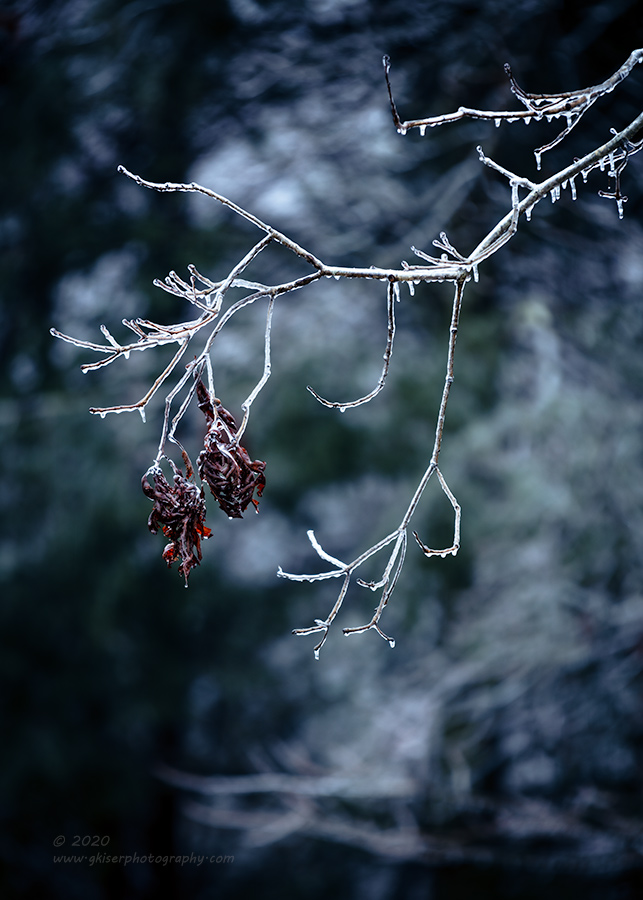
This seems like a great time to talk about this photograph which was shot several years ago during a freezing rain event. The roads were slick, and the weather was dreadful. However, I found myself looking outside through the windows of the warm house and marveling at the way the ice was coating the trees. This was our first Winter in the new house and it was all just so amazing to me. I started feeling kind of creative and I wanted to capture some photos, but at the same time, I had no interest in getting out on the roads. That is a different discussion than what we are talking about here today, I just hate driving on dangerous roads after 20 years of having to do it for my job. Every Winter, I had to patrol on ice and snow-covered roads, while doing many wreck reports from folks that wrongly thought they could drive on them. When I finally retired as an Officer, I found I had no interest in driving on those kinds of roads ever again. I admit, that makes it hard to get out and photograph the iconic Winter scenes, but where there is a will, there is a way.
Sitting there and marveling at the beauty of the ice, I found a specific part of a tree which captured the essence of what I was seeing. The rain was still falling, and it was just not a pleasant time to be outside. That didn’t stop me from cheating a photograph which was something that I had learned after many Summer trips to the beach. You see, there were many times that I would shoot sunrise from the balcony of the room which made it easy to roll out of bed and get a photo. It was a lazy way, and something that I don’t do much of these days, but I saw the benefit of doing just that in this icy situation. I made use of the covered porch and set the camera up sheltered from the rain. Using the telephoto lens and the teleconverter allowed me to zero in on the particular branch that I was wanting to capture on the tree in the front yard. I kept myself and gear out of the rain but was still able to capture the results of the freezing rain on the branch.
Because I understood how to render this season photographically, I was able to edit this photo in a way that completed the story I was trying to tell. For a three-season photographer, the inclination would have been to use a neutral white balance, or even warm the scene a bit to make it more inviting. I knew that this wasn’t going to be an accurate way of rendering the photo because I didn’t want it to be inviting, or necessarily pleasing on that level. I wanted the photo to feel as inhospitable as the conditions it was shot in. For that, I knew that I wanted to cool the image quite a bit which I did. Nearly three years later, I can still say that I nailed this photo, and it is still one of my favorites. The success of this image is because I am comfortable shooting in the Winter months, and I know how to see a scene during those conditions. This came from years of working in those conditions which only came from deciding a long time ago that I would photograph all year round.
Of course, this entire entry has been focused on those shooting landscape type images outside. There are many other forms of photography that can fall into these same traps and considerations. Portraiture comes to mind and when done in natural light outside, you will see a lot of similarities. I’ve seen a lot of examples of seasonal photography in portraiture and with fair reason. You are dealing with live subjects that you want to appear comfortable in the conditions you are shooting them in. Adverse conditions could mean extreme heat with sweat dripping, or the other end of the spectrum all bundled up in coats and hats. While I don’t have examples of ways to work around this as of yet, I have plans in place for times when I have the opportunity to shoot in these conditions outside. I just have to have a willing subject, or a client that is requesting this. The closest example I had was a Winter family photoshoot in Banner Elk which took place on the porch of the rental house in a light rain. It was less than ideal conditions, but I had to be able to perform. I would happily share examples from that session, but I did not secure model releases from the clients. They turned out pretty good, and it was the first time that I had shot a large family of 12. I had to pull on a lot of my experience working in these conditions while adding the specifics of portrait photography to the mix such as off camera flash to provide a bit of light on the faces. It was nothing at all like going out in the middle of the day under a blue sky like I had done for the first few times learning photography in 2005. We grow by expanding the conditions that we understand how to shoot in.
The idea of being a three-season photographer, or one that only shoots in certain conditions is just so limiting. I get the draw for that, and don’t fault those that do it. I would just like to put it out there that you are really reducing your chances to learn different skills, different editing techniques, and just problem solving in general. One of the greatest results of shooting outside of your comfort zone is the fact that you might just find a new passion within photography which opens up doors you never would have thought you wanted opened.

I owe my decay photography to just this fact when I really look at things. As a purely landscape photographer back in the day, I found that Winter was my least favorite time to capture landscapes and Summer wasn’t too far behind that. I looked forward to the Fall and the Spring for the colors that were introduced into the landscape. Before I really found out how to photograph the landscape in all four seasons, I started to gravitate toward finding objects of interest during those times that the landscape lacked the interest for me. As with all photographers at one point in their tenure, I had photographed barns from time to time, but found that I could use the concepts of barn photography within the landscape. By having an actual subject in the landscape, I was able to bring in interest where there might not be as much due to the season. This would allow me to continue to make images no matter the season because I could use the season to help tell the story of different types of subjects.
In the example above, I took a dreary Winter day and used it to tell the story of this old house. The house is gone now for those who are interested. The bare roof showing the details of the framing of the house matched perfectly to the bare trees revealing their wooden frames. The starkness of the scene was amplified by the lack of color, and the fog set the mood as it obscured the mountains in the background. This photograph would not have been nearly as effective at capturing this mood and atmosphere in any other season, and it was a season that I had not really liked shooting landscapes in prior to my discovery of these decay subjects.
Trying to find a way to effectively shoot in the Winter brought me to a new understanding of how to tell a decay story, and it opened up a whole new kind of photography for me. These days, I not only shoot decay in the Winter, but have found a way to shoot it year-round to tell different stories of the subjects. The passion for this type of photography has grown by leaps and bounds over the years, even to the point where I was wondering if I was becoming only a decay photographer. This year, I’ve seen a resurgence in my landscape photography roots, but even with that, I am still having a hard time motivating myself to capture landscapes in these Summer months. While I am lacking that same motivation for going out that I have always experienced during the Summer, I was really surprised over the month of July as to how many new images have been added to my collection. I do believe that this year will go down in the history books as being the most fruitful Summer for photographs that I have ever seen. There have been a mix of coastal landscapes, as well as plenty of decay images to round it all out. There would have been a lot more treks, but August saw a focus on client portrait shoots which kind of kept me busy planning and executing those sessions.
One other thing that I would like to mention here for your consideration is the concept of shooting something completely different during those seasons or times that you aren’t inspired by how things look outside. This can take any number of forms, and you are only limited by your imagination, and possibly the space you have to work with. What I mean is, when I first got started with photography, it was a hobby that took place during the weekends when I wasn’t at work. I know you know the struggle when the weather is great all through the week, but the minute you have time to go out and enjoy it, there is nothing but rain, and other inclement conditions which keep you indoors. This is something that has come up more times than I can count over the years and there are just times that I have that creative bug to do something with the camera. Here is what I came up with.
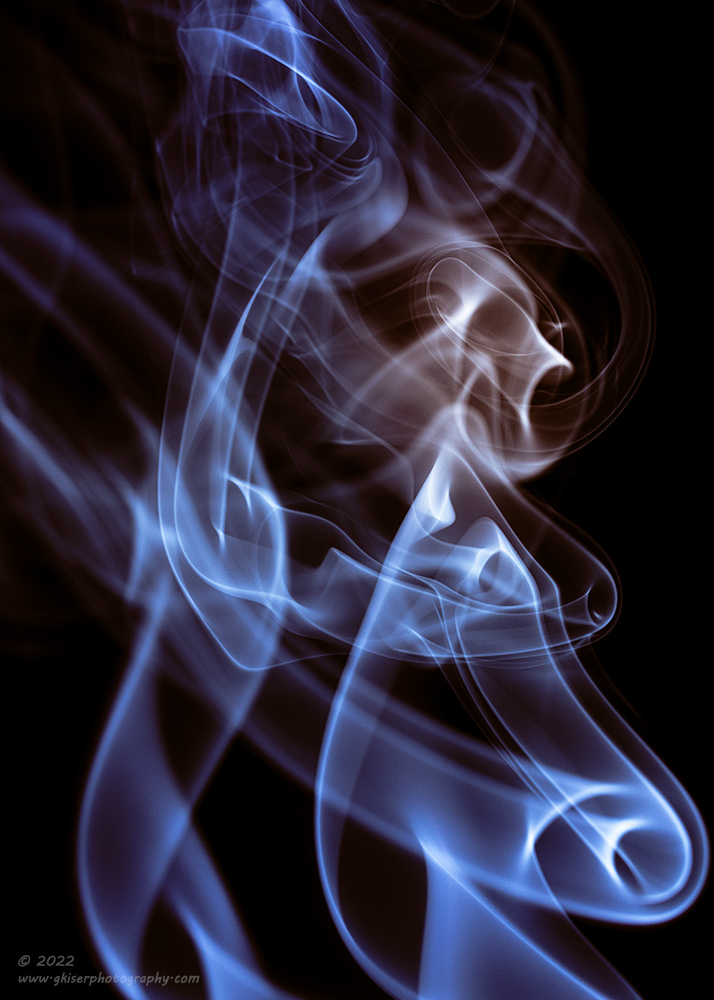
It is these times when I started to do my studio work where I worked with still life subjects, or in the case of this photo, I worked with smoke to form abstract pieces. I’ve done this type of photography in a living room at night, in my home office during the day, and most recently in my actual studio. Obviously, this is something completely different from what I normally photograph, but that is part of the draw for me. Not only did it give me an opportunity to use the speedlite that I purchased with the initial camera purchase, but it allowed me the chance to experiment with different editing techniques such as adding color. As a landscape photographer, I don’t really get the chance to use flash all that often, so this was a chance to really learn a new skill in relation to photography. Until doing photography like this, I never had the need to understand flash sync speed, or how important controlling the light output from the flash could be. These times of doing smoke photography helped to pave the way for my portrait work that I am currently working on learning.
Not only did I do smoke photography, but I would also photograph water drops as they splashed into a bowl of water. This was an exercise in patience and failure as getting the timing right was something that I didn’t have a lot of luck with. Again, it taught me things about the angles that I shot at to produce reflections and how the light was able to freeze action. Using artificial light isn’t always about freezing action, and sometimes, I would use artificial light along with a slow shutter speed and do painting with light in the studio on a very small scale. This was a fun little bit of photography that allowed me to understand how light and a long exposure worked. This led me to a place where I could go out in the middle of the night and do the same type of photography, only on a larger scale.

In this example, I was shooting well after sunset, and well beyond blue hour despite the name of the piece. By using what I had learned with my studio use of painting with light during inclement weather, I was able to go out well past natural light hours and create my own light. Instead of working with an exposure of 30 seconds, I was working in the several minutes category which gave me enough time to walk around and paint the subject with a regular flashlight. It was just another way that I could beat the conditions and photograph on my terms.

As I am always looking for alternatives to my normal cloudy day photography, I realized that photographing in the dead of night wasn’t a problem at all when you embraced man-made subjects and artificial light. When we start to look at the world like this, there is no time limit on when we can create photographs. We just have to take our knowledge of composition and finding a subject with the appropriate light into different environments. With the right level of creativity, we can create photographs anywhere, and at any time. Don’t ever feel restricted by conditions when it comes to photography (unless you are in jail, that is). Get out there and create when you are feeling creative.
I thank you for joining me for this latest Behind the Camera. I hope that you have enjoyed it, and possibly learned a few things about photography. One of my primary goals behind this feature is to create a collection of topics that helps you to understand not only my process, but what makes photographers tick in general. I hope to inspire those that want to create their own images as well as create a deeper understanding of who I am behind the camera. As with all art forms, what we create is largely due to what we bring to the process. By understanding my own story, I hope you will understand the visual stories I am creating a little bit better.
I hope to see you back here next month for the newest topic. Unless something different jumps out at me, I plan on talking about the difference between zoom and prime lenses. This is a topic that I’ve had in the wings for a few months now, and figure that October might be a good month to cover it. In the meantime, I hope that you enjoy the rest of September. Cooler months are ahead, and I’m so looking forward to those days.
Until next time….

Remember to use the code KISER10 to get 10% off your purchase