Wednesday, October 4, 2023
I bet you said Ice Cream, didn’t you? Well, I really can’t fault you for that and in all actuality, that was kind of what I was thinking too. You see, a few days ago, Toni and I decided to head into Taylorsville to get some ice cream at Taylorsville Scoops. She had chocolate and black cherry, while I had a brownie batter concoction and a dark chocolate caramel thing. It was good, and we both enjoyed every bite, but I’m pretty sure that you didn’t tune in to hear about our evening treat. The reason that I mentioned it was that even though I have made many trips into Taylorsville over the last few years, there is usually something new and different that catches my eyes each time. Most recently, it was a Ford Fairlane that was situated well off the road under some trees. I had seen that car many times, but finally was moved to shoot it. What I saw while we were on the way to get ice cream was something that I hadn’t seen there before, and it didn’t even really jump out at me at first.
You see, what I was seeing was a pair of Ford Fairlanes that were perched on an elevated parking lot which were obviously for sale. These cars were in really good shape, and looked to have been recently restored, or at least were still in a restored state. They didn’t fit my criteria for a decay subject at all, so I just enjoyed seeing them and went on with the evening. Of course, seeing them again on the return trip just burned them into my brain that much more. I thought that I might try to do something with them at some point, but I wasn’t too concerned if they were to happen to go away as sometimes happens with these old cars. Honestly, I didn’t give them another thought until this afternoon while I was sitting in my recliner pondering a themed portrait shoot that is scheduled for next week.
I had done pretty much everything that needed to be done other than modify a lantern for use with a speedlite and then go out and see if it will work the way I am hoping. I wasn’t quite ready for that evolution though, and started to think about what I was going to do with the rest of the day. I could watch videos, I could start on the next Behind the Camera, or I could make use of the clouds that I was seeing moving into the area. I was feeling a bit creative and wanted to get out with the camera again but seemed to have a hard time getting excited about doing landscape work with the Autumn colors. So far, I really haven’t seen any colors that I was overly thrilled about, and really didn’t care for the option of going into the very crowded Blue Ridge Parkway to where the leaves might be the most colorful. I just hate crowds, and getting some yellow trees isn’t a huge concern for me these days. I did have good light, and I wanted to make use of that the best that I could though.
As I went through my options, I started to consider finding an old car to photograph. I was still trying to make contact with the roofing company in Lenoir about the Impala that they had behind the shop, but hadn’t been able to talk to anyone yet. I pulled out the phone and gave it another try with no success. I tried to think about other vehicles that I had seen recently. One that popped into my head was in Winston Salem near Walburg. I didn’t know much about that location other than there was an old truck in the woods near a house. That was a little far to travel for a shot in the dark, plus with the sun still kind of bright the lighting would not be good under the trees.
I was about to give up and just settle into my chair for the evening when I recalled the pair of Fords sitting outside of a shop in Taylorsville. They weren’t rusty, but the colors of both would go nicely with the blue sky and a bit of clouds for contrast. Because they were elevated and right at the edge of the parking lot, I was thinking that I would be able to get some very unique perspectives on these cars by shooting them from down low. It had to be easier than what I faced with the Hudson truck the other day. That truck had opened my eyes to the possibilities of photographing a shiny vehicle as well. The Fords were worth a try, and since they were at a shop, there should be no problems getting permission to photograph them.
I grabbed my bag and started down towards Taylorsville. All the way down I fully expected the cars to be gone and I was prepared for that event. If that had happened, I was just going to drive around and see if I could find an alternate subject to work with. There seems to always be something out that way, so it shouldn’t be difficult. As luck would have it though, when I got into the area that I recalled them being in, I saw the mint green Fairlane right where I remembered it being. I slowed and pulled into a neighboring parking lot to look at the compositional possibilities for a moment before committing to asking permission.
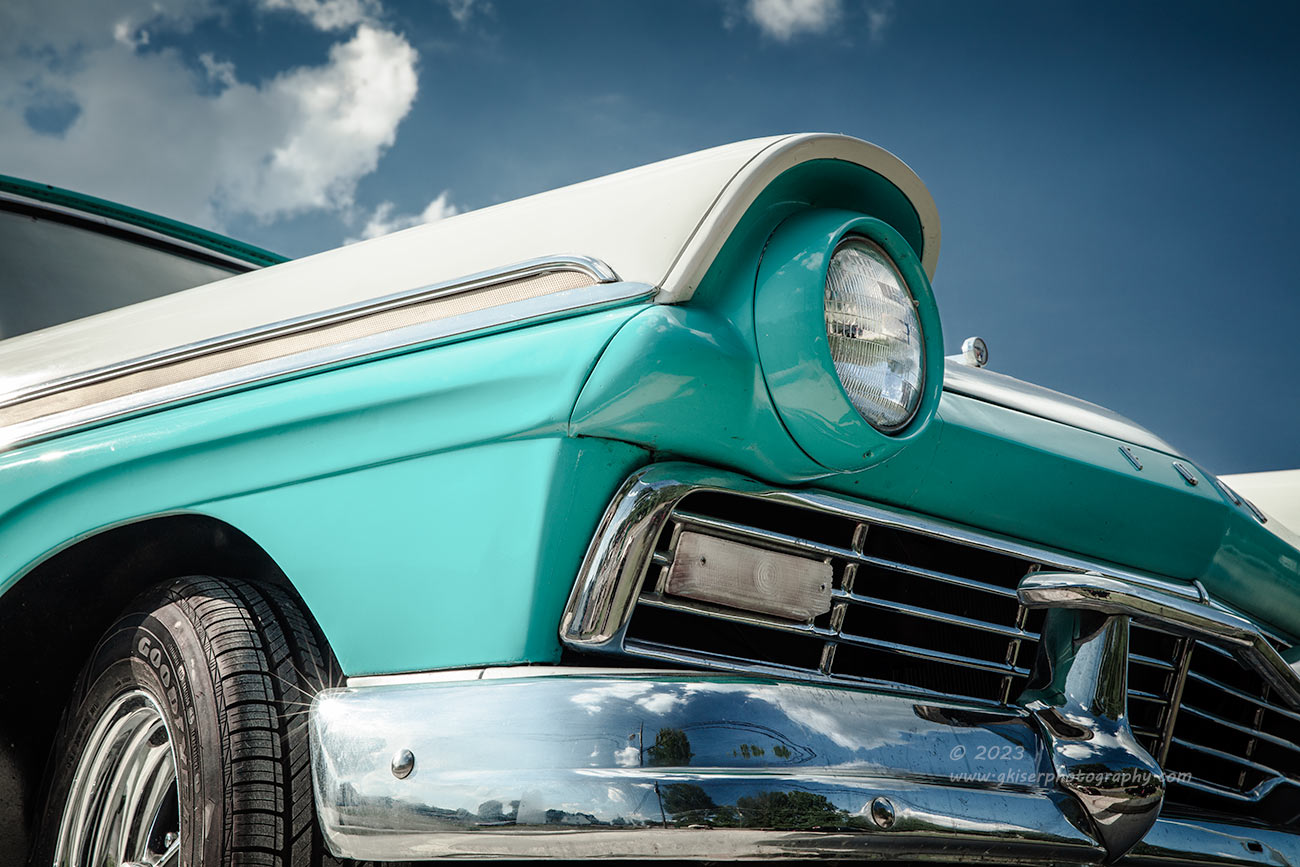
At first, I wasn’t all that thrilled with what I had to work with. There was a lot of clutter around the cars whether it be the roadway, other vehicles, power lines, the building, and all the reflections that would be part of the image thanks to the chrome and pretty paint. The only thing that really drew me in was the fact that I could shoot from well below the bumper line on the fronts of the cars and overshoot the building behind them. It was worth a try, and if nothing else, it would be a unique opportunity to photograph a car at this angle.
I pulled into the parking lot where the cars were and parked the truck near the door. When I got out, I could see that the “Open” sign wasn’t lit and it looked dark inside. I went to the door and knocked, but there was no answer. Since there were “For Sale” signs on both cars, I figured that there might be a way to contact someone. I looked around and saw that the place was under video surveillance, and I also saw a sign on the front of the building with a phone number. I decided to give it try to see if maybe it was a cell phone, and not an office number that would be ringing at a vacant desk. After dialing the number, I put the phone to my ear and waited. There was no ringing, no dial tone, no nothing at all. A few seconds passed and I looked at the phone to see if it had connected. Then I realized my mistake. The truck was still idling, and I was close to it…close enough for the Bluetooth to still be connected. I deactivated that feature and hoped that there was still somebody on the other end of the line.
Fortunately, there was, and I had a nice conversation after admitting to my lapse of tech savvy. He was happy to let me photograph the cars and even told me that there were some more old ones behind the shop that I was welcome to shoot. I thanked him and went to turn off the truck and grab my gear. I just got the whole bag because I really didn’t know what was going to work the best at this location, so I wanted easy access to all my lenses and filters.
I started off by walking around the two Fairlanes. The red one was a bit newer and had less appealing lines than the mint one. Neither was anywhere close to being a decay subject, and that was a little bit of a turnoff for me, but I wanted to see what I could do with both of them because the colors were really nice in the light. About the only part on the red one that caught my eye was the long Fairlane lettering on the quarters, but I wasn’t sure how to get that in a composition just yet. The other one had great lines and all the emblems were there, but without rust, I was having a hard time filling the negative space that was created by the large body panels. Nothing was jumping out at me, so I decided to walk around to the lower level and see what the angles were looking like down there. That was going to be my easiest composition and would get me started with the cars at least.
When I got to the lower level, I started to examine how things lined up. I was going to be able to get in very close to the front of the car and could have the camera below ground level if I wanted it to be. The building behind would be totally gone from the shot as well as the neighboring car as long as I didn’t shoot too wide. This was going to be one of those times when I was just going to work a corner of the car to include the interesting bits more than anything else. Based on how everything was positioned, I chose to go with my trusty 24-70mm lens and a polarizer. This combination stayed on my camera for the next 30 minutes which was the entire time that I was on the property after getting permission.
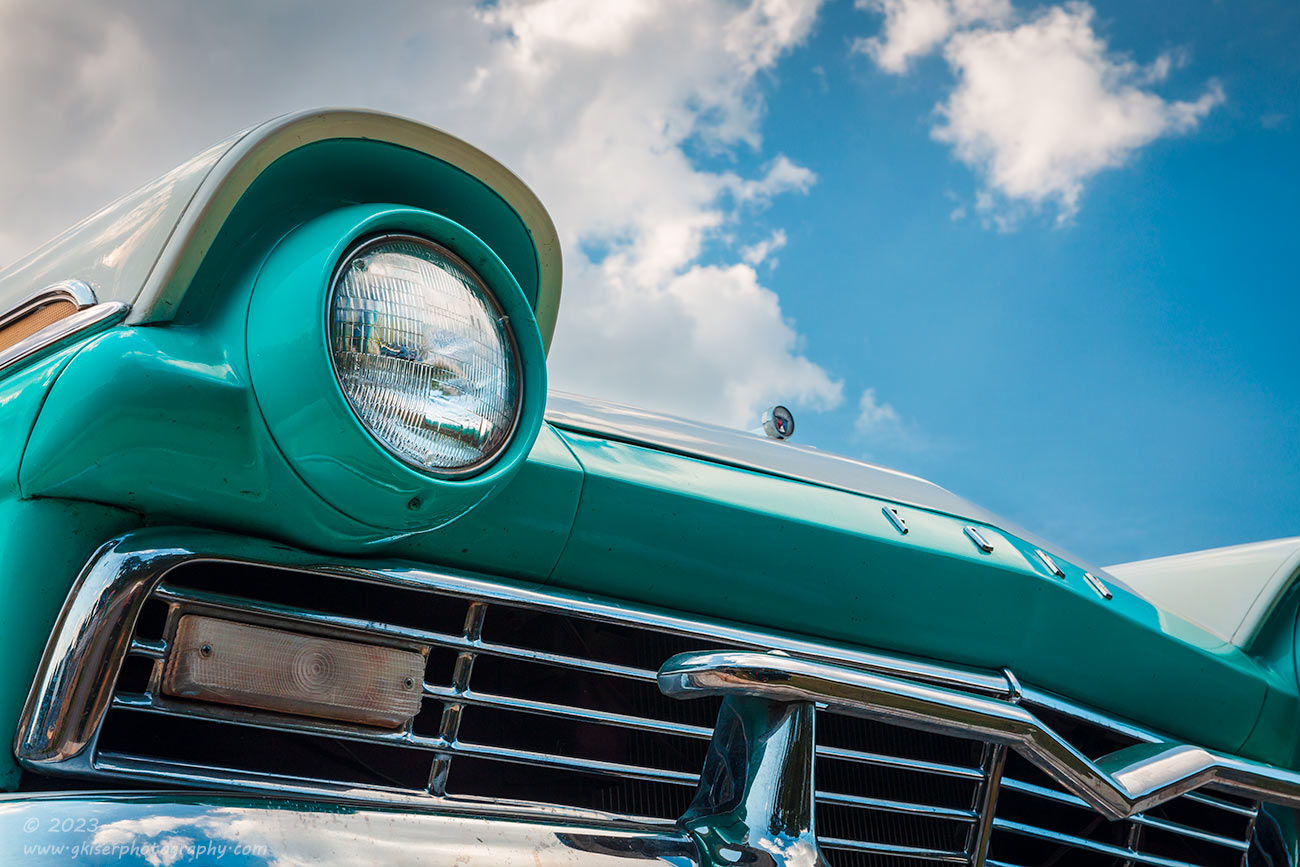
The next 30 minutes turned into a whirlwind of shooting where I ended up creating 33 image files. It was a slow start, but after I got into that low position, things started to come together for me. My first composition was of the front of the car primarily, but I cropped it in very close on the driver’s side so that I didn’t include the late model car that was parked next to it. I actually do like the single headlight shots because having two of them seems to change the balance of the image in the wrong way. This way, I was able to focus on the headlight and make it the visual anchor. I think that I had the most exposures on this part of the car because I was figuring out the exposure values I wanted, and then had to wait for the traffic to die down so that I didn’t get odd color blurs going across the chrome. It a surprising turn of events, I was nowhere to be found in the chrome, and I wasn’t going to have to worry about deleting my cameo appearances when I got the images into post.

Now that I had the basics figured out, I moved over to the left a little bit so that I could get the line of the fender and the textures of the turned tire into a frame. I actually liked this composition better than what I had started with. Since I had the basics all figured out, this one went quite a bit faster, and I was able to shoot less frames because I knew how to wait on the traffic and where I needed the road to be empty.
After two shots, a car pulled into the neighboring parking lot where I had sat to scope out the cars and the driver got out and started towards me. I was thinking that this might be the owner which I kind of expected to show up, but it wasn’t. He started asking me what kind of work the shop did and if they were hiring. I’m pretty sure he thought that I worked here, so I just told him I was there getting some photos and I had only talked to the owner for a total of about two minutes via phone as the shop was closed. I knew nothing at all about what he was asking but pointed him to the front of the building where the phone number was displayed.
Once that diversion was finished, I went back to what I was doing and made a slight change to the composition before getting another two frames. By this point, I was pretty well set on doing a double capture of each composition because the light wasn’t really changing, and nothing was moving in the scene. I just wanted to get a safety image in case I missed traffic and there was an odd blur in the frame. For the most part, I was nailing the photos as I shot them which was really nice and had so much to do with the high hit rate for the day.
Now that I was feeling really good about the captures up front, I started to make my way around the car, but I stayed on the embankment since it gave me a very unique perspective on the car shooting from so low. It was also the only way I could get far enough away from the side of the car to get a photo composed. I favored this side because it was the one in the sunlight and had the best colors as well dimension. It was just a matter of figuring out what I liked best about the side of the car. Normally, I would have gone with the trim that divided up the two-tone paint, but the chrome was just too shiny, and I didn’t like the way things were coming together without any texture. Oddly enough, what did grab my attention was the wheels, and the shapes of the fenders. The wheels were just perfect in their style and the center caps were both very detailed which grabbed my attention. I had two different visual anchors at this point, I just had to figure out how to create an image around them.

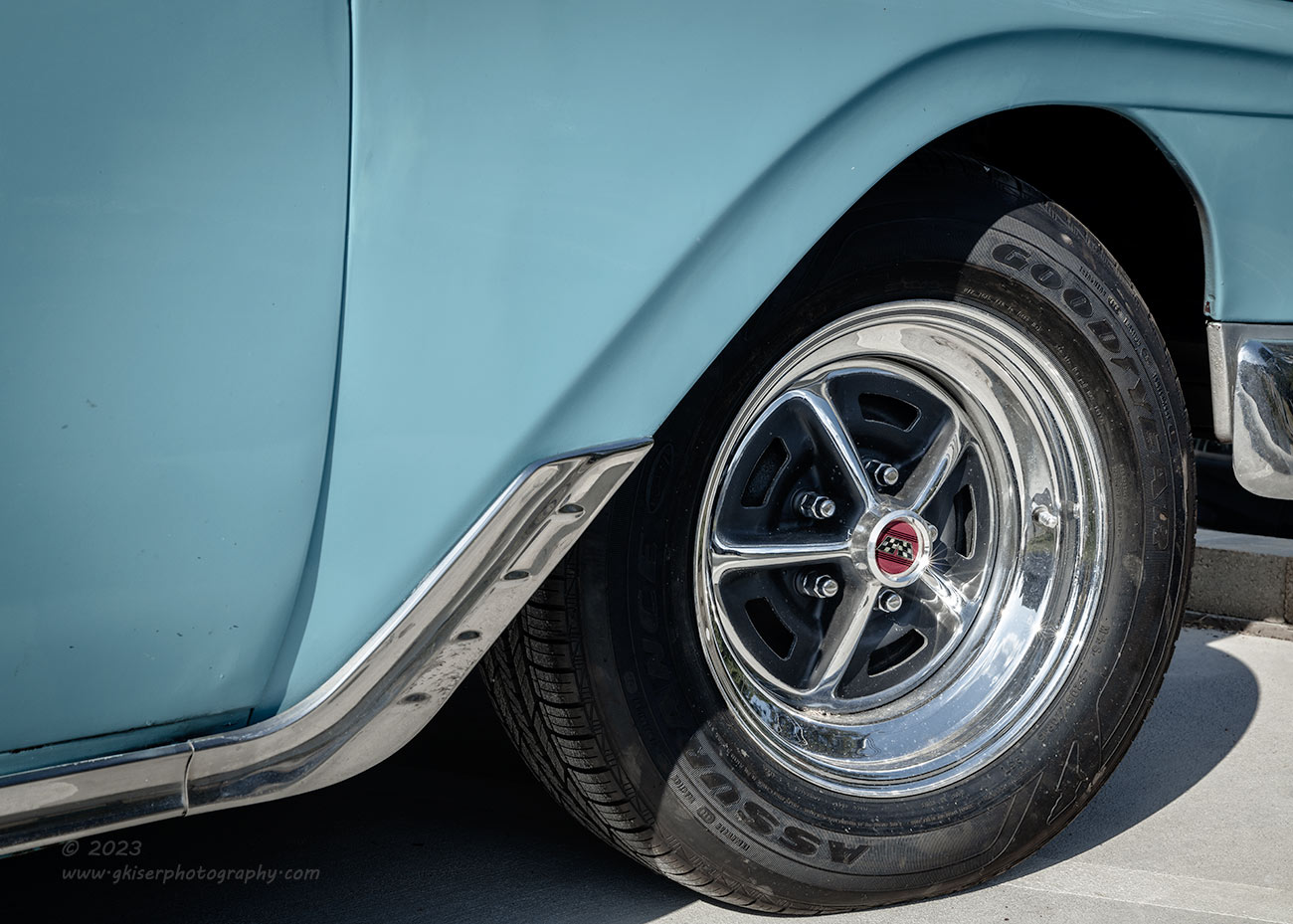
For simplicity, I decided to take both wheels as individual compositions. The front wheel was turned slightly to the right which prompted me to photograph it from slightly behind to get a better angle on that wheel. What I found was the swooping line of the wheel opening was the perfect shape to pull the eyes through the frame. The body line between the fender and the door broke up the negative area and kept it from becoming empty space, while the chrome trim at the lower edge provided a wonderful complementing element to the wheel. The subtle body line that followed the curve of the fender opening was another area that I loved and decided to keep whole.
This composition seemed to create itself as I was getting the lens dialed in. If you will recall, one of my arguments for using a zoom lens was precisely this reason. I was perched on the embankment and had very little room to move the camera. The only way that I was able to get the exact framing that I wanted was to use my zoom lens to create the right frame at the time of capture. There were no wasted pixels here except for what I lost changing the aspect ratio from the native 3:2 to 5:7 which fit the composition much better. In fact, this is pretty much straight out of camera with just a color profile selected and some local adjustments to the center cap. Most of these images required very little in the way of post processing and I was able to get all eight photos edited in an hour. That is moving right along in my book, but shiny cars usually don’t need much.
Once I was happy with the front wheel, I moved the rear wheel which I wasn’t as thrilled about initially. The lines were not nearly as dynamic compared to what I had shot on the front of the car. However, as I looked at the scene, I noticed the white striping on the concrete. It was not terribly dominant, but I liked the stripes and saw that they made some nice leading lines to the wheel. Once again, the focus of the shot was going to be the weel. Now that I had the idea to use the stripes, I needed some balance to the image on the top. That came from the fender which I worked on getting the right angle on and including just the right amount so as not to overshadow the pavement, or the wheel.

The curve of the fender grew on me really quick once I started to frame this shot up. It was actually quite dynamic, but I hadn’t really appreciated it before I saw that wheel arch as a primary element rather than the large fender. Everything was coming together nicely for this, and I was able to get the wheel off center to the upper right, while still keeping the arch of the fender as a primary element. The pavement fell into place, and I used the curve to block the visual exit to the lower left. The image was lacking something though, so I didn’t spend too much time with it. I got my two shots with one being a safety and moved on.
When I got the images home, I looked at these two shots and really liked what I had created here, but as I had thought after shooting them, something was just not quite right. The more I looked, the more I realized that the color was throwing me off. This struck me as odd because it was the mint green color that had really drawn me to the car in the first place. The edits that I had done up to this point had already been three different color profiles with variations on the color of the car in each profile. I had gone with the mint green, a desaturated version of the mint green, and then had gone with a baby blue tone to contrast with the red of the center cap, so I wasn’t married to the color when it came time for the photos. With that in mind, I realized that the color wasn’t important here at all. What was important were the white lines on the gray concrete, and the textures of the wheel and tire. Then it hit me, this tire had been curbed several times and there was a tan film over much of it which threw my brain off. By getting rid of the color, I would be able to hide that anomaly while also being able to precisely control the contrast to pull the stripes out of the concrete much better. I could also dictate the brightness of the fender to match the needs of the image better this way. Once I started on the B&W journey, I never considered turning back.
That was the last composition that I shot of the mint green Fairlane, but you will recall that there was a bright red Fairlane parked a couple of spaces down which I liked but hadn’t photographed yet. The time had come, and I was ready for a change in mood to a more exciting red subject. I went over to the car and started to look around to see what lines and shapes I liked the best. Just like before, I was left kind of empty with this car. It was an absolutely beautiful car, but when it came to shooting isolations, nothing was motivating me with the exception of the very long Fairlane 500 emblem on the long quarter panel. This had been what grabbed my attention before as well, so that meant that I was going to have to figure out a way to capture this before I left.
This was actually the hardest composition that I ended up shooting while I was here. I moved the camera all around to see what angles made the best sense, but nothing was working because there was just too much red in the frame. When it comes to color, we have to be very careful with the use of red because too much of it will overpower an image which I didn’t want to do. I needed something to cool the color palette down significantly for this to work. My only option was to include the sky. The question was how in the world could I do that and make a pleasing composition.
I got down low to the ground and started to look up. The sky looked great over the car, but the composition was boring to look at with a single line of division between the red and blue. As I played around with the ideas, I decided that to make the line interesting, I would include the rear pillar and the rear window. In order to do that, I had to move over to the left which added a bit of perspective to the quarter panel that brought with it some drama to the image. This was going to work out. I just had to be careful about the power lines which were at the right of the image. If I included the emblem on the pillar, I would include the power lines which I could remove easy enough, but there was also a tree that didn’t really fit the scene. No matter what I did, the tree was always there. The only solution was to frame the shot without the pillar emblem. I actually liked how this worked out better because it kept the focus right on the long emblem which is where I wanted it to be.
It took me a long time to frame the shot, but once I had it, I had it. I fired off two images with one being a safety and evaluated them. I saw no room for improvement and picked up the camera happy that I had worked out a photo from this car. I spent a couple of minutes looking around the car for another composition but found nothing of interest. I had overcome the red while focusing on the red. There were no other interesting shots where I could do that again.
I still hadn’t forgotten about the other old cars out back and it was time to go and see what else he had. When I got there, I could see a Mustang that looked like a perfect decay subject, but it was in a setting that didn’t allow much flexibility in composing a shot. There was another car that was covered by a tarp which had no interest at all for me since it was covered. Beyond that was a late ’60’s Ford truck that looked to be in decent shape but nothing that excited me photographically. It was looking like the Mustang was going to be my last subject for the day, I just had to figure out how it wanted to be shot.
With everything around it, including off road tires next to the driver’s door, there was no way to get an overall shot of this car. I had to play my favorite game of what do I like and What do I dislike about the car to decide on my compositions. It was the patina on the front that really drew my attention to start with. That was where I started out and I went with a proven composition that would allow me to include the 289 emblem, the horse emblem, and the headlight with the iconic grill surround to fully identify the car. The only part that I didn’t like here was the white hood that was present that was going to throw the attention to close to the upper right corner. This was going to have to be something that I would need to address in post to keep the eyes locked into the frame.
After my first exposure, I saw where I had a problem. When I used my hat to shield the polarizer from the sun which was behind me, I was casting a shadow over the grill that I didn’t like. I had to adjust how I was blocking the sunlight, and I made that second image which was my safety. I saw no shadow there, and everything else looked good so I moved on to the next composition. I’m really liking this workflow where I shoot less but take much more time dialing in the image before taking that first shot. It felt like I wasn’t doing much at all, but I was able to think back on at least six images that I was probably going to love already. Just because digital is free doesn’t mean that we should be in the habit of getting so-so photographs. Work them out before you start pressing the button. As long as nothing is changing like lighting, or positioning of elements, there is just no need at all to fire off image, after image, after image. The more bad shots that you take, the more you will learn what works and what doesn’t which will increase your hit rate in time.
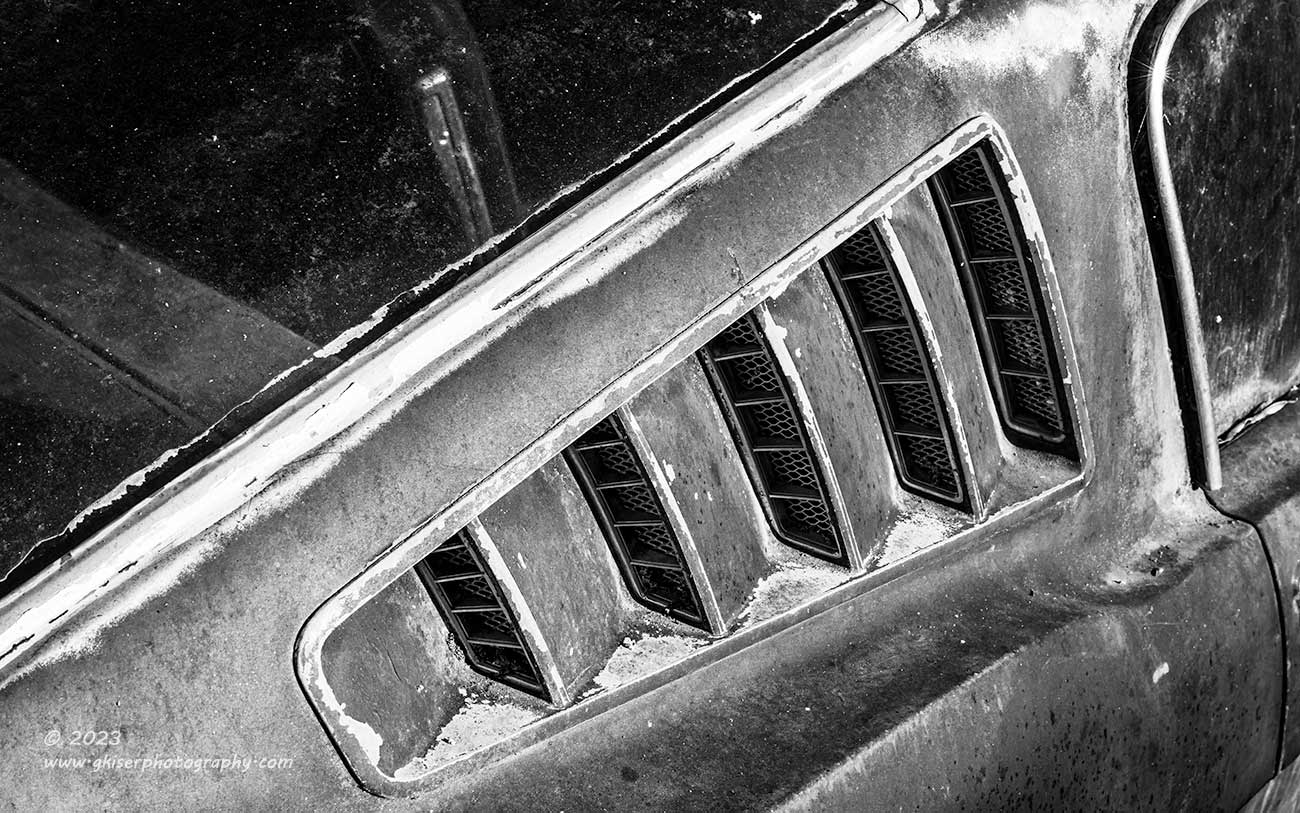
The next area of the car that caught my eye was the louvered vents behind the side windows. I don’t get the chance to work with these all that often, so I wanted to give it a try. Looking back on the experience, this was the second most daunting composition that I worked on. Again, there were only two frames shot here, but I spent a very long time getting the composition dialed in before I pressed the button. I looked at them from in front as well as behind. There was more contrast with the lighting, and I was able to see the actual guts of the vent better from behind so that won out. From there, it was deciding how to place the frame around the vents so that the image was balanced and had a visual flow. I based most of my choices on triangles and tried to keep that a theme inside the frame.
The patina here was not nearly as interesting as the front of the car, and the dominant color was green which didn’t really suit the photo. Because I had spent so much time on getting shapes and contrast with the light, this was a natural to go black and white which was the first and only way that I edited it. I was able to pull out all of the texture I wanted to, and without the color, the viewer was forced to focus on the shapes within the frame which was the intent all along. The edit was one of the quickest ones with the fewest local adjustments because it just all fell into place so well from the capture.

I could have easily called it a day at this point, but I felt that the Mustang still had something left to offer me. I wanted to get a better shot of the famous 289 emblem which was on the front fender. The original photo here had that as an element, but it was so small that it wasn’t a primary focus. I felt that the car deserved a bit more direct approach for this bit of chrome. As I compared both sides, the fender was a bit more interesting on the driver’s side which I hadn’t really worked with yet. This side was in the shade, but that would keep the highlights down. I just had to figure out how best to shoot it.
My first thought was my standard straight on shot with the emblem surrounded by rust. This is effective but has started to bore me in the recent years. I have grown very fond of shooting with a bit of perspective included in the composition, so I looked at the angles from down low which I loved on the car, but the background was full of power lines and houses. It didn’t suit the car at all, so I elevated the camera to eliminate the distracting background. Now the background was the dirt driveway and a little bit of grass. It was simple, and provided some interesting texture, but most of all, it gave me a warm color tone to contrast with the cooler tones of the fender. The only thing left to really figure out was the depth of field.
I needed to focus the attention on the emblem with everything else being secondary, but I did like the textures of the fender which meant extending that depth of field just enough to include that aspect as well. For this, I used the depth of field preview button and decided that f/9 was going to be the winning aperture for this composition. I did my normal two shots and evaluated. Everything looked very good, but I wanted to tweak the composition just a tad which I did. Two more shots later, I was done. I made a quick look back at the three cars that I had shot to make sure there was nothing left for me to work with. Satisfied, I checked my image count and found that I had shot only 33 frames which is just barely more than a roll of film. I felt really good about what I had photographed and figured that I had at least six workable images from the half hour that I was out here.
The culling process went very quick since there were not tons of the same images over and over. I narrowed it down to 11 photos that I wanted to edit and evaluate. Of those 11, three of them were alternate images that were slightly different in composition. I chose the best and ended up editing just eight files which were finished in no time at all. Even with the blog entry to this point, I am looking at only four hours since starting the culling process. I love when a trek goes this fast and there are this many photos to show from it.
I hope you have enjoyed the trek and photos as much as I have. I would love to help match you up with a beautiful print to hang on your wall, so let me know if you would like to get that process started. Should you want to improve your own skills as a photographer, don’t forget that I offer many levels of mentorships where I can share my skills and techniques with you so that you can expand your own photography. For those who have done workshops or mentorships with me in the past, you know how willing I am to share anything that I know and will help you figure out solutions to problems that I might not have run into before. Give me a call so that we can discuss your needs and the options that I can provide during a no-risk, complementary consultation. Who knows, I might just be able to help you during that consultation eliminating the need for a formal mentorship session.
My portraiture is also moving right along these days, so if you are interested in booking a session with me, let’s get it in the books. I’ve started a group of sessions that I intend on blogging about when they are all finished up. The first one is done, and I’m really happy with the results. I can’t wait to share them with you, but I am still trying to keep this blog primarily about my landscape and decay work which is what it was built on. Just don’t be fooled that those are the only types of photography that I engage in. I would love to talk with you about what you are interested in from a photo session, and depending on what it entails, I am happy to do some trade work as long as I can learn something new and use the photos from the session for my own marketing.
Let me know what your favorite photo from the day was. I think I have my favorite figured out, and it isn’t a decay image which surprises me. I’m actually starting to enjoy doing “prettier” vehicles from time to time. They offer different challenges as well as some very different looks to the final images. If I never look at things differently, I’ll certainly never grow as a photographer.
Until next time….

Remember to use the code KISER10 to get 10% off your purchase