Thursday, January 8, 2026
Things might be a touch different with this blog entry, but don’t worry, the differences will be subtle. You can tell from the title that I am restricting myself and that kind of took several different forms this morning. The first clue is the date of this trek which is a couple of days ago. I chose to restrict myself to one blog entry a day and since I was still working through my last trek and the time at Outlawed Restorations, I didn’t want to interrupt that flow when I still had another entry scheduled for Friday, which was yesterday. That is why this one has been a little delayed in being published. I actually finished with the photos shortly after lunch on Thursday. The next restriction was the number of photos that I was going to capture and process. I wasn’t wanting to have another experience with a long multi-part blog entry, and I’m sure that you all appreciate that as well. I didn’t have a number of photos in mind, only that I wasn’t going to go overboard with the day. I was going to go to one place, and more than likely only shoot in a small area of that place. This brought me to the next restriction that kind of came in right before I pulled the camera out. I wanted to restrict myself to my wide-angle lens which I have decided I want to get more proficient with this year. That turned into the biggest restriction and probably the most important one.
It all started yesterday as I was finishing up the last blog from my previous trek. I was feeling really good about how the day had gone and what I had learned from my time trying to see things differently. I was actually feeling like going back out with the camera again, even though I knew that I had blog entries scheduled for the next two mornings. I wasn’t wanting anything major but really wanted to spend some time with the 16-35mm lens and force myself to use it more to see what else I could come up with in terms of techniques. Now, I’ve used this lens for many years so it might come as a shock that I am wanting to learn it better. I’ve realized that for the most part, I use this lens when I am in a bind and need some more extreme scaling, but it usually comes in response to a compositional situation. In that regard, I am pretty well versed with the lens, but much like the telephoto lens years ago, it was there to solve problems and not be the basis for a composition to start with. I needed to change that, just like I had with the 70-200mm a couple of years ago. I can now use that lens in all kinds of situations that I never would have thought about before. That was what I wanted for the 16-35mm because I generally loved the images that came from that lens, but they were usually few and far between.
One thing that I knew was that this lens was bought as a landscape lens, and I found that I just don’t really see in wide-angle naturally which meant that even in landscape this lens would get left in the bag more often than not. I had just used it with great success photographing some decay subjects, and I wanted to take it back to its roots of landscapes and try to teach myself to see in terms of wide-angle focal lengths. There are a few different ways of doing this which I’ll touch on later, but I was ready to get back to doing some landscape work and this seemed like the perfect time.
I checked the weather and found that there were clouds expected during the morning on Thursday, and they were looking to be the high-altitude variety which was going to mean the potential for color. I started to think about where I wanted to go and realized that I was still suffering from the time that Doughton Park had been closed since Hurricane Helene over a year ago. I pulled up the local weather forecast for that area and found that the clouds were looking about the same with some thinning right at sunrise, but there was also the chance of some fog which I really liked the idea of. As with Outlawed Restorations, I was very familiar with this park, so I didn’t mind doing a bit of experimentation with the chance that nothing would turn out. That is a hard pill to swallow when you are visiting a place that you aren’t going to be able to go back to.

I was not overly sleepy but turned in as early as I could so that I could get started at 5am on Thursday morning. When the alarm rang, I was kind of confused as to why it was waking me up, but I quickly remembered that I wanted to go out and get some photos. Because I was nice and comfortable in the bed, I lingered for a moment and thought about just waiting to get up and taking advantage of the clouds and washing the Miata later in the morning. That was lazy, and I wanted to restrict myself to following through with the plans of the morning, so I pulled the phone over and looked at the weather. The forecast was still showing the same conditions for sunrise even though it was currently clear overhead both at home and over Doughton Park. Both forecasts that I use were in agreeance that there would be high clouds overhead with at least 55% coverage at sunrise. Just to double check, I looked at the sunrise forecaster and found that all of Western NC was supposed to see color at sunrise. I didn’t want to get up, but I needed to follow through with this since my last attempt at doing a sunrise found me staying in bed and getting a text from Toni with the beautiful sky overhead as she headed to work several days before.
The covers were finally pulled back, and I got up to get the day started. I was by no means happy about this as I am just not a morning person, but once my mind cleared, I was glad that I was going to head out for a sunrise. It had been a very long time since I last did that. After breakfast, I went down to the studio and grabbed the camera and put on my shoes. About 45 minutes and a dozen deer later, I was pulling into the park. As suspected, the gate was closed, but I was able to park at the old lodge which was fine by me. The area that I wanted to photograph was about equal distances from either parking area and would take the same amount of time to get to. I didn’t waste any time getting my gear together and starting to move because the color was already showing in the sky to the East. It was a bit over 30 minutes before the official sunrise, and that usually gives me plenty of time to get in position when I know where I’m going.
I think it was about a 10 minute hike to the bluff where I was wanting to work. This is an area off to the side of where I normally go, but it is one that I have shot less often, and I know that it offers some great views at sunrise. It was also a spot that I had wanted to shoot when I was last here doing landscapes but had to deal with other visitors to the park. I could tell that nobody else was here because the parking lot was totally empty and it was cold this morning. I saw no other cars along the Parkway coming into the park and felt like this was a little slice of heaven all to myself.
Once I arrived, I quickly moved around and spotted the composition that would incorporate the one lone tree at the top with the sunrise behind it. I wanted to pull out my standard zoom to maximize the colors in the sky, but I stopped myself in short order. That would defeat the purpose of coming out here this morning and I really wanted to learn to use the 16-35mm better. I knew if I started with the standard lens, I would end up leaving it on there for most of the morning. Right there, I decided that I was only going to shoot the wide-angle no matter what I found. I could come back later and get compositions with different lenses. This was a great chance to change the way that I saw the world.
With the wide-angle mounted, I didn’t bother with any filters to start with, and I plopped the tripod down where I thought it would provide the best composition. The problem was, I had dropped the camera in the perfect spot for a 50mm shot which is what my eyes were seeing. that left the tree very small and a lot of extra background when viewed through the chosen lens. I had to move much closer to the tree which was something that I wanted to become quicker at recognizing. The lessons were starting early this morning, but I rose to the occasion and got in close to tree and started to frame up the composition that I had in mind. It was a lot more dramatic than I had shot here before because of the change in focal length and I was liking what I was seeing.
There was another problem though, this lone tree just wasn’t holding any interest for me. There was another one at the edge of the ridge that I had shot before with the telephoto lens with great success. I wanted to see what I could do with the wide-angle lens. It was maybe 100ft away from where I was positioned and it took no time at all to get there. Once again, I started trying to frame the scene too far back in what would be the realm of the standard zoom. I moved closer, determined to break that habit this morning.
When I got the base composition figured out, I fired off a test shot and found that the luminosity range in the scene was just too much for the camera to take. I was going to lose detail in the foreground for the sake of keeping the little bit of color in the sky. There was no breeze, but I knew that with the intricate detail of the tree, doing a HDR blend wasn’t going to provide the cleanest image possible. I needed to get this in a single shot, and the only way to do that was through the use of a grad filter.
Now, I have a selection of grads in my bag, but most of them are the typical grads that get darker the further up the filter that you go. This wasn’t the right choice for this situation because the brightest portion of the scene was right at the horizon and I needed to have the top of the sky affected by the filter less. Fortunately, I carry two different reverse grads which address this problem by having the maximum filter effect at the horizon while the effect trails off towards the top. Of course, the lower half of the filter has no filter effect at all. This allows me to darken the bright par while keeping the sky looking natural. I went with a 2-stop version which would be a more subtle change at the horizon which was important since this is essentially a hard-edge filter rather than the soft that I usually would use in this situation.

Now that I had a workable exposure, I started to make a few shots as the sky got brighter. As the light changed, the clouds did as well. This started to force my hand to move to different locations around the tree. I was reactive to the clouds in the sky and there was just no reasonable way to commit to a composition with things changing like they were. As the sunrise approached, I started to see the chance for a photo that I normally don’t go for. This is the shot where the sun is just coming over the horizon. I think that it is an overdone idea, but for this sky, it made sense. There wasn’t the drama of clouds full of color above, and what little color was there, kind of lacked any real visual interest. I knew that with the sun coming over, I could stop the lens down and create a sun star which would add that visual interest and keep the attention at the horizon.
The brightest part of the horizon indicated where the sun was going to emerge from, so I moved the camera into a position where I could take full advantage of the sun without it being blocked by the tree. I just needed it close to the tree but fully separated from it. When I found that spot, I planted the camera and decided to commit to that composition. There was starting to be great light behind me on another tree that I wanted to capture, but I knew that this photo was going to come together in just a few more minutes and I really wanted to give it a try. I did know that this lens works really well when pointed directly at the sun when it is low in the sky. The standard lens is decent, but not nearly as good as this one, and the telephoto lens just falls apart in this kind of scenario, so I really wanted to take advantage of the tool that I had and the ability that it possessed.
Those minutes ticked by and the sun started to creep over the horizon. As expected, I could see the sun star showing up with the lens stopped down to f/16. I fired off a few frames as the sun started to hit the spot I was waiting on and decided that was good enough. I had other compositions that I could shoot in the increasing light. That was when I turned back to the tree that had been looking good minutes before but still needed a bit more light. It had the light now, but the contrast on the tree really drew attention to the fact that the sky was rather bland above it. When the tree was bathed in a pastel color, the sky made more sense. That was now lost, and I knew it wasn’t coming back. That was OK though because I knew that I had other photos that were waiting to be captured.

I moved around the tree that I was going to shoot at the beginning of the morning and found that the sky was interesting to the North. I started to put together a composition in my head and then plopped the camera down approximately 20 feet too far away. Geez! Will I ever learn? Once I moved closer to the tree, the composition came together nicely. The tree was isolated by itself and with the wide-angle lens, I was able to capture a broad swath of the sky which was what I was looking to do. The tall grasses were picking up the light from the low sun which contrasted nicely with the areas of moss that were still in the shadow. The soft textures of the sky worked well with the textures of the ground while the tree linked both portions of the composition together.
I didn’t plan on this one being done in black and white because I really liked the color of the sun on the grass, but it was the contrast that I really liked the most with this photo and the way to concentrate on that aspect was to strip the color away. Without the warm glow on the landscape, I could now see the contrast in the sky, the ground, and especially the side lighting on the tree. There was not in the frame to show depth, but the lighting took care of that for me, and black and white showcased that aspect beautifully.

I was in a great area for compositions with this tree using the side light from the low sun. I worked around to find some foreground interest that would work since I had the lens on which made foregrounds a very important part of the composition. There were plenty of bare portions of the landscape as this is a very rocky area. That was what I started to look for in terms of foreground. I found one that was probably twelve feet long, but thanks to the perspective distortion of this lens, I was able to get just a small portion of it to look almost massive in the frame. The tree was still bathed in that wonderful sidelight which was adding dimension to the image.
I pulled out the polarizer and stuck that on the camera but realized that with the angle to the sun and the focal length that the sky was suffering from a polarizer banding which I didn’t like. This happens with skies when the focal lengths are wider than about 35mm and it is just a product of how the light is bent in the atmosphere which is picked up by using the polarizer. I pulled that off and went back to work without any filters on the camera.

When I was satisfied with the compositions looking to the North, I moved around to the other side of the tree and started to look at things in the opposite direction. What I liked about this side of the tree was that I could include my other, and possibly my favorite tree in the par as part of the background. I’m sure you will recognize that tree as I have shot it for years in all kinds of light and conditions. Now I was going to use it as a background for the main subject, but in a different way than I had done it before. Usually, from this angle, I will capture the image with a longer focal length in order to make the background tree larger in comparison rather than just a small footnote in the composition. I wanted to do that again this time, but I had told myself that I was only going to use the wide-angle glass today, and I stuck with that promise.
This meant that the tree was going to be rather small, but I was also noticing another small detail that was showing up in the composition. That little dot to the upper right is the moon and while it wasn’t large, it seemed to match the diminutive size of the tree in the background. I got the camera positioned so as to keep those two elements positioned diagonally opposed from one another crossing through the tree. It was just a chance at adding a bit of tension to the scene while keeping the main focus on the tree.
By the way, I did get the camera placed in a much more appropriate spot to get started, so I was slowly learning how to see like this lens. If nothing else, I was happy about that, and I actually liked the scaling of the scene as I was seeing it in the image review. There was more visual interest along the horizon with this lens, and I was able to get the curve of the hill to the left which I normally wouldn’t have been able to capture. It just gave the scene a much more open feeling which I liked and was something that I didn’t get to see with the telephoto lens and was kind of difficult with the standard zoom. The benefits of this lens were starting to become apparent, and even though I was familiar with all the positives of this lens, it was different to force myself to use it when I would usually default to a different lens based on how I saw a scene.
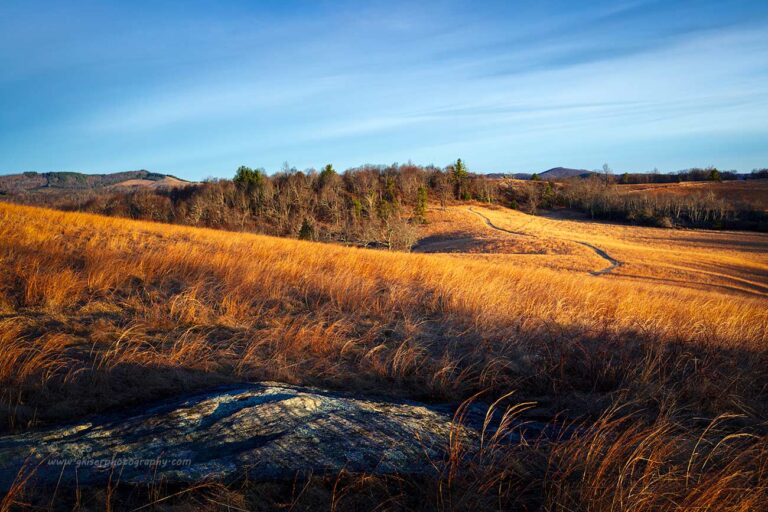
Of course, I was spending a good deal of time looking around to see how the light was falling on the different areas of the park while I was creating other photos. You kind of have to do that when the light is constantly changing or you might miss a great composition just because of how the light was falling on an area. I had been noticing the field that I had hiked through was starting to get some nice morning light and I liked how the shadows were playing across that field. Once I was happy with the photo of the tree, I decided to turn my attention on the field for a bit.
This was another example of a time that I would want the standard zoom, but I didn’t even entertain that idea but instead looked for a nice bit of foreground that I could include in the frame. That came in the form of another rock that was smaller than the other one that I had used, but by getting very close to it, and dropping the camera slightly, I was able to make it much larger in relation to the background. The rest of the composition came from placing the trail in opposition to the rock leading to the tallest portion of the sunlit field which took your eyes to the sky.
The clouds were subtle, but they were there and I paid particular attention to the exposure so as not to lose any detail in the sky. I really loved the soft contrasts in relation to the more texture driven landscape below the sky. It was the sunlight that I was after which was going to prove a bit more difficult that I thought. The sun had found its way behind some clouds which caused the light to be very flat across the landscape. There weren’t many clouds around the sun, so it shouldn’t be too much longer before things lit back up again. I just waited for a few minutes, and I could feel the warmth on my face before I saw the light change in front of me.
When the light started to rise on the field, I started a series of photos in an attempt to get the best quality light that I could. As quick as the light came, it went again leaving a flatly lit landscape in front of me once again. I had the frames with the light so that didn’t bother me at all. In fact, I was pretty happy with how things had gone for the morning. It seemed that the light was just about gone at this point with the sun getting higher in the sky. It was probably time for me to pack it in and head back to the truck. I had accomplished my goal of using just the 16-35mm lens and had kept the number of images to a reasonable number which I could get processed pretty quickly when I got home.
I grabbed my bag and started towards the trail just keeping my eye out for anything else that I might want to shoot before I put the camera away. When I got to the trail, I remembered a composition that included one of the trees that I had already shot, but from a much lower vantage point. It was best shot with a wide-angle lens which I had already fixed to the camera. I walked over to the scene and took a look at how it was situated with the morning light.
It was definitely well lit as I was used to seeing it on a cloudy day, or at sunset when it was in shadow. Now the tree was fully lit as was the landscape. It was flatly lit which I didn’t really like and the sky above it was kind of bland. It wasn’t anything that I wanted to shoot, but I remembered that part of what I was wanting to improve on was seeing things differently. I had only looked at this tree from one angle and once I found a composition I liked, I kind of stalled at that point. I went to the other side of the tree to see what that looked like with the morning light hitting the tree so well.

One of the first things that I realized was that from a bit further down the trail I could totally isolate the tree on the side of the ridge. I had never really noticed this before, but it made for a really nice minimal type of image, especially with the very subtle sky overhead. I started to figure out the framing and found that in order to avoid the trees in the lower left corner, I needed to get closer. The problem was that to get close enough to avoid the trees, I was crowding the tree which was the main subject. There was only one answer to this, and it still fit within the goal for the day. In fact, this was kind of the graduate level answer to the problem. Since I needed to go wider than 16mm, I had my oddball lens that would allow me to do this. The Rokinon 14mm prime is the cheapest lens I’ve ever purchased, and it is a phenomenal piece of glass. It would get me that extra bit of framing for the composition and would do it actually sharper than the Canon lens at 16mm.
I don’t think I used this lens once during 2025, and it is not one that I use all that often, but when I do the photos always turn out great. The lens is a little persnickety to use since it is manual focus and has a manual aperture ring. The live view doesn’t work as well with this lens since the histogram is not available, and I have to apply a bit of Kentucky windage to the exposure based on the light meter to get the right settings, but once I get it dialed in, things are fantastic. I started to get excited about mounting that lens and it was certainly in the scope of shooting only wide-angle for the day.
There was a bit more movement needed with the camera and the tripod because this lens is a prime and I wanted to get the framing exactly right in camera as I always try to do. When I finally landed on the right composition and framing, I was looking at a fairly minimal image that surprised me. This tree was right on the edge of an elevated section of the meadow and had other trees in the background as well as bushes. The position I was in had the camera pointing nearly straight up, but the leaning tree created a bit of an illusion that the I was just looking across a summit somewhere. I had never even considered this composition before and never seen it this way. Because I was changing things up and trying to learn to see in wide-angle, I had stumbled into this composition, and this was the exact reason that I was wanting to do this little exercise. In just the first two treks of the year I have opened up my options as far as compositions in places that I am very familiar with and had thought that I knew all of the compositions. It is almost like learning photography all over again, only this time I’m photographing scenes in ways that I don’t see naturally.

I had a renewed interest in working new views of this tree, so I continued further up the trail to the far other side from where I would normally work. I actually saw a very similar composition to what I would normally shoot from the other side, but it was somehow cleaner and more orderly. Because of the direction of the light, this angle looked much better than the original way that I would have shot this. The only issue that I had with it was the way that it read. The tree was now on the hill to the left of the frame. This effectively blocked the travel for the eyes through the frame and made the composition appear choppy. Since there was nothing in the frame that would indicate left to right, I knew that I could just flip the image in post to put the tree to the right side. This would make the image read better from left to right and would look very much like the original composition from the other side.
It didn’t take long to get that photo shot because the sunlight was pretty constant on the scene with the sun out of the clouds. The clouds that were in the frame weren’t moving much, so there was no reason to wait for changes after getting a successful image in the bag. It was just that simple to create, and once I had it done, I picked things up and started to walk around the area one last time to see if there were any other locations that I would want to photograph with the 14mm that I hadn’t considered previously.
There was nothing else that was jumping out at me, and I was noticing that the sunlight was getting less and flattering over the landscape. I had been out here for about an hour and a half and the good light was now over. I had shot my single location, and a very restricted portion of it, while using only wide-angle lenses. Everything that I had wanted to accomplish, I had done; and I had 87 exposures to show for the time here. Even though the shutter count for the day was similar to what I had done earlier in the week, I knew that I wasn’t going to be looking at anything like the 26 keepers I had come away with from that day. The lighting was changing too much, and landscapes just take a bit more time as you wait on the light to change when there are clouds passing over the sun like they were today. Coming away with eight solid keepers is still very good and represents a higher hit rate than I would usually have when photographing a sunrise. I’ve come away with nearly 100 exposures for a single composition to get two keepers in the past. What is even better is that these photos are all quite different in personality and aren’t just focusing on the sunrise.
I’ll say that this has been a great learning experience for me and I am looking forward to continuing the process of getting to know wide-angle photography even better than before. I’m happy to have you along for the ride, and hope that you enjoy the treks to come. I also hope that you have enjoyed this one and the photos that came about from my time at Doughton Park. I do offer prints of my work if you would like one to hang on your wall. They are great conversation starters and purchasing my art is a great way to show your support for my photography as well has helping to fund these treks. You will have a unique piece of art to show for it as well. I look forward to talking with you to discuss options.
Until next time….