Sunday, August 20, 2023
Clear skies, full sun, and a little on the warm side. Sounds like a great day for most people, but these is typically conditions that I tend to stay home for. I’ll talk more about this in my upcoming Behind the Camera which is all about picking and choosing when you decide to go out with a camera. One of the benefits to writing entries like that one is they tend to force me to really think about what I do and how I do it. One of those paths that my thoughts went down was my reluctance to get out in the bright sun to capture photos. That got me thinking about the times that I had gone out in those “horrible” conditions with the camera such as my previous trek into Yadkin County. While I am limited in the directions that I shoot and the environment that I can work in, there is no denying that if I find decent subjects, I can make some pretty good photographs in bright sunlight.
With the weather forecast being pretty much clear skies for the foreseeable future, I’ve been hesitant to go out with the camera which hasn’t really been all that bad of a decision for the most part. You see, last week, I had the opportunity to take part in a photoshoot for a non-profit that is pretty much worldwide in their operation. I’ll get into more detail about it in my year-end wrap-up, but I have to say that I feel very honored and humbled to have worked with Dear World for their Brain Tattoo event at UNC Asheville. It was a full day, and there was several days leading up to that event that required planning on my part. That kept me pretty busy and not able to really focus on going out for my own images. Additionally, I have a large corporate client headshot session that is going to be happening on Tuesday which is taking another big bite out of my time as I am planning and coordinating for nearly 30 staff members to be photographed during the day. Honestly, I hadn’t really planned on doing any personal work for the majority of August because of all of this.
Obviously, you can tell that I’ve been out with the camera today, so there is no fooling you about the fact that there are some new photos to be shared. I would like to say that the planning phase included things like checking the weather, figuring out what area of the State would be the most photogenic with the conditions. Yeah, I would like to say that, but the reality of the situation was, I had some free time on Sunday and felt kind of creative. I knew that the weather was going to be clear and likely not all that interesting, which meant that I had very little pressure on me to create anything in particular. I just knew that the best way to deal with the light was to slow down and look at what the shadows were doing, and how the light was interacting with the environment. The best way to go about doing that is to just go out and walk.
Since I had no real idea about what I wanted to create, it really didn’t matter where I went with the camera. The biggest consideration was the speed at which I worked finding my scenes. Driving wasn’t going to be a good idea because there was no way I would be able to focus on the nuances of the shadows in the second or two the scene would be visible to me. I needed to be walking. Hiking in the woods was worthless because the canopy would allow strongly dappled light to shine through and create bright hotspots along the terrain. I needed an open canopy and unfiltered light coming down. I knew that working around buildings would be where I could make use of that kind of light, and I also knew that the middle of the day was the best time to make use of that light because it was able to get into the alleyways much easier as the sun was directly overhead.
For those of you who know a thing or two about photography, because you’ve done a thing or two, you will immediately recognize clear skies in the middle of the day being a lousy time to be out with a camera. Normally, I would agree with you here, but my dislike for going someplace for 30 minutes of magic light on a clear day has forced me to learn other solutions that allow me to stay out longer with the camera and work different scenes instead of just a single composition. I’ve learned how to shoot black and white during this less than ideal time to shoot, and I’ve learned what subjects work the best in this kind of light.
The answer to where I was going to go was simple enough. I was going to go into downtown North Wilkesboro. This isn’t your typical downtown with tall buildings, or even modern architecture. This is an older business district that has some unique character that I’ve photographed many times over the years that Toni and I have lived in Wilkes County. In order to see these little touches of character, the best way to look is to do a photo walk. I don’t do nearly enough of these because the subject matter is a little out of my norm and it doesn’t really fit into my overall portfolio. However, that is as good a reason as any to go out and do these photo walks from time to time. I feel like I grow as a photographer each time I do, and I certainly learn some new things by getting out there and just hunting interesting aspects of areas that usually go unnoticed.
I left around lunch time and was parking about 15 minutes after I left. I do love a short commute to where I intend to work. The weather didn’t disappoint and was exactly as I expected. Not a cloud in the sky, and the temperature was climbing quickly. I drove through the edge of downtown trying to find something that interested me but failed to latch onto anything in particular. I almost went on to another location, but I just parked and got out. I felt that my main goal was to just get out and walk for a bit with the camera. If I found something to shoot, I would count that as a win, if I didn’t, I would have gotten a little fresh air and exercise. Either way, I was going to come out of this ahead. It was already appearing like the activity levels were below even a slow weekend day which was a nice surprise. This would mean that I wouldn’t be in anyone’s way, and there was a good chance that nobody would be in my way.
I went ahead and grabbed my bag and tripod along with my trusty ball cap which I use as a lens hood in the bright sunlight and picked a direction to start walking. I took my time looking into the alleys and the areas that weren’t all that visible. Nothing was really jumping out at me, but I knew that was part of the charm of a photo walk. It just takes a little while to get in tune with the area and start to understand what makes it unique. I did notice something odd during this walk. I was really seeing some interesting areas for a potential portrait shoot. I just took some mental notes for such an opportunity should it arise in the future. For now, I was here trying to find some scenes that might fall into the fine art category. It just wasn’t clicking with me yet.
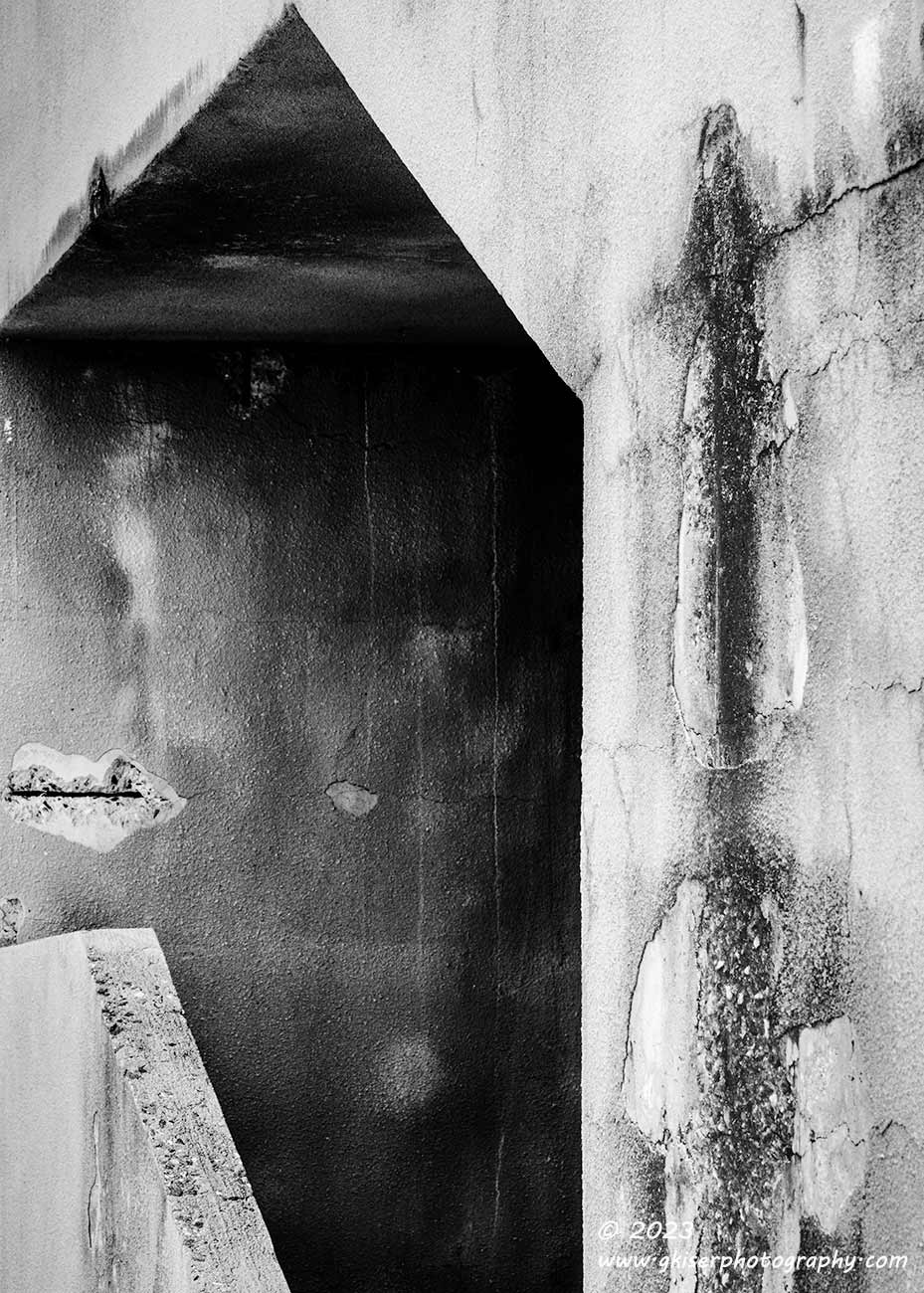
As I approached the police department in town, I remembered having some very good fortune on the rear of the building. I knew that the light wasn’t as dramatic right now as it had been before, but I knew that there were shapes there which would photograph pretty well even without the deep shadows. I just worked my way around to that part of the building and found the lower section of the stairs which I had worked a couple of years ago. I remembered that I had some pretty good shadows that helped to define some shapes that weren’t actually there for some added visual interest. This time, the shadows were gone, but I still had some depth to the scene with the existing light. It was good enough to get the camera out to see if I could make something happen. I knew I was going to want some compression to this as I didn’t want any perspective distortion to take away from the shapes I was seeing. I fitted my telephoto lens which would prove to be very useful for this location. Since there was no direct sun here, and nothing that had water molecules, I left the polarizer off and started to work the composition that I felt would make this scene come together.
My first attempt was a horizontal composition which I liked, but it was lacking something to keep my interest. I just kept dialing it in as I constantly defined what aspects I liked about the scene and which ones I didn’t necessarily want in the frame. Within a few minutes, I had decided to flip the camera on its side which was very easy to do with the L-plate attached. I never realized just how much I loved that little accessory until I was shooting from a tripod with the EOS R5 for the Dear World assignment. Since I primarily handhold that camera, I just have a basic quick release plate that I attach when needed. It made things so much more cumbersome to work with a tripod. Having the ability to just reattach the camera in a vertical orientation without changing the overall composition was so nice, and effective here.
After just a few minutes of working with the camera, I had my initial composition nailed. Since the overall scene was pretty much a uniform concrete color, I knew that I was going to be shooting this in black and white so that I could really squeeze out the tonal differences for added visual interest. To make that simpler, I switched the camera over to black and white mode to help visualize the overall composition. This is a very handy trick that I have done for years when I am planning to process an image in black and white. It doesn’t affect the RAW data that the camera records, but I can see in the LCD how the image will look once I start to process it.
Things were starting to move right along. I wasn’t spending a lot of time on any particular composition as the light didn’t really change much. I just worked on getting things right in the viewfinder before exposing the image. I was working more like I was shooting medium format film rather than digital. Every press of the shutter was intended on making a keeper image, so I was really being careful about what I was capturing. I prefer to work like this as it makes the culling process much easier at the end of the day. Since the light wasn’t changing, and I didn’t have the sky in my shot, there was just no need in capturing a lot of similar compositions. I just made sure that everything was right before I pressed the button.
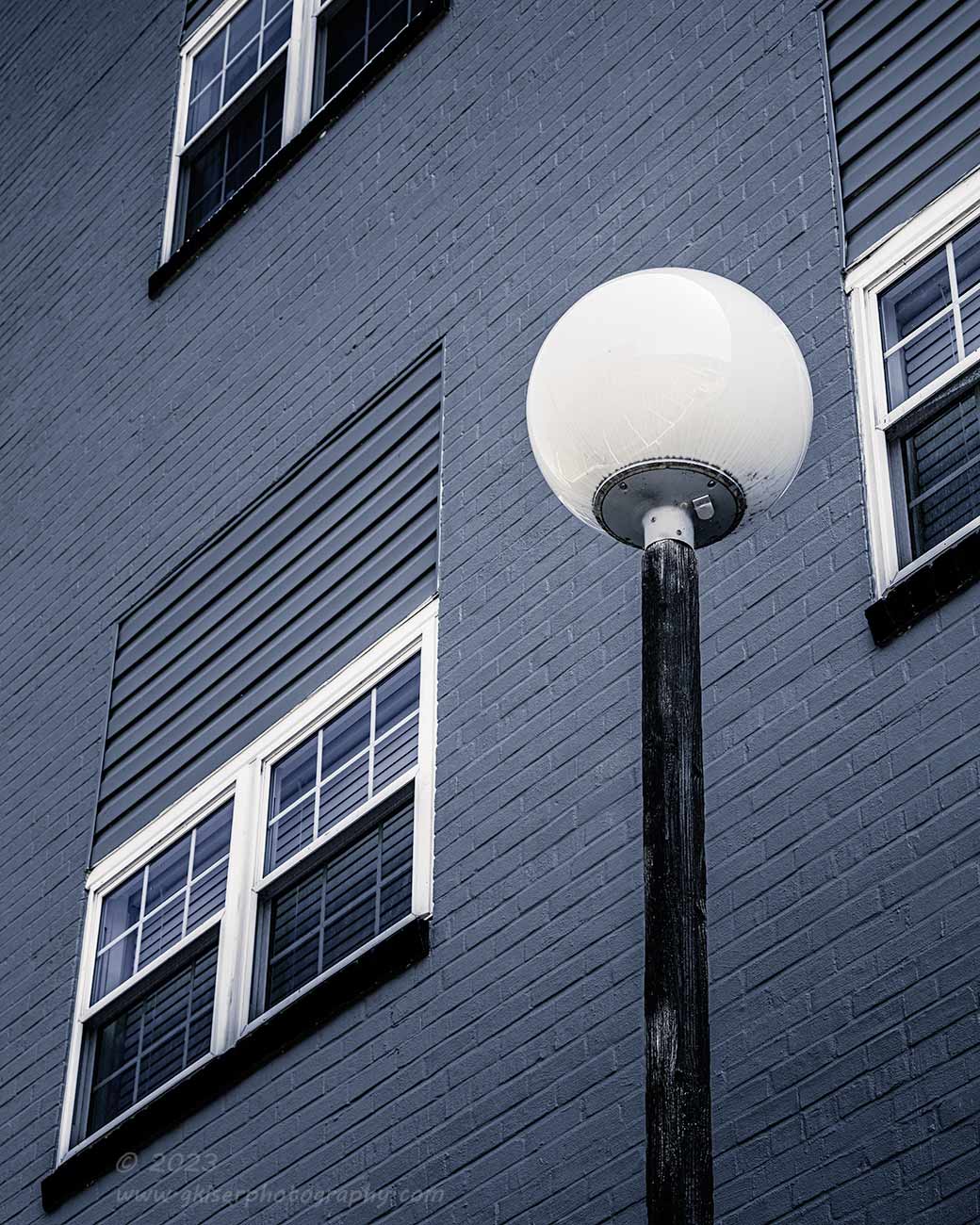
When I was finished with that first compositional idea, I started to look around to see what else might catch my eye. It was the lamp that was close to the side of the building that grabbed my attention next. I recalled shooting this same lamp a while back from the side of the street above. I liked the idea, but the resulting image wasn’t quite what I was after. Here I was looking at the lamp from a completely different point of view and I was seeing something that the last image missed out on. The way that I had shot it last time was a bit more “correct” in that I made sure that the lines were all proper in their orientation. I made sure that the verticals were vertical, but that made for a rather dull image in many ways.
I couldn’t’ help but think about a conversation I had with one of my Advanced Mentorship clients a while back on this same subject. She had captured a photograph of a castle in Europe from ground level with introduced some pretty strong converging verticals. She wanted to correct that, which we did, but left some of the perspective distortion in the photo since it was shot from the bottom. We both thought that it looked really good, and it was convincing. She later received some negative comments on it because the angles were not exactly correct from an architectural point of view. That opened up a whole dialog on the difference between artistic photography and technically perfect photography. It is those bits of the photographer that will make a photo stand out, and if you create a technically perfect photo, you stand a pretty good chance of having a photo that just blends into the crowd. In my opinion, a photograph should be created to cause a reaction, not impress a judge. Since I was not out here to create a blueprint of the side of the building any more than my client was trying to create a scale model of the castle, I chose to really skew things for this composition.
The only line that I felt was important to be straight was the pole that the light was on. This was my main subject, and what I wanted to anchor the image. As I started to work on the overall composition, I incorporated the rule of odds for the number of windows that I placed in the frame. By using only three windows, I was able to frame the light, and create a triangle around it. The perspective distortion caused by my shooting position turned the rectangle windows into diamond shapes with lots of diagonals. I loved it, and as I was getting the perfect placement of the camera, I realized that the image got boring as I moved away from the building because the diagonals faded, and the windows became more normal looking. I had to find that fine line where the angles were pleasing, but not over the top. Once I found that position, I worked on the framing.
So as not to lessen the visual weight of my visual anchor, I chose to crop into two of the three windows. I left only the lower left window in full view as it balanced out the light quite well. The remaining two were cropped into rather significantly so as to control the visual weight of those elements within the frame. It seemed to work very well, but I wasn’t liking the glare on the glass. I went to my bag and clipped the polarizer onto my filter holder before mounting it on the front of my lens. A quick twist of the polarizer pulled that glare off of the glass and helped to saturate the side of the building a bit more as well. I adjusted my exposure and fired away.
Again, I didn’t take many shots here because I had worked out the composition pretty well before that first exposure. There were only three exposures made with slightly different framings made to the composition. They were all very similar, but this was the one that won out because of how the visual weight of the entire scene came together. When I shot it, the plan had been to make it a black and white image as there wasn’t much in the way of color to be seen. That didn’t quite happen though when it was time to edit this photo. I didn’t even spend any time with the black and white profiles because I really liked the blue tone to the entire photo. I made the decision to really capitalize on that aspect by choosing one of my favorite profiles that desaturates the colors quite a bit while bringing out the blues in the scene. This worked well, and I was very happy with how it was coming together as a photograph.
This one had all the things that the first attempt had missed. It was exciting, well balanced, and compositionally, it made sense. It felt really good to get this image captured after looking back on the other one so many times and feeling like I had let myself down. Until I was standing below the light and looking up, I didn’t know how to fix the photo, but that is the case with a lot of compositions that I shoot. It comes down to being in the right spot when you start to look. That is when the scene will come together for you.

I was starting to feel the surge of creativity kicking up after the last composition. I was seeing things differently than I had before, and I could tell that I was in the right frame of mind for this location finally. I took a breath and stepped back to see what else I might want to capture. I walked around the stairs to see how the different layers and angles came together. I eventually came to the left side of the stairs where I had successfully shot them on that first attempt. The light wasn’t nearly as interesting, but there were other things at play that I felt would make this an interesting photograph in its own right. The colors on the concrete seemed to be really quite saturated in the shade, while the painted brick wall was also looking rather colorful in this reduced light. It certainly fit with the decay theme that I love working with and that was enough to get me excited about shooting this scene again.
I started to find the right place to set the camera up and recalled how I had done it before. I didn’t really like the window placement from that composition, so I started to figure out how to address that. The window had felt a bit overbearing in that first composition, and I wanted to reduce the size of it a little in this composition. I just elevated the camera a little bit which cut the top part of the window off. That actually did two different things. First, it reduced the size of the window, but it also created a sense of depth between the concrete and the brick wall. You can tell that the window continues up and behind the concrete which adds a bit of mystery to the scene.
I wasn’t sure if this was going to be a black and white shot or a color one. I liked the textures and lines that the black and white would have showcased, but there was something really nice about the way that the colors were showing up in the noon shade. I shot the image with lots of flexibility in the exposure which was pretty easy to do since this was not a scene with deep shadows and bright highlights. It was actually pretty flatly lit which meant that I was going to be able to go into post and really work the tones to my liking. I shot this knowing that I was going to allow myself to get a bit creative with it which is always fun for me.
When I got it home and started to look at it, I wasn’t sold on it being a black and white image at all. It seemed kind of blah without color since the shadows weren’t all that deep. Looking at the color version, it was missing what I had loved about the scene. I knew that I could work the image and get that back, but I wanted this to really jump out and grab the attention of the viewer. Remembering that I had given myself permission to go a little crazy with this one, I decided to go through some of the lesser used color profiles that I had to see what might work best. I landed on one in the artistic group that I really liked and selected that.
From there, I started to edit the photo with a strong emphasis on the teal and orange colors that the color profile brought out. Slowly, the image started to come together, and I was seeing what I had been drawn to when I was shooting the scene a couple of hours before. I kept making small adjustments to the photo until I thought I had taken it too far. From there, I just pulled back a little bit and called it done. It was a very similar composition to what I had shot before, but I chose to go with a vertical composition this time instead of the horizontal. The elements all felt a lot more connected in this fashion and I really liked how it looked with the color profile changed up. I think that the decay of the concrete is a bit more pronounced as well which also adds to that visual interest as well as being unmistakably one of my images.
With that composition out of the way, I felt that I had spent enough time at this particular location. I hadn’t shot a ton of frames, but I knew that I had three or four images that I was going to be working on. I wanted to get something else in front of the camera though, and ideally something that I had not photographed before. Normally, I would have just grabbed my bag and kept the camera on the tripod to walk around, but I felt that was going to be detrimental to the outcome of the day. That makes it much easier to stop and get photos, but I will also feel more inclined to stick with the lens that is already on the camera, and in many situations will just look for compositions that will work with the configuration that I already have. Not wanting to limit myself, I chose to make things a bit more difficult for me, so that I would stop and really survey the scene before trying to get the shot. I wanted my next scene to be something special.
I wasn’t disappointed.
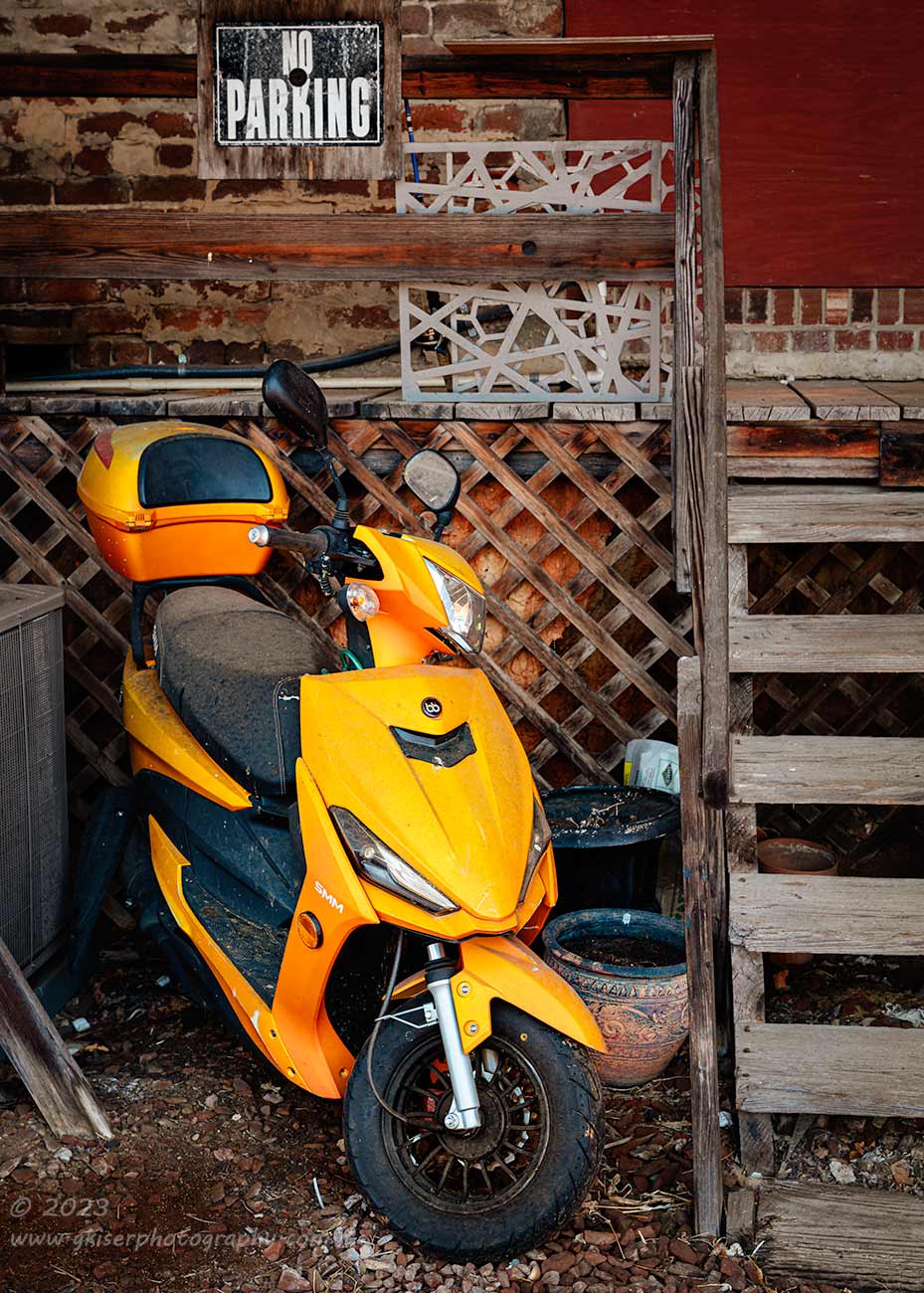
I might have walked 100 feet from where I had been as I continued on the back side of the buildings before I found something that caught my eye. I didn’t recall seeing this scene before in any of my walks, but there was this beautifully aged, moped sitting in a parking alcove at the base of the building. It stood out to me because it was a neon orange color. It wasn’t my normal photographic subject by any stretch, but there was something about it that I really liked. As I looked at the scene, I could see all kinds of distractions all around the moped, but the thing that struck me the most was the sign right above it that read “No Parking”. That was the only sign in the area, and I saw nothing that would indicate that I couldn’t be there to photograph the scene. It was the irony of the sign and the fact that the moped appeared to have been there for some time now that forced my hand. This was going to be my next composition.
I started to look at everything and decided that I could include a portion of the stairs as a framing element on the right, while eliminating a white foam core board on the left in front of the A/C unit. This would allow me to get a nice frame to include the sign that told the story that I wanted to share, but it would also include a red door with a white sign stapled onto it. The sign was probably the least problematic of the distractions to deal with, so I chose to get a composition that included a bit of that sign, knowing that I would be removing it in post later. This was not a matter of fixing it in post though, I was making a conscious decision to shoot knowing how I intended to edit the image. Nothing was left to chance, so there was nothing that would need to be fixed afterwards.
When it came to lens choice, I was struggling to decide between the telephoto lens that I had already used and stepping down to my standard lens. The more I looked, the more I wanted less compression so that the moped would jump out of the scene a bit more. I pulled the camera out with the 24-70mm lens that has historically been my workhorse glass and added the polarizer to it. Again, I chose to go with a vertical composition as I had for the majority of the time I had been shooting thus far. It just seemed to fit based on where the elements were and where I wanted to have the edges of the frame. I moved around a little bit front and back as well as from side to side to get the best blend of elements in the scene. I also shot with the intention of cropping the image down to a 5:7 aspect ratio as the native 3:2 would have been far too tall for the subject matter.
While I was setting up the shot, a lady was walking behind the building towards me. As I expected, she asked what I was doing, and I let her know that I was taking a photo of this ironic scene. It turned out that this was her store, and she hadn’t even paid attention to the sign. I shared that this was one of the things about photography that I loved, and that I have trained myself to see things that would normally go unnoticed. When those little details show a natural dichotomy like a moped parked in a No Parking zone, the camera has to come out. She took some time to share the story of the moped with me which gave some context to the scene that I was seeing. This made it even more of a meaningful image for me, and I was excited to get it shot.
I just had a few more little details to iron out with the composition and I was ready to set the exposure. The first image I shot had a hotspot that I hadn’t anticipated that caused me to speed up the shutter by a third of a stop. I fired off a second frame, which was followed by a slight change in the framing and a final frame captured. In just three presses of the remote shutter release, I had an image that I was particularly happy with. It fit my style perfectly and I really thought that I was lucky to have found this little scene in downtown North Wilkesboro. I felt that I had gotten the one composition out of the scene that I would be able to, so I packed up the camera and started back on my walk.
Things slowed a bit at this point because I didn’t find another scene to photograph in the next 100 feet, or even 200 feet. I ended up walking around for a bit over a mile before I found my next subject. Ironically, what I found was a location that I had shot before on the Northern end of town. It was a staircase that had resulted in a photograph that I was quite happy about. In fact, that photo had made it into my 12 most significant images of 2022 in the number 12 spot. It wasn’t a stellar image, but it had opened my eyes to the beauty to be found on these photo walks. While it was obviously a standout image for me, I knew that I could do better and here I was back in that same location with a chance to do just that.

There were actually two different staircases in the same building, and I think that I ended up working with the other one this time. I wanted to avoid the rubber step covers in favor of the wooden ones. I also wanted to spend more time and care on the bricks as the stairs themselves weren’t as interesting to me this time. I knew that last time I shot this scene, I had used the long lens, but this time, I wanted to include more of the surroundings and that meant a wider-angle approach and the standard lens. I found the angle that mostly masked the mailbox on the inside edge of the stairway knowing that I was going to be removing that in post. The larger box I removed with a creative crop. In an attempt to mitigate the perspective distortion of the scene, I elevated the camera to the maximum height of the tripod and paid particular attention to my spirit level atop the camera to keep the lines as correct as possible.
I started to make exposures and found that the exposure latitude was greater than I really expected. I was shooting with the camera white balance in shade because that was the existing condition that I was in. Since the dominant color was red, I bumped it down to cloudy to pull some of the warmth out of it in an attempt to get the histogram to cooperate a bit better. That helped, but I was still seeing some clipping in the bricks. Even though I was planning on making this a black and white image, I was shooting with the neutral color profile on the camera because I have that set up to have the least amount of contrast and saturation built in which gives me a much more accurate histogram. This is really useful for high contrast scenes like this, but I still wasn’t getting the shadow detail that I wanted. As a last ditch effort before shooting an HDR bracket, I clipped on my Color Combo Polarizer which I knew would pull out some of the shadow detail and allow me to reduce the exposure a tick. That did the trick, and I was seeing a histogram that I knew I would be able to work with.
When it comes to shooting a scene based on how I intend to edit it, there was a big change that I planned on making with this one compared to the previous attempt. I was now focusing on the bricks more than the stairs and with that came an opportunity to really work on the contrast of the different toned bricks. A big change that Lightroom has seen since the last time I’ve shot this is the ability to use curves within the masks. I knew that this was going to prove very valuable here because the contrast that I wanted was only going to be found by using the curves. This is just what I did, and it allowed me to almost work the tones of the bricks down to the individual blocks in terms of tonality. I don’t think that there is any question that this is a more impressive photo than my first attempt at this type of scene. I love it when I am able to create an image that is stronger than one which was deemed to be a significant image from a previous year. I’m always hoping to outshine those images because if I don’t, that means that I am not growing as a photographer.
After getting the final version of this staircase shot, I had a grand total of 27 frames captured which is essentially a roll of film. Not too bad for a day’s work! I did walk around a bit more but didn’t find anything that caught my eye. I was thirsty and getting a bit hungry which meant that I was better off calling it a day and going home. Also, I was not wanting to get into another situation where I had a dozen or more images to edit and blog about. I’ve ended up with far too many multi-part blog entries here lately and just didn’t want to go through all of that again. I still had to get ready for a huge photo shoot on Tuesday, and that meant that this trek needed to only be a slight diversion, not a full-on event for the week.
To say that I am thrilled with this little walk around North Wilkesboro would be an understatement. I ended up with about a 20% hit rate with images that I really like. Sadly, I know that these images will not do well at all on social media, but that was not why I shot them. I wanted to stretch my creativity doing a type of photography that I don’t normally do in conditions that I would normally not bother with. I count it as a big win, and I’m glad that I went out there and had a productive walk around town. If there are any of these photos that speak to you, I would love to match you up with your very own high quality print. Not only do I offer standard photographic prints and fine art prints, but you can also opt for canvas and metal prints. I am delivering a beautiful metal print of a photo that was shot on Driftwood Beach last month. I’m slowly coming around to the metal look for the prints. They are economical because they are ready to hang right out of the box and they are very durable and easy to maintain. I’m going to be doing a lot more with metal prints in the future, and I highly recommend selecting them for your own decor. Of course, my photographs look amazing on canvas and paper as well. It is all just a personal preference when it comes down to it.
Thank you for joining me on this trek. I hope that you have enjoyed it, and maybe even learned a thing or two. You will probably notice that there are a few more links in the text than normal. I do apologize for that, but I realized that for some reason my Amazon links were not showing up at the bottom of the entries unless you were on a desktop computer. As I am sure many of you are reading these entries on your phone, or possibly a tablet, I wanted to make sure that there were links available to you. I’ve tried to include links to some of the gear that I used both through B&H and Amazon. If you make purchases at either of these retailers after entering through my link, I get a slight kickback without it affecting your purchase price. This does help fund these treks, as well as keeping the website up and running. I appreciate those who use these links to purchase these items, even those items that I don’t specifically link will work. It is only a few dollars here and there, but it does make a difference.
Until next time….

Remember to use the code KISER10 to get 10% off your purchase