Sunday, July 23, 2023
Jekyll Island (Part 1): Getting to Know the Island
Jekyll Island (Part 2): Trying it All Out
Jekyll Island (Part 3): Visiting Another World
Jekyll Island (Part 4): My Last Stand
I honestly don’t know if I woke up before the alarm, or after the alarm Sunday morning. I was more than exhausted by this point and was enjoying the sleep that was going on, up until sometime around 4am. Yep, I had the alarm set there once again with hopes of getting back to Driftwood Beach one last time before we left Jekyll Island. Whenever it was that I became coherent enough to remember where we were and what I was wanting to accomplish, I opened up the weather app on the phone to take a look. The current conditions were clear, and it appeared as though clear skies were going to prevail through the morning hours. Switching over to the cloud app I like, I could see that there was about a 40% coverage in the upper and middle altitudes around sunrise. Taking what I knew about the forecasting methods, I deduced that there would be some clouds, but they would likely be very thin, and the sun would be totally visible on the horizon. Moving over to the sunrise forecaster, my understanding of the situation was confirmed with a small chance for some color in the sky for the Georgia Coast.
I took a breath and considered my options. I was worn out, and if I was to go back to Driftwood Beach, I would be hoofing it once again for an hour each way to get what was probably going to be a lackluster sunrise. My other option was to revisit the trio of palm trees by the hotel which I thought would look good with the sun just above the horizon in the right part of that composition. If you missed the shot, check out the opening image from the first part of this series. There was no doubt that it would work well at sunrise with a clear sky, but it was not really my kind of image. Additionally, I would be pretty much stuck with a single composition by sticking close to the room.
My choices came down to a sure thing with the palm trio, or another gamble on Driftwood Beach where I really felt that to be successful there, I needed some color and interest in the sky. I didn’t have any grand plans of compositions as I had explored most everything that I wanted to shoot there the morning before. If I was going to hike North, I was going to need to make that decision pretty quickly as I wanted to get there before first light just to make sure that I had time to figure out some compositions and catch whatever sunrise colors I could. I went through all the different scenarios in my head with a soundtrack to Jeopardy playing in the background. This was a timed test and I needed to select an answer.
While I’m thinking about this, I would like to take a minute to thank you all for being with me on this trek and reading through all of the entries I’ve done this week. If you haven’t had a chance to read through all of the days, feel free to check out the links at the top of this entry for each day. While beach trips usually result in a bundle of photographs, this one might be one of my most successful trips to date. I think that the overall quality of images that I have brought back surpasses that of any other trip to the coast. This should be expected as each time I go, I have had longer to learn skills and techniques behind the camera. That is only part of the equation though as a significant factor in the success of any photo trek comes down to the weather conditions. Either you have great light, or you don’t. The experience comes into play more when the light isn’t really working with you, and you can still create worthwhile images. I think that for the most part, the light was pretty wonderful for the time that I was there. I’ve had some form of interest in the sky, or good quality light each time I’ve gone out which isn’t always the case. I’ve been able to take advantage of some really wonderful locations and scenes that I haven’t been able to capture in the past which makes these images a bit unique in my collection.
For only being on Jekyll Island for two full days, I’ve come back with more meaningful images than I have after a week-long stay on the coast. The efficiency I experienced in creating these images speaks to the light more than anything. When you look at the different blog entries, I think you will be able to determine for yourself that on the second morning, when I went to Driftwood Beach for the first time, I could have pointed the camera in any direction at any time and probably come away with a pretty darn good photo. I couldn’t move around fast enough to capture everything that I would have wanted to. Even the first full morning that I went out there were many different flavors of lighting that allowed me to do quite a few types of photos which gave me a relatively unheard-of variety for a beach trip session. I was very fortunate for the conditions, although I can always wish for even better.
I remember coming back from Driftwood, on Saturday and telling Toni that it was a solid 7.5 out of 10. She scoffed and said that it was better than that because she knew how hard I was on myself when it came to photography. I still think it could have been better in a lot of respects, but she is probably right that it was more like an 8.5 out of 10 in retrospect. The other two sessions up to this point were not nearly as epic, and I would put them around a 5/10 each, but that still isn’t bad at all. Too many times I’ve gone on trips with the intentions of creating something perfectly beautiful and the weather turns out to be lousy, or just boring. I find that I can’t get in the rhythm of the moment and therefore can’t connect with the landscape on a level that allows me to photograph it properly. I might have a dozen keepers, but out of those only one or two that I really like. One of the traps I fall into as easily as other photographers is that I have a lot of memory information tied up in each photograph which is connected to the vacation as a whole. Everything becomes prettier when you look at it that way. Where that does the photographer a disservice is that months, or years later, you look at the same photos that you really enjoyed after shooting them only to find out that they are kind of blah after the moment has passed. We all have those photos, and they are hard to weed out. It is still too early to tell about this trek, but I really feel that the majority of the images stand for themselves better than most of my coastal photos. What I mean is that the story behind the images that I know doesn’t really matter, and the image takes on its own story, and speaks to the viewer differently depending on who is looking.
As with all of my treks, my ultimate goal is to create images that are appreciated by others as much as I appreciate them. I want to be able to make prints of the photos to have displayed on walls as the art that they were intended to be. I go through all of this not to create more noise in the digital world for you to swipe by and like, but rather to look into and strive to appreciate the subtleties of the image. I want the image to envelop you and transport you to a place that isn’t your living room couch, or maybe your office chair. I want my photography to affect you so profoundly that you want to look at it every day, and experience different reactions each time. Those are the reasons that I get up early in the morning and go through all of the processes to create these images. I certainly appreciate those of you who have supported me through the years, read my many blogs, commented on my photos, and those that have purchased prints of your favorite images. This is my art, and my language. I am humbled that others find value in it.
With all that in mind, what in the world did I decide to do on this Sunday morning with very little cloud cover? Well, after traveling all this way to photograph Driftwood Beach, it seemed kind of silly to only go there once and spend more time around the hotel where the scenery was pretty generic to other beach destinations. I owed it to myself to pay a return trip to my new favorite coastal spot. That meant that I needed to get my butt out of bed and get ready to head out. The combat boots were on, and the camera bag was on my back at 4:30. I should also mention that at 4:29, I was in pain from putting the camera on my back due to a rather bad sunburn from being out so long the day before. Oh well, it was worth it, and I expected my shoulders to be a little tender. I just sucked it up and started my little morning walk
I had the route pretty well figured out and I didn’t need the GPS to monitor my position. I knew the midway point, and I knew the landmarks to look for when I was getting close. Once again, the trip took 50 minutes and it felt much better than the previous morning. It was cooler outside, and the humidity was much lower. It was almost a comfortable trip, but there was still a little sweat involved. As I got to the trail, I transitioned to my red lensed flashlight for the remainder of the morning. The arrival on the beach wasn’t nearly as impactful as it had been the day before, but I was still in awe of this magical place. I could see a lot more this morning because the sky appeared totally clear. The stars were all visible overhead, and what little bit of moon that was there added a bit to the ambient light. The warm glow over Georgia was absent thanks to the missing clouds, but I was here once again and that was what mattered most.
I moved around quickly, in the dark trying to figure out the compositions that I was going to be working with. Taking the conditions into account, I was going to have to use a different approach this time. If you will remember, the morning before, I used my wide-angle lenses exclusively during the morning. This allowed me to get a lot more of the sky in the shots which was important because there was a lot of visual interest in those skies with the clouds. Since there were not nearly as many clouds this time, I wanted to include less sky and concentrate on some of the smaller trees with a longer focal length. This would allow me to take advantage of the glow on the horizon rather than the colors being reflected in the clouds. With that in mind, I looked for smaller trees than I had shot the morning before. This meant that my favorite subjects from the morning would not be in play for this session. I had seen some good examples of what I was looking for the previous morning, but they would have gotten lost in the composition with the way I wanted to capture the sky.
After walking around for a bit, I found three scenes that I thought might work out well. I prioritized them in order of potential and set up on the best option for the morning. My logic was, with very few clouds, the light will transition quickly, and I might only have time to shoot one scene. If that were the case, I wanted it to be the best. If I had time for another one, I wanted it to be the next strongest subject and so on. If the clouds didn’t come in like the forecast suggested, I would have time for only a single composition before the light was gone to the East.
With the strongest composition picked out, I put the camera bag on some roots because I really couldn’t tell if the ground I was standing on was saturated with salt water or not. I pulled the camera out with the standard 24-70mm lens which would give me the flexibility that I needed with the sky. It also gave me a better chance to incorporate a foreground interest should one reveal itself. I added the filter holder to the front but didn’t add any filters since I wasn’t sure what the light was going to do. The last stage at this point was to get the camera placed just right for the composition that I had in mind. This didn’t take long at all but required me to get down really low to the ground in order to get the perspective that I was after.
Unlike the morning before, I could see a bit better through the viewfinder, but there was still not enough light to use the auto focus. I manually focused as best I could in the dim light and looked at the light meter. Based on a 30 second exposure and how underexposed that was, I did some quick calculations in my head and estimated a 2.5-minute exposure at f/8 and ISO 100. I pressed the button on the remote and waited. During that time, I was feeling all kinds of itching on my legs. This was not unexpected since I had been devoured the morning before by all sorts of insects. I really felt like it was just the blood circulating through my calves after the walk and now the squatting down by the camera. I dismissed it and waited for the LCD to click over to the image review.
When it popped up, I saw that I had nailed the exposure, but the focus was way off. More importantly though, the photo was just not interesting. The subject was a tree on its side which I really liked, and that part was great. The sky let the image down because there was no color, and the few bits of clouds were not moving over the course of the exposure and just appeared as a distraction in the composition. The water was smoothed with the long exposure (even more so due to the missed focus). In short, there was nothing really here but a strong subject.
If you will recall that three-part recipe to success that I mentioned in the last blog, I had a great subject, lousy light, and a weak composition. Like a Cheez-it, this photo was not ready yet. I had to wait for the light to get better. Sunrise was still 35 minutes away, and the light that I was after would appear sometime during those 35 minutes. I knew that once the sun hit the horizon, I would be done shooting in this direction. It was the soft hues of the sun still below the horizon that I was after. I just didn’t know for sure when that would happen, or how long it would take.

Something else that I realized while I was examining this photo was that my legs were getting itchier and now my arms were joining in. I had to investigate what the problem was. I pulled out my red lensed flashlight and looked at my legs. I saw nothing out of the ordinary, so I rubbed my shin to see if I felt any welts. No welts, but what I did notice was that there were little dots that moved when I rubbed my hand over my skin. I looked closer and realized that these were probably sand fleas, and there were tons of them on my arms and legs. I brushed them off as best I could and went back to adjusting the focus and firing off another test shot.
I’m not sure if I was sitting on a nest or what, but the routine became press the button and go walk around to keep them from getting on me because any time I stopped at the camera, I would be attacked. I was constantly brushing my arms and legs remembering how I looked like a baseball coach the morning before with all of the insects I was swatting away. This was almost worse because if I stopped moving, I became a mobile home for hundreds of the buggers. Just the thought makes my skin crawl right now. Of course, some of that feeling might be the fact that all the skin on my shoulders is currently migrating South in small pieces along my arms and back. I was glad that there were only a few other photographers on the beach this morning because I was drawing way too much attention to myself with the sporadic dancing behind the camera and the secret hand signals to the sun. There might have been a little white van on the way to collect me and give me a new jacket that lets me hug myself. If it were, I wasn’t there when it arrived at least.
Over the next 20 minutes I shot a series of images as the light seemed to get better and the fleas worse. I first saw the glow that I expected growing from the horizon, and then I saw some very thin clouds coming into the frame overhead. As these elements started to add themselves, I would take test images, and occasionally put the picture style to landscape in order to see how the colors would look with a moderate amount of saturation. If you know how I shoot, I am usually in the neutral picture style with the contrast and saturation both dropped as low as they will go. It gives me a very flat image on the LCD, but it also gives me a much more accurate histogram so I can determine the exposure more accurately. Seeing the flat image always lets me down during sunrises and sunsets because rarely do I get to see any color on the screen. That is where I will select the landscape style just to check out the colors before moving back to the neutral style for exposure information.
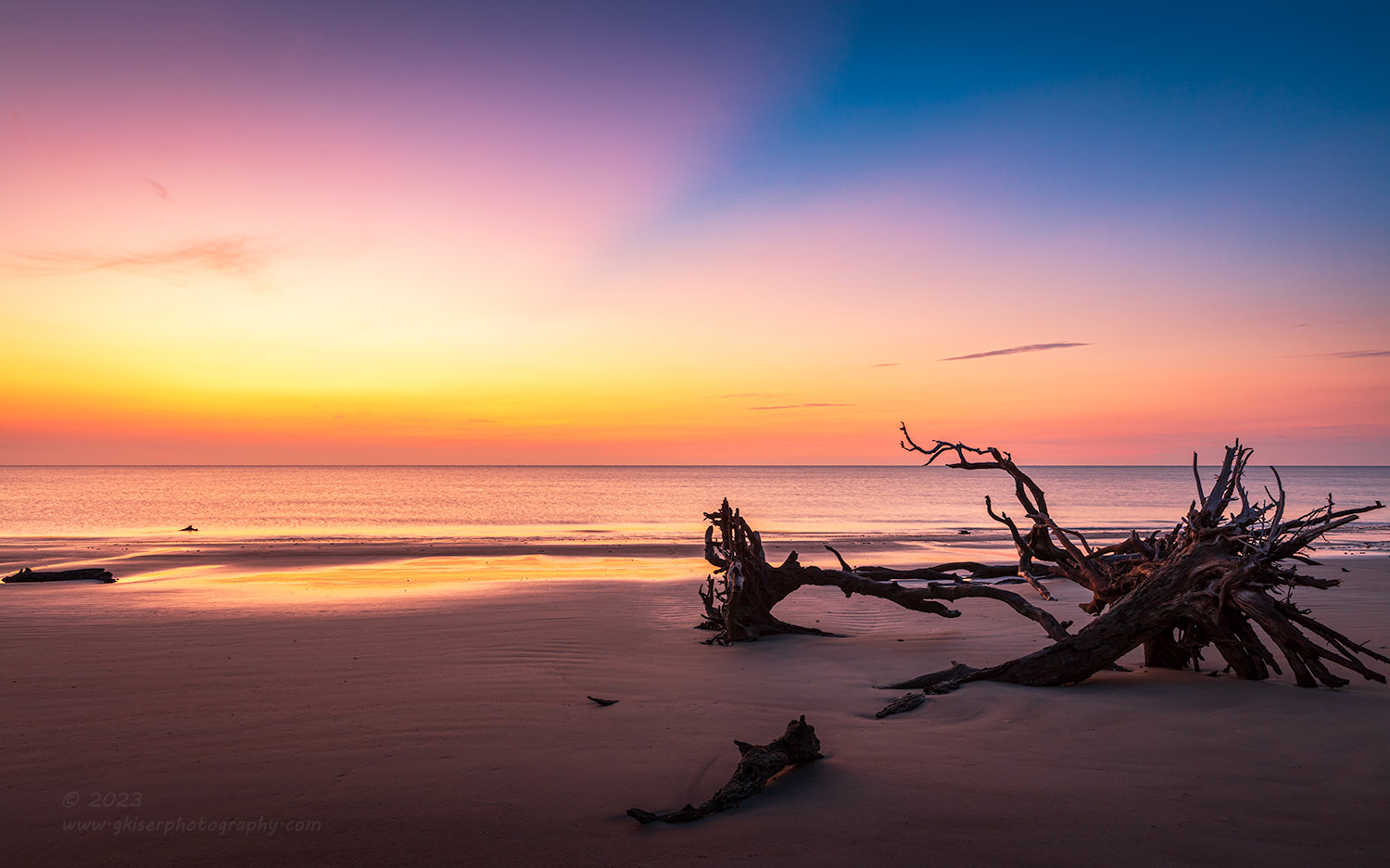
Progressively the colors were getting better, and the faster shutter speeds were showing texture in the water that I thought worked well with the scene. I knew that the fallen tree was just going to be a silhouette which was fine by me. There was no need for any detail in it, and it was largely two dimensional anyway, which made for a very strong silhouette. This is why I chose this tree while it was still dark. That choice was paying off, and at 6:12am, I exposed the 13th image in the 20-image series of this tree. It looked like the ones around it for the most part in the LCD, but it was around this time that I was seeing some really nice color erupting from the horizon. There wasn’t really time to change color profiles in the camera to see if it was seeing these colors or not, so I just kept pressing the button on the remote. The reason for the rapid-fire approach was that there were a lot of birds in the area, and I was trying to get an image where they weren’t in odd places where I would have a hard time cloning them out. Sure, I would have loved to have had a few Gulls in the shot, but they were much too far away to make a positive impact on the scene. They just showed up as specs in the frame, or even blurs with no shape. Maybe I could get AI to put a Gull landing on one of the branches with another one circling above. Yeah, that would make it an epic photo…only it wouldn’t be a photo at all. It would be a form of digital art. I’ll stick with reality here.
It wasn’t until I got home and started to look at all of the images that a couple of them really stood out. The warm glow on the horizon was showing up very well in the images, and there was a section of blue sky in the middle that I found very important to the composition. I’ve found that whenever possible, I like to include a bit of blue sky in my sunrise and sunset images to add validity to the colors that are being seen. It is far too easy to take a boring sky and change the hue to something warmer like a sunrise or sunset, but to do that, we usually see the entire sky take on that color. By having the touch of blue, the warmer tones not only appear more accurate, but they also have more punch due to the contrast. All that was left for me to do was to find the pinnacle of best light here while taking into account the position of the birds and how the ocean looked. It was the exact same composition that I had started out with, but how the sky eventually looked made a huge difference and added both light quality and another compositional element which gave this image all three pillars to rest on.
As I mentioned, once the light started, I was going to have to work fast because it would be over quickly. I decided to call it quits on this composition because I was sure that the light was as good as it was going to get here, and I needed to move to the second spot. It was just a few steps over to the side, but when I got there, I saw a bunch of clutter that I hadn’t seen before which kind of turned me off from the whole composition. Instead of trying to make it work, I went to spot number three and set up a shot quickly.
This third string composition was one that I really hadn’t planned on shooting, but I wanted to have it in my back pocket. I’m glad that I did because I didn’t have the time to figure out another shot with the sky changing by the second. The part of this scene that appealed to me was the fact that the fallen trees were all very low to the ground which would allow me to include just a sliver of the sky because that was really all that I was expecting to be colorful at this point. I’m glad that I was wrong about that aspect and that the sky was actually looking pretty good for the lack of clouds. I think that the particles in the atmosphere were picking up the color of the sun more than the clouds were. Whatever was doing it, the colors were looking really good to my eyes, even though the camera LCD wasn’t picking them up. Since the colors were there, I needed to change my idea of the composition to be able to include more of the sky.
This was not all that easy because the low deadfall didn’t really stand out like a leading line, and there was not enough structure for it to work as a main element. Thinking on my feet, I decided to make it a framing element and place it to the far right of the frame. At this angle, it did kind of point up and to the left which is where the sky was interesting. Thanks to the fact that I had the 24-70mm lens attached, I was able to open up the field of view to include a bit of wood as a foreground leading up to the main cluster, and then I found another bit of wood to the left that I used for the left side framing element. The result was a composition that brought your eyes into the scene to the large clump of deadfall before scooting over to the left, and then up into the sky. There was a lot of negative space here, but I think that it worked well with the way the sky presented. Again, I had that swath of blue to really make the warmer tones pop with a truthfulness.
This was the first of three images shot over the course of a minute and twenty seconds. At the end of that time the light had finished, and the colors had washed out. To put this into perspective, from the first shot to the last shot facing East had been 37 minutes. In this time, I had started with barely enough light to allow me to focus and ended with the sun seconds from cresting the horizon. On mornings with very few clouds, there is no time to waste. I was very lucky to have had the time needed to grab two images when in all actuality, one would have been an accomplishment.
An interesting bit about this photo is that it was one of the last ones that I edited from the entire time at Jekyll Island. I wasn’t convinced that the composition worked, but I tried to see how it looked after a run through Lightroom. A few adjustments and the color really came to life, and I was liking what I saw. I couldn’t put my finger on why I liked it so much though which bothered me. I didn’t want this to be one of those images that was only special because of the memories that I had tied to it. The only way to really tell was to get another opinion of somebody that didn’t have any ties to the scene. Yep, you guessed it, the Photo Wench came down as I was finishing up the edits on Monday afternoon. I showed them all to her and when I came to this one, I started off by saying that I Wasn’t convinced that I liked it. She looked surprised and asked “why not?” She said that she loved it and that it had a romantic feeling to it. Hmm, I didn’t see that in the photo, but that was probably because I had been in the middle of a long-term relationship with sand fleas at this point, and they were now being chased off by mosquitoes and gnats. There was nothing romantic about this image for me, but what she said made sense to me. She pictured a couple walking along the beach holding hands in the sunrise. In essence, I had created a photo with an “insert yourself here” space, and I liked that idea. I started to look at this one through her eyes and the story started to come together for me. In honor of that help, I even went with her title for the photo.
I think that this might be one of those times where I can say that I’m getting better. Usually when I have these kinds of hesitations on an image, it is because there is a glaring technical issue with the photo that makes me feel bad about showing it. When I tell her why I don’t like it, she will tell me that it is one of her favorites and I am compelled to keep it and try to present it as polished as possible. These photos usually are the ones that are best received, and I develop a love/hate relationship with them because every time I do a print, I see the imperfections that drive me crazy, but nobody else sees. For the first time, she has convinced me to keep a photo that I think is technically spot on and is one that I liked…just didn’t know why. Hey, I’ll take any positive growth I can get!
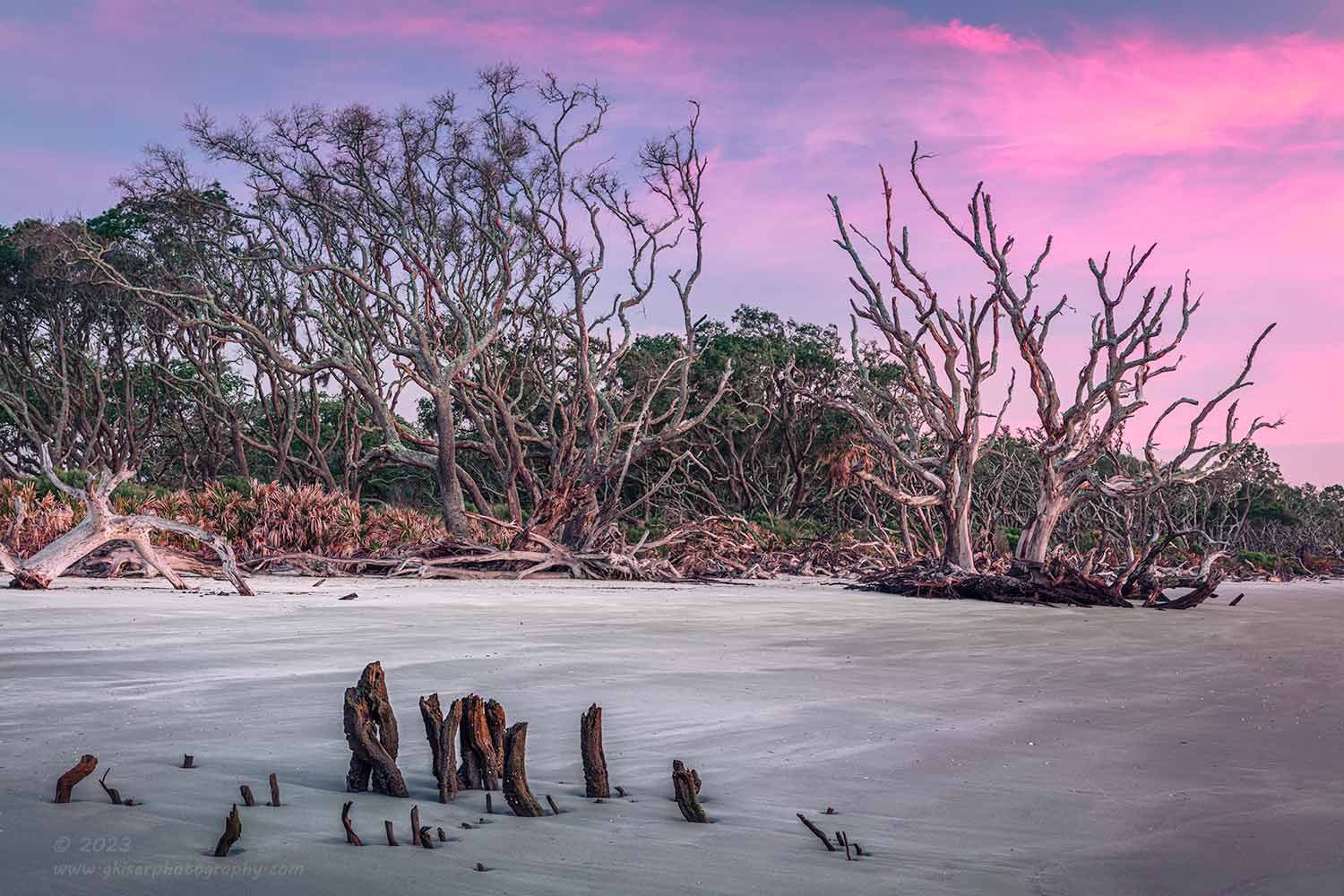
With the sun now above the horizon, I turned my attention inland. You might remember the magic light that I was able to get the day before which made for such excellent photos. I was hoping for that, but sadly, without the clouds overhead to contrast with the warm light, the magic light was much less dramatic. I was still hoping for some of it though. What I was really interested in was the scene that I had shot last the morning before because when I arrived there, I had missed my chance to catch the magic light. With that glow being minutes away, I rushed over there to see what I had to work with. As I was getting close, I could see some pinks and magentas being reflected in the clouds which I thought worked well with the scene still bathed in the cooler glow of predawn. Knowing that the sunlight would help provide separation to the trees, I didn’t feel like I needed to go with the 14mm lens this time, and in fact, felt that the standard lens that I had was more than adequate since the sky wasn’t going to be nearly as impressive as the previous morning.
As I got closer, I evaluated the scene and picked out my composition. Since I was less worried about the sky, I was able to include more of the foreground which was a huge difference from the last time. In that foreground were some bits of trees sticking out of the sand. The formation mirrored much of what was going on in the background and I liked it as a visual anchor to the image. My favorite part was still the group of trees to the right of the frame, but there was also enough interest to the left of that grouping to carry a wider composition which I set up. There was just enough sky to highlight the colorful clouds which was all that I needed. It was that touch of color that would establish the mood for the image and make it all fit together.
Since I was shooting almost exactly 90 degrees from the sun, I added the polarizer to the lens which gave more contrast to the sky and removed some of the glare to the rest of the scene. It was a subtle effect, but one that I liked for this image. I got things all sorted out and was ready to take my first shot when a family with a dog started to walk into the scene from the right. Taking into account the trajectory of their path, they were going to walk right through the image and stay there until they passed me. Now normally, I would deal with this because I have no right to impede on other’s enjoyment of a space. However, if they adjusted their track to their left just three feet, they would be clear of the frame. I stood up and gently motioned for them to guide over to their left. It took a few seconds for them to react, but they did, and I acknowledged that they were in the clear and thanked them. It was a compromise, and one that I was glad that worked out. I now started to make exposures to see what was going to happen.
Unlike the sunrise where I set up the composition and waited for the light, the light was already here, and I had to work quickly as to not lose it. My first exposure was 10 seconds at f/11 and ISO 100. The exposure looked good, but during review of the image, I could see some motion in the trees. There had been a gust of wind during that exposure, and I felt that I could do better. I boosted the ISO to 200 which allowed me to speed up the shutter speed to 4 seconds. I waited for a lull in the breeze and fired off another shot. This one worked out much better and I used that as a starting point for the subsequent exposures that got faster as the sunlight increased.
As an indication of how quickly the light changes, it was that second frame that I shot that turned into the keeper, even though I continued to shoot every minute or so as the light changed. This second frame had the most vibrant color, and the least amount of movement in the branches. Later images had less movement, but the color was not as good. I wanted to keep with it though because I knew that shortly, the sunlight would be hitting the trees and that would change the nature of the image quite a bit. If I were lucky, the clouds would keep some of the color as well to add more interest to the scene.
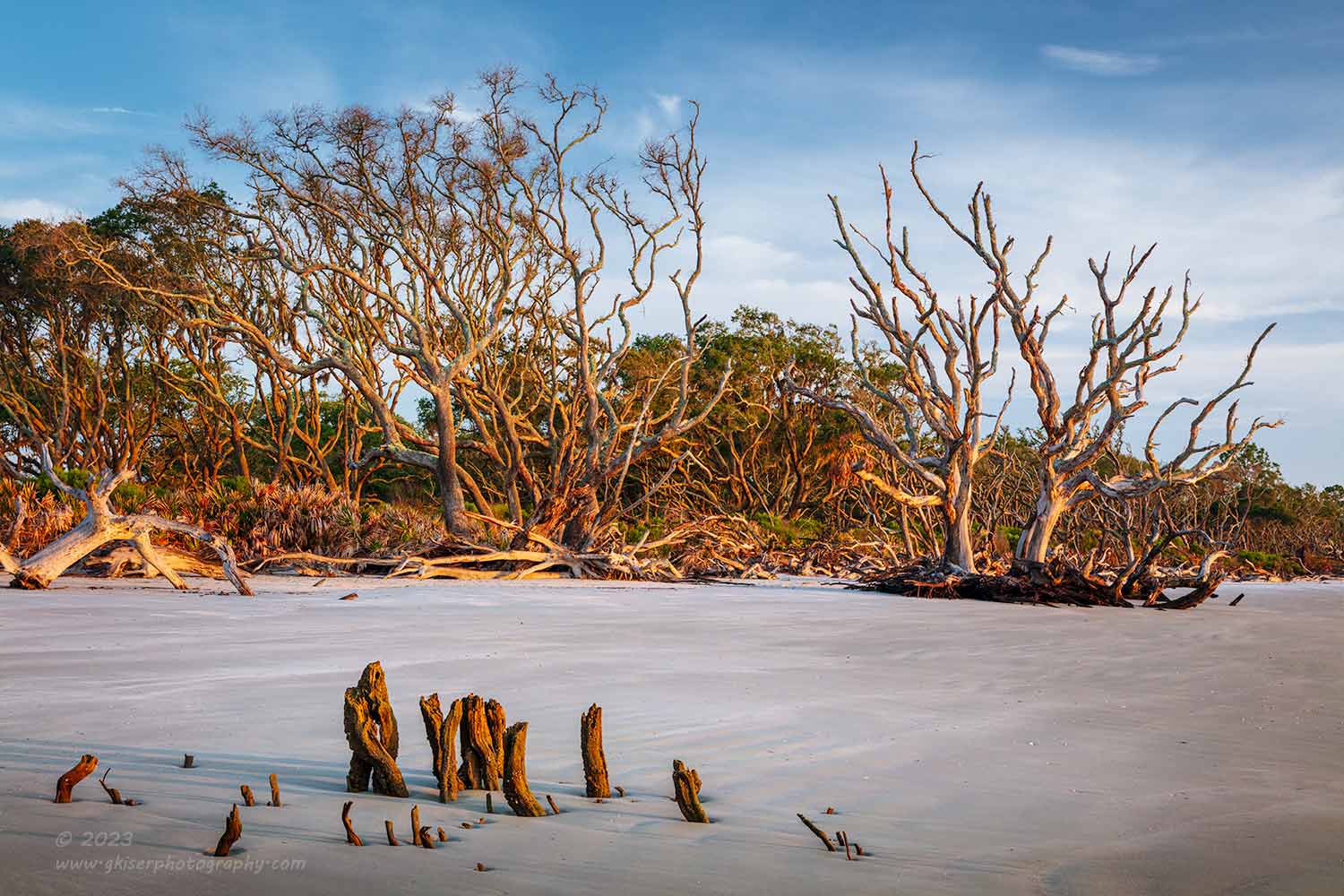
The light steadily changed over the following 32 minutes. The pink clouds transitioned to white while the trees remained a grayish blue. Eventually, the warm sunlight started to hit the trees and I was able to get many images of that light as it changed intensity. The last element that I wanted in the scene was the warm light to hit the wooden remnants in the foreground and cast a shadow behind them. In order to get that to happen, I had to lose some of the warmth in the trees because the sun was rising up further in the sky. However, on the last of the 37-image series, I had a very pleasing balance of warm light on the trees, as well as the foreground, and some interest remaining in the sky. After I shot that frame the warmth continued to fade and the impact of the scene dropped quickly giving no more reason to continue with the exposures.
I took a deep breath and was very thankful that I had stuck with this scene for as long as I had. It was the lighting that I had been hoping for the day before but had missed. In fact, looking back over the morning, I had seen incredible conditions considering the lack of clouds in the sky. I had no doubt that the rising sun would have been a great addition to the palm tree composition from the first day, but I felt that was going to be my only photo from the morning had I stayed there. By returning to Driftwood Beach, I had been able to get three different compositions that I felt pretty sure would give me three keepers. Of course, you see that I ended up with four from the morning which was icing on the cake. I think that looking back over the four times I had gone out while on Jekyll Island, I had made the right choices each time to put me in the right place at the right time.
This is what makes travel photography so difficult. It is nothing for those that live in the area to come back to places many times over until the right conditions are met in order to get the shot. It is what I do close to home. However, when you travel to destinations, whether it be a beach, the mountains, or another country, you have a finite amount of time to work with and you are completely at the mercy of the conditions. Had there been rain every morning that we were on the island, I would not have been able to get the images that I did. The same can be said if the skies were totally clear. I lucked out with the conditions, but part of that luck was knowing how to adapt to those conditions and how to shoot for them. No matter what happened though, if I had misread the light, or just had terrible conditions, there would be no come back in a day or so to try again solution. This is why you should never base your expectations on photographs that you see online or in other avenues. The truly stellar photographs are rarely a first attempt capture. They are the result of many trips in many different conditions as the photographer tries to find the right combination of elements. With this in mind, I had tempered my expectations and just hoped for the best. I’m thrilled at the results and while I know there is room for improvement, I think that the vast majority of the new images here are pretty darn strong.
Ideally, I would have stuck around for a while and added more to the collection, but the light was pretty much gone at this point and the crowds were coming in. I felt accomplished and had no problem packing up and heading back to the room. There was still the matter of being in the car for about seven hours considering we were dropping Aulani off with her dad. During the 50-minute return walk to the room, I considered how glad I was to be away from the sand fleas and the swarming insects. I also thought back over the last four treks that I had made since arriving on the island Thursday evening. I had shot 282 frames which is about the normal for a beach trip. Out of those, I ended up with 29 keepers and maybe three or four that will be in the running for most significant images of 2023. I essentially shot at two locations which makes this even more spectacular, and after writing all of the blogs, I realized that it took me two days to get in the right frame of mind to capture these coastal images. Once I got my rhythm established, I was creating the images that I had hoped that I would.
Driftwood Beach lived up to all the hype in my book and I’m so glad that I took the chance to go and experience it. I do understand why it is popular with photographers as it is very much a unique place. I’m not sure if I’ll be back here anytime soon, but I certainly won’t turn down an opportunity to return to this haven for a landscape and decay photographer. Who knows, I might even try to put together a full weekend workshop out here during the off season so that we might have a little more space to roam around on the beach without causing any problems with others trying to enjoy it. If this is something that you would like to see in the future, please let me know. It would be a workshop that included image editing as well as capture over two days. The price would be significant unfortunately, but there would be accommodations and I’m sure fees that would have to be paid to the park system. Anyway, it is just a thought, and one that I think would make for a great workshop.
As I have been working on blogs all week long, I am ready to sign off and take a little break from photography for a day or two. I do hope that you have enjoyed the photos and the stories that went along with them. This is an experience that I won’t soon forget, and I’m so happy that I was able to document it visually as well as in narrative form.
Until next time…

Remember to use the code KISER10 to get 10% off your purchase