Sunday, February 20, 2022
I bet you thought that I had disappeared or something. No such luck! I’ve just been a little busy here lately getting ready for my most recent workshop at the Wilkes Art Gallery where I did a class on Exposure. I’ve also been working hard doing some headshots for a company in Huntersville which ultimately resulted in me doing my own headshot for this website. You can see the resulting photo in the “About Me” section if you are interested. It was long past the time that I actually got a professional headshot added here to replace the cell phone selfie (the horror!) that I have been using for so long. I’m really digging the low-key dramatic lighting for the new picture and suspect that this will become a well-used photo over time. Speaking of which, if you are needing an updated professional headshot, look no further. I can help you out with that and I’ve been doing quite a few of them here lately. Just contact me and we can set something up here at the studio or I can do it on location if needed.
Back to the Exposure Workshop for a minute. This was the third in-person classroom workshop that I have done, and it was by far the best one yet. The best part about it was, I had put it together from scratch in about a month’s time. I had planned on the class lasting three hours, but I ended up going over by an additional hour. This was partly because I love teaching, and partly because I had seven participants that were quite interactive which I truly enjoyed. It really was a fantastic class and I’m glad that I was asked to come back there for another workshop. At the conclusion of this one, the possibility of me coming back in the Spring to do another workshop was discussed and I told them that I would get to work figuring out something to put together which could be done outside.
That kind of brings us to this particular trek. I spent a portion of the evening last night considering what I could do for a workshop. The thought crossed my mind about doing the same composition workshop that I had done last year, but I was already doing that same workshop in May. I didn’t want to run that same workshop back-to-back for fear that I would lose my excitement for the material. I also wanted to do something different for the Art Gallery with hopes of drawing a larger crowd than I did last year. The problem that I was running into was that I didn’t know what the needs of the membership were, and I was wanting to get something that could be applicable to many types of photographers. The exposure workshop was just that because it dealt with a concept that is universal among photographers.

The more I considered my options, the more I ended up pushing myself into the classroom once again to talk about basic concepts behind photography. With it being Spring, that just didn’t feel right, so I really tried to change gears and come up with something outside. I remembered a recent trek in North Wilkesboro near the art gallery where I found some interesting subjects to shoot that were just hiding in plain sight. It wasn’t really landscape photography, and it didn’t really fall into decay either. It was really more of a search and find something that interests you kind of affair and I thought that could possibly work as a workshop. It could be billed as a photo walk or sorts and working through photographing things that excite you. The question that I had was there enough potential to be had within a walk from the gallery to maintain a workshop? The best way to figure that out was to go and scout the area and try to find some different things to photograph.
Looking at the weather for Sunday, there wasn’t going to be a cloud in the sky. Typically, I would not even consider doing any photography with those conditions, but I was in a particularly photographic mood after teaching the class. I also knew that working the angles of buildings worked very well usually with some direct sun and shadows. I could go into North Wilkesboro and start that scouting mission and look for some interesting shadows while I did that. It seemed to be a good idea and it was a very low key way of going on a trek. I had no preconceptions of what I was going to be photographing, and with the weather I wasn’t expecting anything overly great either. In short, if I came home with nothing, I was no worse off than if I had sat at home tinkering with things. I would also have a better idea of whether or not the workshop idea would work in the Spring. With that thought, I decided to go on and give it a try.

To really show how different this trek was from my normal ones, I actually waited until about 10:30 to head out. This would put me at the worst possible time to photograph most anything on a sunny day, but I knew that it would make the shadows more interesting and allow me a little more light in the alleys as well. My plan was simple for this one. I would park at the gallery just as I would for a workshop there and start walking around. I knew that I would see much more by walking than if I was driving through the different streets, and the hope was that I would find a lot more interest in the downtown section than I had considered before.
When I arrived, the streets were basically empty which was just what I was hoping for. I do enjoy spending time in North Wilkesboro on Sundays because it doesn’t get populated until well after lunch. I knew that I would have the ability to work undisturbed for several hours which was what I wanted to see happen. I grabbed my bag and tripod and started walking around. I dipped into alley after alley to try and locate points that I figured a workshop could make use of. One of the first areas that I stopped at was a place that I had seen from the street many times. There was an interesting mural on the wall, but that wasn’t what I was looking at this time. Now that I was on foot, I was looking at the metal staircase on the opposite building and seeing how the shadows fell around that feature. I was a little disappointed in those shadows, but I noticed some really great decay underneath the landing at the top. The wall had started to fall away from the structure and that really spoke to my decay photographer instincts. I spent some time looking at how the scene appeared and considered my options.

I started out with the cell phone to see if there were any isolation compositions available to me. It took a little time, but I eventually landed on an angle that I liked and figured that it was worth bringing the camera out to give it a try. I loaded up the telephoto lens and skipped the filters. I figured that there was really no need for any filters for this since I was working in the shade without much glare at all. This was actually the rig that I used the entire day. I just kept my bag on my back and left the camera mounted to the tripod. It was an interesting time using a telephoto lens as my walking around lens when I would usually default to my 24-70mm lens for a more flexible option. It worked out perfectly for the shot that I had spotted at the top of the stairs though, and I spent a little bit of time working that composition out. The right composition didn’t come as easy as I had expected it to, but it did finally work out and I had a pleasing balance to the image when I was all said and done with it.
After I had that first photo in the bag, I started to look around at the wall I had just shot because it was very interesting to me. Nothing else was jumping out as a composition, but there was a wooden sign for Suite 3 that was interesting. I started to pay a bit of attention to that sign and what was around it that might help to tell the story. The only thing that was really interesting was the texture on the wall, but that wasn’t really enough to fully capture my attention for a composition. I debated different framing and eventually started to look at the railing for the steps that lead down to the door. It wasn’t an element that I would typically include in a composition like this, but there was something that told me that I needed to give it a try.
The railing was a series of lines that formed several rectangles which gave a repeating pattern of sorts for a foreground. It mimicked the shapes of the sign for the suite and the arrow pointing down the stairs. It was that similarity in shapes that convinced me to include the railing as a foreground. I paid particularly close attention to the depth of field for this shot because I knew that I had a decent distance that needed to be covered between that foreground and the background. I started off by doing a focus stacked series of images at f/8 and then stopped the lens down to f/18 and noted the two focus points between the railing and the wall. Since there was nothing for me to focus on between the two points, I estimated a point approximately 1/3 of the way from the railing to the wall based on the focus marks on the lens. Theoretically, that would give me a hyperfocal distance and the maximum depth of field for the aperture. I tripped the shutter and looked at the image review to verify that the focus was sharp throughout the image. It appeared to be, and if I was lucky, I would be able to use that single shot as opposed to doing a focus stack of the two images.
I wasn’t feeling all that confident about the sign photograph, but I was glad that I had tried it. When I got home and looked at the images, I actually had plenty of depth of field with the f/18 shot and decided to work that one for a bit to see if I liked how it turned out. It was kind of a surprise to me that I actually really liked how this one turned out. It was so very different from how I would normally “see” a photograph, but yet it was something that was right up my alley. Maybe I was feeling a bit more comfortable stretching my creative energy since I didn’t put any pressure on today to result in any photographs. Maybe it had been that I had spent a good deal of time with a room full of photographers that were looking to broaden their own horizons. Whatever it was, I was feeling pretty good about my choice to give this composition a try.
The sun was starting to get into the alley a bit more than I would have wanted, so I took that as my clue to move on to another location. Not wanting to miss out on another potential composition because I didn’t want to build the camera again, I just left it all put together and just tossed it over my shoulder as I walked around. I was looking at all of the details that I passed and tried to make compositions out of them. I went by the newspaper building that I had tried to figure out a composition with weeks ago, but still didn’t see anything that I wanted to try. I just kept on walking around until I saw a tree that was starting to show signs of Spring. It was growing from a small patch of dirt next to a building in the middle of a sidewalk. The tree was interesting in shape, but the way that the sun was hitting it from the side was what captured my attention most.
I started to consider my options with this tree. There was a brick wall directly behind the tree which I didn’t really care for, but something inside was telling me not to pass up this light. As I considered everything, a story started to develop behind the tree. It really became apparent that this tree was the last standout of nature among all of the brick that now surrounded it. It was that dichotomy that I really liked about the scene. As I studied the light, I realized that the tree was fully side lit while the brick wall in the background was in the shadows. That would make it easy to really highlight the structure of the tree against that dark background. The brick framework that the tree was planted in was lit on one side and dark on the other which really emphasized the triangle shape of the base.

All of these things worked together to force me to consider this one as a black and white image. There was nothing particularly great about the red portions of the limbs with the red bricks. It became an overly warm image to look at in that regard. It was the light on the tree, and the shapes of the elements around the tree that excited me. The textures of the bricks were also a part of the visual interest. Since I was looking at light, shape, and texture to tell the story, there was no need for color for this one. I shot it with the intention of converting it to black and white which I did when I got home. It is not a typical tree photograph of mine, but there is something about it that I really like. The story here is an important one, and it speaks to my landscape photographer’s heart.
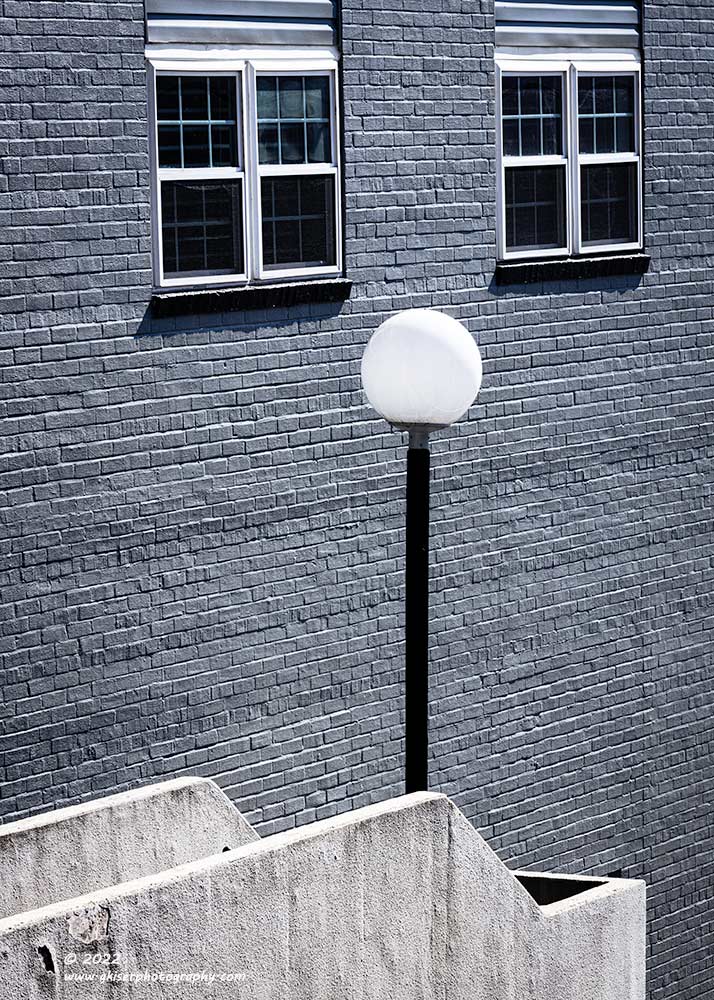
I continued walking along the sidewalk and eventually came to the Police Department. It was this building that I had photographed earlier in the month when I worked the stairway with the concrete shelter. This time, it was the light on top of the stairs that caught my eye. I had tried to photograph it from below that day but couldn’t get it to play nicely with the windows. From this vantage point, I had a much better relationship between the elements and thought that I might be able to make something work here. I worked out the best angle to set the camera up at by considering the spacing between the windows and the light as well as where the light pole lined up with the concrete. I tried both vertical and horizontal framings and determined that it was the vertical one that made the most sense. It kept things simple with the two windows at the top of the frame and the concrete wall at the bottom. The light was positioned nearly at the upper right intersection of thirds.
The composition worked but felt odd to me. I started to play with the elevation of the camera until I had a bit more separation between the light and the windows. I ended up cropping the trim above the windows slightly to give the composition a more relaxed feel as well as a bit more balance. The last part of this equation was the color rendition. The wall was a bluish gray which turned into the primary hue of the scene. The concrete had a bit of warmth to it, but not much. My gut told me to do this one as a black and white photograph and that was how I shot it. However, when I got home, I started to look at it as both a color and a black and white image. While the color wasn’t really important, the hues helped to set a tone for the image. I ended up pulling a lot of the color out of the wall, while bringing a bit of added warmth to the concrete just for that extra bit of visual balance to the scene. The end result is an image that feels very monochromatic but has just enough hint of color to set a mood. What can I say, it is a lot of fun to experiment with a camera from time to time.

Feeling pretty good about how the day was going, I continued on my little Sunday walk downtown. I was going back over the images that I had shot in my mind as I was trying to get a good read on whether or not I had gotten anything that I was really excited about. There really wasn’t anything that I had captured that fell into the realm of what I was hoping to get during this trek. I hoped that I had a few keepers but thinking back on things I didn’t think I had enough to call it a day just yet. I needed to find some more images to make in order to give myself hope that I gotten something good.
I just kept looking into little places along the street as well as walking through the alleys. Nothing was jumping out at me at all. Had I gotten all that there was to get out here? If that was the case, this definitely wasn’t going to be a good opportunity for a workshop. Hey, wait a minute…. what was that? I looked back across the street and found an opening that led to some stairs. The sun was lighting up portions of the brick wall to either side of the stairs while the stairs were in the shadows. It was just interesting enough to get me to cross the street and look at things in a bit more detail. I spent some time moving from side to side and seeing how the angles worked out. Slowly, I started to see a composition developing and I put the camera in roughly the area that I thought would work out. From there it was a matter of small movements to get the right balance and perspective. The bricks were very bright, so I had to be careful with my exposure. Fortunately, I had just been through a very informative class on how to get the best exposure with a digital camera, so this was no problem for me at all.
The issue that I ran into was that the flow of the image wasn’t quite what I wanted it to be. I had set up for the best light, which caused the stairs to flow from right to left which was not ideal. From early on, I had anticipated flipping this image so that the image read from left to right for a bit more appeal. With that in mind, I found the composition that provided the best balance of elements as well as luminosity. I was pretty sure that this one was going to be a black and white image, so I was fine with a few areas that were a bit overexposed in the interest of getting the stairs to be exposed correctly. It was those overexposed bricks that added to the visual interest of the scene when I finally started to process the file.

It was those stairs that I felt might be my strongest image of the day thus far which made me feel pretty good. I was getting into the zone of doing this type of photography and I was starting to see more and more compositions. One of these compositions was a location that I had passed by already during the morning. What had drawn my eye to it in the first place was the fact that the door was painted a blue that was almost purple with bright yellow bars added vertically. The building was white, so this really stuck out to me. Since that is a primary consideration for my compositions, I took note of the scene and considered it. Initially, I hadn’t been able to come up with a composition, but now that my brain had been in creative mode for a while, I was able to see some possibilities. As I studied the scene, I realized that what I loved about it was the colors first and foremost with the secondary draw being the lines and right angles. It was the white doorknob that really stuck out in this sea of color and hard lines. That doorknob became my anchor and I started to form up a composition around that element. I knew that I wanted to bring in the yellow bars to give balance to the colors here, so I went with a horizontal approach to capturing the door. This is a little odd for me since I would normally try to capture the entire door as part of the side of the building. In this case, I wanted the viewer to be able to break the door down into some very specific sections, all of which are defined by either line or color. To balance out the doorknob and to give it a bit of breathing room, I opted to include a portion of the door frame as well which had some beautiful wear to it. The resulting image was much better than I thought was possible the first time I saw it and was still better than what I thought I would be able to come up with when I decided to give it a try. The colors and the shapes all worked together just as I had hoped they would.
Since I was feeling a bit more confident now, I started to wait for the best compositions to develop before I started working out the camera positions as I found new subjects. One of those locations that I felt pretty good about was another one that I had passed by a couple of times already. It was the side of a building that had a very interesting brick facade that was made to look like it was partially collapsed. There was a stucco wall behind the bricks and on both sides of the main door there were windows which were situated in the areas of missing bricks. It was odd, which made it interesting. I started to evaluate both sides and determined that the side with the closed shutters would be the better option for a photograph. What I didn’t like about it was the shadow of the covered porch which came across the shutters diagonally down to the bricks. I did a couple of test shots on the window that turned out ok, but I didn’t like how the shadow was cutting the image in half. In an attempt to salvage this location, I moved over to the other side and tried to figure out how to deal with the shadow issues over there. While the window was not fully obstructed, the power lines were causing shadows to fall diagonally across the facade of the building. It looked like it was going to be a distraction, but there was a chance that they could be a nice geometrical element to the scene as well. I went ahead and framed up a composition that I liked and did a few frames.
The more I looked at it, the more I thought it might just work. As I was getting ready to move on to the next spot, I looked at the original window again. I much preferred this one because the shutters were closed, and it was a single window instead of a double one which made for a simpler composition. As I was looking at it, I noticed that the shadow from the porch was moving up the wall since the sun was now on a downward path. I considered this for a moment and thought about what it might do for the composition. Currently, it was about a brick’s width above the line of bricks at the bottom. If I could get lucky, this line would creep up and fall right over the bottom edge of the shutters while leaving the wall in daylight. The diagonal cut of the shadow across the shutters would a bit of tension to the composition and it would balance out nicely with the black bricks to the left of the window as well. My framing would be the same as I had done before using the natural seam of the wall as a border to the left and the top. This positioned the window offsides to the right allowing just a portion of the brick wall to start climbing up the right side.

As I waited for the sun to drop a little further to cause the shadow to rise up, I noticed something else that was going to benefit the scene in front of my camera. The sun was raking across the front of the building and was catching the bricks to the right of the window causing a shadow to fall to the left of the bricks. It was the first notch in the wall that was casting a triangle at the same angle as the shadow over the window. It was a small detail, but one that was very welcomed to the composition. I just had to sit and wait for the shadow to rise to the lower edge of the shutter. When it got there, I fired off the shutter and captured the image. I waited a couple of seconds and shot another frame as well. This one was just a bit too late because the sunlight was already hitting the portion of the shutter that I wanted to keep in the shadow. That first frame was as good as I could get it. There was a hair of light, but the shadow was mostly cleaned up on the wall which was a perfect compromise. The extra triangle was there, fully visible as well as a secondary triangle that was slightly in the shadows, but still visible.
I had images from both windows of this building, but I was pretty sure that the last attempt on the left window was going to be the one that I kept from this location. I had finally found a composition where I worked with the sun to create a dramatic image which was what I wanted to do most of all with this trek. Obviously, I had captured a number of other images as well which all used the sun and shadow to some extent, but this was the one where it was a dominant element in the frame.
Feeling pretty good, I started walking again and found myself further into an alleyway. There was a business that I saw crossing the road which had caught my eye before because of the corner of the structure. It was a brick building, but the corner was not a typical right angle which forced a creative bit of masonry to build. The bricks were set at an angle, and you could see a zipper pattern forming. The face of the building was painted white while the side was still the natural brick color. The contrast in colors made for a bit of visual interest for me and I decided to go and see what I could do with it. The idea was fairly straightforward since it was the corner that interested me the most about the scene. Since the dominant color was red and there was nothing really to balance it out, I decided that this was probably going to be a black and white image. It was after all dealing with texture and the difference between light and dark within the scene.

I set the camera up to shoot in portrait mode to really draw the attention to the zippered bricks. I chose to place that seam in a way so that the front of the building didn’t take up too much room in the frame. I needed it there for the contrast, but there was no texture to the white, so I wanted to give the natural bricks more real estate in the frame. My only question was whether or not to include the ground in any capacity to the image. I tried different compositions where the ground was omitted and some where it was fully there, and this one where there was a small portion that fell beneath the darker bricks on the left side. I liked that one the best because it gave a sense of grounding as well as keeping the focus on the seam of the bricks. I do enjoy these studies in textures, and I was glad that I stopped to give this one a try.
I was starting to get a little tired at this point and felt like I probably should be heading back to the truck. I walked on down to the main stretch of road one last time and headed towards my truck. As I was walking, I remembered that there was a sign that I was interested in capturing somewhere on this road, but I couldn’t remember where it was. I also couldn’t remember what it was. I just remember seeing it while I was looking at another composition and then I forgot about it. I was pretty sure it was in the other direction, so I turned around and went back down the road further into town. As I was walking, I saw the marquis for the theater, and I remembered that it was the sign above that which I had seen before. When I got closer, I looked up and confirmed that was the sign that I had seen before. It was interesting in how it was presented on the building, and I liked the colors. The question was how to best capture it which I hadn’t figured out yet.
Since the marquis came out from the building, I wasn’t going to be able to capture it from down low on the building, so I had to go across the street. From here, I had a good view of the sign and was thinking that I could avoid the marquis completely which was my goal. The current movies that were playing there were showing, and I didn’t want that in my photograph. The issues that I had were that the marquis was very close to the bottom of the sign, so I was going to have very little breathing room below the text. The other main issue was the power lines that were stretching across the sign and casting shadows lower on the sign. They were very distracting, but I felt confident that I could remove the power lines in Photoshop easy enough. If I could get rid of the power lines, I could also get rid of the shadows that they caused. It was worth a try to get the photograph at least.
I had to set the camera up at a very high vantage point which kept me from being able to really see what I was doing. I framed the composition up loosely because I knew I was going to have to apply some perspective corrections to the file which would cause some cropping to have to be done. By intentionally overshooting the composition, I had the room needed to correct that slight perspective distortion. With that set, I just dialed in my exposure based on what I could see of the histogram and let ‘er rip. The resulting image looked good, but I kept making small adjustments to it in the hopes that I could get at least one image that I wouldn’t have to crop too much out of. I think I captured about five variations on the composition before realizing that I had exhausted the possibilities for this particular composition. I didn’t know if it was going to work out or not, but I was glad that I had tried it.

Not far from where I had been standing to capture the movie theater, I saw a section of the sidewalk that caught my eye. There was a raised section of bricks with a stone top that was curved around a natural area. It was this variation in brick elevations and textures that interested me the most. The icing on the cake was the smoother in comparison stone toppers that were doubling as a bench of sorts. I started trying to figure out the best place to set the camera up for this composition and found that the most interesting part was near the start where the rise of the bricks was just starting. That gave me a progressive amount of elevation gain in the lighter shaded bricks to add to the dynamic qualities of the lines. I got things set up and decided if I wanted to include both sides of the smooth stone or concentrate on the bricks instead. Simpler is always better, so I just let the smooth stonework come in just enough to frame the different bricks. I knew that this was going to be a black and white image simply because it was all about textures and the different luminance values of the bricks.
I tried a few different variations on this composition before I found one that I liked. I missed out on the curve that I wanted and ended up with a gentle diagonal cutting across the top corner of the image. While I didn’t get the curve that I wanted, I did get a better framing of the bricks which was my main point of interest for this one. It was nothing like I had envisioned when I started working the composition, but I have to admit I like this better than that original idea. It just goes to show you that sometimes you have ideas that are just not well thought out. They turn into a springboard for other ideas that are much better, but would have never been sparked had you not stopped to look at another bit of potential.
I was feeling pretty good about the day and was ready to call it quits. Downtown was starting to come alive now and that made it more difficult to work. I don’t like being in people’s way any more than I like for them to be in my way. I had right at 65 images which was plenty for what was supposed to be a short scouting walk. I was content and ready to head home to see what I had captured. I didn’t put the camera away just yet though because it would be easier to pack away with it in the back of the truck than finding an elevated surface to place the bag. Of course, on the way back I was keeping my eyes out for anything else that might catch my eye.
One such location did materialize about eight feet from where I had parked. It was the corner of a parking lot which was elevated above the road. There was nothing really special about this as it was a white stucco type wall underneath a concrete block that formed the parking area above. It was the stucco siding that had peeled away from the brick which caught my eye. The evidence of decay was right at the corner underneath the concrete. Really, there was nothing special about it from eye level, but I wanted to see what it looked like from a lower vantage point. As I moved over closer and leaned down, the corner of the concrete block turned into diagonals which greatly increased the visual drama of the scene. The fact that the sunlight was hitting the right side of the wall while the left side was in shadow brought more tension to the scene as well. It was a good deal more exciting from this perspective so I decided that I might as well shoot it before heading home.
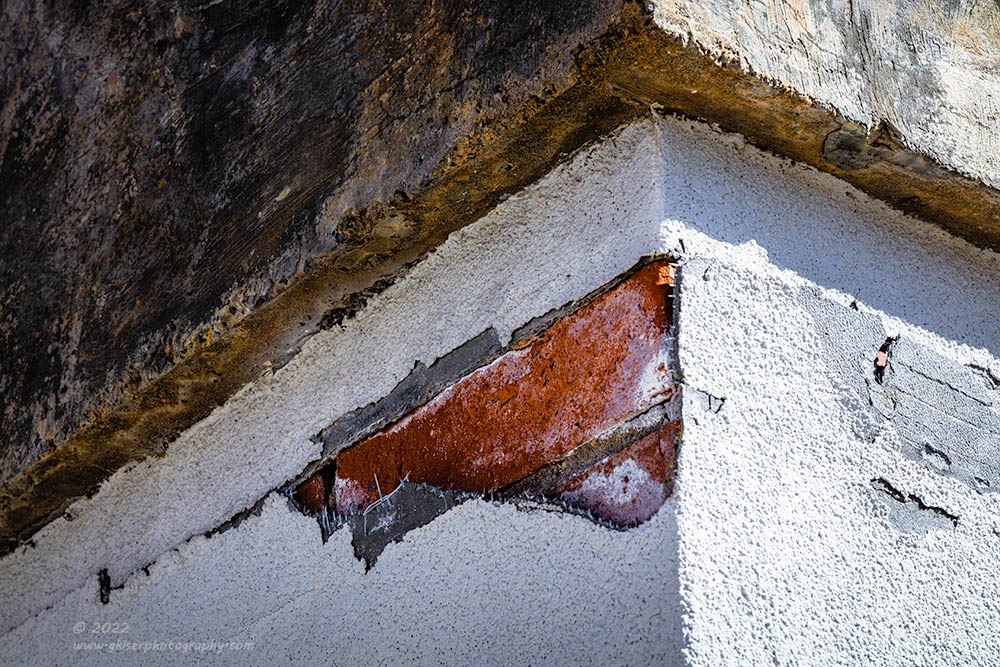
Since I was back at the truck, I went ahead and placed the bag in the back and went back to the camera to work out exactly how close I needed to be to the corner. I started out with the composition symmetrical using the corner as the dividing point of the image. It worked, but it wasn’t as dramatic as I had hoped. I considered my options and decided that the dark side was more interesting with the exposed brick and decided to short light this composition. I moved the camera slightly so that the corner was now along the right third line which filled two thirds of the frame with the shadowed side of the wall. This worked quite nicely, and I really liked the composition.
I only shot about six frames here between the two variations and when I was finished, I decided that I had done enough for the day. My creative energy was tapped, but I had accomplished my goal for the day. I had scouted the location for a possible workshop venue, and I had gotten a handful of new images which I was hoping I would like. I’m still not sold on whether or not this will work for a workshop location because for it to be beneficial, the participants would have to find scenes that moved them and then they would need to work them. There was no way to ensure that I could keep a group together in the same locations for each segment of the day. I try to avoid having the group spread out because I like to stay close by for questions and to check in on progress to see if I can offer any suggestions along the way.
Even if I didn’t cement the idea of the workshop on this trek, I ended up adding eleven new images to my catalogs which is an accomplishment in itself. This was meant to be just a walk around town on a day that I normally wouldn’t go out for photography because of the clear sky. I not only got inspired by what I saw, I was able to work with the light to create images that I’m really proud of. It is always nice to venture out of my comfort zone which includes things like cloudy days, rural scenes, and landscapes. There is a certain satisfaction that comes with knowing you can make images no matter what the conditions bring.
I do hope that you have enjoyed the trek and the accompanying photographs. I know I haven’t been out much this month, but I feel that the times that I’ve been out have been quality treks. I will always choose quality over quantity if given the choice, so I don’t mind a slow month here and there. It also helps to know that I’ve been busy with other things photography related for most of the month. I hope that will continue as we move through the year. I know that at some point this week, I’ll have product shoot to do which has originated out of Florida. I’m looking forward to that experience because it will give me another chance to set my studio up again and play with the studio strobes. I’m hoping to get some more portrait clients booked as well for here in the studio as well as potentially some Spring portraits outside. Speaking of which, if you are wanting to some new portraits keep me in mind and let’s get something booked. I would love the opportunity to listen to what you are wanting and to deliver the photographs.
I’ve got two workshops in the books coming up this Spring which I am very excited about. The first one will be the Spring Landscape Workshop at Stone Mountain. This is my first officially sold-out workshop, and I couldn’t be happier about that. My next workshop will be one on Building Compositions in the Landscape and will be held in May at Doughton Park. There are only three spots left for that one, so please sign up soon if you are considering going to that one. I have every reason to believe that this one will sell out as well. If you miss out on these, I am planning a decay workshop and a Fall landscape workshop, with a possibility of a waterfall workshop towards the end of the year. I will have all of that ironed out at some point this Summer. If workshops aren’t your thing but you would be interested in spending some educational time with me, please check out my new Mentorship Program which I’ll talk more about in my next Behind the Camera.
As you can tell, there is a lot going on right now and that is a very good thing. I want to continue on this path for as long as I can and keep building on it. A busy photographer is a happy photographer.
Until next time….