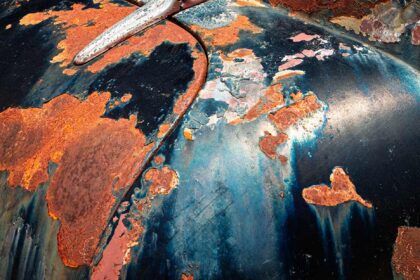
Friday, September 1, 2023
What is photography without rules? Well, I’m not really talking about “those” kind of rules. You know, like the “Rule of Thirds”, or other arbitrary rules that seem to be so popular when you are learning photography. I’ve moved away from those rules a long time ago, and work on a guide system more than anything. That is where I just do what feels right and refer to the rules when I begin to get stumped. No, that is not what I mean by breaking the rules this time. I’m talking about the self-imposed rules that I usually go by to ensure my photos turn out like I want them. You won’t find any of these in a book, or even online (until now) because they only apply to me and my creative desires. Let’s look at the rules for a minute.
Sunny days are for the birds
If I’m going to be out at noon, there better be some clouds
I try to avoid cars that are in too good a condition
Decay subjects are best photographed where they have been for a long time
Running and driving cars make for lousy decay subjects
Bright sunshine sets the wrong tone for decay subjects
The best photos are of subjects that interact with their surroundings
Avoid shiny chrome
Subjects should be tack sharp
Stay a stop away from the tightest aperture to avoid diffraction
There are probably more rules that I go by when it comes to photography, but this will give you an idea of where this trek is going to go. You see, I have just finished up with the previous trek to Linville Falls which turned out so much better than I ever expected. Part of my satisfaction with that trek was that everything that I had planned fell apart and I was left working on the fly with no expectations. I loved the resulting photos and the longer they breathe, the more I like them. They kind of got that creative energy pulsating through me, and I wanted to get out there and get another dose of it. The problem was, the forecast for the next…well, foreseeable future, called for sunny skies and no clouds at all. This is one of those setups that I don’t really care for unless I have something specific that I want to shoot that requires bright light. Of course, I realize that just this morning, my most recent Behind the Camera was published and I talked about why limiting your shooting times is of no benefit to you as a photographer. I guess you could say that I was kind of guilting myself into working with the sunny days.
Ideally, I would want to go out either right at sunrise or at sunset to get that warm golden hour light which is so beautiful. That would mean some type of landscape setting and an early morning. I wasn’t opposed to that, but I wasn’t able to think of a landscape that I really wanted to shoot under a blank sky. I considered going to Doughton Park to get a bit of the twilight wedge captured in the sky, but that didn’t really appeal to me either. What I was really wanting to do was some decay photography. A possible subject even popped into my mind as I was thinking about ideas. Both on the way to Linville and on the way back, I passed a yellow Oldsmobile Cutlass that was probably a ’66 model sitting all alone in a parking lot. I had noted its existence on the way up, and then stopped on the way back down. I pondered the options for photography with the car and determined that it didn’t quite fit my needs. The car was in decent shape with the paint intact without much in the way of rust at all. The chrome was in good shape, and the car was just too nice to consider a decay subject. The surroundings were lousy as well. It was in a parking lot beside a restaurant and a lower-level building behind it. There was not a meaningful composition to be had where the surroundings could help tell the story of the car.
Ultimately, I decided to pass on this car and head on back home. It stayed in my mind though because it was a unique looking car from what I typically photograph. Trying to consider what I might want to shoot on a sunny day, this car popped back into my mind because a yellow car in the sunlight is a good thing. The lighting would support the look of the car, and I could possibly get an isolation or two from the front around the grill and headlights. It would not be easy because the chrome and paint were both fairly reflective and I hate making cameos in my photos. It wasn’t the ideal subject, but it was something that I could at least give a try.
I had a slow start to the morning and took a little extra time at the computer since it was the first of the month and I had things that needed to be taken care of. By the time I was ready to head out, the sun was relentless, and it was around 10am. I really considered just staying home and working on sourcing set design items for a styled photoshoot that I am working towards. That just wasn’t going to cut it though. I needed to get back out with the camera, and I had a workable subject for a sunny day.
I set my course toward Foscoe, where the car was parked and rode with my sunglasses on which is usually an indication that it is too bright to be worrying about photography. I felt optimistic though as I climbed the mountain. Even if I didn’t get anything, I was doing exactly what I was suggesting in that recent Behind the Camera. I was planning on tackling this car a bit differently than I would have normally, and that usually means that I grow as a photographer which is always a good thing.

As I got into Boone, I was passing by the Chevrolet dealership and saw something that I didn’t recall seeing just a couple of days before. There was an early ’50’s Chevy sedan sitting at the side entrance off of US421 that appeared to be for sale. It was black which is not one of my favorite colors to photograph, especially in the bright sun. There was a little patina on it, but not much rust at all. It was just sitting at the side of the driveway near some signage, with the dealership behind the car. The setting was terrible, and the light wasn’t great for this car. I had one in mind that would benefit from the sunshine much better, so I kept on going.
The old Chevy did stick with me though, and I found myself wondering about different compositions that I could maybe do with it. I kind of made the decision to stop by there on the way home and check it out. It might just be a scouting stop, but there was a chance that I would be able to photograph it right then if I was feeling confident after working the Oldsmobile. The more I thought about it, the more I realized that it would probably make a nice secondary subject for the day.
Not much long after passing that Chevy, I was on the other side of Boone, heading out to the community of Foscoe where the Cutlass had been two days earlier. I didn’t recall exactly where it was parked, but I knew to look for a restaurant on the left side of the road. A little sooner than I had anticipated, I found the car, but there was a huge difference this time. When I had seen it on Wednesday, it was the only car in the parking lot. It was about this time of day when I was passing by the second time. This time though, the parking lot was full and there were other cars parked right up on top of the Cutlass. I pulled into the lot to see what was going on. The restaurant was open for business which I hadn’t been expecting since it was closed in the middle of the week. I tried to search the business hours on my phone, but the connection wasn’t strong enough to get a search going. It was around 11am which meant that lunch wasn’t going to be over any time soon which made this car nearly impossible to photograph without being in everyone’s way. I briefly parked and thought about compositions that I could do with the car. There were only a couple that jumped out to me, but the sunny day really was looking good on this car. At least I had that part right.
I moved to the neighboring parking lot so that I could check out the back of the car to see if there was anything there I could work with. Again, not much at all since the car was in pretty good shape. I decided to take this one as a loss and head back down the mountain again. If I found anything worth shooting, I would give it a try, but the day was probably going to be a wash. Of course, I kept thinking about my own words that had just been put in print this very morning saying that I had reached the level in my photography where I could make successful images in less than ideal circumstances. Was I full of crap, or did I really mean that? I mean, I could have made a few images of the Cutlass, but I would have been in the way, and I didn’t want to get run over in the parking lot which was a high probability. Giving up on that location was a safety issue, not a creative one. The fact still remained that I needed to prove to myself that I could make a photograph in the conditions I found myself in.
The Chevy sedan was right there on my radar, and that was the direction I was headed. If we look back at my “rules” that were listed earlier, you may realize that there are several things at play here working against the successful image goal. First of all, the sun was bright, and it was nearly noon. This is typically a terrible time to do any photography because the light is harsh and unforgiving. There weren’t even any thin clouds that might help to diffuse the light. The car I was going to photograph was in decent condition without a lot of rust. The chrome had looked to be pretty shiny as well which is always a problem for reflections of the photographer. Possibly the worst part about this car was that it was sitting in a large asphalt setting with advertising banners flying to the side. It was in full view of the highway which would also pose some problems with traffic and reflections. In short, photographing this car, at this point and time went against pretty much every rule that I have. But these rules are ones that I made up, so I could break them any time I wanted to. I guess it was time to be a rule breaker.
I made my way back to Team Chevrolet and pulled into the parking lot. The car was all alone and there was no dealership business going on nearby which meant that I would probably have the location to myself for the most part. That was a plus, but I saw a lot of things that I didn’t like about the setting. The car had a for sale sign on the windshield that listed it as a ’53 Chevy, with 69,000 miles for $20,000. Yes, this sign tells a lot of the story of the car, but that isn’t the story that I really wanted to tell. I wanted to get into the story of the car based on the memories of its life before this point. I wanted to celebrate the aging process and the design of the car. I wanted the memories of car washes and family trips to come through more than the asking price. Looking at the scene, I wasn’t going to be able to do that with an overall capture of the car. The surroundings didn’t add to the story, and the paper in the windshield was just a distraction. My only option was to work the isolations on this car which was exactly what I had been in the mood to do with the Cutlass that I had passed up on earlier.
I didn’t see anything right away, but I had thrown down the gauntlet and challenged myself to make a photograph or two in these adverse conditions. I turned the truck off and went back to grab the camera. I loaded up the 24-70mm lens which is my favorite walking around lens and added a Color Combo Polarizer to control the glare. Since I was close, I just left the bag in the truck, but went ahead and mounted the camera to the tripod as I knew I would be using that. I went over to the car and started to walk around it to see what caught my eye. I was left feeling very flat after my second trip around the car. Nothing was sparking my interest, but I knew that was because I had been thinking about a sunny yellow car and this wasn’t that subject. I just slowed down and started to look at the details.
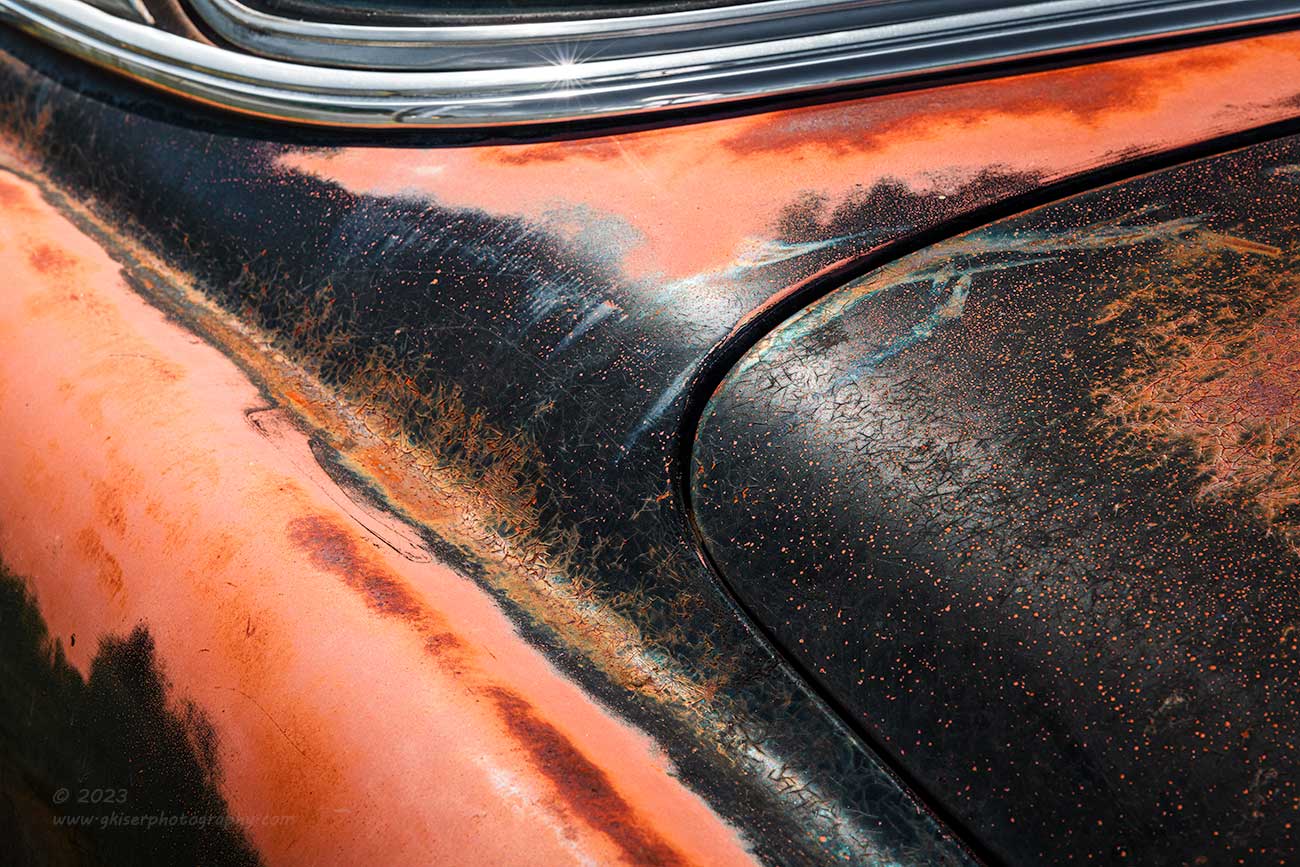
The first area that caught my eye was the top of the rear quarter panel. There was a really nice patina and the cracked paint was looking quite defined in the strong sunlight. There were no emblems around it to have a visual anchor, but I felt that the body lines would create a visual pathway that was needed. I played with some ideas holding up the whole apparatus until I was happy with a composition. Without moving the camera, I dropped the legs of the tripod and planted the camera where I had found the composition. From here, I just fine tuned the placement, rotated the polarizer, and chose the exposure. I fired off two frames and decided that I was happy with that.
I had my first photo in the bag and was feeling better about this car. Something that I will say from time to time, and especially during my workshops is that you have to listen to your subject and find out how it wants to be captured. That was what I was doing here. I had worked around the car and realized that this was an area of interest and the story was the patina. Now that I had started to understand my subject, I was seeing different compositions more frequently and that was how I liked it.
The next composition didn’t even require me to move much. I just focused on the same area, but from the opposite direction. This gave a much different flow to the composition, and I liked what I was seeing with that one as well. I made a few different exposures with varying degrees of effect from the polarizer until I was sure that I had something from here as well. I was only a half dozen frames into the session and felt pretty good about both of the compositions that I had been shooting. This usually doesn’t happen, even on a perfectly cloudy day. Here I was looking at conditions that were less than favorable and was banging out compositions that I really liked.

Not wanting to stagnate because that will kill my creativity, I decided to move around the car and find other elements that could be photographed. I really liked the front of the car because, as you know that is where the personality of the car comes shining through. It was not easy to photograph because of the setting which I was going to have to include some of the surroundings at least. I looked at the driver’s side which would have forced me to capture the shoulder of the highway as well as the flags that were waving along the side of the property. This wasn’t going to work at all, so I moved to the passenger side. This side offered a more simplistic background with the asphalt taking up much of the space. As long as I didn’t get too low, I would be able to avoid the fence and trees beyond the car keeping it very simple. There was also the matter of the for sale sign in the windshield which made it necessary to crop the composition just below the glass. I started out eliminating all of the windshield and chrome, but it just didn’t feel right to do that. I let a bit creep in to the corner which worked out better as it helped to keep the eyes in the frame. The inclusion of the windshield wiper arm kept this from looking accidental, and the glass right at the corner was dark enough to keep the eyes from exiting at that corner. Nothing is ever left to chance in my photography.
The angle that I shot from was dictated by my own reflection. I moved to an area where I was only visible in the corner of the bumper which was a bit hazed over so the reflection wasn’t crisp at all. The only other place that I could find any evidence of the photographer was in the far bumperette which just had a little bit of me in the chrome. Both locations were places that I could easily clone me out of. Once again, I was shooting for how I intended to edit rather than looking at fixing anything in post. Every choice was made on purpose, even the tire that was cropped by the lower edge of the frame. I did that because I knew that the majority of that side was in shadow, so the tire wasn’t going to be that visible anyway. Had I included the entire tire, the bumper would have been pushed too far away from the edge of the frame which I felt was detrimental to the composition. Since the bumper was brighter, it was going to make a more visible element, and since the wheel was about as bright as the bumper, the tire became inconsequential to the composition. By keeping the bumper and the wheel closer to the lower edge of the frame, I gave them more visual weight inside of the frame. Essentially, I had cropped the car on three edges which kept everything balanced and the focus firmly on the front of the car where I wanted it.
There were only three exposures made of this composition with very minor tweaks to the composition and exposure as I progressed. When I had all that I thought I needed here, I moved on to something else. Honestly, I would have been happy to call it a day at this point. My intention was to get just a handful of images of the Cutlass. I had that goal achieved here in my first nine frames. I could have called it a day, but I felt like I was just starting to understand this car, and how it wanted to be captured. I made a quick walk around the car to see what else looked interesting. What I found was the chrome trim in front of the rear wheels which I have worked as a composition before. The trim was a bit different, but I figured that the formula would still work. What I didn’t like was the fact that the chrome was in such good shape that no matter where I put the camera, I was entering into the composition thanks to the reflection.
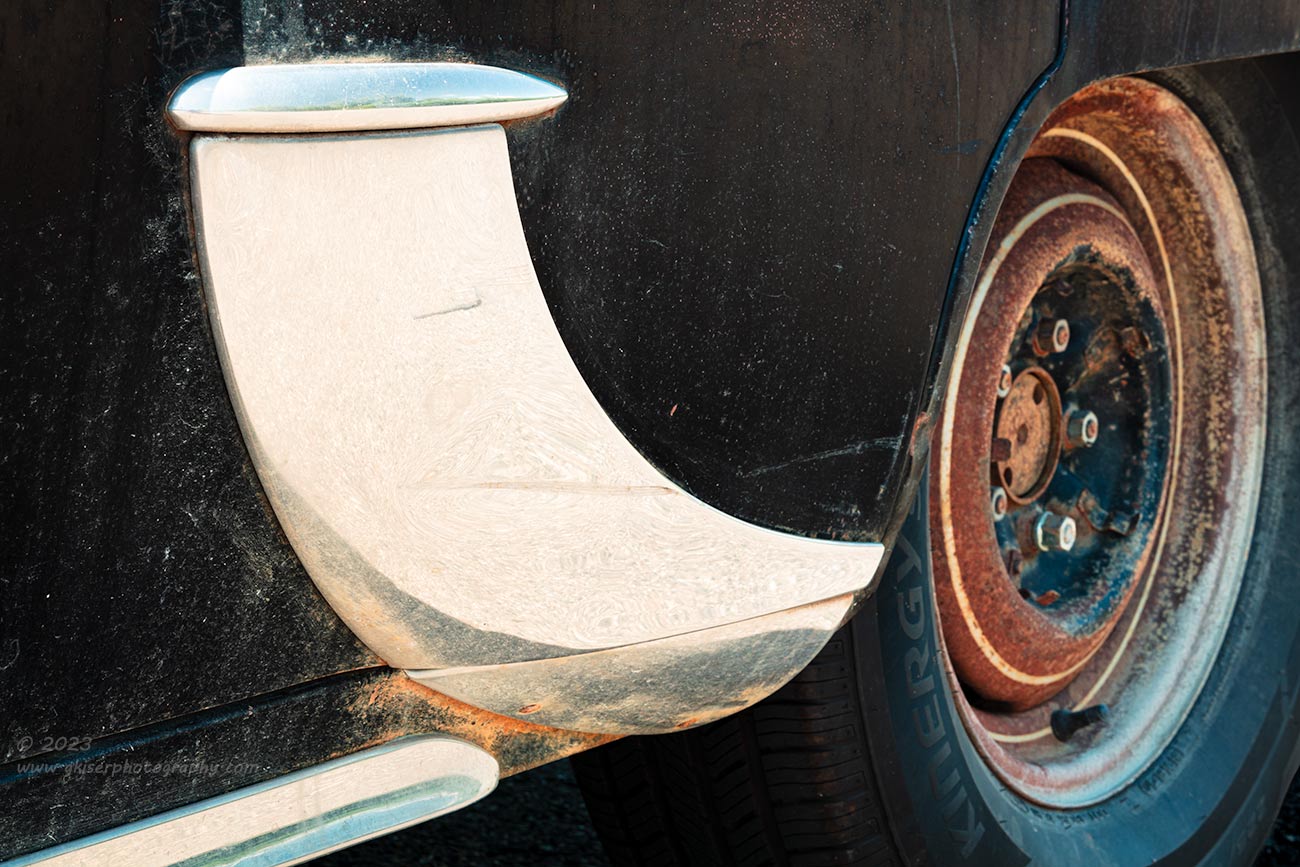
The easiest thing to go was to get further away from the car, but at 70mm, I couldn’t get far enough away. That meant that it was time to change lenses so that I could remove myself from the composition. I went back to the truck and grabbed my 70-200mm lens which has been increasingly invaluable during these old car shoots. Now that I was able to back away from the car, I could no longer see my tripod in the chrome. I made three exposures on the passenger side with slightly different angles. In each case, I happened to look at the image review and I saw a heavy green reflection from the grass which kind of ruined the chrome for me. I thought about doing this as a black and white which would have been possible, but I really liked the warm tones of the wheel which would have been lost without color. I knew that there was no grass on the driver’s side, so I went over there. There was a bit of damage to the chrome on that side, but the overall patina was a bit better on this side, and I still had the warm rust tones on the wheel.
I framed up a similar shot on this side but used a bit more of an angle to add some more drama to the photo. There were another four frames shot here as I had a bit of trouble getting the exposure dead on with the specular highlights. I have no issue with chrome clipping because we are used to seeing a bright reflection in this type of surface, however, I didn’t want to lose too much information on that chrome panel since it was a main part of the composition. The black of the car was also a challenge to interpret as it forced my histogram to look very underexposed. After a shot or two, I had a good understanding of what I was dealing with, and the exposure was right on the money. Out of the seven frames that I shot of this basic composition as shot from both sides, I went with the next to last frame which offered the best exposure, composition, and least amount of odd reflections.
Of course, now that I had my long lens on, I had new eyes to look at this car with. While my 24-70mm is a great walk around lens and one that I use most often for this type of subject, I’ve found that the telephoto opens up some interesting opportunities whether it be compression, limited depth of field, or just the ability to step back away from the car. I owed it to myself to look around the car one last time to see if there were any off the wall compositions that I wanted to shoot. Yeah, since I was breaking my own rules, I might as well have a lot of fun with it, huh?
I began moving around the car and looking at emblems, badges, chrome, and the patina. It was all starting to blend in, but there was something that I was missing. There had to be another story here that I could tell. As I got around to the rear of the car, I was looking at the trunk. Nothing of interest there for the fifth time. However, I happened to look through the back glass to see the steering wheel. I’ve been getting better with my interior compositions and felt that this one might offer a good opportunity to try to expand on that. I moved around to the driver’s door and looked in. There wasn’t a good angle at all for that side, so I moved to the passenger side. Once again, I found nothing of interest there either. I did see the speed limit sign on the highway which got my imagination going. If there was a way to include that sign in the composition of the interior, that would connect the subject with the act of driving. It interested me, but I wasn’t quite sure how to make it happen.
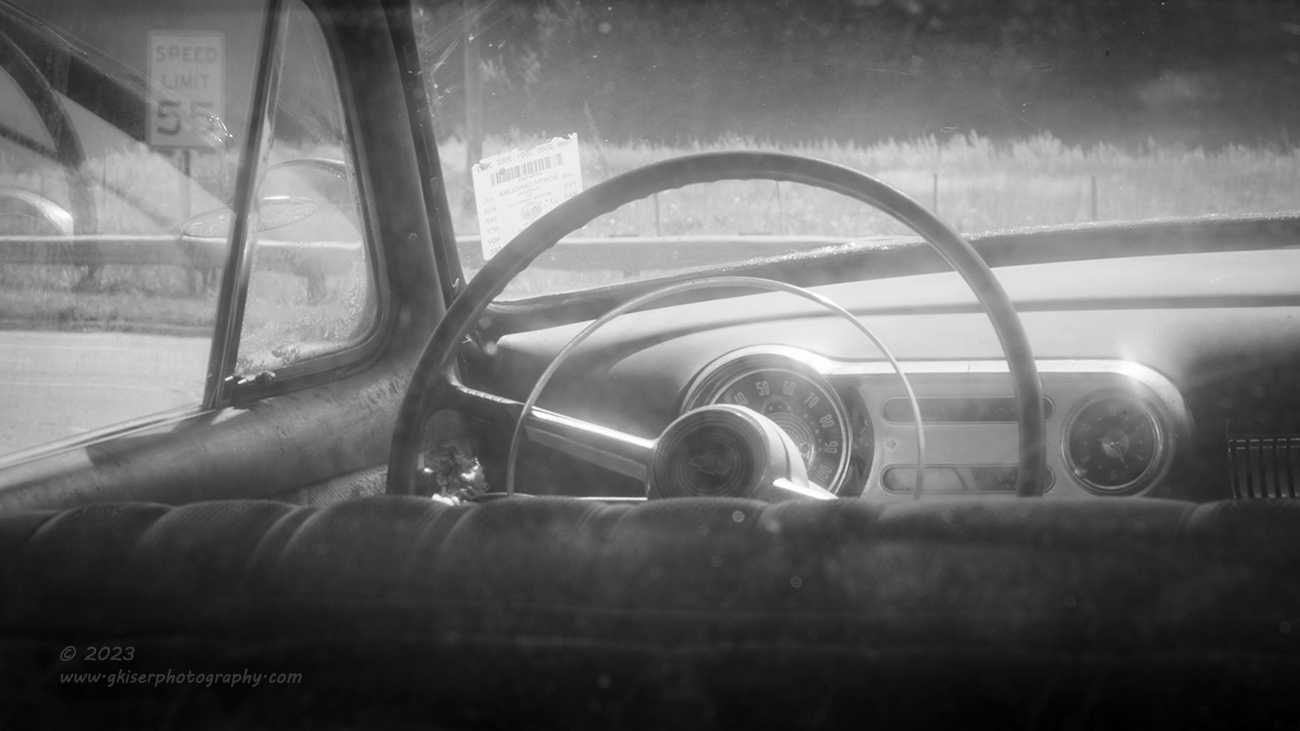
I pondered the idea for a few minutes and went to the back of the car. From that angle, I could get the sign in close proximity to the steering wheel and driver’s seat. It had to be placed behind the glass to work though, which presented a problem. The glass on this car was old and not terribly clean which I knew would cause a haze over the entire photo. In the past, I have done this, but only when I have had something outside of the glass to focus on so that there was something tack sharp to anchor the image. There was no way to make that happen here, but I liked the idea. As I worked through the elements of the image, I realized that the hazy glass could also be a part of the story telling. The rear window which I would be shooting through would soften everything in the interior and give it a dreamy diffused look much like a fuzzy memory. The speed limit sign on the other side of the road would be shot through two layers of the glass and would have another 70 feet or more of distance beyond the dash. That would cause a bit of softening just from the depth of field.
I was seriously considering what would be a soft image from the beginning with no chance of being sharp and contrasty like I usually like. It felt like sacrilege to be using a high priced “L series” lens and a top quality polarizer to capture something that looked like a pinhole camera with a cobweb over the hole. I wasn’t crazy though because this visual element was going to tell part of the story that I was developing. You remember when I said if you photograph in conditions that you don’t usually, there is a good chance you will learn something new. Well, I was about to learn something new and see how this concept would work out.
I worked the angles at the back of the car for a while because I had to get the sign in the right placement to be able to be framed by other elements while remaining visible. I also needed to get the steering wheel and instrument panel in view while shooting over the seat back. I didn’t want to get the roof in the photo, so I had to watch that line, but to drop the frame down to avoid that roof forced me to include a lot more of the back seat than I needed. If I shrank the frame enough to work the right height, I ended up cutting through the clock which I didn’t like. I decided to select a 16:9 crop in camera and framed up that composition which worked better. I was able to get all of the dash that I wanted as well as just enough of the seatback to give away the location of the camera.
I ended up shooting five variations of this theme and by the time I got to the fourth exposure I was pretty sure that I was onto something pretty cool. As part of what I always do, I was looking at the image review and zooming in to check focus which I wasn’t too concerned with since the entire image was soft anyway. However, I wanted to get the speed limit sign a bit more in focus than it was at f/22. Normally I don’t want to go any tighter than that with this lens because diffraction is introduced. Then I realized that because of the glass I was shooting through, diffraction meant nothing at all to the final image. I stopped the lens down to f/29, which was just a 1/3 of a stop away from closed all the way down. I then used the depth of field preview button while zoomed in on the instrument panel. I extended the focus point to a distance where the instruments started to go soft and stopped. I have no idea what point I focused on in the frame, but this allowed me to get the sign in much better focus while the important parts of the interior were also in appreciable focus. It was looking pretty good considering I was shooting through as many as two panes of seventy year old glass which needed to be cleaned.
I wasn’t sure how this was going to turn out, but when I got home I checked this series out pretty quickly. What I was expecting to happen actually did work very well. The automotive glass added atmosphere in the way that a foggy day, or a stormy sky would a landscape image. I was looking at a beautifully diffused scene that looked more like a memory than a photograph. Seeing how the colors worked in the scene, there was not much reason to keep the colors in place because they were all pretty well blended together in a pretty cool tone. By switching to black and white, I was able to really bring in more contrasts which helped to overcome the softness, while still embracing the soft aspects of the scene. The composition worked, and by the time I was finished with the edit, I was very happy with the way that this turned out. It was the first time that I had attempted something like this and had it not been for the difficult conditions I was working with, I wouldn’t have even thought to give it a try.

While I was at the scene, I had no way of knowing that the image would work out as well as it did, so I was still on the hunt for other images that looked promising. I started looking around the back doors on both sides for other points of view to the driver’s area so that I could build on the concept to see if I could increase my chances of getting a keeper. What I found was the C pillar area which caught my eye. Both sides were well aged, and the chrome was still nice and shiny to add that visual contrast. In looking at both sides, I found that the looks of the passenger side was a bit more to my liking. The patina had a better look, and the lighting was a bit better on this side as well.
I had worked out a pretty good composition of that rear pillar on a ’57 Chevy last winter and I thought that I could do something similar here. The more I tried to frame up the shot, the more I found that I liked the door handle better. because the sun was shining bright, I was getting a nice shadow beneath the handle that added a lot of depth to the chrome and brought in another shape to the composition. As I was working through some compositional choices, I found that the pillar was abandoned completely in favor of the handle. I ended up shooting three different exposures here, but nothing changed between the frames. The only reason that I needed to shoot three versions was to try and get a clean frame with no reflections in the chrome strip since there was a large section of the road being reflected there.
It was a first attempt at a section of the car that I found interesting, so I didn’t spend that much time on it. However, when I got home, it was this simple composition that really spoke to me. It might actually be my favorite image of the day. There is just something about the contrasts, both in color and in luminance all work together. The composition works so well with the body lines and the angle of the door handle working in unison. The patina was the icing on the cake that really packaged this photograph up nicely. Not knowing all of this at the time, I did keep working the scene in an attempt to find something even better.

I’m not sure that this next variation was any better, but it did include a lot more of the scene. I had to extend the frame a good bit in order to get any part of the pillar chrome that I was after. I still wanted to keep the handle because of how it looked with the shadow under it. The patina was still a main character in this composition as well. The idea was to capture the elements as shapes more than anything else. That was what the composition was showing me and I felt pretty good about how it was looking.
I ended up shooting four frames of this with two different focus points while paying attention to the passing cars since once again, there was a large swath of the roadway visible in the trim. It seemed that the only time there was traffic on the highway was when I was shooting frames that included the reflection of the highway. The rest of the time, I don’t think that there was anyone traveling by. I’m sure that wasn’t the case, just the passing cars weren’t affecting me at all during those times.
I had come over here to get another interior photo but had gotten very sidetracked by the door handle and the patina. This wasn’t a bad thing at all, and I really enjoyed the time I spent working with that area. However, I wanted to see about getting another interior shot of this car before I called it a day. From where I stood, I could see the steering wheel and dash quite well. There was also a nice crack in the rear door window that was really quite interesting to me. It was the crack that motivated me for this next composition, and that became a bit of an obstacle to get past.
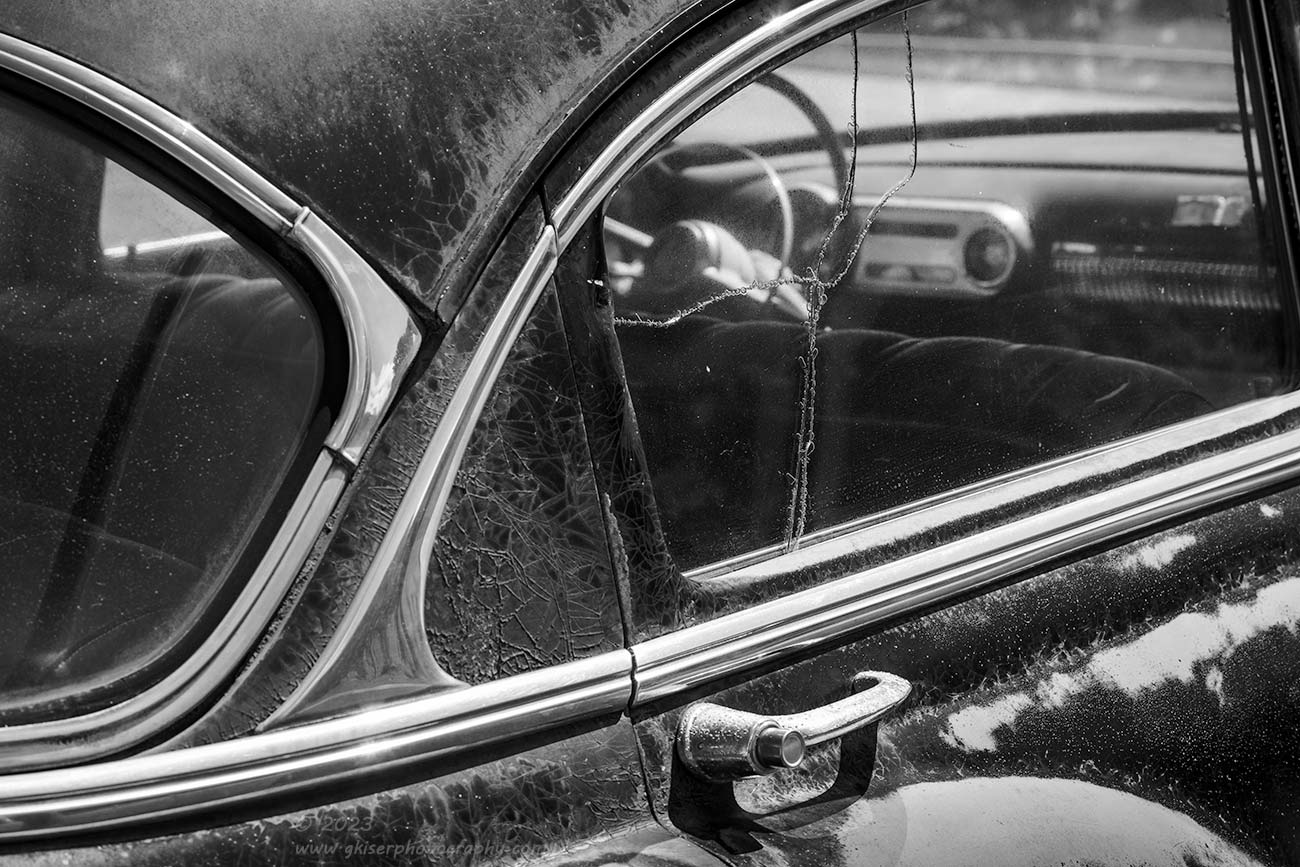
As I framed up the shot from where the camera was, I noticed right away that the crack went right through the center of the steering wheel and there wasn’t enough separation from the elements. This started about five minutes of moving the camera around to get the steering wheel placed in the best position possible. Each time I moved the camera, I had to recompose the entire scene because all of the elements moved in their respective positions. All this fiddling wore me out and I wasn’t sure if I was ever going to get a composition that I liked.
The first one that I shot didn’t work, but I did land on a composition that was workable even though the crack still went through portions of the steering wheel. Since the crack was over the wheel, I needed a different way to provide separation from the elements and that came in the form of depth of field. I used my depth of field preview button once again while zoomed into the crack to open the aperture enough to where I had the right amount of blur on the wheel while keeping it enough in focus to be a part of the visual story. F/11 was the magic number while staying focused on the crack. This allowed the exterior of the car to be in sharp focus while the interior went a little soft.
The quality of the window played the same role from this angle as it did from the rear of the car. The overall softening of the interior portions gave the depth that I was needing here, but in a way that I was much more used to. Remember, I will usually put something sharp in the foreground when shooting an interior through a window. That was exactly what I was doing here, and it worked perfectly. Now that I had the composition and exposure set, I needed to time the shutter so that there was no traffic. That was a harder task than I had become used to because now I was seeing the highway through the window, while still getting reflections of the traffic in the chrome along the side from traffic in the other direction. Essentially, I had to wait for a time when there was absolutely no traffic in the area before I could make a shot.
I ended up capturing seven frames of this composition. Three of them had a car sneaking into the frame at the steering wheel which left four others. Three of them had a car visible in the chrome from traffic behind me. There was a single image that was clean of reflections and that was exposure number four. That was the one that I went forward with for the editing process. Initially, I wanted this to be a color image, but when I looked at it, the focus was on the exterior of the car since that was what was sharp and most saturated. I wanted more of the story to take place within the car, so by eliminating the color, the eyes focused on textures, lines, and luminance. In this black and white version, the crack is more visible, and the attention is further into the frame rather than just looking at the foreground.
This one turned into a more successful image than I had anticipated, and part of that was the choice to go black and white. However, it was a culmination of all my choices that brought us to the success of the image. The depth of field, the composition, the camera placement, and the waiting for the traffic to cooperate all played valuable parts to making this image work. It is all of these little details that are things I’ve learned from my failures over the years. Everything that would have prevented this photograph from working are things that I’ve been guilty of doing at one time or another. Only through constantly getting out there and thinking through these photographs am I able to learn how to avoid those pitfalls.
If there was just one thing that I wanted you to take away from this trek, it would be the concept of practice, practice, practice. Yes, that is just what I have been doing with this car from 11:40 to 12:30. Even though I have been a photographer for nearly 20 years and a full time one for the last four of them, I still have to practice and learn new things. I broke all my rules for this trek and went out with the intention of photographing a car at the worst possible time of day, in the worst lighting conditions, while in a terrible setting. I put to use things that I have learned over the years and then added a bunch of new techniques on top of those existing tools. The end result was a day where I shot only 35 photos and came home with eight keepers. With my average in mind, I should have only had three or four really good images, and realistically with the adverse conditions that number should have been even lower. Because I have gone out and shot in all different conditions with a variety of subjects, I have proven that when the challenge is put forth to make photographs, I can deliver. If you are wanting to become a stronger photographer, this is just what you should be doing. Overcome your own weaknesses and learn how to adapt to the conditions at hand. That will go so much further than buying a new camera or lens. It is also the ONLY way that you will find out what kind of photographer you actually are.
Thank you for joining me on this short and sunny trek. If you are as impressed with these photographs as I am, I would like to invite you to consider purchasing a print. Not only is it the best way of enjoying the art that I have created, but it also plays a valuable role in allowing me to add to my collection of photographs which I share with you all. Keep in mind that I am not an influencer, and I don’t get paid to write these blogs, or even go out and photograph scenes like this. My only financial incentive for these treks is the print sales that happen afterwards. I’m not sponsored by anyone, and nobody pays me to go out and shoot these landscape and decay scenes. It is a labor of love, and you can show your support by selecting a print of your favorite photograph and allowing me the privilege of seeing it in the intended form.
Also, keep in mind that I offer varying types of mentorship programs which are designed to work for your specific needs. I wish that I had every variation listed on that page, but the fact of the matter is, everyone’s needs are different. I can’t offer a detailed program that fits everyone’s needs, so I keep things very flexible and will happily form up a plan that suits your particular needs. Of course, that plan is figured out during a no-cost, and no-risk consultation by phone or video chat. During that contact, we will both have a chance to determine if we are a good match and then what I can do to address your needs. It is then totally up to you as to whether or not you continue with the plan as presented. It all starts with a phone call or email, and I can’t wait to hear from you.
Until next time….

Remember to use the code KISER10 to get 10% off your purchase