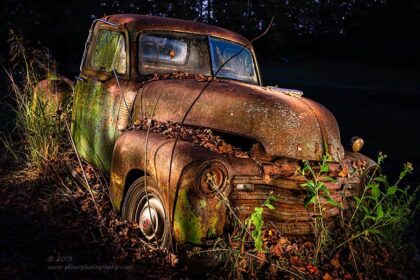
Welcome back to another installment of my monthly Behind the Camera! It is in this feature that I spend a little bit of time talking about what makes me tick as a photographer as well as sharing some of the tips and tricks that I have used along the way. This month, I’m going to talk about how a photographer interprets the world around them, because it is different than a non-photographer. The photo that I opened this piece with shows one of the typical scenes that I might come across and fall in love with. It is the exact same scene that when I ask permission from the owner to photograph, they look at me funny and ask why I would want to photograph their junk? After I assure them that it isn’t that kind of a photo shoot (inside photographer humor there), I go through explaining how I see the scene. To be fair about this particular scene, the owner understands the beauty of it because he has some of the same screws loose that I do, which is why we get along so well.
Anyway, I’m sure that when you looked at this photo, you didn’t see anything particularly pretty about it. You might be interested in the truck because you would like to see it restored, but you are probably quick to dismiss this scene as something “abandoned” that I stumbled on. What is it that I see here that others don’t? When I look at a scene like this, I will look at the lighting, shapes, colors, textures, and of course, the main subject which is the truck. Now, the lighting is pretty flat here, so that wasn’t exciting. The smooth shapes of the truck body did make for a nice juxtaposition with the hard lines of the shed and the items stored around it. The colors were muted and just kind of blended together. For this to be an interesting photo, I was going to need either different lighting or added contrast in some way or another. This is where seeing like a photographer comes in very handy.
Because I understand how a camera can “see” the world, I can spot things that will make a good photograph in a sea of visual complexity. I can also understand what conditions will make for a good photo of that scene. It all comes down to noticing the little details and what will work out as a photograph.
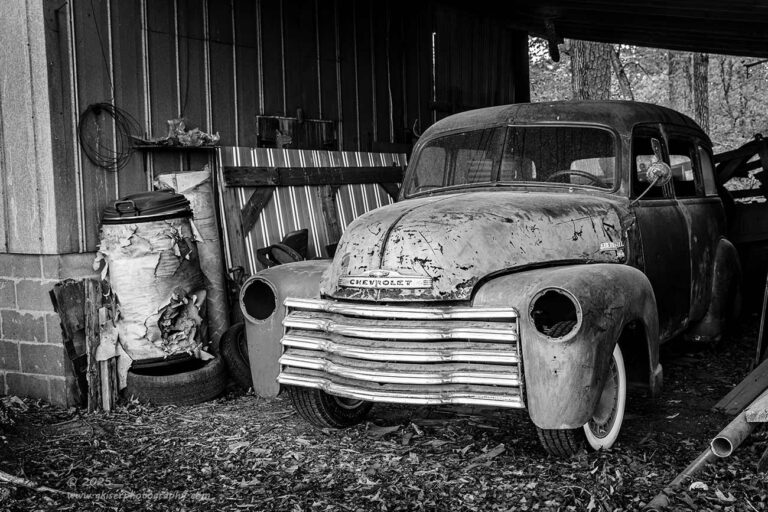
Here is the composition that I chose to work with when photographing the truck on that particular evening. This photo was made slightly before the cell shot that I started this entry with. You can see that there is more contrast in the scene with the shadows from the sun which was still in the sky. By converting to black and white, I was able to capitalize on those contrasts and add to them in some locations. The colors had been kind of flat which I didn’t like for the scene originally, but by removing the color, the shapes became much more important. It wasn’t that I didn’t like the colors, but they needed more punch to make them really work out. That was where the next phase came into play.
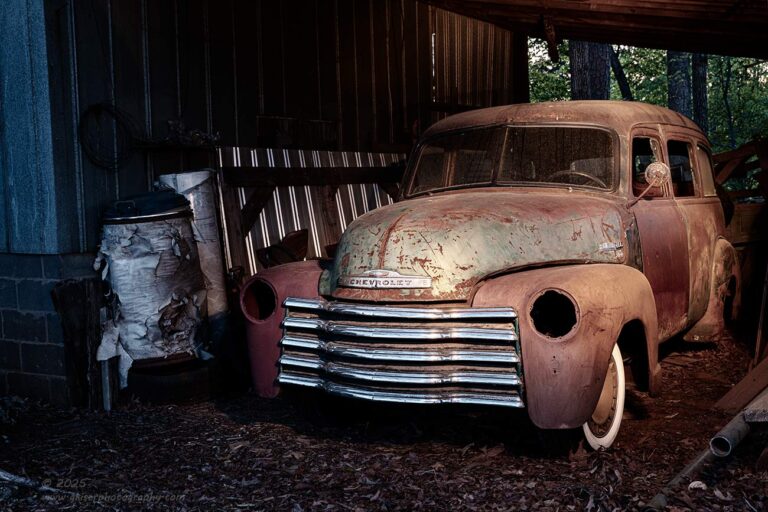
After the sun went down, I was left with a largely blue scene (hence blue hour), but when I added a simple incandescent flashlight to the truck for a bit of warm lighting, the color contrasts started to pop out. Either of these photographs turned out much stronger than what you might have seen walking past. Would you have recognized the possibilities in the scene for a photograph? This is what I am wanting to talk about this month. Photography is more the art of noticing than knowing what aperture to use, or what equipment you choose to buy. Before a photograph can be made, the person with the camera has to identify the subject that they want to capture. They have to notice something in a sea of visual stimuli that we all face each and every day.
It has been said that a camera will teach the user how to see without a camera. Think about that for a moment and really try to understand what is being said there. Humans are visual creatures by nature, and we rely on our sight more than any other sense. Most of what we learn comes from visuals which creates all kinds of problems for those that lose their sight or are born without it. Think about a typical day in your life and how much information you glean from the world through your eyes. You are reading this blog currently, and seeing the photos. You picked your box of cereal based on visual clues and poured it into your bowl knowing where to aim because you could see it. We learn to interpret visual information from a very early age and by the time we are just a few years old, we are really pretty efficient at seeing.
How can a device like a camera teach us to see when we have been seeing all our lives? Well, for starters, the camera is a simple thing that knows nothing about the world around it. It sees things much differently than we do as humans. The camera sees all, and it sees it for what it is. Humans see the same things, but we see it through a filter known as our brain. I’ve talked about this before at some length, so be sure and read this Behind the Camera before we get too in depth with this one. Essentially, what we see is tempered by our other senses and our overall experience and mindset while we are looking at the scene. Add to that, our brain is gifted as a visual filter allowing us to completely miss objects in our field of view to concentrate on what actually interests us. This is from our hunter instincts so that we can spot motion and food in a cluttered environment. Think about the next time you are looking at something. What are you looking at? Now look around it and see all the things that you didn’t see before. For instance, I am looking at the desk in front of me and focusing on a business card for something that I am dealing with currently. I see all the details of the card, but I’m not paying attention to the fact that it is sitting on a letter beside my cellphone right at the base of the monitor with the Wacom Tablet stylus standing next to it. All I saw was the business card because that is what I was most interested in. The rest was in my field of view, but my brain filtered it all out.
The same thing happens in the field when you see a scene. Consider the barn that you drove past the other day. It was a pretty barn, and you thought that it might make a good photo, or maybe it was a barn that you wanted to tell me about so that I could go and get a photo of it. You can remember every detail of the barn and it looks fantastic, almost a post card ready to be made. However, when you go back out there and look again, or I go out there and check it out, we are looking at the same barn as seen before, but things are different now. We are seeing the 18 power lines that are draped across the field of view in front of the barn, with the large power pole blocking the view of the corner. There is a Dollar General on the cross street that is fully visible from two of the angles that the barn could be shot at. There is a second Dollar General being constructed on the other side of the barn because it is a different street and we need more of these stores, but there is construction equipment that is parked right next to the barn. There is a large truck that is parked along the front of the barn blocking the view to the entrance. All of a sudden, the beautiful barn that was a post card, is no longer all that pleasing to look at…or at least the scene as a whole. This is what the camera would see making no apologies for that fact.
What happened to the scene that you had spotted the day before? Nothing changed other than the Dollar General popping up overnight, but it isn’t the same picturesque view that you had once seen. Well, your brain was focused on the barn because it caught your attention. It filtered out all of the extra things around it because they didn’t work with what you were trying to see. Now that you are looking again, you are seeing more like a camera because the camera can’t eliminate those distractions. A camera can only capture what is there, and that is all that it can do.
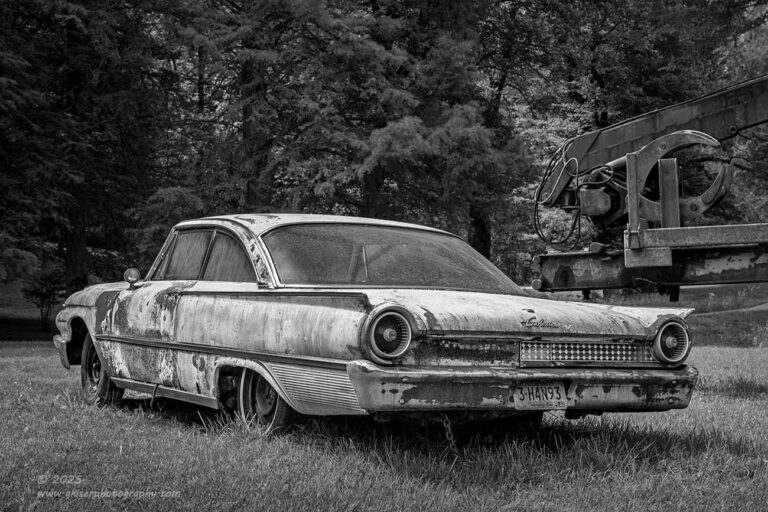
Here we can see what that looks like, when a camera captures a scene. To look at this view, our eyes would focus on the car when we are there. However, now that I have shot the photo, there is a distraction of sorts reaching into the frame to the right. To look at this in reality, the front of the logging trailer would really not bother me at all. I would focus on the car and disregard everything else. I can do this because my brain is acting as a filter. Thanks to the experience of being here and seeing the scene, the trailer would just fade into nothingness to my eyes. However, when I point the camera, it will see everything and will document what it sees. The person viewing the image will then only have the information in the frame to reference to determine what is being seen. The brain’s filtering capacity is greatly limited when looking into the finite space of a photo with just visible information available. The viewer ends up seeing everything in the frame as they explore within those confines. In other words, the viewer will start to see just like the camera has seen it.
As a photographer, we have to understand this dynamic and learn to see without a filter. In the case of the above photo, I wanted to get a photo of the entire car because the coupe version is a rare sight for me. Looking at all the different angles, there was not a single one that I could shoot where the car would be isolated from the surroundings. Knowing how the viewer would see this photo, I had to compromise and include another element in the frame, but I had to do so in a way where it wasn’t as much of a distraction. The way I cropped the image and the choice to make it black and white limited the visual weight of the heavy equipment while allowing it to look meaningful and purposeful in the composition. One of the biggest mistakes that I see photographers making is not paying enough attention to the edges. I call this “edge patrol” and it is something that I harp on during workshops and mentorships. Essentially, anything that is coming into, or going out of the frame needs to look intentional as if it was placed there for a specific purpose.
As I mentioned, I had no choice but to include that trailer with the claw in the frame because of how close it was to the car. I had total control over how to include it though. I had just enough of it visible to establish what we are seeing, but not so much that it became an important object. I placed it in relation to the car so that there was separation allowing each element to have its own space within the frame but not separated so much that they were not relating to each other. The choice was made to do the photo in black and white because the reddish rust hues drew too much attention away from the car. All of these choices were based on how the camera sees the scene and therefore how it is presented to the viewer. None of these things were considerations to my eyes when looking at the scene initially.
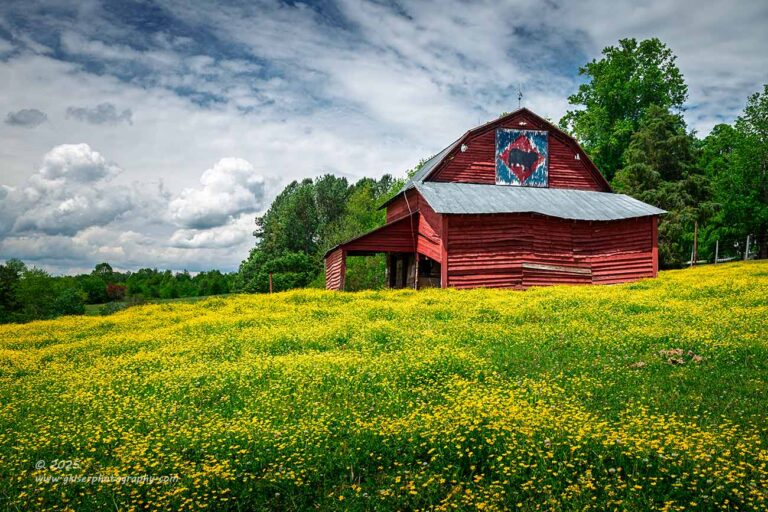
Here is another great example of how a camera sees versus how I initially saw the scene. I’ve passed by this red barn several times over the past five years. I’ve dismissed it each time because the barn is located behind a wire fence, very close to other buildings and an RV. There are power lines visible in different directions, and the barn has some awkward shapes to it that require some very specific angles to make it work. To look at the scene, it is actually kind of boring in reality, because my brain filtered out everything around it that was distracting which left a red barn sitting on a green hill. I liked the red barn and that was what drew my eyes into the scene, but when I started to look at it through the camera’s eye, I realized that there was really nothing to photograph here because the shape of the barn wasn’t able to carry the whole weight of the photo by itself.
This last time I went by the barn things were different though. The field was full of yellow flowers, and the sky above was looking really interesting. The scene looked like something straight out of a postcard. However, I knew that my mind was playing tricks on me because I wasn’t seeing all the buildings behind the barn or the fence that was blocking the barn from the lower vantage points. Looking at the scene critically, I started to see all of these things which would overly complicate the photograph. That was where I had to see like the camera sees in order to find the right angles to work with. To avoid the clutter in the background, I was going to have to move to a certain position where the first building was just out of the frame. There were other distractions that were lower as well that would require me shooting lower to the ground to mask them with the ridge of the hill. I wasn’t able to do this with the fence in the way, so I ended up getting permission and getting inside of the fence. Now I could get the angles to work in my favor to omit the distractions from view.
The photo that you see here is exactly what my mind’s eye had seen except for the fact that it has been flipped horizontally to make it read better from left to right. The difference is, when I spotted the barn from the street, there were a lot of distractions present that I really didn’t see until I started looking at the scene critically. It took a lot of maneuvering to arrive at a composition that matched what I had seen from the road, although it was from well within the field where I ended up standing to miss the distractions.
The first time I had seen the barn, it interested me, but I knew that it wasn’t a photograph because I was missing an important “and” with the composition. A red barn alone doesn’t make for a good photo, and that was all that really interested me about the scene. I knew that there needed to be more visual interest in the frame the way that a camera was seeing the scene. When that interest arrived in the form of the flowers and the clouds, I had the right ingredients for the shot. The problem now was all the distractions that my mind had been so efficient at filtering out, were now very problematic for the camera. This is where the positioning came into play as well as the creative use of focal lengths. Because I knew how to see like a camera, I was able to capture the photo that my mind had seen when I had driven by.

One of the things that Mom used to say about my photography is that it opened her eyes to things that she had never really noticed before. Essentially, she was responding to what I chose to photograph and the fact that it wasn’t always the expected “pretty scene.” This is the kind of photo that she was referring to because I was always shooting little details that I saw, and I did it in a creative way which made things like a fire hydrant interesting to look at. How was I able to find these things and photograph them successfully? The camera had taught me to see the way that it does. When Mom would look at a scene like this, she would see a fire hydrant and know not to park near it. She would recognize it for the protection that it provided for the surrounding businesses, but she would only see the hydrant for what it was.
After years of looking through the viewfinder of a camera, I see the hydrant for a shape and a color first and foremost. I am also looking at the environment and what is around it. I see the three different colors of pavers that make up the floor, the rusted water access point that kind of matches the shape of the hook-up on the hydrant. I am also seeing the curve of the stone wall behind the hydrant. All of these elements together made for a very interesting scene. All I had to do was figure out how to position the camera so that these elements would be arranged in a logical and pleasing fashion. I knew that the camera would see everything, so I had to organize things in a way where the shapes became the image rather than just the hydrant. Everything had to work together in the frame so that a viewer would want to look deeper into the scene and start to ask questions about what they were seeing. The ultimate goal was to create an engaging photograph of a very mundane subject.
By understanding how the camera sees, I was able to use that to my advantage to create a photograph that accurately translated what I had seen through my filtered brain. As a photographer, learning to see as a camera does, is as important as learning grammar and spelling before writing your first letter to a friend. OK, fine….sending your first email to your friend. Geez….I mean posting on your friend’s wall or sending a Snap. Whatever kids are doing these days utilizing written communication. I guess these days it is all about emojis and cave drawings, so the comparison might not be as effective as I had hoped. I don’t like progress anymore; I miss the old days. Back to my point, the camera is the tool by which we translate a particular view through technology so that others can share in what we saw. In order to accurately accomplish that, we have to understand how to harness that tool and how to utilize the visual language that it brings.
Now that we understand how a camera sees and how we have to translate the view we see to the view we capture, we can talk about noticing things that will make a good photo. As I mentioned, it is expected for a photographer to capture a pretty scene. it is almost second nature the minute you pick up a camera, but the art of noticing goes way beyond just responding to a simple scene. As we hone our ability to see like a camera, we will start to find that there are scenes and objects that are not innately beautiful will still make a great photograph. What is it that makes that statement hold true?

As photographers, we start to become drawn to things like shape, color, and light. These things actually replace the actual subjects in many circumstances. This is one of those photos that kind of took on a life of its own. I had initially noticed the badge on the fender. That got me looking at the scene closer, but then I noticed the shape of the fender by the badge, which then got me noticing the headlight. This was now getting out of hand because I was adding a lot of elements in a straight line. I then noticed that the clouds were breaking up in the sky which revealed a blue sky. That really worked well with the red paint on the car and provided a nice balance for the image. I paid attention to all of the things that I had noticed with the car and started to build a composition that focused on those aspects.
The resulting photograph gives you this feeling of a wide-open scene with lots of breathing room. This was the feeling that I wanted because that feeling of space went with the “Satellite” badge in my mind. The reality of the situation was that the car was up on jack stands, right next to the shop building. There were other cars parked right next to it on the driver’s side and there was a house in the background. Because I knew how to see like a camera, I was able to jockey around to find this position which reduced the image down to the important aspects and elements. It all started by noticing something as insignificant as the fender badge which then turned into what is still a favorite photo of mine from the year.
When we notice things that others don’t, we will then have the potential to create an image that will catch the eye of the viewer. Humans all recognize pretty scenes, and we are used to seeing them. We see them in our everyday life, we see them on television, at the movies, and in our social media feeds. We tend to go numb to those pretty scenes, so when a photographer captures one, it will eventually get lost in the myriad of imagery that we have seen. The trick here, as a photographer, is to learn how to notice things that a regular person would miss. If you can notice something inconsequential and then create a meaningful photograph of it, you will have created something that will stand out in a person’s memory and create a different kind of connection.

Going on a photo walk is a great chance to do just this. You aren’t there with the intention of getting any specific photo of a pretty scene, or even an interesting subject. You are there to respond to the visual stimuli that you see. Anything becomes fair game on a photo walk, and eventually if you do these enough, you will get very proficient at spotting scenes that will work as a photograph. So, what is it that you are looking for if not a beautiful scene? Well, for me, I like to look for contrasts both in color and light, angles, shapes, and things that include visual pathways. I enjoy picking out a small portion of a larger scene that represents the scene as a whole. This photo of a staircase is a good example of what I enjoy looking for. The sunlight is providing some wonderful contrasts that create the shapes that make up the photo. The shadows also provide separation between the different sections while the textures of the concrete make the negative space work in the composition. The window at the top gives a hint of blue that balances out the overall warm color tones of the rest of the scene, while the shapes of the scene lead your eye right to the window. The photo also brings to mind what the entire scene might involve, and the viewer can start to fill in the visual blanks to the sides of the frame.
Is this something that somebody would have walked by and thought “Blimey, that would make a fantastic photograph, let me pull out a camera!” Of course it wouldn’t. However, for those that have an understanding of how a camera sees and are used to limiting the scope of a scene to just what is in the frame, this becomes a very intriguing scene for a photograph. It is one of those that Mom would have looked at and said that she would have never noticed that had she seen it in the world. However, she would find that looking at this scene would be very pleasing and would prompt her to start looking at scenes like this when she was out and about.
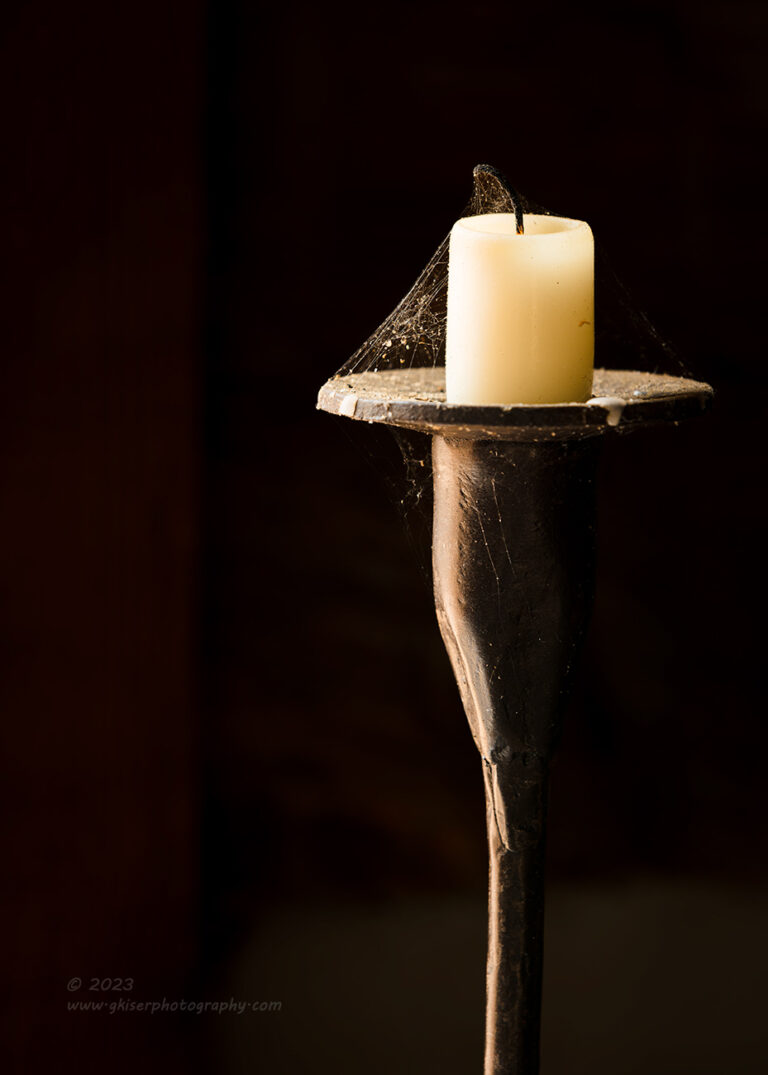
Here we have something very simple that caught my eye. It was a candle stick that was situated by a window in an old church. It was just a single detail within the interior, but my eyes were drawn to it because of the way that the light from the window was hitting the side of it. That light really highlighted the webs that were present which added a bit of texture to the scene. Looking at the scene, I knew that if I were to underexpose the image while exposing for the highlights, I would end up with a very minimalistic photograph of just what the light was hitting. I had the composition in mind to keep the frame interesting while introducing some visual tension. For just a bit more visual interest, I exposed just enough of the background to show some of the framing elements that the wall provided, but they were very subtle while bringing in some more warm tones.
What I had noticed about this scene was the way that the light was hitting the candle base and the candle itself. The textures from the web added visual interest, and I liked the stark nature of the composition that I had in mind. It is not a classically pretty scene, but it is one that has a lot of visual interest and something that stands out from the crowd in terms of photographic subjects. Had it not been for the light hitting the candle as it did, I wouldn’t have noticed this scene, nor made the photo.

Here is another example of noticing things that aren’t really the subject which make for an interesting photo. To look at this photo, you might think that the wheel is the “why” and the reason that I shot it, but you would be wrong. The wheel is actually not all that interesting by itself, and the tire has very little added interest despite these two elements taking up the majority of the frame. What drew me in here was the shape of the fender well and how it had a certain swoop to it. That shape takes up very little of the photo though, but because I noticed how the painted lines on the pavement worked with the scene, I started to be able to put the image together. The wheel became the focal point, but only because it helped to link the pavement lines and the shape of the fender. The composition was much greater than the sum of the parts because there is nothing interesting about painted lines, or a wheel, or just a portion of a fender. Any of these elements on their own would have been boring and easily forgotten. Put them all together though, and you have a compelling composition that has a dramatic flair to it.
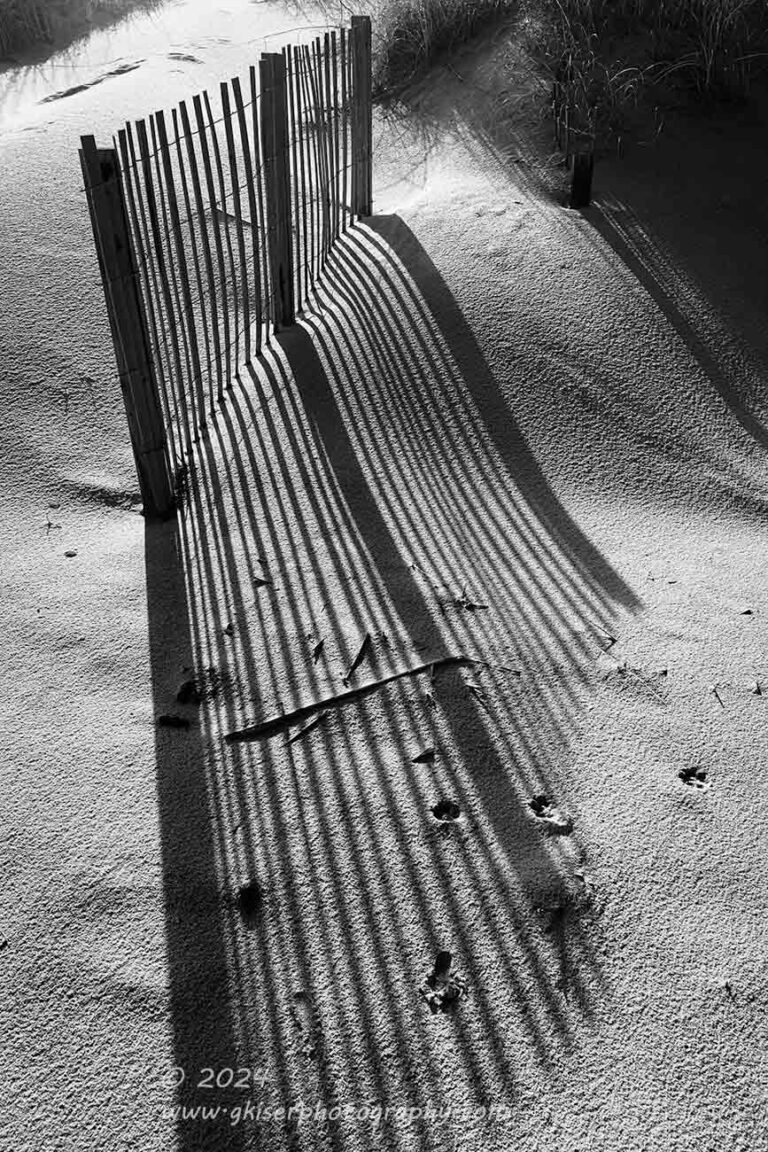
When it comes to noticing, I’ve talked about noticing subjects which is probably what I do most of the time. However, there is something else that photographers can notice, and that is moments. Street photographers and sports photographers are geared to notice moments more than subjects. This doesn’t mean that we need to restrict ourselves to one or the other. With this photo, it was the moment that turned into the subject of the photo. With the sun at the low position that it was, the shadow cast from the fence formed a fantastic shape on the sand. It was this particular moment where the sun was precisely in the location that it was which prompted me to frame this photo and capture the image. It would have been a different scene moments earlier or later.
It is the art of noticing those fleeting moments which set photographers apart. Even when the subject is the main point of a photograph, you also have to pick the right moment to shoot the photo because lighting will likely change as well as the surroundings. The length of that moment is all relative. It could be a matter of a fraction of a second, or maybe a minute as was the case with the shadow above. That moment could also be an hour or even more for a nice cloudy day. The faster that moment is, the more important noticing that moment becomes while if the moment lasts for a long time, you can concentrate more on the subject.

There are times when noticing the subject is only half the battle. In the case of this hay rake I shot several years ago; I noticed the subject while shooting the tractor that was towing the rake. I liked the repeating shapes around the arch, but I just wanted to capture a portion of it to represent the larger scene. Once I had a composition that I liked, it still wasn’t quite ready for the photograph to be shot. I needed something else to create a story behind the photo. I wanted to give this rake purpose, but with it in the stored position elevated, there was no way to get it linked to the ground, and that would have been expected anyway. I saw that there were clouds moving across the sky into the view of the frame. This would be my other element and would provide an interesting juxtaposition for the rake. To make it even more interesting, I decided to use a long exposure to cause the clouds to streak across the sky.
The plan was solid, and I ended up shooting several different variations as the clouds moved by. I was looking for that particular moment to go along with the subject that I had selected. It was not that easy to plan with minute long exposures because you just never knew where the clouds would end up being positioned during that length of time. This was one of the ones where the clouds made sense to the frame and the moment was right for the subject that I had chosen. It could also be argued that the light played a very important role in this photo as well with the sun backlighting the rake providing those little hints of highlights which help to show the structure of it within the frame.
No matter how you look at it, photography as a whole, is the act of noticing. You notice something that excites you and you create a photograph of that particular scene or moment. If you are good at what you do, and understand how a camera sees, you will be able to translate that concept which you noticed into a photograph that will show your full intention to the viewer. For this to happen, we absolutely must be able to harness the limited, though extraordinary capabilities of our camera. It doesn’t matter what you are shooting with because all cameras function in the same way which I’ve talked about earlier in this entry. It is up to us to use the camera in a way that filters out the extraneous details that our mind does for our own perception of a scene. It is through this two-part process where we step into a realm of photography which elevates us from a casual, amateur photographer into an enthusiast or even an artistic photographer.
The more you practice this creative routine from noticing to creating the quicker you will be able to do it. The end result should be something simple and natural, not looking too contrived. It should look as if you just responded and clicked the image into existence, but with a very considered look. This is to say that everything in the frame should support the subject or story that you are wanting to show, and that there is a good balance in the image. It shouldn’t look accidental in any way, and it should engage the viewer. Most importantly though, it should show the viewer something that they had never really noticed or paid attention to before seeing your photo.
As the photographer, your job is to notice things that others haven’t actively seen before and make them regret not spending the time to see them before. This is the art of noticing and what will elevate your photography to the next level. Don’t just be satisfied with photographing pretty scenes. We have all seen and noticed those things before which means that the photos really aren’t all that special. Only by presenting a photograph of something which is not really noticed, but in a creative way, can we hope to stop somebody in their tracks as they take time to look at what we have seen.
Elliott Erwitt said it best. “To me, photography is an art of observation. It’s about finding something interesting in an ordinary place…I’ve found it has little to do with the things you see and everything to do with the way you see them.” David Alan Harvey took it one step further when he stated “Don’t shoot what it looks like. Shoot what it feels like.” Both of these quotes hit at the core of what I am trying to get at. You don’t have to go to epic locations and find those same views that are all over your Instagram feed to make a good photo. In fact, if you do that, you are going to be making derivative photographs which will just add to the visual noise around us. To make a good photo, all that is needed is to notice what is around you and capture it in a way that makes your audience feel the same way about it that you did at the time.

The Blue Ridge Parkway is 469 miles of relatively untouched beauty. For the most part, folks will jump from overlook to overlook and hiking trail to hiking trail in search of the scenes that they might want to see. If you keep your eyes open and remain open to the beauty that is around you, there is a really good chance that the best photographs are not of the overlooks at all. This photo was shot on a nondescript section of the Parkway without a view of the mountains at all. I had noticed how the colors were looking through this portion and I liked how the roadway was gently curving through the scene. Once again, I was drawn to this scene from the colors and shapes that were present, not any specific subject at all. I pulled off on the side of the road and worked on framing up this shot which captured the moment and how it made me feel more than any particular subject. In fact, the argument could be made that there is really no specific subject in the frame at all. Sure, you have the beautiful Fall colors, but they are serving more as a framework for the scene and not really a main subject. The road is pretty dominant in the frame, but it just pulls your eyes into the frame. The sky takes up the most room and is probably the most reasonable main subject present in the frame, but I use the skies to set mood in the photos for the most part. Therefore, I believe that the mood of the photo is actually the main subject, and because of that, I really think that the point of the photo is more what it feels like rather than what it looks like. It was the way that I saw the scene, not so much the things in the scene.
By capturing this photo, the way that I did, the viewer has a chance to explore the frame and try to determine why I shot the photo in the first place. If my creative plan works, they will be left with an emotional reaction from the scene rather than a typical “hey, that is pretty” reaction. I really hope that what I noticed about this scene will be the same thing that the viewer notices. If that is the case, then I have succeeded as a photographer.
Thank you all for joining me for this month’s installment of Behind the Camera. Try to keep this one in mind whether you are creating photographs or just enjoy looking at them. Consider the importance of noticing in photography. Let the camera, or the photographs you see change how you see the world around you. Beauty can be found in some of the most regular scenes and in objects that we take for granted. Over the top imagery is only that. It succeeds based on shock value, but once that shock is over, the viewer will move on and forget what they have seen. If the photographer can point out why a dismissed scene or object should have been studied more closely, then you are challenging that viewer to find beauty in places they have never looked before. This is something that will stay with the viewer and photographer alike as they go through life. I don’t know about you, but I want to be the one that understands that beauty can be found everywhere, even the most unlikely locations.
If you enjoy this content, consider supporting this blog by clicking the donate button at the bottom. You can donate as little, or as much as you would like. Consider it to be like buying me a cup of coffee or maybe a lunch…or a Lamborghini if you are so inclined. It lets me know that these entries are beneficial to you, and that you are enjoying what I have to say on various topics. I’m not sponsored by anyone, nor do I sell advertisement spots here on the website. I am affiliated with a few retailers, but I receive nothing unless purchases are made with them directly through my links. That means that everything that I do here in the blog I do with my own free time with no guarantee of income. At the same time, I keep putting content like this together with the hopes of benefitting others while explaining some of my thoughts on photography.
Until next time….