Monday, June 12, 2023
To sum this morning up, I got rained on, got lost, almost broke my tripod, slipped, fell on my camera bag, slipped again and bent a finger, and nearly lost my hat. This was not my normal calm trek by any stretch of the imagination. It also represents the second time in two days that I have attempted it. You might think that this is some really exotic location which would justify all of the dramatics that I went through, but it isn’t. In fact, the location of this trek is one where I have gone a number of times before. The most recent was a couple of years ago and I got lost on the trail for the first time. That one had me frazzled and I didn’t even get to see amazing conditions like I did when I found a rainbow after a quick rain. Those are just two of the more recent visits to Hawksbill Mountain in the Linville Gorge Wilderness. It seems to be getting more and more difficult each year, or maybe I am just getting older. One thing is for sure, most of the time when I go, there is something interesting going on with the weather. That is the cornerstone for a landscape photographer, and what makes the difference between a pretty photo and a dramatic one with lots of eye candy to look at.
Since getting back into landscape photography on a very serious level, I have been picking the locations that I want to shoot based on the weather and I have tried to hit them at the right time. I’ve managed to do that on occasion, and then I’ve fudged it a little bit, and even found conditions completely opposite of what I was hoping for. These stories are no different from any other landscape photographer out there, but each time I go out is an adventure to some degree. The trek that I have just come back from is probably in the top 5 adventures that I have been through with my camera. You can scroll through the entry here and see the nine new images. You will hopefully like some of them, maybe love one or two, and could pass on a few more. That is all well and good, the fact that you are here to see the new photos is the most important thing for me. You have probably become accustomed to reading about how the images were created and some of the different things that went through my head during the creation. I’m going to do things a little different today because what lens I chose, and how I decided to frame the image just really doesn’t matter in the grand scheme of things. What matters for this trek is the behind the scenes action that I went through in order to get the photos.
It all started Saturday afternoon when I was looking at the weather after getting Toni’s car cleaned up from the recent rains. The forecast was calling for clouds and rain both Sunday and Monday. Not to worry because the car is tucked safely away in the garage next to the Miata which just went through a complete detail and service. I was hoping that the rain would hold off long enough for me to go out and get a few new photos, and it looked very promising in that regard. The weather was calling for partly cloudy skies in the morning with rain in the afternoon, continuing into Monday. I started to think about where I might want to go. The clouds were favorable for landscapes with a bit of sun shining through. I was even hopeful to see some color in the sky. The one place that came to mind was Hawksbill Mountain. I had mentioned that in a comment on one of my recent postings when I was asked if I had been to the Linville Gorge before. Since that was stuck in my mind, I looked at the weather for Linville and saw that it was very similar to what I was seeing for locally. It seemed like a good time to consider heading back out there.
I did my normal math with needing to be onscene at least 30 minutes before sunrise. I was going to need about 45 minutes to hike the trail barring getting lost, and the trip itself was about an hour and a half. After I carried the one, I was going to need to leave 2:45 before sunrise which was at 6:08am. For those of you who don’t get along with math, that puts me on the road around 3:15 in the morning. There are nights when I don’t get to sleep by then, so the thought of driving down the road that early didn’t appeal to me. I decided to set the clock for 3am and get going as soon as I could. I could hustle up the trail if needed.
When I went to bed at 9pm (the sun was still out), Toni said it was like we were being punished and sent to bed early. The punishment hadn’t even begun at that point. I spent the next four hours mostly awake and trying to convince myself to go to sleep. At 1am, I checked the weather and saw that the clouds that were supposed to be in place were starting to fade away. There was certainly going to be no color in the sky, and the harsh sunlight would take over soon. With only a few minutes of sleep, I decided the best bet was to kill the alarm and forget it. That started the best sleep that I had all night long. When I woke up at eight, I was groggy, and a little upset that I didn’t make it to Hawksbill. A quick look at the weather confirmed that I had made the right choice though.
It was actually for the best when I look back at the day. Having that creative energy in place worked out because Toni had agreed to do a test shoot with me, and I was trying to figure out a time to do it. My day had suddenly opened up, so I confirmed that she was still onboard, and I went down to set up the studio. I won’t get into much detail about the shoot here, but it was my absolute favorite studio session and one that I was quite surprised how well everything turned out. You have to know Toni to know just how much of a feat this was. She really hates to be in front of the camera and gets impatient with me while I am working out the different aspects of the shoot. She is nice enough to volunteer her time for me to practice, and I really do enjoy the opportunities. The end result was a two-hour session that yielded 14 photos that amazed me. It took the better part of the day to work through all of those and get the final edits done.
When I was finished, I went upstairs and started to consider the possibility of going to Hawksbill on Monday. We had experienced a really serious storm while I was editing, so I knew that the rain had moved into the area. Looking at the weather forecast, I was getting two very different looks at what the morning was going to hold. The main weather forecast was calling for rain from early morning until early afternoon. The cloud forecast was calling for the rain to stop right at sunrise and go to an interesting cloud day with the rain returning around noon. There was no way I was going to be able to plan for anything with wildly opposing forecasts.
I did like the chances of getting some dramatic clouds though and decided to get up early once again with the hopes of getting first light at Hawksbill. By this time, I knew the drill. I would wake up at 3am, but instead of racing to get out the door, I would take my time. There was no need to get there before sunrise with the chance of color in the sky being slim to none. As long as I was up there around 6am I would be fine. I was putting my faith in the cloud forecast that also showed rain percentages. There were also readings for wind which was showing a maximum speed of 13mph. I’ve been around the Linville Gorge enough to know that at the edges, the wind is rarely controlled, and usually has nothing at all to do with any forecasts. It has become a known thing, especially when visiting Hawksbill that I will be getting blown around a good bit. That 13mph forecast was probably going to be double that on the bald. I was also seeing a chance for fog in the area thanks to the rain that we had experienced on Sunday. It was all coming together to be a potentially decent day.
It took me about an hour to get to sleep, because I can remember hearing the clock strike 10. After that, I don’t remember much except for the occasional stirring to roll over. At 3am the clock went off and I silenced it within the first couple of notes. Did I really need to get up this early? I had just had a great day with the camera and that was enough wasn’t it? Ugh!! I checked the weather and saw that the cloud forecast was holding pretty steady and the main weather forecast had come off of the rain chances after sunrise. It was currently raining in Linville though. I decided that I had messed up my sleeping pattern for two different nights now and wanted to make it worth something. I went ahead and got up and started to get ready to leave. I wasn’t in too much of a rush, and I think that I ended up leaving at 4am which was sufficient for what I was wanting to accomplish.
The drive out there was rainy and dreary. It made me sleepy, but I had the radio to keep my company during the drive. By the time I started to get into the Linville community, the fog was starting to settle in with a heavy mist falling along with it. Visibility was getting terrible, and I hoped that the summit wasn’t socked in with fog. With most of the views being off in the distance, I was needing to have visibility, but the low clouds would be great for atmosphere. It was a delicate balancing act for sure.
By the time I turned onto Gingercake Rd, visibility was pretty much nonexistent. For those that have been to Hawksbill and Tablerock, you know that the service road is pretty much without any driver’s aids such as lights, lines, or pavement. I found myself creeping down the forest road bouncing in and out of muddy puddles for about four miles. The only way that I knew that I had arrived was the road got wider to the left which was the parking area. I got the truck parked and stepped out. I couldn’t see the trailhead for the fog, and the rain was starting to come down pretty heavy. The forecast had said that it was going to rain right up until sunrise, so this was expected. I was glad that I had worn long pants but was really wishing that I had brought a jacket since the rain was rather cold.
I only had what I had and there was no sense lamenting about things that I left at home. I went to the back and started to get things ready to hike. I mounted the tripod to my camera bag and grabbed my Boonie hat which has been with me since I went to Alaska in 2008. Once I had the bag secured to me, I pulled out the LED flashlight that I keep on the waist belt to light the way. I hunted for the trailhead with the light and found it over to the right. I was off. The trees were keeping the rain off of me, but I was already starting to get wet. I wasn’t worried about the gear because I knew that the Lowepro Whistler bag would keep everything plenty dry. The trail was pretty easy to follow which was a good thing after feeling like I was a late cast member to The Blair Witch Project the last time I was here.
The trail was starting to pitch up at this point and I was finally having to slow down a bit to keep my lungs from exploding through my chest, never mind the fact that I could feel my heart beating in my throat. I was happy to see that things were going smoothly even though I really couldn’t see much at all in front of me. I kept playing the last hike back in my head to try and figure out what I did wrong to get so lost. I had never had a problem before that last hike, and for that matter had never gotten seriously lost on any hike before. I had no idea what I had done wrong but hoped that I would not see a repeat performance this time.
After I had ticked off about 30 minutes worth of hiking, I came to the large boulder that marked the intersection of doom for me last time. I pondered the options and tried to remember which way I had found to be successful. I had read that blog entry the night before to see if could get any clues, but I pretty much left it as magic because the way that took me to the summit was the same way that I had come up. I looked at the trail, and saw a path to the right, one down the center around the rock to the right, and one to the left of the rock. The one to the right seemed to be the way to go, but it only brought me to a camp site. I came back and saw that the same gravel from the main trail was continuing by the rock, which meant that was likely the way to go. I tried that one and in short order I saw a climb into a clearing. Yep, I had figured it out.
Nope, I had not figured it out.
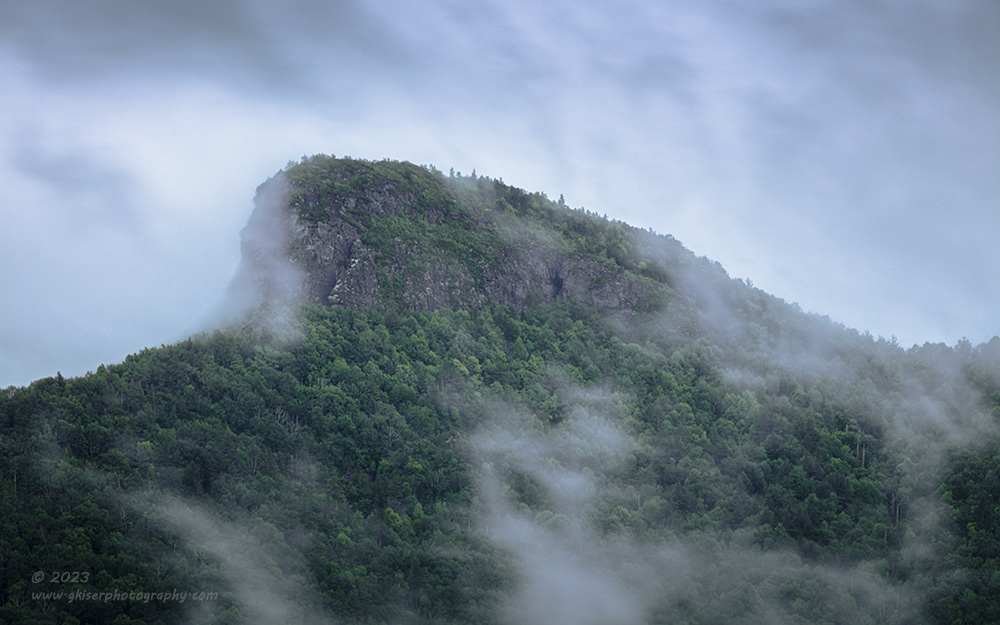
I found myself back at the small overlook that I recalled visiting the last time. As it turned out, though, I was in a pretty good place for some photos. I could see Table Rock in the distance shrouded by low clouds. It was one of those floating mountain scenes that I enjoy so much, but rarely get to photograph. I decided to get some photos here since I was here and didn’t know where I was going to go after this. I pulled the bag off my back and got the tripod. I started to notice that the wind was rather fierce here. It was well beyond the forecasted high of 13mph, and a whole lot more than the single digit speeds that were forecasted for this early in the day. This is what I have come to be used to with Hawksbill though.
I got the tripod set up and pulled out the camera. My intention was to fit the extender to the telephoto lens, but in my excitement and haste to get the camera put together, I totally forgot the extender. I looked through the camera to see if I was going to have enough reach to make the shot work and found that it was sufficient for my needs. I didn’t bother with any filters because I saw no need for them, and I was more interested in keeping a fast shutter speed for this composition.
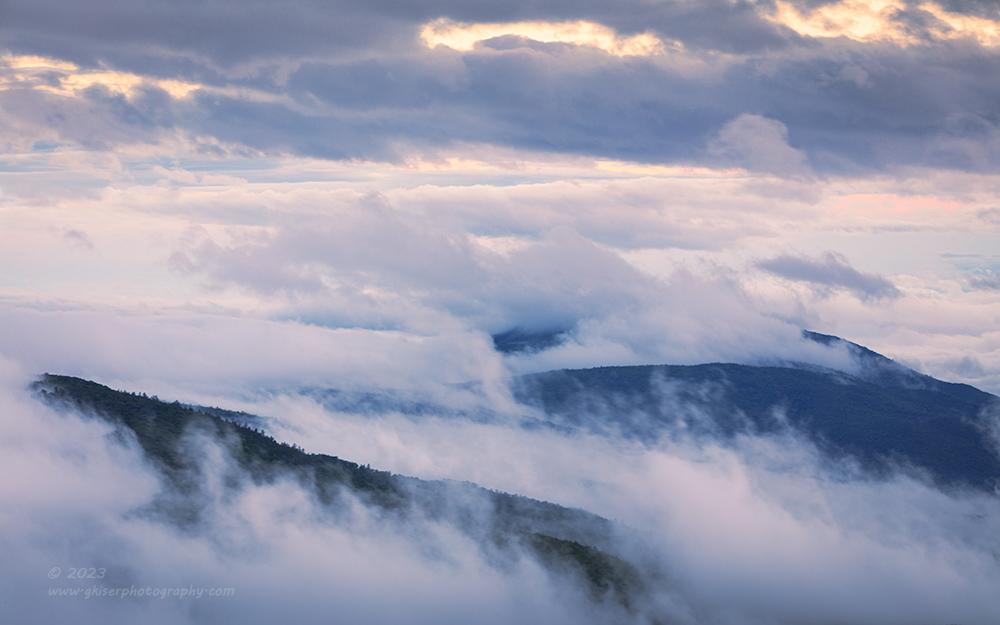
Sadly, by the time I got the camera all put together and mounted (less than 2 minutes), the fog had mostly cleared from Table Rock. I stuck with the composition for a few minutes in hopes that it would return, but I started to lose hope in that happening. There was so much going on here that I didn’t dwell on the composition. Instead I found another area which was starting to show some interest. Just like what had drawn me to the previous composition, I was seeing mountain summits detached from the ground floating in the clouds. I swung the camera around and started to make some exposures there.
This was working so much better than the previous composition and I committed to this area as the clouds changed positions. I wasn’t sure if I was going to be doing these in color or black and white, I just knew that I had to capture what I was seeing. While I was shooting these compositions, I could see my spirit level shaking which was a good indication that the camera was shaking in the wind. With a long lens, this is a pretty serious problem to have, so I considered boosting the ISO to give me a fast enough shutter speed. That would have worked, but with this lens, I had Image stabilization which I opted for instead. This allowed the lens to correct for the vibration and help to give me a sharper image in the wind.

I can’t remember how many frame I shot here, but there were at least 20 as the clouds changed position in the sky and around the mountains. Eventually, the clouds cleared off and I could tell that the moment was finished. I broke the camera down and put it all back in the bag. I needed to get back on the trail and actually find the right trail to get me to the summit. I knew I was close because this was the same route that I had taken the last time. I also knew that even though I was close to the destination, I had no idea which spur would take me there.
It only took a few minutes to get back to the rock where the intersection was. I looked around and found another spur off of the main trail which was off to the right. I followed that, but it ended shortly after I turned off the main trail. I turned around and went back to the large rock. I looked around again and realized that there was another trail right beside the main access point that was essentially a right “U” turn from that trail. I had missed it before since the paths were all very worn down at this interchange. I remembered my words from my last blog about the right direction to go was what seemed like back down the trail that I had come up. That was essentially what I was doing. Mental note to self for the next time I am out here, at the rock, take a hard right back the way you came to get to the summit.
It wasn’t but a minute or two and I was at the top of the summit. The second I stepped out on the rock I realized how easy I had had it with the wind at the last location. It was a piece of cake compared to what I was dealing with here. I know that the gusts were 40-50mph and the sustained winds were every bit of 20-25mph. The landscape looked gorgeous though, and I was glad that I was here. I started to walk around in an attempt to find a composition worth shooting. Yes, even in a location like this where there is beauty in every direction, I still had to find the right composition to showcase that beauty.
It didn’t take long, and I had a really interesting composition picked out that showcased one of the craggy structures near the summit. It was overlooking a lot of low clouds dancing in the valleys below. I started to get things all lined up so I knew where I would be putting the camera, but that put me well out on the edge with no protection from the wind. I was getting pounded, and almost lost my hat twice. Before doing anything with the camera, I stepped out of the main path of the wind and pulled the chin strap down and locked it to my head. If it were to blow off, it would probably blow to the coast before slowing down.
Once I had my lid secured, I pulled the camera bag off and set it over in a crevice out of the way. I pulled the tripod off of the side and extended one of the lower leg sections. I did this to help plant the tripod where I needed it before lowering the other two legs. As I was doing this, something interesting happened that I don’t believe has ever happened before. Once I extended the leg and let go with my right hand to get the other legs extended, the wind kicked the leg out and I was left holding a tripod in the wind by the ballhead. Yes, the wind was that forceful when it gusted. I tried two other times to get the tripod extended, but realized that even with all three legs extended, it was going to move with the wind. I ended up wedging one of the legs between two rocks to keep it locked down while I got the camera.
The following account will sound like an advertisement for my Manfrotto 055CXPRO3 tripod, but it isn’t. I’ve had the same tripod since 2013, and it has been my only tripod. I bought it with my own money, and I’m not sponsored by Manfrotto, although they might want to sponsor me after this bit of the adventure. If you are moved to try this tripod out after reading this account, if you purchase by using this B&H link or this Amazon link, I’ll get a few dollars without it costing you anything more.
Well, after wedging the carbon fiber leg into a crevice for safe keeping while I grabbed the camera, I shifted my attention to the camera bag. As I was moving to the right, not even five feet a gust of wind came through and nearly knocked me over. I grabbed for the tripod which was starting to move, but wasn’t going anywhere thankfully. I tried to get it more stable, but there wasn’t enough weight on it. I just ended holding it with my left hand while I pulled the bag closer and started to open it. Again, a gust of wind that had to be 50mph came blowing through. My hat was knocked off, but the chin strap held it somewhat in place. I felt that I was going to lose the tripod or the camera bag if I continued on my present course.
I got disgusted because I really wanted to capture this scene, but I saw no way of doing it without potentially losing thousands of dollars in equipment in the process. I pushed the bag back to the crevice while still holding onto the tripod. Once the bag was in place, I felt another gust of wind coming up and I tried to snatch the tripod so we could both get behind cover. If you will recall, I had the carbon fiber leg wedged between two rocks…I didn’t recall that. I was too busy fearing for my life to worry about such trivial things as that. Well, I was reminded the second I gave the tripod a tug. It didn’t lift up like I would have thought. Instead, I heard a slight crack which reminded me of what I had done to secure the leg. Having ridden several carbon fiber bikes in my life, I know that carbon fiber is very strong, but it can certainly break. I expected to see the leg in pieces due to my own stupidity, but the foot was still attached to it. I didn’t waste time examining it here because I wanted to get behind some sort of cover before directing that much attention to the gear.
My thoughts were that I had just destroyed a $500 tripod which would pretty much put an end to my day. When I finally got in behind some other rocks with a calm 30mph wind, I had the chance to look at the leg in more detail. I saw no cracks, felt no soft spots to the leg, and everything appeared to be normal and happy. All of the levers on the legs worked and clamped the legs as they were designed. There was no signs of injury except for two small scratches that could have very easily been there. This tripod has seen rough use in everything from salt water, to waterfalls, to rocks, and sand. It has been beaten on trees during my hikes and has been used a walking pole on numerous occasions. I had just used it as a prybar for two immovable objects and short of letting out a little whimper, it was no worse for the wear. The luck that I had just experienced didn’t escape me at all. I was happy that I wasn’t going to have to cut the day short, but I still had the wind to contend with. The only solution was to find something that was less windy.
Everything that I looked at near the top of the summit was just too windy to safely deal with. From experience, I knew that the lower I went, the less wind I would have to deal with. There were other compositions down there to work through, so I had no problem going a bit lower. I picked the same line that I had walked many a time over the years. I had my tripod in my hand because I didn’t want to take the time to put it back on the side of the bag just for a quick walk to the other side of the bald. I was looking forward to getting out of harm’s way and back to making exposures with the beautiful conditions I was seeing. There was even a little color in the sky which was a very nice surprise.
The following account will sound like an advertisement for a Lowepro Whistler BP350AW camera bag, but it isn’t. All the same things apply here as I mentioned for the tripod, but Toni had purchased this one for a Christmas present in 2016 if I’m not mistaken. I’m not sponsored by or affiliated with Lowepro, but again, maybe after this account they will want to talk to me. As Gavin Hardcastle says….”Get in touch.” If you are moved to aquire one of these bags, you can find the second generation of it at B&H and Amazon. If you buy after clicking one of these links, I’ll get a few dollars back, but it won’t cost you anything at all extra.
You might think that paying around $250 for a camera bag is silly, but I’ve always used bags that are roughly that, or even more. The reasons will become clear just from this trek alone. As I already mentioned, the exterior of the bag was pretty much soaked from the hike up. Everything inside of it was dry as a bone which is one of the reasons that I love this bag. The second reason that I love bags like this is the cushioning that it has. The benefit of that aspect will become apparent here in a minute.
There I was walking down a slope of wet rock, which I was prepared for. I even wore my waterfall boots which are great in the wet and I’ve used them almost exclusively for walking on wet rocks and in streams. What happened next surprised me greatly. I was happily walking down the slope looking forward to less wind when I felt myself getting shorter very quickly. Oh crap, I was falling. I have a fear of slipping and falling after getting a pretty bad concussion at work a long time ago when I slipped on the ice. I felt myself going backwards and I landed hard on my right elbow, but even worse, I didn’t feel much of an impact on my butt because I landed fully on my Lowepro bag. The last time that I had slipped this bad with camera gear was at Hanging Rock in 2010 when I broke my 10-22mm lens, and the Canon 40D that it was attached to. Of course, at that time, I had the camera on the tripod perched on my shoulder. The whole thing landed lens first on the trail and came to rest on the input side of the camera. That ended up costing me the price of a new Canon 5D Mk2 to replace the malfunctioning 40D and make the lens a non-issue since I moved to full frame.
All I could think of was that I had broken my fall on top of around ten grand worth of gear. I don’t care who you are, that is not a comforting thought. I would have much rather injured myself since I can heal easy enough. I got myself right side up again and CAREFULLY finished the retreat from the higher altitudes. When I got safely down to the base of the hill, I ducked into the woods to get out of the howling wind to assess the damage. The tripod that was in my hand appeared to be fine. I banged the Acratech ballhead and scarred it up again, but that thing is built like a tank, and I don’t think I can hurt it. I pulled the bag off and opened it up. I didn’t know what to expect, but things still looked packed away like I had them with everything in its own padded compartment. I saw no physical injury to anything, and since I knew that I was going to have to replace the battery that I had started the day out with, I went ahead and made that switch and turned the camera on. Everything seemed to operate correctly. While this is a pro level camera that is built for abuse, I still try to take care of it the best that I can. This was not part of my care routine, but the fact that I had it in the Lowepro bag seemed to mitigate the situation.
I have no doubt that if the camera had been on the tripod, or in a lesser bag I would have been looking at quite a bit of damage from that fall. I am so glad that Toni had bought that bag for me all those years ago. Granted, it replace a Tamrac bag that was possibly as well padded, but the only thing that I knew was that the current Lowepro Whistler had just earned its keep by keeping the camera and lenses unhurt. I was going to have to test out the lenses to make sure that everything was fine with them, but I was feeling pretty confident that they were unhurt as well. I’ve always been a huge advocate of having a good camera bag for this reason, but I’m now completely sold on the ability of the bag to protect what’s inside of it for even a pretty hard fall.
I was rattled after that experience and I’ll be completely honest here, I was kind of wanting to call it a day and go home. The creativity only flows when I’m not distracted and at this point, I was kind of worried about my gear, not to mention the ongoing fight with the wind that I was having to deal with. that wind was not letting up at all and seemed to be getting worse. I remembered seeing that the wind speeds for the “normal” weather area was going to increase about double (from 7-13mph) by the middle of the day. If these winds were going to double, I might not have to drive home. I wanted to give up, but I had come all the way out here, and there was no denying that the weather conditions looked awesome with the low clouds. If I was smart about it, there was no reason that I couldn’t stick around and try some more compositions out, and maybe test the camera a bit more.
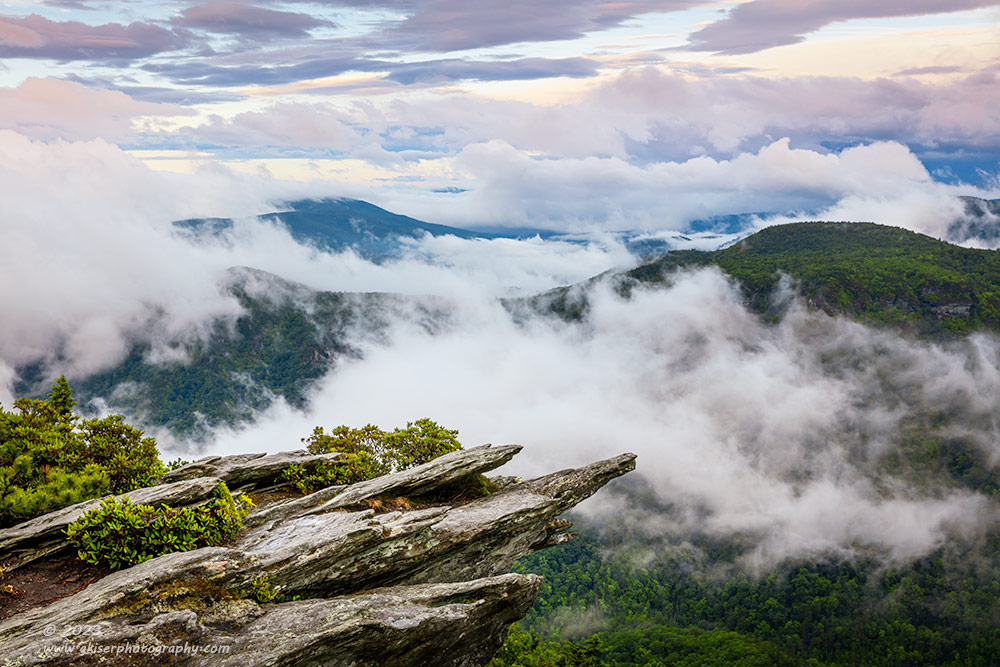
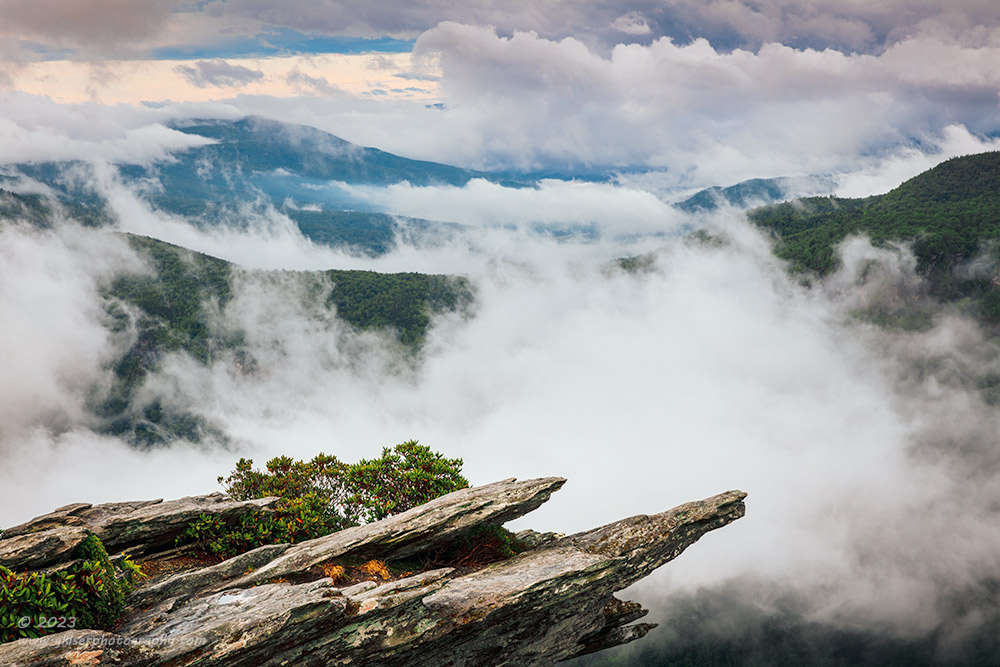
I put on my boy britches (actually pretty descriptive after having lost nearly 40LBS since March) and went back out into the wind tunnel. The difference in the wind was not nearly what I was hoping for, but I was getting a little bit of shelter from it considering where I was in relation to where I had been. I found the composition that I wanted which was over the Gorge. The low clouds were caressing the mountains and providing some great separation for the craggy outcropping that I have tried to photograph many times before. I wasn’t going to be able to get into my favorite location to shoot this from because it was too close to the edge, and I had experienced enough difficulties there with much lesser winds. I stayed in much further from the edge, which dictated the use of a my 24-70mm lens which I fitted to the camera. I put it all on the tripod and started to extend the legs. I was hyper aware of how it felt, and short of the legs collapsing a bit easier than I was used to, I felt no difference. The ease of collapsing could have very easily been the force that I was having to use against the wind, so I wasn’t worried about that.
I looked at the composition developing as I moved the camera around and saw no need for any filters. I would have liked to have used a polarizer, but I couldn’t bear to lose the stop and a half of light when the bushes along the surface were moving so fast, I couldn’t make out the shape of the individual leaves. I had to be pretty judicious with the ISO in order to keep the depth of field where I needed it, while keeping a very fast shutter speed. Any filters would change that dynamic.
Once I got the basic composition set, I made a crap-ton of exposures as the clouds changed position. I would make adjustments to the composition as needed when the clouds changed. I found that just the clouds were affecting the visual weight of the scene and I kept having to recompose to adjust to the cloud formations. It kept me busy, but I was on level ground, far away from any edges that could lead to my demise. I remember that at some point the clouds blocked up most of the interest in that direction and I decided it was time to redirect my attention to something else.
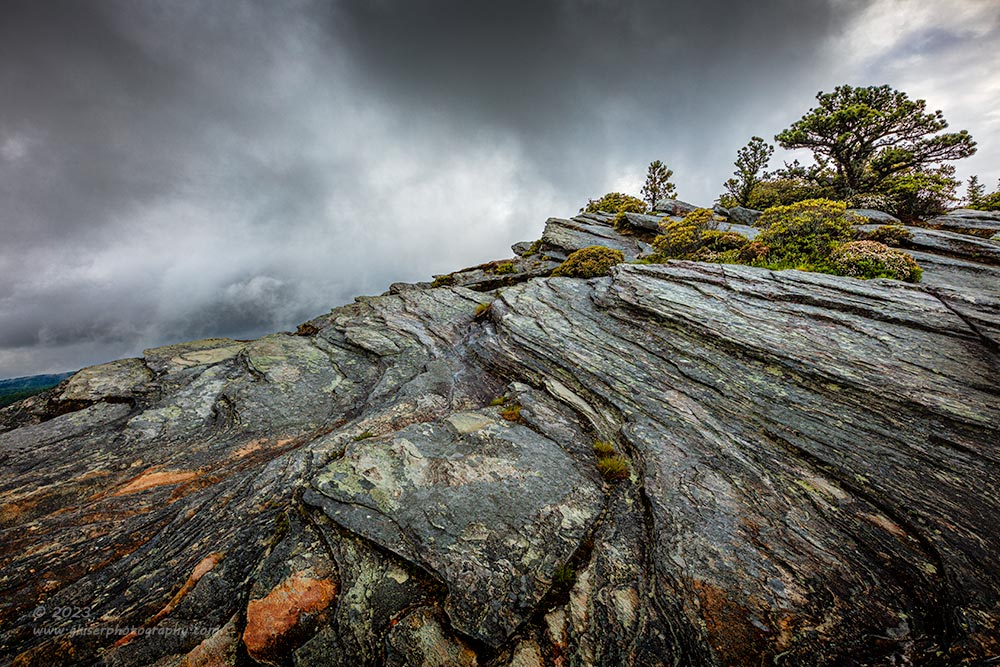
The slope that I had slipped and fell on was behind me. It was also one of the more unique features of this summit and an element that I have photographed pretty much every time I have been to this location. It was on one of my last visits that I found that it photographs very well under a heavily clouded sky, which is exactly what I was seeing overhead. I Moved into position, with the wind now at my back. I was freezing at this point now that I could start to pay attention to how I was feeling. I was really wishing I had brought a jacket with me, but as I had determined at the truck earlier, I only had what I had with me, and no more. I was going to have to suck it up and deal with the chill I was experiencing.
I started to frame up the composition of the slope and decided that the standard lens wasn’t going to cut it. I needed a wider lens, and fortunately I had that with me. I always have my lenses with me, it’s things like jackets that I commonly find myself without. I made the swap of lenses and considered filters once again. I could have used a grad filter here, but I just kept thinking that it would act like a sail with the wind coming in strong from my back. A quick check of the histogram showed that I could expose for the clouds while still retaining enough detail in the shadows to get the photo that I wanted. The only concern was going to be the noise from the ISO levels that I might have to use in order to freeze the bushes and trees. If I start with a slightly noisy image and then pull up the shadows a lot, I will end up with even more noise. The main thing was that I was considering the issue because I was shooting for how I intended to edit the image. This is a concept that I teach a lot in my workshops, and it does help with how you build your images when you look at things down the road which will make your life easier here and there.
I ended up spending way more time with this slope than I expected to. The clouds were moving very quickly which changed up the lighting and the composition almost by the second. If it hadn’t been for the moving bushes and the likelihood of camera shake, I would have gone for a long exposure here, but the wind was causing too many issues for that to work out. I just kept looking at the conditions and firing off shots that I thought might be the best light yet. I was certainly glad that I was shooting digital rather than film because each of these shots was costing me nothing. I would have been several rolls of film into the day by this point if I was shooting film. Ironically, the potential costliest parts of this trip had nothing to do with making photographs, but just moving around and trying to set up the photographs. Even though the exposures were free to make, I still had to call it at some point and move to something else. When I was relatively sure I had some options to work with, I packed the camera up.
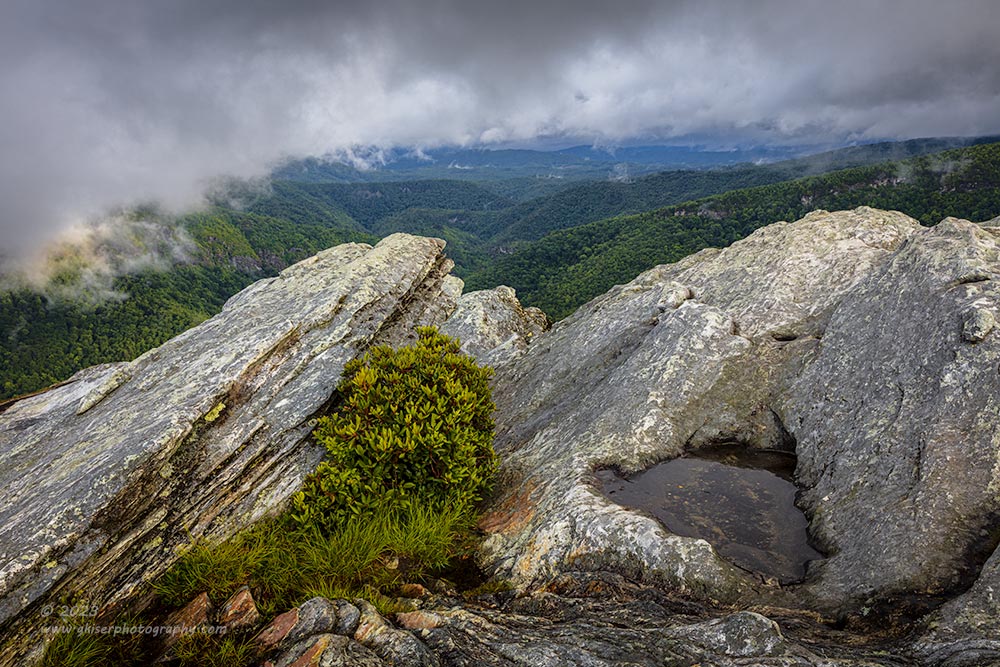
No, I wasn’t done for the day, but I was pretty sure that I was done at the base of the hill. I didn’t want to leave the camera unprotected as I tried to walk back up the hill. I can be stupid at times, but I try not to make the same mistakes twice. With the camera protected, I started the rather laborious walk up the hill being overly careful. I made it to the top with only a slight misstep which fortunately was just a stumble. When I got back to the top of the summit, the wind was just as bad as it had been. I was getting my sea legs so to speak, and I was feeling more stable in the high wind environment. One of the subjects that I had wanted to photograph was the puddles in the rocks up here because they make for great foreground interest. I started to look for a composition that might work with that in mind.
In short order I found one that I could deal with which included a bush next to a puddle. This wasn’t the strongest composition, but it was one that was safe to be able to work. I could be on level ground and hopefully keep the camera low enough to keep me out of the direct wind. I slid the bag off my back and placed it in a small relief so that it wouldn’t blow away. I got the tripod set up where I thought it would best go. It managed to stay put for the most part once I got the legs in some good spots. My first attempt allowed the tripod to slide over a couple of inches when I turned to the camera bag to get my camera out. Once I had the legs positioned with some divots in the rocks, the tripod seemed stable.
I got the camera back out and mounted the standard lens once again. I forewent any filters because once again, I was needing to keep a very fast shutter speed to freeze the bush. The clouds were kind of interesting, but they were occupying too much of the upper portion of the frame. I was hoping that they would do something interesting, so I kept shooting and watching for things to change up. Just about the time that I was about to abandon this composition, the sun peeked through the clouds and shined its warm light on the mountain across from my location. I adjusted the composition and grabbed a few shots of that event before it faded away.
When that was over, I was pretty sure that I could find something better to work with than where I was at. I looked around and saw a section to the East which had some of the puddles to work with as well as some very interesting textures to the rocks. There was a bit of the gorge visible in the distance as well for a bit of depth. I loved the scene and was excited to capture it. The biggest problem that I was going to have was the fact that the sun was in this direction which caused the clouds to be much brighter than the rocky surface. I didn’t want to deal with any filters for the same reasons that I have been mentioning thus far. The wind was a good bit stronger here since I was pretty much at the top of the summit with no protection from anything behind me.
I still had the standard lens fitted to the camera, so I just moved the tripod up to the new location with everything still as it was. I tried to frame up the composition and realized that the 24mm end wasn’t going to be enough to get the perspective that I wanted. I tried to back up, but that left the puddle too small in the frame. To make this work, I was going to have to get the wide-angle lens, but the question was how in the world was I going to be able to do that? If I let go of the tripod, the camera was more than likely going to tip over which has happened at Rough Ridge. That cost me a 24-70mm lens and scuffed up the 5D Mk2. I had been incredibly lucky so far today with my gear and I wasn’t wanting to ruin that now.
The solution was a bit complex, but it worked. I just took the camera and tripod over to the camera bag. I opened the bag up with my free hand, and then removed the camera from the tripod. I held both the tripod and camera until the wind died down and did the quickest lens change, I’ve ever done. Once I had the camera back on the tripod, I closed up the bag and drug it over to where I was needing to work. There was another little place I could tuck the bag so it wouldn’t blow around. I spent the next minute or two getting the tripod positioned right and the composition put together. Looking at the histogram, I was going to be OK on exposure, but I was going to have to pull a bunch out of the shadows, which forced me to be very careful with my ISO values.
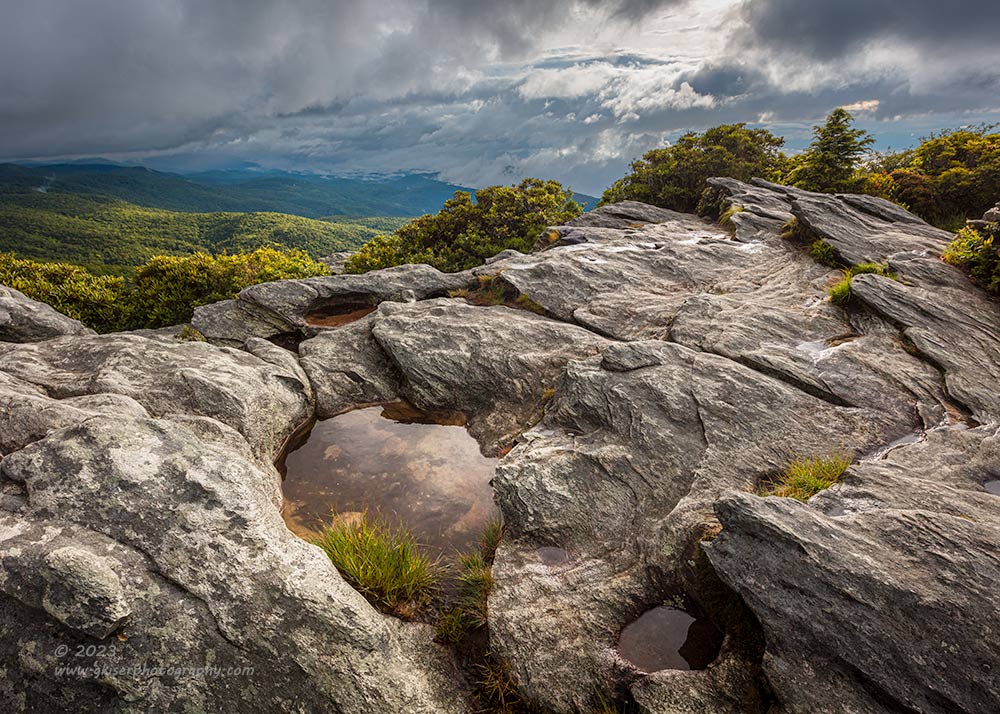
I spent the next 10 minutes or so photographing this scene under different skies. The clouds were staring to break up which gave me hopes that the foreground would get some light on it which I thought it really needed for structure. The thinning clouds were also causing more of a disparity in exposure values which was forcing my hand with filters. I needed to get a 2-stop hard edge filter on the lens, but I couldn’t take my hand off the tripod because of the wind. I thought things through very carefully and put together a plan of action.
While holding onto the tripod with my left hand, I reached over to the bag with my right hand to open the main flap. That was where my filter holder was stored. I clipped that onto the adaptor ring that is always fitted to the lenses. Then I closed up the back of the bag so nothing would blow out of the bag. I then opened the top pocket and grabbed the filter wallet to pull it out. While using my foot to hold the wallet still, I unzipped it and retrieved the proper filter. Fortunately, I know what pocket each filter is in which makes this very easy to do even without seeing the labels on the filters. With my foot holding the wallet again, I slid the filter into the holder just enough to secure it. I then went back to the wallet with my free hand to zip it up. I moved the wallet back to the bag, which I slid on top of the wallet to keep it from blowing away.
I was now able to turn my attention back to the composition I had been working on. Fortunately, the camera hadn’t changed positions and I was able to slide the filter as needed without recomposing. Almost as if on cue, once I had the filter in place, the sky opened up and the sun hit the rocky surface. I made a quick adjustment to the shutter speed and fired off a single shot which turned into the keeper from this location. There were highlights that helped to sculpt the rocks and the sky was even cooperating with me for the most part. The moment lasted just a few seconds and then I lost the light again. With the filter in place I kept shooting though because the exposure was much easier to deal with than it had been. I think I also kept shooting because I didn’t want to think about how I was going to break the camera back down and get it in the bag. My decision to make it happen came in the form of a horizontal rain shower that surprised me.
Now with a bit of exigency, I worked out a gameplan. I pulled the filter wallet back out from under the bag and got it opened. I pulled the filter out of the holder and slid it back into the sleeve. I closed up the wallet and wedged it back in the upper pocket of the bag. I made sure that all the zippers were closed and picked up the bag and tripod to walk out of the way of the wind. Once I was out of the main path, I got the camera broken down and put back in the bag. With the wind and the rain, I decided that my day was done. I was exhausted and needed a break from the wind. I made a quick journey to the top of the trail that would lead me back to the truck. There was a small campsite there where I paused to catch my breath. I’m serious, it was hard to breathe on that summit because the wind was coming at such a direction that it felt like at times it was pulling the breath out of my lungs. I was shaking, not from being cold, but from sheer exhaustion after two hours of working in hurricane conditions. Honestly, it felt like I had been out here for the entire day.
I texted Toni to let her know how things were going as I thought about my next step. After about 10 minutes of resting, I decided to head back out to the summit to see what else I could photograph. The rain had stopped, but the wind was still just as bad. The moment that I left the cover of the woods, I did a quick about face and left the wind behind me. I worked my way to the trail which was a slightly different way than I had come in apparently. I had to go around this small bald which was pretty steep. As luck would have it, I slid once again on the wet rock and landed on my left hand, bending my pinky finger sideways. I’m typing with all of my fingers, so I think that it is unhurt. I know that I managed to keep the bag safely off the ground this time and for that I am very thankful.
I had a harder time than I thought I should finding the right trail to go back to the truck. There are now so many offshoots for the different camping locations that it looks like an intricate trail system. Eventually, I did stumble on the right trail and settled into a serene hike with no wind or rain. When I go to the big rock where I always get turned around, I did a quick left hand “U” turn which put me on the right trail headed to the parking area.

The hike was almost relaxing, so it is no surprise that I stumbled upon a small micro woodland scene on the side of a rock near the trail. There was a tree that was growing out of the rock which had a couple of really interesting bends to it. The tree was also framing two small stems with green leaves on them. I don’t know if the scene itself struck me, or the fact that it was mostly still that caught my eye. I just figured that I might as well try and get a shot of it since things were rather calm.
I got the camera out once again and worked on a composition that made sense. Unlike the rest of the day, I could have used a polarizer here, but I just didn’t feel like messing with any more than I absolutely had to in order to get the photo. It was dark, and my exposure times were already in the area of 1.3 seconds up to 6 seconds. The polarizer would have made it even longer, and while there was no wind, there was an occasional slight breeze which was just enough to unsettle the leaves.
It didn’t take me long to feel satisfied with this composition and I was back on the trail once again. In another ten minutes or so, I was back at the truck. I let Toni know that I was headed home and was back in the 4Runner again. Just when I got started moving, she let me know that the contractors showed up to finish up the railings and the rest of the siding for the house. After a month, they were finally going to be done with the project. I hadn’t expected them to show today with the wet weather and I had a punch list to go over with them. I was still an hour and a half away which meant they weren’t going to get started on those items for a while.
It all worked out well though. The house is finished and turned out pretty darn good. I got my trek in today along with nine new images for the collection. I’m still riding a high from the studio shoot yesterday as well. The only bad things that happened appear to have not been that bad after all. I am still seeing no damage to the equipment which is partially because I get very durable gear when I buy, and then I make sure that the gear is protected while I am out in the field. I’m not saying that you have to get exactly what I get if you are a photographer but know that durability and reliability are two big considerations with my gear and the things that I recommend to others.
I hope that you have enjoyed this windy trek. The photos from this one will be special to me for a long time because of all that I went through to get them. There is no correlation between how hard a photo is to get and how good the photo is which is a shame, but that doesn’t mean that I can’t look at the photos and remember just how much of an adventure I had to get them. If the photos trigger something inside of you as well, please consider ordering a print of your favorite one. I am very anxious to see how these look in print form and since I have no more wall space, I have to wait for a client order to see my work in print form these days. It is always a treat for me, and from what I am able to gather, I’ve not had an unsatisfied client yet. Show your support of my work by adding a print to your collection.
Thanks for joining me, and I look forward to the next one, hopefully very soon.
Until then….

Remember to use the code KISER10 to get 10% off your purchase