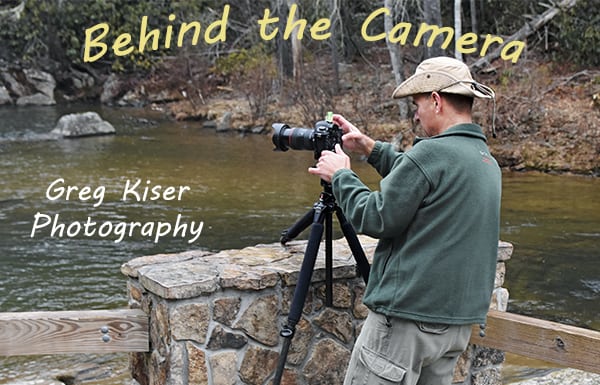
Welcome back to Behind the Camera, which is a monthly feature where I pick a topic to discuss which is related to my photography, or photography as a whole. You read the title correctly, this month I’m going to be talking about limiting yourself and your choices to arrive at better photos. I felt that it was a natural progression from our last discussion on embracing the ebbs and flows of your creativity. If you will recall, I talked about those things that get in the way of our creativity and some strategies that I have used to get that creative spark back. The biggest point that I wanted to make was that we all need to treat our creativity as a living and breathing organism where we embrace the ups and downs that happen naturally. Of course, there does come a time when our creativity has been gone too long, and we are starting to accept a non-creative world. These are the times when extreme measures should be examined, at least if you are missing that creative part of your life.
This brings us to the topic of this month’s flow of thought. I kind of skirted the idea when I was talking about how too many choices can become a block to your creativity, and this could be in the form of what you are wanting to photograph as well as how you choose to photograph it. Think about it from my point of view based on what you have seen here from my photography. I wake up in the morning and want to create some photography. What do I want to shoot? I could go for a landscape, maybe an old car, how about that deserted house, or broken-down barn? Maybe the weather is not great, and I want to stay in the studio and shoot smoke photography or still life? There is always the idea of doing some portrait work provided I can find a sitter. Which camera do I want to use, and which of the ten or so lenses that I have, should I use? Do I want to add light, or go with whatever ambient light is there? Studio or location? The list goes on and on until I get overwhelmed and roll back over to go back to sleep. What have I accomplished in those minutes of thinking about all my options? Nadda, nothing, zilch. In fact, I have just done more damage to my inner creativity than I have helped it. Remember, I woke up and wanted to create. It was all the choices that I started going through that shut it all down.
What I have just experienced is referred to as “Analysis Paralysis” which simply put is overwhelming yourself to where you just can’t make a decision at all. I’m sure that to some extent we have all experienced this in some aspect of our lives, but it is very prominent for introverts and overthinkers which are two things that I tend to be. When I am looking at infinite choices, I get very much overwhelmed to the point where I can no longer consider the options for what they are. I get lost on the introduction of each idea in my own mind. This is a huge block not only to creativity, but to productivity. Fortunately, the solution is simple, and requires very little thought…even for an overthinker.
The answer is to limit your choices. By removing some of the choices, or most of them, you are left with a very specific set of options which will then spark the creativity in you. I use this to differing degrees just about every time I want to go out and shoot, but don’t really have an idea of what I want to capture. It could be as simple as looking at the weather and deciding what type of photography will work with the existing conditions. It might be that I am just wanting to work with a single type of subject and then will just go with whatever the weather throws at me. There are other times when I get so specific as to choose a certain lens to work with and stick with that for the day. There are also other times when I just want things to be simple and I avoid the use of filters in favor of making things as basic as possible. All of a sudden, I have gone from too many options to realistically explore, to something very specific which fosters the creativity within me. This leaves only the choices of a creative nature left to make.
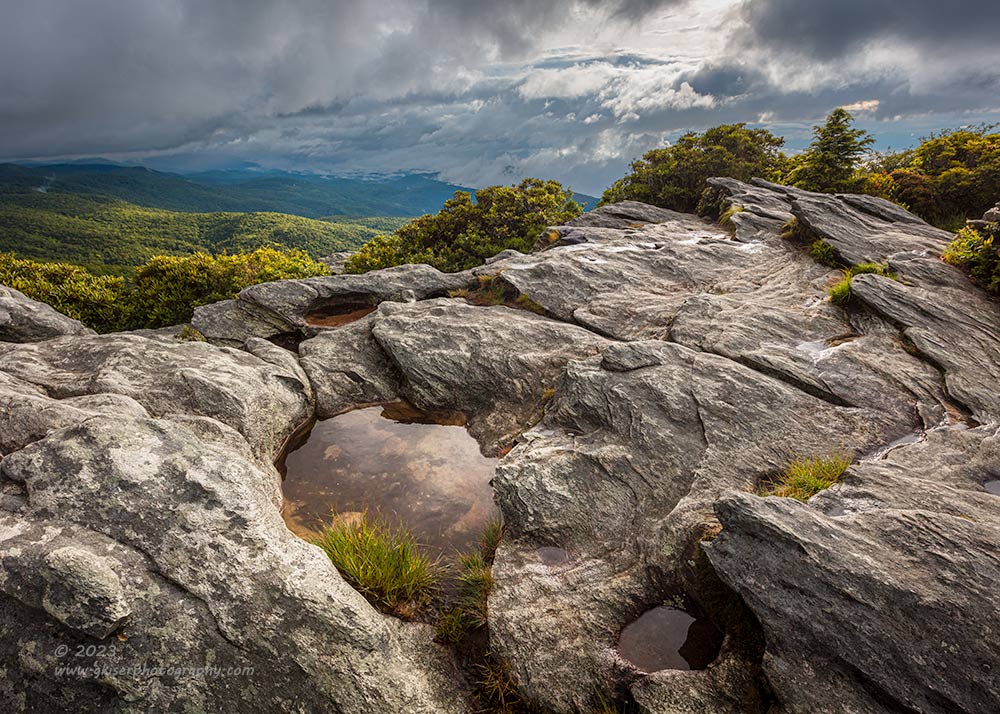
The resulting clarity of thought reduces the panic that is brought about by having too many choices. Many times, that clarity is needed to just simply move forward with a day of photography. One of the recent examples of this was a trek to Hawksbill during the Spring. I had been inspired to shoot there and found some of the most dramatic and dynamic conditions that I have ever seen before during my time there. The issue came from the high winds and occasional rain that I was facing. I needed more hands than I had in order to hold onto equipment and make sure that I was stable. I didn’t have the luxury of working through each composition, selecting the perfect lens, and dialing in filters. My time and energy had to be applied to survival and that meant that for the most part I kept with a basic setup of camera and lens on the tripod and composed out of gut reaction to the scenes that were in front of me. This usually meant using the lens that I had attached to the camera when I pulled it out of the bag and just getting the shot. The only times I was swapping lenses was after moving locations since I had packed the camera away for safety. That was a great reduction in the amount of thought that I would normally put into a landscape shot. By the end of the morning, I came upon the composition that you see above, and I committed to it in a way that I hadn’t been willing to do leading up to that point. In order to control the light, I had to add a grad filter which complicated things and added more elements to the process of capture that I had to keep track of. I could feel myself panicking during this experience because I had to not only keep the wind from knocking things over, but I had to fit a filter, keep the rain off of the filter, and position the filter as I altered the composition based on the ever-changing light and clouds. Fortunately, I had worked out the basic composition before adding all of this extra stuff to it, because I had no mental energy left to be creative with the photographic process. All I could think about were the technical aspects of capturing the scene which I managed to do. I was essentially at the limit of my ability to work through variables.
That is just an example of when you start to complicate things, creativity starts to take a backseat in many respects. Of course, working in strong winds on the summit of a mountain is an extreme example of trying to keep things simple, in order to keep creativity afloat. There are many more examples where this comes into play just to get you into a creative headspace. As I mentioned earlier, what I do most of the time is to pick what type of photography I want to do and stick with that plan. It gets me out of the door and puts a camera in my hand.
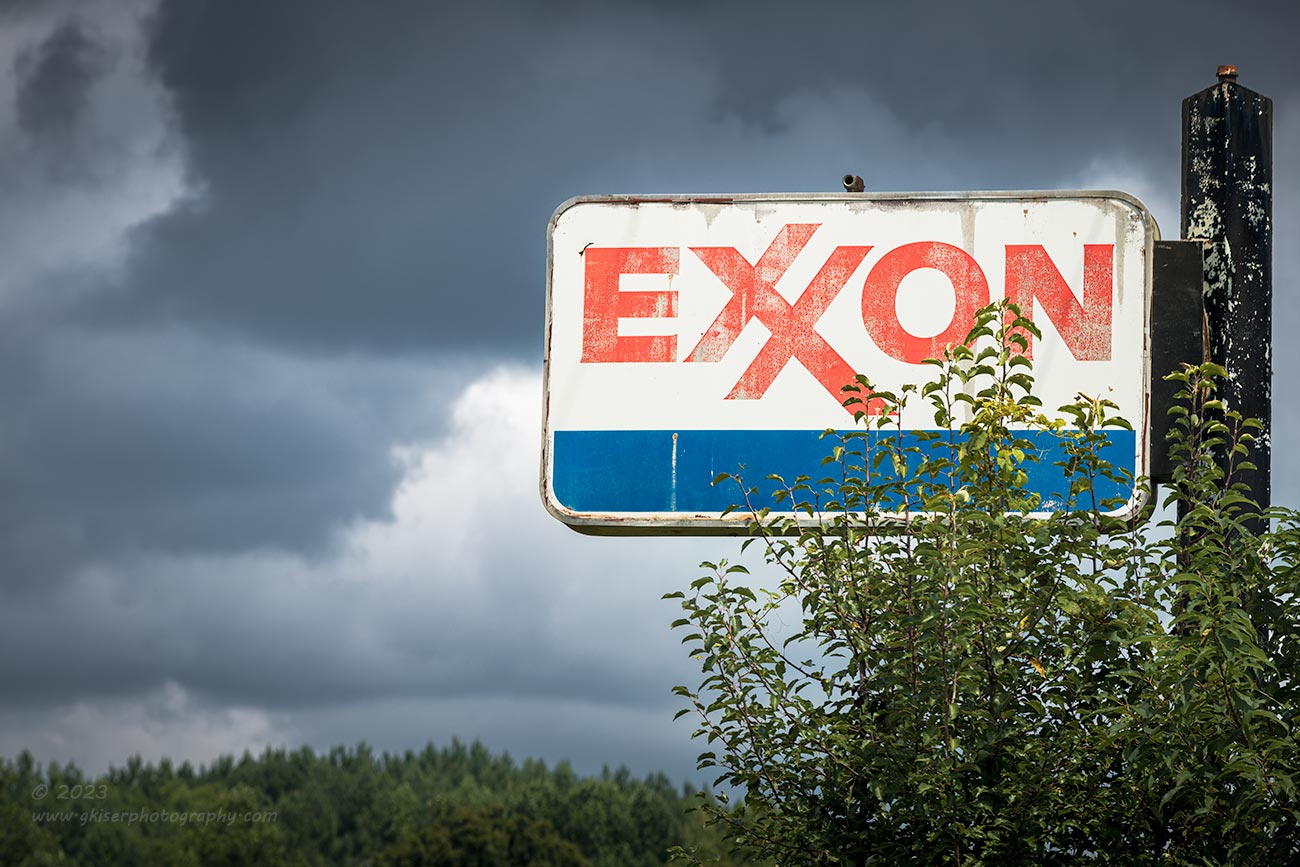
A great example of this, was the time that I decided to go and shoot an old Exxon sign that I had been contemplating for years. Leading up to this shoot, I had been very busy with portrait clients which can sometimes prevent me from being overly creative in my own personal work. Just driving by the sign one evening got me thinking about photographing it once again. After spending time recuperating, I decided that I wanted to go out and shoot something. I didn’t have much time to decide on what to shoot since there was some bad weather coming in later that day. I just focused on the last bit of inspiration that I had come by which was the sign near Lenoir. That would be something very simple that I could go out and shoot, and this is where the liberation of limiting of choices comes into play as well.
The setting is not really all that great with power lines and a power pole close by. There are structures around it which have nothing at all to do with the sign. The only ingredient that I felt was beneficial to add was the vegetation that was now growing up on the sign. It was pretty obvious that to capture this, I was going to need the long lens which removed even more of the options I might have considered. I used a simple polarizing filter to take a bit of the glare from the scene and that was all that was needed. I didn’t overcomplicate things by trying to find a specific angle that added perspective. I just found a composition that eliminated what I didn’t want in the scene. What I was left with was this photo, which I shot wearing sandals standing right next to the 4Runner in the parking lot (or what was left of it). It was the only photograph of the day, and I went out with the intention of getting just that one. Again, I was limiting my choices and that fed into a level of creativity for this sign that really helped.
You see, by removing options and various choices we are left with a more specific expectation. Had I been out doing my usual looking for things and trying to find the best subjects to photograph, I would have passed this sign by as I had so many other times before. I knew I would have better options down the road, and unlimited choices in what to photograph, as well as how. Even if I had stopped at this sign, I would have overthought it to the point of not photographing it because I would have tried to do something really amazing with an odd lens choice, or funky angle. On this particular day, however, I set out to photograph this sign, and knew that this simple composition was the way to do it. I wasn’t thinking about what was down the road, and really wasn’t even worried about whether or not this photograph would work at all. It was just something that I wanted to try, and I had enough time to do just that before the rain hit. Even looking at this photo now, I don’t know if I would have stopped for it that day if I hadn’t gone out with that specifically in mind. I also look at it and see that I really love how it turned out some three months later. I shot no other subjects that day and don’t feel like I missed out at all. Had I gone out with unlimited choices that day, I still wouldn’t have had a photo of this sign which will eventually come down if history is any indication.
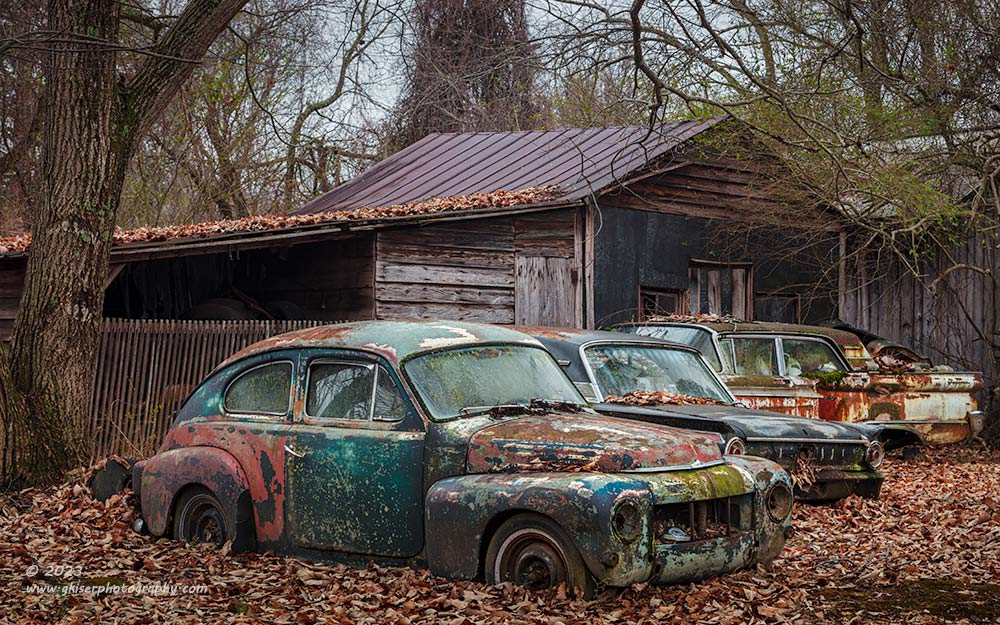
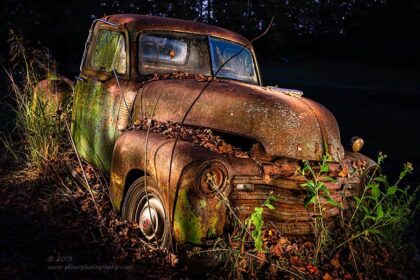
One of the most freeing examples of limiting choices I can think of was when I made this photograph back in the Winter. This is probably the quintessential example of the concept of how liberating limiting our choices can be. You see, it all started while I was still at home dealing with some major home repair issues as well as a good deal of client work. I had been able to focus very little energy on my own photography for a very long time it seemed. I was needing to get out and shoot for myself again, but had no idea what to shoot, or where to go. To simplify things and allow my creativity to come out, I just went with what I saw last, which inspired me. This was a property that had several old cars, most notably an old Volvo which I wanted to shoot. I could see so many different compositions that I wanted to try and just knew that if I got out there, I would be able to create something. I actually counted on creating a lot of somethings from this location.
Well, I did get out there, but was unable to make contact with the property owner to gain permission to get onto the property. I think that this was my third attempt at trying. I tried the relative that lived across the street once again without success and felt that I was going to have to let this go once again. As I stood there and looked at the scene, I hated to just leave because the lighting and overall conditions were perfect for the photos that I was wanting to make. Not wanting to trespass greatly limited my options though. In fact, the only option that I had from where I could stand was a telephoto shot showing three of the cars all jammed together with the Volvo out front. No, this was not ideal, but it was my only option. I pulled out the long lens and started to frame up different compositions until I had one that made the most sense. It was a letdown after thinking about all the possibilities that I could have done here with access, but in hindsight, the telephoto composition really worked well.
There is a certain elegance to the scene which I might have overlooked had I had permission to get closer. I know from my history that once I get permission, I use that access to get in closer so that I can use wider angles for a bit of distortion to the scene. I start to work isolations earlier than I probably should and I most certainly would have found a way to eliminate the two Fords from the composition as well as potentially all of the house behind them. That would have been a shame for sure, because it was the overall scene that grabbed my attention from the beginning, and I think that this is probably the most powerful composition that I could have come up with. Had my options not been limited by the situation, I might have missed out on this particular shot. If I had made contact and been denied, I would have also missed out on this one, so it all worked the way it was supposed to in the end. I fully credit the lack of options for feeding the creativity to make this composition work so well. With no other options, I spent extra time getting this one just right.
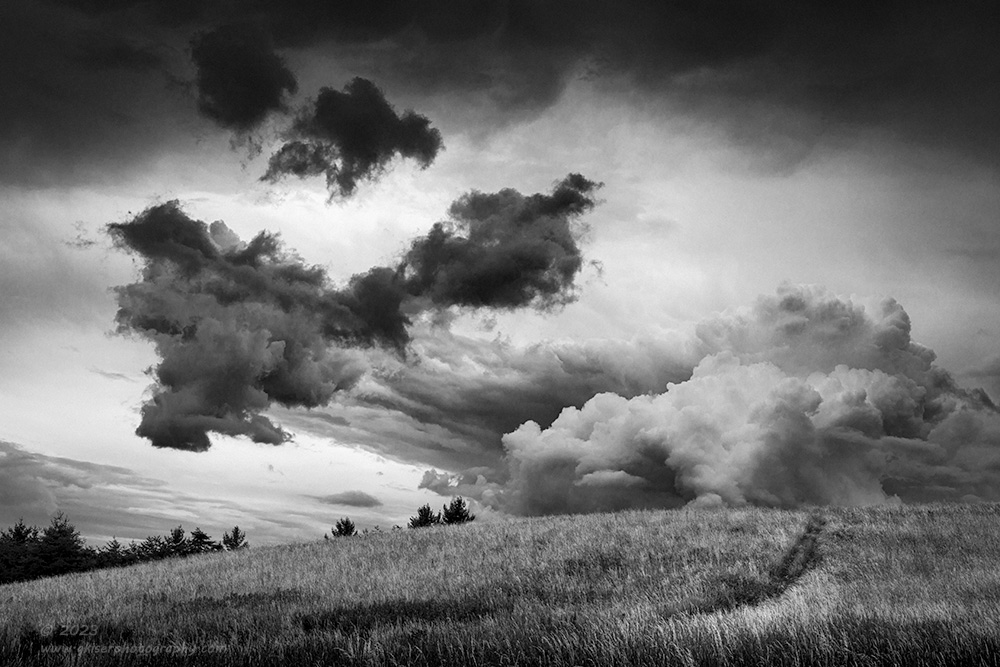
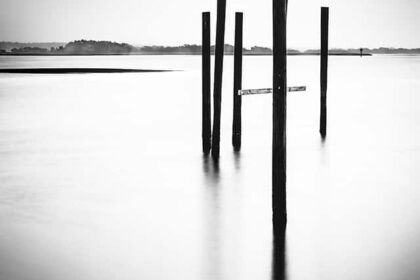
I’m sure that I could sit here for hours and hours and give examples of times that limiting my options fed into my creativity. If you have been a reader of the blog, you will certainly know the clues to when that happens. I’ll start out with, I had no idea what to shoot, so I looked at the weather and decided on a subject. Or maybe, I started it off by saying, I had just really wanted to shoot such and such for a while and I decided that today was going to be that day. It could be something to the effect that I just wanted to get out and do some black and white photography with a minimalist landscape subject as above. I actually started on this path wanting to do architectural photography, but there was nothing around here that fit the minimalist approach that I wanted. That was what brought me to the Lump overlook which is essentially a path through a field. You can’t get much more simplistic than that.
It was that very specific idea that got me out to this overlook where I spent plenty of time photographing the minimalist scenes, but the crowning achievement for the day happened at the end of the session when the storm clouds started to roll in. Because I had limited my choices and even subject matter, I found myself in a very creative space at a time when conditions kicked off to provide one of the most interesting skies I have seen in a very long time. I wasn’t out hunting photos; I had some very specific things in mind and was at a location that supported those ideas when the conditions changed. I would have been sitting at home had I not reduced my choices down to something manageable to where I could go out and engage in some photography.
Something that I have heard in photographic circles for the longest time is that all you need is a camera with a 50mm lens and you can do anything. While I tend to disagree with that for a lot of reasons, especially in the landscape genre, the sentiment is spot on. I think that gear is one of the biggest hurdles for creativity out there. Sure, there are times when getting a new bit of kit will inspire you to go out and use it, but usually after you use it a time or two, it reverts to being just what it is…a tool…an option. Photographers are some of the biggest gear nuts out there, myself included. This has great benefit short term, with our levels of creativity and even inspiration. I have a lot of gear that I have collected in order to do specific things, and while they are great at doing those things, eventually those products just become another option to work through when planning out a photograph.
Back in the day, it was filters that I was always adding. They were cheap (though, shouldn’t have been) and therefore something that I could add to my bag without going into debt. Each filter promised me the ability to create that next great landscape. In reality, I was carrying about 20 filters where I would only regularly use a couple. Those filters didn’t add to my creativity, they just provided more options and more pause to think before I actually shot the photo. These days, I carry just a few types of filters which I consider very helpful in landscape photography. Essentially, I have limited my choices and can act quicker. I’m very vocal about using a Singh-Ray Color Combo Polarizer, but what you might not know is that Singh-Ray has several different types of polarizers from your basic one, to one that will change highlights from blue to gold. There is even one that will add a ND filter effect for even slower shutter speeds. Yes, I could probably have a lot of fun with all of those filters, but in the end, I know that it will just provide more choices for me and will overcomplicate things. By limiting those choices out of the gate, I am making myself much more focused on the creation of the image. That is my goal as a photographer, not to see how much gear I can lob at a scene, or to sell products based on my use. I am no influencer, and don’t pretend to be. The only thing that matters to me is the photograph that results.

Since starting portraiture, I have really seen the correlation between options and how stressful the creative process can be. You might recall this portrait that I made last year. I had very little to go on from the client which only included wearing a black robe with purple trim. They wanted the session to be in the studio, and the photo was going to be used for a large print at the church where he was preaching. That was it. I had to fill in all of the blanks to arrive at this photo. In the studio, there is no ambient light allowed into the images because it is all florescent which has an ugly color cast to it, so everything you see here is specifically lit by intention. Had I turned off the flash units and shot the photo at the same camera settings, it would have been a totally black frame. There is a lot of gear at my disposal in the studio and that really complicated things for me to plan this kind of shoot. Before I even started thinking about a pose, or anything aesthetically specific, I had to figure out an environment to photograph him in. I had tons of options from pure white, to pure black, with different combinations of textures or other backgrounds to choose from. I ended up using a gray background that I planned to gel to a purple gradient behind him to match the trim on the robe. That was the first light that I used in building this scene. I needed a key light which turned into a gridded beauty dish positioned above and to the front. In order to separate him from the background, I needed a kicker which was a gridded strip box to the rear on his left. That was now three lights, and I added a fourth in a gridded softbox underneath for fill. Not knowing exactly how he would look in front of the camera, I opted for a 70-200mm lens which gave me a range of compression and would keep everything contained in the backdrop. I stressed over this for days before the shoot and didn’t really start thinking about the pose, or the story until they got here. I had too many options to go through, but the end result turned out great because I had time to think about it, and this was a paying client where I had to perform. If this was just about creativity alone and for my own purposes, I would have shut down and not been able to put this one together.
When you get right down to it, we can be our own roadblocks to creativity. Having choices is fantastic when you have the mental energy to think about those choices. They can even fuel what you are wanting to create. The times when choices help are those times when you are so creative you are thinking outside of the box without any effort at all. I like to refer to these as the “what if?” times. I love it when I’m in that zone and everything that I shoot is followed up with a “What if?” What if I used a different lens? What if I tried this filter? What if I shot from this angle? What if I shot with the light in that direction? The what ifs can go on and on and can lead to a really stellar photograph, or series of photographs. However, if I am not as receptive to the creative energy, I am left with the answers to all of those “what ifs” being “that is too difficult, I doubt it will work.” This is when the options stifle the creativity and eventually shut you down.

If you find yourself getting to that point of being shut down, just step back from the process for a moment and evaluate how many options you have allowed yourself. If you can’t finish listing the options available to you, start by removing the options, or just starting over from the beginning. Look for the initial inspiration and let it build from there. In the example above, I shot this during a mentorship session a couple of weeks ago. My mindset was looking at things differently than I would normally, and thinking about all kinds of different techniques that I could share with my client. While working on a composition for him, I had been looking around at the different things within the church that we were standing in. A candelabra by the window caught my eye and eventually it was the one candle that was covered in webs that prompted me to get the shot. I had all kinds of things at my disposal, and many different ways that I could shoot it. In the end, I went with the lens that was already attached to the camera, no filters, and a very basic centered composition. It would have been far too easy to let myself get overwhelmed trying to photograph this simple object, but I just went with what was the easiest. Once I got a feeling for the subject, I moved it off to the right and allowed the wood framework to form a shape to the left and bottom for balance. At the very end, because I saw a chance to make it a bit better, I pulled out a reflector for some fill light. In photography, simple works wonders much of the time. The best way to arrive at simple is to limit your options. I had done that here, but added elements to the shot as I saw they were needed. It was a step-by-step process instead of trying to put it all together beforehand.
I think that is a great lesson to be learned here. Much of our analysis paralysis comes from trying to think through all the options beforehand. It is easy to get overwhelmed and just decide to move on. If you start with just a basic concept and build on that as you see the need, you are limiting those choices as you progress. This allows you to really put more energy into creating the photo rather than planning it all out. As with the candle above, there were just three stages to this photo, but when I started trying to make the photo, I just wanted a simple photo of the candle. It was the two simple changes (composition, and reflector) that ultimately made the photograph work. I hadn’t seen that particular end result in my head before starting because there were just too many options on how to do the photo at that stage.
I thank you for joining me on this follow-up to last month’s entry. I hope that you found it inspirational as well as informative. I’ll be back here on New Year’s Day with my annual year in review. If you are interested in everything that has been going on during 2023, be sure to drop in and give it a read. I’ll be getting started with it here very shortly and hope to make it an interesting read. There hasn’t been as much going on this year as previous ones so hopefully it won’t be too long. Until then, I hope that everyone is having a wonderful holiday season. I’ll see you back here next year!