Wednesday, September 30, 2026
Yep, I started with a photo for this blog entry. Normally, I will do a bit of an introduction before I get around to posting the pictures. I like that little air of mystery as to whether or not I actually got any decent images for the day. There was just no point in dragging this one out though because I’m going to do something a little different than normal with this entry. The end result was 147 frames captured and you will find a total of 40 keepers in this entry. I could have made this a multi-part blog, and it would have certainly benefited those that like to read through each blog entry as this one might go a little long. I really didn’t see much point in doing that since the camera didn’t move during the entire session, and everything was shot with the same lens and same settings with the exception of moving the camera closer to the subject shortly after getting started. It just made sense to pull it all together into one single entry.
Another reason that I didn’t go with, say….a four part blog is that I know that very few will actually click on this blog and read through it, so to think that I could keep the interest over the course of several different entries with similar photos was a bit optimistic. Now, I’m not saying that the photos here are not up to par, or of the same quality as say the photos from a recent multi-part blog series. Actually, I would say that these photos are just as good as any that I have shot and do deserve the same attention by an audience. The fact of the matter is that these kinds of photos are just not that popular with my core audience who expects rusted cars, old barns, and landscapes. Hey, I hear ya, and I like those photos as well. I just need a chance of pace every now and again to keep things fresh.
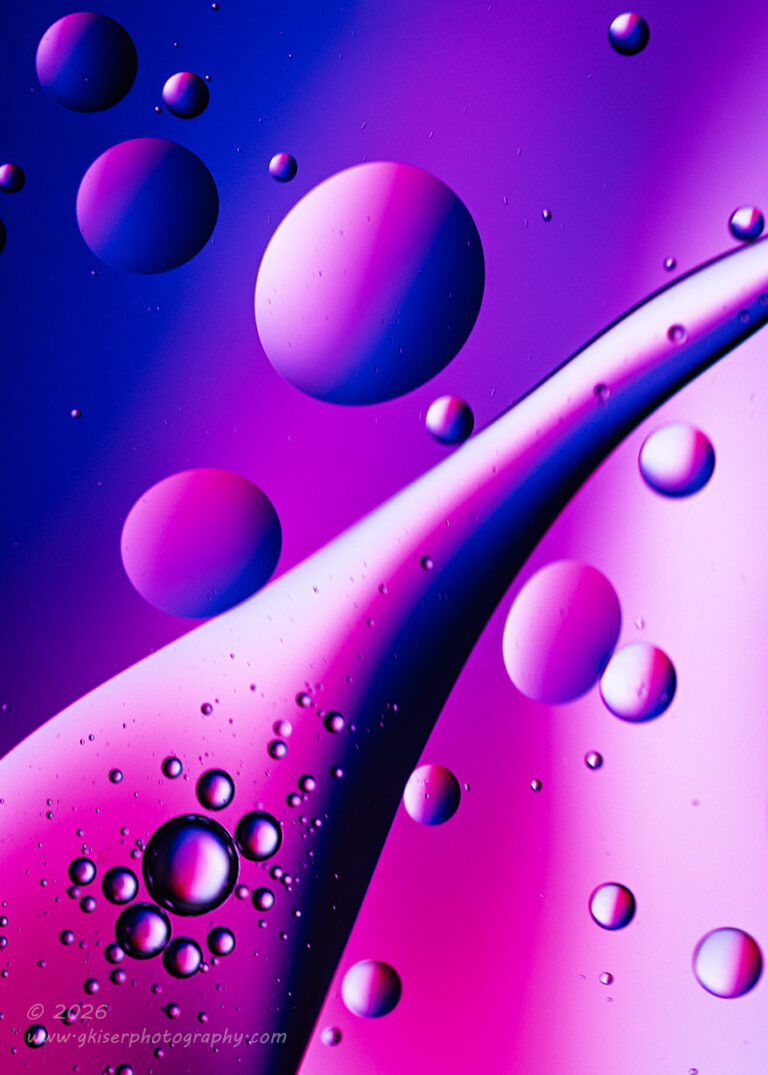
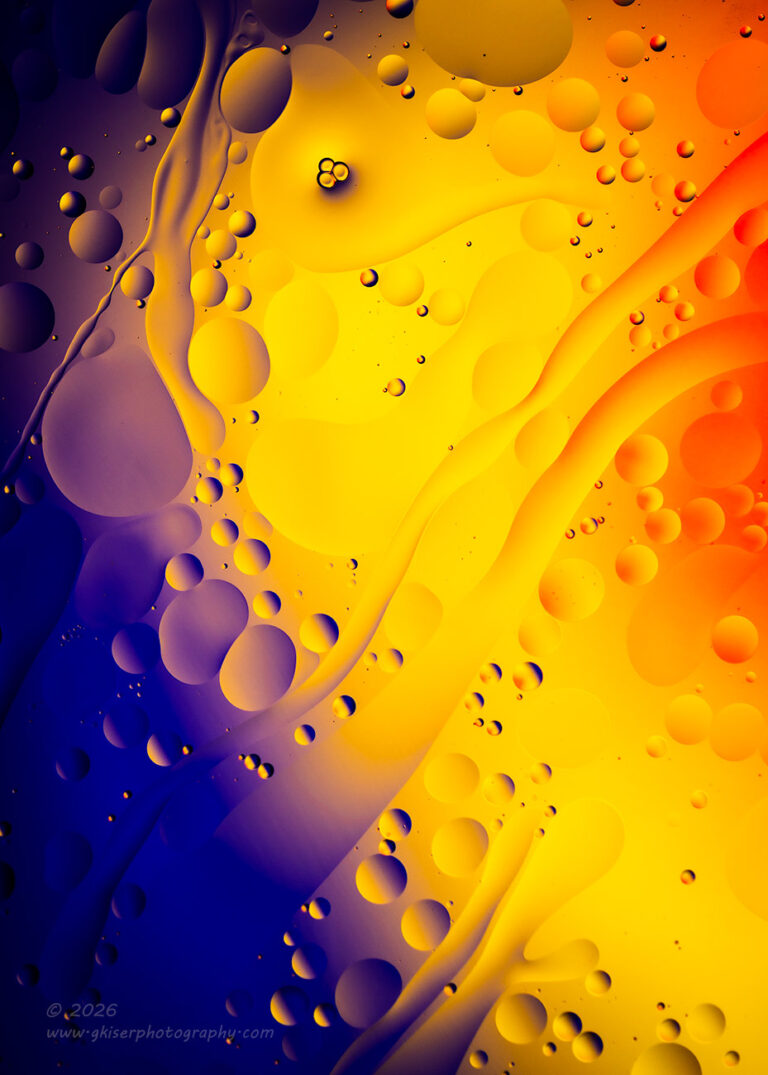
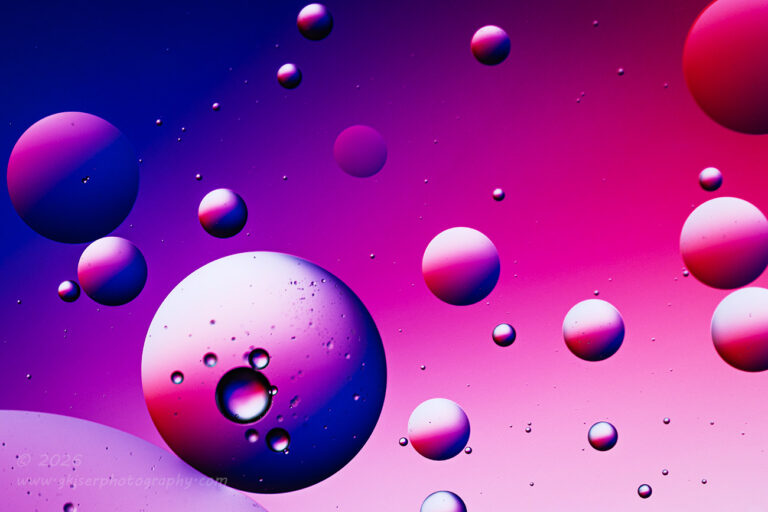
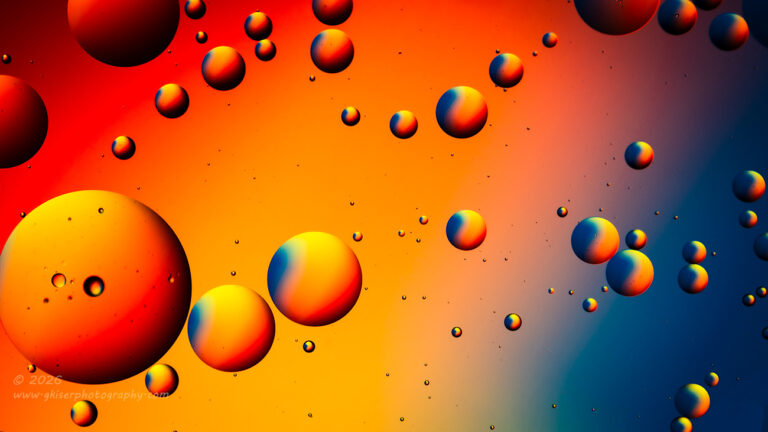
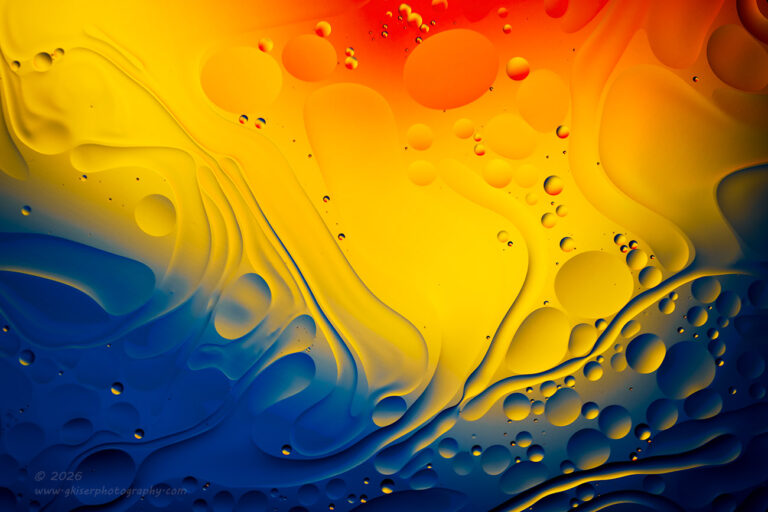
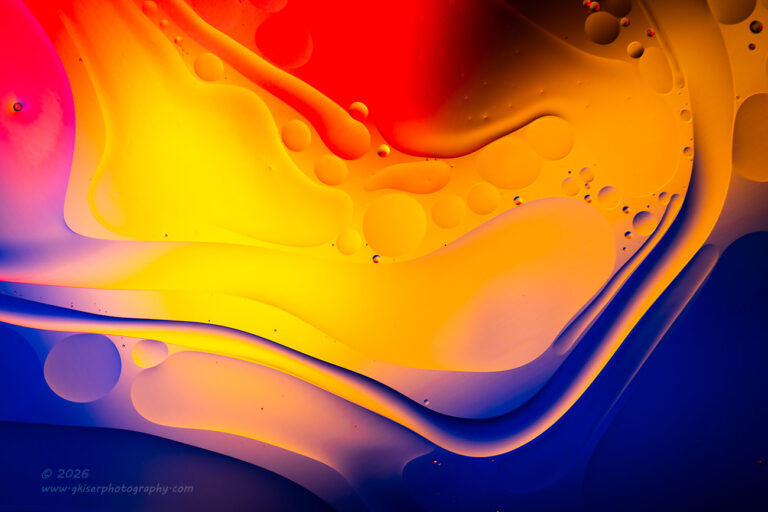
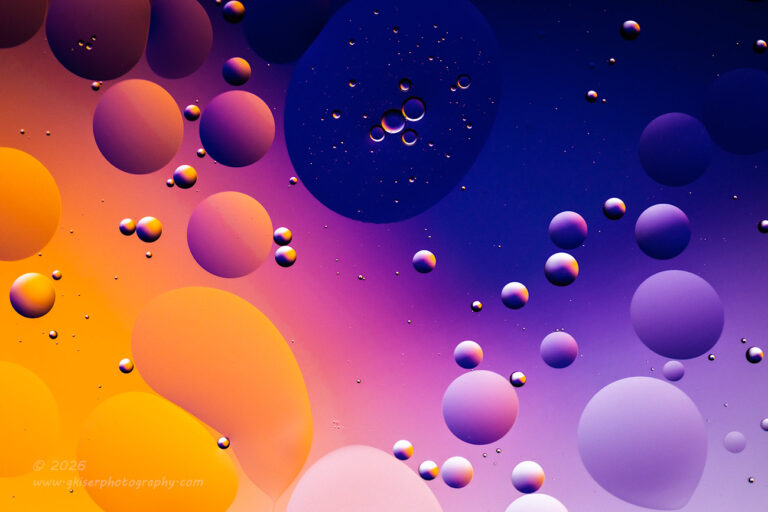
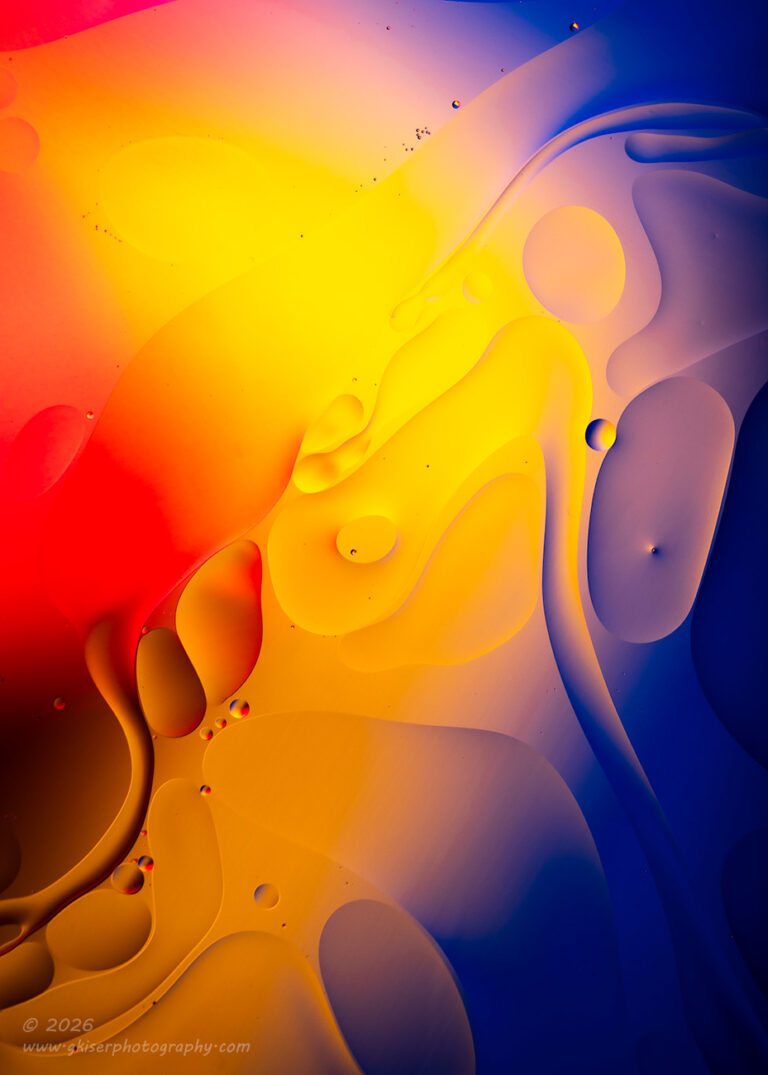
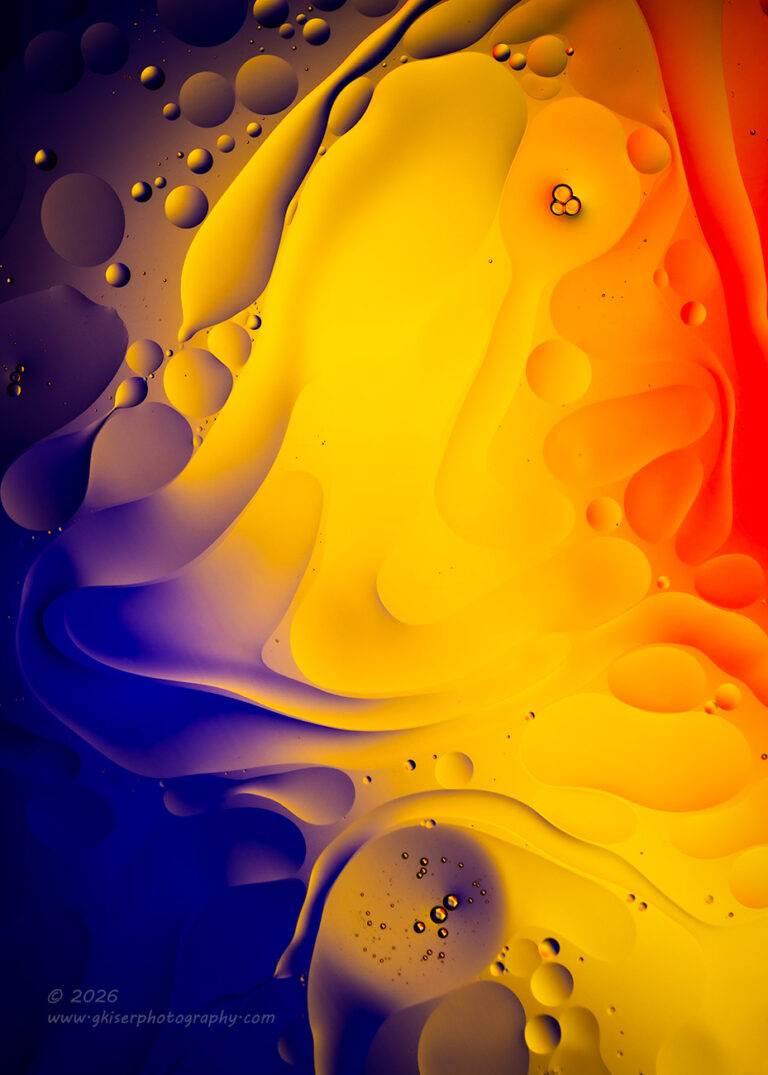
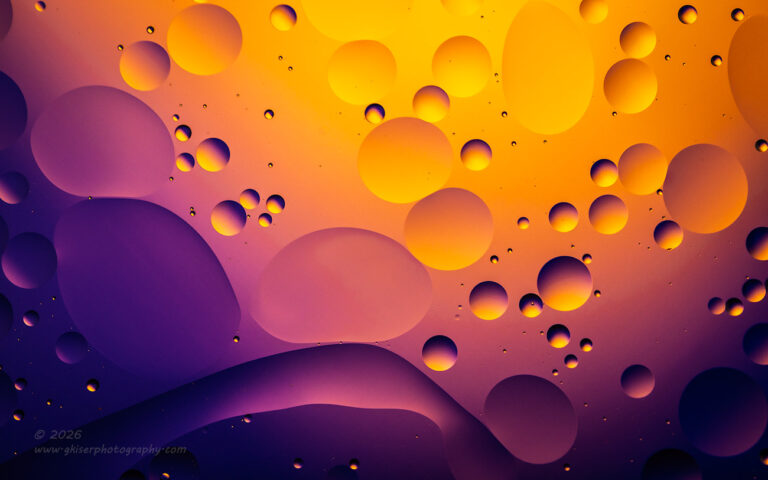
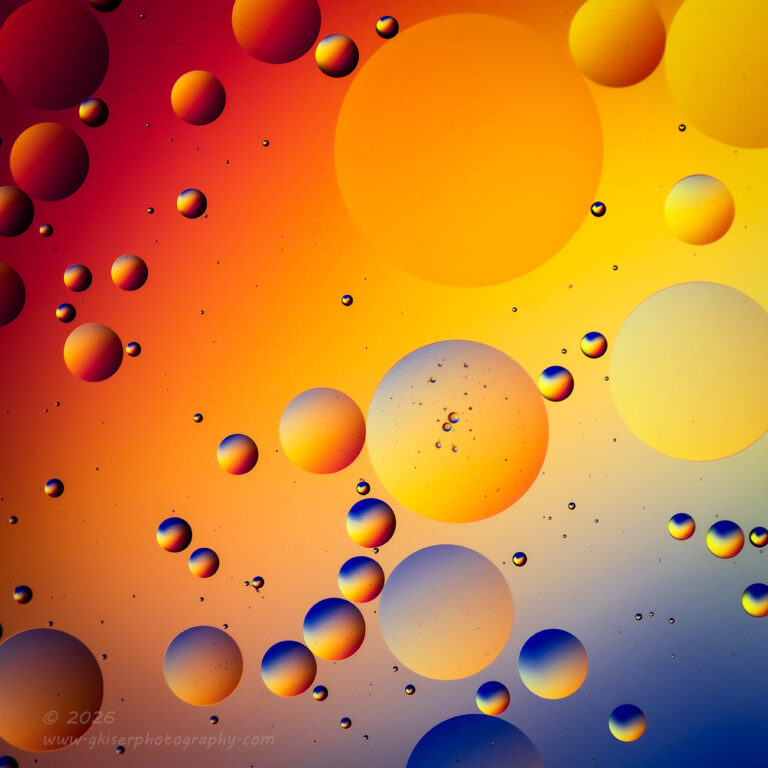
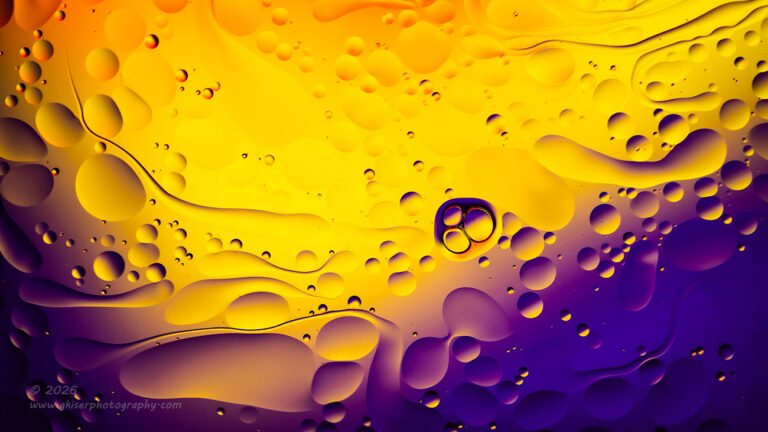
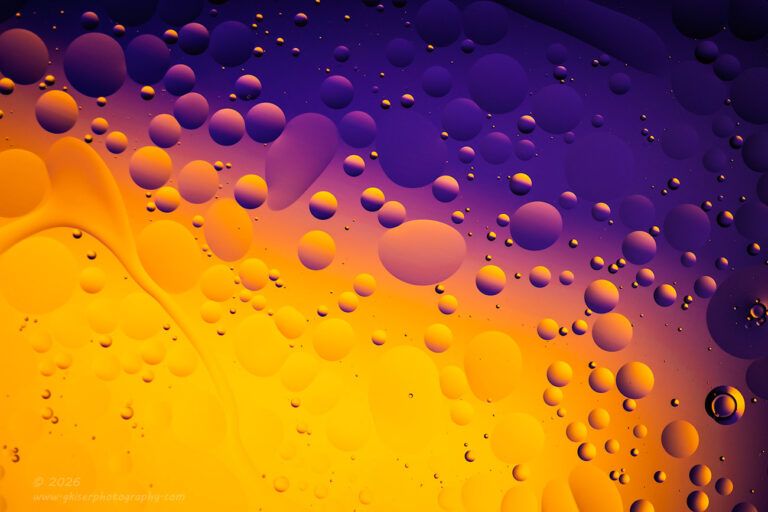
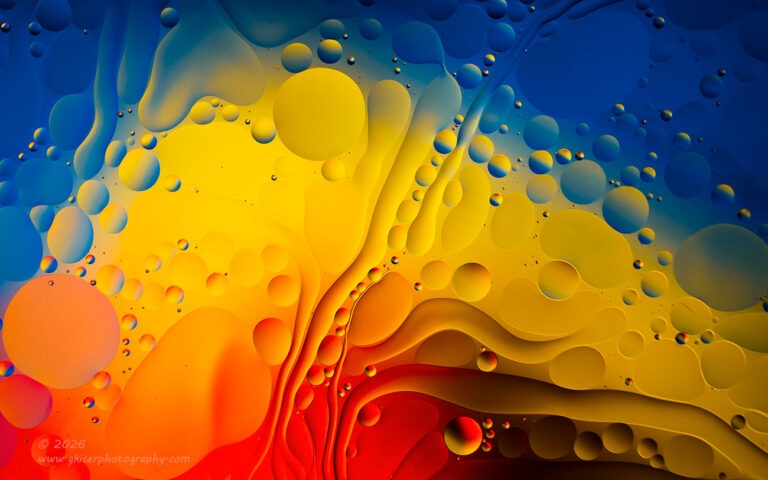
So, you have already seen a few of the photos from today and you either know exactly what you are looking at, or you think that I have gone nuts with a lava lamp. Go ahead and take a guess at what you are looking at. What did you come up with? We know that “lava lamp” is the wrong answer, but if you guess oil and water, you are correct! That’s right, every photo here is actually done with a mixture of oil and water in a casserole dish, suspended above a surface where my colors were sitting. It was all lit with a constant LED light and the only thing left to do was to agitate the water and pull the oil bubbles around until I liked the composition. Sounds simple enough, doesn’t it? Well, it kind of is, but it still takes some time to work through the process. That is the main reason that I haven’t done more of these photos.
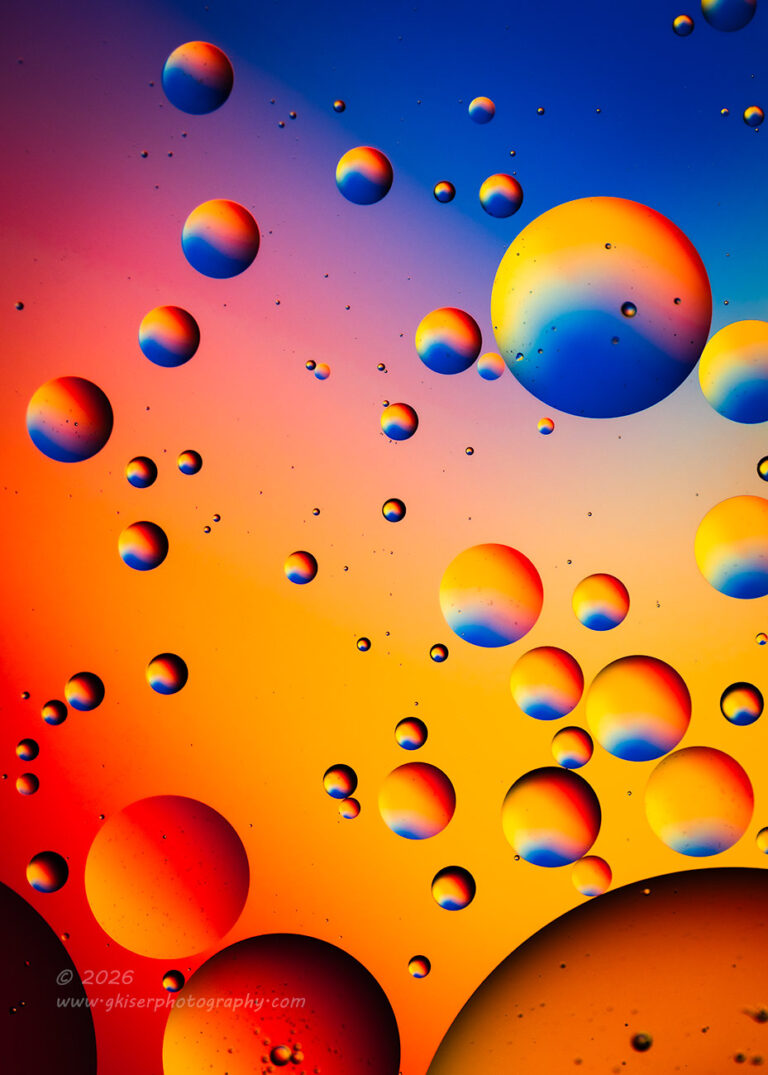
The last time I shot this subject in the studio was three years ago and that marked the first time in more than a decade that I had engaged in this type of photography. That was a largely successful day in the studio with 19 new images added to the collection, but I stayed kind of frustrated through the process and had a harder time with the editing than I would have liked. Of course, there was not much in the way of reaction from anyone so I kind of felt like the effort was kind of misplaced. Of course, I go through this inner debate far too often when it comes to photos that I like and what seems to gain traction with the viewers. I know that with very few exceptions, the time that I spend in the studio is mainly for myself and my own enjoyment. That is fine I guess, but artists rarely create just for themselves, so I do hope that at some point these photos will find an audience that appreciates them as much as I do.
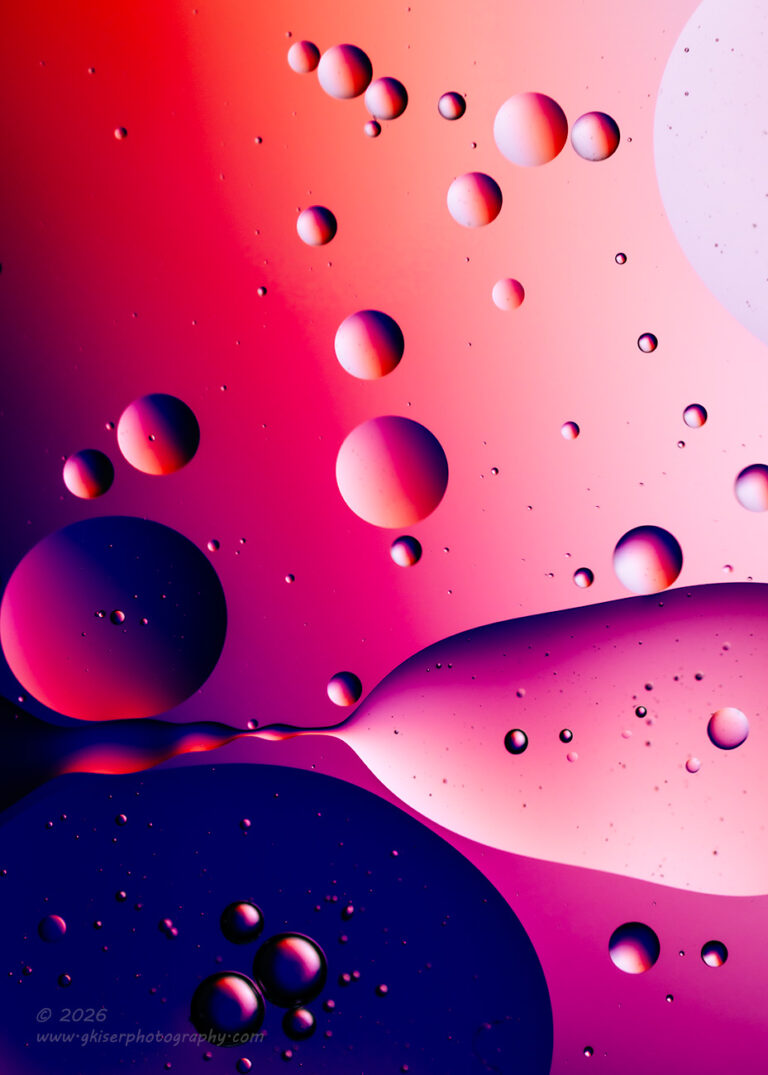
So, I know that these images aren’t all that popular, and they are a bit of a hassle to create, so why am I doing them? The answer is actually rather simple. I wanted to. Actually, I have wanted to do these photos for a while now, but have kept putting it off as I decided what kind of container I wanted to place the water in. I did get most of this set up a couple of months ago but ended up having something far mor pressing come up that ruined my mood for the session. Since then, I have tried to figure out when I would want to do it. The days when I felt creative, I ended up out in the field doing what I normally do with the camera. I didn’t really miss the time in the studio working with abstracts in oil and water. I had so many other things that I wanted to capture, but it was always in the back of my mind as something that I did want to try the next time I was stuck at home with some free time.
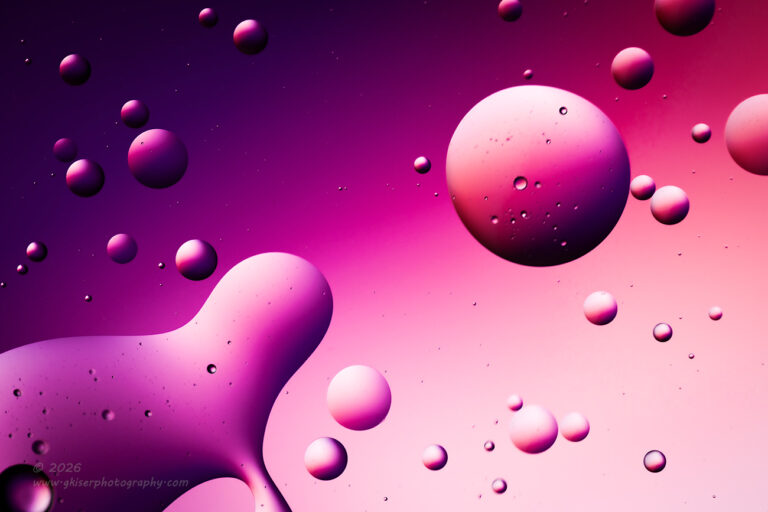
Stuck at home with some free time…that seemed to present itself all on its own, but it actually started during the ice storm that we had last Winter. You may remember me talking about how the ice really started to tear up the driveway and large chunks of it were starting to break away from the surface. It continued to get worse, even into the Spring. The decision was made to have the driveway redone and after getting an estimate all sorted out, I decided that it was going to have to wait until the Fall when I could get the money together to make it happen. It was looking like roughly three weeks of downtime between the tearing out of the old driveway, the pouring of the new one, and the curing time before we could drive on it. During that timeframe, we would have to park on the side of the road which I was not too fond of doing. Between Toni and myself, she is the one that really needed to be mobile and there was room for her to park safely out of traffic, but it would have been very crowded to add my truck as well. To that end, I decided that I would just stay put during the time that the driveway was under construction which meant that I have spent the last few days getting a truck and a convertible detailed so that they could sit quietly for three weeks until I could drive them again. There was also the matter of getting the yard taken care of since I wouldn’t be able to get the mower out more than likely. All of that took place from Friday to Monday and I managed to slip in a service on Sierra’s car yesterday evening.
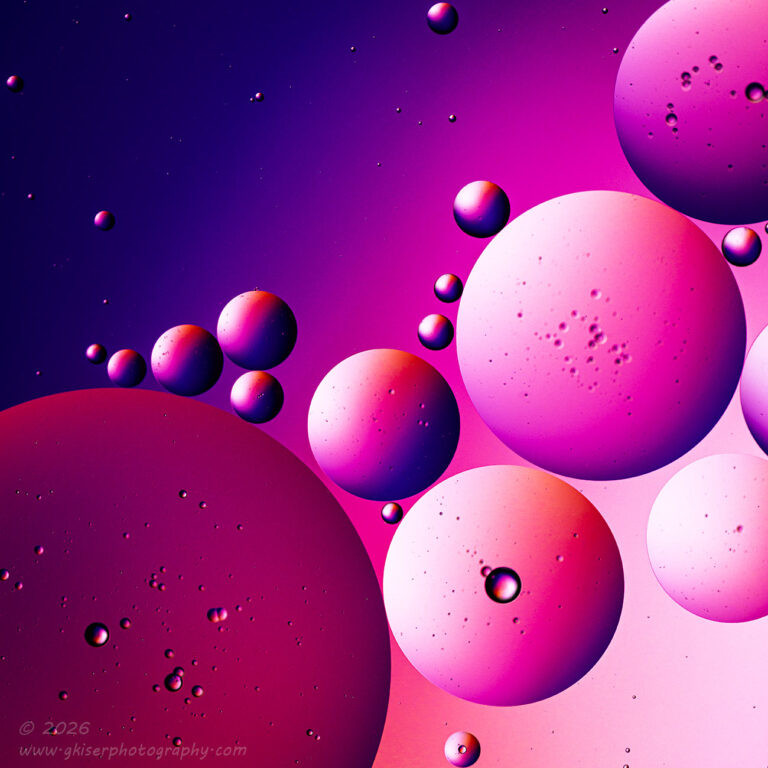
With the work starting this morning, I knew that I was going to be home and I needed something to take my mind off of the work that was going on outside. It seemed like the best time to pull things out in the studio and start working on a session of some sort. It was also the last day of the month, and this has been a much less active month photographically than I have seen recently. I figured it would be a good way to wrap up the month and possibly set the tone for some more studio work as I am remaining at home for the next few weeks. Since I had been toying with the idea of doing a session with oil and water, I figured that I would go ahead and do that to get started.
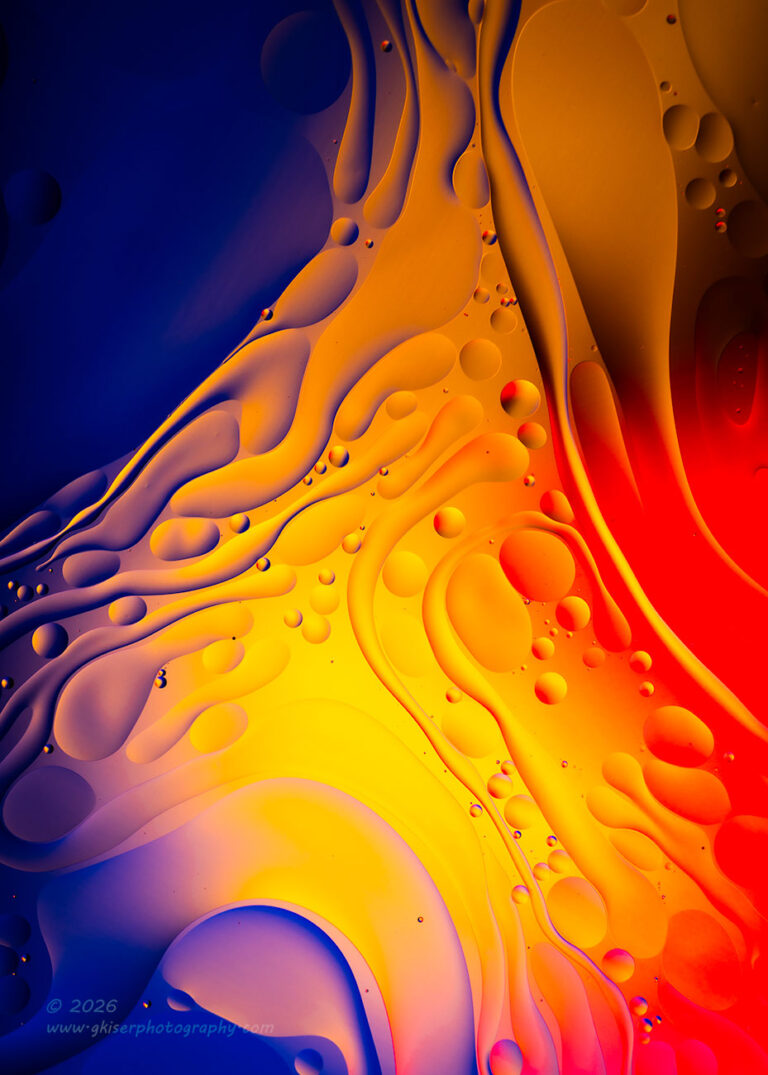
Once I got my morning stuff taken care of and the end of the quarter paperwork done for the state, I started to pull out the supplies that I needed. This included the different color paper that I was going to use for the basis of the color for the images. I had some tucked away just for this session and it was easy to pick out. I then went upstairs and got a medium sized casserole dish that had a pretty clear bottom with no sizable scratches or large logos. I used vegetable oil this time as opposed to olive oil which I had used the last time. I wasn’t too worried about the slight color shift because it would just warm the images which would not cause a problem at all. Back down in the studio, I used two apple boxes to suspend the casserole dish above the ground and set up a light stand with an LED stick light right at the floor to light up only the paper and not the water. The camera was placed on a tripod with the lens pointed directly down over the dish. When I had all the heights figured out based on how things were focusing, I filled the dish with water and started to add the oil.
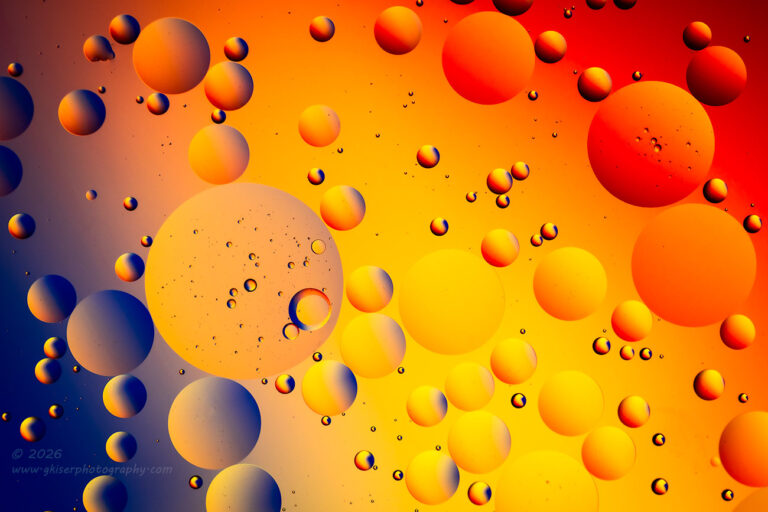
Once I was sure that I had enough oil in the water to make the patterns that I was looking for, I turned off the lights in the studio except for a couple of small lamps. This made t easier to saturate the colors and not get any odd reflections on the surface of the water. I checked the focus with the straw that I used to stir the mixture, but that didn’t work well enough for me. I switched to auto focus and waited until one of the bubbles passed under the focus point which allowed me to lock in the focus directly on the surface of the water. By selecting an aperture of f/2.8, I was able to sufficiently blur the paper edges below which left just a nice color transition to work with as a background. That was pretty much all there was to the setup. See, I told you that this was kind of easy to do.
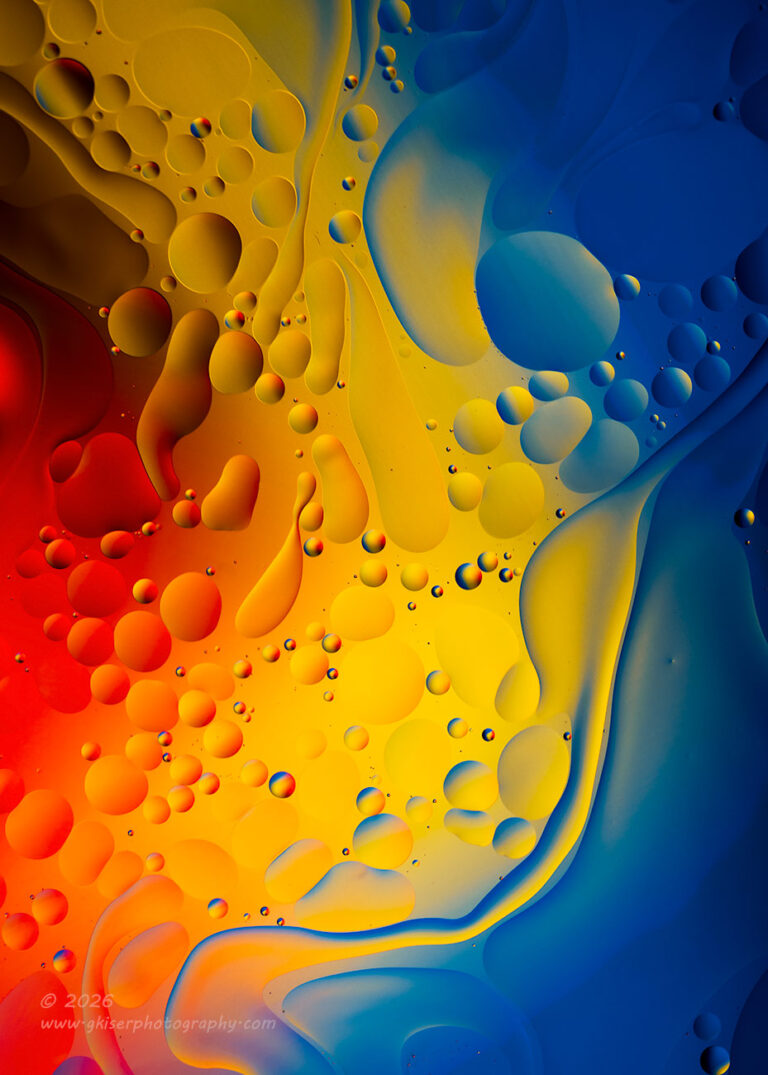
The next part of the equation was all about moving the bubbles around in the water. It was largely by chance that I found compositions and it was a matter of anticipating when the bubbles were going to be in the right position. As with smoke photography, I never really know what I’ve captured until the image review comes up on screen. There is a component of “the thrill of the hunt” to this type of photography and while it can be fun and exciting, it can also be rather frustrating. I missed more than I captured, but there were other times that I fired off the camera for no real reason, just because I thought something was bound to happen. It really is a lot like smoke photography and that quality makes it very different from what I normally photograph.
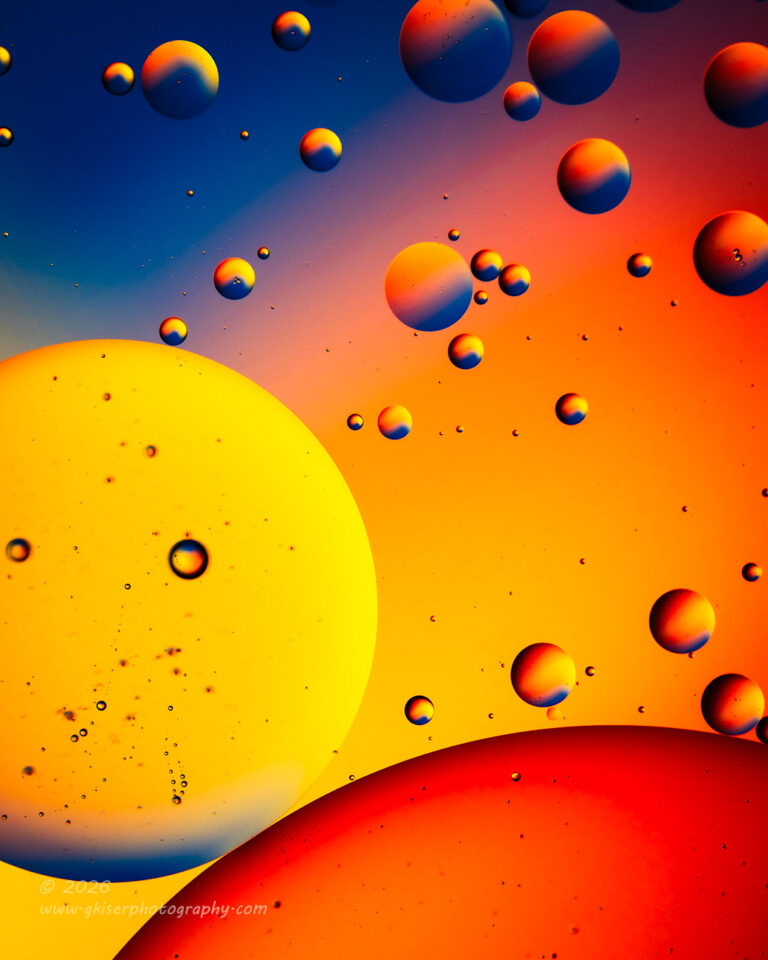
My usual way of capturing a scene is to set up a composition around static points and really pay attention to how things are looking. I’ll take a few shots and move the camera to get a slightly different view of the same scene. This process is repeated until I get the perfect composition of the scene in front of me. When dealing with random subjects like smoke or oil and water, there is no second chance and there is no fine tuning a composition. What there is has been reduced to a split second being the difference between getting the shot or missing it. This is a very different way of working for me and is kind of alien in many respects.
There was also another layer of difficulty added to this session. I wasn’t able to have my music playing in the background because I was having to listen for the workers in case they needed me. I was also listening to the large saw that they were using to separate the old driveway from the house which if you have never heard that before, it is a little unnerving. I could smell the concrete dust in the air and knew that the exterior of the house was going to be changing drastically in the coming days. Of course, this kept my mind from fully focusing on what I was doing so that every step of the process was a considered step. I never really reached my flow state, or the point where the music was playing to coin the phrase from Josef Sudek. Still yet, I was making images at a very quick rate as I moved the bubbles along in the water and changed out the paper combinations below.
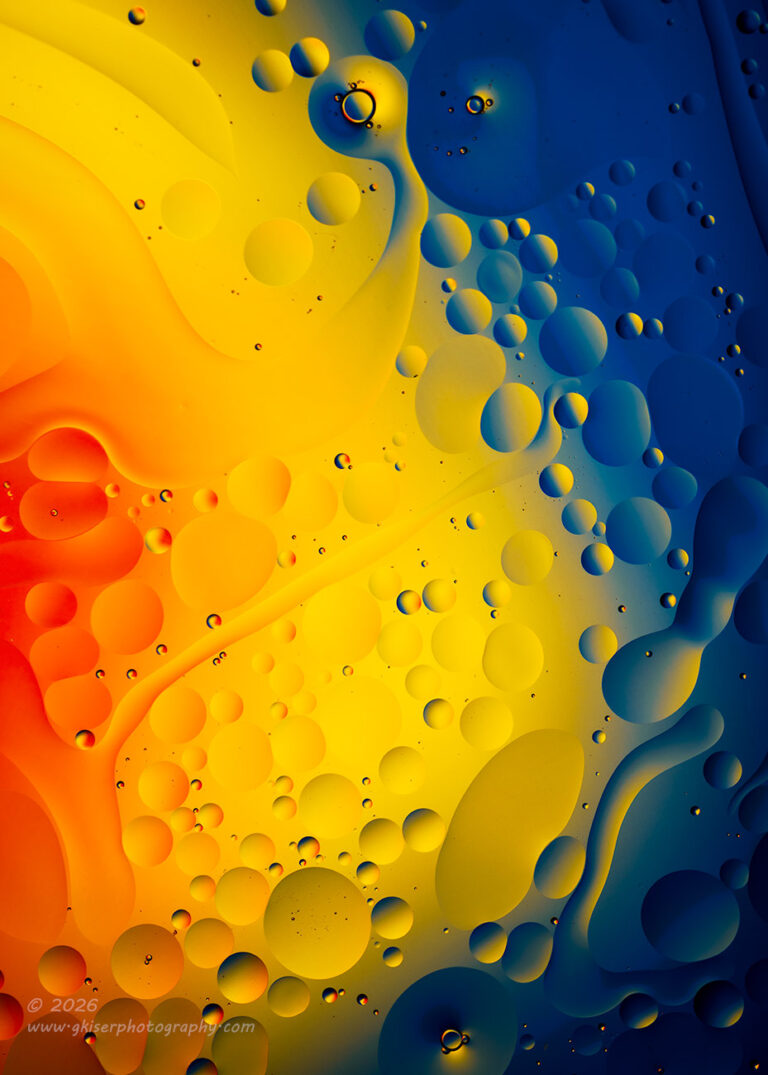
With this kind of photography, there are quite literally two levels that I am having to work with. On the top level is the texture created by the oil and water. This is what I have the most interaction with during the session, but there is also the color level which is roughly 18 inches below the water mixture. This is the level that actually sets the tone for the color palette and is probably more important than the textures that I am constantly working on changing in the upper level. Thinking about these two levels often leaves me forgetting about the camera which has a static position with a locked focus. My only contact with the camera is through the remote shutter release that helps keep things tack sharp and free of camera shake. In essence, it feels like the camera has been completely removed from the entire equation which is very odd in photography.
Speaking of the camera, I might as well get into why I made the choices that I did considering I have plenty of room to talk about this session. You have probably noticed that I used my R5 camera for this session which you don’t get to see much of. This is primarily my portrait rig, and I use it almost exclusively for people photography. It is the newer camera, and it is mirrorless while the camera that I am usually using for the photos you see in the blog is an older DSLR. I’ve talked about the difference between these types of cameras before, so I won’t get into those details again. I will say that I’ve been running the two different platforms now for about four years and I still feel the same way about them. In terms of the photographs that they produce, there is no difference at all between the 5DS R and the R5. They are both excellent and I love seeing them. The difference really comes into play in terms of auto focus, and the eye auto focus in specific.
The mirrorless camera, by design, has a much better auto focus toolset than the DSLR because it focuses directly on the sensor which allows it to pick out faces and even eyes. This makes things much easier when photographing people but is not a concern when photographing an old car. In my landscape and decay photography, there is no need for the advanced auto focus of the newer camera and that makes the battery draw a detriment to the system when I can do many things through the optical viewfinder without even having the camera turned on when using my DSLR. It simply lasts longer in the field. I also really like the sound of the mirror flipping out of the way and a little more of an analog feeling to the whole process. It is just more satisfying for me, but the DSLR is slower with people and my hit rate isn’t as high without the eye AF feature. Since that is dealing with paying clients for the most part, I want to bring everything that I can to the table to make the shoot a success.
All things being equal, I would have rather used my old DSLR for this session, but there was one other key difference that I haven’t mentioned that brought me to the point of using the R5. That one difference was lens choice. I don’t own a macro lens for the DSLR because I have not really needed one all that often. I did buy one for the R5 for doing engagement photos and have used it quite a bit in a studio setting like this since I’ve added it to the bag. This is an RF mount lens which can’t be adapted to the EF mount on my DSLR. It was the lens choice that dictated the camera choice for this session in much the same way that it influenced which camera I used when I did a studio session with a chess board recently. In that case, my EF 24-70mm was the lens of choice and that was mated to the 5DS R which I prefer to use for static subjects. These are times when gear matters, but not in the way that you would think.
Sure, I used the newer and more feature packed camera for these photos, but that wasn’t why I picked it. I picked it because of the lens that I needed to make the images. I chose the right tool for the job. Sure, I could have used one of my other lenses on the preferred camera, but those would have required some deep cropping in post production which would killed the resolution no matter which camera I used. By using a dedicated macro lens, I could reproduce the textures that I was seeing at 1:1 if needed while keeping everything in focus. I didn’t have the close focusing ability with the other lenses in my arsenal which made this particular gear choice very important to the overall success of the shoot. The final photos do not give any clues as to what gear I used, nor does it matter. I used what I had on hand that would give me the outcome that I was seeing in my head and that is the whole key to gear. Never let somebody say that you need the latest and greatest to make good images. The first time that I did this kind of photography, I was using a 10mp Canon 40D and a 24-70mm f/2.8L lens if memory serves. It was what I had at the time, and it worked just fine though making noticably smaller files.
Now that we have been through the setup and how the images were shot, we can get past all the technical stuff that really doesn’t matter all that much. In photography, it is all about the images created and that is what we are here to see. Normally with these blogs, I will go through the images in the order that they were shot. It just makes more sense to me to do it that way as I am telling a story about how the day went. I like for you to see the progression of how I saw a subject, or a collection of subjects. There are times when I go for the overall and establishing view before going for the details, and other times, I do it in reverse. There are plenty of times it is an either/or situation and I like for you to understand why I make the choices that I do.
This just wasn’t one of those times when going through the images chronologically made sense. As you have probably determined already, I left the colored paper in place for a number of frames before changing it up to something different. Had I gone through these images in order, you would see the groupings that I came up based on color which would likely make the individual photos less exciting to look at. I didn’t want things quite that organized which prompted me to go with something random. The problem was picking a random order out of 40 different images would overload my brain processor quickly and I could see doubling up on an image or two and leaving a couple on my hard drive that never made it to the blog. No, that wasn’t going to work, but if I changed things around and just posted them alphabetically, I would be sure to get them all in, and in truth, they would be ordered randomly in terms of where they fell in the succession of frames.
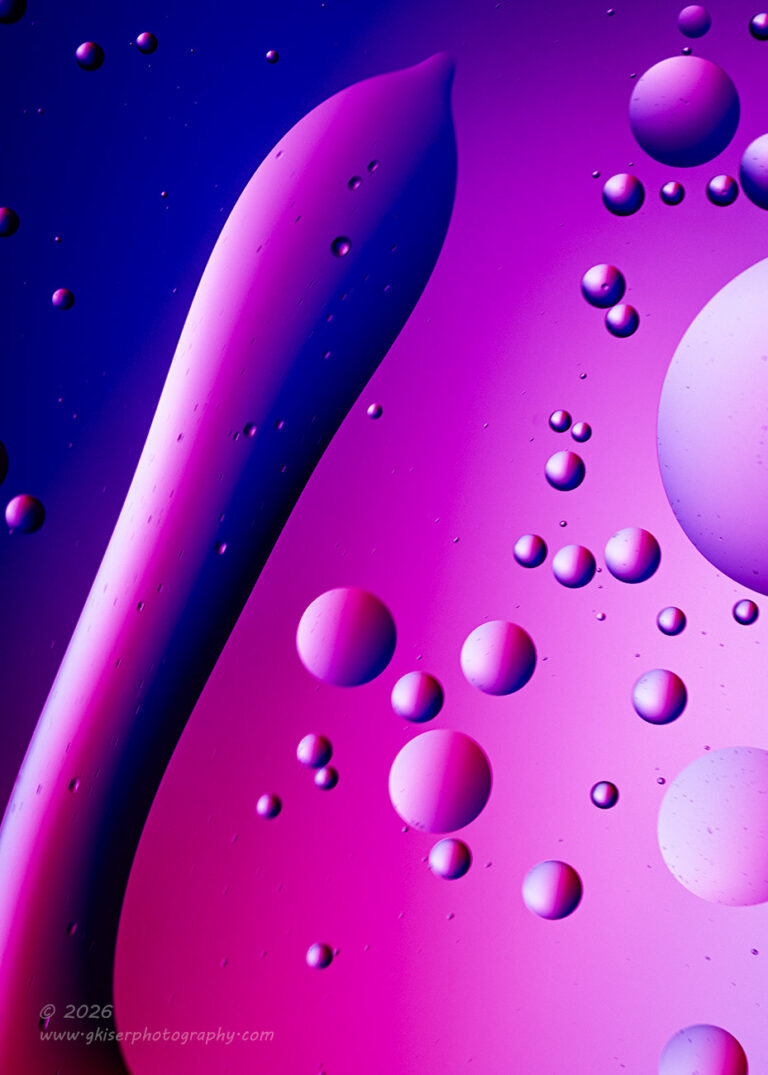
This actually made it easier to post than my normal method which was a nice surprise. Normally, I would go to the Lightroom catalog and pick the next photo and then match it to a named file in a folder for upload. This works fine for a session with a handful of images, and it works great for images that are very different from one another. Those shoots where I work the same subject for a while does tend to create some complications in picking the images in the correct order for addition into the blog. This time, I bypassed Lightroom completely and just went one after another in the image folder for upload. It was a very fast process considering the number of images that I had to go through. It also shook up the order for the colors that were used giving a bit more variety to the narrative. The narrative wasn’t directly related to the images, so the order didnt’ matter at all.
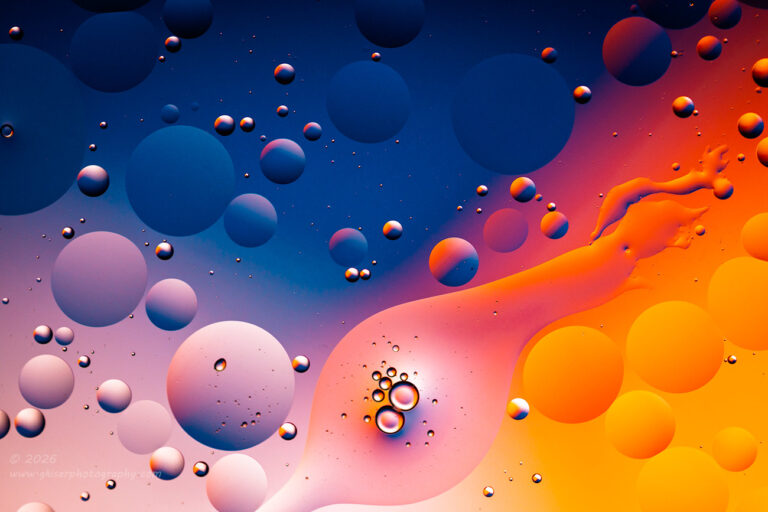
Speaking of the narrative behind this session, you might be asking yourself why I’m even going through the trouble of writing about this session the way that I am. It would have been much easier to do a simple introduction and then just fill the blog with nothing but images. I mean there is really no need in explaining of the individual photos and the chronological order doesn’t even matter. There is even a very good chance that you have stopped reading long before we got to this point in the blog. Why go through the time and effort of writing this narrative, especially about a session that few will care about. Well, the answer is simple…at least to me.
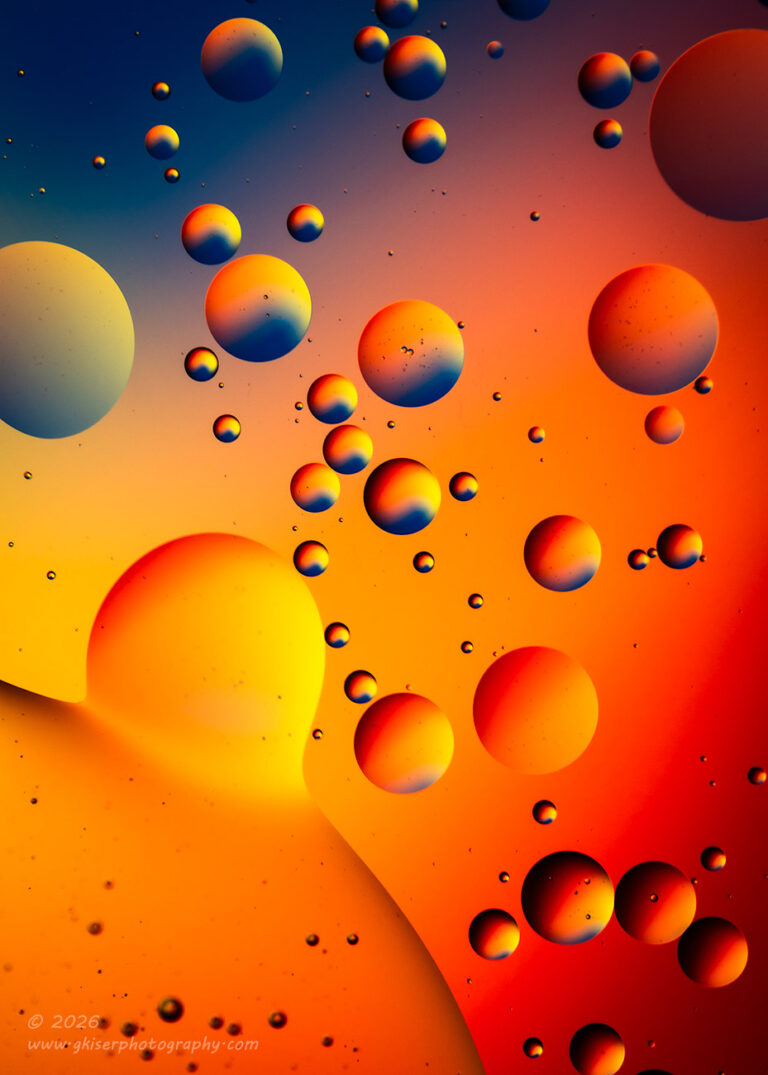
These blogs are the historical documentation of each of my treks or time in the studio. They are my creative notes and a way to go back and see what was going on in my life at the time when the images were created. It is an undeniable human touch that I think is becoming increasingly important in photography. I’ve always thought that it played a part, even in the days of the AOL Hometown Journals that I started out on back in 2005. Yep, I was blogging about the photos that I created even back then. The photos that I create have always come from something inside of me and to omit that for the sake of letting a picture say 1000 words seems like a crime against myself. I want to stay connected to my images long after the internet has possession of them. I want them to be able to speak for themselves, but at the same time, they are all a part of me, and that part needs to accompany the images beyond my time editing them.
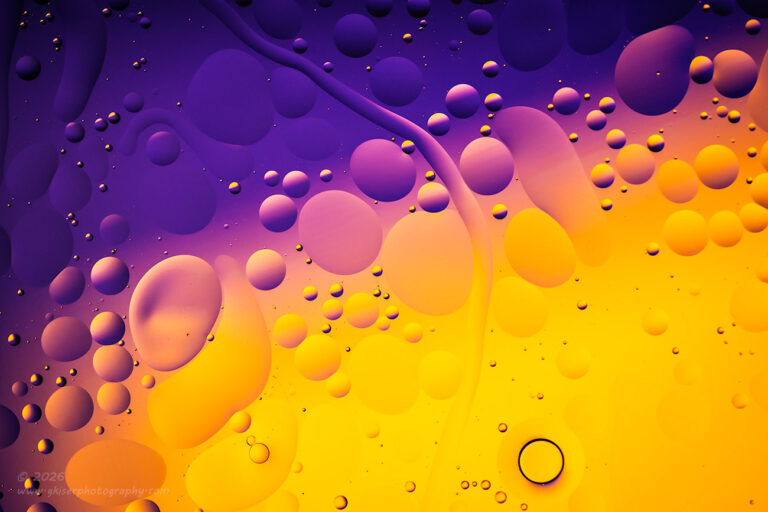
These days it is even more important, and I would say that with this kind of photography, even more so. With AI getting better and better the questions are coming more frequently as to whether or not a photo is AI generated or not. It is getting very hard to tell, and there are so many photographers out there that are using AI to create something vastly different from what they captured with their camera…if a camera was even used in the first place. I can say over and over that my images are not products of AI and that they have a real human hand to thank for their creation. I can show RAW photos, though that really doesn’t prove much unless you start to look at the data file itself rather than the image that is presented after the conversion for viewing. The only thing that I feel can really establish my photos as actual photographs is to describe how they came to be and why I chose to create what I did on that particular day.
Of course, what is to stop me from using AI to create the narrative behind the photos? Hmmmm, that is a question I will have to think about. My best answer right now is that I am still the same partially dyslexic individual that can’t spell worth a damn that is sitting here typing out these stream-of-consciousness blogs that tend to get very wordy. This is the same thing that I have been doing for better than two decades now and short of getting more in-depth into the creative process and the thinking behind the actions, it hasn’t really changed. I lay it all out for you and bring you along with me on my treks while showing you the photos. Yeah, sometimes it is like having a slide show for company about your trip to Yellowstone National Park where everyone goes to sleep. However, when they wake up, they have no doubt that you were there and saw those things. That is just something that AI can’t really accomplish, so that is why I do these blogs the way that I do.
I won’t lie about being nervous about where photography is headed. I’ve talked about it at length before, and with every new facet of AI coming out, I have new concerns unlocked. There are two poles out there when it comes to the future of the art. On one side, we have the group that is screaming “the sky is falling, the sky is falling” who have pretty much put an end date on photography careers. It will all be replaced by prompts within the next year. There is another camp which thinks that AI is like digital photography was to film photography. It wasn’t the death of the craft that everyone thought it would be, but it did change it. I fall somewhere in the middle of this and really think that what AI is going to do is put everyone in a state of imagery fatigue where we all just get so tired of looking at photos and wondering if they are AI or real, or some combination thereof. When that fatigue sets in, no imagery will matter in the way that it once did. The only images that will matter will be the photos that you have taken yourself because you will have the backstory to those photos and they will mean something to you.
What is strange is while typing this blog, I am remembering a video that I watched earlier this morning on YouTube. It just came to mind as I was typing that last paragraph because as I said, this a stream-of-consciousness narrative that has no outline or real organization. I just type as I go and hope that it all makes sense. Anyway, the video talked about the fact that this particular photographer was saying that he was his own favorite photographer. He was quick to put the caveat that he wasn’t saying that he was better than other photographers or even deserved to be liked by other viewers of photography. He was just saying that out of all of the photographs that he sees, his are his favorite. The reason…because he knew the experience behind the photos and remembered being there. That was the one quality that that he wasn’t able to get when he looked at another photographer’s work. He could watch a video about how the images were created, but it wasn’t the same as living through the creation. I think that he has a point here and that having a connection to the photo as well as to the events surrounding its creation can elevate a photograph to a different level.
Hopefully this blog goes a little way towards that goal. My hope is that through my words, you will know me a bit better and because of that be better able to understand my photos. With that understanding should come a level of appreciation which I strive for with my audiences. Of course, I have no actual control over what folks think about my work and I really can’t dedicate too much time to that consideration. In the end, I have to understand that the photos I make are the ones that appeal to me at the time. I would drive myself crazy trying to identify photos that would appeal to somebody else and ultimately miss the mark in creating anything meaningful at all. If I stick with this long enough, I will find the right audience for my work and part of that will fall on the blog element of the experience.
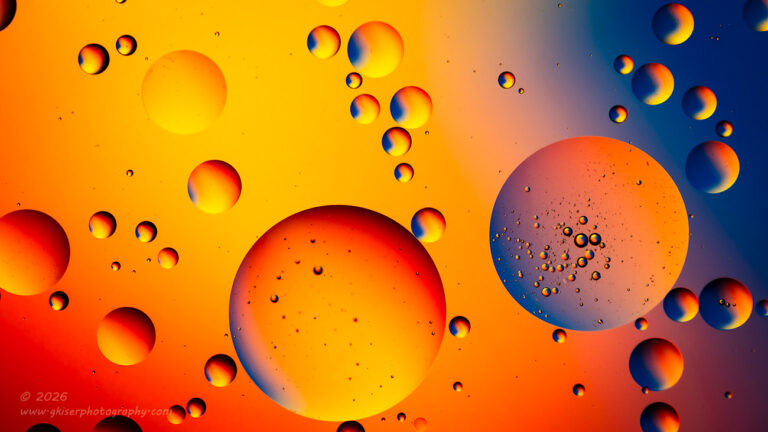
So, where do images like these fit into the mix? I’m sure you have heard that photographers need to niche’ down and become specialists if they want to become sought out for their work. I certainly see the logic behind that, but at the same time, I am struck by how much there is out there to photograph. If I were to follow that advice, I would only go out and shoot decaying subjects and likely just old cars. Not only would this mean that I wasn’t photographing waterfalls, landscapes, or portraits, there is a very good chance that I wouldn’t take the time to photograph old Jaguars that didn’t have much rust on them. I could niche’ down to any level of specificity and call myself a master of rusty Chevrolets if I wanted to. However, I would be passing up on so much else that is beautiful and worth photographing. There is something creatively freeing about being able to photograph oil and water when you want a change from the norm. It helps to keep me energized and ready for that next trek or photo session.
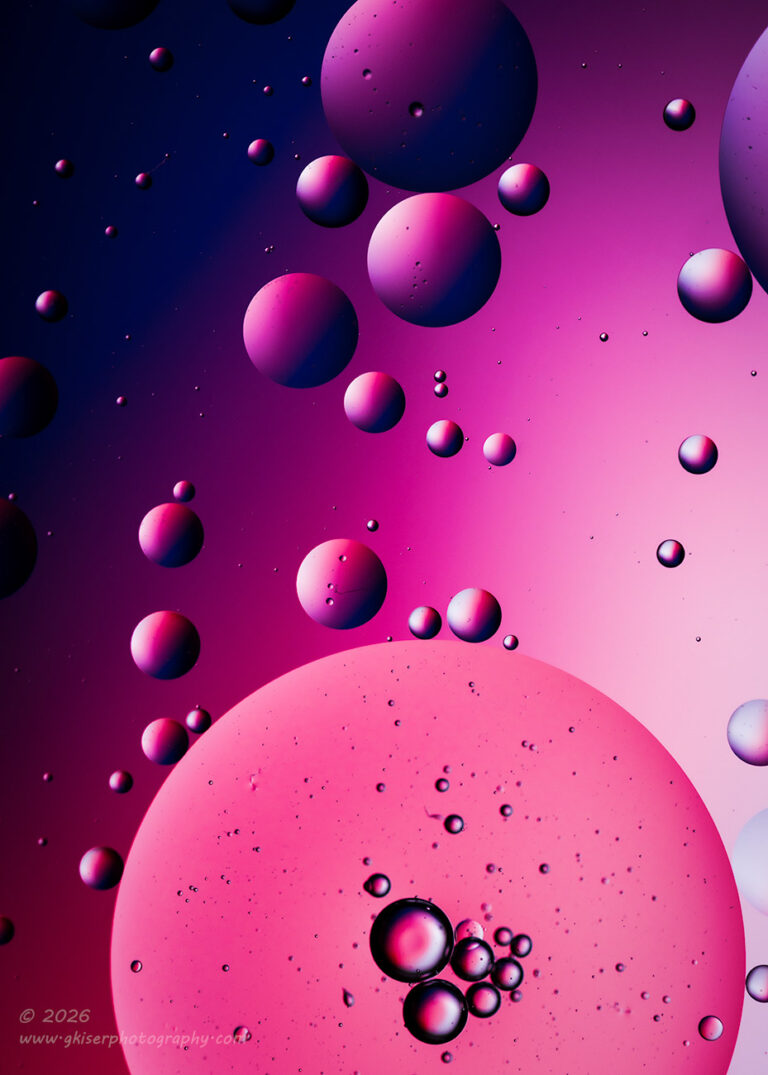
I’ve also found that the more I veer off in other creative directions the more I tend to learn about myself and how I see things. These little side quests for lack of a better term end up being wonderful opportunities to try different techniques and push what I am able to create to new levels. I always find aspects from these shoots that I can bring back to my regular treks. It also allows me to explore other options in case I run out of gusto on what I am currently focusing on.
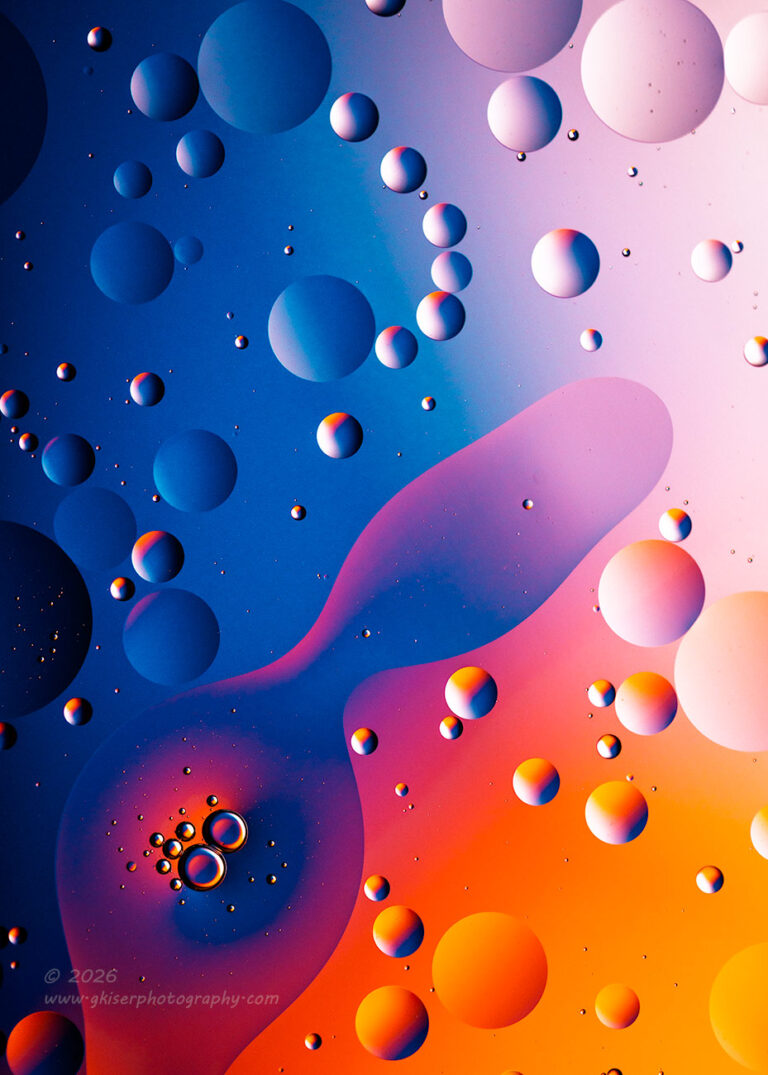
A great example of this is with waterfalls. Back in 2007, I was going hard and heavy with photographing waterfalls. I had plans of visiting every waterfall in North Carolina and creating a collection of images from all of them. This was before I really knew the scope of waterfalls in this state. I don’t think that photographing all of them would be realistic, and in a few short years, I even got kind of bored with waterfalls. They are a lot of fun to photograph, and they are all different, but I’m kind of picky about what kinds of waterfalls I find pretty which limits what I want to shoot. There is also a lot of travel involved in getting to all of these waterfalls. All of this started to wear on me, and I found myself drifting from waterfalls to other subjects. One of those subjects happened to be a guilty pleasure of min…rusty vehicles.
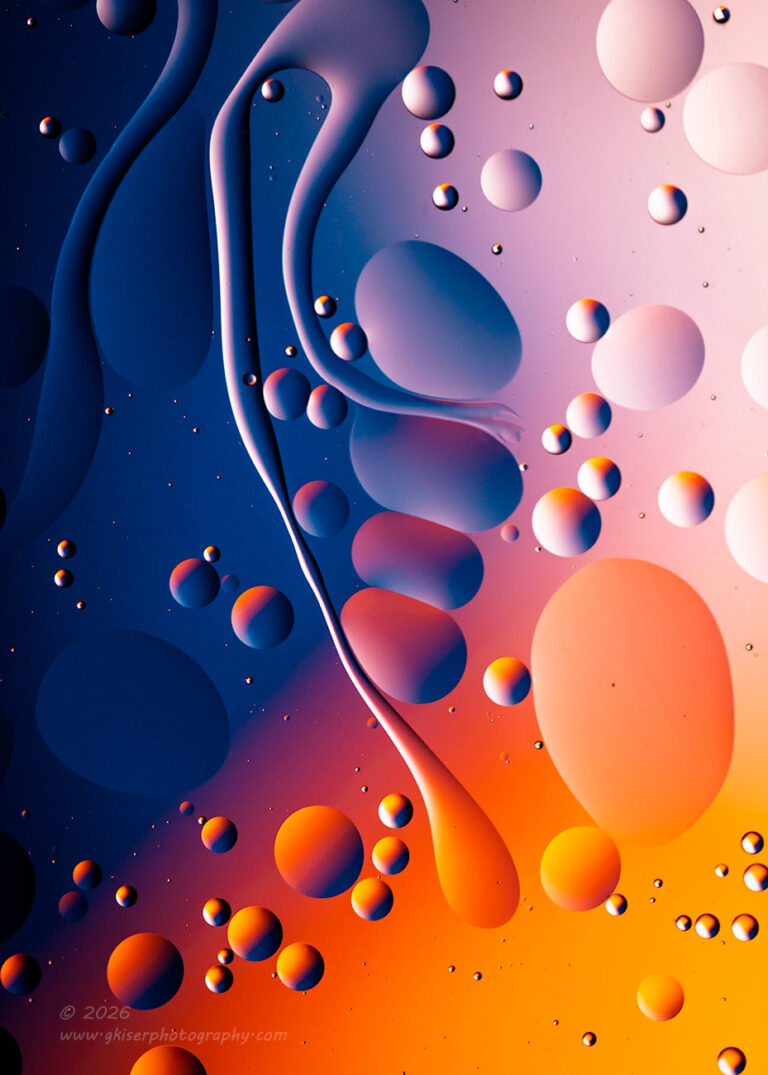
Had it not been for the occasional side quest of finding rust, I would have likely stuck with waterfalls until I just decided that photography was boring. Of course, this would have ultimately resulted in me throwing in the towel (which I actually did a couple of times in the past) and giving up. Fortunately, I never niched down in a way that trapped me in any particular form of photography. I’ve always had other options and ways to go creatively. I keep my skills and techniques current in several different types of photography which allows me to be able redirect as needed. This flexibility which I’ve learned over the years has been the answer to many a question that has come up on different shoots.
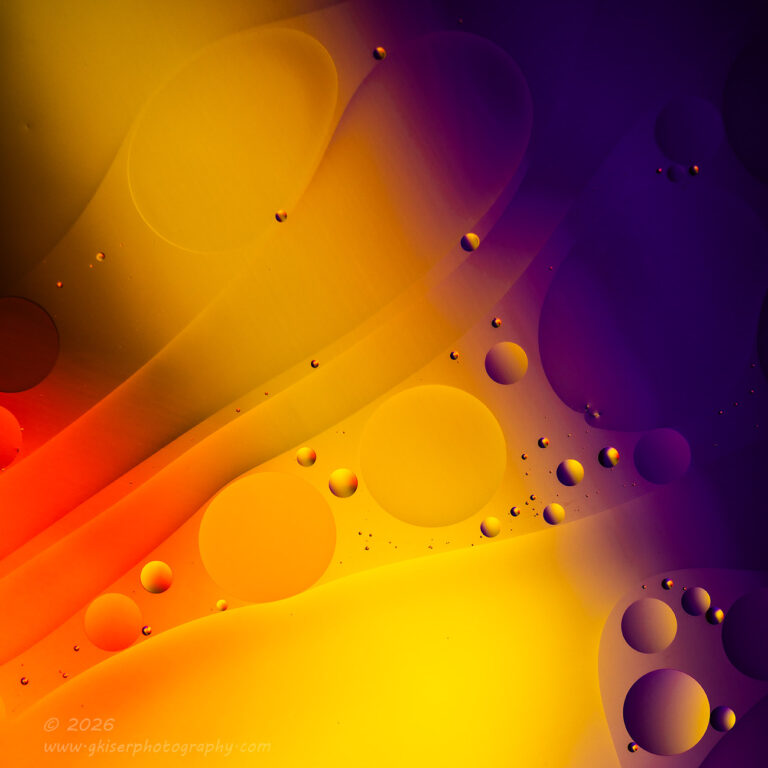
Had I stuck with photographing only waterfalls, I would have never really learned about color harmony which came about during portraiture work. These color harmonies that I have learned to work with in the realm of people photography doesn’t really play into waterfalls, but it certainly does in my decay photography and to a lesser extent basic landscape photos. Working with rusty cars has given me insight into what compositions really work with automobiles which I can use for different client shoots when the cars aren’t rusty. The compositional skills that I have used in relation to organizing elements that are already in existence has allowed me to better understand how to create a composition from scratch or quickly recognize a good composition when it appears randomly as with this shoot.
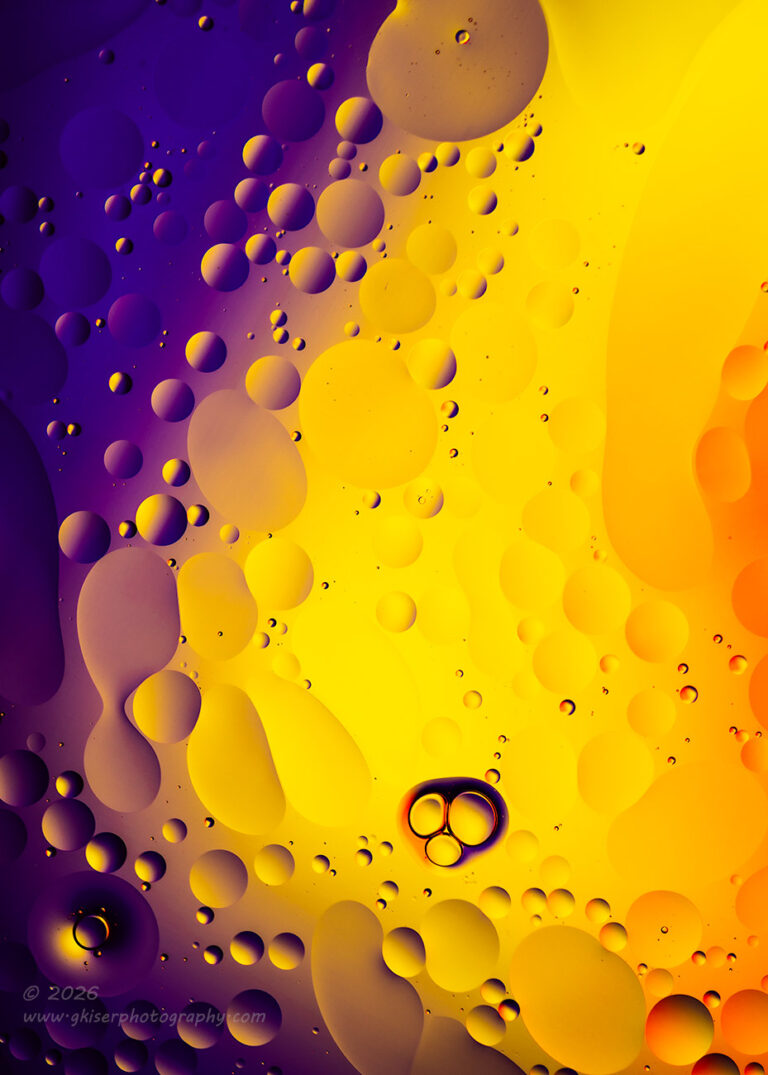
I’ve learned a lot more about photography since I have allowed myself to move around within the different genres. These experiences have made me the photographer that I am today. While I might not be a master photographer in any one niche’, I think that I bring much more to the table now that I am so well versed. There have been many times that I have had to think on my feet and pull from past experiences to make a session work out when I have run into issues and problems.
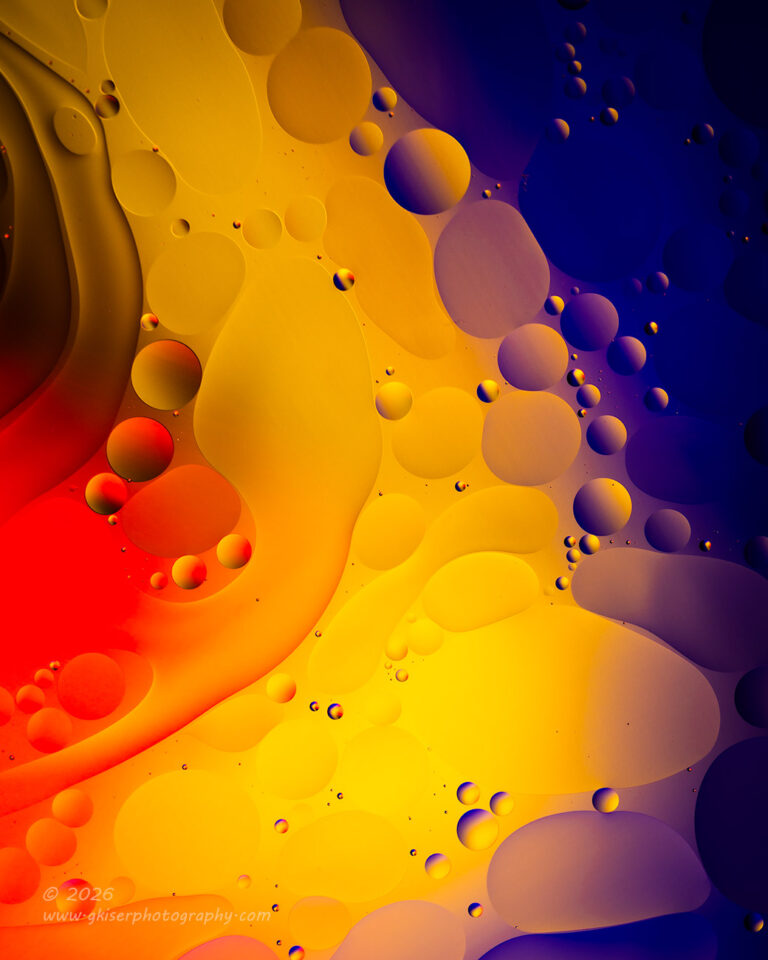
Coming back to this session, the hardest part about it was the blending of the two different layers of interest. I’ve talked about the color layer on the floor and the texture layer suspended above that. One of these is in constant motion while the other is static. This introduces a level of difficulty when it comes to composition, and I have to watch for when both elements gel into a single layer of composition before releasing the shutter. Of course, this is something that is based on anticipation rather than reaction which means that I have to have a really fluid understanding of composition and how to apply it. There just isn’t time to think about the rule of thirds, or the golden mean, or even the golden spiral. I just have to take in the scene and know when things all fit together.
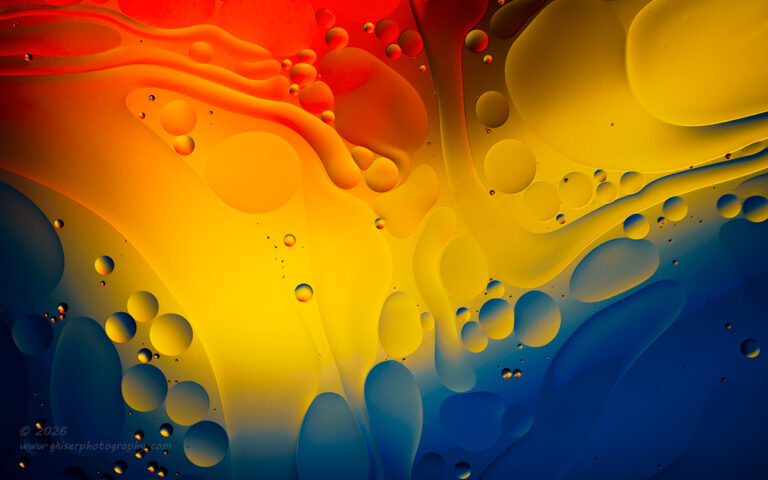
This would likely be easier if I cropped after the fact, but as you have heard me say plenty of times before, I don’t like giving up resolution for a cheat in compositional technique. This is why I chose the macro lens that I did because it would allow me to fill the frame with the colors that I wanted in the ratio that I thought would work. Then I would look for the arrangement of oil bubbles to fit the colors and get the photo. I do all of this while keeping the full resolution of the camera intact which is very important to me, but it does require a very good understanding of composition in all of its forms not related to rules.

As with all of my compositions, I look for something that catches the eye as a visual anchor and the look for balance within the frame. This is the same recipe that I use for the vast majority of my other photos and doesn’t rely on an arbitrary rule. That is what makes these photos such a challenge because there are two very different layers coming together to make a composition. I need the colors to balance out to start with. I need the textures to balance out as well, but when you blend the two together the balance can shift a good deal. This is where I have to take some amount of creative license to work the image.
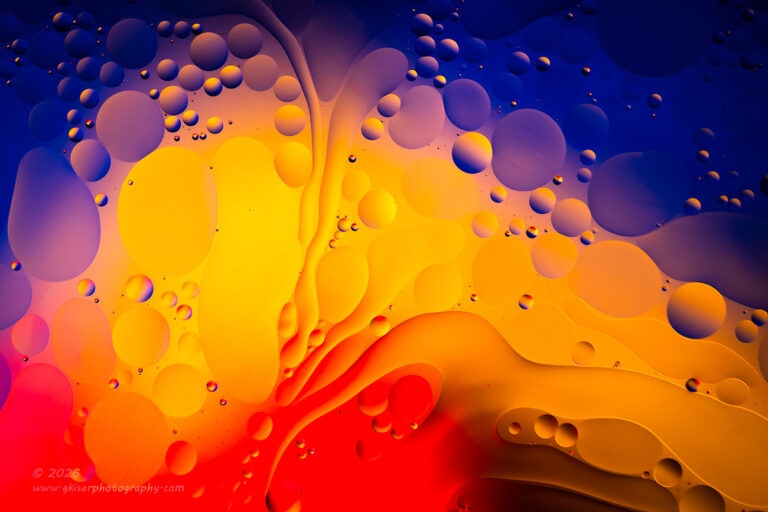
This is one of those times when I can position the image in any way that I choose after the fact. I can rotate, flip, or a combination of those to get the final composition. I can also crop to change the aspect ratio which can eliminate certain areas that I don’t want visible. In just about all of these images I would look at the initial crop and try to find patterns and the main visual weight. That would dictate whether the image was going to be vertical or horizontal. If it became vertical, I would automatically shorten the image by changing the aspect ratio to suit the composition that I was after. If the image remained horizontal, I would see if a different aspect ratio would positively affect the visual balance, of if the native 3:2 was still the best. This was really where the fun happened because I could make the images tell a story of sorts even though they were a collection of abstract patterns and shapes within the frame.
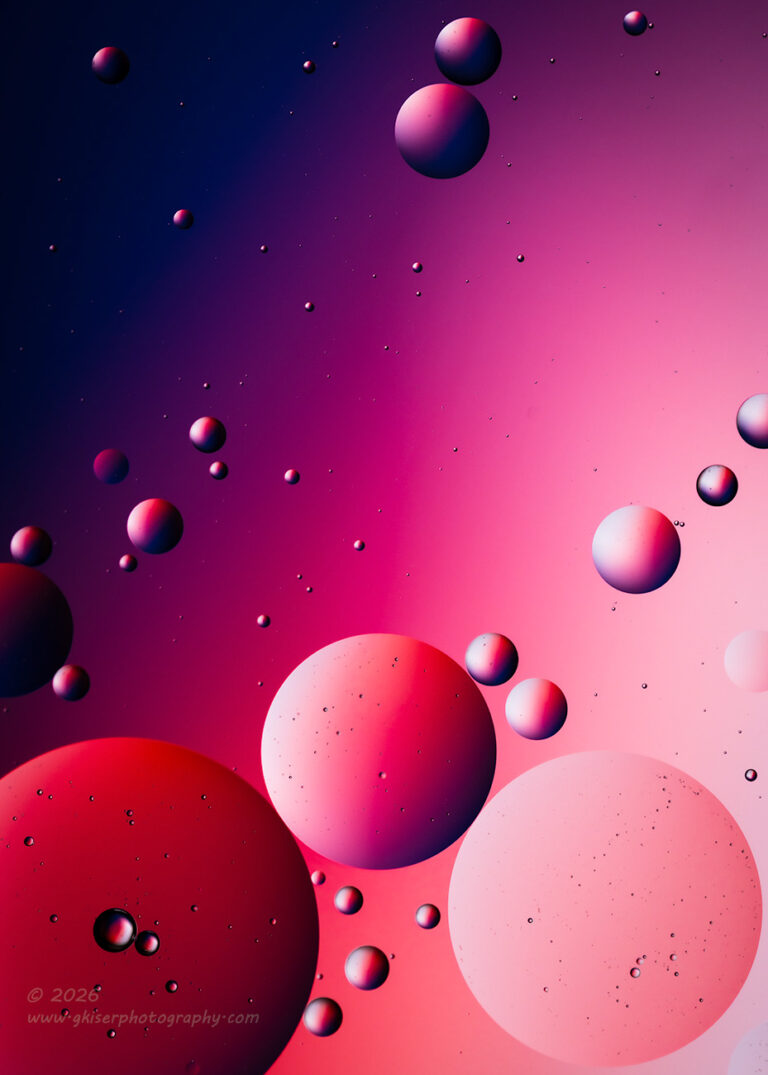
Once I had the composition completely figured out, I would deal with the colors. This isn’t like how I deal with the colors in smoke photography since I am adding all of the colors to those images. Here, the colors are already baked into the image as decided by the paper below. However, I do have the ability to tweak those colors in hue, saturation, and luminance to arrive at the final image. Again, I am looking at balance within the frame. You would be surprised at how much those color tweaks can alter the visual weight of an image. This is one of those things that I have learned through doing portraiture and have applied to my decay photographs as well. It also is a very useful technique in this type of photography as well. You will also find that the different treatments to the colors will offer even more variety to the images beyond the original color combinations.
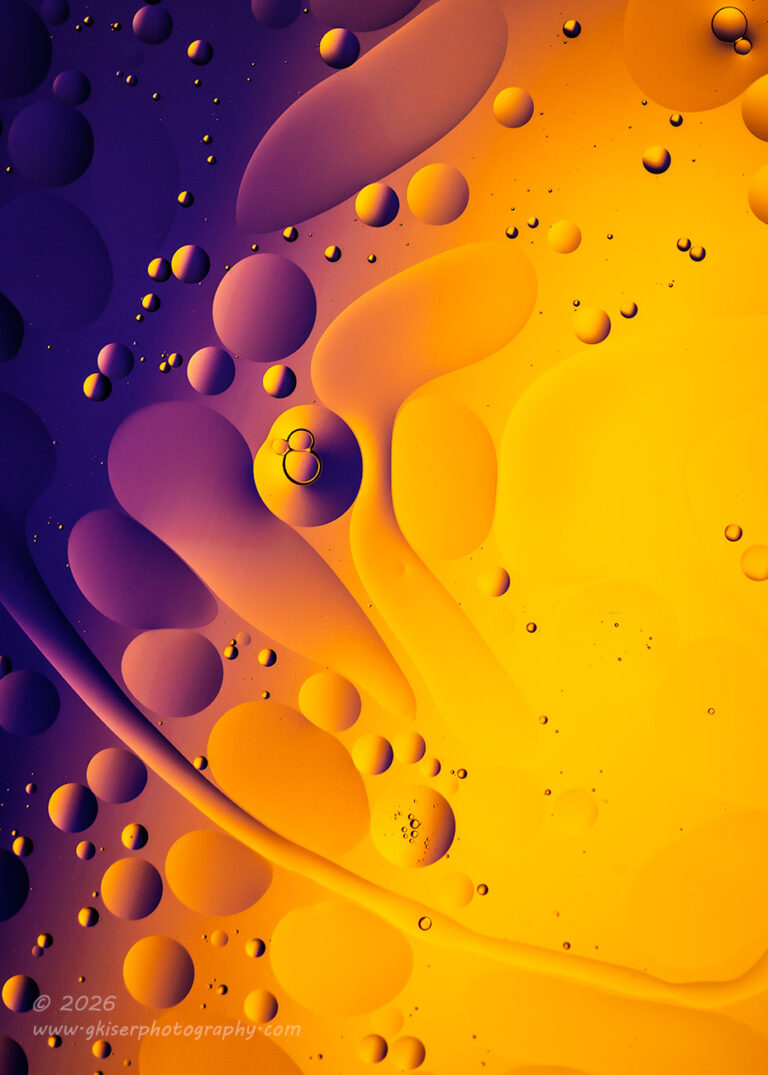
So, you have made it this far. Give yourself a pat on the back, I’m proud of you for hanging with me this long. You have heard pretty much the whole story about these photos now. You know why I decided to do the session, how I pulled it off, and even the distractions that were going on outside during the session. You’ve learned how I blend the techniques from different types of photography to come up with what can only be described as my personal style of photography. Hopefully, you have seen how I’ve been able to improve along the way by checking out the last time that I did this type of photography. Most importantly though, I hope that you have no question about the creator of these images. There was no AI used here and it was all human driven and created. If that is something that you value, consider purchasing a print of one of these. Make it your stand against AI and know that you have something created by a human being hanging on your wall. The only prompts needed for these were “pick up camera and create.”
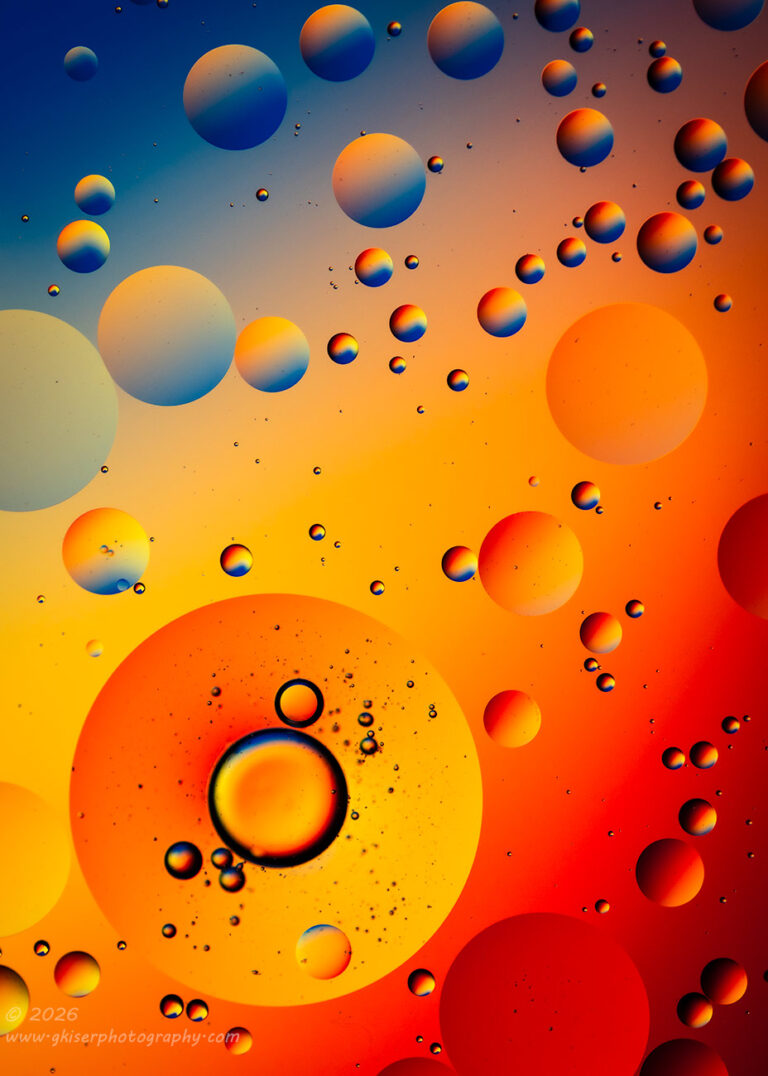
Thank you so much for joining me for this studio session. I do hope that you have enjoyed the photos as well as the narrative that went along with them. Abstracts don’t really have their own story to tell because, much like the clouds in the sky, you will see what you bring to the table when you look at the photos. There isn’t much narrative that I can add to them since I see only what I see. For me, it is the mystery that makes the photos and I like this kind of photography more and more every time I do it. I know that it won’t get much attention and my web traffic will likely drop when I start sharing these images on social media, but sessions like this are important to me and to my development as a photographer. Maybe one day, they will be appreciated on a wider level if for no other reason than they were created by a human.
Until next time…