Friday, November 25, 2022
It is starting to seem like all of my treks are a bit atypical these days. The routine that I usually follow is just not there. In fact, if you start looking at my more recent treks, you are seeing changes like huge amounts of new images being added like we saw a bit over a week ago. There have been several multi-part blog entries done like the one from the end of September, leading into the beginning of October. All of these have decay as a common theme which goes right along with my newfound excitement with decay photography. None of these treks were planned to be as big as they turned out to be, but each time I got carried away and created so many more images than I would have thought possible. I appreciate those of you who have taken the time to read through all of these blog entries, and my goal was to give you a bit of a break as the year came to a close. The plan was not to even go out for the rest of November and to rest my creative energy since in addition to these mega-treks, I’ve been doing several different portrait shoots that have brought about over 100 new photos that have had to be edited which you haven’t seen here. In short, I am tired. The amount of work that I have been producing the last couple of months is well beyond anything that I have done in the past. However, I am very pleased to say that the quality of the work is also higher than it has been in the past.
Obviously, we are here talking about a trek which means that I didn’t take the rest of November off. It really isn’t my fault though. Yes, I took the camera out, and yes, I was in photographer mode, but the intention was to work with a client and maybe go out afterwards to get a few photos if something moved me. Let’s review the highlights of how we got here. A couple of weeks ago, I was contacted by a new client that was interested in a mentorship session with me. We talked for a while as I got an idea of what they were interested in learning. We decided that going to Stone Mountain and working at Widow’s Creek Falls would be the best option for what he was wanting to learn during the session. For this to really work out, we were going to need some cloudy conditions for that soft and even light. As you have read through most of the Fall, the cloudy days have been few and far between out this way which was going to make it difficult to schedule our session. I ended up having to call our first option off because the clouds just fell out of the forecast. The second option was going to be Friday morning, which started to get a little dicey because of rain in the morning. We shifted the time slightly to try and miss the rain which had us starting at 8:30 in the morning.
I arrived around 8am to make sure that I was there to meet him. There was a slight drizzle, but the lighting was perfect. He arrived as planned and we ended up doing a nearly three-hour session on waterfall photography. We worked through building a composition, selecting exposure, and using filters. It went amazingly well, and it was good practice for my upcoming Waterfall Workshop which is scheduled in a couple of weeks. Obviously, I haven’t been doing much waterfall photography, so this was a nice change of pace for me. However, during the entire three hours I was out there, I found that I wasn’t moved to work this waterfall which is one of my favorite ones in the area. I wasn’t really feeling like creating any new photographs, but I was having fun helping the creative process of someone else. It was kind of like having Grandchildren over. You get to have all the fun without all the follow-up responsibilities. I’m really starting to become aware of the balance of time I spend capturing the image, processing the image, and then writing about the image. Every photo that I shoot and keep, represents about an hour to an hour and a half of work after the photo is made. With all of the different shoots that I’ve been doing, I have been spending a lot of time in Lightroom, and a lot of time here in the blog. The fact that I’ve been very successful at creating strong images here lately means that I have been working through way more editing hours than I ever have before. There have been plenty of full months’ worth of shooting when I didn’t capture as many keepers as will be represented here in this blog. So, it was nice to work through a few compositions without having to follow that up with an edit and then a dear diary entry.
At the end of the mentorship, I was feeling great. The session had gone very well, and I felt fulfilled having shared some of my knowledge. I still wasn’t interested in capturing new photos of the waterfall. I did have my camera just in case something screamed out to be photographed though. It was still early in the day, and I figured I would take the long way home and possibly go up into Sparta to see if there was anything out there that I wanted to shoot, or at least scout for a while. The clouds were supposed to thin out and fade shortly after lunch, so I knew that there wasn’t going to be much time at all to get photos.
As I was driving out of the park, I was thinking back to a conversation that I had been having with Don Kimmer through messenger where he had mentioned several different locations that I wasn’t familiar with. I remembered roughly where these were and considered checking them out while I was driving. It wasn’t until I was well outside of the park that I finally got good phone connection and I called Toni at home to see how she was doing. I could tell in her voice that things were not alright, and I pushed to find out what was going on. It turned out that she was feeling kind of sick and had a couple of ideas why she was feeling that way. I threw my plans out at that point and started my way home. She kept telling me that she didn’t need me and ended up saying that she was just going to go to sleep and see if it was exhaustion that was causing the issues. If I came home, she would not be able to sleep, so she tried very hard to keep me out of the house. I finally agreed and redirected to the North once again.
As I was driving towards Sparta, the clouds were thinning, and the sun was becoming very intense. This was not the light that I was wanting to work in, so I was figuring that I would end up home sooner than later. There were clouds on the mountain though, and I figured that would be in the area of Ashe County. Since I really didn’t know where I was wanting to go, I started to consider Don’s suggestions. I pulled my phone out and pulled that thread up. Sadly, Facebook Messenger is not great, and I can only get the entire conversation on the desktop at home. There was only a small portion of that conversation available on the phone which happened to include the directions to a ’57 Chevy in Glendale Springs. Judging from the clouds that I could see, that was going to be under them which would mean favorable light. I started out that way to check it out and possibly photograph the car.

The description of the car sounded perfect. It was alone in a field all by itself where it had sat for 30 years. Based on the directions, I was really surprised that I hadn’t seen it before since I have explored that area many times over the years. I just couldn’t place the car in my memory which was why I was headed out to check it out. If it was as advertised, I would be able to get a shot of it really easy, and from the sounds of it, would be able to do it from the shoulder since it was alone in a field. I still wasn’t feeling particularly energized to make new photos, but if the sky was good, I wouldn’t be able to pass that up since we have had more than our fair share of cloudless days here lately.
The directions were very simple, and pretty much included just a couple of turns. I turned on the road that the car was supposed to be on and knew that I had been here many times before. The thought that I had missed a ’57 Chevy in a field baffled me though. The road was only a quarter mile long and right before the end of the road was where I was supposed to be able to find the car. Each house looked familiar, and I knew exactly where I was. I was beyond confused, but then it all came together for me.
I found the car right where Don had said it would be. I even knew the car because I had passed it many times over the last two years. I hadn’t bothered to shoot it because it was actually parked next to an RV which was next to a garage, right off from the driveway. There was no way to get a photo of it from the road, and I didn’t see much opportunity to change the angle and get a good shot because this was a neighborhood street with houses and cars all over. This is one of those neat little things that being a photographer has allowed me to understand. The mind’s eye has a great filter on it which allows you to see a very confusing and cluttered scene while only actually registering that point of interest that you want to see. I have seen this car in just that way many times and it causes me to look twice where I still only see the car. It isn’t until I start thinking about compositions that I start to see all the other stuff around it.
It was a disappointment to find out that this was the car that I was coming out to see. The weather was really good, and the light was fantastic. The only problem was I didn’t have a composition with the car. As I was still driving by slowly, I began reviewing my current theories on automotive decay photography and realized that I have been having a lot of fun with isolations lately. The patina on the car was probably the best that I have seen in a long time which opened up the possibility of some really interesting isolations. There was also a mid ’50’s Chevy truck in the driveway that offered some additional possibilities. Who knows, maybe I could get a shot or two of these two cars. It was worth pulling up and seeing if anyone was at home.
There was a car that I hadn’t remembered seeing parked there before which told me that I might get lucky with somebody being home. I knocked and saw movement inside, so I stepped back from the door and made sure that my hands were visible. The inner door opened, while the storm door was locked, and I saw the opportunity for a little joke that immediately lightened the mood as I introduced myself and requested permission to get a few photos. She was happy to let me photograph the cars and even added that there was an Anglia parked just beyond the truck which was in worse shape than the other two. I now had three potential subjects to work with so I figured that I would probably be able to get a few decent photos out of this location.
I went back to the truck and grabbed the camera with the long lens attached. This has quickly become my primary lens for this type of photography, and it has opened up some new compositions for me. I left the bag in the truck since I was going to be relatively close to it if I needed to change anything up. I figured that if I was just going to be shooting isolations I wouldn’t need anything but the lens and a polarizer which was all I took with me.
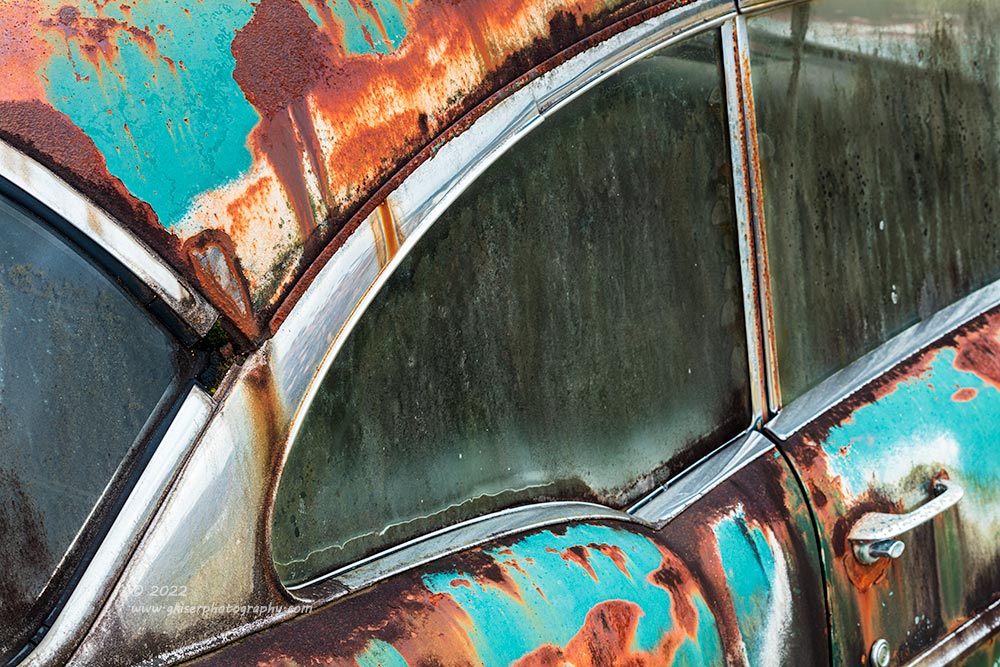
I started off at the car which had brought me out here in the first place. The patina on it was nothing short of amazing and I quickly gravitated to the rear quarter on the passenger side where the chrome trim was shining between the quarter window and the rear window. This was certainly an area of interest for me because I love chrome on rust, and the color of the car was the perfect complimenting color to the rust. The compositions just fell into place very quickly. There was none of my usual shoot and fine tune the image. It was pretty much a shot, or two and then move to another composition. It seemed that everything that I was shooting was exactly what I had in mind. It was almost too easy, and the images on review looked fantastic despite being a very flat representation of the colors and contrasts of the scene.
Within just a couple of minutes I was very glad that I had decided to come scout this place, and then happy that even though I had passed it up before, I had the presence of mind to see the possibilities this time. I still wasn’t seeing an overall composition which was a real shame considering how perfect this car was. I was almost in overload about how to shoot it so I decided to break away for a minute and let things stew for a while. I needed to make sure that I was seeing the right kinds of compositions and for that, I needed to let the car sink in for a while.

I walked over to the truck and looked at it for a while. It was in much better shape than the shoebox car as the patina wasn’t all that great. I looked at the front and found rust on the grill that was interesting, but there wasn’t enough to carry a composition. From here though, I was able to see the little Anglia car which I knew nothing about. As it turns out, this was a Ford that was built for export to the UK in the last ’40’s. It was the cutest little thing and certainly had a British feel to it. Since this is something you just don’t see anymore (if at all), I wanted to be sure to capture the emblems which were still there surprisingly enough.
The front emblem was a simple engine displacement icon which is barely enough to count as an engine these days. On the rear was the emblem that I had been told about surrounded in rust. The Anglia script just had a presence for me, but there wasn’t much around it to make for an interesting photo. The same could be said for the front emblem as well. Having rust around emblems is a great thing and I live for that opportunity, but when the rust is all pretty much the same color, the composition starts to fall apart with too much negative space that is just taken up by texture. However, I knew that by removing the color, I could make the textures part of the composition by giving them more contrast and importance than a color image would allow.
I started with the front because there was more structure to work with. I played around with different angles and finally decided that a straight on shot of the top of the grill was the way to go here. The emblem because the tip of a compositional triangle with the top arches of the opening forming the bottom two points of the triangle. By shooting this in black and white, I knew that I would be concentrating on the textures and pits of the rust. The image looked boring in the back of the camera, even when seen in black and white. It wasn’t until I got home and really finessed the contrast values through several different sliders and then adding a dodge and burn layer that the image I had in mind finally materialized.
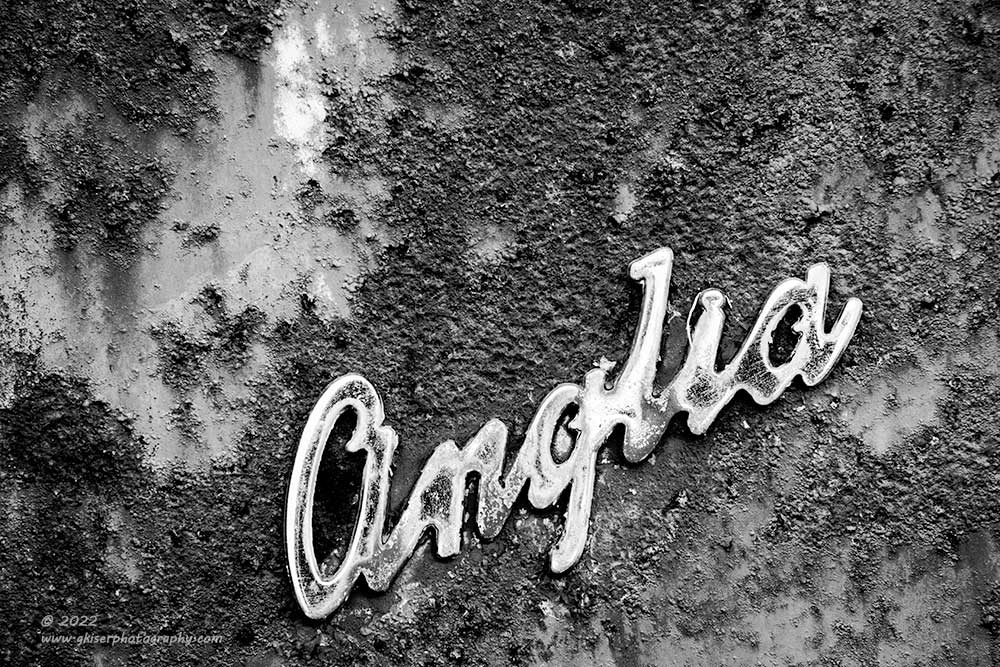
The same approach and realization happened with the nameplate on the back of the car. It was installed at a diagonal which I decided the placement of based on where the rust texture changed to the upper left. That would give me a balancing element to fill the negative space to keep it from just being empty space. Having this in black and white eliminated the very strong red cast to the whole image and again allowed me to concentrate on the contrasts. The dodge and burn layers at the end made the entire image pop and really pulled the detail out of the textures which was what I was after for this image.
I wasn’t sure that I was going to like either of these emblem images after I had shot them. They looked very boring and flat in the camera. I wouldn’t have bothered with either of them on a normal day, but I wanted to be able to tell the story of this little car through photos since I had never even heard of one of them before. The emblems were the start of that process, but getting an overall shot of the car was not going to be easy.
I pulled back from the car and was able to get a clean shot of it from left rear quarter, but the composition was not all that interesting. I think it was overly simple and just had nothing to really look at once you identified the car. There was no mood to the scene, and no story other than just the editorial one that I wasn’t after. That was the only angle that I could get on the car that didn’t include a house, a garage, a shed, or a garden. All of the good angles on this car had too many distractions around it to be able to successfully work it out. I was going to have to think on this for a while, so I moved back to the truck to see if anything jumped out at me.

This time, I went around to the back of the truck to see if there was any interest back there. The minute that I saw the back end, I knew that I had something to work with. The patina on the tailgate and the front wall of the bed was something out of a rusty dream. The black paint had this blue tint to it, while the rust runoff was a deep yellow. The rust was this beautiful red-orange that just pulled it all together. The “Chevrolet” stamping was the source of all the patina and immediately reminded me of a Ford tailgate that I shot on the back of a rat rod that turned out amazing. I knew that I had to capture this part of the truck before I left.
I still had the long lens on, so I worked with that. The part that was most interesting was right around the stamping which was a whole lot longer than it was tall. The standard 3:2 aspect ratio of the camera wasn’t flattering to this at all. I switched over to a 16:9 ratio and that fit it better but was still taller than the tailgate. Since I also liked the front wall of the bed, I had an idea of how to fix this composition problem. I elevated the camera so that I could get the front wall in the frame which showed the same rust patterns, but I limited the depth of field to show depth. This gave an extra layer to the image which had been missing. It all just fell into place with that, and I had the composition that I was after.
I shot a couple of images with slight movements of the camera just to make sure that I had the right balance of elements in the image. I happened to look at the frame count and saw that I had only shot 23 photos to this point. Thinking back through the, I was pretty sure that I had about four images already that were going to be keepers. So much for just getting a couple of images and having a quick editing session when I got home. Things were starting to get serious because I was just getting obvious photos right now and had yet to go into depth with the subjects.
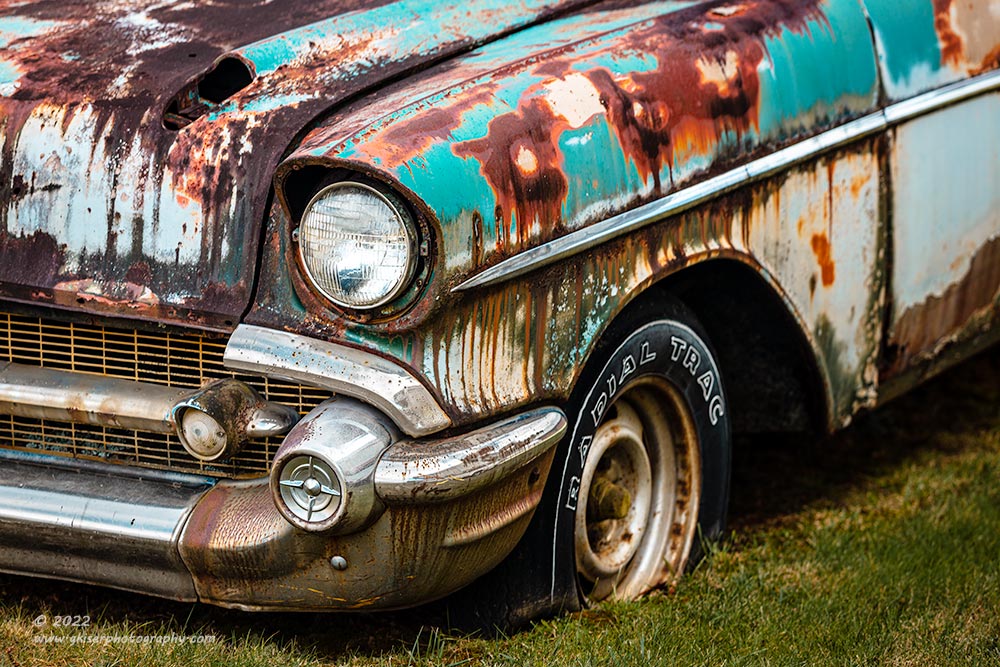
Speaking of going in depth with the subjects, I had to get back to the Bel Air out front because I was pretty sure that I had some ideas for it at this point. I knew that I wanted to do something with the front of the car since that was one of the very characteristic styling points of the car. I started to look around to see which side was going to be the best to shoot. They were both equal in terms of patina. The driver’s side was a little better in terms of lighting since it was parked next to a white RV which was bouncing some extra light onto the side of the car. The front of the car was just as amazing as the rest of it which pretty much mandated that I do something with it. The problem with this part of the car was that there was an RV maybe eight feet from the left side of the car. There was a driveway with a white sedan and a white 4Runner (mine) parked in a way that I couldn’t get them out of the frame. Of course, the house was just at the top of the driveway. Beyond that, to the right side of the car was another house and a yard with cars lined up. In short, no matter which quarter view I went with up front, there was going to be distractions in the background.
Since the car was so beautiful on both sides, I wasn’t able to pick a single side to work with and wanted to get the entire front of the car. I tried a hood shot looking down, but that didn’t work compositionally. I thought about a panorama of the front end, but I would still have to include something in the background since I would have to give the headlights breathing room. It seemed that the only thing that I could do was go get quarter shots and focus on the headlights as I have done before.
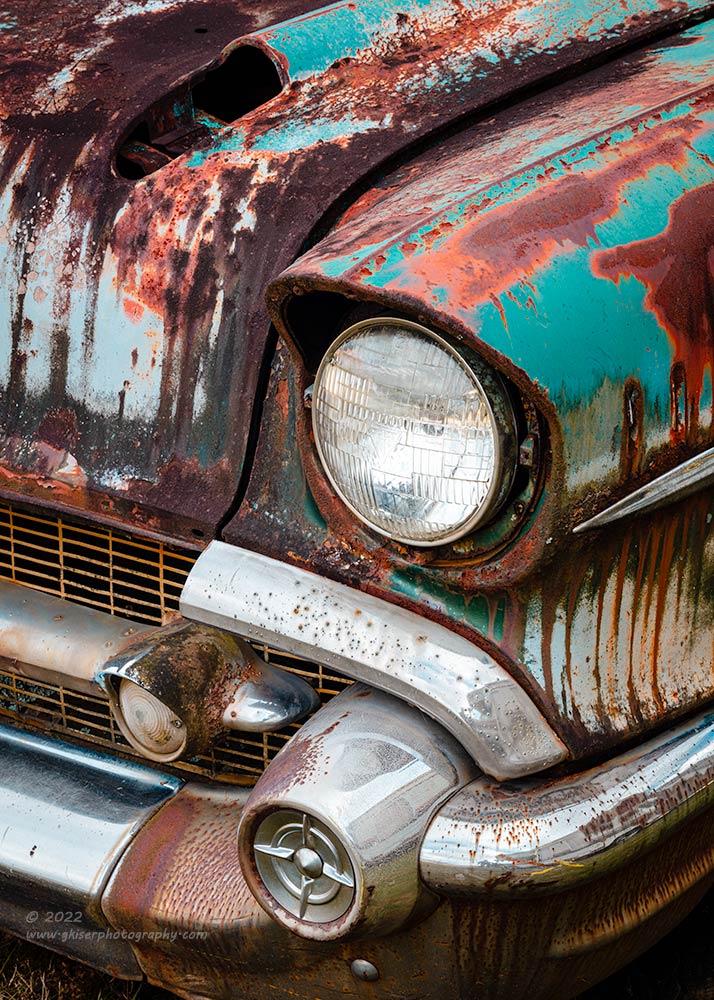
I didn’t hate that idea, but I had done it so many times before with this type of car that it felt almost expected. It was still my best bet in order to capture the patina that was all over this car. I picked the driver’s side since it was lit a bit better thanks to the bright RV next to it. I started to frame up my compositions still using the long lens and just absolutely fell in love with the way that the patina looked in the camera with the polarizer engaged. I made the shot and then changed things up slightly by going vertical and moving the camera around a bit. Both vertical and horizontal worked so well here and I was really loving how this was looking.

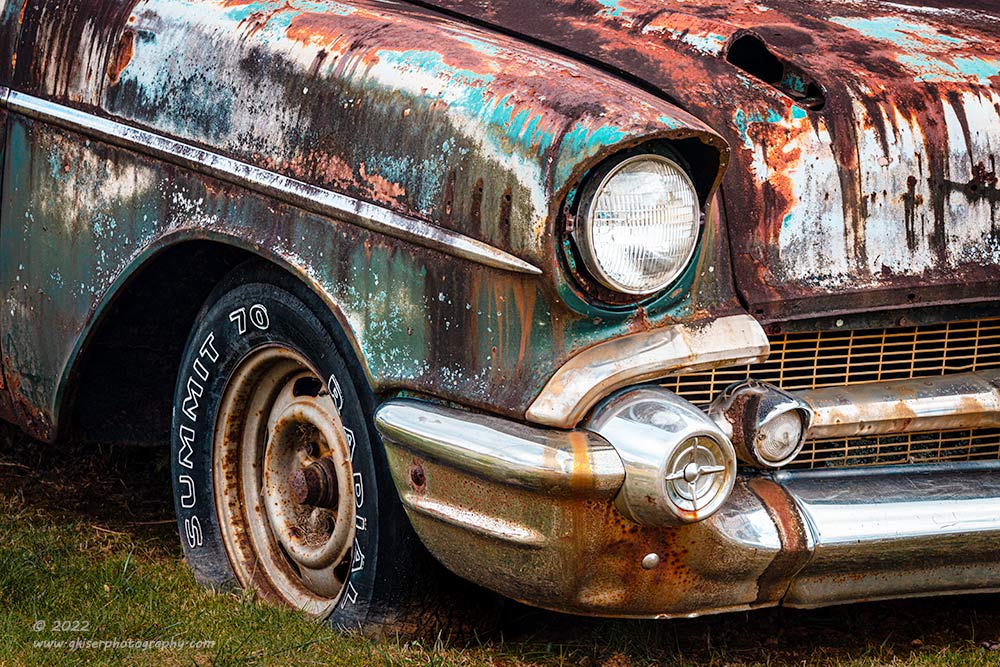
I didn’t want the other side to go to waste though even though the lighting wasn’t as good there. This car was all about the patina and the passenger side deserved a few frames as well. I started to frame up a composition on the other side and realized that I was basically mirroring the composition that I had just shot. I paused for a moment as I considered the fact that I was going to have to choose which was the best when I got home. There was no sense in having essentially multiple exposures of the same basic composition. The realization that the horizontal and vertical compositions were very closely related as well hit me, and I started to see a decision in my future that I didn’t want to make. I was working on creating the third version of the same basic composition I had started here with.
Just because I am a glutton for punishment, I decided to go all out and shoot the horizontal version on the passenger side as well. I would eliminate all but one of them when I got home, and I had a feeling that the winner was going to be the first one that I had shot. I ended up shooting 11 frames of the front of this car knowing that I would only keep a single one, but felt that it was good to have options available to me.
When I got home and downloaded the images into Lightroom, I went through and did an initial culling which got me down to the best of each composition on the front quarters of the car. I then started to go in and try to determine which one would be the winner of the editing treatment. I was looking at them on the filmstrip at the bottom and they appeared in the same order as they do here in the blog. So essentially, they went from horizontal at the ends to vertical in the center. The direction of the car pointed away from the center and had a rather dynamic look to it. As I was looking at this, it hit me. I shouldn’t be looking at this as a single image decision. What I had here was a perfect grouping of four images that would look stunning above a couch or mantle. I didn’t want to pick a favorite here, because the images as a group were a favorite of mine.
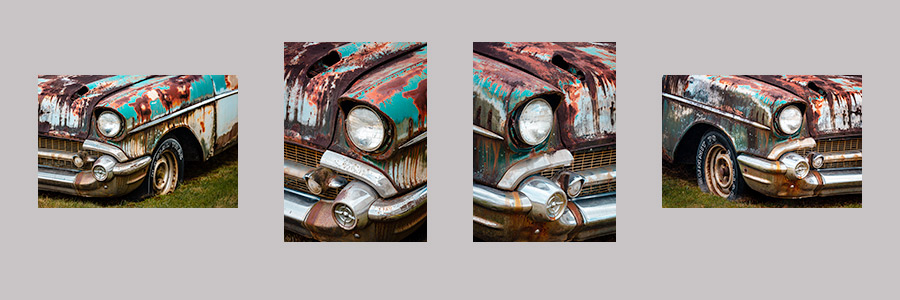
I decided that I was going to edit them exactly the same and then make sure that they matched in exposure so that they would be at home together in a display. As I worked through the edits, I became very excited about the possibilities here and started to picture moderately large metal prints all displayed together on a wall. This would allow me to be able to capture the entire front of the car like I wanted to do, but in a very different way from normal. I wouldn’t have the distractions in the background to deal with and it was a great way to include all that great patina. If this is something that you are interested in having, I would consider this a special order and will do a package price on all four prints. You know you want this for your wall. Shoot, I want this for my wall! Get in touch with me to get things started so you can have this very much one of a kind presentation in your own home.
Anyway, I digress, but I really did get excited about this idea for the four photos. I wasn’t actually done with the trek at this point though. I had just started to work out some creative alternatives to compositions and I was ready to come back to the little European Ford to try again. The least objectionable obstacle for a flattering angle on the car was the storage shed that was just to the right rear of the car, and slightly down hill. I thought that I might be able to mask the building with the car if I used a wider angle focal length. For that, I needed to switch lenses and went with my 24-70mm which would give me plenty of wide end without going over the top. I started to get the camera situated and found that the easy part was going to be masking the building. The harder part was going to be the inclusion of the sky. At 35mm I was getting a lot of the sky which normally wouldn’t be a bad thing. The clouds were looking great, and there was a lot of texture to be had in the sky.
The problem came from the fact that I was shooting the car backlit as the sun was coming from the front right corner of the car. This gave me a decent exposure on the front of the car, but the side closest to me was in the shadows for the most part. This meant that I was going to have to overexpose the image slightly in order to get the detail that I wanted. That was going to push the sky well out of the range of the camera. I liked the composition and the light was changing enough to where I could get the car all in shadow from the clouds for a nice even exposure if I waited, but the sky would be that much brighter.
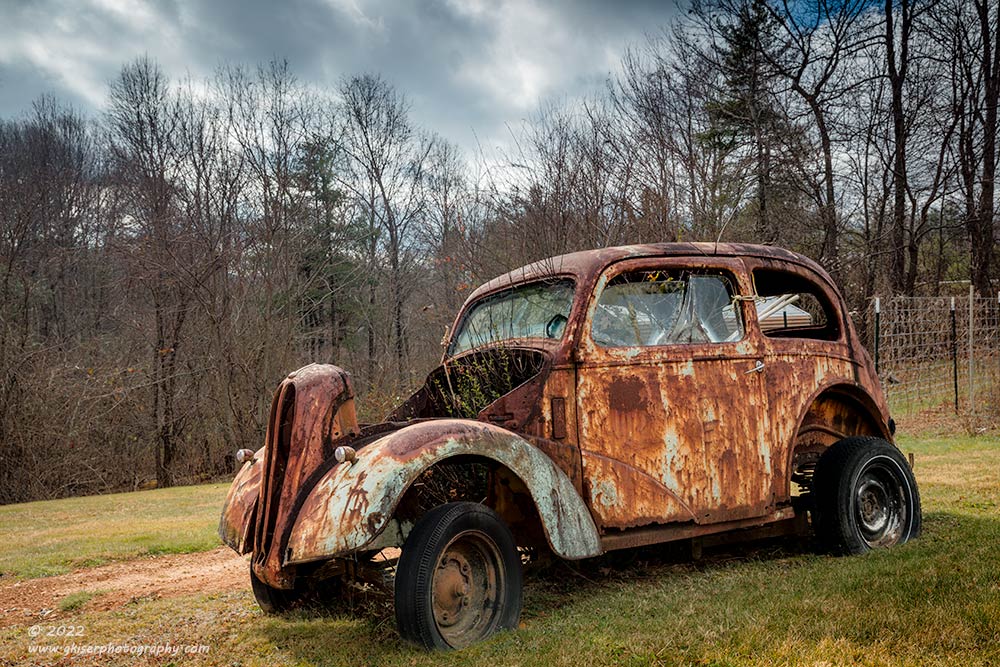
I went back to the truck and grabbed my filter wallet and slid in a 3-stop soft edge ND Grad which helped the sky a little bit, but not enough. I added another 2-stop soft filter and that evened things out significantly. From here I just waited on the sun to hide behind the clouds and started to make exposures. I was still clipping a good bit in the clouds as the brighter ones came through, so I had to wait for the car to be out of direct light AND for the clouds to be darker uniformly in the sky. It happened only a couple of times, and I managed to capture both occurrences. That gave me the opportunity to pick the one with the most interesting cloud cover as the keeper.
You can still see the garden to the rear of the car, but it just adds a bit of interest and tells more about the location. The lighting was much more difficult and I’m really happy with how this one turned out from a lighting standpoint. Had this been a ’54 Chevy pickup, I probably wouldn’t have gone through the hassle to get the image made since I was really bending the qualities of light more than I wanted to. However, I know with 99.99999999999% certainty that I will never find another one of these to photograph, so the little bit of clutter and exposure difficulty was worth dealing with. I’m really happy that I stuck with this and tried as hard as I did. The end result is a solid 7/10 image for me and one that will certainly be around for a long time just because of the subject.
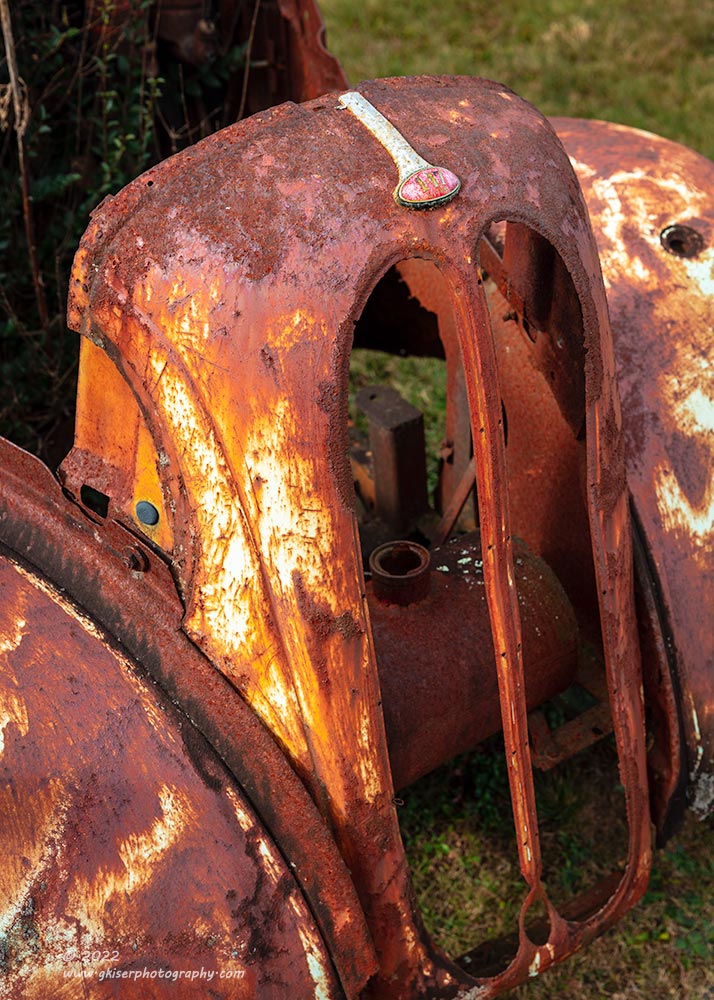
With the overall photo finally complete with the little Anglia, I was feeling a bit better about my chances with this car. I started to look for other isolations and found that the most interesting part of the car was the front end. I loved the missing grill and the fact that there was a small tank right behind the grill shell. The firewall of the car was overgrown with vegetation which added another interesting element as well. The patina here was also quite interesting so I wanted to get a composition that captured all of these elements. It took a little figuring since I had not shot a car like this before which meant that I had to work out a compositional formula to see if it would work.
I tried a mixture of horizontal and vertical frames and eventually decided that the more prominent vertical composition fit the subject better. While most of what I had shot of this car as an isolation had been black and white, there was enough color contrast in the patina in the frame where I felt that color would be a more suitable option. You can see how uniform the color was around the emblem at the top of the grill that prompted me to go with black and white. Fortunately, there was a lot more character to the patina for the rest of the car.
When I got the photo that I thought would be the keeper, I made one last look around the car to make sure that I wasn’t missing anything else. Satisfied, went back to the truck where I had only shot one successful composition thus far. I wasn’t feeling pressured to get another photograph here because the other two cars were much better in terms of patina. I had shot plenty of trucks of this era also which allowed me to be a little more selective in what I photographed.
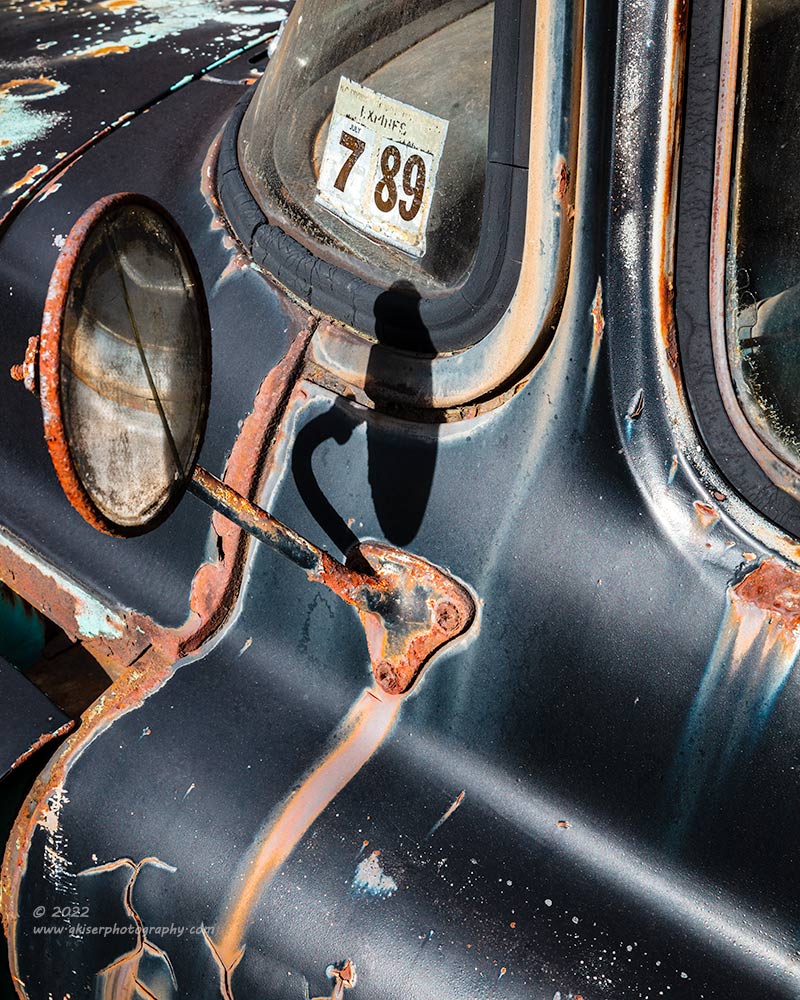
As I was looking around the truck, it was the driver’s door and mirror that caught my attention. I thought back to how I had used the mirror on the green GMC recently and thought that I might be able to do something with this mirror as well. I looked at the area around the mirror to determine what my points of interest were. I had some interesting lines and curves. The edges were all accentuated with rust and there were streaks in the paint from that rust. I liked the way the windshield curved and framed the old inspection sticker that brought back so many memories. The fact that the numbers were all in sequence made this sticker even more interesting.
I started working on a composition trying both horizontal and vertical frames. I eventually decided that the vertical frame was the best option for this scene, but it was still missing something. There just wasn’t enough interest here without more rust. While I was trying to figure out how to make this more interesting, the sun came out from behind the cloud and turned my live view into a very overexposed image with the histogram jammed to the right. I just waited for the sun to pass, but in doing so saw the shadow from the mirror adding yet another element to the scene. I liked it, so I changed the shutter speed to get a proper exposure. Just as I got it set, the sun went away and I was left with the same scene that I had before, only darker. I was interested in the shadow though, so I waited for the sun to make another appearance to see if it would work in a photograph.
A minute or two later, I could see the light changing and the histogram starting to look right again. I had the sun, and the shadow. I shot a few quick images as the intensity of the sun changed. When the door was back in shadows once again, I looked at the review of the images I had shot. I really liked how they looked and figured that I had at least one keeper out of that group. I made another check around the truck to see if there were more compositions that I might have missed. I didn’t see anything that really interested me, so I happily called it quits on the truck. I was still stumped about the Bel Air though. I so badly wanted to get an overall shot of this car but hadn’t been able to figure out how to make it happen yet.
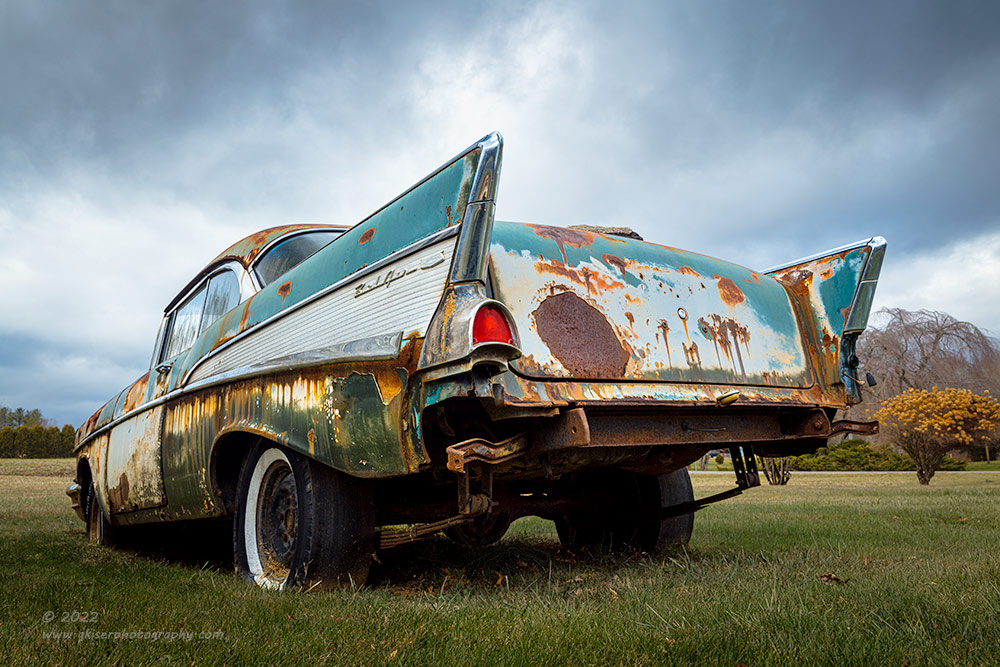
I went back out to the old Chevy and started to look at my options. My preference was to get it from the front, but as I had determined that was just not possible. My other option was from the back. Looking from the passenger side quarter, I would have the RV in the background which I didn’t like at all. From the driver’s side, there was a large house across the street and an intersection that I would have to deal with. I started to think about how difficult it would be to cover the house with the car. It might be possible to do.
I moved in close to the car and got low. I could see that if the camera was about a foot off the ground, I would be able to cover the entire house with the car. The sky would fill most of the background and there was a very subtle texture to it that I kind of liked. I still had my 24-70mm lens on which would probably give me the right perspective for this photo. I extended the center column of my tripod and flopped it over to allow me the ability to spread the legs in order to get the camera down on the ground. I was now on my hands and knees getting the composition figured out. There were a lot of subtle movements to hide the various bits of clutter while keeping the car looking good. The framing was decided based on a small tree to the right, and a power pole to the left which was just out of frame. The wide-angle perspective really made the car look impressive from this low. The lack of a rear bumper made this possible as the chrome would have been too bright and very possibly too reflective at this distance.
Looking at the histogram I saw that the sky was probably a bit too bright to allow me to get the exposure that I needed under the car as I wanted a little bit of detail in the shadows. I went to the truck and grabbed a 2-stop soft grad filter to just take the bite out of the sky, but not be noticeable at all. This did the trick and allowed a very nice exposure through the image which I knew would allow me room to work in post. I cleared a few leaves that were in front of the camera and made my exposures. I was hopeful for this series as it looked like there was a lot of potential in the image reviews.
When I got the images home, this one became an early favorite, and I was very excited as the edit came together. I think that this is my favorite image from the day and is certainly the one that I worked the hardest at in terms of design and execution. I always enjoy those successful images that are the result of a lot of hard work. Somehow, I feel like I earned the right to be proud of those images since they didn’t come easy.

I still wasn’t done with the old Chevy though. I went through another round of finding interesting points on the car to show off the wonderful age of the body work. In addition to some less than satisfactory images of the front end of the car, I spotted the remains of a AAA sticker on the right side of the windshield. That little detail became the starting point for a composition that included panel lines and some great curves highlighting the patina of the car. The rust and layers of paint just positively glowed in the soft lighting of the cloudy day.
With that composition done, I felt that I was through with the car. I had shot 91 frames in about an hour and 45 minutes. Considering this is a location I had passed by several times I was floored at how much there was here. I was thinking that I probably had about six or seven photos to go through and edit. You can imagine my surprise when I doubled that with keepers from this location. As I mentioned, I am getting to that point where I’m starting to go deeper into a location than ever before and I’m getting more images than I am used to. This is not a bad problem to have, but it does take more time on the back end. The edits on these took about four hours to go through. That brought about three hours of typing here to get to this point, but wait….there’s more.
I did leave the location in Ashe County and started back towards home. After checking on Toni and finding out that she was doing better and was getting a bite to eat, I made sure she was OK with me trying one more location before sunset. She was fine with it and almost forced me to go since she knew that I didn’t get clouds as much as I was wanting here lately. The other location that I was wanting to try was a barn that I had shot at the end of 2020. The conditions hadn’t been all that great when I was there as far as how the sky looked, but I made it work. I even sold a large three-piece version of the panorama a few months after that day. Since then, I had been considering going back when the sky was more interesting, but never got around to it. With one of my other mentorship clients wanting to shoot a grand landscape with a barn, the thought had resurfaced once again.
I decided to go out there and see if the barn was looking good in the evening light with the clouds as they were before calling John. There was no sense in bothering him if the conditions weren’t right, and I only had an idea of how the light was going to be behaving around the barn. When I got there, the clouds above the barn were magnificent. The barn wasn’t in great light since the sun was behind clouds on the other side of the road, but there were enough breaks in the clouds that would likely let the sun through. It was good enough for me to see if John was free to do a quick session. Unfortunately, he was out of town which meant I was going to be on my own.
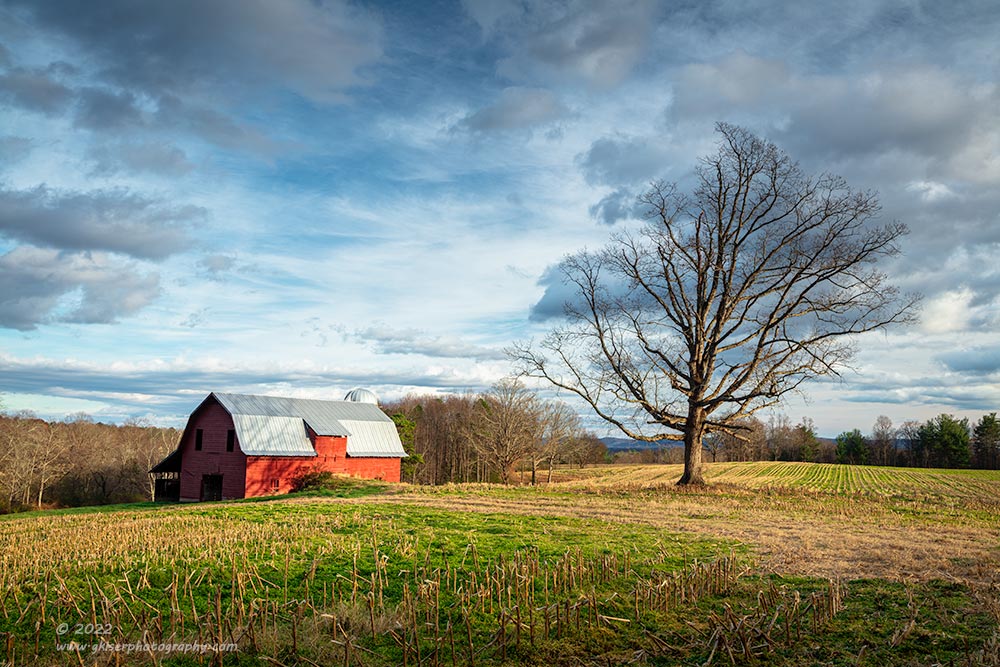
The layout of the scene was almost too simple and that made finding the right composition kind of hard. I remembered some of the issues I had gone through a couple of years prior. They were still very much the case. To combat one of the compositional issues before, I had shot a panorama. I really liked the composition in that kind of format, and it worked with the sky that I had then. This time, I had a much more interesting sky, so including it wasn’t going to be a problem at all. Remembering back a couple of weeks when I had made a scouting trek out here and tried to get a shot in the rain, I knew that there was no need for a telephoto lens because I didn’t like the composition that it offered. Instead, I went with the 24-70mm lens which gave me a wide enough angle to include a lot of the sky and keep the scale where I wanted it between the tree and the barn.
I started working out the composition from right at the road and found one that I liked. I started making exposures here as the clouds moved and every once in a while, the sunlight would hit and light up the barn which I wanted. As time moved on though, the clouds started to thin from this angle, and I decided to alter my angle a little to get the clouds back in the frame again. This also gave me the opportunity to move in closer to the fence and use an even wider angle focal length. I liked this composition much better and committed to it. To make sure that I kept interest on the ground and barn, I added a 2-stop ND Grad to bring the sky’s exposure down slightly. From here, I just waited to see what the sun and the sky were going to do.
I ended up shooting more photos of this composition than I did any of the other subjects from the day. At final count, I had 42 exposures just on this barn with only two different compositions. When it comes to a sun close to the horizon mixed with clouds, there are so many things that will change that influence the scene you just keep making exposures hoping to get that best light. In addition to the best light, I also wanted to get the clouds in the right position in the sky to work with the light. It was a constant battle between those two elements, and rarely did they fall in place together in the way that I wanted. Our of those 42 images, there were only three that I looked at closely for an edit and this is the one that won out. It just had the best mix of warm lighting on the bar, tree, and field, while the pattern of clouds in the sky seemed to add to the overall impact of the scene.
After about an hour of watching the light change, I saw that the sun was dipping into a very large bank of clouds that had no end. Knowing that the light was going to be gone, I packed up and headed home. The sunset was remarkable but would not have worked for this barn because of how the horizon was. I would have loved to have captured the sunset, but I was tired and needed to get home to check on Toni. She was doing better, but still very sleepy. I ended up letting her sleep in my lap for the evening while I let the images from the day float around in my head so I would be ready to edit them in the morning.
Here we are, a bit over 24 hours later and I’m finally to the point where I can release the new images. I have fifteen new keepers from the day which is amazing from just two locations. I’m glad that you got to come along with me for the adventure, and if any of the images jump out at you, or if you would like to have that grouping of four photos, please let me know. You can order stock sizes directly from the website if you like, or we can discuss specific needs and budgets. If you would like to take your photography up to the next level, consider joining me for a mentorship. I have a lot of options and I’m always open to putting something together for your specific needs even if I don’t offer that certain plan.
I think it is safe to say that I am ready to take a break until December. Of course, anything can change, and I might be back here in a couple of days with the latest trek. I seriously doubt it though. I am worn out and want to recharge my creative batteries for a bit.
So, until next time….

Remember to use the code KISER10 to get 10% off your purchase