Monday, August 24, 2026
We’ve finally made it! This is the last entry for this trek that really was more of a scouting mission than anything. You can read all about how it got started by visiting this blog entry. I had gone out with the idea of getting something specific, but that just didn’t work out. It wasn’t a failure of conditions as I think that the conditions were just about perfect for what I was wanting to capture with that Dodge truck in the fenced lot. However, I chickened out when it came to trying to contact the property owners knowing that it was going to be more than just getting permission. Someone was going to have to come down to the gate to let me in and would then have to come back and lock up when I was finished. All that was taking into consideration that they would even let me into the property for the photos to begin with. I think that the safer option will be to wait until there are people inside the fence and the gate is open. I’ve seen it that way a time or two, but never when I was in the position to get photos. Hopefully it will work out that way at some point.
At any rate, I decided to look for alternatives for the day since I was out and itching to get some photos. The next two spots didn’t really work out either, but as a last-ditch effort, I decided to do a little more research on a property in Booneville which I had gotten a tip indicating that there might be many more old cars further back in the property. The sun was out pretty strong, but there were some passing clouds that softened the light every now and again. It wasn’t ideal, and based on how I normally shoot, it was horrible. However, there was something inside of me forcing me to pick up the phone and give the owner a call. That ended up with a few extra steps, but I did get in touch with the family member that was close by and he was happy to let me get some photos. It helps that I got the contact information from one of their family friends who knew me very well.
I ended up getting a tour of the property, at least what could be walked easily with the brush that was all grown up. The canopy was dense enough in most places that the strong sunlight wasn’t a complete killer for the scenes, and in some situations made them slightly better. After having seen probably ten percent of the vehicles on the property, I was very excited about the possibilities and was thrilled at the prospect of returning out here during the winter when I could get deeper into the property and not get eaten alive by the mosquitoes. My arms look like I have a skin condition today as I am typing out this last installment. I’m also really wanting to see this under a cloudy sky. Fog would be excellent, but I really doubt that I will be able to time it to get fog that densely in the woods. It would be a really nice element though.
When we last left off, I had been working with a Buick convertible that I had spotted during the tour that was just too unique to pass up. I had also talked about how I had gone back through and reworked three different black and white images to see how they would turn out in color. You have seen two of those, and the third will appear in this blog soon enough. The reason behind the change of heart with the presentation of the images was the fact that initially, I had used the black and white approach to counter the mixed lighting over the scene. I’ve already gotten into the details of this, but essentially, the color temperature in the shadows is different than what appears in the sunlight. Since most of the images that I had shot included both types of lighting, I was getting some odd color casts through the scene and then the fact that much of the bounced light was tinted green created another layer to that mixed lighting. Black and white is a great way of dealing with that problem, but I also figured out how to address it successfully in the color images as well. Going back through the black and white images, I found three that might benefit from the colors within the scene and worked through those images once again. They worked, and were just as good as the black and white ones which prompted me to keep both versions for the collection.
Something else that you might have noticed up to this point is that I had been using the telephoto lens exclusively to this point. It allowed me to really isolate the scenes that I was photographing as well as getting me in closer without having to work through the brush as much. Now that I had been out here for about an hour, I was ready to change things up a little bit and swapped out to my standard zoom which is what used to be my workhorse lens. It is still one that I lean on a good bit, but it is not used nearly as much as it once was. I thought about using the wide-angle, but that was going to get into too much background, and I was going to have a harder time using it at the wider end of the spectrum. The standard zoom on the other hand, was better suited for this environment because it had a moderate telephoto range as well as a moderate wide-angle range, so I had options. It also had a close focusing distance which would be beneficial for any more detail shots that I might want to frame up.
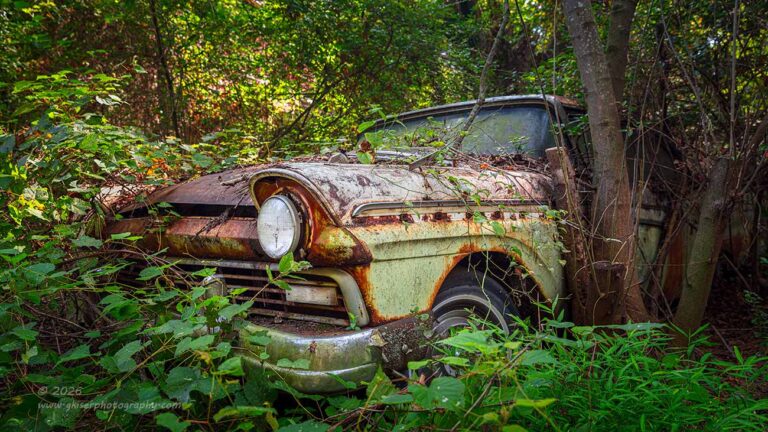
The next subject that I chose to work with is the primary reason that I wanted to change out the lens. I had spotted this Ford during the tour with the property owner. I even remember him saying that everything was very grown up back here and that I might have a hard time with photos. To that, I had responded that there was a Fairlane that we had just seen which had an exposed headlight that I thought would make a very strong composition with the grown-up brush around it. Now that I was making my way back to the beginning point of the tour, I was looking right at that Fairlane and everything that I was seeing was confirming what I had thought earlier. The long lens just didn’t work for this scene though because of how close I had to be to it. Changing out the lens was exactly what I needed to do here.
All that was left to figure out was the right angles to work with and how high the camera should be. I decided to frame this scene up using the landscape to frame the car. On the left was the brush that was partially obscuring the front of the car while the right side had a group of trees that were growing right alongside the driver’s door. Behind that tree was the rear of the car, but it was in deep shadow. The front was getting a bit more light from the sun and there were some highlights in the distance that added depth and dimension to the image. This was one of those cases where the sunlight actually helped out the composition.
There is a difference in dappled lighting and lighting that comes through a clearing in the canopy. I was looking at the latter, and it was creating some depth in the scene. You might remember that I had to forego an overall photo of the Buick convertible because of the dappled lighting that was falling over it. The dappled effect creates a camouflage of sorts because the highlights and shadows mask the lines of the subject and create some extra visual confusion. Dappled light is just not a good thing when you are working in close to something. That light is better on larger landscapes caused by the clouds as it adds more to the scene. The shadows from the trees above these cars is just too distracting in most cases. The same sunlight that prevented the photos of the Buick were making the photos of the Ford much better. The difference was in how the shadows were cast in the scene.
Essentially, this is what I refer to as reading the light. I talk about this a good bit during my mentorship sessions and when I used to teach workshops. This has nothing at all to do with concepts like only shooting at golden hour or place the sun behind your subject for more even lighting. Those are generalized suggestions that have turned into edicts for new photographers. When I talk about reading the light, I am just suggesting that you look at the light that you have at hand and try to figure out the best possible way to utilize it for the subject that you are working with. You can see the results here as I have shot two very different images on the same day, at roughly the same time, but the differences came in terms of what the light was doing with each subject. I chose the right composition based on the light that I had to work with. Photographers tend to forget just how powerful of a tool that composition is, and tend to put all their eggs in the basket of light. I’ll always say that composition is the most important because it is the one thing that we can control, at least outside of the studio.
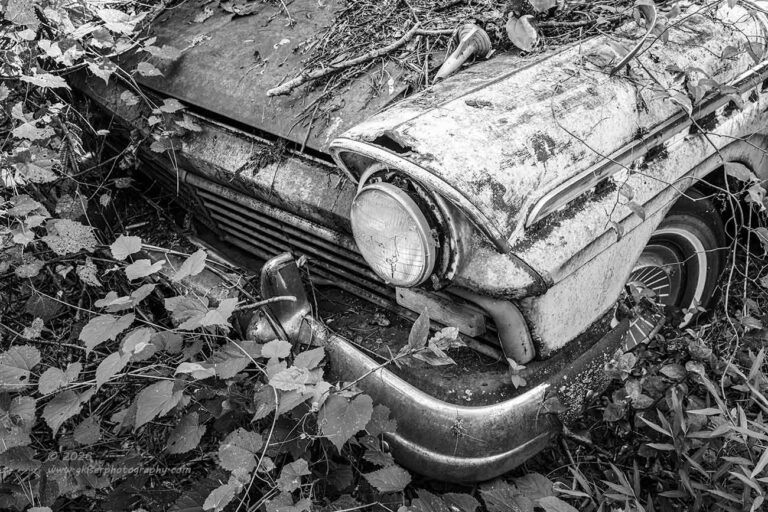
The lighting was actually quite good on this Ford and that prompted me to spend some more time with it. The brush was causing me issues in getting in position for a lot of compositions that I might have wanted to make, but there was a lot of working room at the front of the car which I wanted to work with. As you all well know, I have a think for headlights with these old cars. They have so much to do with the styling language of each manufacturer and it seems that how the car looks as a whole all stems from the headlights. Yes, I know that these are the same off-the-shelf sealed beam headlights that all of the manufacturers used during this time. That is what makes them so interesting to me. The designers started with the same circle of glass and built the individual style around that element. These days, manufacturers can design the headlight however they want to thanks to using plastic lenses. LED options have furthered the design boundaries as well. Yes, today’s headlights are more dramatic, but it is almost a cheat sheet of sorts since they can look like anything the designers want them to. Back in the ’50’s and ’60’s, the headlights were all the same and the design language had to grow from there. This brings out the soul of the car much better than modern designs, at least in my opinion.
Because I love working with the headlights so much, this visible headlight caught my attention because the trim ring around it was missing. This created a bug-eyed effect that I found interesting and a little humorous at the same time. It made that simple sealed beam headlight stick out from the rest of the styling and almost become its own element in addition to the car. That separation from the rest of the styling highlighted the fact that the headlight was just a universal piece which was used for every car of the era. With the headlight separating from the rest of the car, you can start to appreciate the unique styling approach that Ford took with this car even though they were using that stock piece of illumination.
I’m sure you have been anxiously awaiting this deep dive into automotive design and how that influences my photography. I just really like design that works around elements that can’t be altered. The fact that the design is still rather valid some seventy years later is pretty cool. The fact that the design has found its way into an overgrown woodland setting is just that jarring element that makes everything that much more interesting. This is where we find ourselves back at the argument for the fact that photography can share a lot of qualities with Haiku poetry.
Images like this one are just small details of the whole that speak for the entire scene. It is a simple and concise composition with an unexpected twist that startles you in a way. I’ve been creating images like this for many years now, but only in the past year or so have I been able to give that concept a name. Synecdoche is a term that describes much of what I photograph, especially dealing with the detail shots. I like the word because it is one of the most oddly formed words that I know how to spell without relying on auto-correct.
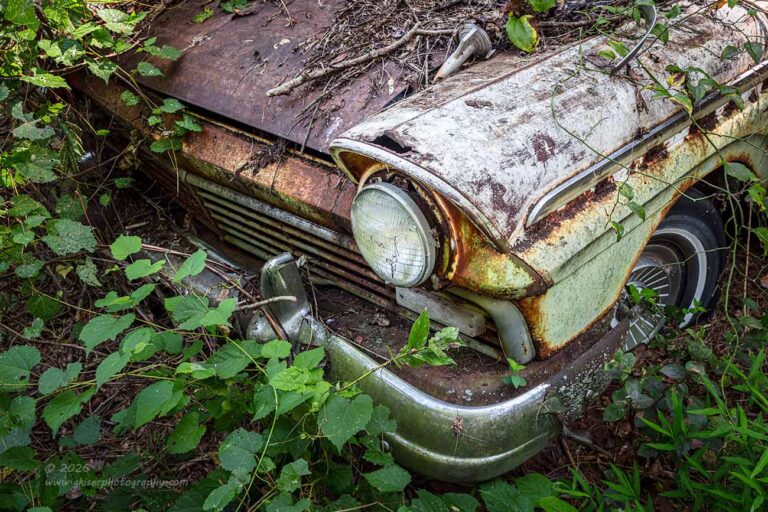
This image of the Ford was also the third image that I revisited and turned into color after the first round of processing was done. The colors weren’t all that funky in this scene because the lighting was a bit more even. The issue that I had was that the car had a green hue to it that kind of blended in with the vegetation. This created more of a monochromatic look than I really wanted to see. With the overall photo, I worked very hard with the color grading to get the car to stand out from the background. I wasn’t able to get that division of elements in black and white, so I needed the color to establish the main subject and give it separation. That took some doing, but in the end, I feel that it worked out very well.
Not wanting to go through all of that with the detail shot of the front, I chose to go with black and white. The difference in textures was obvious and that made creating that visual separation very easy in black and white. It was possibly even more effective than I had anticipated now that I’m looking back on the images. However, after I did the final touches on the overall image of the Ford, I was really impressed with how the colors came out. So much so that I decided to copy those processing settings and apply them to the corner shot to see how that looked. The colors came out great, but the tonal values for luminance were off quite a bit. It took a bit of work to fine tune the image, but I did have a solid starting point for the colors which had taken me quite a bit of time to work through in the larger composition. In just a little bit of time, I was looking at a color version of the corner of the car that I felt was just as good as the black and white and fit in very nicely with the overall composition.
There are many times when I look at the photos that I make keepers as parts to a puzzle. My hope is that they will find clients that wish to do a grouping of images, and for these groupings, I need to offer more than just the hero shot of the subject. I could easily see a diptych arrangement with the full composition and the detail shot, both in color, hanging on a wall. The black and white version would not really fit, so I wanted to have that option for the client. The black and white image would stand on its own quite nicely though, and I feel that it is a very powerful image on its own.
I’m always thinking about the intended end use for my photos when I am out capturing them in the field. My goal for these images is never to have them languish on a hard drive never really being appreciated. That is usually the case unfortunately, but my ultimate goal is to have them printed large and hung on a wall to be enjoyed in a physical form. I sell prints of all of my work, and part of that process is counseling my clients. I fully understand and respect those that know exactly what they want. Those clients are the easiest to work with and that makes my job much simpler. However, most of the folks that are buying fine art photos to hang might not understand the ideas of groupings of images, or media that the print is to be done on. There are probably questions as to what size is best for a particular space as well. All of these questions I’ve been considering since I shot the image and am happy to help you with your decision process. It is just part of the service that I offer as a photographer. For me, the print is the ultimate expression of my artistic concept and to be able to work that print into a client’s personal space is the whole reason that I started out in photography more than 20 years ago. All you need is the idea that you like one of my images and would like to have a print. From there, we can discuss options and get you matched up with the perfect print or prints to meet your needs. Of course, this can be for home or business use. I even work with a gallery that travels all over the state of NC that will frame and install the prints in a large commercial setting. No matter the size of the job, I do have options available for you.
OK, enough about print sales, now back to the trek at hand. When I was done working with the Ford by the front of the property, I decided to go back through the accessible property one last time with the standard zoom lens to see if there was anything else that I wanted to capture before I called it a day. I was getting kind of warm, and I was surprised that there was any flesh left on my arms at this point. I was waiting to be carried away by a swarm of the mosquitoes, and it might have been the weight of my camera bag that was preventing that from happening.
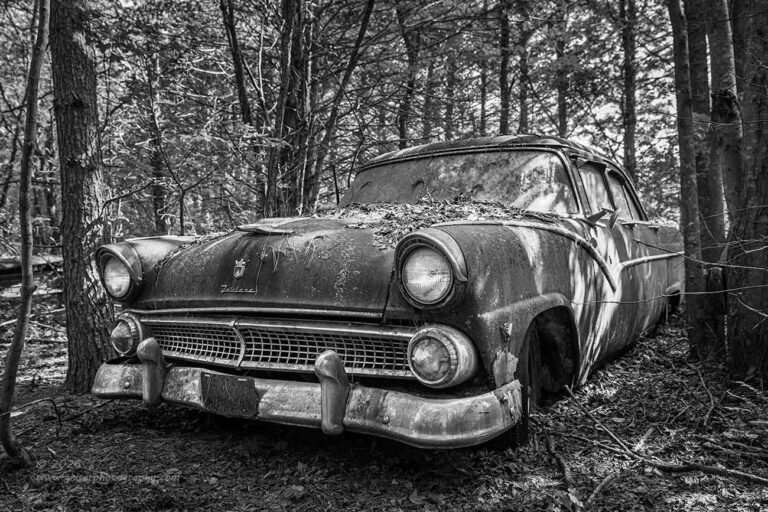
As I was walking through the property, I spotted another Fairlane that I had seen earlier. I believe that it was a Crown Victoria based on the trim. I hadn’t really thought to do much with it earlier and I don’t know why not. It was a gorgeous car and was situated kind of alone between the trees. The only problem was how the light was coming down on it. It was that dappled light that I didn’t really care for in a sunny woodland setting. However, I noticed that the front of the car was pretty well in the shadows while the dappled light was restricted more to the door of the car. It didn’t really pose that much of a distraction, and I thought that it added more dimension to the image in many ways. It was a concept that was either going to work or it wasn’t. I wasn’t convinced either way, so I decided to give it a try.
I only shot a couple of frames of this Fairlane just to try and control the hotspots as best I could. I left it at that and continued on with the day. When I did finally start looking at the images, this one made it through both rounds of culling and was good enough to try and process. As I had done with so many of the other images from the day, I chose to look at this one as a black and white presentation. The reason for that was that the car was covered in a green layer that really made it blend into the woods. The actual rust and patina on the car weren’t enough to add that much interest either, so black and white really worked out well for what I was trying to accomplish. It was also a great way of dealing with the bright highlights through the trees with the bright sky in the background. White skies always look better in black and white, at least in my opinion.
The further I got into the edit, the more I liked the photo. Sure, it was a pretty “expected” composition of the entire car and looked kind of like a postcard shot, but it established a lot about the story of the car. For me, it was a good starting point for where I decided to go next. Now that I was involved with the car, I started to look for other angles and details that might work as photographs. Because the trim was a bit more involved which was why I was thinking that it was a Crown Victoria, I started to look at the emblems and trim for some detail compositions. The hood ornament was a likely candidate for me and I’ve shot these hood ornaments many times over. This car offered something a little different though which pulled me in.
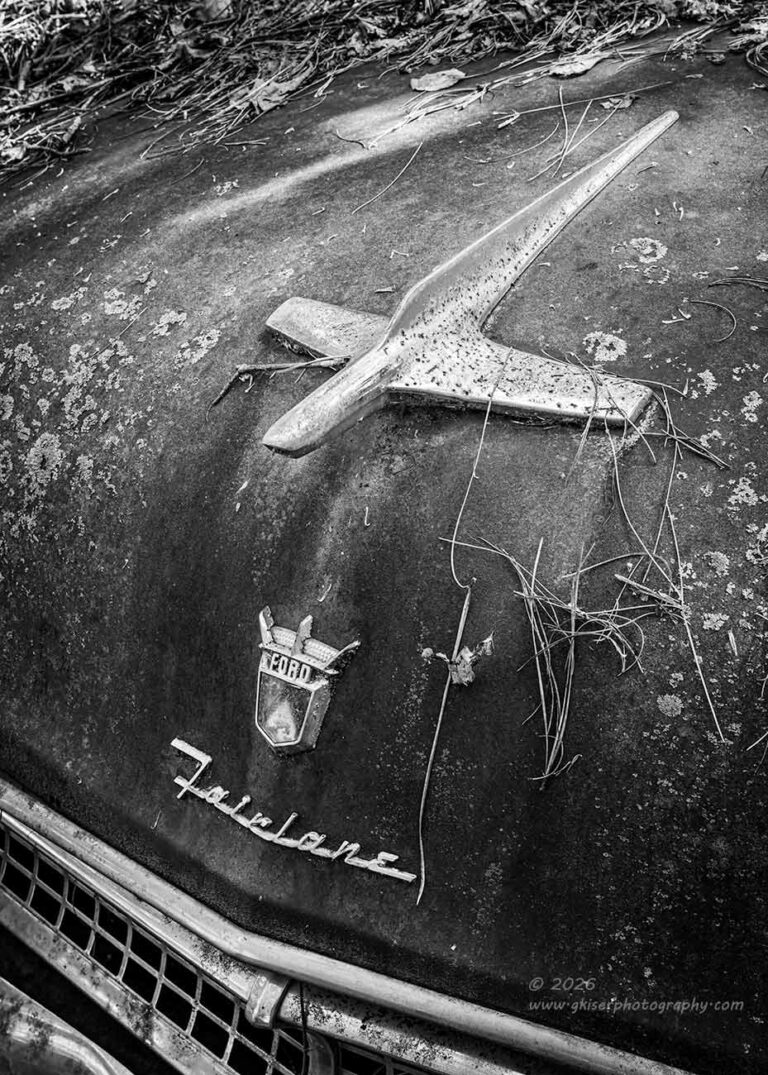
To start with, the fallen leaves and needles made for a wonderful natural vignette towards the top of the frame which kept the eyes in the actual frame of the photo. While I am very used to finding the crest below this hood ornament, the crown on top of the crest was kind of a unique detail for me. The script below that read “Fairlane” was also something that I don’t run into all that often. This became the foundation for the next composition and I chose to include the grill below for a bit of a lower framing element. I also liked how things were falling into place when I stepped off to the right side and let things go a bit diagonal in the scene.
Everything fell right into place and I loved the composition. I just needed to make sure that the framing, depth of field, and the ultimate final crop to change the aspect ratio was going to work out well. Because of these concerns, I ended up shooting four different exposures with the keeper being the second in the group. Black and white was a natural here because of the lack of importance that the colors provided to the whole scene. I was much more interested in the contrasts in luminosity as well as the textures that I was seeing. The end result just looks effortless, but there were a lot of decisions that went into this image both in the field and during the processing.
I would have really enjoyed working more with this car, but the rest of the car was in too harsh a light to get any other isolations captured. It was one that I wanted to come back to in different conditions to work with more fully. I just hope that I get the chance. I kept hearing the word “Crusher” bouncing around in my head. I knew that many of these cars were going to be hauled off soon, but I didn’t know how soon, or which cars. I was only hoping that the great examples that I was seeing were still going to be here in the near future. These thoughts kept me motivated to get what I could while I was here which is why you are seeing so many photos from this trek. I knew that there was every chance that this was going to be my first and only chance to get photos from here. I had to make it worth my while. If I do get to come back and work this area more fully, that will just be icing on the cake.
It was getting more and more difficult to work the area though. It was almost 11am at this point and the sun was really getting high in the sky. It had been difficult enough battling the sun while it was kind of low in the sky, but with it at full strength with no clouds almost at the top of its travel, the lighting was getting very difficult to work with. Things were much too contrasty in just about every direction that I looked at this point. I felt that it was probably time to pack it in and head home to see what I had captured. I didn’t break the camera down just yet though and started walking with it over my shoulder fighting the urge to use it to swing at the mosquitoes that seemed to be ramping up their attacks on my skin.
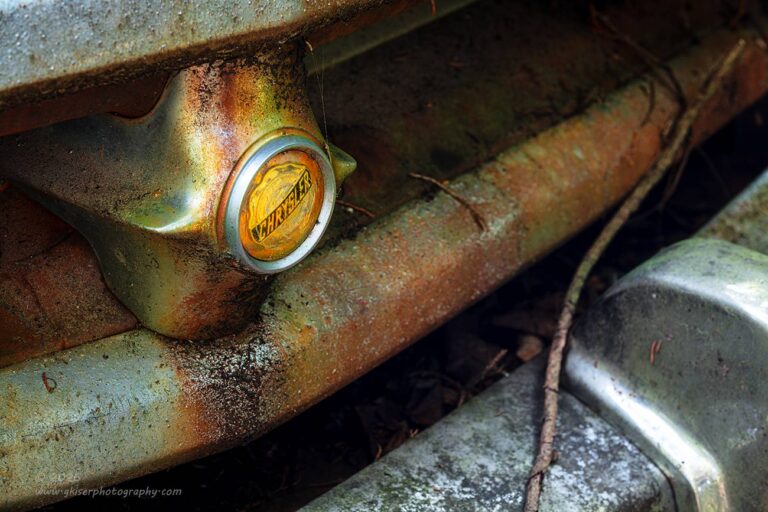
I walked past car after car and wished that the light was better so that I could get some more photos, but nothing was really working out at this point. Some twenty minutes later, I was back at the first scene that I had worked after contacting the owner. Once again, the Chrysler was calling out to me. It was the one subject that had a good enough sight line to photograph, and the light was still not too terrible on it.
The day had started with me photographing it from a distance and not worrying about the details. I had kind of moved on quickly from this car wanting to see what else the property had to offer. Now that I was calmed down a bit, I was able to concentrate on working some details on the car. After getting in close to it, I started to see what grabbed my attention. Almost immediately, I spotted the little badge on the grill which almost glowed in the light that was falling on it. This was very interesting to me and I decided that the light was good for a few quick photos. I thought that I had the right lens for the job already fitted, but I wasn’t able to get the framing that I was really looking for out of this. Everything that I was seeing through the camera included too much around the badge.
Ironically, I decided to switch to the telephoto lens that I had started off with. When I first was photographing the car, I was capturing an overall and establishing composition with the long lens. Now, I was quite a bit closer and picking out details with that same lens. This car shows just how versatile a 70-200mm can be when you know how to use it. It allowed me to get the exact framing that I was after which really took advantage of the different diagonals that were in the scene. It was a very simple composition but turned out to be one of my favorite photos from the day.
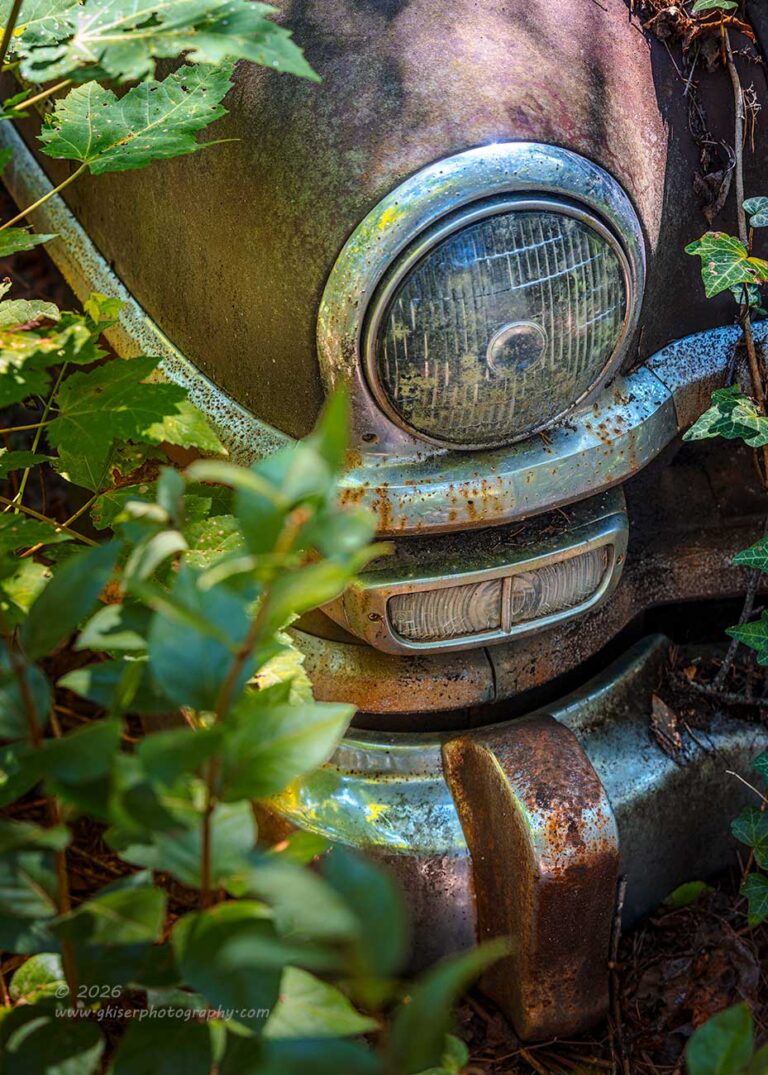
I was feeling pretty good about that last isolation shot of the grill and felt that this car had one more view to offer me. My creativity was waning a bit, and I was getting rather tired. I mean, when I set out earlier this morning, I had planned on working a single subject with just a few photos. I was not mentally prepared for working a location with a couple of hundred cars over many acres. It had been draining, but in a good way. The mosquitoes had also been draining, but in a very bad way. In both cases, I was nearing the end of what I could give. There was just this one shot right at the corner of the car that caught my eye. Once again, this composition was formed around the headlight with the vegetation acting as a framework for the image.
The headlight was nothing special and was roughly the same as the Ford Fairlane that we started this blog entry off with. How the designers at Chrysler worked this headlight into their car was completely different though. That was the part that interested me. I worked around with the different angles to see how I liked the different combinations of elements. Once I found the right angle, I started to fine tune that composition hoping that the sun would find a cloud to hide behind for a quick moment. I could see the clouds above, but they seemed to evaporate minutes before getting to the sun. It wasn’t looking good at all, so I had to really pay attention to the exposure and make sure that I had enough information in the shadows and highlights to make the image work.
There was a total of four frames captured with the keeper being the second in line. The sun never did cooperate for me and I really thought that this one was going to need to be done in black and white to deal with the high contrast. By the time I got to the processing on this one, I had been at it for hours and had figured out how to make the color images work the way that I wanted them to. I looked at it as a black and white but felt that there wasn’t enough separation between the fender and the leaves. I needed that color contrast to add to the image. The problem was that the fender had a great deal of green tint to the colors that it was showing. The colors actually looked quite ugly in the RAW image, but I was now familiar with this process and knew what to do with it. That started a long and arduous process of color grading to get the fender and the leaves to be different tones while keeping everything realistic.
Don’t think for a minute that I was changing and manipulating the colors beyond what was actually there. What I was doing was massaging the colors that existed and correcting for the lighting that was falling on the scene. I was able to purify the green tones of the vegetation while removing the odd color tint from the rust and leaning into the natural rust tones. The end result shows how the scene looked to my eyes at the time, but the camera just was not able to capture the colors in the same way as my brain was able to process it. What I see here is actually quite impressive considering what the image started out looking like. I has all the qualities that I was wanting to showcase for this isolation and I was very glad that I took the time to get the image captured.
I was beat at this point, however, and was ready to call it a day. I had been out here for a bit over an hour and a half and during that time had captured a total of 56 exposures. It really wasn’t that many frames considering I will usually come back with more than that from only an hour’s work. It goes to show just how hard it was to get some of these photos. Remember, I don’t just spray and pray, I do a ton of initial culling by choosing not to press the shutter button in the field. When I do press the button, I am pretty sure that what I am capturing will work. With that in mind, I was really figuring that I had about ten keepers from the day, and that was going off of a very optimistic hit rate for the conditions. I was surprised to see that after my first round of processing that I had double that number as keepers. After going back and looking at the black and white images, I brought that number up to 23 keepers for the day which you have now seen all of.
To say that this trek was successful would be an understatement. I’m actually scared to see what will happen out here on my next trek when the conditions are better and the vegetation is not nearly as prevalent. After only seeing a small percentage of the cars out there, I know that there has to be some really awesome examples further in the woods. I just have to be able to get to them which should be possible towards the end of the year. The only issue will be what cars get hauled off before I can get back out there. I’ll keep my fingers crossed on that. There is a certain solace that can be found in the fact that I was able to capture as many of the cars as I did during this trek. Even if I never get back out here again, I have done it justice and created a monument of sorts to these antiques. I’ve done my part, now it is up to you to do your part and select a few of these as prints to hang on your walls to be enjoyed long after the cars are gone and turned into paperclips.
Thank you for joining me for this trek and for slogging through three chapters of blogs in order to do so. I really don’t mean to keep doing these epic treks and, in my defense, the original intention was for three or four images to be shared. My photography does go with the flow of the day though. If I find myself in a situation where there are a lot of photos to be captured, that is what I will do. There is usually no such thing as a plan in photography because everything changes up when you get where you are going. That is part of the draw for me because it is exciting to see what is around that next turn. I just hope that you share in that excitement as I go through these different treks. Let me know if you like these blogs and enjoy reading them. They are very beneficial to me for remembering what I did to get the photos, but I could certainly cut a lot of the narrative out if the stories are not interesting to you. Once upon a time, my blogs would be more like field notes than a full-on narrative. I could knock a blog out in less than an hour for a trek like this rather than roughly nine hours of typing over three different chapters. It is a labor of love because I don’t get paid to do these blogs, and I’m not sponsored by anyone. At the same time, I do want to add that human quality to the photos which is something that AI can never do. It is part of the process and part of my creative language. I just want to be doing it for more than just my own benefit, if that makes sense.
I’ve got a few ideas for my next trek, which will likely be out to Ashe County focusing on some barns that I have found recently. I’ll need some good skies for those subjects, and it is looking like for the foreseeable future, the daytime hours are going to be mostly sunny which won’t work for what I have in mind. Hopefully, I’ll be able to get out there soon and get some more photos captured, so stick around and stay tuned. Of course, if you haven’t already, be sure and subscribe to the blog so you will get notified with every new entry and the new photos that come along with them.
Until next time…


Remember to use the code KISER10 to get 10% off your purchase


