Thursday, January 12, 2023
Yes, I know that this trek actually happened on the 12th, but by the time I finished up doing the final edits on them, it was lunchtime on the Friday the 13th. When I set out on this trek, I was actually looking for just two photos, and one of them I didn’t get the chance to try, so to find out that I had 13 keepers out of 159 frames shot was pretty awesome. As I have done in the past, I am going to break this entry up into two parts. It makes a lot of sense to do it that way since the two parts are completely unrelated in location or subject matter. Ironically, it was the vast difference in themes I shot where I made some conclusions about my own photography. These are not new conclusions as I have been thinking about this for a while now. I’ll get back to that later on, for now, I want to get started with how all of this came to be.
I guess this trek kind of got started at the beginning of December when I was hosting the Waterfall Workshop at Hanging Rock. You may remember that I wasn’t really feeling waterfall photography then but being involved in the learning process of creativity helped to spark my own creativity. As the weeks went by, I couldn’t help but realize that I really haven’t done much waterfall photography at all since the beginning of last year. When it came to Hanging Rock where the workshop had been, I hadn’t done any photography there since moving out to Purlear in 2020. I honestly couldn’t remember the last time I shot photos out there for me. In a way that made me kind of sad because this was the first location that I shot a waterfall at and that created a very long-lived love affair with moving water. I still enjoy waterfalls, but they have lost the ability to amaze me as they once did. After doing the workshop, I started to get the itch to work with moving water. Some of that came from looking at the different photos that the participants were creating as I was able to see the amazement that they felt when looking at the waterfalls. It kind of rekindled something in me, but it was a slow burn.
Just about a month later, I started wanting to get out and photograph a waterfall or two. Not wanting to travel all over creation to find one, I decided to get my feet wet, so to speak, back at Hanging Rock. There were two different compositions that I had seen there which I wanted to try. I also wanted to get some updated photos of the waterfalls to show my current thinking on preferred shutter speeds for moving water. It really made sense to start back at the beginning and see if I could find the call of the waterfall once again.
It just so happened that there was a lot of rain that had moved through NC early in the week which would swell the different streams that fed the waterfalls. Looking at the weather, there was another day of rain on Thursday, but that rain was not scheduled to hit until around noon which would give me time to get the shot of Window Falls that I was wanting, and to go up to the Lower Cascades for the second one. I decided Wednesday night to set the alarm for an early morning so I could get to the park shortly after sunrise to take advantage of the clouds before the rain arrived.
When I woke up, I wasn’t really feeling like going anywhere even though the weather was looking perfect for waterfall photography. I debated for a while and then went ahead and got up since Toni wanted to get up early to work on some of her paperwork from clinicals before she went to class. I took my time and left a little later than I had planned, but I wasn’t really worried since I was only going for two photos. It still gets to me how long of a drive it is to get to Hanging Rock after years of it being about 40 minutes away. The hour and a half drive was a lot further than I was used to, but having quick hikes and many waterfalls in a short distance makes this trip worth it.

When I arrived, I grabbed my gear and started down the trail to Window Falls. This is how the workshop always starts out and I felt like I was conducting a workshop, only with no people. It didn’t really seem like I was here for me this time which was odd. When I got to Window Falls, I was happy to see that the water flow was substantial which was what I was hoping for. It also looked just like it always has, and I felt a little let down even though I wasn’t expecting anything any different. For the first time ever, I had a problem getting into the right mindset for a location that I had come to specifically. Ironically, I just started going through the workshop points on how to get started with your composition as I was literally talking myself into building a composition. I knew that I wanted to go back to the side of the falls which I had shot years ago for the first time. I started to look at how everything came together and tried to create the composition that I had in mind. My idea was to create something different from what I had done before from this side. I had an idea in my head, but I wasn’t able to get it to work out in reality, so I eventually landed on a composition that would work. As I look back on that other trek, I realize that it is essentially the same composition, but with a big change in seasonal aspects.
At any rate, I liked the composition, and I even liked the lower light due to the dense clouds and low sun. One of the main reasons for coming back out to reshoot this waterfall was to get a different shutter speed involved. I was likely shooting at around 2-3 seconds back then, and I’m now more partial to a half second or so in most cases. That can be hard to achieve in lower light and I found myself boosting the ISO up to 800 with an aperture of f/8 to get the shutter speed that I needed. As the light came up, I was able to lower the ISO as I fine-tuned the composition. After about 30 minutes or so, I finally had some good light that allowed a more reasonable ISO which allowed me to capture the composition that I had decided on.
An interesting side note, I was very impressed with the ISO performance at 800 in this situation. Usually, there would be too much noise without going into some form of noise reduction. However, with the lighting the way that it was, and the fact that I wasn’t having to pull anything out of the shadows, even the ISO800 images were pretty clean to look at, even at 100%. That is not the case in most situations, but for this application, I could have very easily used the high ISO images and had no problems at all.

Having been at this waterfall for some time now, I wanted to make the visit worth my while which meant looking for more compositions than just the one that I had committed to. I spent a little bit of time walking around the waterfall to see what else grabbed my attention, but nothing was jumping out at me. The only thing that held any interest for me was the area where the drop hit the rocks before forming the cascades. I had shot this area many times and knew where I needed to be in order to get the composition. I moved around to that location and swapped out my lens from the wide-angle zoom to the telephoto zoom. This gave me the ability to isolate a small portion of the waterfall which was what I had in mind.
I played with the framing in an attempt to get the best visual balance for the composition. My default was to go with a vertical shot which I had done previously with success. The flow of water was actually a little heavy for this composition, but I felt that it would work since there were enough motionless elements to frame the water. I really liked the lighting here as the wall behind the water was very dark and that made the water stand out quite a bit. I even changed my white balance over to daylight to get a very cool feel to the image with a blue tint to the water. This effect was dialed back in post, but it gave me the ability to see the mood that I was trying to capture.
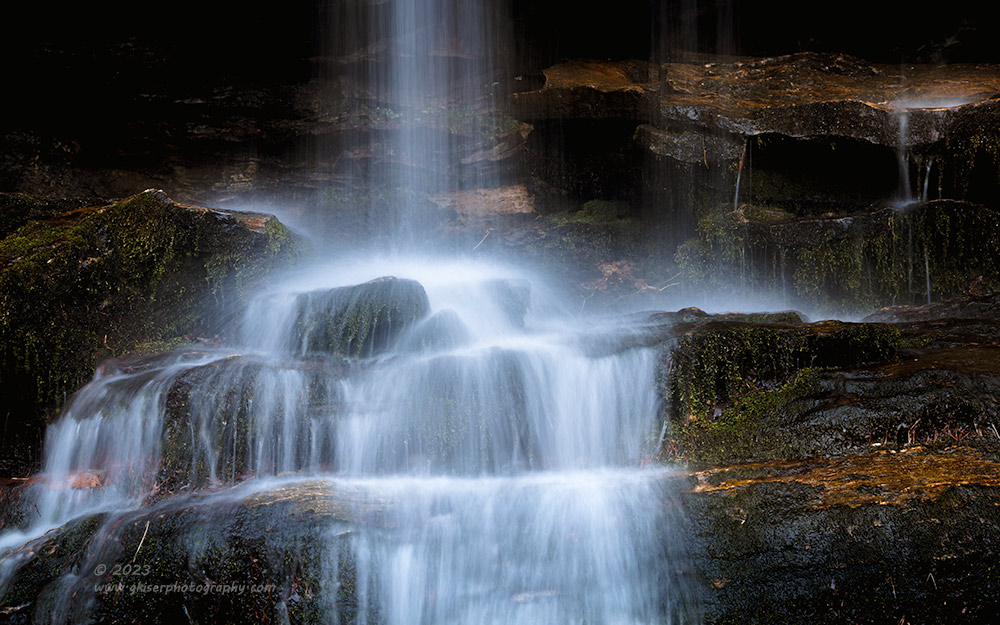
Before leaving that composition, I took note of the way that the rocks behind the water were layered and that many of them had warm tones to the upper surfaces of the stones. Seeing the images with the bluish colorcast made me really appreciate the warmer tones and how they balanced the scene. I wanted to take advantage of that feature, so I flipped the camera back to horizontal and framed up a different composition which took into the frame some more of the falling water to the right, but also much more of the warmer tones surrounding the rocks. I paid particular attention to the shadows in this one as I had done before because part of this image was about the water jumping off of the background. I wanted to keep a mystery behind the water, but show enough detail to know the setting.
I played with this for a while, but never really did feel overly excited about how anything was looking. Having been around these waterfalls for so many years, I just really couldn’t muster much excitement for them, and then I was also thinking that everything that I had been shooting had been captured countless times by others, including myself. I really wanted to do something different here, but I couldn’t come up with what that “different” would look like.
I was getting a lot of frames captured, but I just wasn’t in the moment. I was really feeling uninspired despite feeling like things were working quite well with the light and the conditions. There was just nothing clicking with me, and I realized I was pretty much just going through the motions. This is a very dangerous place for a creative person to find themselves. It is all too easy to let that thought eat at you and convince you that you should just cut your losses and stop what you are doing. I recognized that and decided that the better option would be to move on to the next location and hope for some inspiration there.
My plan had been to make the hike back to the truck and drive out to the Lower Cascades to complete the second composition that I had in mind. Well, when I got to the fork for Hidden Falls, I decided to take that quick detour to see what it looked like. This is another one of the waterfalls that I have photographed more times than I care to remember and the last few times I’ve been here for photos, I didn’t even stop. Quick bit of trivia on this waterfall…I had shot this in 2006 and entered the print into the Dixie Classic Fair competition where it had won 1st place if memory serves. When I got the print back in my possession, I decided to donate it to the visitor’s center where it still hangs. Seventeen years later, there isn’t much else about this waterfall that I haven’t already explored. My reason for stopping was that I wanted to try some different shutter speeds on this one as well. Most everything that I have here is using 3.2 seconds or so and that was just too long for my current liking.

When I arrived, I was happy to see that there was some decent water flow here. It can very easily go to just a trickle which doesn’t photograph very well at all. I’ve seen it with more flow, but this wasn’t bad. I went where I knew the composition was and then started to decide how I wanted to build the composition. There was nothing that looked any different from anything that I had done before, so I just went with what felt best for the conditions. I did elevate the camera a lot higher than I normally would. I was seeing the link between each drop from the elevated position which changed the look of the waterfall slightly from what I was used to. Since I had spread the elements out vertically, I decided to go with a vertical orientation to follow the path better. The composition actually worked out very nicely and I was almost excited about this one just for the change in perspective from normal.
I played with the shutter speed until I had one that I felt looked right across all the different drops. The light wasn’t changing much, so I didn’t have to stay here long like I had done with the first composition. Once I had the look that I wanted, I started to pack things up. However, I stopped and considered that I had come here and gotten just a single shot and was ready to move on. There was more here to work with, and I wanted to try a horizontal photograph because I hadn’t done one of those in a while here. In fact, I don’t think I’ve ever done a photo where the falls were on the left side and I included the rocky bank to the right. Most of the time, I would include the rock wall to the left in the horizontal frame.

By including the area to the right of the falls, I was able to introduce a very different texture pattern into the image which I hoped would add visual interest. For this to work, I was going to have to drop the camera a little bit. That would bring the top and bottom falls closer together, but I did want to keep the top surfaces of the rocks as that was where my color was located. I shifted the camera around until I had the right relationship among the elements and started to make exposures. I kept with the same basic exposures but did adjust the shutter speed just to make sure that I had what I wanted. Again, I wasn’t here long because the light wasn’t changing and my only concern was the pattern of the water, so I made a few extras just to give myself options when I got home.
After I had enough frames of that composition, I went ahead and packed up my gear and got ready to hike back to the truck to go to the Lower Cascades. As I was hiking, I could hear rain falling, and I would catch a drop every now and again. It wasn’t raining hard, and it wasn’t coming down enough to prevent me from getting more photos. I did start to wonder about how much longer I had before the rains would start. There were storms forecasted for the afternoon which I wanted to avoid.
I had come out here with the intention of shooting just two waterfalls, but I had already added one additional one to the list for the sake of trying a different shutter speed. In that light, I was contemplating adding another one which we had missed during the workshop due to time. The Upper Cascades was one of the last waterfalls here to appeal to me. I had shot it a couple of times before I started to really appreciate what it offered photographically. I also knew that the last few times that I had shot it, I had been less than pleased with the outcome. I was here, and it was just a short hike from the parking lot to get to. There was also another waterfall below that which I had no interest in visiting because it would definitely mean wet feet. Knowing that my time here was limited because of the rain coming in, I had to make a choice. I could go as planned and get the one composition that I had planned at the Lower Cascades and risk not realizing the vision as had happened at Window Falls, or I could just keep hiking and try again at the Upper Cascades in a hope to get something that I liked better than previous images. If nothing else, I would at least have a high resolution version of either of the waterfalls since I had never shot any of them with the 5DS R before.
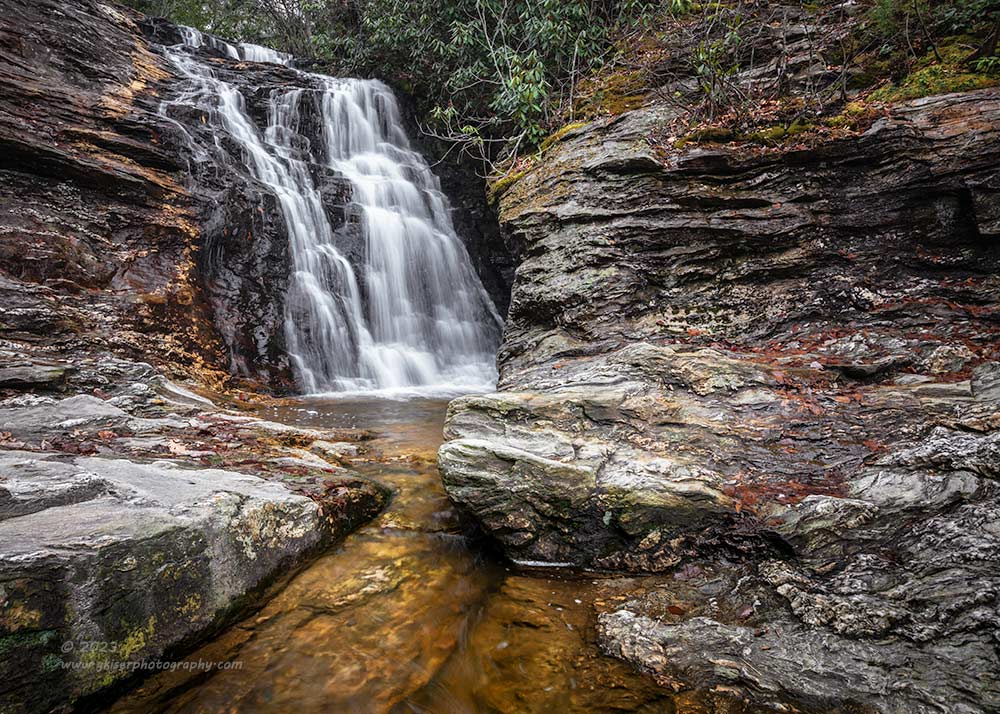
When I got to the parking lot, I opted to keep on hiking although I really don’t know why I made that choice. I was just listening to the voices in my head I guess. The hike was quick, as expected and it felt good to see this waterfall again looking its best with perfect water flow. I kind of hated that the workshop missed this one, but I knew that there was kind of just one position for a composition and it would have been difficult to cycle everyone through that spot with the time that we had left that day. I did spend some time looking around to see if there was a different view that caught my eye before I started working with the spot that I knew. Nothing really caught my eye, so I just jumped over to the other side and then got in the water to line up the elements. Once I had the photo in my mind that I wanted to capture, I went back to dry land to get the camera built. I wanted to use the wide-angle lens again here which is how I do this composition more often than not.
When I got the camera built and the tripod placed about where I needed it to be, I started to look at the way everything was lining up. I made small movements until I had the right flow to the image, and then worked on the elevation. The one part that I wanted to be affected by the elevation was how much of the waterfall was blocked by the rock wall. What I ended up deciding on was to have the wall just touch the bottom of the falls so that there wasn’t a line of golden water to separate it. This way, the froth would just go into stone with the intention of adding to the depth that was created along the right side of the falls where the stone overlapped the white water. By doing this, I kept the dividing point looking the same across the two different edges for uniformity.
Once I had the camera position worked out, I started to make exposures as I tried different shutter speeds. I landed on the one that I thought looked best and shot several frames hoping to capture different patterns in the water. I did see the start of a swirl at the base of the waterfall, but it was going so slow that I would have had to use a shutter speed of at least 30 seconds to get it to go all the way around. That would have been much too long for the waterfall. The thought of doing a blending of two shutter speeds in Photoshop came to mind, but the exposure difference was so large that I really didn’t like that idea. Also, looking at how far away that swirl was it would not be a focal point of the photo anyway. It just seemed like the right thing to do to capture this as a single image and just leave the swirl alone.
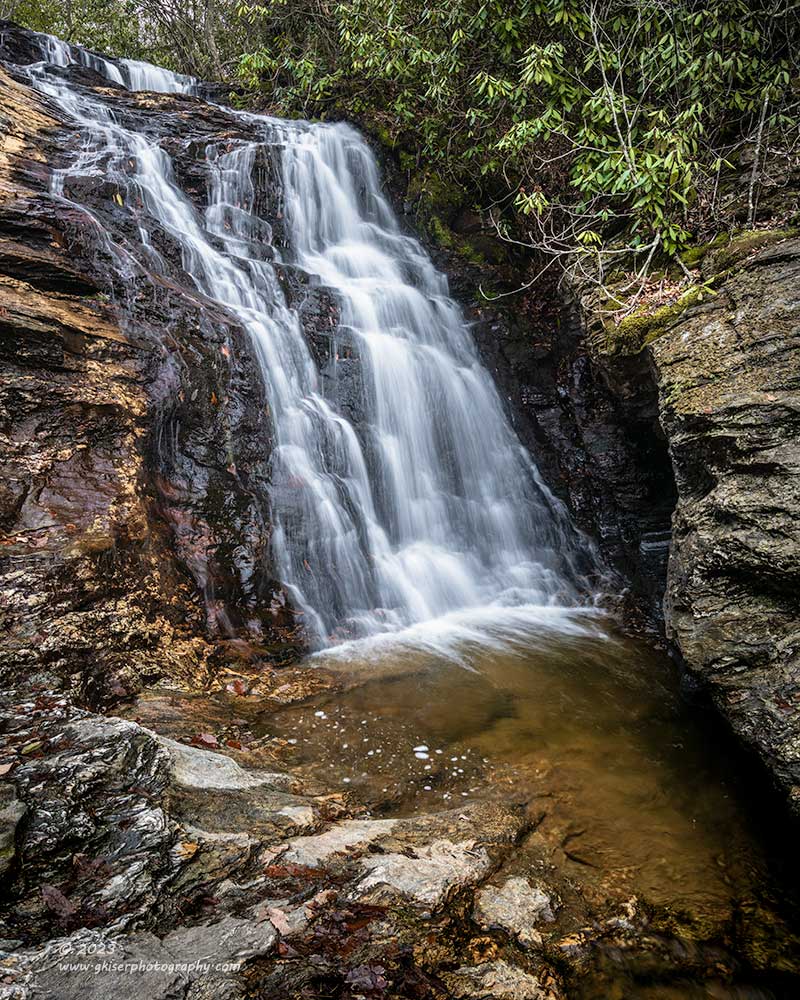
As I finished up with the composition that I really like from here, I decided to look at one other angle that I had shot in the past but had not really liked too much. I just had to get back to the shore to the left and find the place to set up. From this side, the composition definitely calls for a vertical frame which is what I set up. I’m not sure what I did differently here, but the composition started to fall into place very quickly and I was liking what I was seeing. I had the overall exposure set from the starting point, so I just fine tuned it with the ISO so as not to affect the shutter speed or the depth of field. I again revisited the idea of capturing the swirl in a composite image, but the same issues applied as before. With such a large exposure swing, I would have to pull out an ND filter to get the right shutter speed, and I could just see all kinds of issues with the blending of the images. It again seemed like the right choice to leave the swirl as bubbles in order to leave the focus of the image on the waterfall.
I only shot a few of this composition because I was liking what I was seeing, but also because nothing was really changing. When I was done with that, I looked around for other compositions that I might want to try but found none. I broke the camera down and packed it away. The drizzle was still happening, but there were no adverse effects from it. I figured I probably had time to get back to the truck and drive up to the Lower Cascades before the rain started to fall.
When I got to the top of the stairs, I looked over to the left because I knew there was another waterfall down a short scramble path. This was the one that pretty much assured me of having wet feet, even with my waterfall boots on. I could hear the water flowing and knew from the Upper Cascades that the water flow was going to be about perfect. I also started thinking that I had only photographed this waterfall a couple of times over the years since I hadn’t learned about it until I had been going to the park for about 10 years. I was here, and I had good conditions…I really had no choice but to go down and get my feet wet to capture this one yet again.

The scramble wasn’t bad at all. A few minutes later I was at the large rock that I had to walk around to get to the waterfall. When I rounded the corner, I could see that the water flow was beautiful and I was happy that I had decided to come down here. The only issue that I had was a bit of debris that had fallen down to the base of the waterfall. There was one tree in particular that really stood out as there was a gaggle of limbs still attached. It was going to be a serious distraction to the photo if I left it in there. I left the camera and tripod on the small dirt bank and went through the water trying to keep my feet on the higher points so that I could get in close enough to pull the debris away. The tree was heavier than I had anticipated, but I managed to get it pulled over another fallen branch and cleared out of the scene. I then went back to the camera with wet feet and put it together with the wide-angle lens.
Once the camera was put back together, I went back out into the water and got into position. I was standing in water that was up to my mid shin which was just about the limit of the waterproof lining of the boots. I contorted into position so I could see behind the camera which had to be placed very specifically in order to get the composition that I wanted. As close as I was (my back was pushing against the trees behind me), the lens was getting water spray from the cascades, so I had to slog back through the water to get a lens cloth that was in the bag on the shore. From there, it was an all too familiar experience of wipe the lens, get the photo, and repeat. I could keep the lens clear for all of one shot at a time. I also found out that part of the problem was the rain that was now falling heavier. The fine mist was rain, and the larger drops were from the waterfall.
It took me a while to find the right shutter speed thanks to the added step between each photo, but I did eventually land on that right speed. Then it was just a matter of shoot several frames with the hope that one would come out without any visible water drops. When I was confident that I had what I needed, I carried the camera back across the water and made it to dry land. My feet were wet, but at least the boots weren’t sloshing as they have done many times here in the past. I got the camera dried off and put back in the bag. Then it was a matter of climbing back up to the trail which wasn’t too bad at all.
I could hear the rain falling and was feeling it through the trees by this point, so I knew that my time here was about at an end. The hike back to the truck was quick and I got things put away before starting down the road to exit the park. My intention was to head up to the Lower Cascades and get that composition shot really quick because it was looking like the rain was slowing a bit. However, by the time I was at the main gate, the rain was coming down harder than ever. I took that as my clue to be done. I regretted not getting the composition at the Lower Cascades, but when I looked back over the day, I had shot more waterfalls than I had planned. That eased my mind, and I was passing up on the waterfall that I had photographed the most over the years which made it not so big of a deal.
The rain continued to fall heavier so I decided to call it a day. I was close to Walkertown, so I decided to head down there and pick up something for Toni to save her a trip down here later on. I was content with the day, but hardly excited about what I had shot. I really wanted to be more upbeat about the day, but I felt that for all that effort, I had not created anything wildly different from what I had shot here many times before. I was sure that I would like the photos when I got them home, but I also knew that they were just going to be part of the gazillions of Hanging Rock waterfall photos out there. It really got me thinking about my relationship with landscape photography these days. Even when I have a less than ideal day of decay subjects, I am still excited about aspects of what I had shot. It was kind of strange to be this soon after a morning of photography and not have any connection to the photos that were captured.
Of course, I hope that you feel different about the photos and there are ones here that you are excited about. If that is the case, I would love to talk with you about matching you up with a print or two. As you can see, I have several standard sizes available for prints, but I can very easily do custom orders for larger prints or done on different media. Metal prints are all the rage now, and these would look fantastic on metal as well as the customary print media. Feel free to contact me to discuss options and pricing.
It would seem that this was the end of my trek at this point, and I certainly thought that it was. However, I had a bit of an unplanned addition to this day which I am going to cover in a follow-up blog entry which I will link to once I am done writing it. I will continue some of the introspective thinking and we will see a different side of things soon enough. The more I gain experiences like this, the more I think I was on the right track when I wrote about my decay photography. I’ll see right back here shortly after I finish with part two of this trek.
I’ll be right back….

Remember to use the code KISER10 to get 10% off your purchase