Thursday, January, 12, 2023
If you missed part 1 of this trek, feel free to read it before getting into this one. I will say that the two are in no way related, but they happened on the same day which is why I’m doing it as a part 1 and part 2. There are also some realizations that I had during the day which I have started to talk about with the previous entry. All that being said, let’s pick up where we left off. I had gone through Walkertown to pick up some things for Toni and was on my way back home. The rain had kind of stopped at this point, but it was getting darker and darker as the storms were approaching. I was really just looking to get home more than anything else. I had originally thought about going through Jonesville in an attempt to photograph some old cars that I am waiting on a chance to speak with the owner about, but I just wasn’t feeling much like getting the camera out again.
It wasn’t that I was lacking any creativity or anything like that, I was just feeling a little down after my morning at Hanging Rock photographing waterfalls. That used to be one of my favorite subjects to shoot, and I even had aspirations of photographing every waterfall in NC. Then I realized the scope of that dream and decided it would never happen. The fact that I had just shot four different waterfalls and really felt no excitement at all from the experience was a little disheartening for me. I guess a lot of what I had said in a previous Behind the Camera was more true than I had thought. Landscape photography was just not nearly as fulfilling as it had once been for me. Every time I shoot a landscape, I feel like I am just adding to the overabundance of landscape photography out there. In this saturated market, it is almost impossible to stand out from the crowd, and to make a living at it, you kind of have to stand out. Over the past several years, I have been shifting my primary focus from landscape photography to decay and rural subjects which I find to be much more exciting and there are so few photographers in this genre that it is easier to stand out from the crowd and create something that is truly your own.
I had already experienced part of that bit of self evaluation while at Hanging Rock. The second part of that was going to occur in the next 30 miles or so.
The music was playing, and the cruise control was set. I wasn’t thinking about anything photography related other than my wet feet from the last waterfall that I had shot. Other than that, my mind was clear and I was just enjoying the drive. When I got into Yadkin County, I could see that the clouds were getting thicker and the fog was starting to roll in. It was odd to see this in the middle of the day which made me realize that the storms that were on the way were probably getting close.
There is an old house that I shot for the first time many years ago that I can see from the highway. Well, it isn’t the house that I have shot, but a Pontiac that is parked on the side of the yard. The fist time I shot it was in 2013 when I knew very little about decay photography, and really didn’t understand the lighting that I was shooting under. Since that time, I have been back here under different conditions and even at night. The car hasn’t moved, but occasionally the doors will be left open which I find odd. Every time I am driving through the area I always look over to see if “my Pontiac” is still there. This past summer I could barely see it because of all the weeds that had grown over the front of the car. I even thought to myself several times that my days of shooting this car were probably done because the Earth was finally reclaiming it. That wasn’t really a big concern since I had shot a prize-winning piece on a subsequent trip out there and really didn’t think I could improve that much on what I had shot over the years.
Anyway, as I drove past the house, I looked for the car and could see that the fog was settled in behind the car. The scene looked very monotone, but at the same time had a very specific mood and atmosphere around the scene. Like a light switch my creative instincts were flipped on and I gave it no more thought before hitting the next exit and heading to the house. I already knew the situation here so there wasn’t the need to figure out where to park, and whether or not there was a composition to be had. I just parked where I normally do and grabbed the bag to head up the hill to the car.

Since the sky was pretty much a featureless wash of cloud, I started off by getting a composition that used the trees in the background to provide a bit of interest in the sky. I went ahead and fitted my 24-70mm lens which I knew to be a great choice for this car and location. Even though there was no sun out, I still mounted a polarizer because that filter does a remarkable job at getting rid of the glare from the glass and metal as well as saturating the colors. I then started to work my way through the rows of old corn stalks until I found the best place to set the camera for the perspective that I wanted. Within a couple of minutes, I had my first composition put together and I was thrilled with it. There was a story here, and emotion. I was already seeing it as a black and white photo since the sky was a wash. It was the textures of the weeds over the front of the car that I wanted to really capture and the lack of color would help with that.
Already I could feel that my creative voice was coming out in this one composition which I had not felt for the entirety of the time at Hanging Rock. It felt great and once again I was feeling like a photographer. I looked around and considered my options. The weeds and vines that I had loved in the first composition were causing me some problems when it came to other compositions, especially isolations. I had to keep the compositions rather broad in order to define the car, but in order to do that, I was going to have to include the sky. The solution to that came from my first trek of the year where I dealt successfully with a sky very similar to this. The fog in the background was going to help here and I figured that it was worth including the sky in order to get the whole car.

Probably my favorite composition of this car is from the passenger side. From this angle, I can include the small barn in the distance as another element. This is the composition that went on to win at the Dixie Classic in 2017. I had also shot it with much less success in 2016 which was the first time I tried it. In both of those cases, color would play a big part in the photo, although the first attempt is a little garish in hindsight. Color wasn’t going to be a big part in this particular attempt though. The lighting was making everything very desaturated and dark. This was the mood that I wanted to capture, and I knew that I was going to go for a very analogous color palette when it was all said and done. I found the right angle for the composition, being very careful to avoid the clothesline pole which kept trying to enter the frame to the right. Since the fog was so important to this composition for how I wanted it to look, I had to wait for the conditions to change to make sure that I had the right look for the background. It really didn’t take that long though before I was confident that I had what I needed from this view.
Things were really starting to come together at this point. I was feeling like I was back in my element once again. It really hit me how times have changed because it wasn’t that long ago that I could go up to a waterfall and get a composition put together along with an exposure that I liked in just a couple of minutes. Photographing a car enveloped by weeds would have taken me a lot longer to figure out. Here I was shooting a subject that was essentially as familiar to me as the waterfalls had been from earlier in the day but was having no problems getting inspired by what I was seeing. The compositions were coming easily to me, and I was having a lot of fun working through the different angles that I was photographing. The waterfalls, on the other hand, had been more of a tedious task to work through.

I knew that there was one isolation that I could get of this car which wasn’t affected by the weeds and that was the detail on the trunk lid. It was one of the earlier shots that I had done of this car, and I knew that it would work. I also knew that there were some issues with perspective from the last time I shot it. I wanted to do this one better and have it more symmetrical than the last version. I got the camera set up to get the shot and worked every trick that I could in order to get the badges centered up in the frame. This was not as easy as you would think since the car was leaning heavily and angled down the hill. Trying to get the camera exactly centered on the trim work was hard, and then I had to make sure that everything was level. I shot two frames with one being a bit wider of a composition so that I had room to transform the perspective if needed in Lightroom. As it turned out, I had the first one close enough and I was able to do a small tweak to the perspective without needing to crop it in so close that I cut into the elements.
When I was showing this one to Toni during the initial edit, we saw where I made a cameo in the chrome. I told her that I would go in and remove me as it would be an easy task. She convinced me to leave me in there as a bit of a signature. I’m not sure I’m that recognizable, but the point had some validity to it, and I left Waldo in the chrome. The rest of the edit was very easy, and this was the only one where I allowed myself to embrace the colors as I did. Since there was no atmosphere around this composition, I didn’t feel the need to keep the colors subdued.
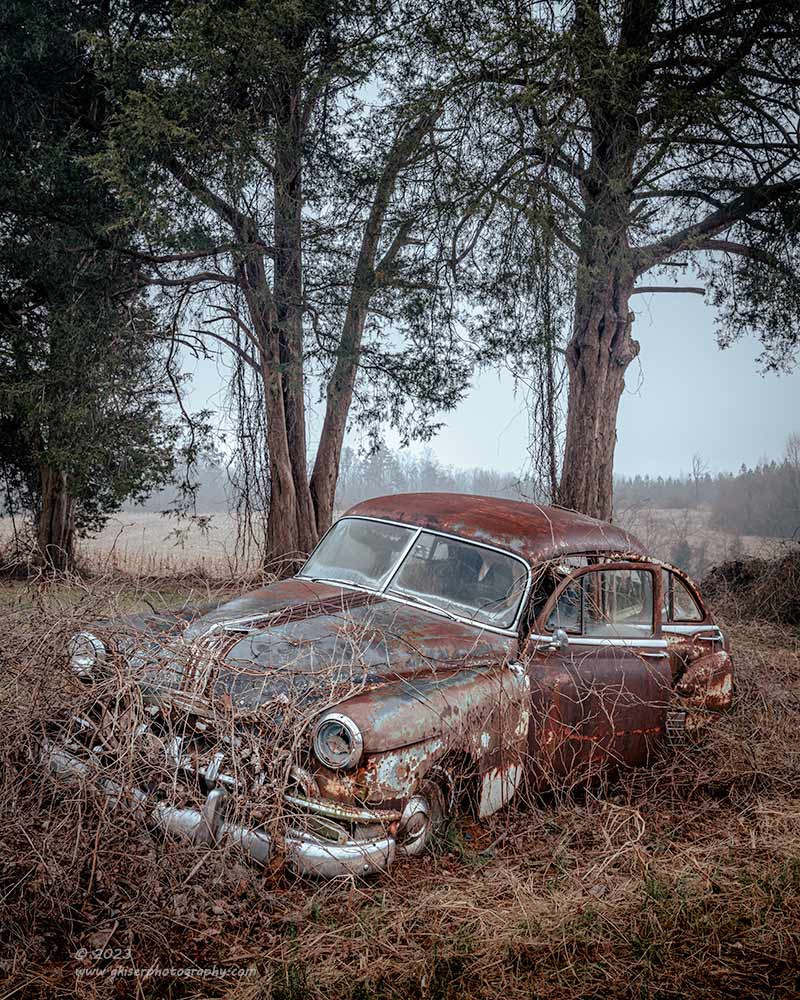
When I got done with the rear emblems, I again walked around the car to see what angles I might like. Once again, I found myself back at the front left corner where I could use the trees to help give interest to the sky. This side also showed the open doors which sometimes were closed. I wanted to really get the trees in the shot and wanted to keep the car completely beneath the tree line to the rear in order to keep the car completely surrounded by something other than the fog. In order to make this happen, I thought that going with a vertical orientation was the way to go. I had to elevate the camera all the way to the highest point the tripod would allow which put the camera well above my head. That perspective showed off more of the top of the car than the front and side which was ideal since the front of the car was largely obscured by the weeds. It was just a nice little visual trick to give some weight back to the car which had been lost by the vegetation.
At this point, I started to feel a breeze coming in. This was causing issues with the trees in the background that showed movement. With the lack of light, my shutter speeds were in excess of 3.2 seconds at this point. I had to again boost the ISO in order to get the shutter speed down to a half second or so which was sufficient to freeze the motion of the trees. I shot a number of frames here to ensure that I would get at least one shot where nothing was in motion. Looking back through the series, I was sure that I had at least one where everything was good, and I was very happy with the composition compared to the first one that I had shot from this same angle at the beginning.
As I studied the different compositions that I had shot, I realized that my initial thought of filling the frame with the car was a solid idea and worked for a black and white composition, but seeing the car in the environment had a completely different feel to it. I really liked the trees with this last composition that I had shot and wondered what it would look like switched back to a horizontal frame to allow the inclusion of more of the trees to the left. I flipped the camera and started the task of positioning the trees behind the car. With the now horizontal framing, I had to be careful how much empty sky was included on the right side because the left side had a dense evergreen tree filling the entire corner. With the camera in the same place as the last shot, I was ending up with too much empty sky to the right. The solution was to move the camera to the left a little bit to include more of the right side of the last tree with the idea being to fill the upper right corner with a cluster of leaves.

The concept worked out nicely and after I lowered the camera a bit to get a perspective that fit the horizontal frame a bit better, I was very happy with the composition. I had to play with the wind again which meant a lot of changes to the ISO as the light levels changed. My goal was to get the ISO as low as possible as the light got brighter and I timed it to where the wind had died down a bit. The more I shot this composition, the more I liked it. When it was all said and done, this is probably one of my favorite shots from the entire day, and my most successful attempt at capturing this car from the front left corner.
It was the editing process of this car that really got me excited from the day. I had gone through all of the initial edits that night, with the subtle tweaks happening this morning. The first one that I edited was the black and white one which was the one that I had the clearest vision for, and I had also been looking forward to doing a black and white image for a while now since it has been so long. Once I got that one done, I moved to the others and decided that I wanted to use the colors to tell the story that I had captured. I tweaked the colors to show a very reduced color palette to keep the photos simple and let the ambiance of the fog affect the entire photo. I made sure that the sky and the cooler tones of the patina worked together and then I had the rust toned very similar to the dormant vegetation with the greens complimenting the reddish tones.
Some photographers call this color grading and make it sound more technical than it actually is. The way that I do it is just a continuation of the simplification of an image that I am always trying to do. I try to reduce the amount of colors in an image to just a key few that work together. I do have a good understanding of the color wheel, but I generally go with my gut as to how the colors interact with themselves. I might be doing it wrong, but the end result is usually what I have in mind, and I don’t do it through the “Color Grading” feature in Lightroom, this is actually a process that involves the “Calibration” tab and the “HSL” tab along with slight tweaks to the RGB curves occasionally and final adjustments to the vibrance and saturation sliders. I enjoy the look of the colors when they have been adjusted individually more than when a tint is applied to the different luminance levels, although there are times when that works better for me. As long at the end result is what I’m after, I don’t really care what process I have to go through to get there.
I do hope that you have enjoyed this trek and the photos that resulted. As I mentioned, I would love to talk with you about matching you up with a print of your choosing in various media and sizes. When you order a print, you are not only telling me that you appreciate my work, but you are also helping to fund these treks. Unlike my portrait work, there is no guarantee that I will find a customer when I go on these adventures. Honestly, most of the time I am doing these photos for myself, and I don’t get paid anything for them. For a full time photographer, that is difficult because these photos take time and time is money. I now have two full days invested in these photos and the associated blog work. I have no income to show for that effort unless prints are purchased. I know I sound like a broke record here, but I’m not in this field to be a social media photographer or an influencer. I am here to create art for clients who want to hang my photographs up on the wall. I graduated from needing likes and comments years ago.
But I digress…
It was a fun day for the realization of where my passions are currently with photography. I’ve been suspecting that decay is where I’m leaning heavily, and this trek proved it to me. Both locations that I shot have been shot numerous times over the years, so the familiarity was the same with them both. I’ve spent a lot of time photographing both types of subjects, but yet there was still excitement for one of them. It was that old Pontiac that offered more of a story to be told and even though the conditions were perfect for waterfall photography, I made them work even better for the car. I’m sure that I will go through many more changes in terms of what I like to photograph over the coming years, but I can say that currently, I’m primarily a decay photographer and truly enjoy that genre. I can also come away from a decay subject knowing that there are not thousands of similar photos floating around. Everything that I shot at Hanging Rock on this trek can be found in many other circles and I’m sure that there are photographs out there that look so close to mine that you would have to look at the metadata to really know who they belonged to. On the other hand, this Pontiac will likely not show up anywhere else, but if it does, I bet it would be easy enough to determine if the photo is mine or not by the look. I’ll go ahead and say that these stand out from the crowd, if there is even a crowd that has shot this particular car. This second half of the day was so much more fulfilling than the first part was.
Don’t forget to look into my upcoming workshops as I am dealing with foundation skills for photography through the beginning of 2023. I’ll be hosting a classroom workshop here in my studio right at the start of Spring for those who are wanting to learn how to master exposure with their digital cameras. I’ll be following that up with an in-depth look at making a composition in May with the third workshop looking at controlling your focus and depth of field in June. If you can get these concepts down, the rest is easy. I hope to fill up each of these workshops and help many new photographers grow.
Until next time….

Remember to use the code KISER10 to get 10% off your purchase