Monday, May 29, 2023
There are times when I really work through a plan for a trek, and there are other times that I just kind of go with the flow and end up places. I would like to say that this trek kind of fell into one of those categories, but in all honesty, it was a product of the weather, and my availability more than anything. If you have been following along, you will know that we have been having quite a bit of work done to the house over the past month or so. The last two weeks have been filled with hammers and thuds that keep catching my attention as the siding has all been put on. The doors and new gutters have all been installed, and things are starting to get back to normal. We were very lucky that the rain held off for pretty much the entire process, but we paid for it with a soaker of a system that moved through over the weekend.
With the major part of the work finished, I was looking forward to getting out and doing more photography once again. I really lucked out last weekend when I was able to work both landscapes and decay subjects in a very short amount of time. It is not uncommon for me to have an extended period of inactivity after such a trek because it is very easy to exhaust my creativity during a day such as that. Fortunately, however, I wasn’t quite done being creative. I guess a lot of it came down to the fact that I have been unable to go out as much as I would like which has left me with a lot of pent-up creativity looking for an outlet. I knew that I wanted to get out and find some new photos, but I wasn’t quite sure what it was that I wanted to work with. I did have a lot of fun with the decay subjects, and that got me thinking about doing more of that. That would be the easy way of picking a subject, and I even had a location in mind where there was a great example of a ’57 Chevy on a hill. That just didn’t quite cut it though because for the last couple of months, I have been having a landscape Rennaissance of sorts.
Knowing that I had that Chevy in my back pocket, I started to look at doing some landscapes since the Spring colors were still so vibrant through much of the state. I started to look at the weather forecasts around the end of Friday. It was looking like I might be able to get out Saturday morning for a bit before the rain came in, but there was very little possibility of color during the sunrise. The clouds were looking pretty much like a dense overcast for the most part. Knowing that I wouldn’t have a lot of sunlight, I considered shooting some waterfalls, but I have really been out of the habit of selecting waterfalls that I wanted to capture. I went to Hanging Rock earlier this year and tried to get back in the mood for shooting moving water, but that failed miserably. I ended up having much more fun with an old Pontiac on the way home, which kind of pushed me away further from doing landscapes at the time.
I ended up going to sleep without a sure plan of where to go and what to shoot. Without a solid plan in place, it will come as no surprise that I ended up sleeping in a bit on Saturday morning since I didn’t have to be up for the contractors. I probably needed the sleep since I spent most of Friday feeling pretty lousy. I can only attribute it to the stress of all the work being done to the house. I spent Saturday just taking it easy and waiting for the rain to come in. I probably would have done good going out during the morning hours, but I really had no plan at all of what I really wanted to shoot and didn’t want to make it a forced outing because those photos never look good.
Through much of Saturday, and all of Sunday, I watched the rain fall and was thankful that the house was all covered up once again. I kept giving some passing thoughts to going out for photos, but I was really having a problem figuring out where to go. I kept coming back to the Chevy, but I just wasn’t really feeling like shooting rust. I was still wanting to do landscapes, but the weather wasn’t really ideal for it. Looking ahead at Monday, there was going to be rain in the afternoon with some pretty solid low clouds during the morning. Looking at the cloud forecast, I instinctively thought of waterfalls because that kind of cloud cover is ideal for keeping the highlights down. It wasn’t going to matter if there was texture in the clouds either since I was just needing the diffusion of the sunlight. I started to lean further and further towards shooting waterfalls; but that brought about another problem. I had recently gone all through the Waterfall book looking for something that inspired me without success.
The more I thought about it, the more frustrated I became with my inability to come up with a destination. The weather was getting a little more complex also which added to the frustration. There was now a fair chance of rain during the morning hours with a better chance in the afternoon. The clouds were going to thin out quite a bit later in the week which would give me an opportunity to shoot some landscapes at some point hopefully, but I had kind of gotten my mind set on doing waterfalls. For simplicity, I went through all of my favorite haunts and the thought of South Mountains came to mind. Now it has been about a year since I went there, but when I did, I found a new waterfall which I had not visited before which I really enjoyed. It was Big Bear Waterfall that stuck in my mind, and I started to get excited about it. I had only seen it with what I would consider average flow last year. After two days of soaking rain, I figured that all of the waterfalls would be a bit swollen come Monday. It was a good plan except for the fact that it was a holiday and with the rain keeping everyone indoors, I might run into some extra people. This pushed me to keep with an early morning schedule of arrival in hopes of getting Big Bear shot before the crowds showed up.
The plan was to get up at 5am and be on the road by 6:30 which would put me at the park by 8am. I could have gone in an hour earlier, but the light seemed to be too cool that close to sunrise and I usually have much better luck with the lighting after about 8am. I got up and got all my morning stuff done before loading up the truck. I had checked the weather and it looked like only a minimal chance of rain until lunch time when it went up to 30-50%. Things were looking great, and I could see no rain on the radar at all. I debated getting gas before heading out, but I still had over a quarter of a tank with a range of 124 miles. I figured that I would get gas on the way there, or on the way back just so I didn’t burn through a significant portion of a full tank. I’m strange like that. The park was 64 miles away according to the GPS which meant that I would have plenty to work with, even if I chose to get it after I was done.
The entire way there, I was under a heavy mist which kind of had me concerned since I knew I would be in an area that was under a clearing. I have no problems with the camera getting wet, but I hate having to wipe the lens and filters between every shot. It just adds an element of complexity that I really don’t care for at all. I knew that the rain would help to saturate the colors which was a nice benefit, but I would still be happier if the rain would stop. By the time I got there, the mist was steady, but not too much to really dissuade me from making the quick hike out to the falls. However, the moment I hit the trail, I could hear the rain drops coming in harder. It was no longer a mist, but a decent shower. The hope was that it would fade away by the time I got to Big Bear.
When I made it to the end of the trail, the rain was now a steady shower, and I was wishing that I had loaded up my wet weather filter kit that includes the 82mm polarizer along with the lens hoods for my lenses. It is a bit easier to work with that combination than to have a 105mm filter protruding from my Lee Filter Holder allowing rain drops to find their way on the front and rear of the Color Combo Polarizer, and occasionally the lens element itself. They were all still in the truck and I didn’t want to waste the time to go back there and get them, I so just started to look at compositions in hopes that the rain would stop.
I spotted several different compositions that I wanted to try, and some of them were of the lower section of the falls. The water was really flowing on this one and it was looking the best that I had ever seen it. However, there was a large tree that had fallen just past the lower cascades which kind of ruined most of the compositions that I would want to shoot. I did see some isolations that I was thinking might work out for me. I did notice that I could shoot those images from under a tree, and away from the wind that was pushing the rain horizontal at times. When I realized that the rain wasn’t going to ease up, I went with plan B which was a cumbersome one at that. It involved a small umbrella that I keep in my bag for just such occasions.
I pulled out the umbrella and set it on the ground opened. I got the tripod set up approximately where I figured it would need to go. I then pulled out the camera and the 70-200mm lens and checked the composition before mounting it to the tripod. I angled the lens down to keep the lens element dry as I went back to the bag and pulled out the 105mm polarizer which I mounted to the holder before placing it on the ground under the umbrella. I closed up the bag to keep the contents from getting wet which was wishful thinking. By the end of the day, I had to empty the entire thing out to let it all dry overnight. As carefully as I could, I grabbed the polarizer and umbrella which I used to cover the camera while I attached the filter.
Once it was attached, I started the not so elegant task of getting the camera properly positioned and the filter dialed in correctly while holding the umbrella. It was a very slow and arduous process, but one that I have done many times before. I finally started to get the compositions worked out and I was shooting some frames finally. I wasn’t sure how they would turn out, but it was keeping me occupied while the rain was coming in from the side rather than from head on which would happen if I was to shoot the main waterfall. I guess I spent about 35 minutes working the lower section trying hard not to slip on the rocks. At the end of that, I had 23 frames on the camera with a couple of them seemingly decent. Spoiler alert, none of those worked out at all, and I ended up trashing them all because they looked like snapshots. I would like to think that given easier conditions I could have come up with something better, but I am pretty sure that it was the fallen tree that killed the compositions for me.
By this point, I was pretty much soaked, and I was very much in the rhythm of using the umbrella to get the photos, so I decided to move on to the main falls. This was going to be a good deal more difficult since I was shooting into the breeze which carried the light rain, plus I was getting the spray from the waterfall. My goal was to work out a composition and then clean the filter off before shooting the image. I would then drop the umbrella in front of the lens while I checked the shutter speed’s effect on the water. It was going to be a complex series of moves, but if I was going to get a photograph of this waterfall today, that was what I was going to have to do.
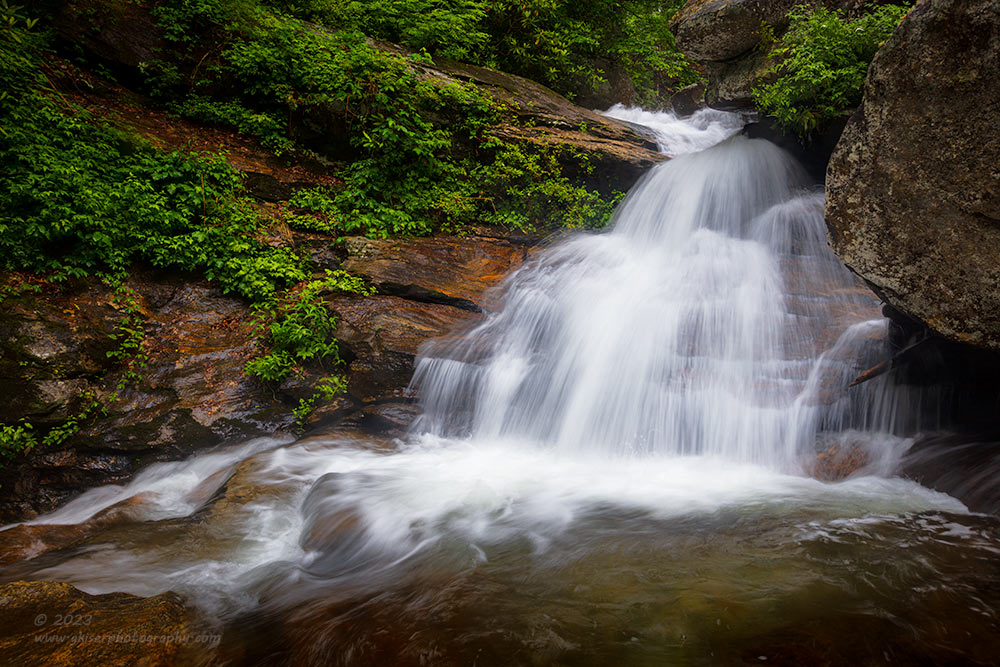
Once I got the camera in place, I started to work through the angles to get the composition fine-tuned. One thing that I really liked about the scene during the Spring was the greenery on the rocky wall to the left of the falls. That allowed me the opportunity to really bring in some added visual interest as well as color to the scene. The biggest thing that I had to work out was the shutter speed which turned out to be 1/6 of a second for the effect shown above. I tried several different speeds until I hit the one that I felt was going to do the job that I wanted. It was quick enough to freeze the vegetation while still showing a good deal of motion in the water, while leaving plenty of detail at the same time. When it comes to waterfall photography, it is the shutter speed that really defines the photo, even more than the composition.
I did work a number of variations on the composition as I moved in closer to the falls and went wider. I had swapped out my telephoto lens for the wide angle one before I started shooting this falls because I knew that I wanted to capture a lot of the surrounding scenery to help tell the story of this one. The closer I got, the more prominent the pool below the falls became, and that started to define the composition. I elevated the camera quite to the top of its travel in order to get the right perspective. It was not easy though since I was having to hold up an umbrella to cover the lens and then drop the umbrella completely over the lens after each shot. About every three exposures, I would have to get the microfiber cloth out to wipe the lens off which was a pain, and never a spotless process. At the end of the process, I had shot 18 frames of Big Bear Falls with three different compositions. It was that last one that I ended up keeping because everything was right with it from the shutter speed, to the composition, to the fact that the filter was dry and not fogged over. Yep, fogging was another issue that I was having with the filter that kept killing the contrast in the scene. I was really earning my money today because this just wasn’t easy at all.
After shooting over 40 frames at Big Bear, I was tired of being in the rain and was looking forward to getting back into the woods. I had shot the scene that I had wanted to, and would have been happy to head home, but I recalled seeing Jacob’s Fork on the way to Big Bear and was really interested in the flow that it had thanks to the rain. There was also a dense canopy above this area which should make it much easier to photograph. Since it was on the way back to the truck, I decided to make a quick stop there and see what I could do with it.
The hike only took a few minutes and I started to see a few people, but nothing bad just yet. When I got to the fork, I scrambled down the bank to get to the shore and started to look for the right angle to work with. This was one of those areas that I had shot the first time I came to South Mountains more than a decade ago. I wished I still had the blog entry from that trip to show the comparison of the photos. The composition had been my most successful one of this section since I shot it and I was ready to change that today. I had the water flow, and since I was already wet, I wasn’t too worried about standing in a bit of water to get the shot that I was after.
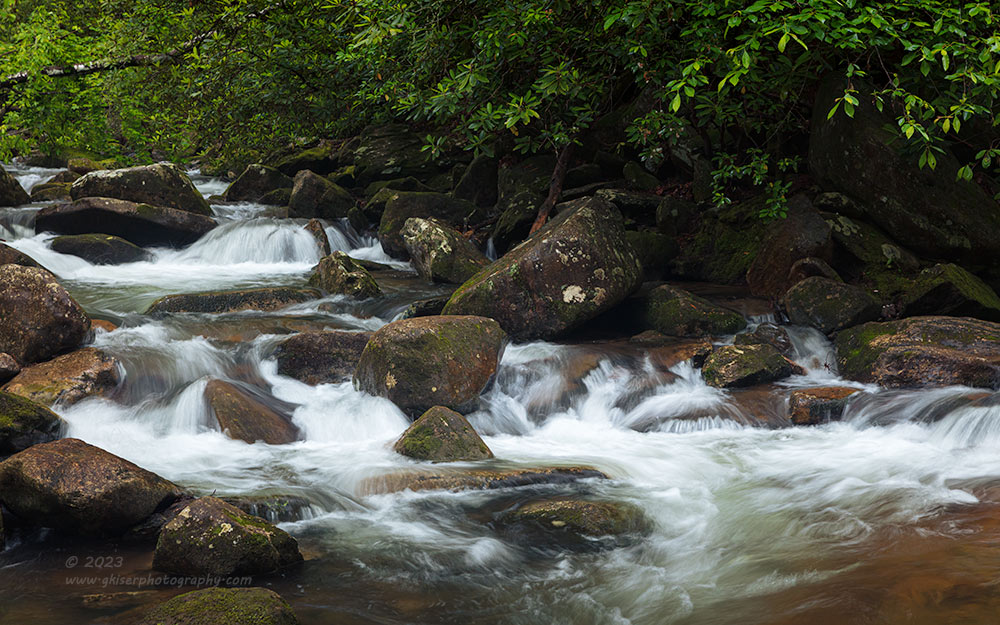
I worked my way around about 20 feet worth of the bank until I found the right angle to capture this cascading stream. Once I got it dialed in, I selected the lens that used to be my most popular lens for everything, the 24-70mm. This year, that lens has not gotten the use that it usually would because I have really been getting friendly with the 70-200mm during the first half of this year. For this composition, it was the right choice. I needed more coverage than the long lens would allow, and I was suspecting that the focal length would be a bit tighter than the 16-35mm would give me. Essentially, I was liking the scaling between the elements as my eyes were seeing them and I saw no need to change those relationships.
Just to be sure, I got the composition dialed in before I bothered putting the polarizer on which would make things easier should I decide to switch lenses. This one turned out to be the right choice and I got a composition dialed in using some of the rocks in the middle of the stream as a foreground. Once I had it all worked out, I went to the bag and got the polarizer. It was still wet from the last waterfall, so I pulled out a cloth and wiped it down before mounting it to the holder and then to the lens. From the time it was in my hands, the temperatures got all messed up and it fogged immediately when I put it on the camera. I had to wait for the fog to dissipate which was an annoyance since I had the composition figured out. While I was waiting, I noticed that the trees were dripping from the very wet conditions. In order to avoid having to wipe the filter and get it fogged again, I opened the umbrella back up and held it over the camera.
I tell you what, I didn’t feel like a hard core photographer at this point. It wasn’t raining, but I had an umbrella in my hand, over the camera while standing under some trees. Those passing by on the trail were probably wondering what kind of delicate camera I was shooting with. I just kept telling myself that everything that I was doing here was for the final image, and the only thing on the camera I was worried about was the glass and the filter. The rest of the camera could just about fall in the water without a problem, although I really don’t ever want to test that out.
When the fog finally cleared, I double checked the exposure and fired off a shot. The photo looked good, but it was not as exciting as I had hoped for. The foreground was too far away from the rapids, so I lowered the camera to bring them closer together. This helped, but it still wasn’t the image that I really wanted. I decided to do away with the foreground rocks and make the white water the foreground with the trees a more integral part of the composition. This seemed to work out nicely, and I started to work that variation with different shutter speeds and changes to the aspect ratios. I ended up with a lot of images of this basic composition as I tried different things to bring more excitement to the image.
The image that you see here is number 14 of 22. Essentially, I improved on the image until the improvements that I was making started to hurt the image. This is usually the way that it works if I spend enough time on a subject. I can only improve up to a point and then I will start to work in the opposite direction. This usually means that I have gotten it as good as I can somewhere in the middle. I think that is the case with this one. I had the right composition with the 16:9 aspect ratio and the right shutter speed. The only change that I made was I thought that the scene was a little cramped with the 16:9, so I opened it up to 16:10 in Lightroom which is becoming one of my favorite crops for many different images. That is the beauty of working with RAW images. I never throw anything away during the capture and I was able to change the aspect ratio and crop to something that the camera wasn’t capable of doing with its options.

I was feeling pretty good that I had something really nice at Jacob’s Fork for the first time in many years. I got the camera put back in the bag which was now pretty much soaked to the core. Even areas that I hadn’t been in had gotten wet from exposure while having the contents exposed for lens changes and such. There was no doubt about it, when I got home, I was going to have to pull everything out and let it dry overnight. With that in mind, I hated to call it a day after only shooting two locations and three subjects. If I was going to have that kind of clean-up to do, I might as well make it worth my while. Since I was at the portion of the trail that gave me the option of continuing back to the parking lot or to go to High Shoals Falls, I opted to go to the main waterfall attraction of the park. Well, that isn’t completely true because I really don’t like High Shoals Falls at all. There is just no real interest there for me. What I love is the lower falls by the boardwalk. These are the ones that I usually end up spending most of my time with. It is my history with them which kept me from wanting to visit them today. Having shot them so many times, I wasn’t sure if I could do anything better this time.
It was the water flow that really got me interested in seeing them though. Usually, I get to see moderate flow here and while I like that, I wanted to see what they looked like after heavy rains for a chance. The hike wasn’t far at all, but I was starting to see a lot more people. I think that this is the first time I had ever been stuck between two families walking through the trails with more in front of us and behind. There were also other groups coming back down the trail which made things that much tighter.
I managed to break free of most of the groups at the rock garden section of the streak and I made a quick hike to the lower falls. When I got there, the flow was excellent, and I really wanted to get some new captures of this area. I knew that I was going to have to get off the boardwalk though which was usually pretty easy, but with everything being so wet, I was finding my footing not so secure. I just carefully made my way around the area until I found the right spot to set up my camera. It was a good thing that I was off of the boardwalk because while I was looking for my spot, several groups passed going up and down which I would have blocked without a doubt. Normally, I can be here and not see a single person which I much prefer.
When I got my position figured out, I set the tripod up and pulled out the camera with the 16-35mm lens which I figured would cover all the compositions that I had in mind. I had wanted to get a grand view of this waterfall including the boardwalk as I had done several years ago. That was the first composition that I came up with and I worked out the shutter speed to 1/5 of a second which forced my ISO to 640 which wasn’t terrible in this low light. It was about the time that I got things all dialed in that many folks started to walk up the stairs. With a couple pausing right in my shot, I recomposed for a more intimate capture of the falls and shot a single frame with the settings that I had determined for the other composition.
I wasn’t complaining at all because for the first time this morning, I was able to shoot without an umbrella. I just used my hat to shield the filter from light leaks as I normally would. There was no spray, and no rain to mention. There was an occasional drop from the trees, but an occasional check of the filter was all that I needed to do. I wasn’t having any issues here except that I was standing in ankle deep water. At least I was prepared this time with the proper boots, so my feet stayed dry.
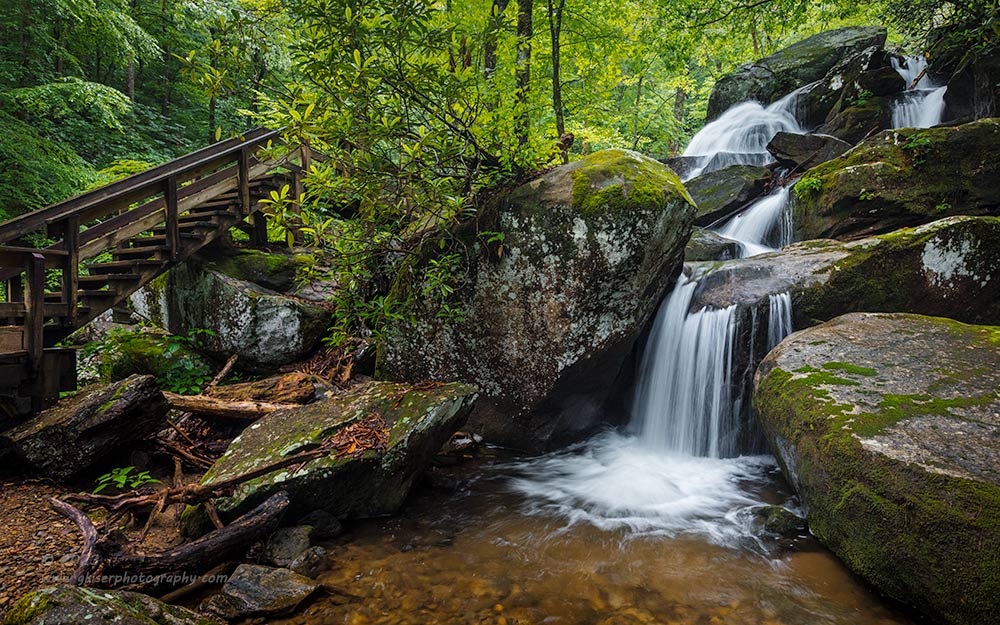
When the groups started to clear the stairs, I went back to the wider focal length and recomposed the original composition which included the boardwalk. I made some slight tweaks to the camera height to make sure that everything was properly placed within the frame. I had the exposure all figured out and started to press the shutter. There were some things that I didn’t like about the composition which I made some adjustments to and found that the water at the base of the waterfall was looking different in each frame, so I started to try and figure out exactly what conditions were going to look the best. As I was pondering that, I found that the depth of field needed a little help. I stopped the lens down to f/7.1 which then forced a shutter speed of 1/4 of a second at ISO 640. This worked and allowed me to get the foreground in sharp focus as well as the background. A few more shots and I was happy with the pattern of water at the base of the falls.
From here, I looked around to see what else I might want to photograph in this area. There wasn’t anything that really stuck out to me, so I packed up the camera and climbed my way back onto the boardwalk. While trying to do that, I had to stop for a family coming down the stairs. I then had just enough time to hop over the railing and move on to get out of the way of the next family coming up. In all the years of visiting this spot it never occurred to me that the boardwalk was only wide enough for a single lane of traffic with the exception of a few areas that were wide enough to pass in. I was painfully aware of it this time since I wasn’t even able to stop long enough to really survey the next set of falls which I usually stop at. I had to completely exit the boardwalk and wait for three families to pass by which were behind me, and then wait for another one to enter the boardwalk in front of me. I went back to try and get a read on a possible composition which I had to act quickly because there were more people entering the walkway.
There was no way to shoot this from the boardwalk as I was hoping to be able to do with the high water levels. I had a composition in mind, but it would require me blocking the boardwalk which I just wasn’t going to do. My other option was to climb over the railing once again and go down on the rocks. This was not a favorable option either because of how slick things were and that most of what I was used to standing on was under water. There was also the matter of the spray that I would be in the middle of with the high water flow. On a good day, this is an area that I usually have to deal with a certain amount of spray, but today it would have been even more frustrating than what I had already dealt with. Thinking about having to wipe the filter off repeatedly, while standing on some slick and loose rocks while the tripod was perched on rocks and limbs just didn’t seem like a good idea to me. The decision was made to pass that one by and just be happy that I got some really good images of the other section of the lower falls.
I could have turned and gone on up to the main waterfall, but as I mentioned, I really don’t care much for it at all. I think that it is a boring waterslide of a waterfall with no real textures to it. There is also the matter of the several hundred steps to get to the viewing platform that I didn’t feel like dealing with. I just worked my way back down the trail headed to the parking lot. I had a total of 85 frames at this point and I was happy with that number even if I knew that I was going to have nowhere near eight or nine keepers out of them. I was figuring on maybe three or four keepers from what I was remembering shooting. That was good enough for a waterfall trek to a location that I had been to many times before and was quickly becoming very crowded.
As I walked down the trail, I kept having to move over for other groups and families. I kept wondering if I had ever seen a park this crowded before. I’m sure that I have, especially Stone Mountain, but for sure, this was the most crowded I have seen this one…EVER. I didn’t like it at all, and it was beyond too peoply for me. I was ready to cut bait and leave, it was just a matter of getting down the trail without having to stop.
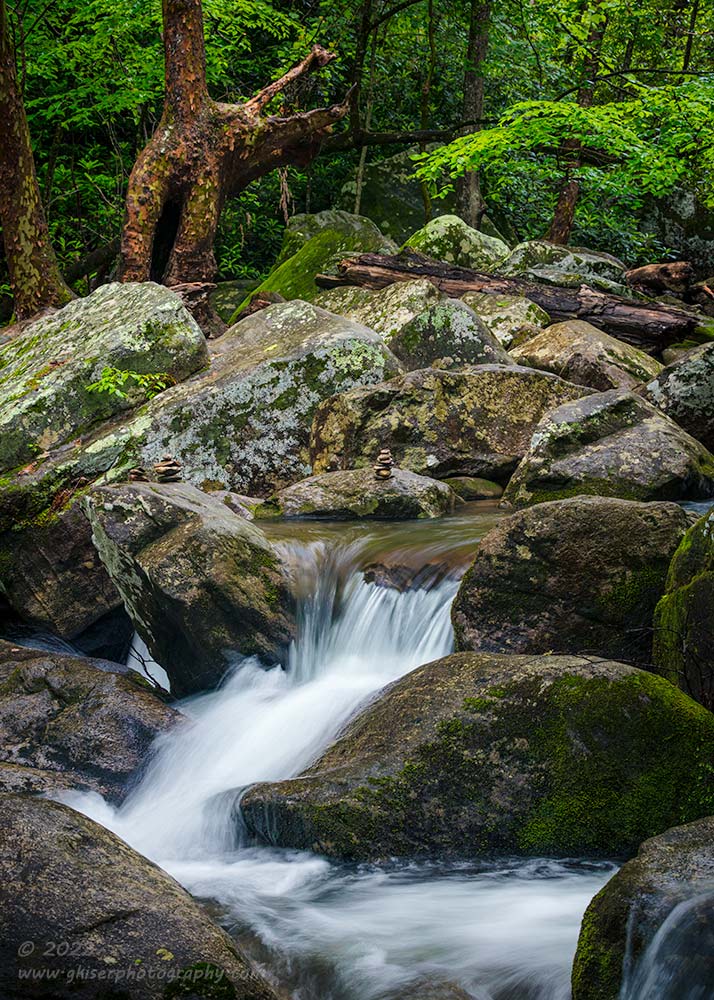
Not long after leaving the lower cascades, I came up to the rock garden section of the stream. This is an area that I had shot many times before and one that usually very few people stop at. I decided to take a quick break here and see if there was a composition to be had. I found my favorite tree that kind of looks like a yawning tree. I knew that from certain angles, I could bring in some of the cascades below into a composition. With the increase in water flow, I figured that I would be able to find a pretty interesting composition.
It did take me a while to finally find where to put the camera in order to get something that looked good. Most everything that I found formed a static composition, but I was able to find the right boulder to stand on that gave me a composition with some diagonals in it which was what I was looking for. In order to get that composition, I had to put a lot of distance between me and the tree which forced the needs for a long lens. I pulled out the telephoto and added the polarizer which had to be cleaned once again from the last set of photos. Have I mentioned that I hate cleaning filters in the field? There are just too many chances of getting them scratched or dropped when you are having to constantly wipe them off. Fortunately, I had no issues along those lines, and I had the filter mounted and read to go in short order.
I worked on several different compositions using both horizontal and vertical orientations. I tried framing with different aspect ratios in mind and worked in different numbers of elements trying to figure out what worked the best. I ended up shooting 18 variations on the compositional idea which may not seem like much, but those were each individual framings of the scene as I had already landed on the exposure that I wanted to use. It was a lot of zooming in and out along with rotating the camera. By the end of those 18 frames, I still wasn’t sure that I had anything usable.
When I got these home, I found one that I liked which I started editing. I hated the crop on it in the native 3:2 and when I tried to shorten it to a 5:7 or 4:5, it was no better. Something was off, so I went back to the group and found another one that had only received a single star rating but was framed more like I was thinking I might need. I put a 5:7 crop to it, and then did a little stretching to the sides with the transform tool and that gave me a workable composition of the scene. From there, I started to do my edit going with local adjustments primarily and started to see a photo develop that I was liking. I had almost tossed all of these but felt that there was something worth holding onto.
This was feeling like the end of my day. the sun was starting to come out and the amount of people was growing exponentially which I really didn’t like. I got things packed up and set course to my truck. I was only a few minutes from it and most everything that I normally shoot was behind me at this point. I don’t know why, but I decided to go on the offshoot nature trail which I will only take occasionally. It skirts the stream and has several overlooks as well as access points to the water. I will occasionally find something worth shooting here, and I was hoping that my luck would hold with another composition or two before I left. If nothing else, I was happy to see that there were very few people on this part of the trail as most of the groups were staying on the main feeder trail.

I came up to the first overlook which I have shot from before years ago. The water was much deeper this time, but I saw no good compositions. I decided to leave this one and keep on going. I passed by the next one because there were no areas of white water to be found near it. The next area of rapids that I came to was just off of a stream access point. I moved down to the side of the stream and started to look for a composition here. The colors were really good, and I liked the flow of the water which meant that I was more than likely going to find something to shoot here.
I finally landed on a section of the water where the rocks made an interesting formation and the water helped to define that shape. I pulled out the camera once again with the telephoto lens on it along with the polarizer and started to work out a good composition. This one really came down to the height of the camera to fill the frame in the best way possible. It took a bit of doing, but I finally landed on a pleasing balance to the scene. I worked out my exposure and made several different photographs of this section.
There was just one thing that bothered me about the image, and that was the way that it read. I had a pleasing balance to the scene and gobs of visual interest, but when it came to reading it, my eyes would stop at the rocks and only go through about half of the scene. I figured that I would be flipping the scene horizontally in post when I got home to make it read better, but other than that I was really happy with the composition. When I got home, I did end up flipping the image before doing any other edits to it. Once I did that, my eyes entered from the left and pursued through the image from left to right, in an upward diagonal direction which added to the visual tension of the scene. It all worked out just like I had hoped when I started to frame up the composition in the first place.
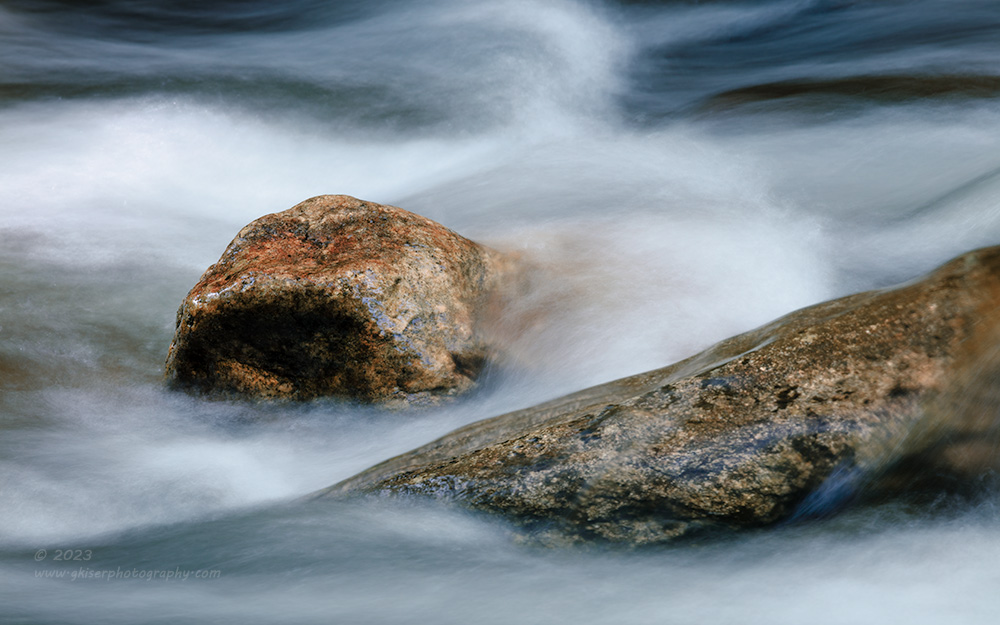
While working on that composition, I was spending a good bit of my time zooming in on the LCD to check focus and to look at the texture of the water. As it happens sometimes, I saw an isolation in the LCD which I had not considered before. If you compare the two images above taking into account that one of them has been flipped horizontally, you will be able to see the area that I am talking about. An added benefit to flipping the one image is that the two images here aren’t immediately recognizable as the same scene. That allows them both to exist independently of each other.
With the idea of doing the isolation, I reframed the shot for the more intimate view and worked out the exposure needed for this scene. Once I had the exposure figured out, I started to play with the camera position to make sure that each element was in the right place in the frame. This took a bit of doing and required changing the elevation of the camera as well as some slight tweaks to the placement of it. Once I had all that dialed in the photograph almost made itself.
At this point, I was very happy with the day, and saw that I had 147 frames on the memory cards. I had about doubled what I thought I would have from the day, and I was looking at probably six or seven keepers out of that batch of photographs. The sun was starting to come out which was totally unexpected because the weather had been very clear about calling for rain during the afternoon. I don’t care much for the high noon sun, and it certainly doesn’t work for this kind of photography. I was done, and ready to head back to the truck. It was only another five minutes or so worth of hiking before I got there, and I didn’t imagine that I would pass by any more points of interest.

When I got to the parking lot, I found it to be jam packed with cars. There were people all over and I was ready to get out of there. However, for some reason, I felt drawn to the fishing areas off of the parking lot. It had been years since I had photographed the water along this section, and when I had, it was in the very early morning hours when the light was overly blue. I wasn’t going to have that problem today, but I might have some specular highlights due to the sun unless it stayed hidden behind a cloud as it was currently. I walked along the edge of the parking lot looking for the place that I had gone out at that last time. It was further down that I had remembered, but I did find it. The area that I had shot before was not showing anything special at all. I didn’t even try to find a composition because there was nothing about it that interested me. However, about 30 feet down stream, I saw an area with a drop that did interest me quite a bit.
The area that I found had some vibrant colors and the water was looking good with a lot of texture thanks to the different shapes of the rocks and the streambed. I knew that there was something here, so I pulled out the camera and put it on the tripod with the long lens attached. I just moved the camera around the scene to see how things were looking. There was a bit of imagination as I thought about how the moving water would be captured by the camera. I finally landed on a section that had quite a bit of visual interest going on. I worked on framing things up and ended up shooting another 20 frames of this section. These were shot at everything from 70mm to the full 200mm as well as vertical and horizontal. I moved over a large boulder that I was standing on to get different angles on the area. I don’t think that I shot the same composition twice. I changed things up each time trying to find the right combination of elements for an image that was balanced and had a flow to it.
Of course, with the side of the stream that I was on, the water was running from right to left which meant that the images weren’t going to read well which made it difficult for me to visualize the ending compositions with these photos. I just concentrated on finding balance to them and hoped that I would be able to make them read correctly when I got them into Lightroom. This is both a blessing and a curse when shooting landscapes. It is very easy to flip an image left to right when there is nothing that identifies the proper orientation. That is hard to do with a person, or a car with emblems on it. There are always clues to which way is right. With these, there are no such hangups, but it becomes very hard to evaluate a composition because it will never feel right when it reads backwards. There was a time, not that long ago, that I had no idea that this was even a possibility in image editing, or at least didn’t know that there was a valid reason for doing it. I just accepted that a photo would look odd even though it was composed well. These days, I know the fix is simple, and it is something that I do without a problem with quite a few of my images.
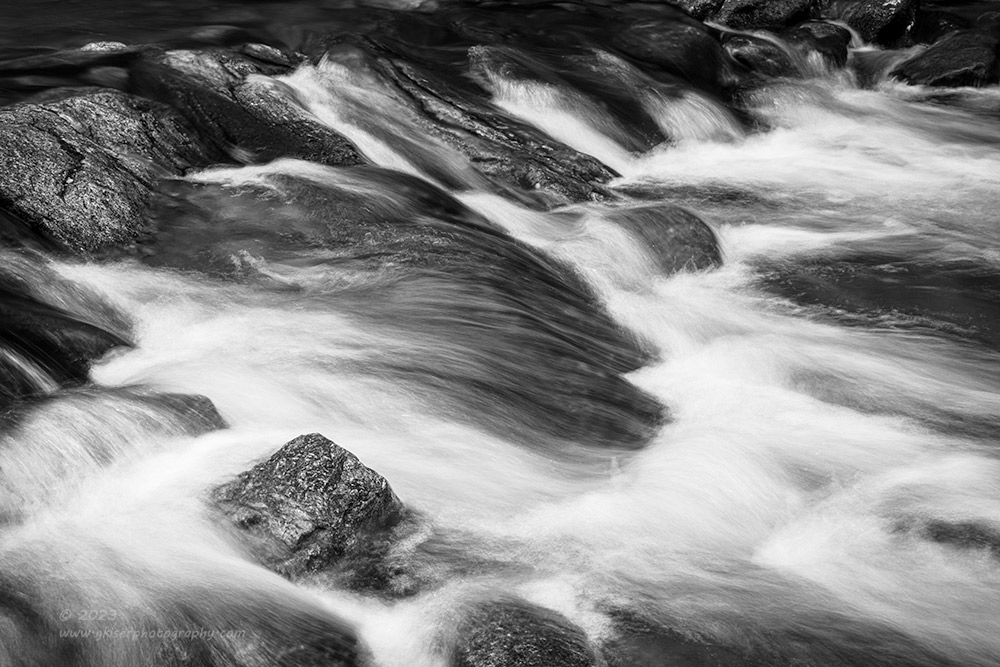
Of the last 20 frames, I ended up with two that I deemed were keepers. They are closely related not only because they are from the same section of the stream, but they were also edited nearly the same. Both of them were flipped horizontally as I mentioned, and while they both started out as color images, I felt they were lacking something. It was this last one that really felt off and I started the edit all over again as a black and white presentation. I didn’t do this to “fix” a bad photo, but I wanted to see if the colors were getting in the way. I mentioned that the colors were very vibrant, which they were, but there was pretty much only one color present which kind of became boring. Looking at the scene, the compositions that I had chosen were all about the textures and contrasts, not the color. When I made the conversion and finished the edit up as a black and white, I was struck by the presence of the whole thing. I actually loved the photo and became more excited about it seeing the edited version than I was imagining what it was going to look like at the time of capture.
Since I liked this one so much, I copied the edit except for the local adjustments and crop to apply to the one that I had finished a color edit on. It didn’t have quite the same impact when I did that, but it was better than the color image. I made some more tweaks to the edit for this one, and went in to fine tune the local adjustments. That was all that it needed, and in a few minutes, I had a fresh edit that I liked much more than the color one, although not quite as much as the last one that I edited. In the final assessment of the images, even though these two were shot at the same location, there is enough difference between them to where you can’t really tell it is the same section. This is why I have chosen to keep both of them.
At the end of the day, I had shot 168 frames in just over four hours. Of those images, I have added nine keepers to my collection which I am very happy with. There were another few that I could have edited, but I couldn’t get excited about them, and I didn’t want to have photographs here just to fill space. I think that each of these is a very strong photograph, and I am proud of them all. I’ll always remember this trek for the droves of people that I had to deal with which is my least favorite part of landscape photography. I was very lucky to be able to capture the photos that I did considering the rain, the people, and eventually the sun. Then again, this is just another day in the life of a landscape photographer.
For those that are worried about me getting home since I had 124 miles worth of estimated range left on the truck and had driven just a tick over 64 miles to get to the park, you are probably doing the math and deciding that I got gas at the first station I came to. Well, I didn’t do that. I was showing 64 miles of range left on the truck when I turned it on, and I only like to use Exxon or BP fuel. I had passed neither of them anywhere on the route to the park. There was an Exxon about 6 miles from the house, and I was going to try and make it there and make it there I did. I had six miles left before bingo fuel which would have gotten me home, but not much further.
Thank you for joining me on this waterfall adventure. I know that there are many of you that enjoy my waterfall photos and I’m sorry that they have been few and far between here lately. I really do have to be in the right mood to photograph waterfalls because they tend to start behaving very similar over time. I like the variety of working through the different landscapes a little better these days, but I can’t forget how many years I spent looking for waterfalls and learning to photograph them. Should any of these photographs speak to you, I would love to make a print for you of your favorite one. You can order stock sizes through the website, or you can get larger sizes, or special media by ordering directly through me. If you would like to step up your own photography game, consider a mentorship with me. I have several different options to suit just about anyone’s needs.
Check back by on Thursday as I will have another installment of my monthly Behind the Camera feature published. I’ll be tackling a topic that I have been putting off for some time now. I hope to see you back here then!
Until next time…

Remember to use the code KISER10 to get 10% off your purchase