Tuesday, April 15, 2025
Hello darkness, my old friend.
Spring is one of those interesting times for me. Many years, I get in the mood to shoot landscapes and play the part of a nature photographer. Other years, I start to grasp onto the decay subjects that come so easily during the Winter. There are also years when I am confused and between creative directions and end up sitting idle for much of the season. This year has been a bit of an interesting one when looking at those typical options that I go through. I’ve actually been wanting to get out and do some landscape work and have been trying to put together a landscape workshop as well. The problem that I have been running into is the same one that I ran into during the previous Fall. Thanks to Helene, much of the Blue Ridge Parkway is still shut down, at least the sections that I like to visit. Those areas that are open, are seeing a lot more traffic than normal because of the reduced options. Of course, the season hasn’t really started in the upper elevations yet, so there is that concern as well. In short, I am just finding it hard to decide on a place to go for landscapes. I am still feeling creative though which means that I am trying to get out and capture new photos, but don’t necessarily want to just keep rolling with the rusty cars as I have been knocking it out of the park with those here lately.
What I have ended up doing is finding some barns here and there that make for good photos and have even embraced the more commercial settings locally for both workshops and for my own photo walks. The idea is to not lose the momentum that I have gained through the Winter after a very long time of being in a creative slump. Something that I have learned over the years is when I have this creative energy, it is better to direct it somewhere, even if it is not something that I might normally do. That is why I have been more open to doing different things here lately because I don’t want to stifle that energy. That kind of brings us to this trek which might seem like a repeat of so many other treks that I have done since it happened at Outlawed Restorations in East Bend, NC.
Many of you will recognize the location because I have been here more times than I can count both for my own photo sessions as well as for teaching workshops. Speaking of which, I have a workshop coming up in just about a month and there is still room for a few more participants. If you are wanting to take part, you will need to get signed up soon as I will be sending out the initial packet very soon to get everyone geared up for the experience. How could a location that I have become so familiar with over the years offer something new and different and allow me to stretch my creativity? Well, there are many different ways to photograph things and scenes and that is where this one comes in as a little different from the norm.
More often than not, I will choose a nice cloudy day for this type of subject because the light is nice and even. More recently though, I have found some benefit in working during a sunnier kind of day which gives me more shadows to play with and better saturation of the colors. The tradeoff is that the direction of light will often dictate the compositions that I am able to work with. I don’t go out at the edges of the day all that often during that much loved “golden hour” because I just don’t think that light really works for the subjects. However, there are more lighting options available beyond golden hour into the blue hour, and even full-on nighttime. Now we are getting into why I wanted to come back out here once again.
In addition to kind of refreshing myself with the subjects that are onsite, I wanted to pull an old technique out of my hat and give it another spin. You might remember many years ago, I went through a phase where I did a lot of light painting and even conducted a workshop on the topic in 2020, I believe. I haven’t really done much with it in the last couple of years mainly because I just don’t think about it. I’m getting old and like to be home at night which makes going out for photos in the dark difficult. There is also an added degree of difficulty over typical photographic conditions because there is very little light to work with. That makes finding a composition and getting focus very difficult. There are just more steps to this kind of photography, and I’ll admit, I can be lazy at times which is why I like working during the day when I can see what I’m working with.
That being said, I was feeling creative and with a string of clear sky days in the forecast, I figured I could take advantage of the large moon and the light that it provided by revisiting the light painting technique. The best place that I’ve found for subjects and ability to be there is Outlawed Restorations. Over the years, I’ve developed a great relationship with Dean who owns the shop and can pretty much go out there any time I want to. I still make sure it is OK before I go, especially when it is going to be outside of normal business hours. The reason that I like this location so much is that the same subjects that I love working with during the day, also make really strong subjects at night. In some cases, I have more compositional options open to me because the backgrounds are much more simplified in the deep shadows. Rust also looks really good under an old-school flashlight. Seriously, an LED light isn’t all that great because it is too blue and ends up washing out the warm tones of the rust. I much prefer an incandescent light which is much warmer in color temperature.
Anyway, I am getting off track here. I planned on getting onsite around 7:30 which would give me about 30 minutes before sunset and allow me time to figure out my compositions. Remember, working in the dark makes it very difficult to get a composition put together. I always like getting there earlier enough that I can spot the compositions and even grab a quick shot for reference when it turns dark. This is beyond helpful because you can have a visual reference right in the camera of how the subject fits into the scene around it without having to use a flashlight to establish every inch of the scene.
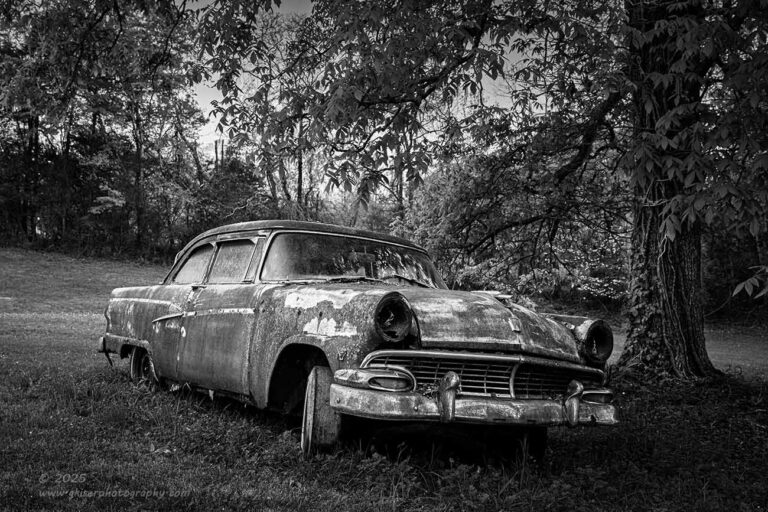
When I arrived, I got straight to work and looked around. There were a few changes to the landscape, but nothing groundbreaking that would cause me to change up what I was planning for the evening. I knew that I wanted to get a shot at Dean’s Dad’s Ford sitting under a tree, so that was the first place I went to set up the shot. For simplicity, I fitted the standard zoom which would allow me to work in closer proximity to the subject which would come in very handy as I would be walking all around the subject in the dark. I didn’t want to have to find where I left the camera out of that working area so that I could use the telephoto lens. I also went ahead and slapped on a polarizer while the sun was still out a little bit because I remembered that some of my test shots have turned out to be keepers in the past. Might as well treat the photos like I intended on keeping them from the start.
As I started to get things set up, I realized that I had company. A black kitten was starting to get curious about what I was doing. Actually, the look on its face pretty much said “you missed the good light, why bother?” I’m not saying the cat was wrong, but I did have plans that would require less light than this. In the meantime, I knew that with the flat light here in the shade, I would be able to really work a black and white presentation of the scene as I added in the contrast that I wanted to see. The main event would require much less light across the landscape though. The cat and I agreed to disagree.
The next conversation we had was trying to convince it that I didn’t need a cameo in the shot. While I didn’t mind having a black cat in the shot, there was no way in the failing light that I could get it nice and sharp without bringing in too much noise and grain. When I realized that the kitten was very happy showing me what parts of the car to pay attention to, I had to get its attention so that it would clear the scene. This was when I started talking to the cat and patting my leg. This hardly ever fails with a cat, and it didn’t let me down this time either. I now had a friend that wanted to climb my legs and play with the strings on my jacket. I’ll admit, it was cute and caused me no problems at all as I was pretty much in one spot at this point.
After working out the compositional variations and figuring out where the best balance was for the frame, I decided that I had what I needed here and wanted to move onto the next composition that I wanted to consider. That happened to be a pair of trucks that were parked along the trees. I’ve shot these several times in the recent past, but this time, there were less distractions around them which made the composition much easier. I set it up and fired off a single shot. The sun was peering through the trees which made the exposure rather difficult. Not caring too much about this shot other than a reference piece, I moved onto their neighbor which was a 40’s Plymouth that was a recent addition to the property in the last couple of years.
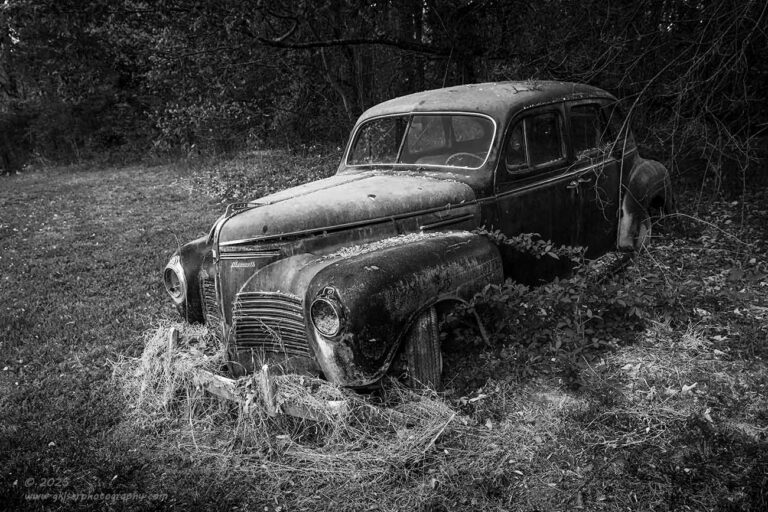
Usually, when I have photographed this car in the past, the light has been difficult to work with. Either the morning sun was bathing it too much and creating a flat light on it, or the sun was behind the trees and casting a shadow over the car. Clouded light was very similar with very little dimension to work with. Now that the sun was basically down, I had a little more interesting light to work with as the shadows were much deeper than I had previously seen, but the top of the car was looking kind of bright as it reflected the brightness of the sky. I actually saw the potential here as I was setting up the shot and did it in a way that would give me a real good chance for a solid black and white image.
I spent a little time here making sure that the yellow grass around the car was filling a suitable amount of space because I was going to use that grass to frame the rest of the car. It would be even more effective in black and white because I could adjust the luminosity of the yellows to get the exact contrast that I was looking for. The rest of the car was going to be darker than the surroundings for a bit of contrast to that foreground. I only shot four frames here and was able to do them pretty quickly because even though the kitten had followed me over here, it was content to just sit on my bag and watch what I was doing.
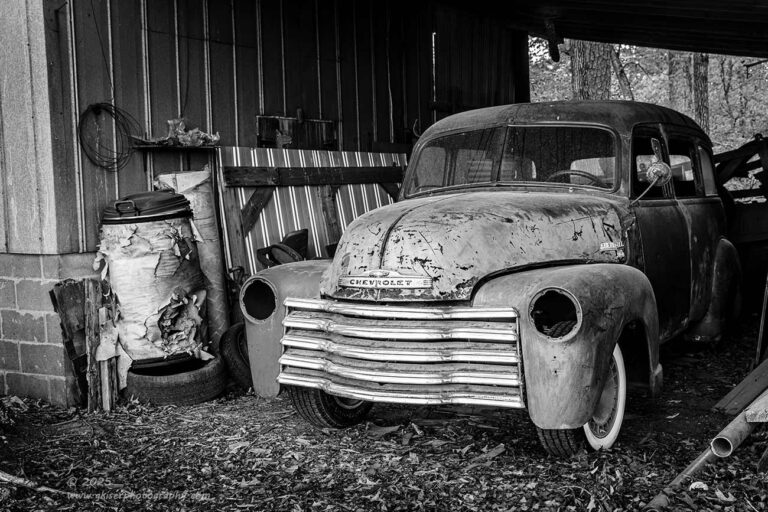
Once I was done with that car, I evicted the kitten and grabbed my gear to start walking over to the other side of the property. I knew that I wanted to get the Hudson which I’ve always had a hard time capturing because it is so large without a lot of details to break up the hugeness of it all. However, when I was walking over there, I happened to see something that I didn’t recall ever being here before. It was a Chevy wagon sitting in a shelter behind a bunch of stacked fenders that I had shot last year. There was a lot to take in with the scene and even more to like about it. I didn’t really have to think about it long before I knew that I wanted to get a shot of this beast.
I knew that I was going to have to include the barn and shelter to make the composition work, and that meant adding in a lot of things that I would normally consider as distractions or clutter in the scene. I just carefully worked my way around the frame and found the right combination of position, focal length, and composition. When I had it, I just knew that it was going to work very well in the next few minutes as the sun went down and I could get some light on the truck. I did grab a quick shot of it with the existing light for reference and decided that I really liked it like that.
Knowing that the composition was right, I decided that there was enough merit to the frame that I needed to really work out a photograph of it dealing only with ambient light. I had pulled off the polarizer in preparation for the light painting to get started which would still make a difference in this light. I pulled it back out and reattached it to the lens and altered the exposure a bit before taking a serious frame of this scene. I kept adjusting the exposure as the light fell and grabbed a total of five frames that I was hoping to make into a keeper of an image. I just wasn’t sure if I was going to do it in black and white or in full color. I did like the colors that were present, but I knew that the colors would get more interesting after the light faded a bit more and I started adding my own light.
This was the point in the evening where things started to change and get interesting. Usually, this is the stage when I would pack it all up and say that the light was gone. However, this time, I was actually looking for blue hour in order to get the visual impact that I was after for this trek. My goal was to do things a bit differently than I have done in the past. As you can see from the video above, the process isn’t all that complicated at all, just a matter of trial and error as you get the light placed where you want it to be. The change that I wanted to make with the process is one that I never really considered in past before working with portraiture. As I have been learning more about people photography, I have found that the camera deals with light a bit differently than I had originally assumed. I was essentially looking at both ambient light as well as additional light added by my flashlight which was taking the place of a strobe. The flashlight would have a different intensity or power than the ambient light, and since the light isn’t constant, the shutter speed wouldn’t matter for the flashlight, but it would for the ambient light. The longer the shutter stayed open, the brighter the ambient light would get, but the flashlight would remain the same based on how long I left it on a section of the subject.
I had been working these kinds of shots using the base ISO of 100 which is not a very sensitive setting for light. I had already planned on moving up to ISO 200 or even 400 for this because it would allow my flashlight to work much more efficiently and keep me from having three-minute exposures as I worked over all the different areas of the subject several times to build up the light. This added noise from the long exposure and created hot pixels in the frame which I would have to remove. The extra stop of sensitivity would cut the amount of added light down by half which would make the process much easier to work with and I would have a much shorter shutter speed which would keep the ambient light under control. I could also temper the overall lighting through the aperture choice which I would be able to stop down further than I had before for better depth of field.
These are concepts that I have kind of adapted to light painting in my mind and had not put them to use at all. This was going to be an experiment as well as trying to get some good portfolio images. I just had to get started. The first attempt was done at 3.2 seconds and ISO 200 with an LED flashlight because it was brighter, and I thought I might like the blue tones of the light for this scene. It worked, but I didn’t really care for the color effect. The higher ISO was making the additional light much quicker to apply which I really liked.
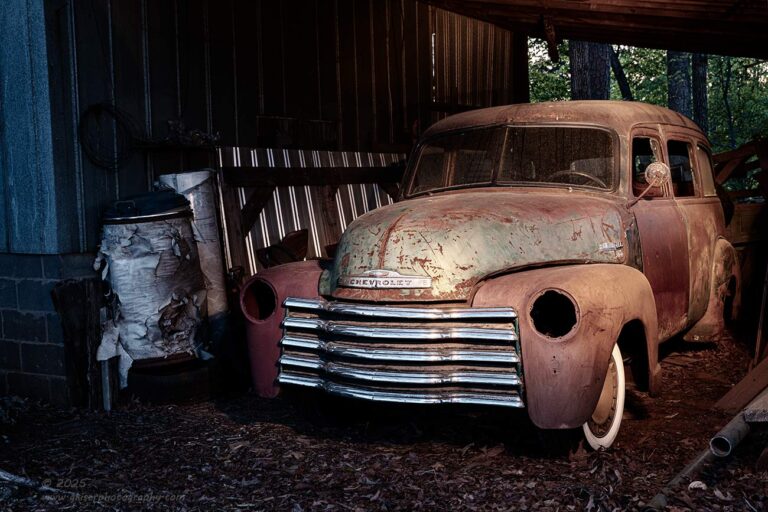
Once the ambient light fell to a level that I could use the dimmer incandescent light, I switched over to the older flashlight and adjusted the exposure several more times as I got a feel for how I wanted the scene lit. The image that you see here is the result of 14 attempts to get the lighting right as well as the exposure. It is just not as straightforward as you might think to achieve this result. On the 15th and final attempt, I was at ISO 200, f/10, and 30 seconds. During those 30 seconds, I moved the light around the truck and under the roof to add a little interest to the top of the frame. I made sure that I didn’t touch the exterior wall as it was going to register blue due to the ambient light’s color temperature. I knew that I wanted that for a bit of color balance to the warm lighting that I was adding to the scene.
There was still a good deal of ambient light in the area, especially in the background since the sun was setting in that direction. That made the sky rather bright, and the trees caught a good deal of backlight which brought out a lot of the green in the leaves. I could tell that I had a nice color palette with reds, greens, and blues in the frame, but I didn’t want them to be overly punchy. This prompted me to use a color profile that desaturates the image quite a bit while changing up the contrasts as well. This worked very well for what I envisioned for this shot and it all came together really nicely.
I haven’t really done light painting with this much ambient light in the past, and that made this image look a little different from what I had shot in the past. You almost can’t tell that I used this technique, but there is obviously additional light in the scene. It is the specific nature of the lighting that reveals how this light was added. It is subtle, but something that I think worked very well, especially for this particular scene. Without having the brighter ambient light, the trees in the background wouldn’t have been visible and the blue siding on the barn would have been less impactful. This was the right scene to shoot for this particular time of the evening.
This is also another reason that I liked going through the different scenes before I start doing the light painting. It is very helpful to establish which scenes will require some ambient light in the sky and which ones won’t. There have been many times that I have worked a composition that really needed more background lighting, or a bit of color in the sky, but I had gotten to that one too late and lost that fleeting light. This was not one of those scenes that would have worked after the light had all gone away.

The next composition that I wanted to get was another that would benefit from a bit of light in the sky. That was the Ford sitting under the tree which I had just shot for the first time last year. After doing the test image that you saw earlier in black and white, I knew that I was going to have a good bit of the sky in the photo, and I didn’t want it all to be black because that would create too much negative space in the frame which is always a concern with doing light painting. Having that bit of blue in the sky defines the tree and gives scale to the scene which are both very beneficial aspects. I had to work when the light was still there, which made this a great second composition to work with.
The problem was, my kitty friend was back and was getting more and more interested in what I was doing. I probably could have done a mentoring session with it, but I didn’t see a camera at all, not even a phone. That made it very hard to teach, but I did talk through the process just in case the interest was there. Actually, I kept the conversation going to remind me that there was a small black cat following me around as I was lighting the car. Now think about this for a minute. A kitten of about five months, solid black, constantly circling my feet in the dark while I was using a flashlight to illuminate a car from two different angles. Yeah, I was worried about kicking or stepping on my new friend.
The routine went something like this. I would press the remote release which would count down just two seconds which in that time I would scoot over to the left watching my feet. When the camera clicked, I would start to light up the side of the car and the leaves before rushing over to the other side of the camera while making sure that I stayed in front of the cat. I would then light up the trunk and more of the leaves as well as splashing a bit of light on the front of the car and the grass until the camera finished the exposure. When I started, that exposure time was just 13 seconds. It got longer as I went, and I kept repeating the process until I had several attempts that I liked.
At some point, I remember reviewing the previous image and feeling claws digging into my leg. I looked down and saw the kitten climbing up the leg of my jeans and it made it all the way to my shirt before letting go. I might have actually been able to open up a jacket pocket and carried it around with me without an issue. Fortunately, the kitten was cute enough that I overlooked how much difficulty was being added to the process. That process repeated a total of eleven times with the keeper of the bunch being that last attempt. That was the one where I had the additional lighting just like I wanted it as well as the ambient light. This was also shot at ISO 200 for a bit of efficiency out of the flashlight, while f/8 helped to control the ambient light over a bulb exposure of 64 seconds.
I was no longer able to set the shutter through the normal manual mode but had to move into bulb mode where I opened and closed the shutter manually. This is how I had done light painting for so long before. It allowed me a lot of flexibility to paint the subject for as long as I wanted. If it was dark enough, the ambient light would never build up to a problematic level. I did have to keep in mind the sky which still had light to it, and the fact that I was working with a sensor that was a stop more sensitive than what I was used to.
In the end, I did have to do some burning to the image to deal with the ambient light while keeping the added light from the Maglite where it had been during the exposure. While post processing isn’t as intensive in light painting as it is during a natural light shoot, there are still things that can be done to really dial in an image and this was one that really benefited from a bit of post processing. I did learn a few things about how the ambient light reacts that I can put in place for the next time to avoid quite as much time in front of the computer afterwards. As I mentioned, this was as much an experimental session as it was a full-on trek for portfolio images.

For my next trick, I went over to the two trucks that I had taken the practice shot of earlier without any success because the sun was coming through the trees at the time. Now that the sun was down, the whole scene was completely different. Of course, I mean that I could really no longer see the scene with my bare eyes. I did know how it looked and could look back at the image I shot to see how I wanted to compose it. I was needing the flashlight here not just for lighting the exposure, but also to be able to see how to set the shot up. I knew the basic areas of the frame that the trucks needed to occupy, so that went pretty quick. Focusing had to take place by using the flashlight to illuminate the focus point and locking the auto focus there. Once that was done, I didn’t have to worry about needing to focus again because I am using back button focusing so the focus isn’t affected when I press the shutter button on subsequent exposures.
I started making the exposures as I had been doing with the camera in bulb mode giving me plenty of time to work through the lighting as I saw fit. Each exposure showed me areas that I needed to pay more attention to. Since I was lighting two different subjects and some vegetation, it became rather complex and would have been a three-to-five-minute exposure if I was shooting at ISO 100 as I used to do. Now that I was working at ISO 200, the flashlight was much more efficient, and I was usually coming in at a minute or a little more for exposure times. That was nice as it took less time to apply the light, and I wasn’t having to linger on places as much as I had done in the past.
In fact, this was actually going very smoothly except for my furry friend that was still with me. It was almost pitch black in the area that I was working which meant that seeing a black cat was like chasing a shadow in the dark. I was getting into a pretty good routine with it through and had learned its patterns. Of course, that would be too easy. It was time for the second layer of feline fun. While paying very close attention to my feet while lighting one of the exposures, I caught a shadow moving across the ground in front of one of the trucks. I dismissed it at first but then saw it sitting on the ground to the left when the light came back that way. I looked down at my feet, and my partner was still there. What I was seeing was another cat. I think that this one is the dark gray one that is usually in the shop. She is really good about staying out of the way, but her version of out of the way was right in the middle of the photo. So, there I was with one cat at my feet, and the other one moving around a scene during a minute long exposure. I had to do something.
I did my leg pat and a little talking which got her attention. She came to me and started walking behind me. She eventually laid down next to my bag and that was where she remained for the rest of the time, I worked this area. I still had my little shadow at my feet, but I was getting really good at avoiding the mobile tripping hazard. Of course, every time I stepped on a root or something I panicked a little bit thinking that I had just crushed a kitten. Fortunately, no cats were hurt in the making of these photos.
There was a total of nine attempts with the two trucks before I decided to move on. It was the sixth in that series that turned into the keeper. It had the best balance of light with the bit of blue coming through the trees in the background. There were also no cats in the frame, and I did a decent job of lighting the subjects. All of these aspects were important to the final image, and I think that this one had the best combination of attributes. There were still more scenes to shoot, and the light was really failing quickly at this point.
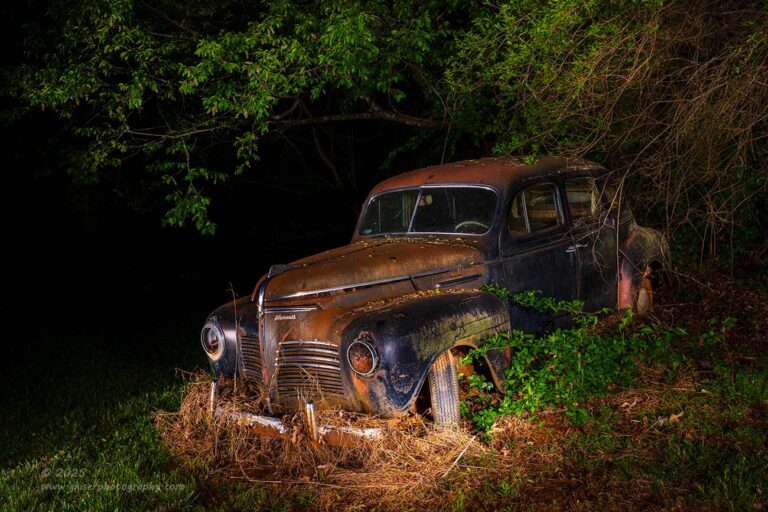
I moved my attention to the Plymouth beside the two trucks that was situated off by itself. I had a good idea how I wanted to photograph this scene thanks to the earlier test shot that I had made which actually turned into a pretty good black and white photo. I elevated the camera to where I had it for that test shot and figured out the placement of the car by using the flashlight. The focus was locked by shining the light on the headlight bucket and fixing the auto focus on that point. From there, it was a repeat of what I have been doing for the last hour or so. The difference was I was getting better at this, and it only took four attempts to get to this photo. The cats were starting to lose interest in me and were kind of staying away at this point, which was nice, but I was also feeling kind of lonely.
I was pretty sure that I had everything that I wanted, but wanted to look around to see if there was anything else I might have missed. I walked around behind the large barn and looked at the three trucks that I have photographed before as parts of painting with light sessions. They didn’t really offer me much more than what I had done before since the light was gone out of the sky. I looked at the White firetruck which I have shot numerous times and gotten a really great image using the light painting technique before. I just didn’t see any reason to try and reshoot it now though. As I continued across the property, I remembered the Hudson that was sitting in front of the old family home. It had completely slipped my mind when I came across the Chevy wagon earlier in the evening. I didn’t have any ambient light to work with since I had neglected to look at the moon forecast. I knew it was going to be 95% full during the evening, but I paid no attention to the fact that it was rising at something like 11pm. The moon was going to offer me no light to work with, and this would have been the time that I could have used it.
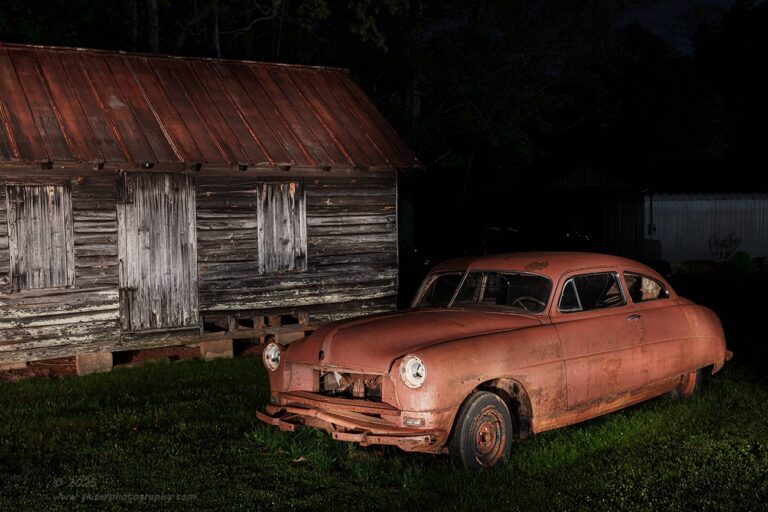
I did make my way over to the Hudson and started to work out the composition that I had in mind. I guess fortunately, there was a spotlight on the flagpole nearby which was providing a little ambient light to help me compose the scene. This light didn’t do anything at all for the trees in the background, but it did light up the metal barn off to the right and there were bits of chrome that reflected the light in the background. I wasn’t wild about all of that, but I figured that I could deal with it a little in post. I just needed to get the composition figured out before I could do anything else.
I landed on a similar composition to what I had shot last year and started to dial it in and get the focus locked. While I was doing all of that, I happened to see my good buddy walking around in front of the Hudson. A quick pat on the knee and a soft word redirected the kitten and we were inseparable once again. At least this time, I had a better view of my shadow with the spotlight behind me. There was a total of five exposures made of this scene to try and figure out the right combination of camera settings to control the ambient light and how I applied the flashlight.
What I ended up doing for the successful image was dropping the ISO back to 100 while keeping the aperture at f/8 which was too dark at f/11 when I tried that. Still in bulb mode and working very slow through the scene as the roof on the house took a lot of light to expose. The Hudson was just big, and needed a lot of light, so it ended up taking me 117 seconds to light this entire scene. The end result turned out pretty good. I had forgotten to spend time on the top of the car, but I actually liked how it gave the car more dimension and the shadow kind of flattered the car by making it a bit smaller in appearance. It was almost like short lighting a person.
That photo represented the 63rd image for the evening in a bit under two hours. Doing light painting is a slow process because of the time to set things up and then the long exposures that have to be made in order to get the light applied. If you are interested in a workshop for this technique, let me know. I would like to do one again and think that I could improve on what I did the one other time that I attempted it. This is the time of year to make it happen because the mosquitoes aren’t out just yet and it is not overly muggy at night.
I do appreciate you joining me for this trek and I hope you enjoyed the slightly different take on one of my favorite locations out there. Remember, if any of these images speaks to you and you would like a print, I can do that for you. Print sales do help finance these treks that I go on as well as offset the time and energy that it takes to put these blog entries together. If you don’t see a size that you are wanting or would like a specific media such as canvas or metal, I can do those as well, but they count as special order, and we would need to discuss those orders before placing them. It really is no big deal, but it is much easier to provide a quote with your specific needs taken into account.
Until next time….