Saturday, April 19, 2025
We all know the saying, but it is easier said than done many times which is odd. It seems that we tend to work ourselves to death doing things for which there are easier ways. Well, Toni inadvertently showed me an easier way to scout locations for treks. As you know, for many years, I have gone out driving for sometimes hundreds of miles down country roads looking for subjects to shoot. Sometimes I am very successful and other times, I come home needing to fill up the tank with nothing to show for my efforts. Well, a couple of weeks ago, she had seen something on Facebook that she thought would interest me, but I wasn’t a member of the group. It was a group specific to Wilkes County, and I joined it because I do have an interest about things going on out here. That was pretty much it.
That is, until I saw several posts in one day in that group about folks looking for this service or that service, or maybe a used car to buy. I thought to myself….”Self, why can’t we ask a simple question and see if we get a response?” Of course, as I was asking that question, I was holding my camera saying in a sinister way….”My precious.” OK, had a slight Lord of the Rings sidebar there, but I was wondering if there was a way to harness this page for scouting, so I posted a simple request for anyone that had old, rusted cars on their property to get in touch with me if they didn’t mind me photographing them. It was kind of a longshot, but I thought that there was enough chance to make it worth my while.
Wouldn’t you know it, within like a day’s time I had received a message from one of the group members simply showing two photos of a Plymouth wagon. It was blue and rust which as you know, are my favorite colors when it comes to these old cars. I got in touch with Ryan, and he was very willing to let me come out and get some photos of the car and we figured out when he was going to be at home. Prior to this conversation, I had been considering heading out to Wiseman’s View in the Linville Gorge for a sunrise panorama that I had in mind, but the weather for Saturday morning was looking promising for doing some decay photography. Waiting a little bit for more Spring colors wouldn’t be a bad thing for the Linville trek, so I decided to put that off; Plus, I wasn’t really looking forward to getting up at 3:45 to get out there before sunrise. Yeah, I am liking sleeping in more and more the older I get.

Anyway, I took my chances and slept in a bit instead of heading out to the mountains. When I got up the weather was saying clear skies, but looking outside there was a medium overcast which didn’t really have much texture in the sky, but the light was looking good. The cloud forecast was showing increasing clouds through the morning before clearing off in the afternoon. I went down to the studio to get some things done first thing and then came upstairs to look at the weather once again. The sky was not great, but the light was pretty good. I pulled up the photos of the Plymouth once again and tried to decipher the lighting that in the photo to determine where the sun was going to need to be in order to make this work. The light was good and diffused but was very directional which could be a very good thing, or a very bad thing depending on the orientation of the car.
After looking at it and trying to figure out how the sun was going to proceed, I decided that it was going to be close enough to noon that the direction wouldn’t matter too much. I know that the age-old wisdom suggests that you shouldn’t do photography near the middle of the day, especially if the sun is shining. Well, in my experience, noon photography doesn’t bother me when doing decay work, and if there are any clouds in the sky, it actually looks pretty good. Shooting landscapes is a different story, but I wasn’t going to be doing that. I was actually looking at roughly an hour onsite and maybe a handful of photos to work through. It was going to be a pretty simple shoot and one that I would be done with well before dinnertime.
Oh, the lies I tell myself.
Around 10:30, I reached out to Ryan and asked if it was a good time to come by and get a few photos of the wagon. He quickly replied that I was welcome out there any time, so I grabbed up my gear and headed down to the Southern part of Wilkes County to find his address. I was roughly familiar with the area as I had been out here many times before, but the last two roads that I had to travel were ones that I had not been on before. The road that Ryan lived on really looked more like a driveway than a road and more than likely wouldn’t have been one that I would have explored down. In other words, had it not been for the Facebook Group, there is a very high probability that I would have missed this location altogether. I realized my fortune as I had made a direct path to this location eliminating the endless driving around and hunting. Thanks to that little suggestion from Toni, I found myself working smarter, not harder. That is always a good thing, and even though I do enjoy the hunt, this is far more efficient and much less stressful knowing that I have permission before even getting in the truck.
I ended up getting there a little after 11am and pulled into the driveway. At first, I wasn’t sure that I was in the right place, so I pulled out the phone to let Ryan know I was here, but there was no connection. Fortunately, he came out and met me after one of his neighbors sent him a text about a strange green truck hanging out by his house. I’m very used to this kind of neighborhood watch and I’ve seen it in action many times doing this kind of photography. It has caused me some delays in the past, but more often than not, it is a great way of finding owners when I am needing to speak to somebody. No matter what the outcome is, I appreciate neighbors looking out for one another and it always makes me feel good when I see it in action….even if I end up getting run off which doesn’t happen often.
Now that I had officially met Ryan, we chatted for a while, and he took me on a quick tour of the property and told me about the different cars that he had out here. There was more to it than the wagon that he had sent the photo of, but that was the one that fit the requirements that I was looking for. There was also a ’68 Firebird in a garage undergoing an engine swap which caught my eye. It wasn’t rusty, or even in a neglected condition. However, I don’t see many Firebirds and that made it rather unique and something that I wanted to try and get some photos of. He had a few later model cars which didn’t really interest me photographically, but I learned quite a bit about the Chevy HHR’s that I had never known before. We worked our way over to the Belvedere wagon which was why I was out there, and he told me how he had come into possession of it and how he had traded a Fairlane a while back. As much as I have been enjoying photographing Fairlanes here lately, I was glad that he had made the trade for something that I don’t think I have ever seen before. There were also two trucks nearby, one of which was a 1975 Dodge pickup which was a limited edition “Spirit of ’76” model which I learned about for the first time. It was actually in pretty good shape and not something that jumped out at me photographically, but the original stripe package that was installed was still visible which did interest me a bit.

I had brought my camera out for the tour, so after Ryan finished sharing about the different cars, I started to get to work. I went with the expected overall composition of the wagon to get started with. This was the shot that I had planned from the beginning. It was a simple composition that was designed to show off the lines of the wagon against the backdrop of trees. There was a tarp behind the car which Ryan offered to move but it didn’t really bother me, so he ended up leaving it there. I’m glad that he did because the little bit of movement that was done revealed the yellow grass underneath which would have been a clue that something had been moved. It is moments like this where I am very happy that I make a practice of not moving things in the frame which I think might make for a better photo. It usually just creates a bigger distraction and evidence that the scene had been manipulated.
I was happy with the tarp there because it worked with a cinderblock in front of the car and a dominant tree trunk behind the car to form a triangle frame around the wagon. Even a simple composition like this requires a bit of organization and flow to really make it work. I shot it in the native 3:2 aspect ratio, but I was pretty sure that I would end up cropping it down to a 16:9 to really accentuate the length of the car and the overall proportions. It is worth remembering that the frame that the subject exists in, is as much a part of the composition as where the elements are placed within the frame.

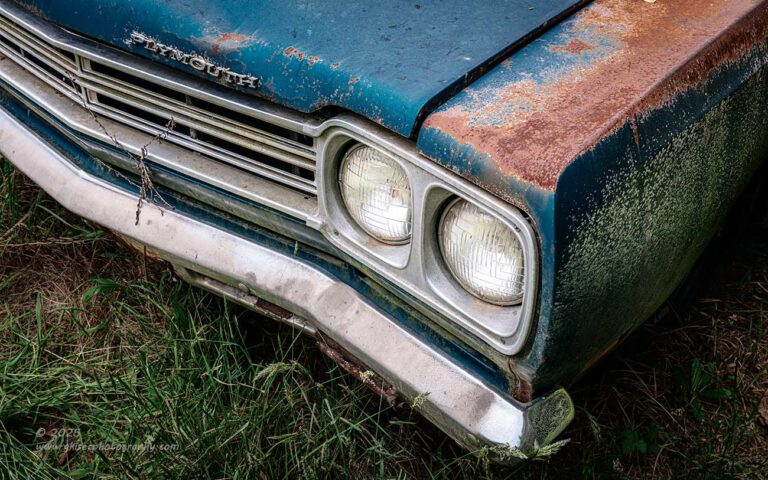
When I had the overall shot figured out and captured, I started to work on the isolations which would make up the bulk of the photos here. Any time I find myself shooting a blue car with this much rust, I always find excuses to capture the details because the two colors really work well together and make any composition look better. Of course, I did my standard shots of the headlights and fenders, but I was drawn to the scallop on the hood as well. The way that the light was hitting it gave some interesting shadows that created depth. I knew that I could emphasize those shadows in post, and I worked on finding a composition that made sense with the hood.
When I was finished up front, I started to work my way around the rest of the car which brought me to the rear driver’s side where the fuel filler cap was. Ryan wasn’t sure if this was the original Plymouth part or not, but I found it to be very interesting looking, and it reminded me of the turbo icon for boost gauges in modern cars. The patina background that it was situated on made it that much more interesting to me. I started out with a very simple composition that just included the cap and the shapes of the patina around it. I felt that was too simple and didn’t really capture the look that I was after. I ended up opening up the composition to include part of the rear window that added a triangle to the composition as well as the marker light in the lower quarter panel. I wasn’t sure how this was looking when I was checking out the image review, but felt that it had promise.
The new composition made it through the early stages of the culling process and even made it into the processing phase, but quickly I figured out that the composition just didn’t work. It was too complicated, and the different elements didn’t communicate together as I would have expected. I took the basic edit that I had started and moved it over to the simpler composition which had also passed through the culling stages. This one came to life and showed me much more promise as the edit was progressing. That became the keeper for this part of the car because it just worked well.

I also spent some time around the base of the windshield which has become a very popular composition for me over the last couple of years. The patina was perfect in this area and the way that all the body panels lined up made for a very interesting abstract shot of the car. There were also two screws that were wedged in between the body panels that added just that little extra bit of visual interest. Of course, this was on the driver’s side because the light was better, as was the patina with a bit of moss growing on the side. It didn’t really occur to me at the time of capture, but when I looked at it after I was finished with the edit, I found that the photo didn’t read as cleanly as I would have hoped. It was a strong composition, but the eyes struggled with it. I saw the problem and flipped the image horizontally which changed the entire design of the composition. This fixed the issue and there were no visual clues that I had done such a change to the photo which made this a simple fix to a big problem.
I really do like compositions like this because the subject always becomes the colors and the lines, not the car itself. This one had the added benefit of having some green tones showing up on the darker portions of the door and fender. The green here went with the redder rust tones, so I left the reds and resisted the urge to move them over to a more orange hue. The green also worked with the windshield for a bit of visual balance. The blue paint was moved to a more cyan hue to go with the orange and to link the green into the frame a little better. The end result is a more pleasing color palette with all complimentary colors.
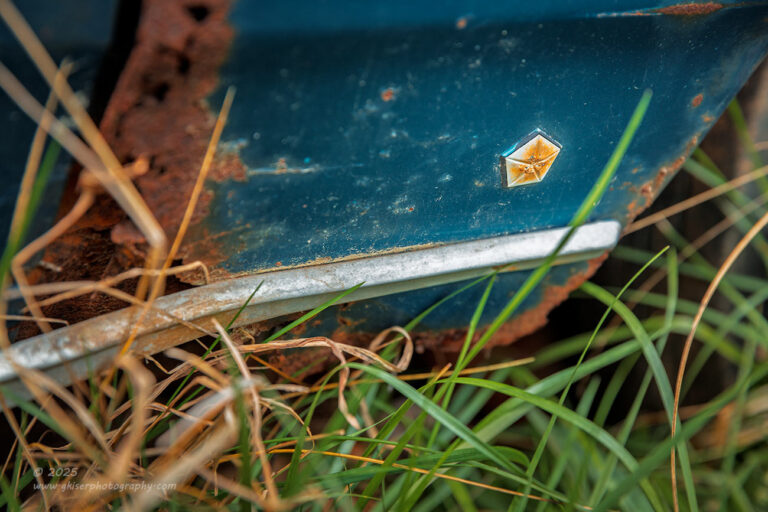
I began working around the car one last time in order to find any more details that I could use in a photo. There was one more area that I noticed that I thought would make a decent composition. This was the Pentastar at the bottom of the fender which was an interesting Dodge quirk during the era. They would only put that emblem on the passenger side fender which drives my OCD self a little crazy, but it is a notable feature that I wanted to capture since this car was down in the weeds, and you could tell a lot of the story of the car from this little snippet of the whole thing.
I started to frame up the composition with the camera down as low as I could get it with the neck still vertical. That didn’t give me enough of a drop, so I had to pull the neck of the tripod out and reposition it lower to the ground. This did wonders for the composition and I was able to get the tall grasses to become an instrumental part as well as the rust on the edge of the fender. The only issue was that the sun was causing a lot of glare on the bit of stainless trim under the emblem.
I stood up and blocked the sun, but that flattened the light too much for what I was after, so I repositioned a little bit and tried to work with the sun. I was having a very hard time with it and Ryan came over and offered to block the sun in a similar way to what I had done. With me down and able to work the exposure, that worked a little bit better as I was able to punch up the brightness of the image taking into account the change in lighting that was kind of hard to adjust for when I was the flag casting the shadow. With Ryan’s help, the composition actually worked out pretty well and I liked how the light played across the scene.
While I had been shooting the Plymouth, Ryan had been telling me about his neighbors and the different things that I might enjoy photographing. I’m no stranger to getting these kinds of tips while working a location. I’ve talked about it many times when I’ve been out to Traphill and now Hays. These areas always end up expanding my treks exponentially as one trek leads to another which leads to two more. While I was happy working this one car which was the result of a single Facebook post, Ryan was telling me about a barn next door, and another neighbor that had a collection of old cars and trucks. That one sounded like something I could possibly spend a day working. I wasn’t sure I was going to have time, but it would be worth stopping and checking out for sure. Ryan had called his neighbor and essentially gotten permission for me to go over and shoot their barn which was awful nice of him. I had no idea what it looked like, but Ryan seemed to have a pretty good grasp of what I liked to shoot after our conversations, so I was looking forward to seeing the barn.
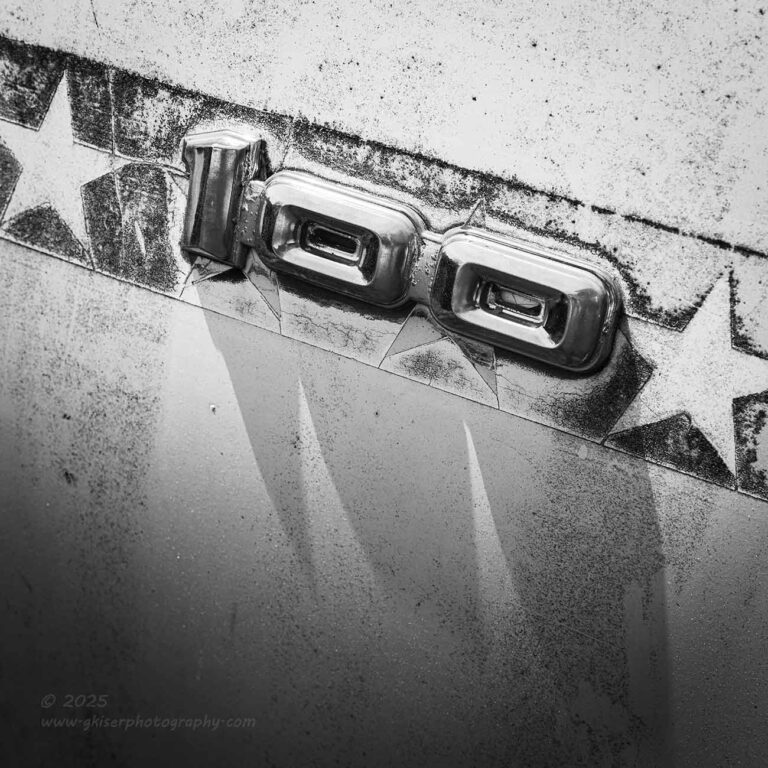
I still had a few more things to shoot here before I headed over there though. There was the Dodge truck that was still showing the limited-edition decals from 1975 that I wanted to do something with, but I really had no idea what. I looked around the truck and found it to be pretty plain except for that line of stars that went down the side of the truck. As I looked around the length of it, I saw that it went through the model designation badge on the fender, but what really caught my eye was the fact that the sun was casting a shadow under the 100 that added a good deal of visual interest. I started to work out a composition there and decided that I would shoot it vertically to accentuate the shadows. This seemed to have too much negative space, so I changed my mind and switched to a square crop that really centered in on the shadows. This worked much better, and even though there was a hint of blue still left in the decals, I knew that this one was going to be done in black and white because it was the shadows and the shapes of the stars that really interested me.
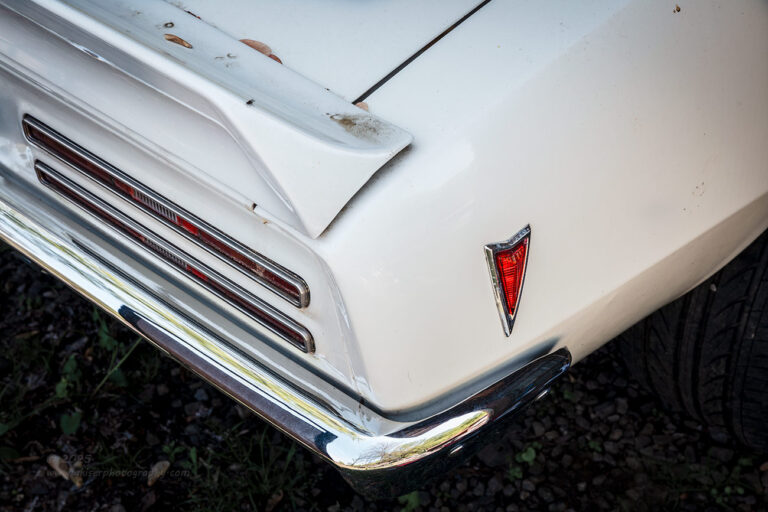
When I was done with the Dodge truck, I moved back to the main part of the property and started looking at the Firebird in the garage. There really wasn’t a way to capture the whole car in a photo, but I did like the rear of the car with the arrowhead badge with the rear spoiler. Just this view alone defined the car and identified it to anyone familiar with the Firebirds. I normally don’t care to photograph white cars, but the red really popped on this one and provided enough interest for me to start working a composition out. I had considered doing this in black and white, but I really wanted the red to shine through so, I knew I would keep it in color for the most part. I also knew that I could neutralize the color on the white paint and desaturate the ground leaving the red there to really pop.
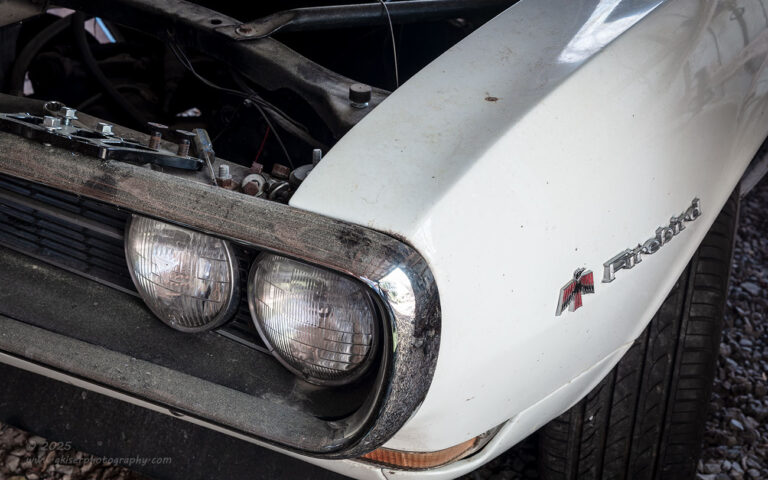
As I was working the rear of the car, Ryan said that I could go around to the front of the car where the motor had been pulled out because there were tools and small parts laying on the rear of the grill that might prove to be interesting. You see, he really was learning what I liked to work with. I went up to the front of the car and started to plan out my next composition. The early thought was to do this one in black and white as well, but as I was looking at it, the Firebird emblem had some spectacular red still very visible and the turn signal was still a nice shade of orange. Those two things prompted me to keep the photo in color for many of the same reasons as what I had done on the rear of the car.
There wasn’t much room to work with, so I had to be kind of careful with the crop that I used to frame the image. It was a little closer than I might have wanted, but to open it up would be to include things that would ultimately be a distraction. I just needed the frame to focus on the emblem, the headlights, turn signal, and the small items on the rear of the grill. Everything else just needed to support those elements. It wasn’t a great photograph, but it did achieve the goals that I had set up for it. I don’t think that it will be a portfolio piece, but I do like it well enough to keep it in the collection. It tells the story of the car, and I have a feeling that when it is up and running, I’ll probably be photographing it again. At least I hope that will be the case.
It was starting to get late in the day at this point, and I was needing to start thinking about heading home. Since Ryan had contacted his neighbor and gotten permission, I didn’t want to waste his generosity, so I headed over to that house to say hi to the property owner and to check out the barn. It was close enough that I just walked over there which made it very easy for me. I could see him on the back deck and walked around the house to introduce myself and to thank him for letting me get a few photos.

Now that I had permission, I looked at the barn for the first time. It was a simple barn, and like Ryan had said it was kind of set off by itself. The sky wasn’t all that great, but there was a little bit of texture visible which was a good thing. I noticed that the wall on the right side was stripped off leaving the framing studs exposed. This was a very interesting aspect for me as it showed a part of the barn that isn’t normally seen. The fact that there was vegetation growing through it sealed the deal for me. I was going to get some good photos here; I just needed to figure out a composition.
From where I was standing, there was a large tree that was also kind of situated alone and was reaching out over the barn. It helped to fill the blank sky adding some detail above the barn that I thought would be beneficial to the composition. I was seeing this as a black and white image to help simplify it because the color balance was going to be way off with the scaling of the elements in the frame. I switched the camera to black and white so that I could accurately frame things up without taking color into consideration.
This was harder than anticipated because I really had to work out the positioning of the camera to get the perspectives right between the tree and the barn. I ended up getting in pretty close to the tree to make it larger and had the lens racked out to 31mm to make this happen. The reduced size of the barn fit comfortably under the extended branch and proved that the composition that I wanted to do was very workable once I got the scaling right. The breeze was starting to come in, so I had to time the shot to keep the vegetation still which boosting the ISO and shutter speed.

When I had the original composition finished, I started to work my way around the barn to try and find any other compositions that might work. I tried different ideas from both sides of the barn, but it was that opened wall that really kept my interest locked which meant that I kept coming back to that side. I wanted to try a more simplistic composition, so I moved in closer to avoid the tree that had been such an important element in the first composition. This allowed me to really focus on the barn and nothing else bit the bar. Of course, I composed this shot in a way that had two interesting and dominant trees in the background to establish depth in the frame. Fortunately, the sky was starting to show some detail, and I could make out clouds and blue sky. With that extra color, I was able to get away with doing this as a color photograph as the reds, blues, and greens, all went together as primary triadic colors.
It was now well after 4pm and I needed to be getting on the road headed home. I was getting hungry, and I had been gone a few more hours than originally expected. I’m not complaining at all though because this trek had gotten better and better, the longer I was working the scenes. What had started out as an opportunity to get a couple of photos of a unique wagon, had turned into three different vehicles that I had shot and a barn. These four subjects ended up yielding 52 frames shot which was about 25 more than I thought I had done. I remember thinking on the way home that I would have about four photos to work on which was enough to keep me busy for most of the night. I had forgotten many of the compositions that I had shot and had no idea that I would end up with eleven keepers from the day.
No doubt about it, that simple post on Facebook that Toni kind of prompted had turned into a successful day and another lead for the next cloudy day that I could get out there. I hope that you have enjoyed the trek and the photos that resulted. Remember, if there are any photos here that speak to you, I do offer prints and would love to match you up with your very own unique piece of artwork. Just let me know if you are interested in a size or type of print that is not listed. I have no problems doing special orders for my clients to make sure that you get exactly what you are wanting for your space.
Until next time….