Monday, October 16, 2023
Welcome back to the blog, once again! If you are subscribed here, you will undoubtedly have been waiting on the edge of your seat for this final installment of my own personal Alice’s Adventures in Wonderland. If you aren’t subscribed, you really need to add yourself to the list either on the side panel of this blog entry, or on the front page of the website. That way, you won’t miss a single blog entry and you will be able to see the newest photos right when they are first published. Go ahead, I’ll wait for a minute.
Thanks, I look forward to seeing you here again in the future. For now, let’s get back to it. I’m doing this blog a little different because of the sheer number of photos that I’ve added to the collection. Of course, when I started out, I was thinking that there was only going to be a single subject to work with. It was that four door Fairlane sitting beside the building that initially caught my attention years ago. In a strange twist of fate on a day that I thought I was only going to get a single subject photographed, I stopped and almost accidentally ran into the owner of the property. I ended up working the Fairlane that I still wasn’t convinced would be a good subject for photos, but that turned into the phrase that I long to hear…”I have some more cars out back.” With that simple statement I ended up down a rabbit hole that brought me back a few days later to start a roughly five-and-a-half-hour photoshoot. We are now down to the last ten of the thirty new photos that I created during that return trip. I think there were a dozen more from my quick scouting walk through the area on the previous Wednesday. What started as a trek with only a single photo to edit and blog about, has turned into a week-long event with four blogs and 43 new photos. It just goes to show you that when it comes to decay photography, once you pull a thread, you might be pulling for a very long time. That is part of the thrill of this kind of photography, and why it is so exciting for me.
Sure, I really should be out in the mountains because the leaves are at peak right now. I am a landscape photographer first and foremost. I considered it, and even tried to go out there to capture the Fall colors, but all I succeeded in doing was trying to find the locations where droves of people weren’t. That one trip kind of burned me on wanting to get Fall landscapes. I mean, if a hundred people with cameras shoot the same scene, are any of them going to stand out? I would dare say that they won’t. Even if the photographer was a master at their craft, which I am certainly not, a perfectly composed and edited image would only be marginally better, or even just different than the enthusiast that was just feet away for their photo. Even the standout images just blend in with the noise of all the other “Fall has hit the Blue Ridge” posts on Instachatgramtok. I’m just not in the need of making the same image that everyone else is. Treks like this one in Taylorsville have always been more rewarding for me creatively than doing the “expected” photos in the landscape. If I’m not unique, there is no reason for me to be out there with a camera.
To keep things brief, I have decided to forego the progression between each photo and just talk about each photo individually, and what made me take note of the scene and ultimately what brought me to the final image. It is also a way to avoid a lot of description about the location as the owner didn’t want me to disclose where I was. If you haven’t had a chance to read through the other entries, here is a list of chapters for you with links available.
Chapter 3 — You are here
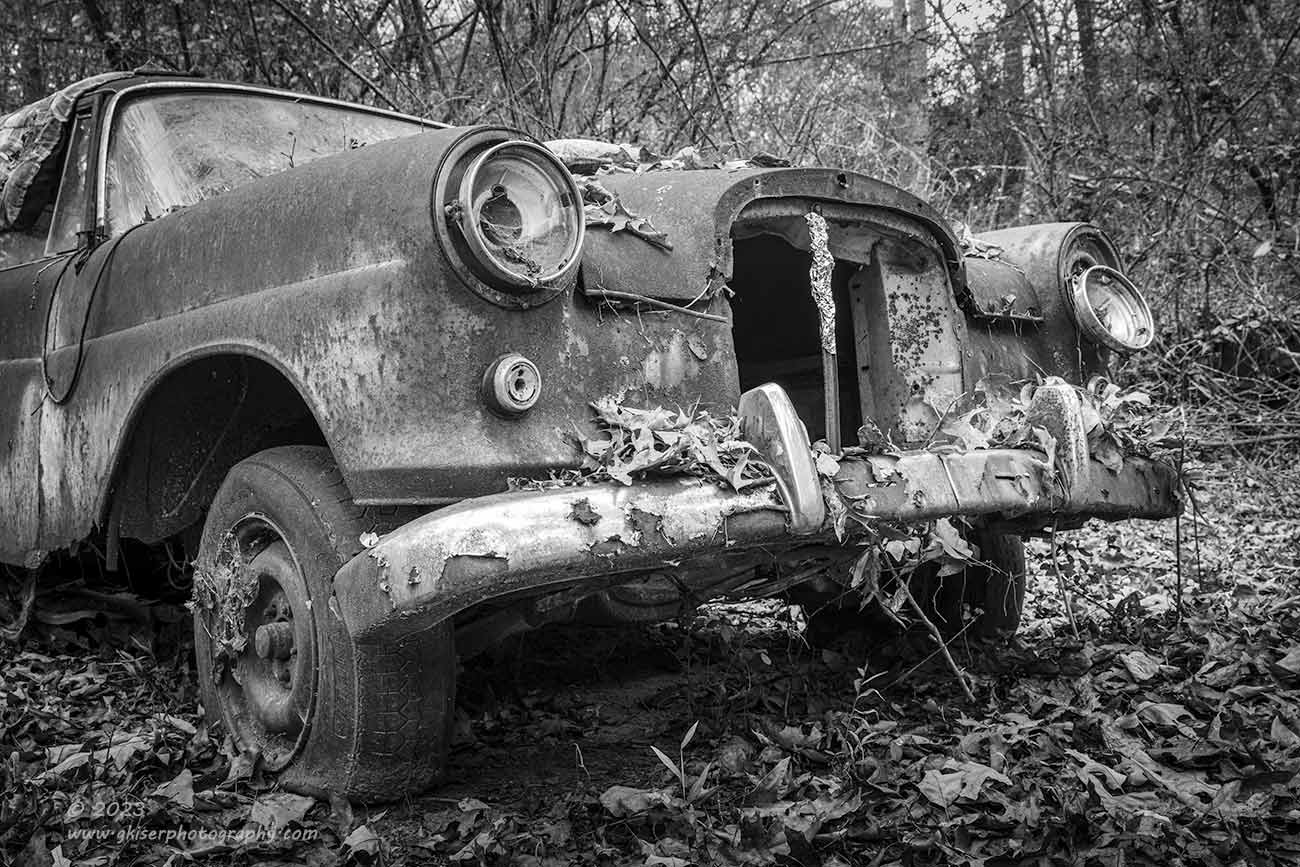
I think that this is a photo of a Mercedes or possibly a Rambler, but I am not completely sure about that. I had tried to shoot it earlier in the day, but the sun was too bright in the background which forced all of the details that I wanted to show into deep shadow. I liked the shadows of the trees forming leading lines into the scene, but the main subject just didn’t turn out like I wanted. By the end of the day, the clouds had returned once again, and my favorite type of light was present. I went back to a lot of the previous subjects that I had tried to shoot earlier and made better images with them now. This car was one of them, and since I could see it better, I went with a tighter shot since it was the details that would become the composition.
As you can see from looking at this car, there are a couple of odd details which I wasn’t sold on at the time. First of all was the blanket that was atop the roof. It was rather colorful in comparison to the car and scene which made it stick out. I wasn’t willing to move it though because it would surely leave evidence that it had been there. It was this blanket that kind of forced my hand in the color or black and white choice. To decrease the visual importance of the blanket, I just lost the color which worked well. I also cropped in very tight on the car to minimize the distraction while I focused on the most interesting parts of the car. The second oddity of this was the aluminum foil wrapped around the radiator support up front. I’m not convinced that this was an authorized repair, but it was certainly a visible repair that was going to stand out no matter what I did with the composition.
I had some choices with this aspect of the photo that had to be dealt with during the compositional planning stage. I could come in even tighter and shoot details which started to lose interest for me, or I could include the foil in the composition. If I included it, would I be able to clone it out effectively, or would it be ok to remove it before the shot? My skills were not good enough to clone this large bit out, and honestly, I felt that doing so would have been wrong. It would have also been wrong to physically remove it for the shot in my opinion, so neither of those thoughts stayed in my head for long at all. I was left with keeping the foil in place if I wanted the shot at all. That was what I decided to do, and fully accepted it in the shot as evidenced by the title of the photo.
So, all I’ve talked about here has been the negatives that I saw with the photo, but not much about the positives. Why even shoot the photo if there are so many issues with it. Well, first of all, when it comes to unique vehicles that I don’t get the chance to shoot often, I will gladly capture them in less than ideal circumstances just so I have an example of that particular model in my collection. This was one of those unique vehicles. In fact, it was so unique that I wasn’t quite sure what it was and I was unable to find any badging on it to confirm. Also, I love to find these old vehicles in such states that they look like they have a human expression. This one did, especially with the headlight bucket out of alignment and the fact that without the rear end of the car, it was looking up.
I framed up the shot to accentuate those features by getting down very low with the camera. I hadn’t been able to do that when the sun was so strong, so this was a nice change for the composition. I had to include just a little bit of the blanket on the roof, but since there was no color, this would not be a distraction to the viewer hopefully. It did allow me to get more of the car in the frame to help with model identification at some point. To keep the car from blending into the background without the color separation, I narrowed the depth of field so that the background would go soft in comparison to the car itself, but still keep enough in focus to tell the story of the location.
The resulting image was everything that I had expected, and I was glad that I had returned to capture this subject when the sun wasn’t as bright. I think I could have made the higher contrast photos work, but why push something that far when I had a much better RAW file to work with which was shot later on. The composition was much better the second time around anyway, so there was really no comparison.

Another car that I returned to was the Pontiac convertible with the tree growing out of the engine bat. You might recall a black and white photo of this car which was shot from down low at the front earlier in the day. I liked that composition, and it turned into a keeper, but I kept thinking that I could tell more of the story from a different angle. I had originally captured the frame in a way that you really couldn’t tell that this was a convertible, but the more I thought about it, the more I realized that I really don’t have many convertible images in my collection, especially with the top down. I was missing an opportunity to add that element to the story and make the photo about more than just the tree which was kind of hard to isolate in the engine compartment with the limbs that were around it.
I changed up my whole approach to this car by shooting from a position behind the steering wheel and up high. This gave a perspective that included what was left of the driver’s position in the car while looking over the tree in the empty engine bay. The lack of a top was evident here, and the wheel and tire on the ground framed the shot along with the steering wheel. I really liked how this was looking as a composition and could see the separation of elements more readily now which meant that this one was likely going to be able to done as a color image. Something else that I realized with the new camera position was I could eliminate all of the cars in the background which had been impossible to do earlier from the lower vantage point. After inching the camera up a bit higher, I removed the last detail from the cars in the background, but this forced a blanket that was draped on the door into the shot.
I loved the composition too much to let this bother me, so I lifted the blanket slightly to see if there was any evidence of it below. I saw no change in the color of the door, and nothing that would indicate that the blanket was there. I just had to fold it back about three inches to clear the frame, and I did that. The composition was complete at this point. All that was left was to determine the focus point and the exposure values that I needed. That was the easy part, and only took a few seconds to work out. I couple of shots later and I had my image of this car. When the light cooperates, things go really quick since I don’t have to wait for highlights and shadows to change up.
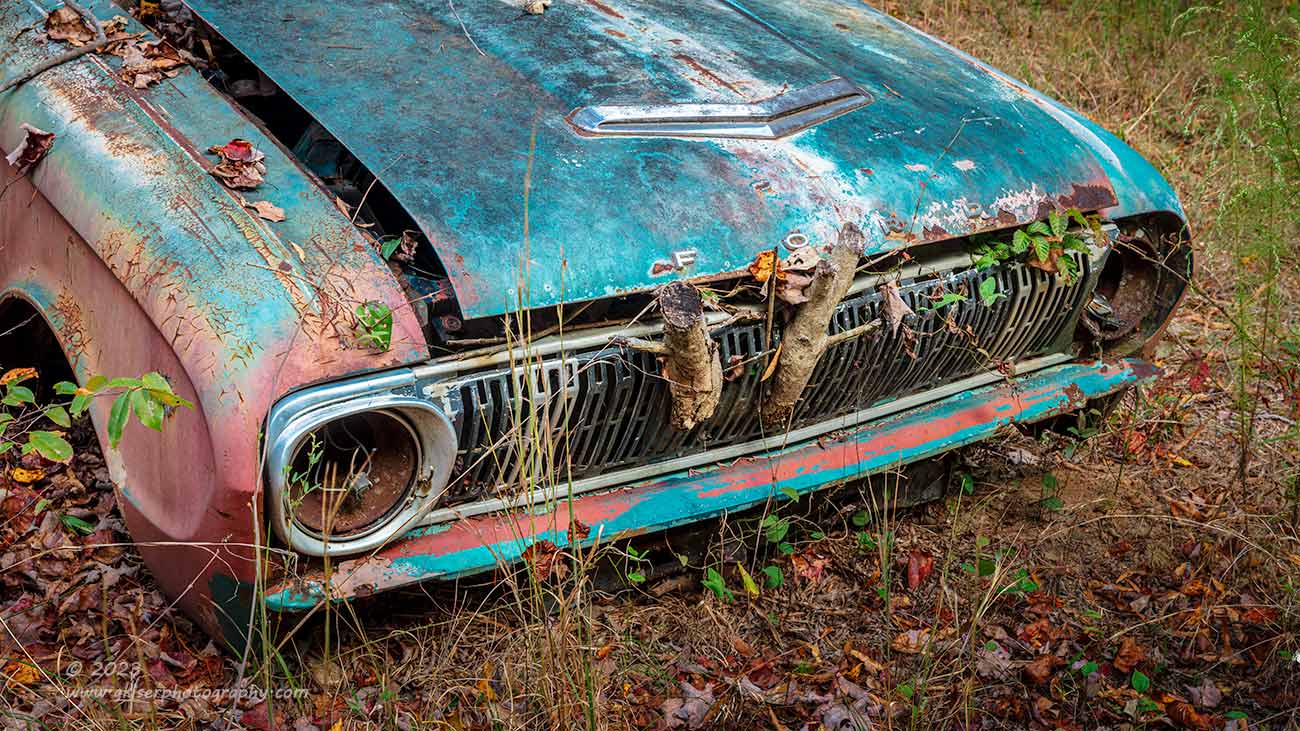
Not far from the Pontiac was an interesting Ford Falcon. It was a four-door model which didn’t really interest me, but the colors on the front end looked great in the lighting. I looked at the possibility of a long shot by zooming in with my 24-70mm lens, and then using the internal 1.6x crop to get an idea of what it would look like with my 70-200mm lens. It was ok, but nothing special. I think that the part that killed the idea was the ’74ish Honda Accord that was parked next to it. There was also a lot of brush between myself and the car which diluted the colors that I wanted to capture too much. I started walking towards the car and things got a little better. I was back into the focal range of the standard lens, and I was liking it more and more. Even the Honda started to not bother me, but the composition just wasn’t right.
Eventually, I was about 10 feet from the front of the car, shooting through the brush for that appearance of depth which is all the rage in portraiture. I felt that it was a bit cheesy here and decided to avoid it. It had done a good job at minimizing the impact of the Honda though and when I moved the brush out of the frame, the Honda was again a problem. Nothing that I was doing was making a workable composition with this car. It was time to play my favorite game of what I liked and didn’t like about the scene. Obviously, the Honda was a problem, and I didn’t care for the four doors. This pushed my composition to focus on the front of the car and when I started to look at the details up there, I realized that there were a couple of trees growing out of the grille. I’m not sure how I missed that originally, but now I had a focal point on the front of the car.
I started to work out a composition based on the trees which allowed me to shoot from the passenger side for a clearer view. I liked the trim on the hood which was still nice and bright which broke up the blue of that hood. Originally, I framed the composition in a way that included the fender badge behind the wheel, but that seemed to make the composition too large, and the trees started to get lost. I played with the focal length and tried to adjust the scale of the trees to the rest of the car, but that didn’t’ really work the way I wanted it to. My best option was to just reduce the scope of the composition and include less in the frame. That was the trick and allowed me to get just what I really wanted to include here. The final compositional trick that I used was to do a 16:9 aspect ratio crop here to focus the attention on the grill area and let the colors frame the image.
It was the colors that made the image work so well as there was a proper balance of warm and cool tones present. The graphical elements kept the story interesting, and the trees were dominating in the scene as I had intended. I think having them essentially front and center made that possible while there was enough visual tension through the rest of the image to keep the eyes moving all around the frame. This is a driving force around my photography, I don’t want to make an image so simple that you just look at one element and move on. I want to establish a visual pathway to keep the eyes engaged within the photo. Of course, I want to keep it from getting too complex to where you lose the focus of what is important within the scene. I truly feel that this is the art of photography.
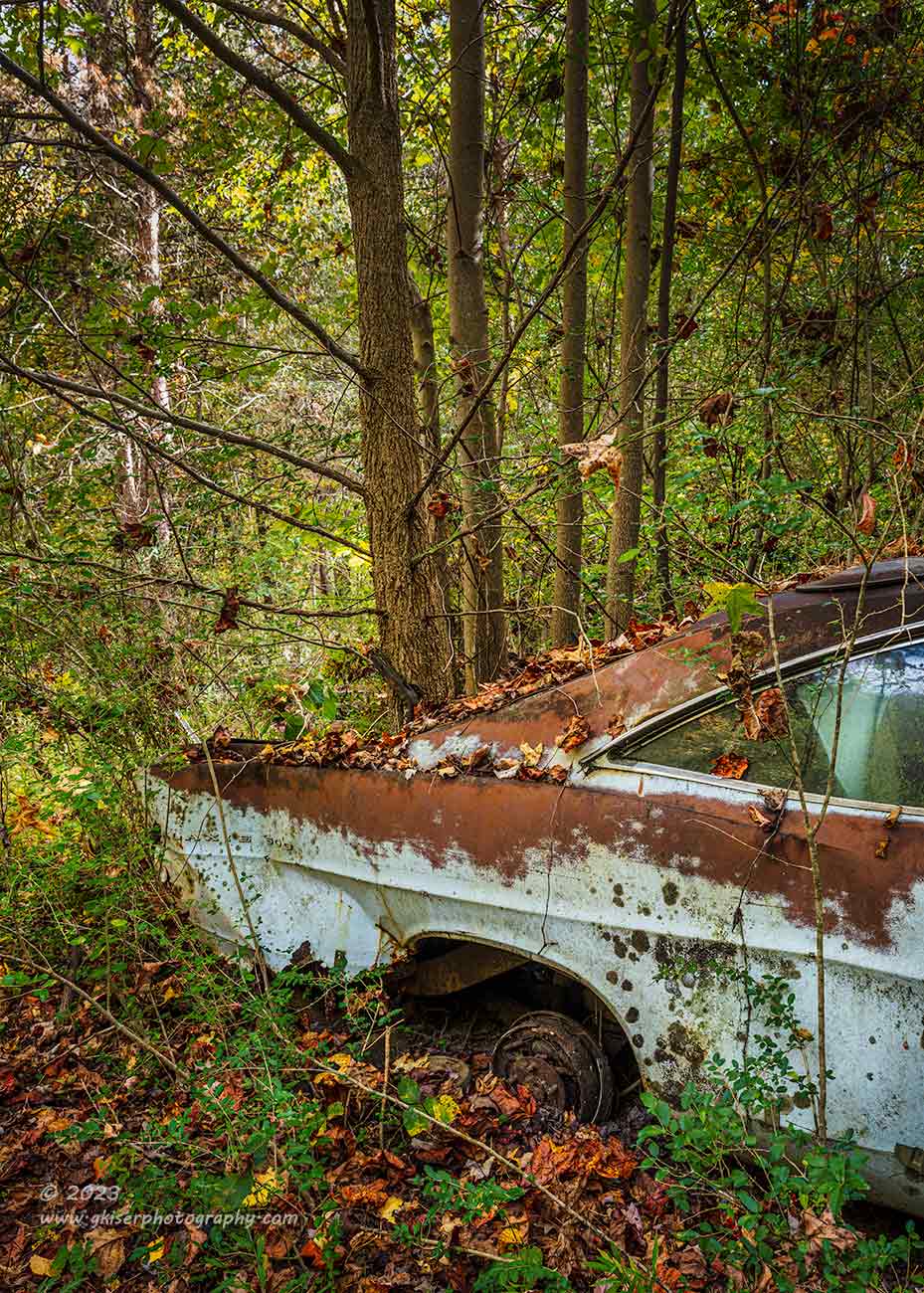
One of the aspects that I was having the hardest time with was the fact that these cars were all back in the woods which made compositions difficult to say the least. I had a hard time getting myself into position for a lot of the images, and then there were all kinds of distractions around the cars, in addition to the other cars that were present. I didn’t want this aspect lost on the viewer because it was a part of the location that I was in. Since I was here to shoot the old cars, most of my images were shot in favor of the visual weight going to the main subject which is understandable. However, it is a powerful thing when the subject can become less important in the overall composition and just be used as a visual anchor to the scene. That concept became a driving force for the next few compositions that I shot. It started with yet another car where a tree was growing out of the engine bay.
I happened upon a Galaxie that was deep in the brush where a large tree was growing out of the hoodless engine bay. Sadly, the brush was too thick to really get a good composition put together and I had to move on. As I was moving on though, I saw that the trunk was kind of in the same condition with a tree growing out of it as well. There wasn’t nearly as much brush around it, and I was able to get a clear shot here. I also liked that the brake drum was missing showing the exposed shoes. I moved around to the rear of the car to get a corner shot that would show things off to the best ability, but I then realized why I hadn’t seen the tree upon my initial approach. There was too much overgrowth to the rear of the car to make a photo. The only angle that I could shoot from was the passenger side which wouldn’t show much depth in the scene at all, and certainly wouldn’t showcase the tree in the trunk.
I had to ponder this one for a bit because I wasn’t able to get a photo that simply told the story that I was after. What I came up with was a composition that concentrated on angles and some interpretation rather than straight-up storytelling. I positioned the camera slightly in front of the rear wheel arch, and elevated the camera so you could just see the void that was the trunk and the tree growing out of it. There were a line of dominant tree trunks that proceeded off to the right from the tree that actually was growing out of the car. The resulting perspective lined the trees up nicely above the leaves that layered the rear window which brought the attention to the trees almost over the car. The angular shape of the Ford was just the visual anchor and foreground for the composition, and I think that this image does a great job of showing the environment while telling several other stories for those that choose to really look into the scene.

Now that I had spent some time looking at cars with trees growing out of them, I kind of had that in my mind so I went looking for hoodless cars and those without trunk lids in the hopes of finding more trees to shoot. What I ended up coming upon next was a Ford that was mostly gone. If memory serves, only the rear of the car was even visible at this point, but the trunk floor had before more forest floor over time. I’m not even sure if the floor remained solid, but I could see the quarter panel, the intact taillight, and the rear bumper. What was on the floor of the trunk looked very much like what was around the car and that was the idea for the composition right there.
I focused on the taillight as a visual anchor while using the repeating patterns of the quarter panel trim to establish that element. Again, I was able to use the rule of odds here by including three pieces of trim which was infinitely more effective than two or one piece would have been. The patina of the car was largely green which made it blend into the ground, so it was important to have details that helped to differentiate it from the forest floor. The bumper was able to do that along the rear of the car, and I was left with a beautiful pair of diagonal lines to establish the figure/ground relationship. To further this effect, I chose an aperture that allowed the ground cover to go a little soft in most areas which left the sharpness on the automotive bits which was where I wanted the attention to be.
The effect of this photo shows the length of time that the car had been here and that slowly, it is being absorbed back into the Earth. It turned into a very visual representation of the phrase “ash to ash, dust to dust” because this car is decaying not unlike a fallen tree in the woods and becoming the Earth once again. I bet you never realized that a photo could say so much, let alone a photo that is essentially just a taillight and some body panels. It is the story that this photo tells that makes it one of my favorites from the day and I’m glad that I was in the right headspace to see the potential in it when I walked past it.

In another example of using the vehicles present as a supporting element for the environment and story of the location, I came across this Pontiac Tempest. The car didn’t really excite me nearly as much as the color did. The teal paint on it just looked amazing surrounded by all of the browns and oranges of the leaves. It was enough to cause me to pause in my walking and try to pick out a photo of the car. I started with a photo of the front fender that had the Tempest emblem, but the fender didn’t have that marvelous teal paint on it. The composition was a bit rough as well thanks to a fallen tree blocking the view of the wheel. I abandoned that composition fairly quick and turned my attention back to the colorful parts of the car.
I was having a very hard time coming up with a composition that I liked which showcased the car because it was parked very close to other vehicles and the shape of the car wasn’t all that interesting to me. What I decided that I really liked was the way that the leaves looked in contrast to the paint. There was nothing else about the car that really excited me and that was when I decided that the car was going to be a supporting player to a photo of the fallen leaves. I didn’t even have to stage a leaf to create a point of interest as there was already a few bright yellow leaves perched right around the rear pillar. This is an area that I love to shoot on the cars from this era because of the hard lines and angles. The rust on the pillar was very much the same color as the brownish orange leaves and that worked well with the teal paint, but the yellow leave catapulted it over the top.
I used my regular composition here to frame the image, but the real stars of the scene were the leaves. I was just using the car for context and a supporting player. The colors were amazing, and the composition was as interesting as I had hoped it would be. There was very little post processing done on this one and it was actually one of the first photos that I worked because I knew that it would be a quick edit. This simple image turned out to be one of my favorites of the day as well. Yes, I know that I have claimed that for like three or four of the photos already, but when I am producing thirty images, I’m allowed to have several favorites, as are you. In fact, don’t forget that any of these images can be had in the form of a fine art print just by letting me know the size and title you want. The good news is you don’t have to decide on your absolute favorite any more than I do. You can have several favorites and have prints of them all. It is these print sales that help to allow me to go on these treks in the first place, and it is a great way of showing your support.
By this point, I was starting to get tired, and my creativity was starting to falter. This happens after long periods of being creative which has been the case. In fact, if you look back over the last, well, six months or so, you will see that I have been operating at a pace that is not really normal for me. I’ve done everything from landscapes, to waterfalls, coastal, to decay, and even portrait shoots during that time period. I’m actually surprised that I still have it in me to go out and shoot on this level while getting images that I am excited about. History has told me over and over that eventually I’ll hit a brick wall and not be able to have this creative energy for a while. After hours of working with the camera and having worked through a battery and a half during the day, it was understandable that I was feeling as drained as the batteries were.
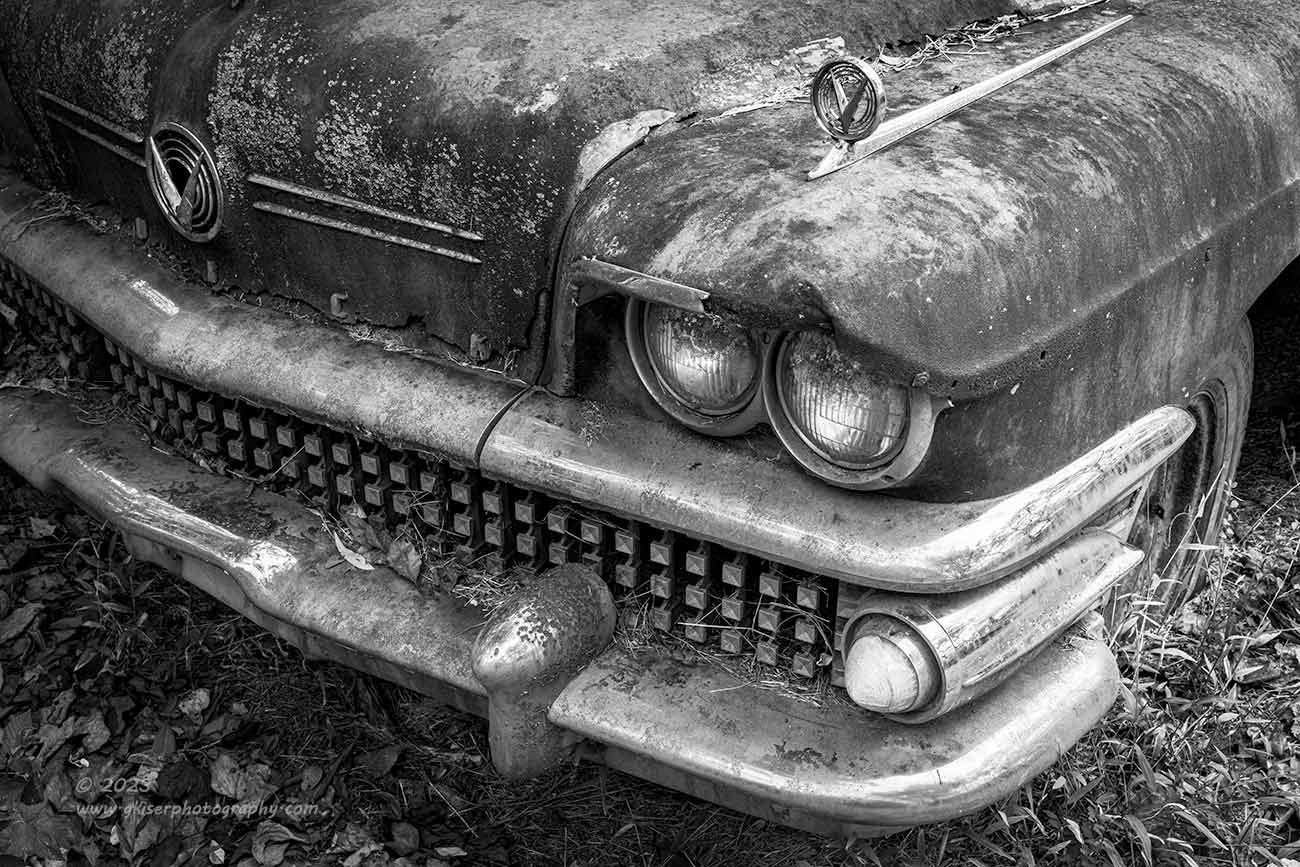
I still had enough in me to stop by the Buick that I had shot during my scouting walk a few days earlier. I had photographed the driver’s side corner and ended up tossing the images in favor of one from the passenger side, but I was still wanting to get one from the corner that I liked. I took a minute to stop by this car one last time before I made my way back out to my truck. What I hadn’t liked about the original images was the fact that they felt too crowded with all the detail that I was trying to capture in a vertical format. They had also seemed very similar to other compositions that I had shot of Cadillacs, so I wanted to do it differently here. I felt that I needed to get a horizonal frame on the car and find a different visual pathway through the image.
As always, I wanted to focus on the headlights which is just my style and I think suites these old cars quite well. Remember, back then, the headlights were sealed units and pretty much all cars shared the same ones. The personality and difference between the cars came in how the headlights were incorporated into the design of the individual car. That is where the personality really shines through on these cars. The Buick, much like a Cadillac was an exercise in excess in many ways. There were big shapes, lots of chrome, more decorative trim, and emblems than were present on the other cars of the era. This was what I wanted to capture but had failed previously.
With the horizontal frame, I was able to stretch the composition to include the decoration on the front of the hood and the entirety of the BUICK emblem with the exception of the B which had fallen off at some point, but the space was there, and the photo felt right because of that. I had the fender bombsight which was characteristic of the car as well as the dual recessed headlights. The bumper and grill were just as dominant on the car and represented appropriately along with the typewriter key grill detail that I enjoyed so much in the keeper shot from the other day. Everything that I wanted included was able to be put into the composition with the horizontal framing and I really liked it when I was getting the shot set up.
I only had to fire off two exposures with one being a safety image to know that I got the shot that I was after. I felt good about it, right up until I got it home and started to look at the RAW image. It seemed boring and predictable and while it made it through the first three stages of the culling, I resisted editing it. Every time I passed by the photo in the filmstrip I didn’t feel motivated to do an edit on it. I had plenty of other images that I felt were stronger which I wanted to spend time with. The edits all went very fast, and I think that this was the quickest I’ve moved through so many photos, especially of decay subjects since they usually require a lot more local adjustments than say a landscape. At the end, I was happy with 29 edited photos…in fact I was elated at having that many from a single location. I just had one left to do, but I didn’t want to. I looked back at the keeper from the passenger side and loved how it turned out with the curved tree framing the composition. I just didn’t think that this new one offered anything more than that did. There was no denying that black and white was a much more impactful way of rendering the details of this car.
I decided to look at this new composition in a black and white colorspace before trashing it. When the color was stripped, it immediately became more visually appealing to me, and I could see more of the details that I was trying to capture. That motivated me to move forward with the edit. I mean what’s another 15 minutes which had been my average editing time on the other images with the exception of the problematic Nova that I talked about in chapter 2. Sure enough, the edit went fast with the front of the Buick and I was sitting there looking at an image that captured everything that I wanted from this composition, and it had a visual presence that couldn’t be denied. It was perfect and was well up there among my favorites from the day. Yes, I know, I have a bunch of favorites. Get over it, I love what I do, and I was in an honest to goodness honeyhole filled with subjects that I couldn’t get enough of.
After photographing the car that had been a primary subject during my scouting walk, I felt that I was done with the day. I had like 150-some images in the camera and I was getting hungry. I exited my rabbit hole and looked over my shoulder with a certain sadness that I was leaving. It had been an outstanding day, and there was no way I would have been nearly as excited after photographing the leaves along the Blue Ridge Parkway. Of course, I didn’t know that there had been snow that morning which might have tipped the scales, but I know for a fact that I would not be sitting here typing out a blog three days after the fact talking about this many new photos. I had made the right choice for me, and I didn’t have to share the space with a single other person which made it worth it to me all by itself.
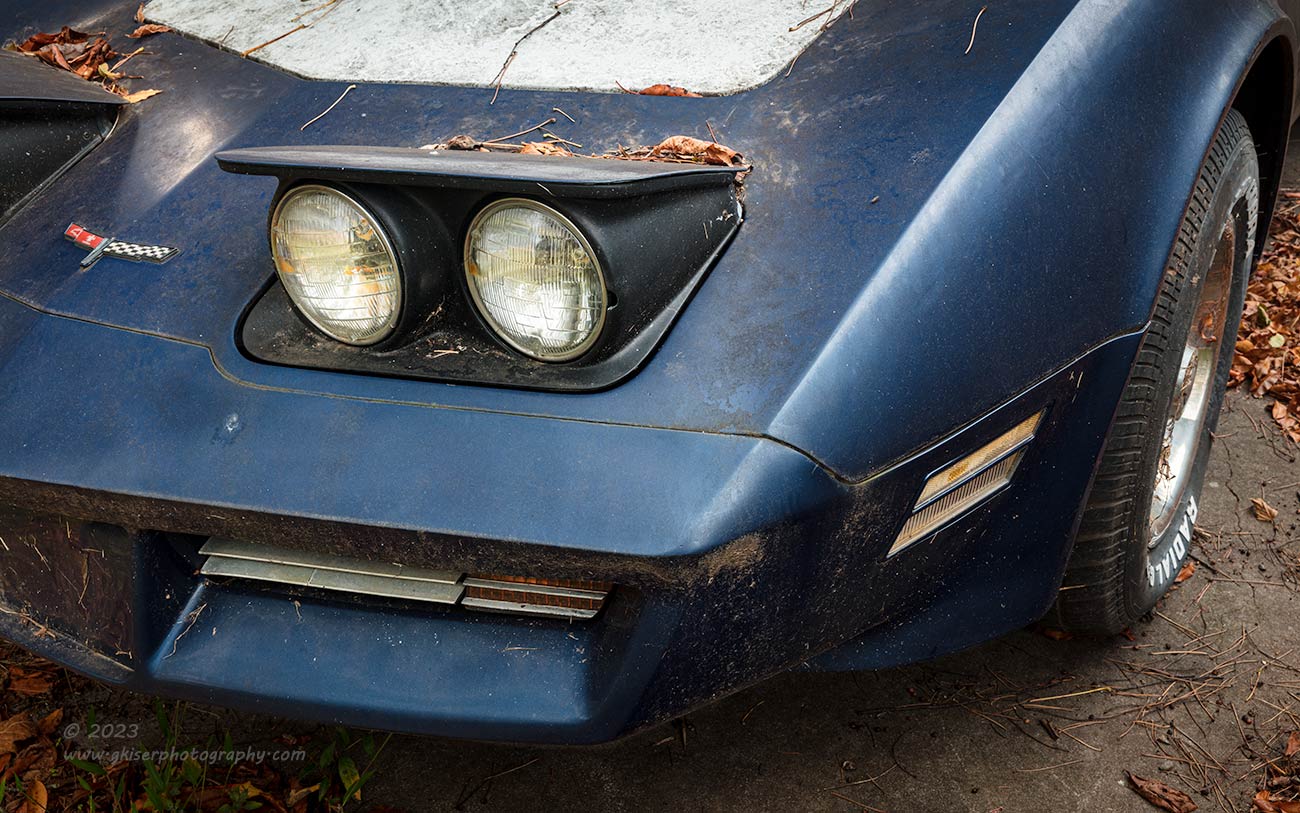
After that last look over my shoulder, I faced forward and was satisfied that I had done exactly what I set out to do when I left the house many hours earlier. As I approached the shop, I paused at the Corvette that I had tried to photograph the other day without success. I wasn’t even able to find a composition that I liked enough to press the shutter button on at the time. I didn’t like feeling like the car had beat me, so I stopped for a minute to look at the car critically once again.
I still liked the headlights as they were very much an iconic feature of the car. The details in the bumper, and the marker lights on the side also interested me as they established the shapes of the car. The wheel was a nice element as it was period correct, but the white hood was still bothering me a bit. I had the camera in hand as I moved around the front of the car changing the focal length and placement trying to find a composition that I really liked. When I arrived at one that piqued my interest, I dropped the legs of the tripod and locked it into position where the camera was. It was then a game of slight movements to get things just right in the frame. I decided that I really liked the portion of the other headlight as it gave a triangle shape to that edge and allowed me to keep the flag emblem on the hood which was important if for no other reason than it introduced warmer tones into that sea of blue. Doing that forced my hand on the hood which I didn’t really want in the frame, but it seemed to work in this lighting. I just had a sliver of it, and it served as more a shape maker for the lines that it added to frame the headlight buckets. With a little highlight control, I would be able to decrease the impact of the white enough to make this work. There were also brighter areas around the scene that helped the hood to blend in a bit more. I even adjusted the polarizer so that a bit of highlight on the front of the car shined through to draw attention to the hood emblem. Not only did I like this composition, but I was also excited about it.
It was probably one of my favorite (bet you thought I was going to say favorite from the day) images of a corvette from this generation. These cars are so hard to photograph well when it comes to details because they are designed to be so sleek that there is usually not much there to establish shape and visual interest. The last of rustable material also keeps me from doing much with them, but in my maturity, I am seeing the value of aged paint just as much as rust. There is no denying that this car is in a state of decay, and that age is creating some visual interest and a story that is necessary for the photo to work.
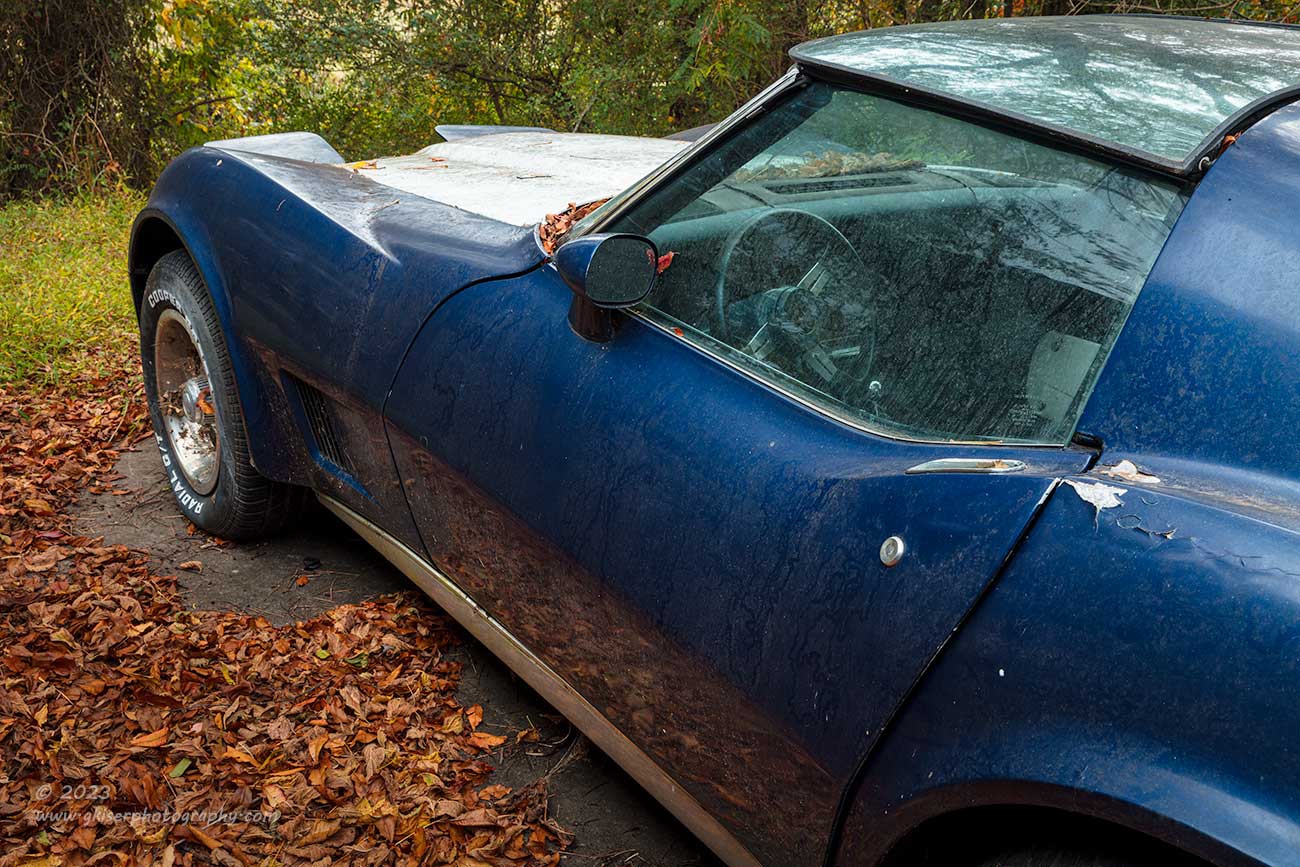
Having finally cracked the code on this Vette, I decided to look around for something else to photograph on it. When it comes to identifying details on these cars, I think that the door handles are right up there with the headlights. There is just something about the recessed nature of them when paired with that sensual curve as the rear wheel arch is introduced. Yes, that was what I wanted to photograph. I got in close and started to frame up the shot, but found that once again, the sleek nature of the car killed the composition. It was boring and showed nothing of interest. I stepped back and looked at it again to see if there was an angle that I could use to get the interest back into the frame. As I was looking, I saw a bigger picture where the detail that I was liking still stood out. For that curve to make sense, I needed to have the entire side of the car present, but that was just too much blue for my liking. As I changed the angle, I started to include the leaves on the ground as well as the grass and trees in front of the car. This was working well and I liked the color balance over the image much better. The bit that I started out wanting to capture was still there, but it had context and more impact now.
I locked down the tripod and started to work out the exposure. I twisted the polarizer until I had just the right reflection of leaves in the door and fired off a shot. I looked at things and decided that I needed to come back more and include just a hint of the wheel arch so that I could get the full curve around the door handle. That allowed me to get even more of the leaves which made it all look better still. I was really liking this composition and made sure that the details were all worked out before shooting two frames with one being a safety, just in case.
With that, I was done. I was satisfied that I had what I wanted from the Vette, and I was ready to call it a day. I was going to break the camera down right there but decided that my back was getting sore, and I would rather do it with the camera bag elevated in the back of the 4Runner. As I walked around the building, I noticed that the owner was no longer there, but it was getting late in the day so that was to be expected. There was a trailer that I had parked next to which was gone and that opened up a view of a Camaro which I had thought about photographing many times before.
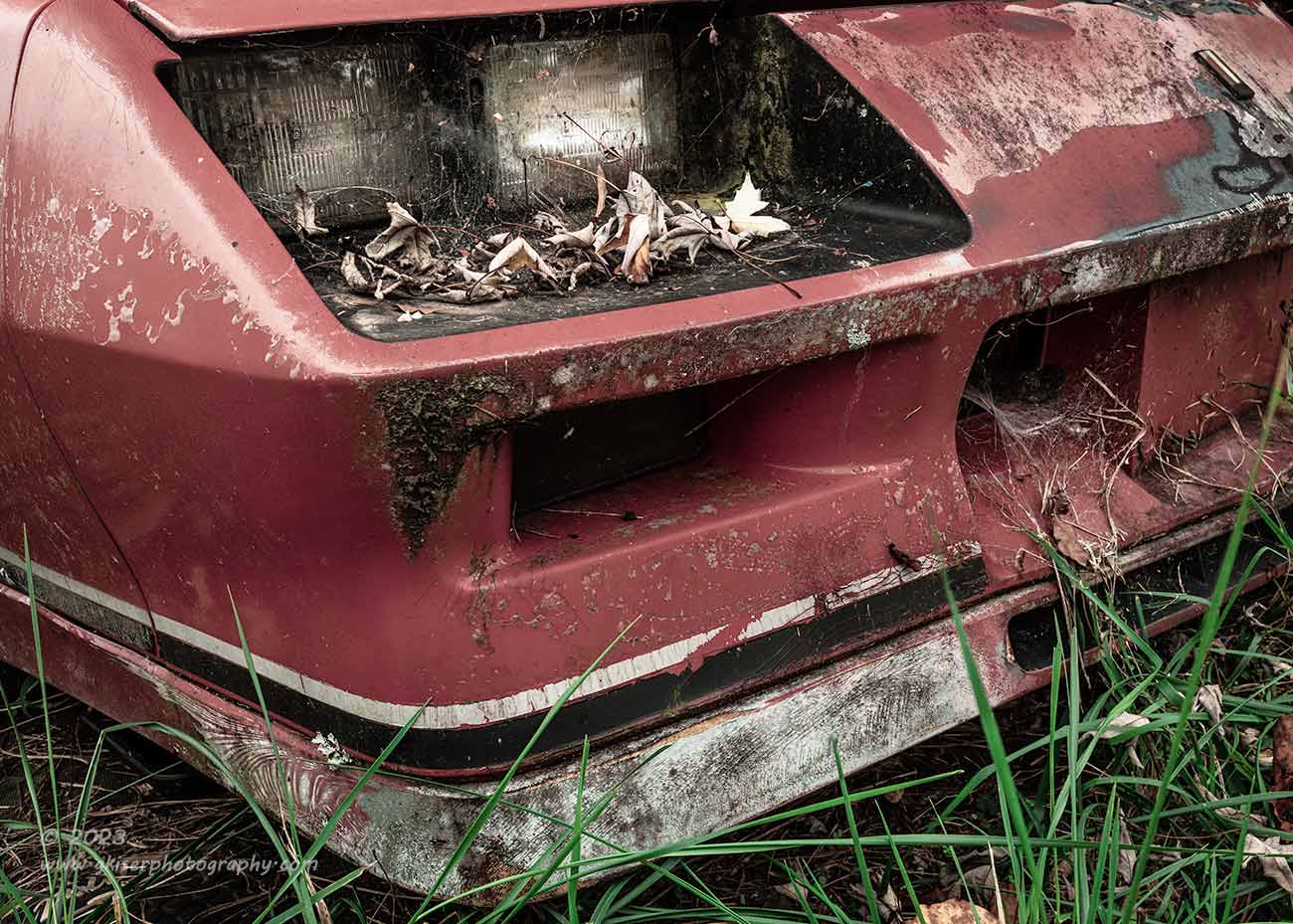
Well, I still had the camera built and I had a bit more room to work with, so I looked at the Camaro once again to see if there was as shot to be had. Much like the Vette, there wasn’t much there to rust, and without that texture, I was having a hard time finding an image that I liked. The answer came from the book of Vette though. I just had to look for the iconic shapes of the car for the answer. Of course, the most recognizable shape on this car was the headlight bucket and the shape of the front bumper. Anyone would recognize what this belonged to, and there was no need to photograph the entire car. Both of the buckets were full of leaves and webs which showed the neglect and decay which I liked to showcase. The issue now was that there was a weedeater on the hood right at the edge. There was no way to sell this as a part of the story, and I didn’t want to move it which left me with very few options.
I tried several different variations on a composition but didn’t like how any of them looked. I ended up looking at odd angles to get things to line up right and to keep the distractions out of the view. My best bet was going to be shooting the photo horizontally and just below the arm of the weedeater. In order for that to work, I needed to have the camera low, which I did. I even extended the neck of the tripod and put it horizontal to get the camera inches above the ground. This worked for the composition, and I could see things coming together.
I made sure that I included the center of the nose because that was where the paint was in the worst shape and the emblem was still visible. I allowed the blades of grass to come into the frame because the green matched up beautifully with the red. The white color at the corner of the chin spoiler helped to establish that shape and helped to balance out the brighter areas where the lights were. I really liked this composition and was excited to get it home to edit.
This was one of the earlier photos that I edited because I really wanted to see if I could make it work. When I started, the red was way to punchy, and no matter what I did to it, I couldn’t get it dialed back in the way I wanted it to be. The answer eventually came from a desaturated color profile where I built the saturation back up again. It changed the hue of the red and made it a little more subtle which is just what it needed. A little fine tuning on the crop by way of an aspect ratio change and things fell right into place. The edit didn’t take long at all, and figuring out what to do with the red took the longest. Once I got that worked out, the rest of it was maybe five minutes.
That was the last frame of the day and represented 170 photographs shot in total. On a good day, I would hope to get 20 keepers out of that but managed to love all 30 frames that I wanted to explore further after my culling process. had the edits not all been relatively fast, I probably would have reduced that number down even further, but things were just moving along, and I didn’t want to stop. I can’t help but think back to how fortunate that I was when the owner came out to see what I wanted when I stopped there initially a week ago. Had he not come out, I had pretty much convinced myself that this was not a stop worth making. Boy, would I have been wrong there. You never know what is waiting for you behind that building, or in the woods.
Thank you for joining me on this trek, and I do hope that you have enjoyed the photography and the descriptions about how the images came to be. If any of these speak to you, or if you have several favorites like I do, please consider supporting my business by purchasing a print or two. There is no better way to enjoy any photography than in the physical form that takes out the variables like what monitor you are looking at. You see the colors and details as envisioned by the photographer in a print unlike any other method.
I look forward to my next trek, but I’m also content with resting for a bit. I think it is well deserved at this point considering that I have shot and edited 83 photographs over the last week between two treks and a themed portrait session. That is just the keepers and there were nearly 400 image files that I went through to get those 83 keepers. Stay tuned to see what I do next. I’ve already got a line on a Ford Fairlane for sale close to the house that I am interested in photographing if the conditions look right before the car is gone.
Until next time…

Remember to use the code KISER10 to get 10% off your purchase