Saturday, January 27, 2024
OK, so I might have a problem. The first step is admitting that right? I just need to know what the next 11 steps are because there is no question that I have a problem. What is that problem you ask? Well, when I get started making photographs, I have a really hard time knowing when to say when. I’ve always kind of had that problem, but the first trek of the year kind of took it to a whole new level. I quite literally went out to get a photo or two just to start the year off on a good foot. I ended up with something like 25 new photos from just a few hours. That was followed up by another trek where I thought that I might get a single photo of an old Dodge that I spotted a while back. That one ended up with 16 new photos from three different locations. Even a quick visit to a waterfall that I have photographed many times resulted in an additional six photos added to the collection. The only time that I have been able to succeed in getting just a single photograph was a couple of days ago when I finally edited a single photo that I shot in 2021.
I thought that I was back on track, especially when I spent what was a wonderful day for photography at home getting the Miata cleaned up for the first time since Fall. The sun was lighting the landscape beautifully all day long and the clouds gave just the right amount of texture to the sky. It was even 70 degrees during the afternoon. I had no need to go out for photos because I have a ton of backlog of new material which hasn’t been shared to social media yet. That really takes the pressure off of me which I am kind of embarrassed to say. I don’t want to be a social media photographer; I want to be a photographer that sells a lot of prints. Just in order to do that, I have to stay relevant on the different platforms. As of right now, I have 196 photos lined up to be shared which will take me into the Fall of this year unless I post several a day.
Not wanting to get sidetracked on a social media rant here, let’s just say that I have a healthy buffer in place that reduces the need to add to my portfolio. The only thing that drives me at this point is to try different things, and to move forward with my goal for 2024 of doing more black and white photos. The plan for today was actually to sit in front of the television and watch the full director’s cut of Lord of the Rings again while it was raining all day. That takes around 14-15 hours if memory serves, and I was going to be very happy doing just that. However, before I went to bed, I looked at the weather forecast and saw that the rain had been pushed back until afternoon. That really didn’t need to change my plans, but I have had this gnawing urge to go to Elkin for a photo walk. I’ve been wanting to go out there for about a week now.
What sparked this was the last time I drove through downtown there were two different buildings that caught my eye as being interesting subjects to photograph. They were not new buildings by any stretch as I have been this way many times as it is my favorite back road route to Winston which I take when driving the convertible. The two buildings just hit me in a certain way, and I have been thinking about returning ever since. Now that the rain had been moved back, I would have time to go out there and try to shoot those two buildings and get back to get the photos edited with time still left to watch one or two of the movies. Just to make sure, I pulled out Google Maps and the street view and started to look at the buildings in a bit more detail. I saw some issues with both of them photographically, and started to think that there was no need to go out there to try and photograph them. I mean, I have passed them by on several occasions for what I thought were good reasons.
the problem was that once I get an idea in my head, I can’t focus on any other creative concept until I see it through. Those two buildings were just the springboard for what I was sure was going to turn into a photo walk through downtown. This is a relatively new type of trek for me which started a couple of years ago here in North Wilkesboro. Since that point, I have developed a workshop for spotting these types of photos and helping with the capture of them in a photograph.
Knowing that I was going to be stuck on this thought process until I went out to scratch the itch in a manner of speaking, I decided shortly after waking up that I was going to go out and give it a try. If nothing else, I would be able to go for a little walk on a day that wasn’t too terribly cold. I would once and for all decide if those two buildings would work as compositions or not and spend a little time getting to know Elkin. Other than putting off Frodo’s adventure, it was a very good plan for the day.
After I got my morning stuff done in the office, I loaded up the camera and headed out to Elkin. The entire way there, I went through some different ideas for compositions with the two buildings knowing that they probably wouldn’t work out. I had such a negative slant on things that I was really thinking that I should just turn around because there was just no way that I was going to make this a successful trek with the attitude that I had. I plowed on because I knew that I needed to do this in order for me to get the creative energy for something else in the future.
When I got into town, I pulled off in by the town square where I normally park, which also happens to be close to the two buildings that I was wanting to photograph. I grabbed my bag and tripod and started off on foot to the closest of the two. I spent some time looking at the building from every angle, and from both sides of the road. There was a power pole that got in the way of every composition that I could come up with. The one composition that could have worked was ruined by a advertisement banner on the side wall which took the visual emphasis from what I liked about the building. The other option didn’t fare to well either. There just wasn’t enough there to successfully fill a composition. So far, I was 0-2 just as I had feared when I was driving out this way.
I really wasn’t stressing it though. I had scratched that itch on the two buildings and now I just wanted to walk around to see if I could find a photo or two from around downtown. Oh, how I need to stop saying that! Things started off kind of slow actually as I walked. Nothing was jumping out at me, but I figured that was just because I wasn’t really in the groove of being in Elkin just yet. I really do have to understand the area that I am working in before I can hear how it wants to be photographed. With that in mind, I just slowly walked around and started the understanding process.
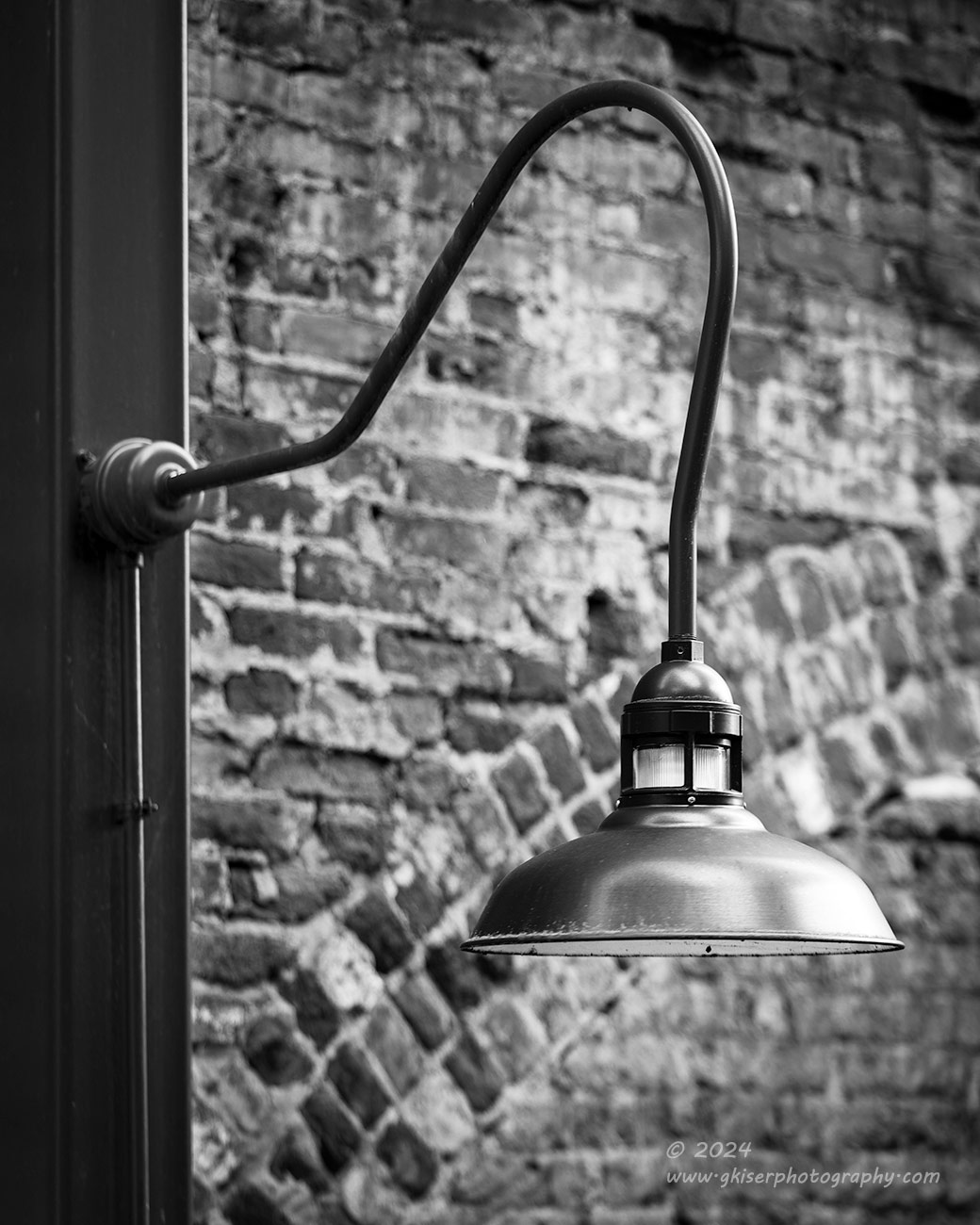
Eventually, I ended up in a large alleyway that had been converted into a picnic area with shades strung up between the buildings, plenty of picnic tables, a Valentines booth, and a restroom. There was something about this area that drew me in, but it took a few minutes before I realized that it was the lamps that were mounted on the walls. I started to really appreciate how they looked against the brick background and began to really look for that one special one that was positioned in a way where I could get a composition.
When I found one that I thought would work, I pulled out my phone and framed up the shot to see if it would work the way I thought. It looked good in the phone, and I could really see this as a black and white photo just showing off the texture. I pulled out the camera and loaded up the long lens because I wanted to be able to isolate this light from the background. I opened up the aperture to f/2.8 to get the background to blur enough to draw the attention to the lamp. then I turned on the black and white picture style so that I could really see how this was going to look. I knew I was on the right track, but the framing was wrong. I spent the next minute or two working through that problem before firing off two frames.
I had the first images in the bag, but I wasn’t all that happy with them. Something about them didn’t sit right with me. It wasn’t until I got home that I realized what it was. The photo wasn’t reading correctly to my eyes because of the side that I had to photograph the lamp from. A simple flip of the image and everything came into play nicely. The edit was pretty straightforward and after a few minutes I was looking at the photo that I had imagined but thought that I had missed the mark on. I was officially off and running, but I didn’t know that was the case just yet which meant that I was still wanting to capture something else worthwhile.

One of the fun parts about Elkin is that this is a maintenance location for the Yadkin Valley Railroad. This means that trains are routinely found here parked in the middle of town by the maintenance shed. One of the first things that I noticed about this area was that the shed was missing, but there were two locomotives parked where it used to be. Apparently, there is a stage getting built where that shed had been which probably means that the trains won’t be hanging around here much longer. One of the locomotives was one of the plain old black ones that I can see anywhere, but the other one was an old CSX unit with the blue and yellow paint scheme. I’ve photographed several of these trains over the years and figured that there wasn’t really any need to do it again but feeling that I probably wouldn’t get to see too many more of these trains here, I decided to give it a try.
Not wanting to trespass on Railroad property, I left the long lens attached and tried to find a location where I could get a workable composition. This was actually harder than I had suspected. There was no way to get the front of either train without a lot of distractions in the background. After going back and forth, and up and down the hill, I found that the old CSX engine was in a better location for a photo. I was going to have to include some of the buildings in the background, but I found that from this angle there were at least no cars. By using a shallow depth of field, I figured that I could soften the background to the point that it would no longer be a distraction. If I was lucky, it would actually help tell the story of this scene.
In the past, I have photographed the entire engine, but that didn’t seem appropriate for the angle that I was at. I wanted to keep the emphasis on the front of the unit which prompted me to crop into it at about the 2/3 mark. I used the nearest track as a foreground which was also blurred. There was a slight diagonal to the scene that I liked based on the angle I was shooting. I just had to wait for the intersection to clear before I made my exposure. I ended up shooting several from here with some different depths of field in case one worked better than the others. I also shot a frame where there was a truck at the intersection stopped for a bit more interest if I needed it. Turns out, it was much better without the traffic. There was the construction going on which shows life in the scene, and I thought that was all that was needed for this.

Something that I haven’t done much of in the past has been detail shots of railroad equipment. Since I had the long lens out, I decided to look around to see if there was something that interested me with either of the locomotives. The only thing that struck me was on the black unit. While this one didn’t have the colorful palette that the old CSX train had, I liked the yellow caution paint on the steps and the railing which contrasted nicely with the black paint. I started to frame up a composition that utilized that aspect along with some of the wheels. I wasn’t sure how it was going to turn out, so I shot a few variations on the theme just to be sure I had a decent chance at success.
When I got the image home and started to edit it, I liked what I was seeing, but as happened with the lamp something wasn’t quite right. Not having that much experience with this subject, I wasn’t sure exactly what would work or not, so I had to really step back and go through a mental checklist of things that I have to think about when composing isolations like this. I start looking at how elements are placed within the scene. I look for the story that is being told, and finally I look for a visual balance. That was where things were falling apart here. I had too much of the body of the train in the photo. Once I realized what the problem was, it was an easy fix. All I had to do was to change the aspect ratio to 16:9 which eliminated just the right amount of the train body at the top. The final composition was perfect for what I was wanting to capture.
You might be wondering why this wasn’t done as a black and white photograph. It certainly could have been, but I was drawn to the scene because of the yellow paint. Because of this one fact, the color in the photo became very important to me. The highly saturated yellow, along with the warm tones of the grass beneath the train balanced well with the desaturated blue tones of the black paint. It was just another form of visual balance to the image that I thought was necessary to the composition. Just because I am looking to shoot more black and white photos this year, doesn’t mean that I am going to just arbitrarily edit them without color. As always, if color adds to the photo, I am going to use the color. On the other hand, I am actively looking for scenes that work well without color.

Not wanting to spend too much time with the train, I picked up my gear and started back on my photo walk through Elkin. This is the fun part where I go through alleys and where cars can’t go. I’m looking for small details as well as little scenes that catch my eyes. As I was walking around behind some of the buildings, a bit of art on a door caught my eye. There was this beautiful painting on the door, but I’m not too keen on photographing somebody’s painting as an entire composition. That is right up there with a painter asking to paint one of my photos. However, if I can put the painting into a different context and have it become an element in a scene, I am ok with that.
As I was looking around, there was a patio set of furniture sitting under a window to the side of the door. The window was covered in bars, and there was some nice concrete flooring around the whole scene. The final element that drew me in was the green trim against the red bricks. I just had to figure out a way to compose this and tell the story that I was seeing develop.
There were leaves under one of the chairs, and lots of little subtle cues that this scene is not something that is routinely used. The chairs were all positioned randomly in a way that suggested nobody was expected here. It really had the vibe of a neglected location, but there was the juxtaposition of the freshly painted artwork on the door as well as the newish trim paint. I found myself wondering what the story was here, and it was that wonder that started to feed the composition. I wanted to include those elements that make me question what I was looking at, and I wanted to frame them in such a way that it felt inviting, but in a cautious way.
For depth, I included a good bit of the concrete flooring as well as the wall to the left. In post processing, I changed the aspect ratio and eliminated some of the left wall to keep things more balanced. The door art was positioned off to the right as a frame for that side of the composition while the patio set was the main element situated under the window. I really wished that the downspout wasn’t going through he chairs, but there was no way to avoid that unless I were to move the furniture. I would have never considered moving it because I really liked the randomness that it showed, not to mention the window was perfectly framed by a chair and the table. Had I moved things, it would have changed too much about the scene that time alone had been able to establish. I was happy leaving things alone and working the composition with what I had.
I chose to leave this one in color as well because the green and red were perfectly complimentary to each other. I also wanted to keep the artwork on the door as accurate as possible. Going with black and white here would have lost both of those aspects and that wasn’t something that I was willing to lose with this photograph.
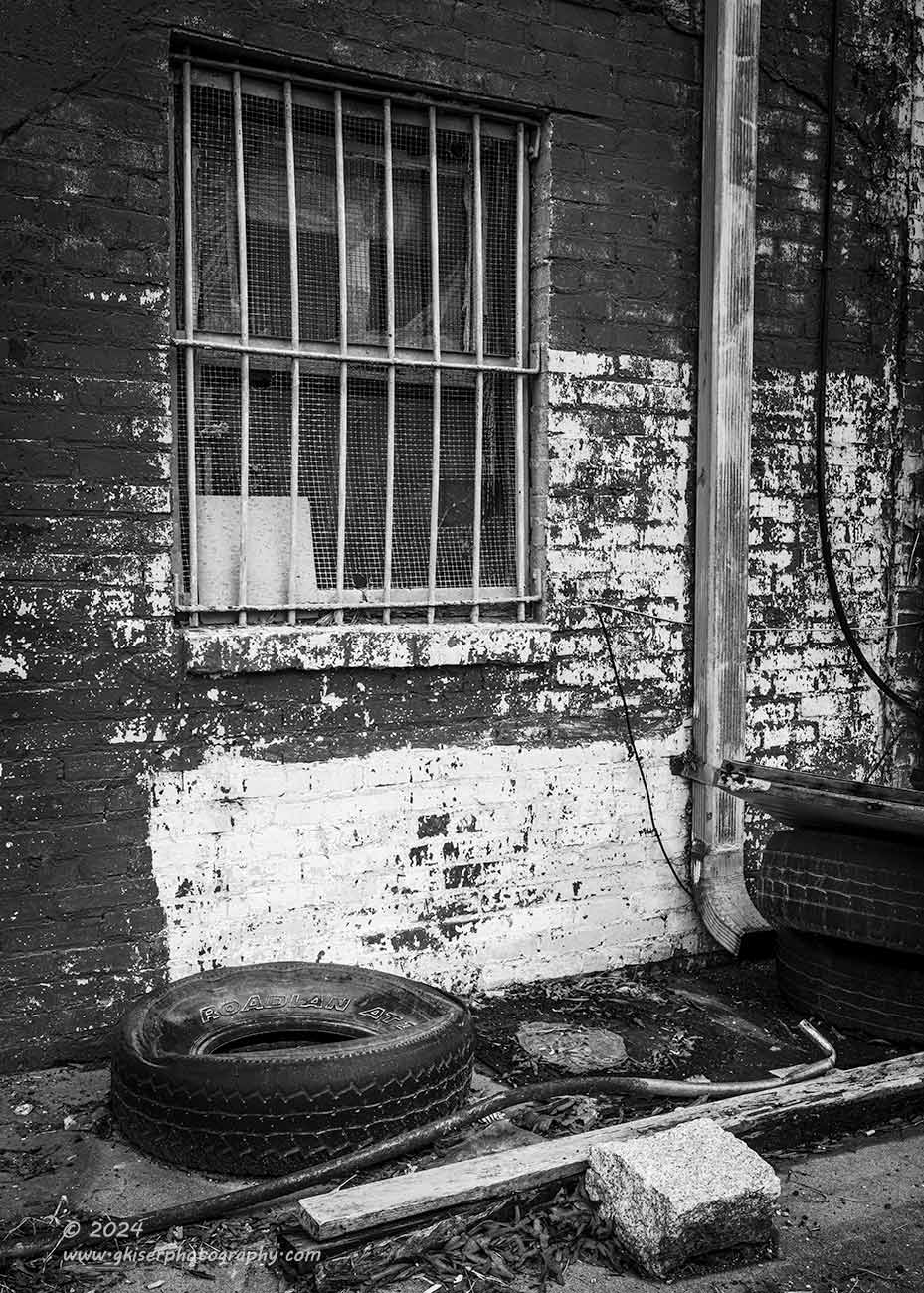
One of the next views that I found during my walk struck me in a different way. The colors were actually quite horrible here with the walls painted red with white areas showing through. There were other colors sprinkled about the scene in a way that really distracted from what I actually liked about the scene. From the beginning, I was seeing this scene as a black and white photo. Even before I had figured out if there was a composition to be had, I knew how I would be editing it. The hard part was working out the composition because the scene was absolutely chaotic. This is where I feel that I excel. There is a certain skill and talent when it comes to creating order out of chaos, and that was what was needed here.
I tried looking at the scene as a horizontal frame, but that brought in too many distractions on the wall. I could deal with the downspout, but there were other strong vertical components to the right of that downspout which threw the balance off. I flipped the camera over on its side and worked a vertical composition. This eliminated the distractions on the wall, but it forced me to cut through a stack of tires on the right side. After pondering my options, I decided that this was the best option and I worked on finding the right amount of space for the partial tires to take up. The main items that I needed in the scene were the single tire to the left, the window, and the chunk of concrete beside the board. Those were the main characters in my photo, and I had to make sure that they were represented correctly.
When I finally got finished with that composition and had shot a couple of exposures, I moved to the other side to see if I could use the pile of tires to the right as a foreground. This worked well, but it introduced too many other issues on the left side of the window. After a few minutes I realized that I had shot the strongest composition of this scene. There was really no need in remaining here much longer since I was pretty confident that if it was going to work, I had it in the camera.

I think it was the unit next door where I found two different chairs with a shelving system between them. It was the chair on the left that caught my eye to start with, but I found that it was too difficult to work with. There was a stick with caution tape around it that was crossing one of the legs. To include the legs of the chair would mean including that stick and the caution tape. That forced other elements into the scene that I didn’t like. The other chair didn’t have the same appeal to it which left the shelf. There was nothing all that interesting about the shelf except for a magazine rack that was sitting on top of it. At first, I dismissed it because it had been spray painted an odd silver color at some point in the recent past.
The more I thought about it though, the more I realized that if I lost the color in this image, the paint would actually help the luminance of the subject. That would help it to stand out from the other elements in the scene. I got the camera set up and made sure it was in black and white so I could see how this was going to look. Almost immediately, I liked what I saw. This is where learning to see in black and white really comes into play and why I am trying to get better at that very thing this year.
Framing up the composition was not that easy to do as the chairs on either side kept creeping into the frame. The solution that I came up with was to shoot this in a square frame which worked nicely in the camera. I made several exposures here in order to make sure that I had the right depth of field, and that had handled the grab handle on the bay door behind correctly. I wanted to keep it close enough to the rack to make it a part of the composition, but not so close as to crowd it. It was a matter of a quarter inch movement of the tripod neck up and down to get it just right.
When I got the photo home and started to work the edit, things were going very well, and I finished up the basic edit in a few minutes. Because of the paint on the rack, there was not much need for local adjustments which sped up the process. The square crop worked very well, and I was happy with it. However, when I came back to the edits after dinner, I reconsidered the aspect ratio. I tried a 4:5 horizontal which just added some more pixels to the mix, but also changed the flow of the composition. I liked this much better and decided to commit to that aspect ratio for the final edit. With just a few little tweaks done after that, I was finished with this one. What arguably started off as a “might as well shoot it” situation has turned into one of my favorites from this trek. Toni even liked this one a lot too which says something since she is the resident black and white photo expert.
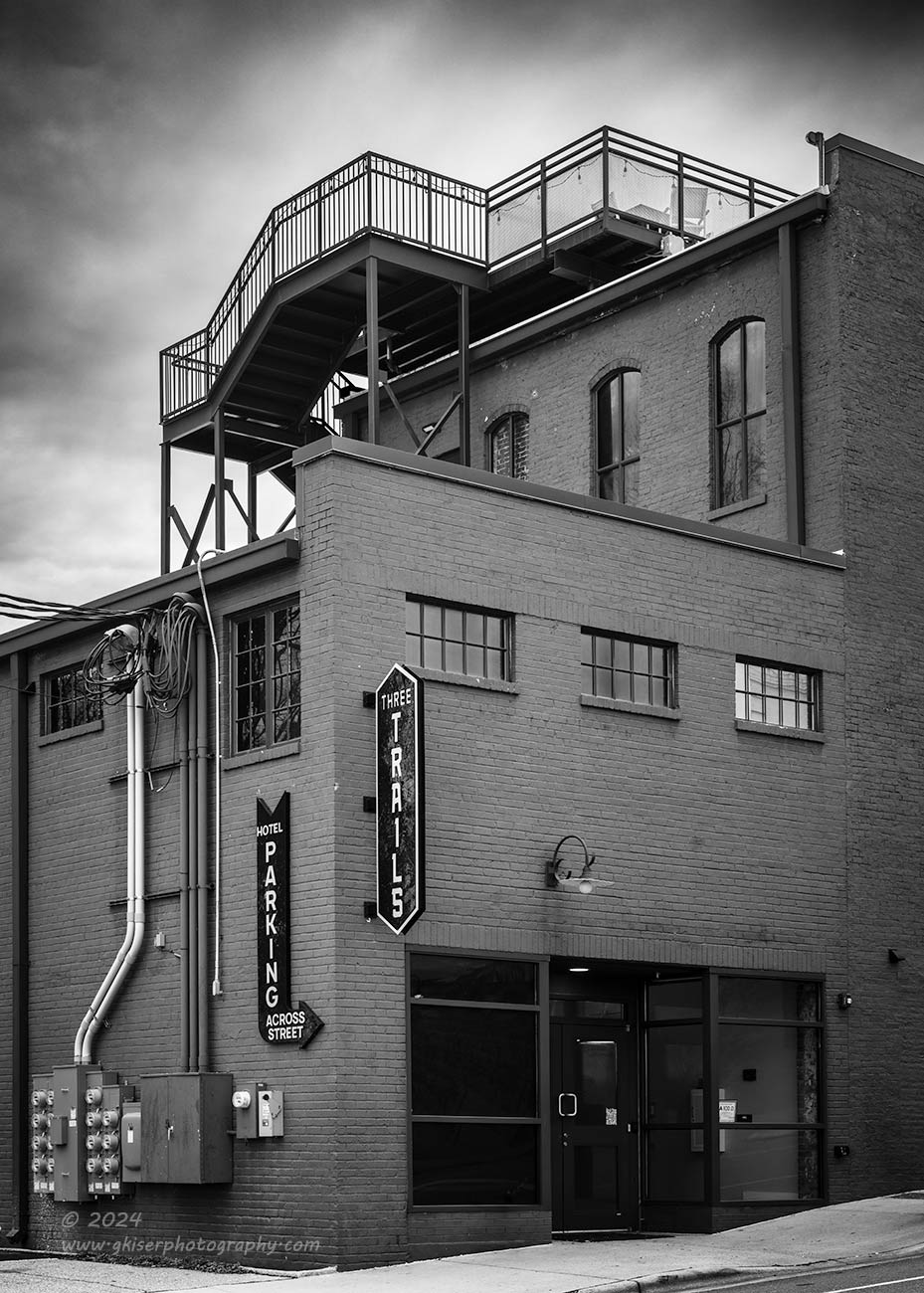
There was a good deal of walking around after I shot the shelf. Nothing else was really jumping out at me. I was going back through all of the photos that I had shot really thinking that I might have one good one so far. Most of what I had been shooting had been experiments more than anything else. It was really part of the process of getting to know the area on this level. As I walked around, I found myself back at the main road through town at a building that had caught my eye for the two signs at the corner. Here I was looking right at the building and the signs. I just couldn’t figure out how to photograph the signs effectively.
The more I looked, the more I started to become interested in the top of the building where there was a raised platform with chairs and a table visible. I liked the geometry of it all, and really liked how the sky was looking overhead. I looked through the camera and started trying to build a composition that showed off the top of the building. It all seemed very much forced and I didn’t like it one bit. Before giving up though, I had another idea. Since I had started off by liking the signs on the corner of the building, I thought there might be a composition that included the signs and the base of the building to go with the top.
I flipped the camera vertical and started to work out the edges of the frame. It actually came together rather quickly and I was really liking what I was seeing through the viewfinder. Once I got a rough composition worked out, I extended the legs of the tripod to lock in the camera position. I then started to fine tune things through the live view. At some point, I realized that since the building was brick, there was too much red in the scene, so I went with the black and white picture style to accurately see how things were looking in monochrome. That one change got me very excited about the composition. I knew that I was onto something special with this one.
Since I was photographing this building from the road, I knew that I was going to have converging verticals that I was going to want to deal with in post. This meant that I was going to have to frame the composition in a way that allowed me to correct for the perspective, while allowing just enough room to get the crop that I was after without wasting too many pixels. Fortunately, I have done this several times and knew about how much extra to allow around the edges. This is where shooting for how you intend to edit really comes into play. Had I not planned for that part of the edit, I would have cropped in too closely and would have lost the framing that I wanted to have for the image. Since I planned for it, things worked out nearly perfect for the image that you see here. I could have allowed a bit more room at the bottom, but there is just enough to make it work the way that I shot it. This one is another one of my favorites from the day.
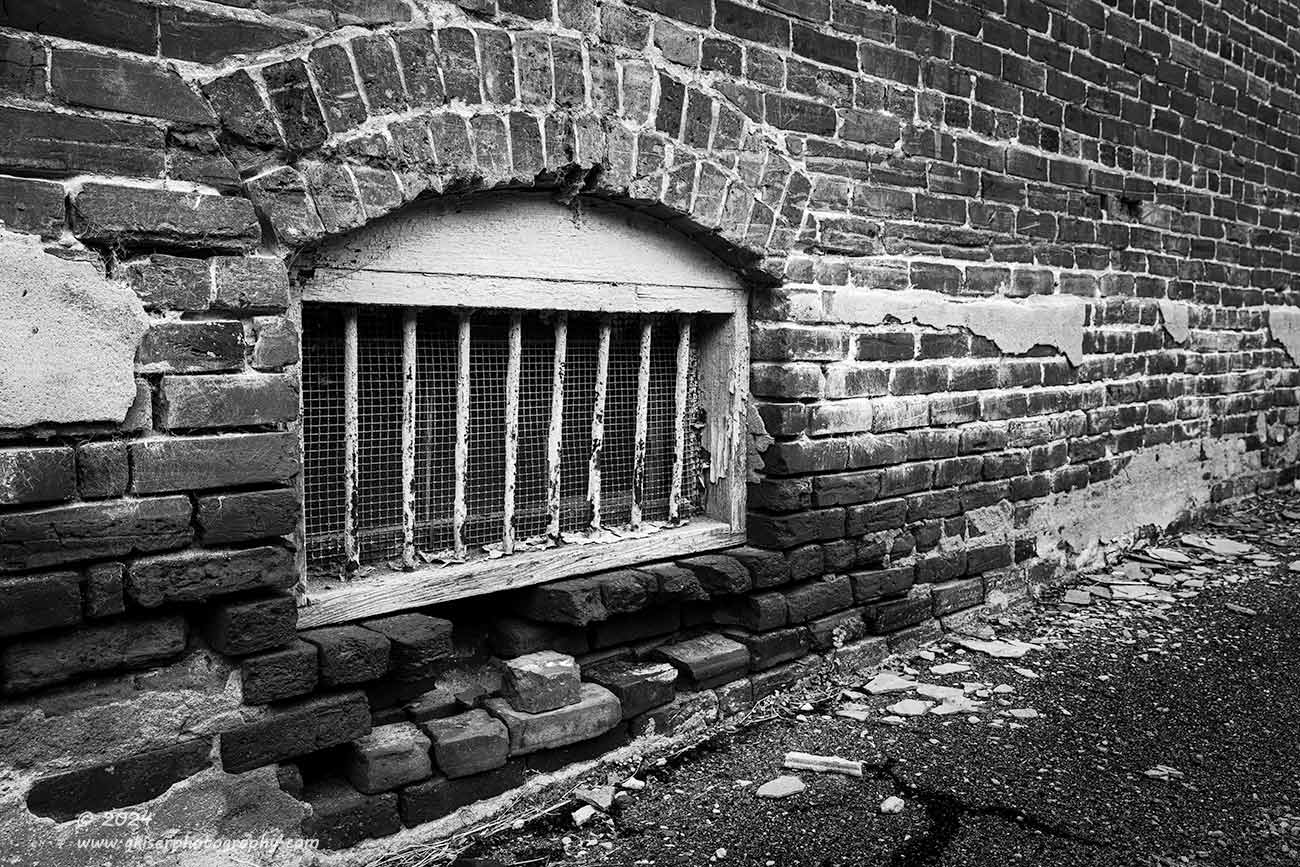
After shooting the large building, I went back on my tour of the alleyways in an attempt to find more little details that might make good photos. One of those alleys that I walked down had some masonry issues below a small window. This was something that spoke to the decay photographer within me. I knew that I had to photograph this scene. I looked at how things were situated and found that my best angle was going to be to work the scene from the left, shooting back up the wall to the right. There were little details like the mortar on the wall which helped to frame the photo, along with some dark bits of asphalt which did the same as well as point to the window. With all the red here, I knew that this one was going to be black and white as well, so I left the camera in that picture style for simplicity.
The composition that I ended up going with required me to get down pretty low to the ground. This gave the right amount of diagonal while keeping the verticals right on the window. I made sure to include the double arch above the window because that was part of the craftsmanship I wanted to share. Once I had the general idea of the composition things came together very quickly and I was rattling off a few exposures with different depths of field to see what I liked the best. I ended up with a wider depth of field than I thought I would use because I just liked the textures of the bricks. I allowed them to go slightly soft on the trailing side, but there is still enough structure to them to allow you to reach into the photo to feel them.
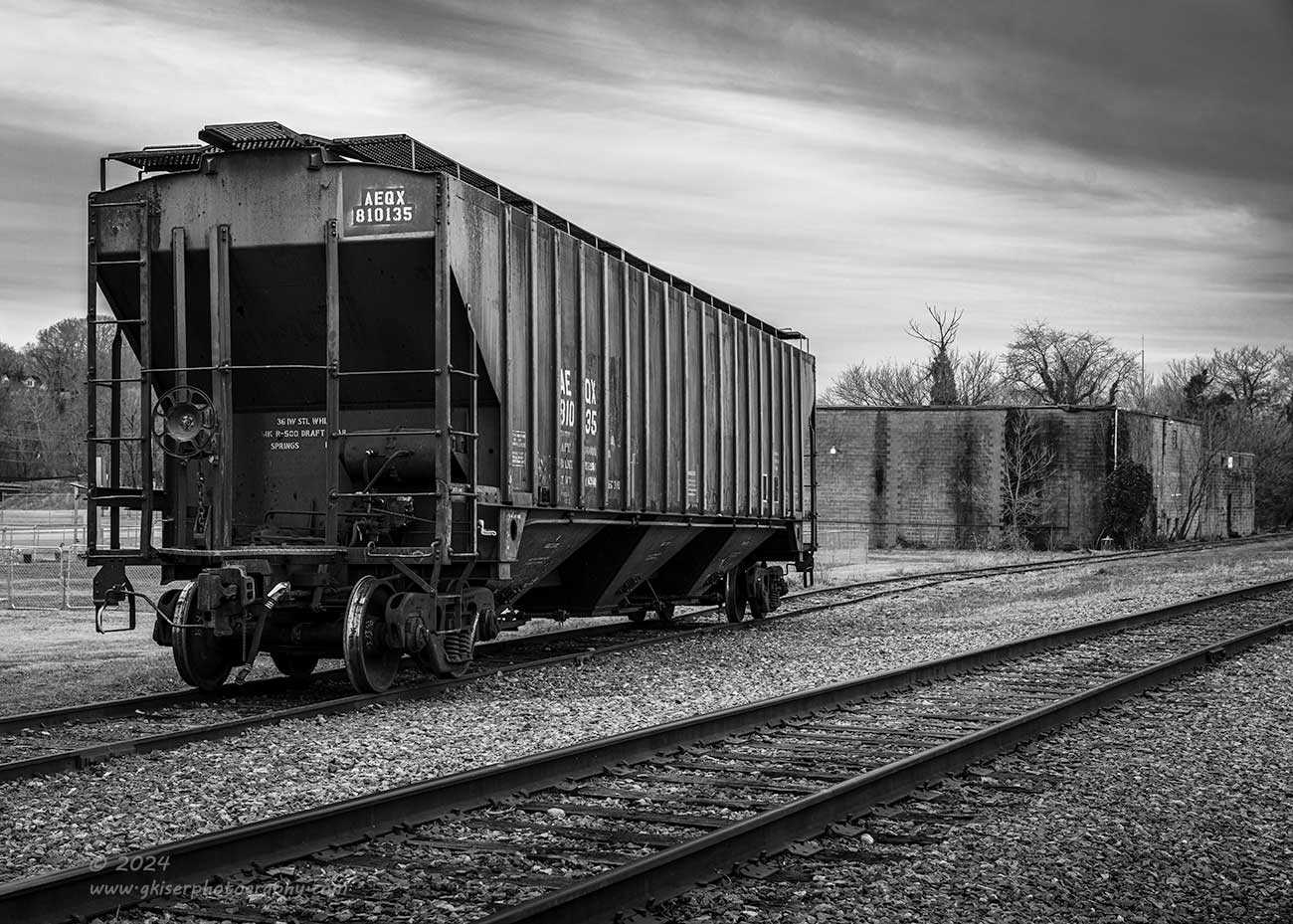
The walking continued and I found myself walking to the other side of downtown. I made it to the far side before deciding to turn back around. Before I did, I looked down to the tracks because there was a grain car which was not accessible from where I had been with the two locomotives. Not feeling confident that there was a photo with this car, I hadn’t really pushed the issue about getting to it. Now that I was on the other side of downtown, I had access to the car and went down to see if there were any compositions that I might be able to work.
It took me a little bit of time during which I was walking all around the car to see what angles worked. I decided that there was an old building in the front of the car that I really liked. It was really the only angle that didn’t include newer buildings, or parking lots of cars. On the other side of the car was a fenced lot that was used for a doggy daycare which I wanted to minimize in the photo. I also had to make sure that the folks outside running with the dogs weren’t going to end up in the photos. Beyond that was a road which was heavily traveled by cars. I was going to have some difficulties to work through with this one, but I felt that it was worth giving it a shot.
One of the first things that I noticed about the scene was the high dynamic range of the lighting. The sky was very bright compared to the dark colors of the rail car. Looking at the histogram in the black and white picture style was showing some issues with the exposure. I also wasn’t sure that I wanted this one to be done in black and white which made it a very simple decision to move back to my Neutral picture style. This is the picture style that I have worked up specifically for difficult shooting situations to make sure that I get the best RAW file I can. I start out with the Neutral style, but then reduce the contrast and saturation within the picture style. It doesn’t affect the RAW capture, but it greatly affects the way live view and the image review look. It also affects how the histogram represents the spread of tones. The end result is that I can usually bump the exposure up 2/3 of a stop to allow more shadow detail to be captured without blowing out the highlights. It just gives me that much more dynamic range in the field, so I have more tones to work with in post.
Once I had everything framed up, I fired off three exposures in an attempt to make sure that there were no cars in either place that they were showing up, and that I didn’t have any dogs or humans in the photo. Two of the three were successes, but it was the last one that had the better looking sky so that is the one that I went with. I started the edit with an open mind as far as color vs black and white, but pretty quickly decided that color wasn’t really doing much for this one. Since color wasn’t important, I made the move to a black and white edit. This had the additional benefit of allowing me much more control over the contrasts in the sky without having to worry about odd colors popping up. I loved how the final image looked with the sky darkening in the upper right corner which just funnels the eyes right where I wanted them to go. A quick change to a 5:7 aspect ratio eliminated a bit more of the fenced in dog lot which I thought made for a stronger overall composition. With that, this photo was done.

Since I was able to get a bit closer to this car, I walked around to see what other areas I might be able to work with. There are just so many different details that interest me with rail cars since I don’t get the chance to photograph them all that often. It was the wheels and the hoppers that really grabbed my attention with this car. I started trying to find the best light and the best angle to capture this aspect. It took me a while and even after I found it, I had to work on the distance that I shot it from to allow for a focal length that would really work to exclude things that I didn’t want in the frame. I ended up much further away than I would have thought necessary, but I like what I ended up with.
I was pretty sure that this was going to be in black and white because there was nothing about the color that I felt was that important to the scene. For me, the story was all in the shapes and the way the light was hitting it. Those were the aspects that I wanted to bring out in post, so black and white was the way to go. It all worked out really nice, and the only thing that really caused me issue was a bit of graffiti on the hopper. It was some tag of some sort, but I didn’t think it needed to be in this photograph, so I essentially made it disappear. I’m not usually one to remove larger things like that, but in this case, I thought it was too much of a distraction to the entire scene. Had there been another section of the train without graffiti, I would have gladly shot that instead, but the same tagging was on every hopper, on both sides. With no other option, I decided to just remove it in post.
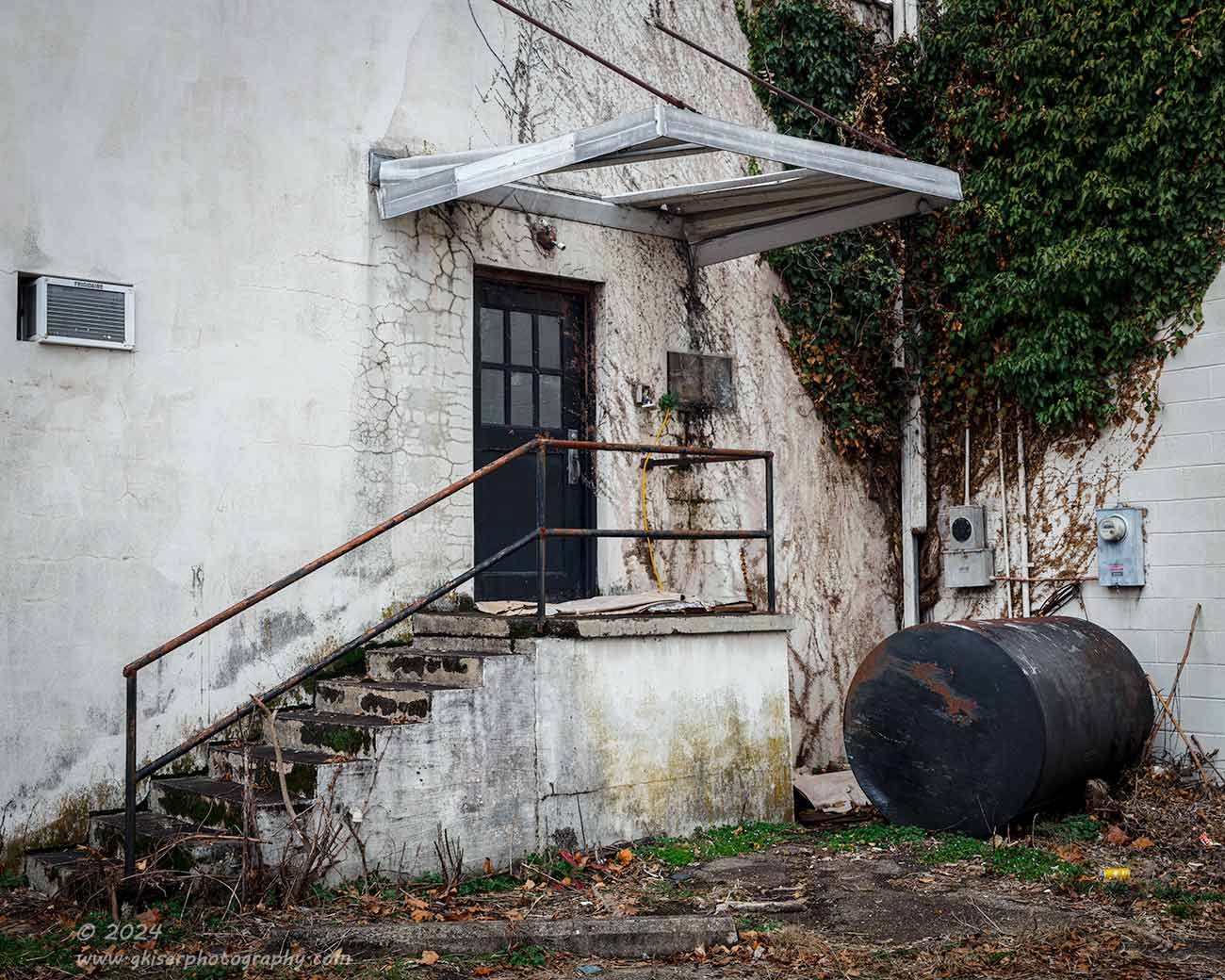
Speaking of graffiti in places that I didn’t really want it to be, the next scene was also hampered by some tagging. It was this back side of the building that happened to be one of the two buildings that I had come out to photograph. This part of the building was much more interesting than the opposite side which I had seen from the road earlier. This back side had a wall meeting the building at 90 degrees which added tons of depth. There was a old tank laying on the ground, and so much more weathering to the exterior. There was also a blue smiley face spray painted on the side of the landing at the top of the stairs.
My first gut was to include the graffiti because it helped to tell the story of the neglect of this building. I built the composition around that staircase and the tank. The part that really drove things home for me was the fact that there was a lot of vegetation that had grown between the walls. This gave tons of texture and even a splash of color to the scene. I thought that the graffiti fit in very nicely with the scene. That is, until I got the photo home and started to really look at it.
The blue paint just didn’t go with the scene, and it seemed to be a big distraction. Going with black and white, helped, but the contrast pulled the eyes to the graffiti. The loss of color also hurt the vegetation in terms of being a compositional element. I had to do this one in color, and that blue just didn’t work. I tried to desaturate it in order to minimize the distraction, but that didn’t work at all. My only option was to remove the offending blue paint which only took a few minutes to do. Once it was gone, the scene really worked visually and told the story that I wanted it to. There was really no need to include the graffiti to show the neglect and decay of this scene. There were plenty of other elements that did just that in a much better way.
This was the last composition that I shot during my time in Elkin. I had shot 43 frames during my walk and really thought that I might have three decent images, but none of them were really exciting me as I thought back through the morning’s photos. I would have never guessed that there would be a total of 11 keepers out of those 43 frames. I really should have called it a day at this point, but that little voice in the back of my head said, I really need to find another location to salvage the day because there just aren’t that many strong photos having been captured.
You might be a little confused because there isn’t the (Part 1) appendage to the title of this blog like I have started doing so many times here recently. Nope, I thought about it, but decided that I would just do two entirely separate blogs since there were two counties involved and some very different subject matter. My plan is to return with the follow up blog by Sunday afternoon, but I might hold off for a bit longer depending on what I get into tomorrow. Just know that there are still a number of new images from my trek that have yet to be shared.
I do hope that you have enjoyed what you have seen and read here so far. These photo walks are a lot of fun and allow me to photograph things that I normally wouldn’t. I’m doing a workshop on this very style of photography in the Spring, and I invite you to join me. You can sign up for it by clicking the link and purchasing your tickets. The workshop won’t be in Elkin, but it will be in North Wilkesboro where I have been many times before. I’ve got a pretty good understanding of where to go to get the best photos and will be there to help you captured what you see.
I’ll see you back here soon enough. Thanks for joining me on this first part, and I look forward to seeing you again….